
Our readers keep the lights on and the weekend projects moving. As an Amazon Associate, I earn from qualifying purchases.
Seven-year-olds are in a sweet spot for board games — old enough to follow multi-step rules and handle a little strategy, but still young enough that pure luck-based games lose their appeal fast. The right game at this age sneaks in math practice, reading comprehension, or spatial reasoning without feeling like schoolwork, while keeping turns short enough to hold attention.
I’m Rikta — the co-founder and writer behind FitlyFast. I’ve spent hundreds of hours analyzing family board game specs, studying age-appropriate mechanics, and reading through parent reviews to find the games that actually work for this specific developmental stage.
Whether you need a stealthy math drill, a cooperative puzzle, or a quick party game that works for mixed-age siblings, this guide to the board games for 7 year olds covers seven options that deliver real play value without the fluff.
How To Choose The Best Board Games For 7 Year Olds
Most parents overestimate a game’s complexity based on the box art and underestimate the importance of turn time and replayability. At age seven, kids need games that hit a specific balance: easy enough to explain in under two minutes, but deep enough that they won’t feel solved after three rounds.
Look for Stealth Learning Mechanics
The best games for this age embed educational value directly into the core loop. Games like Sum Swamp or Whirly’s World make addition, subtraction, and even-odd recognition part of every move rather than a separate trivia component. Avoid games where learning feels bolted on — if you can remove the math element and the game plays the same, it’s not doing the job.
Check Player Count and Play Time
Seven-year-olds have a tight attention window — 15 to 20 minutes is ideal for most. Games that claim 30-minute playtimes often drag by the end. Also verify the minimum player count: many games work for 2 to 4 players, but if you have three kids and only two can play at once, you’ll have arguments before the first turn.
Prioritize Physical Durability
Kids this age are not gentle with components. Look for games with thick cardstock, sturdy plastic pieces, and game boards that won’t warp after a few spills. Several products in this list use reinforced boxes or laminated cards specifically to survive the enthusiastic handling of young players.
Quick Comparison
On smaller screens, swipe sideways to see the full table.
| Model | Category | Best For | Key Spec | Amazon |
|---|---|---|---|---|
| Logical Road Builder | STEM Logic | Critical thinking & puzzles | 200+ challenges across 4 levels | Amazon |
| SimplyFun Whirly’s World | Math Game | Even/odd number concepts | Double-digit even & odd focus | Amazon |
| Exploding Kittens Party Pack | Card Game | Large groups & quick laughs | Supports up to 10 players | Amazon |
| Clever Fox Number Hunter | Math Game | Addition & subtraction practice | 50 challenge cards included | Amazon |
| Spin Master Tetris Board Game | Strategy | Spatial reasoning & planning | 128 physical tetromino pieces | Amazon |
| Learning Resources Sum Swamp | Math Game | First math board game | Two number dice + operation die | Amazon |
| Burgkidz Logical Road Builder | STEM Logic | Early cause-and-effect play | 206 challenge puzzle levels | Amazon |
In‑Depth Reviews
1. STEM MATCH Logical Road Builder

This STEM road-building game hits the sweet spot for 7-year-olds who love puzzles and cause-and-effect play. The box includes four double-sided game boards, 28 track blocks, two wind-up cars, and ten marble balls — kids build a continuous route from the cars to the finish, then wind up the car and watch it deliver the marble. The 200-plus challenges range from simple straight paths to complex multi-turn designs that require serious planning.
What makes this stand out for seven-year-olds is the graduated difficulty system. Beginners start with the “Easy” level that uses only a few pieces, while advanced challenges require spatial reasoning and trial-and-error thinking. The thick plastic pieces hold up well to repeated assembly and disassembly, and the included carrying case makes storage simple — kids can pack it up independently after playtime.
Parent feedback highlights how effectively this game pulls children away from screens. Multiple reviews note that kids with ADHD and autism find the focused problem-solving calming. The game does require a hard, flat surface for the track pieces to align properly, and younger children may need help disassembling the routes. For families seeking a screen-free logic builder that grows with the child, this delivers strong replay value.
Why it’s great
- 200+ puzzles with 4 difficulty levels keep it fresh for years
- Thick plastic construction survives enthusiastic play
- Portable carrying case for organized storage
Good to know
- Pieces need a hard flat surface for smooth car travel
- Younger kids may need help disassembling tight connections
2. SimplyFun Whirly’s World
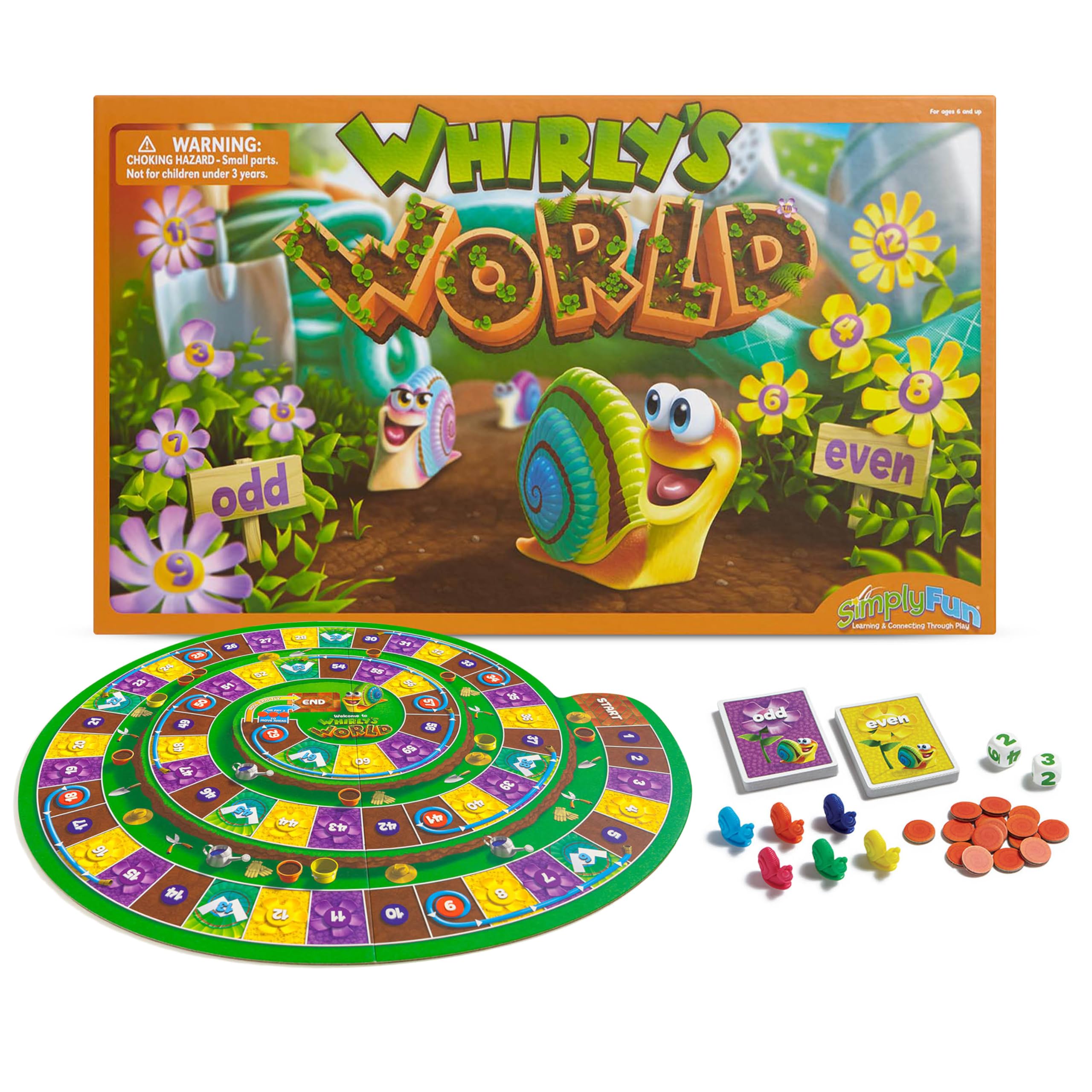
Whirly’s World tackles a specific math concept that many seven-year-olds struggle with — distinguishing even from odd double-digit numbers. Players roll dice to move their snail pieces along a garden path, drawing cards that ask them to count objects, make comparisons, or solve even-odd questions. The whimsical garden theme and colorful snail pieces keep the tone light while the math practice is genuinely integrated into every turn.
The game runs about 15 minutes per round, which is exactly right for this age. It supports 2 to 6 players, making it viable for family game night or small classroom groups. The component quality is high — thick game board, sturdy cards, and well-molded snail pieces that won’t break when dropped. Parents report that kids ask to play multiple rounds in a row, which means the math reinforcement happens naturally without any pushback.
Some families note that the game assumes children already have basic number recognition, so it’s best for kids who can count to 100 and need practice with place values. The instructions are clear and easy to teach in under two minutes. For a focused educational game that doesn’t feel like homework, Whirly’s World earns its place in the math game category.
Why it’s great
- Teaches even/odd concepts with double-digit numbers
- Quick 15-minute rounds hold attention
- High-quality components that last
Good to know
- Requires existing number recognition skills
- Limited to even/odd — no addition or subtraction
3. Exploding Kittens Party Pack

Exploding Kittens has become a modern classic for good reason — it’s a fast, strategic card game where players draw cards hoping to avoid the Exploding Kitten while using defuse cards, attacks, and other special actions to survive. The Party Pack expands the original to support up to 10 players and includes 120 cards, making it the best option for birthday parties, playdates, or large family gatherings where multiple kids are playing together.
The rules are simple enough that a seven-year-old can grasp them after one round: draw a card, play actions to avoid exploding, and use strategy to force opponents into dangerous draws. The absurd Oatmeal artwork appeals to kids’ sense of humor without being inappropriate. Each round only takes about 15 minutes, which is perfect for keeping a group engaged without anyone getting bored waiting for their turn.
Some parents note that the “targeted attack” mechanics can frustrate younger or more sensitive children who get eliminated early. The game also requires some reading, so emerging readers may need help with card text. However, for a party environment where you want high energy and quick laughs, this card game consistently delivers. The box is compact enough for travel and the card quality stands up to repeated shuffling.
Why it’s great
- Supports up to 10 players for large groups
- Fast 15-minute rounds keep the energy up
- Hilarious artwork that kids love
Good to know
- Elimination mechanic can upset sensitive kids
- Requires reading ability for card text
4. Clever Fox Play Number Hunter
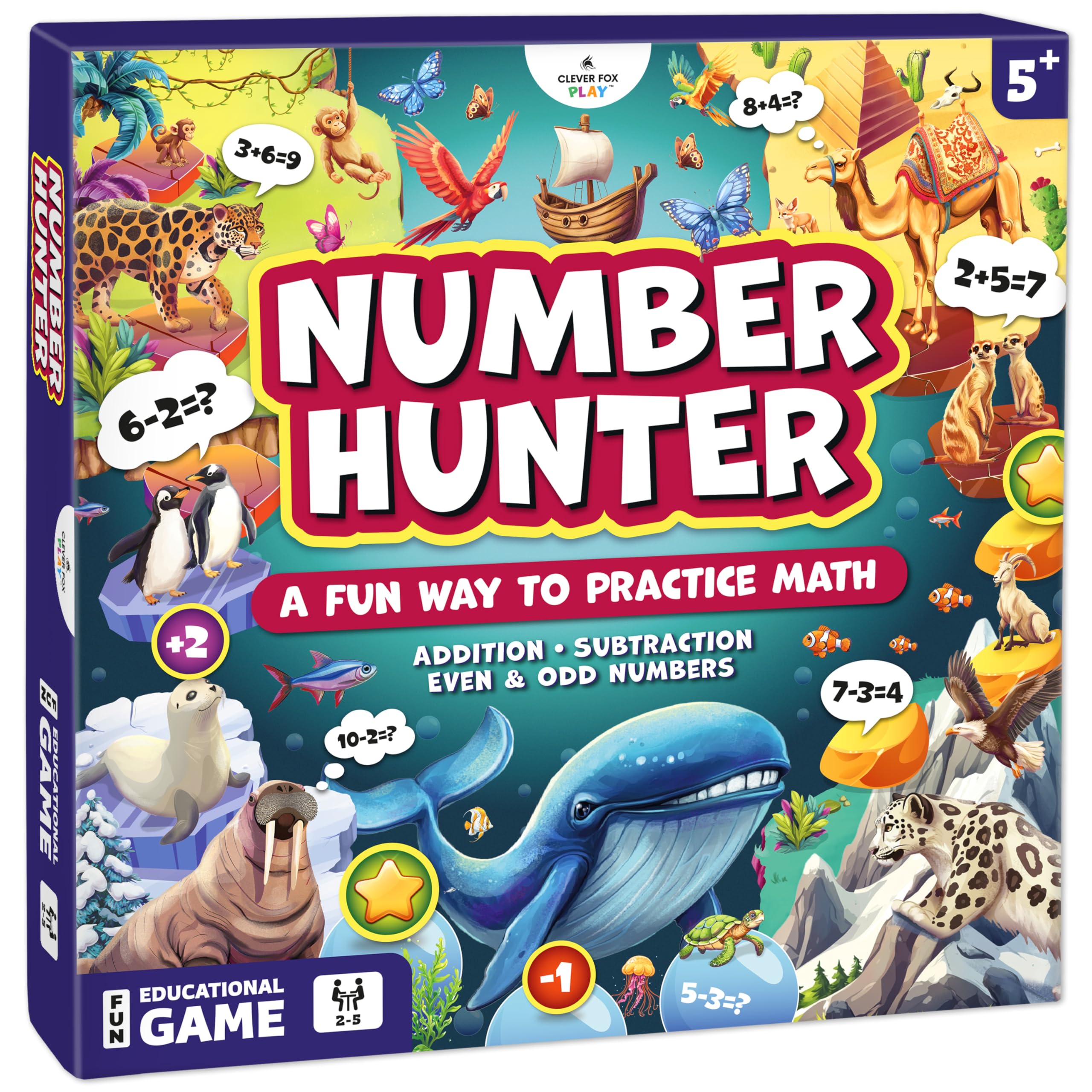
The Number Hunter board game takes kids on a world expedition where every move reinforces addition, subtraction, and even-odd recognition. Players roll two number dice and one operation die, then solve the resulting math challenge to advance. Landing on star tiles triggers fun physical challenges like hopping on one leg or completing bonus math problems, which adds a kinetic element that keeps fidgety kids engaged.
The 50 challenge cards provide enough variety to prevent the game from feeling repetitive after multiple plays. Parents report that first-graders in particular enjoy the daily play sessions and show measurable improvement in quick math fact recall. The board and pieces are made from non-toxic, child-safe materials that have held up well to repeated use. The assembly is straightforward — no setup beyond placing the board and pieces.
Some six-year-olds may need help reading the challenge cards, but the game’s core mechanics are intuitive enough that an adult can facilitate. The estimated playtime of about 20 minutes fits well into a school-night schedule. For families who want a dedicated math practice tool that feels like a treat rather than a chore, this game delivers consistent educational value at a mid-range price point.
Why it’s great
- Combines math practice with physical movement
- 50 challenge cards for replayability
- Non-toxic, durable materials
Good to know
- Younger kids may need card-reading help
- Math difficulty is basic addition/subtraction only
5. Spin Master Tetris Board Game
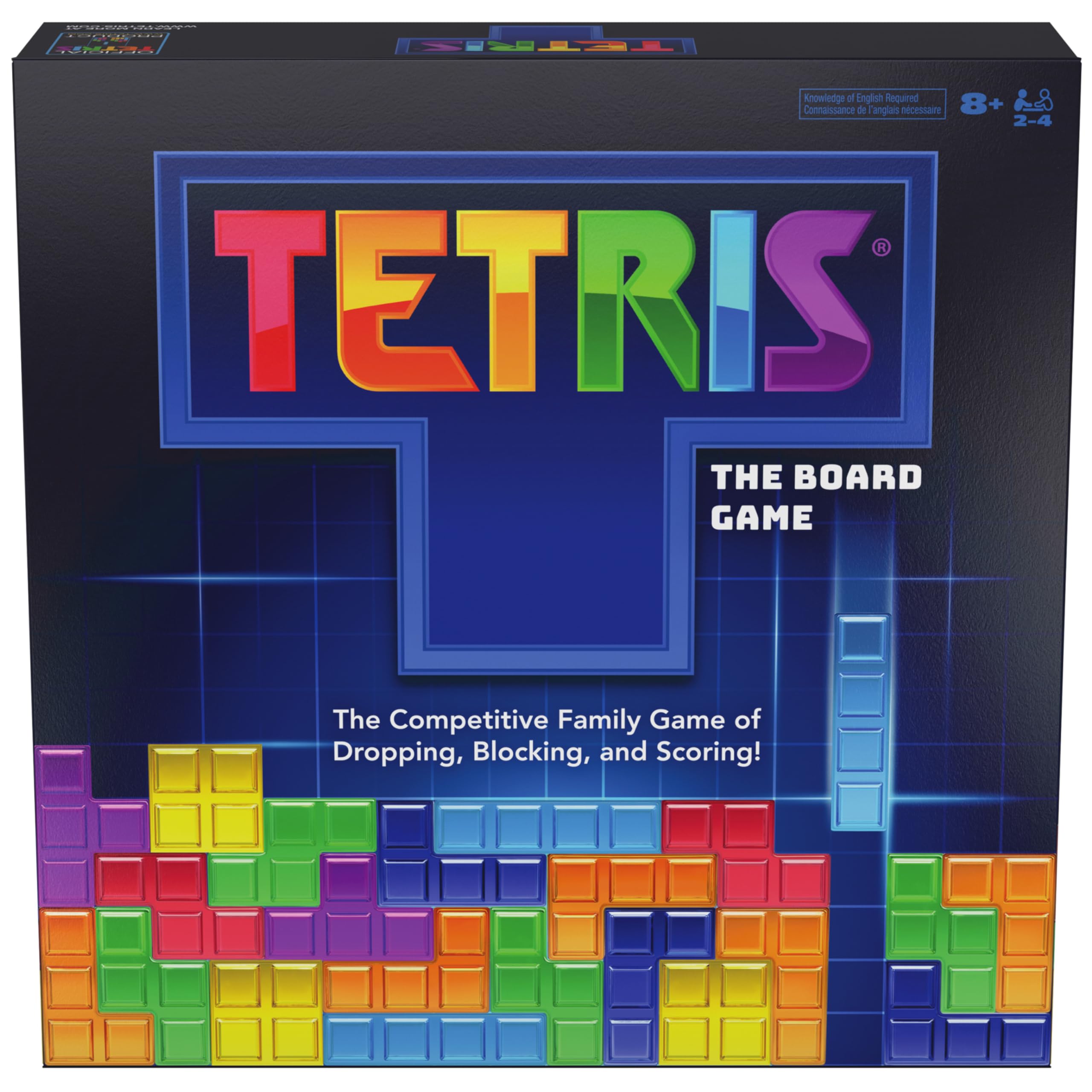
This tabletop version of the classic digital puzzle brings real-life Tetris into a competitive board game format. Players take turns dropping semi-translucent tetromino pieces onto their individual grids, aiming to complete lines while using “garbage drop” icons to block their opponent’s progress. The physical pieces feel satisfying to handle and the translucent plastic mimics the video game aesthetic effectively.
The recommended age of 8+ means this suits advanced seven-year-olds who have good spatial reasoning and can handle the blocking mechanic. Games run about 20 minutes and support 2 to 4 players. The strategic depth comes from deciding whether to focus on completing your own lines or sabotage opponents — a decision tree that engages critical thinking without being overwhelming. Multiple parents note that their kids didn’t realize they were developing cognitive skills while playing.
A few customers reported receiving bent puzzle pieces, though this appears to be a quality-control issue rather than a design flaw. The game requires no batteries and sets up quickly. For children who enjoy the video game version, this physical adaptation offers a fresh social experience that translates screen-based spatial skills into face-to-face competition. It works best as a two-player game due to the head-to-head blocking mechanics.
Why it’s great
- Translates classic spatial puzzle to tabletop
- Competitive blocking mechanic adds strategy
- High-quality translucent tetromino pieces
Good to know
- Age 8+ rating may be too advanced for some 7-year-olds
- Some units have arrived with bent pieces
6. Learning Resources Sum Swamp

Sum Swamp has been a classroom staple for years, and for good reason — it turns simple addition and subtraction into a race through a colorful swamp filled with friendly creatures. Players roll two number dice and one operation die to determine their move, with special spaces that introduce even/odd and the “endless loop” catch-up mechanic. The game board features cheerful swamp graphics and the four creature game pieces are chunky enough for small hands.
The recommended age of 5+ makes this accessible for younger siblings while still engaging enough for seven-year-olds who need fluency practice. The math involved caps at 6+6, so it works best as a reinforcement tool rather than a challenge for advanced students. Many parents report buying higher-number dice separately to increase the difficulty as their children progress. The game requires minor assembly but nothing complicated.
Homeschooling families particularly praise this game for its ability to make math practice feel like a treat. Kids who resist worksheets will happily play multiple rounds. The educational objective covers addition, subtraction, even/odd, and counting — all woven into the core loop. For a budget-friendly entry point into math board games that can be adapted for progression, Sum Swamp remains a smart choice for the younger end of the 7-year-old range.
Why it’s great
- Proven classroom design that works for young learners
- Customizable difficulty with different dice
- Great for mixed-age play with younger siblings
Good to know
- Math caps at 6+6, limited for advanced kids
- Game board is relatively simple visually
7. Burgkidz Logical Road Builder

The Burgkidz Logical Road Builder shares the same concept as the STEM MATCH version but targets a slightly younger audience with 206 puzzle challenges and two wind-up cars. Kids build routes on the base board using different pieces to form a continuous line, then wind up the car to deliver the marble ball to the finish. The cause-and-effect satisfaction of watching the car successfully navigate the track keeps kids engaged through repeated attempts.
Parent reviews consistently highlight how this game captivates both children and adults — one reviewer noted that a 40-year-old parent got as into the puzzles as the 4-year-old. The open-ended creative challenges encourage out-of-the-box thinking, and the bright colors and fun design make it visually appealing. The game is Montessori-style and fosters spatial recognition, logical reasoning, and planning skills.
The main durability concern involves the plastic tabs that connect track pieces — some families report breakage with aggressive use. The pieces also require a hard, flat surface for the cars to roll smoothly; carpet or bumpy tables cause stalling. Missing piece replacement may require contacting the manufacturer. Despite these concerns, the educational value and sheer fun factor make this a solid choice for families who want a collaborative puzzle experience rather than a competitive game.
Why it’s great
- 206 puzzles provide extensive replayability
- Appeals to a wide age range including adults
- Encourages spatial reasoning and planning
Good to know
- Plastic connecting tabs can break with rough use
- Requires hard, flat surface for optimal function
FAQ
At what age should I introduce competitive board games?
How do I adapt a math game for a child who already knows the concepts?
Are logic puzzle games better for 7-year-olds than traditional board games?
Final Thoughts: The Verdict
For most families, the best board games for 7 year olds winner is the STEM MATCH Logical Road Builder because it combines 200-plus puzzles with growing difficulty levels, durable construction, and screen-free logic development that keeps kids engaged for years. If you want a math-focused game that sneaks in addition and subtraction practice, grab the Clever Fox Play Number Hunter for its excellent balance of educational value and movement-based fun. And for large family gatherings or birthday parties, nothing beats the high-energy chaos of the Exploding Kittens Party Pack.