
Our readers keep the lights on and the weekend projects moving. As an Amazon Associate, I earn from qualifying purchases.
Choosing a first board game often feels more stressful than the game itself. You want something that clicks on the first read of the rules, keeps everyone engaged, and doesn’t devolve into a 3-hour rules debate. The right pick turns a regular evening into a recurring tradition without requiring a hobbyist’s commitment to dense manuals or complex strategies.
I’m Rikta — the founder and writer behind FitlyFast. I’ve spent years analyzing game weight, playtime accuracy, and component quality to help new players skip the duds and find the games that actually hit the table.
After sorting through countless options, I’ve narrowed down a curated selection of board games for beginners that balance clear rules, quick rounds, and genuine replay value.
How To Choose The Best Board Games For Beginners
The best gateway game teaches itself in under five minutes and offers decisions that feel meaningful from the very first turn. When evaluating options, focus on three anchors: rule complexity, playtime, and player scaling. A 45-minute cap prevents fatigue, and a clear “victory condition” keeps everyone oriented. Avoid games with dense rulebooks or hidden scoring that leaves new players confused about why they lost.
Rule Complexity and the “Rulebook Test”
The rulebook length is your single best indicator of learning curve. If the instructions run more than six pages of dense text, expect a teaching session that eats into game time. Look for games with one-page quick-reference sheets or video tutorials on the publisher’s site. Games that can be taught while playing — like Tetris: The Board Game — are ideal for groups with mixed attention spans.
Playtime and Engagement Density
Listed playtimes on the box are optimistic estimates for experienced players. Add 50% for a first session. A 20-minute listed game will run 30-40 minutes the first time, which is still manageable. Games that drop below 30 minutes after the first play — like BOOP or Harmonies — keep the energy high and allow multiple rounds in a single sitting. Avoid games with listed playtimes over 90 minutes for your first purchase.
Player Count and Scalability
Consider your most common player count first. A game that plays 2-4 but shines at 2 (like Azul or BOOP) is a different purchase than one that needs 3-4 to function (like CATAN). For families with varying ages, look for games that accommodate drop-in players without breaking the balance. The best beginner games support the player count you actually have, not the one you wish you had.
Quick Comparison
On smaller screens, swipe sideways to see the full table.
| Model | Category | Best For | Key Spec | Amazon |
|---|---|---|---|---|
| Azul | Tile Placement | Award-Winning Elegance | 30-45 min playtime | Amazon |
| CATAN 6th Ed. | Resource Trading | Classic Gateway Experience | 60-90 min playtime | Amazon |
| Splendor | Engine Building | Fast-Paced Strategy | 30 min playtime | Amazon |
| Harmonies | Tile Placement | Relaxed Solo Play | 30 min playtime | Amazon |
| Exploding Kittens: Board Game | Party Game | Laughs and Chaos | Variable playtime | Amazon |
| BOOP | Abstract Strategy | Duels and Quick Rounds | 20 min playtime | Amazon |
| Tetris: The Board Game | Real-Time Puzzle | Familiar IP Entry Point | 20 min playtime | Amazon |
In‑Depth Reviews
1. Azul

Azul won the Spiel des Jahres in 2018 for a reason — it distills modern board gaming into its purest form: draft tiles, place them on your board, score patterns, and deny your opponent the pieces they need. The rules take about three minutes to explain, yet the strategic depth reveals itself over dozens of plays. Every round introduces new tile combinations from the factory displays, so no two games feel identical. The tactile resin tiles are weighty and satisfying to handle, and the linen draw bag adds a premium feel that justifies its place on any shelf.
What makes Azul exceptional for beginners is how naturally the scoring system teaches itself. You start by simply matching colors to complete rows, and by the second round, you’re calculating which tiles to leave in the center to force your opponent into a negative score. The game scales beautifully from 2 to 4 players, but it truly shines in head-to-head duels where every pick carries real tension. Playtime clocks in at 30-45 minutes, which leaves room for a second round after the first one hooks everyone.
The only adjustment new players need to make is learning to balance personal board completion against denying opponents. Early games often result in players accidentally setting up their rivals for big scores. Once the “draft and deny” mechanic clicks, the game transforms into a razor-sharp contest of spatial planning. The components are durable enough for frequent travel, though the box is a compact square that stores neatly on a standard shelf.
Why it’s great
- Rules teach in under 5 minutes, immediate engagement.
- Beautiful resin tiles and fabric pouch feel premium.
- High replayability with randomized tile draws each round.
Good to know
- Player interaction is indirect — no direct attacks.
- Plastic tiles rather than wood may disappoint purists.
2. CATAN 6th Edition

CATAN is the game that introduced millions to modern board gaming, and the 6th Edition refines the experience with chunkier wooden pieces, card trays, and a much-improved rulebook. The core loop — roll dice, collect resources, trade with opponents, build roads and settlements — is simple enough to grasp in a single round. The modular hexagonal board ensures that every setup creates a new geography, forcing players to adapt their strategy each time. The 60-90 minute playtime gives space for genuine negotiation and backstabbing without dragging into the evening.
For beginners, the biggest hurdle is the trading phase. New players often undervalue their resources or refuse trades out of caution, leading to stalled development. The 6th Edition rulebook includes clearer examples of fair trades, which helps speed up the learning curve. The component upgrades — particularly the card trays and the new art on the development cards — make a noticeable difference in table presence compared to earlier editions. The robber mechanic introduces just enough tension to keep players engaged even when they’re falling behind.
One limitation is the strict 3-4 player requirement. The game is not balanced for 2 players without an official expansion, and at 5-6 players it requires the expansion set. The dice-driven resource generation can also frustrate players who prefer deterministic strategies, as luck plays a significant role in the early game. Still, for groups of three or four looking for a classic gateway experience, CATAN remains the standard.
Why it’s great
- Modular board creates high replayability.
- 6th Edition components are significantly improved.
- Trading mechanic teaches negotiation skills naturally.
Good to know
- Requires exactly 3-4 players for balanced play.
- Dice luck can determine outcomes in early game.
3. Splendor

Splendor is the gold standard for engine-building games that don’t overwhelm new players. The premise is elegant: collect gem tokens, buy development cards that provide permanent discounts, and attract noble patrons for bonus points. A full game runs about 30 minutes, and the rules fit on a single page. The weighted poker chips are among the most satisfying components in modern board gaming — they clink with authority and make resource collection feel tactile and rewarding.
The genius of Splendor for beginners lies in its transparent feedback loop. Every card you buy permanently reduces the cost of future purchases, so players immediately see the impact of their decisions. The game introduces strategic depth through card reservation (blocking opponents from key cards) and noble tile timing (racing to meet specific combinations before rivals). Player interaction is minimal but meaningful — the primary conflict comes from sniping the card your opponent clearly needs next turn.
The main criticism from experienced players is that the theme is pasted on — the gem trading narrative doesn’t drive the mechanics. Beginners rarely notice this, as the puzzle of optimizing your engine is absorbing on its own. The game plays well at all player counts but is exceptionally tight at 2 players, where every chip counts. The 90 development cards ensure that no two games follow the same path, and the 30-minute runtime makes it perfect for a quick lunch break or a warm-up before a heavier game.
Why it’s great
- Single-page rules, teachable in 5 minutes.
- Premium weighted poker chips feel fantastic.
- Engine-building feedback is immediate and intuitive.
Good to know
- Theme feels disconnected from mechanics.
- Player interaction is limited to card denial.
4. Harmonies

Harmonies brings a refreshing calm to the board game table. Instead of direct competition, players build layered landscapes from wooden tokens, stacking terrain pieces to create habitats for illustrated animals. The tactile experience of stacking 3D landscape elements on your personal board is immediately satisfying, and the 120 wooden tokens are beautifully textured. The rulebook is concise, and the core loop — draft a landscape card, place tiles, attract animals — clicks after a single round.
What sets Harmonies apart for beginners is its solo mode, which is fully integrated and not an afterthought. Many new board game buyers play alone or with one other person, and Harmonies delivers meaningful strategic decisions at every player count. The animal cards introduce specific scoring conditions that require forward planning, but the scoring system is lenient enough that no single mistake ruins your game. The 30-minute playtime includes setup and teardown, making it one of the most time-efficient options in this list.
The main trade-off is the low player interaction. Each player builds their own landscape in relative isolation, and the only tension comes from drafting cards before your opponent can claim them. Players who enjoy direct conflict or aggressive take-that mechanics will find Harmonies too solitary. However, for new players who find competitive games stressful, or for older adults and neurodivergent players who prefer a meditative puzzle, Harmonies is a perfect entry point. The art direction from Libellud is gorgeous, with 42 illustrated cards that feel like collecting art prints.
Why it’s great
- Beautiful 3D wooden landscape components.
- Full solo mode included in the box.
- Relaxing, low-stress gameplay ideal for winding down.
Good to know
- Very low player interaction — essentially multiplayer solitaire.
- Game can end abruptly when the card deck runs out.
5. Exploding Kittens: The Board Game
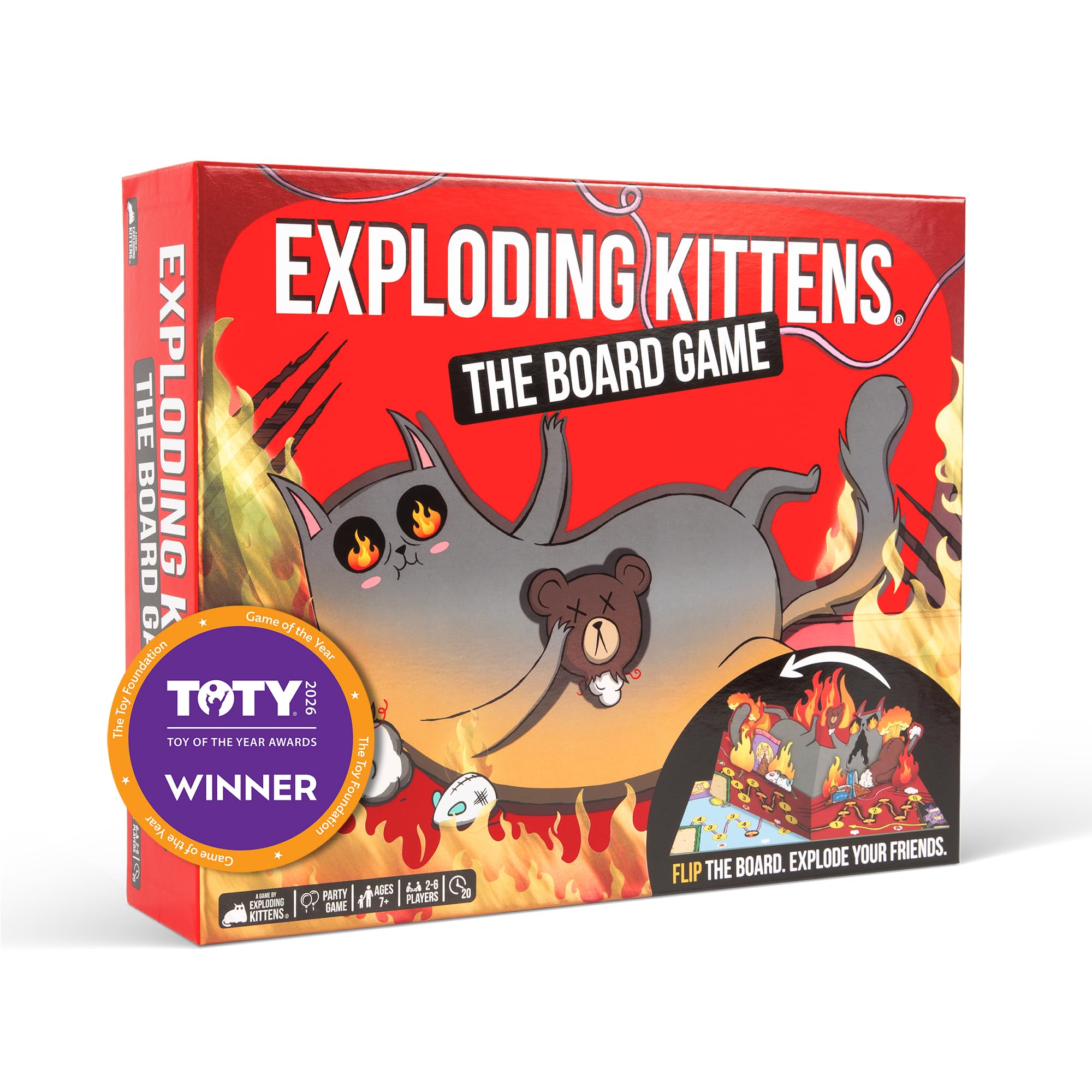
Exploding Kittens: The Board Game transforms the wildly popular card game into a board-based experience with a killer feature: the board flips mid-game, revealing a completely new path to victory. Players start on the “nice” side of the board, but one wrong move triggers the flip, exposing a more dangerous route where every space could end your run. The pop-up board is cleverly designed and adds a theatrical reveal that gets genuine reactions around the table. The game supports 2-6 players and plays in roughly 45 minutes to an hour for a first session.
The component quality is mixed but functional — the cards are thin but durable enough for regular use, and the cardboard standees for characters like TacoCat and GnomeCat add personality. The action cards from the original card game are integrated into movement mechanics, so players use Meatpants and Litterbox Sandworm abilities to manipulate their position on the board. The humor is deliberately absurd and lands well with teen and adult groups, though younger children may miss the jokes. The Toy Foundation 2026 Toy of the Year award signals strong playtesting and polish.
The biggest drawback is the variable playtime. Some games resolve in 30 minutes if the board flips early and players explode quickly, while others stretch past 90 minutes if players are cautious. The flip mechanic, while exciting, creates a luck element that can feel arbitrary when the board flips at a bad moment for one player and a perfect moment for another. For groups that prioritize humor and unpredictability over pure strategy, this is a fantastic choice. For players who prefer deterministic outcomes, it may frustrate.
Why it’s great
- Flip-board mechanic creates genuine surprise moments.
- High player count (2-6) fits larger gatherings.
- Humorous theme lands well with teens and adults.
Good to know
- Playtime varies wildly from 30 to 90+ minutes.
- Board flip can feel unfairly timed for some players.
6. BOOP

BOOP is a deceptively simple 2-player abstract game where you place kittens on a soft quilted board, and each new kitten “boops” adjacent pieces one space away. The goal is to line up three kittens in a row to graduate them into cats, then line up three cats to win. The push mechanic creates chain reactions every turn, turning what looks like a straightforward tic-tac-toe variant into a tense geometry puzzle. Games run under 20 minutes once you understand the flow, making it perfect for quick sessions between other activities.
The components are a highlight: 32 wooden pieces in two sizes (kittens and cats) with charming cat face prints, and a fabric “bed” board that feels like a mini quilt. The tactile quality is exceptional for the price range, and the portability is unbeatable — the whole game fits in a box smaller than a trade paperback. The rules are clear after a single read-through, and most players grasp the boop mechanic within their first two turns. The recommended age is 10+, but reviewers report success with children as young as 6 who understand the spatial logic.
The limitation is obvious: BOOP is strictly a 2-player game. It cannot accommodate larger groups, and there is no solo mode. The strategic depth, while real, is also finite — experienced players will eventually reach a point where they’ve solved most common openings. However, for couples or friends looking for a fast, beautiful, and genuinely fun abstract duel, BOOP delivers an experience that feels much richer than its simple premise suggests. It’s also a fantastic gift for cat lovers who aren’t otherwise board game enthusiasts.
Why it’s great
- Charming wooden pieces and quilted board are tactile.
- 20-minute rounds allow multiple plays per session.
- Boop mechanic creates surprising chain reactions.
Good to know
- Strictly 2-player only — no larger group option.
- Strategic depth may plateau after many plays.
7. Tetris: The Board Game
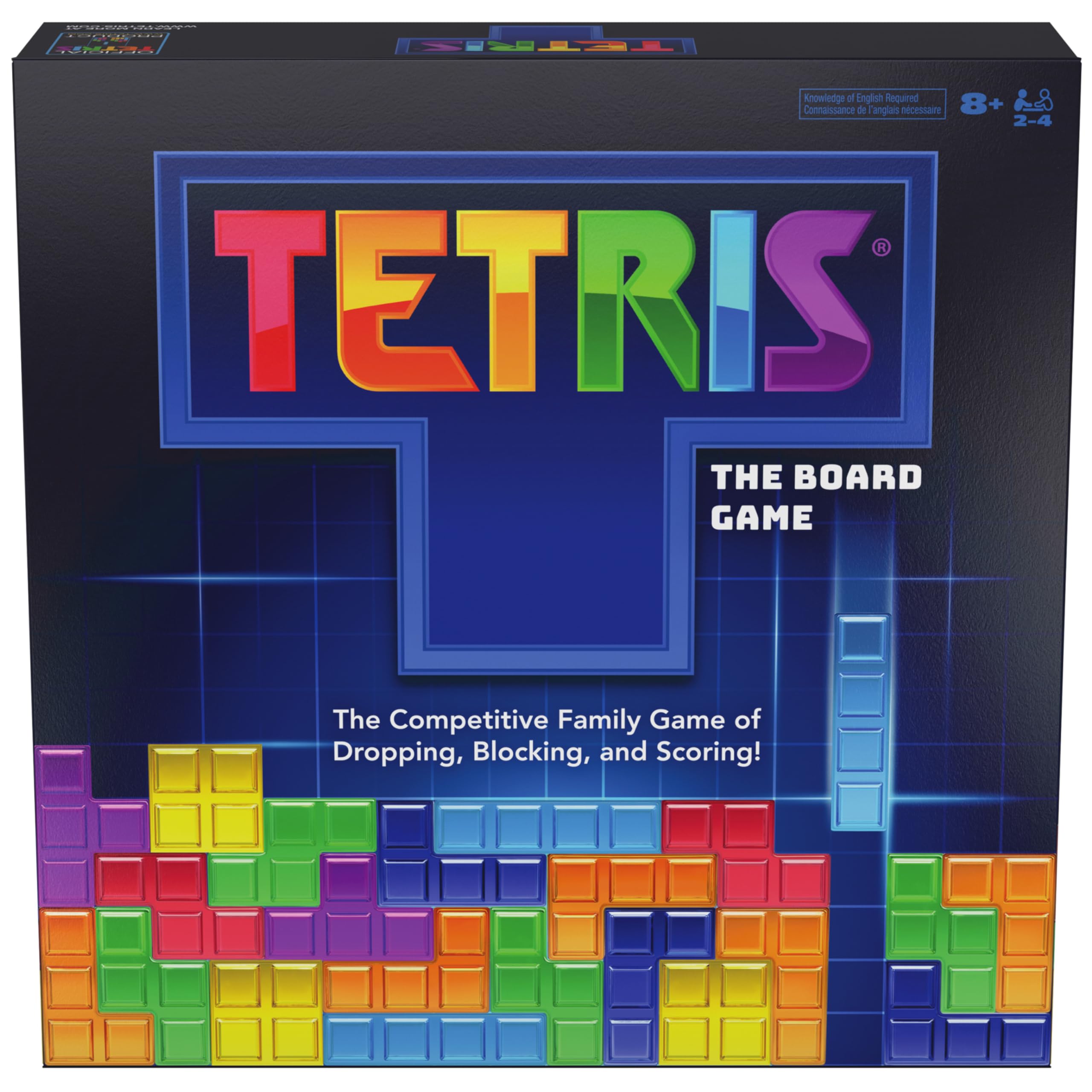
Tetris: The Board Game translates the iconic video game logic into a physical competitive experience. Players take turns dropping semi-translucent Tetrimino pieces onto their personal grids, trying to complete full lines while also sabotaging opponents by sending “garbage” pieces to their boards. The physical pieces are satisfyingly close to the digital shapes, and the translucent plastic adds a nostalgic touch that fans of the original game will immediately recognize. Setup is fast — the 4 player grids snap onto bases, and the card deck shuffles quickly.
The competitive twist — dropping a Tetrimino on a black Garbage Drop Icon to add a piece to an opponent’s grid — transforms the solitary Tetris experience into a head-to-head battle. The 20-minute playtime is accurate, and the cognitive load is lower than the video game because you have time to think about each placement. The included 128 Tetriminos and 8 Minos (single-block pieces) provide enough variety across multiple plays. The instructions include several variant rules, letting players adjust the difficulty for different age groups.
The component quality is a mixed bag. The semi-translucent pieces look great but some reviewers reported bent pieces out of the box, and the thin cardboard gameboard may show wear over time. The game also requires a flat, stable surface — the grid bases are lightweight and can shift during enthusiastic play. For families with existing Tetris fans, the nostalgia factor carries the experience, and the competitive mechanic adds enough novelty to justify a spot on the shelf. For pure strategy seekers, the luck element from card draws may feel less rewarding than dedicated abstract games.
Why it’s great
- Nostalgic Tetris theme with physical pieces.
- Competitive garbage mechanic adds tension.
- Fast setup and 20-minute playtime.
Good to know
- Component quality can vary — some pieces arrive bent.
- Card draw luck can outweigh strategy in some matches.
FAQ
What does “gateway game” mean and why is it important for beginners?
Can I play any of these games alone if I don’t have a group?
How do I know if a game is too complex for my group?
What is the difference between “tile placement” and “engine building” mechanics?
Which game works best for a group of adults who have never played modern board games?
Final Thoughts: The Verdict
For most users, the board games for beginners winner is the Azul because it delivers the perfect balance of instant teachability, genuine strategic depth, premium components, and replay value that keeps a game on the table for years. If you want a classic negotiation experience that rewards social interaction, grab the CATAN 6th Edition. And for a solo-friendly, meditative tile-laying puzzle with gorgeous wooden pieces, nothing beats the Harmonies.