
Our readers keep the lights on and the weekend projects moving. As an Amazon Associate, I earn from qualifying purchases.
The hunt for a game that actually holds a five-year-old’s attention without drowning in rules or frustrating a non-reader is real. Most boxes promising “fun for ages 3+” end up with missing pieces and a bored kid after ten minutes. The right game turns family night into a genuine win — where a kindergartner learns turn-taking, letter sounds, or simple math without realizing they’re doing schoolwork.
I’m Rikta — the co-founder and writer behind FitlyFast. I’ve spent hundreds of hours analyzing the specific mechanics, material durability, and age-appropriateness of preschool and kindergarten board games to identify which ones deliver a genuinely positive play experience.
These picks target core kindergarten skills: letter recognition, early addition and subtraction, pattern creation, and cooperative play. This guide breaks down the seven best board games for kindergarten, each one chosen for its concrete educational value and real-world kid-tested fun factor.
How To Choose The Best Board Games For Kindergarten
Not every colorful box on the shelf is built for a five-year-old’s attention span or motor skill level. The right pick makes learning feel like a side effect of play. Focus on the skill target, the player count, and the durability of the components before you buy.
Age Rating Versus Skill Level
A “4+” label on the box doesn’t guarantee your child can play independently. Look at the specific skill demanded — reading words, adding numbers, or recognizing patterns. Many top picks include adjustable difficulty levels so the same game grows with your child through kindergarten and into first grade.
Cooperative Versus Competitive Mechanics
Kindergarteners often struggle with the disappointment of losing. Cooperative games, where all players work toward a common goal, reduce tears and teach teamwork. Competitive games with fast, simple rounds work well when the stakes feel low and the turns zip by quickly.
Component Quality and Setup Time
Thin cardboard pieces and complex assembly kill a game’s replay value. Chunky wooden blocks, thick laminated cards, and self-contained boards that pop open in seconds are the hallmarks of a game that will survive weekly use. Games that double their box as the game board score extra points for quick cleanup.
Quick Comparison
On smaller screens, swipe sideways to see the full table.
| Model | Category | Best For | Key Spec | Amazon |
|---|---|---|---|---|
| Ravensburger Snail’s Pace Race | Cooperative Racing | First game for ages 3+ | 6 wooden snails, 15-min play | Amazon |
| Educational Insights Frida’s Fruit Fiesta | Alphabet Matching | Letter recognition & motor skills | 26 fruit bowls, Frida Squeezer | Amazon |
| Spin Master Snack-O-Saurus Rex | Action/Dexterity | High-energy, giggly play | Interactive dino tongue | Amazon |
| hand2mind Numberblocks Race to Pattern Palace | Pattern Recognition | Numberblocks fans ages 3-6 | 40 pattern cards, 2 levels | Amazon |
| Gojmzo Wooden CVC Word Spelling Game | Phonics/Spelling | Early reading practice | 50 double-sided cards, 53 wooden letter blocks | Amazon |
| da Vinci’s Room Sums in Space | Cooperative Math | Addition/subtraction K-1 | 3 difficulty levels, 2 play modes | Amazon |
| Mind Inventions Mathemagical World | Competitive Math | Fluent counters ages 5+ | 8 unique worlds, double/half concepts | Amazon |
In‑Depth Reviews
1. Ravensburger Snail’s Pace Race

This game is the gold standard for a child’s first board game. Six wooden snails — each painted a distinct, vibrant color — race across a simple track based on the roll of two color dice. There is no winner or loser in the traditional sense; every snail finishes the race, which completely sidesteps the meltdowns that competitive games trigger in young children.
The component quality is immediately noticeable. The snails are chunky, smooth, and pleasant for small hands to hold and move. The dice are large and easy to read, and the board layout is straightforward. A typical round runs about fifteen minutes, perfectly matching a kindergartner’s attention window. The non-competitive mechanic actively teaches patience and turn-taking without pressure.
Because the game relies purely on color recognition and dice rolling, it works well for mixed-age groups. A three-year-old can play alongside a six-year-old with equal enjoyment. The Parent’s Choice Gold Seal Award reflects its thoughtful design. The cardboard packaging labels are affixed directly to the box, which can leave sticky residue if you plan to gift it.
Why it’s great
- Non-competitive format eliminates losing frustration
- Six chunky wooden snails are durable and tactile
- Fifteen-minute rounds match young attention spans
Good to know
- Kids may outgrow the simple mechanic quickly
- Shipping label sticks directly to the box
2. Educational Insights Frida’s Fruit Fiesta
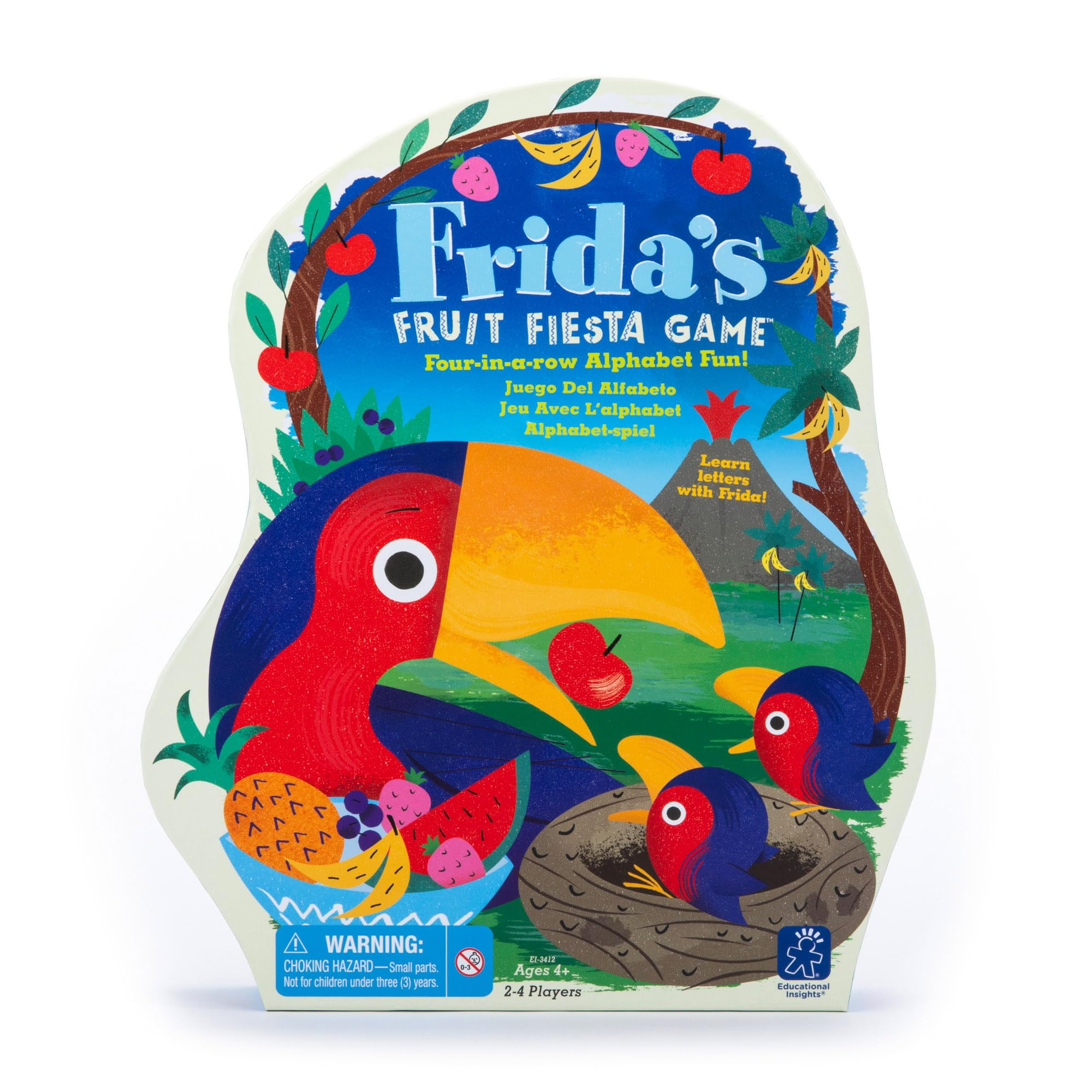
Frida’s Fruit Fiesta cleverly combines alphabet bingo with a fine-motor challenge. Players spin a triple spinner, identify a letter that matches their nest card, and use the included Frida Squeezer (a plastic toucan-shaped tong) to pick up the corresponding fruit bowl. The goal is to be the first to fill four spots in a row.
The Frida Squeezer is the standout feature here. It requires a pincer grip that directly strengthens the same hand muscles used for pencil holding and scissor cutting, making it an excellent stealth tool for occupational therapy goals. The fruit bowls are brightly colored and sturdy, and the box itself unfolds into the game board, simplifying storage and setup.
The game introduces basic strategy: some spaces on the nest card allow you to steal a letter from another player, adding a layer of decision-making beyond pure luck. It supports up to four players and plays in about fifteen minutes. The alphabet focus is firmly on uppercase letters, so it pairs well with a lowercase matching activity for a complete reading foundation.
Why it’s great
- Squeezer tool builds important fine motor skills
- Box doubles as the game board for easy storage
- Steal mechanic adds a gentle strategic element
Good to know
- Supports uppercase letters only
- Best suited for ages 4 and up due to spinner complexity
3. Spin Master Snack-O-Saurus Rex

This is the game that produces the loudest laughter. A large plastic T-Rex sits in the center of the board, and players move caveman figures around a path collecting snack tokens. The central mechanic is pushing a button on the dino’s tail, which shoots out a magnetic “tongue” that can either swipe a snack from the board or knock an opponent’s caveman backward.
The interactive element is magnetic and safe — the tongue is soft plastic, and the snack pieces are lightweight cardboard. The game does not require batteries. The dino rotates on a pivot joint, allowing players to aim before firing. This randomness and physical action make each turn unpredictable and exciting, which keeps kids fully engaged without requiring reading or math skills.
Speech-language pathologists report using this game for targeting articulation, categorization, and turn-taking in therapy sessions. The recommended age is 5+, but many parents find their four-year-olds can set up and play with minimal help. The tongue can occasionally stick if pulled too hard, and there is no traditional finish line — the goal is to collect two pairs of matching snacks.
Why it’s great
- Magnetic tongue mechanic is highly engaging and tactile
- No batteries required; purely mechanical action
- Adaptable for speech and occupational therapy goals
Good to know
- Tongue may not fully retract if pulled too hard
- Game has no traditional “finish line” mechanic
4. hand2mind Numberblocks Race to Pattern Palace

For any child who loves the global hit TV show Numberblocks, this game is an instant hit. Players move pawns representing Numberblocks One through Four across a winding board, drawing pattern cards and using colored bridge tiles to recreate the patterns shown. The first player to reach the Pattern Palace wins.
The game includes two decks of pattern cards: an introductory set for beginners and a challenge deck for more advanced players. The “Six’s Tricks” cards throw in fun twists, like moving an opponent backward or skipping a turn, which keeps the competitive edge light and playful. The dice popper adds a satisfying physical component to the turn order.
All components are high-quality and visually match the show’s art style. The pawns are thick cardboard standees, and the bridge tiles are sturdy plastic. The pattern recognition focus targets a core kindergarten math standard, and the colorful theme turns a potentially dry skill into a motivating race. The game plays best with 2-4 players and takes about 20 minutes per round.
Why it’s great
- Officially licensed Numberblocks theme is highly motivating
- Two difficulty levels extend replay value
- Teaches pattern recognition, color matching, and counting
Good to know
- Best enjoyed by children familiar with the show
- Basic pattern matching may feel simple for older kindergarteners
5. Gojmzo Wooden CVC Word Spelling Game

This is a hands-on phonics kit disguised as a game. The set includes 50 double-sided CVC (consonant-vowel-consonant) flash cards, 53 wooden lowercase letter blocks, and five spelling boards. The cards show a picture on one side and the corresponding word on the other, making them self-checking for independent practice.
The vowel blocks are painted red and the consonants blue, a deliberate color-coding that helps children visually distinguish between the two types of letters. The blocks are chunky hardwood — roughly the size of a standard die — which makes them easy for small fingers to manipulate. The laminated cards are thick and wipeable, surviving sticky fingers and the occasional juice spill.
This tool is best for children who already know their letter sounds and are ready to blend them into simple words. Some customers noted that a few pictures are confusing for absolute beginners (a purse labeled “bag,” a shed labeled “hut”), but most images are clear and intuitive. The set comes in a sturdy storage box that keeps all 110 pieces organized.
Why it’s great
- Color-coded vowels and consonants aid visual discrimination
- Chunky wooden blocks are durable and easy to grip
- Self-checking cards support independent learning
Good to know
- A few picture-to-word pairings can be confusing for beginners
- Not playable as a traditional board game; more of a learning aid
6. da Vinci’s Room Sums in Space

Sums in Space addresses a common kindergarten math gap: moving from counting objects to performing actual addition and subtraction with numbers 0 through 9. The game uses three dice — one for numbers, one for operations (plus or minus), and a special die that introduces concepts like “Even Steven” and “Odd Duck” for learning parity.
The cooperative mode is the standout feature. All players work together to help their rocket reach the finish line before the space timer runs out. This completely removes the sting of losing because the whole group either wins or loses together. Three difficulty levels let parents adjust the math challenge as the child’s skills grow. A competitive mode is also available for faster-paced sessions.
The game board is busy but engaging, featuring bridges, black holes, and colorful aliens. Some reviewers found the board layout slightly confusing on the first play, but the instructions are clear. A typical round lasts 15-25 minutes, and children solve roughly 10-15 math problems per game — enough for meaningful practice without fatigue.
Why it’s great
- Cooperative mode teaches teamwork and removes losing pressure
- Three dice system covers addition, subtraction, and parity
- Adjustable difficulty grows with the child’s math skills
Good to know
- Board layout can feel busy and slightly confusing initially
- Best for children already comfortable counting to 10
7. Mind Inventions Mathemagical World

Mathemagical World replaces the abstract worksheets of arithmetic with eight themed fantasy islands — Dinosaur Island, Pirate Island, Unicorn Island, and others. Each island has its own visual identity, and players solve addition and subtraction problems to advance their pieces. The game also introduces the concepts of doubling and halving numbers.
Two levels of difficulty allow parents to calibrate the math load. The easier level uses smaller numbers, while the harder level accelerates the complexity. The game is marketed for gifted and talented test prep, and some families adapt the rules for older children by swapping in different dice for multiplication practice. The board is large and colorful, and the components are sturdy.
The game’s structure is essentially a math-enhanced version of Snakes and Ladders, which means the gameplay loop can feel repetitive after several sessions. Some younger kindergarteners (ages 4-5) may lose interest before finishing a full game with four players. It is best suited for a child who already has solid number sense and is looking for a fun way to drill addition and subtraction facts.
Why it’s great
- Eight themed islands keep the math practice visually fresh
- Two difficulty levels accommodate different skill levels
- Introduces doubling and halving concepts early
Good to know
- Gameplay loop is essentially Snakes and Ladders with math
- Best for fluent counters; may bore younger or struggling kids
FAQ
What is the best board game for a 4-year-old who can’t read yet?
How many players are ideal for a kindergarten board game?
Final Thoughts: The Verdict
For most users, the board games for kindergarten winner is the Ravensburger Snail’s Pace Race because it offers a stress-free, non-competitive introduction to board gaming with durable wooden components that last through multiple children. If you want a game that builds hand strength and letter recognition simultaneously, grab the Educational Insights Frida’s Fruit Fiesta. And for maximum giggles and interactive physical play, nothing beats the Spin Master Snack-O-Saurus Rex.