
Our readers keep the lights on and the weekend projects moving. As an Amazon Associate, I earn from qualifying purchases.
A truly great strategy board game rewards careful planning, adapts to shifting circumstances, and delivers the satisfaction of a well-executed plan. The difference between a good game and a great one often comes down to the balance between luck and meaningful choice—the feeling that your decisions shaped the outcome.
I’m Rikta — the co-founder and writer behind FitlyFast. I’ve spent over a decade studying the mechanics, player dynamics, and long-term replayability of strategy games, analyzing how rule sets and component quality impact the experience at the table.
Whether you are a tournament-minded tactician or a family looking for a deeper game night, this guide breaks down the best choices across different styles and price tiers to help you find your perfect board games strategy match.
How to Choose the Best Board Games Strategy
Selecting a strategy game is about matching the game’s weight and mechanics to your group’s preferences—whether you crave intense head-to-head conflict, collaborative problem-solving, or building an efficient personal engine.
Player Count & Interaction
Consider who will play most often. Games designed specifically for two players, like Splendor Duel or Sky Team, offer tight, balanced experiences that multiplayer free-for-alls cannot replicate. For larger groups, check whether the game scales well from 3 to 5 or 6 players without excessive downtime—Concordia and Heat: Pedal to the Metal handle this gracefully through simultaneous or fast-turn mechanics.
Complexity & Teachability
A game’s “weight” determines how quickly new players will grasp it. Entry-level strategy games like Fire Tower or Harmonies teach in under five minutes but still offer layers of tactical decisions. Deeper titles like Wyrmspan or Concordia reward repeated plays with richer strategies. A good rule of thumb: a 10-minute teach with a reference sheet often beats a 30-minute rulebook slog for mixed-interest groups.
Replayability & Modularity
The best strategy games stay fresh through variable setups, asymmetric abilities, or expansion modules. Wyrmspan’s 183 dragon cards and multiple scoring objectives ensure no two games feel identical. Heat: Pedal to the Metal includes four double-sided tracks, a championship system, and weather modules that fundamentally shift race strategies. Avoid games where optimal openings can be memorized after a few plays unless your group enjoys pure optimization puzzles.
Quick Comparison
On smaller screens, swipe sideways to see the full table.
| Model | Category | Best For | Key Spec | Amazon |
|---|---|---|---|---|
| Harmonies | Tile-Laying | Family & Solo Strategy | 30 min, 1-4 players, 120 wooden tokens | Amazon |
| Splendor Duel | Engine-Building | Two-Player Duels | 30 min, 2 players, 25 plastic gem tokens | Amazon |
| Wyrmspan | Engine-Building | Deep Solo & Group Play | 90 min, 1-5 players, 183 dragon cards | Amazon |
| Heat: Pedal to the Metal | Hand Management | Racing & Modular Campaigns | 60 min, 1-6 players, 4 double-sided boards | Amazon |
| Concordia | Economic Development | Friendly Competition | 90 min, 2-5 players, 140+ cards/tiles | Amazon |
| Sky Team | Cooperative | Two-Player Co-op Tension | 20 min, 2 players, 8 dice, 20 scenarios | Amazon |
| Fire Tower | Area Control | Fast-Paced Family Battles | 30 min, 2-4 players, 135 fire gems | Amazon |
In-Depth Reviews
1. Asmodee Harmonies Board Game

Harmonies strikes an exceptional balance between accessibility and tactical depth. The core loop of placing wooden tokens to build three-dimensional landscapes while attracting animal cards creates a satisfying spatial puzzle. Each turn you draft a colored token and set it on your personal board, aiming to match pattern requirements shown on the animal cards you’ve collected. The physical act of stacking and slotting tokens makes the abstract scoring feel tangible and rewarding.
The production quality is outstanding for its price tier: 120 thick wooden tokens, sturdy player boards, and 42 beautifully illustrated cards with a watercolor style. The rulebook teaches the game in under five minutes, but the scoring layers—animal sets, landscape heights, and nature spirits—keep the puzzle fresh for dozens of plays. The solo mode works identically to multiplayer, which makes it easy to practice strategies between group sessions.
Some players will note the lack of direct player interaction—Harmonies is essentially a multiplayer solitaire optimization race. If your group thrives on “take that” mechanics or negotiation, this may feel too quiet. But for players who enjoy calm, thinky competition with gorgeous components, this is a modern classic.
Why it’s great
- Exceptional tactile quality with 120 wooden tokens
- Easy to learn but offers deep strategic planning
- Includes full solo mode with identical rules
Good to know
- Very low player interaction—feels like solo play at the table
- Game can end abruptly before you finish your vision
2. Splendor Duel Board Game
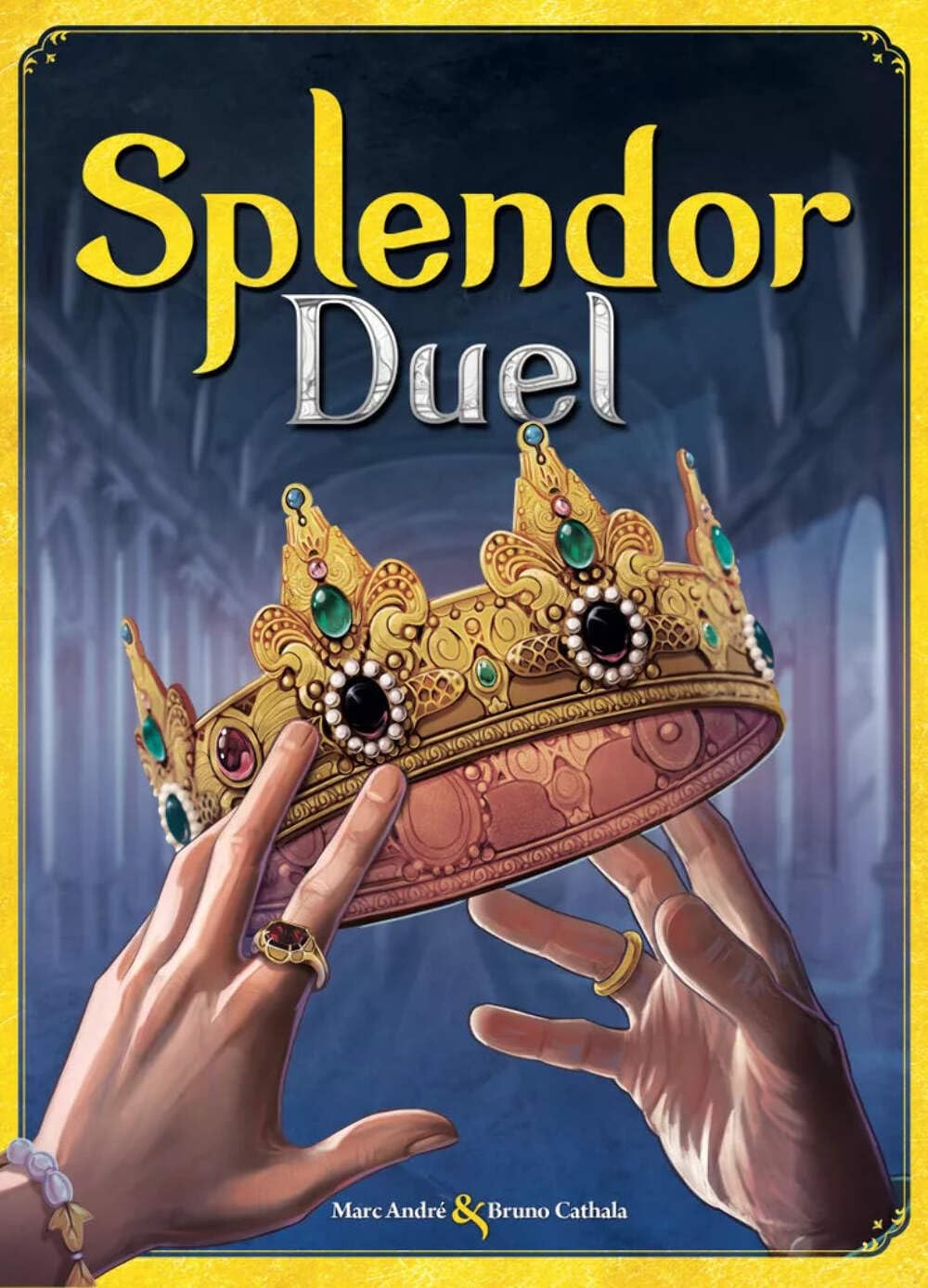
Splendor Duel takes the elegant gem-collecting core of the original and sharpens it into a tight, aggressive two-player experience. The shared drafting board creates a zero-sum tension that the multiplayer original lacks—every gem you take is one your opponent cannot use. The addition of the pearl gem and special privilege tokens add asymmetric powers that break the symmetry and force adaptive strategy.
The component quality punches above its weight: thick card stock, a sturdy game board with recessed token slots, and polished plastic gem tokens that feel satisfying to handle. The rules explain in about three minutes, and a full game completes in twenty to thirty minutes, making it the perfect weeknight duel. The three victory conditions (prestige points, royal tiles, or monopoly) provide distinct strategic paths that keep both players guessing.
Because it is exclusively two-player, Splendor Duel will not fit larger game nights. Some fans of the original Splendor prefer the more relaxed pace of the multiplayer version. But if you want a head-to-head engine-building fight with high replayability in a compact box, this is the definitive choice.
Why it’s great
- Intense two-player tension with zero-sum gem drafting
- Three distinct victory conditions increase replayability
- High-quality components in a compact portable box
Good to know
- Exclusively for two players—no multiplayer option
- Some may prefer the original Splendor’s multiplayer dynamic
3. Scorpion Masqué Sky Team

Sky Team won the 2024 Spiel des Jahres for good reason: it redefines cooperative gameplay through a brilliantly simple communication constraint. Players act as pilot and co-pilot, rolling dice and placing them on a shared cockpit board—but cannot talk about their specific placements. The silence forces you to read your partner’s intentions through the dice they place, creating genuine tension and trust-building that no other co-op achieves.
The production is deliberately clean and functional: a tactile control panel board, altitude and approach tracks, and satisfying wooden switches that click into place. The twenty included scenarios, each representing a different airport with unique challenges, provide a structured campaign that gradually introduces new rules like kerosene leaks and icy runways. Games last only twenty minutes, so you can run through multiple scenarios in a single sitting.
The dedicated two-player format means it will not hit the table for groups larger than two. Some players may find the luck of the dice frustrating when a bad roll forces a crash, but the coffee token re-rolls and intern module provide meaningful mitigation. For couples or frequent two-player groups who want genuine cooperative strategy, this is an essential addition.
Why it’s great
- Innovative silent cooperation creates genuine tension
- Twenty scenarios with escalating difficulty and variety
- Fast 20-minute games encourage repeat plays
Good to know
- Strictly two-player only
- Dice luck can occasionally override strategic play
4. Runaway Parade Games Fire Tower Board Game Deluxe Edition

Fire Tower flips the typical conflict theme on its head: instead of building and conquering, you are spreading controlled chaos across a forest, pushing flames toward opponents’ fire towers while protecting your own. The wind die adds a random element that forces constant adaptation, and the action cards—fire engines, smoke jumpers, firebreaks—provide asymmetric capabilities that keep each turn interesting.
The Deluxe Edition justifies its price with premium components: 135 shimmering “fire gems” that look fantastic on the table, an engraved wooden wind die, custom meeples, and a printed cloth bag for the gems. The original watercolor artwork by Kevin Ruelle gives the board a tactile, painterly quality that stands out on any game shelf. The rulebook is visual-first, showing card effects with icons that make the game teachable in under two minutes.
The knockout mechanic, where eliminated players return as the “Shadow of the Wood” with special vengeful powers, keeps everyone engaged until the final flame is laid. However, the luck from the wind die can sometimes override careful planning, and the game’s fast pace means strategic depth is limited compared to pure Euro-style games. It is best treated as a thematic, high-energy opener rather than a deep strategy grind.
Why it’s great
- Deluxe components include fire gems, engraved die, and cloth bag
- Unique theme with intuitive teach in minutes
- Shadow of the Wood keeps eliminated players engaged
Good to know
- Wind die luck can swing games unpredictably
- Strategic depth is lighter than pure Euro games
5. Rio Grande Games Concordia

Concordia is the gold standard of “elegant complexity”—a game with simple rules that generates deeply interesting decisions through its card-driven action system. You play colonists, traders, and merchants across the Mediterranean, building settlements and trading posts, but the heart of the game is the hand management puzzle: each action card you play must eventually be retrieved, and retrieving cards costs precious turns.
The component quality is solid: sturdy card stock, thick player boards, and colorful wooden pieces. The map boards are functional rather than flashy, which matches the game’s serious tone. The scoring system is revealed only at game end, keeping everyone guessing about who is actually winning until the final tally. This “fog of war” scoring avoids runaway leader problems and keeps all players engaged through the last turn.
The main critique is that the production lacks visual flair—the box art and board colors are muted compared to modern publishers like Stonemaier. Some players find the delayed scoring unsatisfying, preferring visible progress throughout the game. But for strategic depth disguised as simplicity, Concordia remains a benchmark that few games surpass.
Why it’s great
- Simple rules generate deep strategic decisions
- Hidden scoring prevents runaway leaders
- Excellent scaling from 2 to 5 players
Good to know
- Visual presentation is muted compared to modern games
- Delayed scoring may frustrate players who like tracking progress
6. Stonemaier Games Wyrmspan

Wyrmspan takes the beloved Wingspan engine and reimagines it with dragon-themed mechanics that feel distinctly different while maintaining that satisfying “I built a cool thing” progression. Instead of habitats for birds, you excavate caves in three columns, each column having a different activation trigger. The adventurer meeple physically walks down the cave line, activating dragons as it passes, making the spatial layout matter in a way Wingspan’s habitats do not.
The component quality is Stonemaier’s usual excellent standard: thick dual-layer player mats, shiny cardboard coins, wooden speckled eggs, and 183 unique dragon cards with gorgeous watercolor illustrations. The dragon fact book adds flavor text that fans will appreciate. The solo Automa mode is well-tuned, simulating an opponent without overwhelming administrative overhead, making this a strong choice for solo gamers.
The rulebook is denser than Wingspan’s—new players will likely need a YouTube tutorial or a teaching game to fully grasp the flow. The 90-minute playtime also means it demands more commitment than the 45-minute bird game. For experienced gamers who love engine-building and want a fresh challenge with production values that justify the premium price, Wyrmspan delivers spectacularly.
Why it’s great
- 183 unique dragon cards with stunning watercolor art
- Spatial cave excavation adds layers to engine-building
- Well-designed solo Automa mode
Good to know
- Rulebook is dense—expect a learning curve
- Longer playtime may not suit quick game sessions
7. Asmodee HEAT: Pedal to the Metal

Heat: Pedal to the Metal captures the visceral thrill of motor racing through a hand-management system where every card you play generates “heat” that must be cooled before it destroys your engine. The gear-shifting mechanism—playing higher-numbered cards for speed but incurring more heat—creates a constant risk-reward loop that mirrors real racing strategy. Slipstreaming behind opponents for a speed boost is a simple but effective way to model drafting dynamics.
The production is generous: four double-sided track boards (eight layouts), six detailed car miniatures, and an abundance of upgrade and sponsorship cards that allow deep customization between races. The championship system, where you improve your car across multiple rounds and adapt to weather conditions, transforms individual races into a satisfying season-long campaign. The Legends AI module for solo play is robust and easy to run, requiring only a deck flip each turn.
The game’s main downside is the box size—it is large and will not fit standard Kallax shelf cubes. The car miniatures, while thematic, are mediocre in quality compared to the rest of the production. Additionally, there is no built-in collision or damage system, which some racing purists may want to house-rule. Despite these minor flaws, Heat delivers fast, tense, and highly replayable racing action that works equally well for families and competitive groups.
Why it’s great
- Eight track layouts and championship system for high replayability
- Heat management mechanic is tense and thematic
- Excellent solo AI and modular expansions
Good to know
- Large box does not fit standard shelf cubes
- No built-in collision rules—may need house-rules
FAQ
What does “game weight” mean in strategy board games?
How do I know if a strategy game has enough player interaction for my group?
What is the difference between Euro-style and Ameri-style strategy games?
Final Thoughts: The Verdict
For most players, the board games strategy winner is the Harmonies because it offers the best balance of accessibility, tactile quality, and satisfying puzzle depth for both families and solo players. If you want tense two-player competition, grab the Splendor Duel. And for deep, replayable engine-building with gorgeous production, nothing beats the Wyrmspan.