
Our readers keep the lights on and the weekend projects moving. As an Amazon Associate, I earn from qualifying purchases.
Getting kids to grasp earning, saving, and investing often feels like a lecture they tune out — but set those same concepts on a game board with dice and competition, and suddenly they’re hooked. The best selections turn abstract financial ideas into tangible choices: Do you buy a candy factory or save for retirement? Do you pay a bill now or risk a late fee? These decisions build real money habits.
I’m Rikta — the co-founder and writer behind FitlyFast. For this guide, I analyzed dozens of game mechanics, educational scopes, and age recommendations to isolate the titles that actually teach kids about budgets, risk, and building value through play.
Whether you’re a parent or teacher, finding the right board games to teach kids about money and business means picking a game that balances fun with genuine financial lessons.
How To Choose The Best Board Games To Teach Kids About Money And Business
Not all games that involve money actually teach financial literacy. Monopoly famously rewards luck more than strategy. Games that truly build business understanding force players to weigh trade-offs, plan ahead, and deal with scarcity. Look for mechanics that simulate real-world income, expenses, and investment decisions rather than simple roll-and-collect loops.
Age Appropriateness vs. Financial Depth
Games designed for ages 5-7 often focus on coin recognition and basic addition, while those for ages 8+ introduce concepts like interest, market fluctuation, and passive income. Choose a game that has adjustable difficulty levels if you have players of mixed ages in your household. Reviewers consistently praise titles that allow younger kids to play without frustration but still challenge older siblings or parents.
Game Duration and Attention Span
A 30-to-40 minute game is ideal for holding a child’s focus while still allowing enough rounds for meaningful financial decisions. Games that stretch beyond an hour, especially with younger players, risk losing the lesson amid boredom. Look for estimated play times listed in the specs and confirm with customer feedback that rounds stay on pace.
Concrete Skills Taught
The best educational games clearly define what financial behaviors they teach. Some focus on budgeting and making change, others on long-term investing and risk calculation. A game like Paycheck to Billionaire, for example, explicitly models paying bills and building passive income streams. Check the listed educational objective and compare it to what your child needs most, whether that’s basic arithmetic or strategic business planning.
Quick Comparison
On smaller screens, swipe sideways to see the full table.
| Model | Category | Best For | Key Spec | Amazon |
|---|---|---|---|---|
| Ice Cream Empire | Business Sim | Building a retail chain | 60 min playtime, ages 7+ | Amazon |
| Paycheck to Billionaire | Investing Game | Passive income lessons | 45 min playtime, ages 8+ | Amazon |
| SimplyFun BankIt! | Money Mgmt | Saving vs. spending | 30 min playtime, ages 8+ | Amazon |
| Big Money | Risk/Strategy | Fast-paced risk-taking | 40 min playtime, ages 8+ | Amazon |
| The Game of Life | Career Sim | Life-stage financial choices | 30 min playtime, ages 8+ | Amazon |
| Buy It Right Shopping Game | Math Skills | Making change basics | 3 difficulty levels, ages 5+ | Amazon |
| SimplyFun Arctic Riders | Math Game | Double-digit addition/subtraction | 20 min playtime, ages 7+ | Amazon |
In‑Depth Reviews
1. Ice Cream Empire
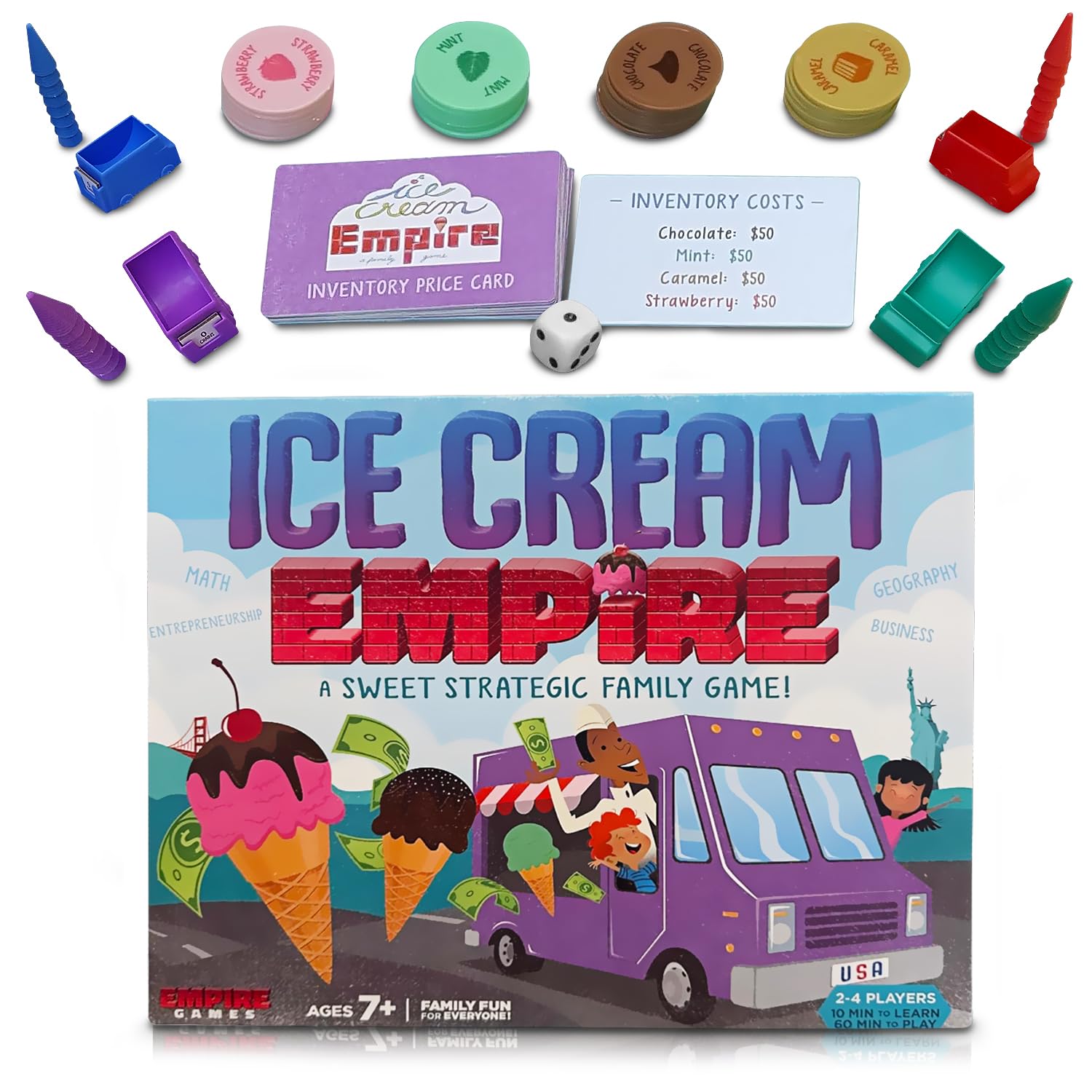
Ice Cream Empire stands out because it simulates building a real retail business, not just collecting money. Players open ice cream shops across the U.S., manage inventory based on market prices, and race to build eight stores first. This introduces kids to supply, demand, and geographic strategy in a way that feels like a fun competition, not a math drill.
The game runs about 60 minutes, which is long enough to develop serious strategies but short enough to maintain engagement for ages 7 and up. The included play money (, , bills) and inventory cards force players to calculate costs, collect profits, and decide when to expand versus consolidate. Parents appreciate that it teaches U.S. geography alongside financial reasoning.
Customer reviews note that the instructions could be clearer on a few edge rules, and the cone pieces are small enough to pose a choking hazard for very young children. However, families consistently report that kids ages 6-12 love the ice cream theme and ask to play repeatedly.
Why it’s great
- Teaches supply-and-demand dynamics through a tangible retail chain
- Combines U.S. geography with business strategy in a single session
Good to know
- Rulebook leaves minor gaps on trading mechanics
- Small cone pieces not suitable for children under 3
2. Paycheck to Billionaire

Paycheck to Billionaire flips the rote money-collecting model by starting every player with a paycheck and forcing them to pay realistic bills — rent, utilities, groceries — before they can invest the remainder. This sequence mirrors adult budgeting and makes the scarcity of disposable income a core mechanic. Players then choose investments like businesses or stocks to generate passive income.
The game includes 100 play cards, 240 banknotes, and upgrade arrows that let kids visualize growing their empire. At 45 minutes per round, it hits a sweet spot between depth and pace. Multiple customer reviews mention that kids ages 8-12 quickly grasp the difference between earned income and passive income after just two or three plays.
Assembly is simple — no batteries required — and the dark green board with clear iconography makes it easy for new players to follow. The main drawback is that younger children may struggle with the investment math in the later stages, so adult guidance is recommended for the first few rounds.
Why it’s great
- Realistic bill-paying mechanic teaches budgeting before investing
- High-quality materials stand up to repeated family game nights
Good to know
- Investment calculations may require adult help for younger players
- Game can feel slightly repetitive after many sessions
3. SimplyFun BankIt!
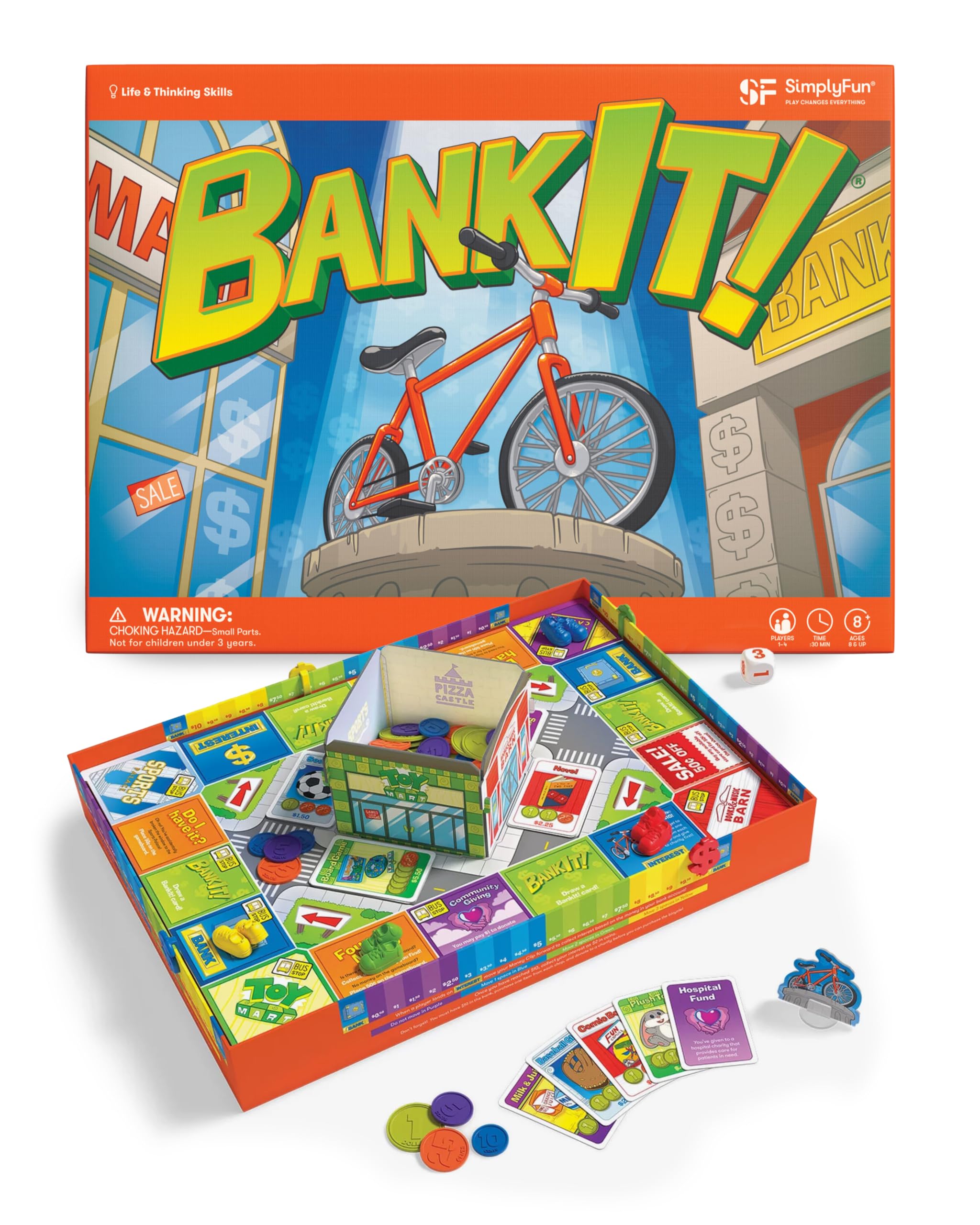
SimplyFun BankIt! is a pure money-management game that strips away business-building complexity and focuses on the trade-off between saving and spending today. Players race around the board earning money, then must decide whether to save it in the bank to earn interest, donate to charity, or spend it to buy a shiny new bike. The core lesson — that patience earns interest — is elegantly simple.
With a 30-minute playtime, BankIt! is ideal for families who want a fast, focused lesson without a long commitment. The game includes chips and a cardboard bank that tracks deposits. Reviews note that the concept of earning interest sparked the first real conversations between parents and kids about how banks work.
The main complaint is that the cardboard bank pieces can be flimsy; some families reinforce them with tape. But the gameplay itself receives near-universal praise for being accessible to ages 8 and up while still engaging adults.
Why it’s great
- Introduces interest and compounding in a simple, visual way
- Short rounds keep attention spans high
Good to know
- Cardboard bank components are not very durable
- Limited strategic depth for older kids comfortable with investing
4. Big Money

Big Money from Ravensburger is all about rolling dice to rake in cash, then buying outrageous assets — like a candy factory or a drone racing league — to build an empire. The twist is that you only get three dice rolls per turn, forcing risk/reward calculations. Do you play it safe or go for a high-risk high-reward roll?
The game plays in roughly 40 minutes with 2 to 5 players, making it a fast alternative to longer titles like Monopoly. The included dice cup and 47 cards create a lively, luck-driven atmosphere that still rewards smart buying decisions. Families who leave the game set up return to it often because rounds feel quick.
Customer feedback highlights that the asset cards spark imagination and discussion — kids love deciding whether a candy factory is a better investment than a drone racing league. The main trade-off is that the luck factor is higher than purely strategy-based games, so the business lesson is less about budgeting and more about calculated risk-taking.
Why it’s great
- Fun, imaginative assets keep kids engaged and talking about business
- Short playtime works well for quick game nights
Good to know
- Luck plays a large role, reducing strategic depth
- Some families find the asset cards too silly for serious money lessons
5. The Game of Life

The Game of Life remains a staple because it introduces kids to the concept of life-stage financial decisions — choosing a career, buying a house, paying taxes, and managing unexpected expenses. The Amazon Exclusive edition includes 31 career cards with quirky options like “ice cream flavor maker” and “secret agent,” which add humor and variety to each playthrough.
The game uses a spinner instead of dice, and the 115 cards create surprising twists that mirror real-life randomness. At about 30 minutes, it’s accessible for younger players who are not yet ready for heavy strategy. The educational objective explicitly listed is “develop life skills and understand basic financial concepts,” which aligns well with its mass-market reputation.
Critics note that the plastic pieces can feel cheap compared to premium alternatives, and the financial lessons are relatively shallow — players mostly react to events rather than proactively budget. Still, for a first introduction to the idea that life has financial consequences, it’s hard to beat.
Why it’s great
- Easy to learn and playable by a wide age range
- Career cards spark imagination about different jobs
Good to know
- Financial lessons are relatively surface-level
- Plastic components may not survive heavy use
6. Buy It Right Shopping Game

Buy It Right Shopping Game focuses purely on the mechanics of making change — a foundational skill for any money lesson. Players move around the board, buy items, and calculate correct change using realistic paper money and plastic coins. The three difficulty levels (paper only, coins only, both) let you adjust the challenge as your child improves.
Designed for ages 5 and up, this game fills the gap for early elementary learners who are not yet ready for business simulations. The math is concrete: add up your purchases, subtract from your cash, and hand back the right change. Teachers often use it in classroom centers because it requires minimal adult involvement.
Some customers report that the included calculator only works in direct sunlight, and the plastic coins are slightly dark, making denomination recognition harder. But the core gameplay is effective: one reviewer called it “the best way to teach change counting ever.”
Why it’s great
- Three difficulty levels adapt to growing math skills
- Realistic money pieces reinforce coin and bill recognition
Good to know
- Calculator is unreliable in low light
- Assembly required for the game board
7. SimplyFun Arctic Riders
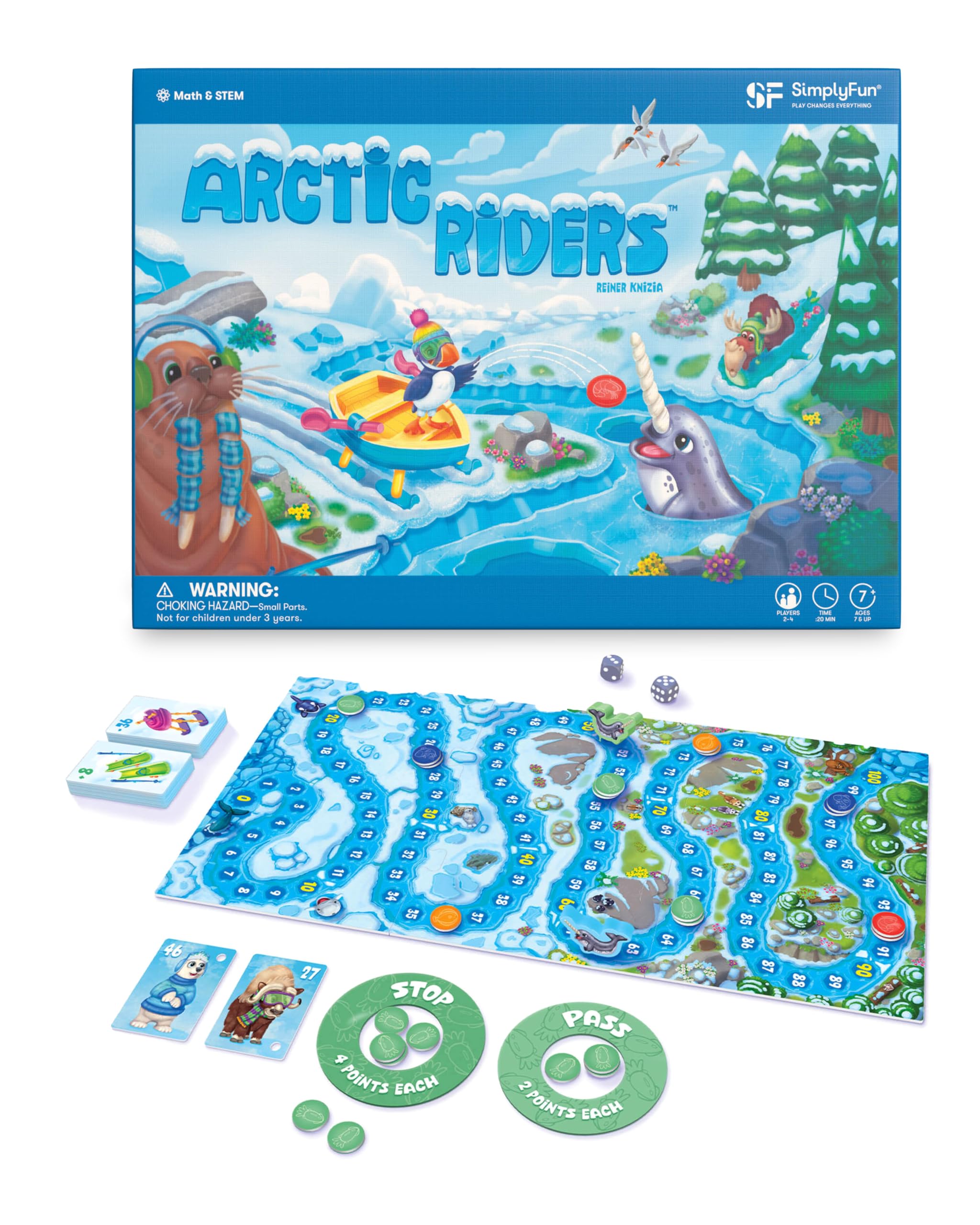
Arctic Riders is a math game that builds the numerical fluency needed for financial literacy. Players use double-digit addition and subtraction to move narwhal pawns across the board, scoring points when they land on treat tokens. The self-check card system lets kids verify their own answers, encouraging independent play.
At 20 minutes per round, it’s the shortest game in this guide, making it perfect for a quick warm-up before a longer business simulation. Teachers use it in classrooms for kids transitioning from single-digit to double-digit calculations, and parents report that even 6-year-olds enjoy the challenge with minimal help.
The educational objective is specifically math improvement rather than financial concepts, so it works best as a supplementary tool rather than a standalone money game. One reviewer noted that the gameplay can feel a bit repetitive since each turn involves solving multiple problems, but the narwhal theme and colorful board keep most kids engaged.
Why it’s great
- Self-check cards allow independent play without adult help
- Builds the arithmetic skills needed for money games
Good to know
- Repetitive gameplay may not hold older kids’ interest
- Focuses on math skills, not financial concepts directly
FAQ
How many players do I need for these money games?
Can a 6-year-old play a game rated for ages 8+?
Which game teaches passive income most effectively?
How long should a single game session last for kids?
Are these games suitable for classroom use?
Final Thoughts: The Verdict
For most users, the board games to teach kids about money and business winner is the Ice Cream Empire because it combines retail strategy, geography, and math in a fun, 60-minute format that appeals to ages 7 and up. If you want a focused lesson in passive income and budgeting, grab the Paycheck to Billionaire. And for introducing the very basics of coin recognition and making change, nothing beats the Buy It Right Shopping Game.