
Our readers keep the lights on and the weekend projects moving. As an Amazon Associate, I earn from qualifying purchases.
Radiant floor heat delivers a level of comfort that forced air simply cannot match — no drafts, no dust clouds, and a gentle warmth that rises evenly from the slab. But that perfect floor temperature depends entirely on the boiler that feeds it. Spec a unit too weak and your zones will struggle to reach setpoint on cold mornings. Overbuild and you waste fuel cycling a giant burner against a small loop. The right boiler for radiant floor heat must manage low return water temperatures (often below 130°F) without condensing acidic flue gas into your venting, modulate its output to match the gentle heat load of a slab, and deliver years of trouble-free operation in a system that operates differently than standard baseboard setups.
I’m Rikta — the co-founder and writer behind FitlyFast. My research for this guide involved hundreds of hours comparing modulation turndown ratios, heat exchanger materials, built-in pump configurations, and real owner experiences across dozens of boiler models to identify the units that genuinely perform in low-temperature radiant applications.
Whether you’re retrofitting an existing home or building from scratch, choosing the right boiler for radiant floor heat means understanding how condensing technology, flow rates, and zoning flexibility interact with your specific slab or staple-up layout.
How To Choose The Best Boiler For Radiant Floor Heat
Radiant heating is a low-temperature, high-mass beast. Your boiler must condense effectively at supply temperatures between 100°F and 140°F, modulate deeply to avoid short cycling, and handle the pressure drop of multiple PEX loops. Here are the four specs that separate a great radiant boiler from a frustrating one.
Condensing Technology and Modulation Turndown
A standard non-condensing boiler fired into a warm floor returns water too cool for safe operation — the flue gas condenses inside the heat exchanger, forming carbonic acid that eats the metal. A true condensing boiler is built for this. Look for a modulation turndown ratio of at least 4:1 (some premium units hit 5:1 or 6:1). That means a 150,000 BTU boiler can fire as low as 25,000 to 30,000 BTUs, matching the modest heat demand of a floor loop without cycling on and off. The more it stays lit at low fire, the higher your seasonal efficiency.
Heat Exchanger Material — Stainless Steel vs. Cast Iron
Cast iron is heavy and durable for high-temp baseboard systems, but it cracks under thermal shock when hit with cold return water from a slab. Stainless steel heat exchangers (304L or 316L) handle thermal stress and acidic condensate without degradation. All serious modern radiant boilers use stainless. If you see cast iron in a unit marketed for radiant, walk away — it will fail prematurely.
Built-In Pump and Controls for Low-Temp Operation
The best boilers for radiant include a variable-speed pump that maintains flow through the heat exchanger regardless of zone valve positions. They also offer outdoor reset control — the boiler automatically adjusts supply water temperature based on outdoor temperature. Cold day? Higher supply temp. Mild day? Lower. This prevents overheating the slab and maximizes condensing efficiency. If your boiler lacks outdoor reset, you’ll need an external mixing valve and logic controller, adding cost and complexity.
Flow Rate and Pressure Drop — PEX Loop Compatibility
Radiant floor loops create significant head loss. A boiler rated for high flow (8 to 11 GPM) with a robust internal circulator ensures every loop gets hot water at the right velocity. For multi-zone systems, a primary-secondary piping layout with a dedicated injection pump separates boiler flow from zone flow, preventing the boiler from short cycling when only one small zone calls for heat.
Quick Comparison
On smaller screens, swipe sideways to see the full table.
| Model | Category | Best For | Key Spec | Amazon |
|---|---|---|---|---|
| Rinnai i150SN | Condensing Gas Boiler | Whole house radiant zones | 150K BTU, 5:1 turndown, stainless HX | Amazon |
| Rinnai RXP199iN | Condensing Tankless | Combined DHW + radiant heating | 199K BTU, UEF .98, built-in recirc | Amazon |
| Rinnai CX199iN | Commercial Condensing | Large homes with high demand | 199K BTU, 97% thermal efficiency | Amazon |
| Rheem Prestige RTGH-RH11DVLN | Condensing Tankless | Budget-conscious whole-home radiant | 199K BTU, built-in recirc, 11 GPM | Amazon |
| Rinnai RX199iN | Condensing Tankless | Indoor/outdoor install flexibility | 199K BTU, UEF .98, Versa Vent | Amazon |
| Takagi T-H3S-DV-N | Condensing Tankless | Smaller radiant loops or DHW focus | 8 GPM, 199K BTU, Ultra-Low NOx | Amazon |
| Rheem RTG-95DVLP-3 | Non-Condensing Tankless | Hydronic radiant with mixing valve | 199K BTU, 9.5 GPM, LP gas | Amazon |
| Warming Systems 300 sqft Kit | Electric Radiant Cable | Small bathrooms, spot radiant | 3600W, 240V, WiFi thermostat | Amazon |
| Sunfire SF80 | Radiant Heater | Shop or garage slab heating | 80K BTU, diesel/kerosene, 6-gal tank | Amazon |
| Hydronic Radiant Panel 1-Zone | Distribution Panel | Single-zone system integration | Pre-assembled, mixing valve included | Amazon |
| Pentair EC-462024 | Pool Heater | Heated slab for small structures | 125K BTU, 82% efficiency, NG | Amazon |
| Comfortbilt HP22-N | Pellet Stove | Supplemental radiant heating | 50K BTU, 80-lb hopper, 2800 sq ft | Amazon |
| Kohler K-5535-NA | Steam Generator | Luxury steam shower warmup | 15 kW, 500 cu ft max volume | Amazon |
In‑Depth Reviews
1. Rinnai i150SN Condensing Gas Boiler

The i150SN is Rinnai’s dedicated condensing boiler — not a tankless water heater adapted for space heating, but a purpose-built hydronic appliance with a stainless steel heat exchanger and a 5:1 turndown ratio. That modulation range lets it fire at 30,000 BTU when only one zone of warm floor calls, then ramp to 150,000 BTU for the whole house on a subzero morning. It’s wall-mountable, compact at 18.5″ wide, and includes outdoor reset for automatic supply temperature adjustment — a critical feature for radiant slab systems.
Real owners report a dramatic drop in gas bills. One found a 2.5-year payback pairing this boiler with a separate tankless water heater to avoid competing with winter load. Another noted the unit is extremely quiet in operation, a huge plus when mounted near living spaces. The digital display gives clear temperature and pressure readouts, and the controller supports up to three zones directly wired without needing expensive external logic panels.
Installation is professional-grade — you’ll need a licensed technician for gas line sizing, condensate neutralization, and proper venting with 2″ PVC. The 12-year heat exchanger warranty reflects Rinnai’s confidence in the stainless build. For a dedicated radiant boiler that will modulate happily at low return water temperatures, the i150SN sets the standard.
Why it’s great
- True 5:1 turndown prevents short cycling on small floor zones
- Stainless steel heat exchanger resists condensate corrosion
- Built-in outdoor reset for optimized supply temperature
Good to know
- Requires professional gas line and venting installation
- Separate DHW heater recommended for winter load balancing
2. Rinnai RXP199iN Smart Sense Condensing Tankless

The RXP199iN bridges the gap between a dedicated boiler and a combi unit. It’s a condensing tankless water heater with a built-in recirculation pump and Smart-Circ technology that learns your usage patterns — ideal if you want both domestic hot water and radiant floor heating from a single appliance. With 199,000 BTU and 11.1 GPM flow, it can handle up to seven fixtures simultaneously while feeding a buffer tank for your floor loops.
Users replacing 40- or 50-gallon tanks report endless hot water and significantly lower energy consumption. One installer noted the built-in recirculation pump is audible from 70 feet away even in economy mode, so placement matters. The unit installs indoors or outdoors thanks to the Versa Vent system, and the Smart Sense gas control automatically adjusts for natural gas or propane — no conversion kit needed.
The integrated pump eliminates the need for a separate circulator in many single-zone applications. For multi-zone radiant systems, you’ll still want a hydraulic separator or buffer tank to isolate the boiler flow from the zone pumps. The RXP199iN delivers exceptional efficiency (UEF .98) in a compact package, but realize that a tankless water heater’s minimum fire rate is higher than a dedicated boiler’s — you may need a buffer tank for very small floor zones.
Why it’s great
- Combined DHW and radiant heating in one wall-hung unit
- Smart-Circ recirculation reduces wait time for hot water
- Versa Vent allows indoor or outdoor installation
Good to know
- Recirculation pump is audible — avoid mounting near bedrooms
- Small zones may require a buffer tank to prevent short cycling
3. Rinnai CX199iN Commercial Condensing Tankless

The CX199iN is Rinnai’s commercial-tier condensing tankless, boasting a 97% thermal efficiency rating that translates directly to lower operating costs for high-demand homes. At 199,000 BTU and 11.1 GPM, it’s built for large households or homes with multiple radiant zones requiring significant flow. The stainless steel heat exchanger is designed for continuous operation, and the Smart Sense gas system auto-switches between natural gas and propane without a kit.
Owners upgrading from older tankless units report dramatic efficiency gains — one user saw an 82% to 98% thermal efficiency jump, with noticeably faster hot water delivery to remote faucets. The CX199iN is taller than previous Rinnai models (30.11″), so measure your rough-in space carefully. The Quick Flush system simplifies the annual descaling process, a maintenance task that’s critical in hard-water areas to protect the heat exchanger.
This unit includes built-in Bluetooth setup via the Rinnai Central App, and an optional conversion kit enables recirculation for faster hot water in large homes. For radiant floor systems, the CX199iN pairs well with a buffer tank when your heat load is modest — its minimum fire rate is higher than a dedicated boiler, but the sheer flow capacity makes it excellent for large slab areas with high water volume.
Why it’s great
- 97% thermal efficiency significantly cuts gas consumption
- 11.1 GPM flow handles large home demand easily
- Bluetooth setup and app-based troubleshooting
Good to know
- Compact but taller than many tankless models
- Best paired with a buffer tank for small radiant loops
4. Rheem Prestige RTGH-RH11DVLN Condensing Tankless

The Rheem Prestige is a condensing tankless with built-in recirculation and a .94 UEF rating at a lower entry point than the Rinnai equivalents. Its Auto-Learn programming tracks your household’s hot water usage and automatically adjusts to deliver heat at peak demand times — a useful feature for radiant zones tied to domestic hot water. The 11 GPM flow and 199,000 BTU output are competitive, and the 25-year residential heat exchanger warranty is among the longest in this category.
Reading through owner experiences reveals a split. Many report perfect operation: instant hot water, compact installation, no issues even with multiple showers running. However, a recurring pattern of failures — cracked heat exchangers, burned flame sensor windows, repeated main board errors — show up in a non-trivial number of reviews. Several users went through two or three units within three years. Rheem’s warranty support drew criticism for slow resolution.
For radiant floor heat, the Prestige can work, but you’re accepting higher risk than with Rinnai units. If you go this route, pair it with a buffer tank to minimize cycling, and budget for a service plan. The built-in recirculation reduces water waste, but the gas leak detection and auto-shutdown are genuine safety advantages. This is a budget option that performs well when it works, but reliability is a gamble.
Why it’s great
- Lowest entry cost among condensing tankless units with recirc
- Auto-Learn programming adapts to usage patterns
- 25-year heat exchanger warranty (residential)
Good to know
- Inconsistent reliability with reports of early failures
- Warranty support can be slow and frustrating
5. Rinnai RX199iN Condensing Smart Sense
The RX199iN is the base-level Rinnai condensing tankless — same 11.1 GPM flow and 199,000 BTU output as the RXP, but without the built-in recirculation pump. What it offers is installation flexibility: mount it indoors or outdoors using the Versa Vent system, and the Smart Sense gas control auto-switches between natural gas and propane. This is the unit to spec when you have a sidewall for outdoor mounting or want to keep the boiler outside the conditioned envelope.
Owners switching from tank water heaters report major space savings and consistent hot water for families of five or more. The UEF .98 rating is among the highest available, and the stainless heat exchanger is backed by Rinnai’s proven reliability. A common observation is that hot water takes longer to reach fixtures 25 feet from the unit — a recirculation loop (external) is recommended for larger homes.
For radiant floor applications, the RX199iN works well when paired with a buffer tank and an external recirculation pump. The lack of an internal pump reduces complexity and potential failure points. If your radiant system already includes a primary-secondary loop with its own circulators, this is the cleaner integration. The Quick Flush feature simplifies maintenance — a small but meaningful time saver for annual descaling.
Why it’s great
- Installs indoors or outdoors with Versa Vent
- Smart Sense auto-converts between NG and LP
- Simpler design — no internal recirc pump to fail
Good to know
- No built-in recirculation — needs external pump for slab loops
- Hot water delivery time can be long in larger homes
6. Takagi T-H3S-DV-N Condensing Natural Gas Tankless

The Takagi T-H3S-DV-N is a solid mid-range condensing tankless with an 8-GPM flow rate and 199,000 BTU output. It’s smaller and lighter than many competitors, making it easier to maneuver into tight mechanical rooms. The Ultra-Low NOx certification satisfies SCAQMD Rule 1146.2 for those in emissions-regulated areas. The wall-mount design is straightforward, and Takagi’s reputation for reliability is well-established — several owners reported replacing 16-year-old units with this model.
A critical insight for radiant buyers: this unit requires 3/4″ gas piping, not 1/2″. If your existing gas line is undersized, you’ll need to run new pipe, which adds significant cost. The unit also requires biannual descaling (especially in hard-water regions), and the neutralizer kit installation can be fiddly. Several reviews note the firing noise is noticeable — not a dealbreaker, but worth knowing if the unit is near a living room or bedroom.
For radiant floor heat, the 8 GPM flow is adequate for up to four to six standard loops depending on length and spacing. The condensing design handles low return temperatures well. Pair this with an external pump and mixing valve for best results. The non-returnable policy on installed units means you should absolutely confirm gas line size and venting compatibility before purchase.
Why it’s great
- Proven long-term reliability from Takagi
- Compact size fits tight spaces
- Ultra-Low NOx for emissions-sensitive areas
Good to know
- Requires 3/4″ gas pipe — may need costly upgrade
- Biannual descaling needed in hard water areas
7. Rheem RTG-95DVLP-3 Non-Condensing Tankless
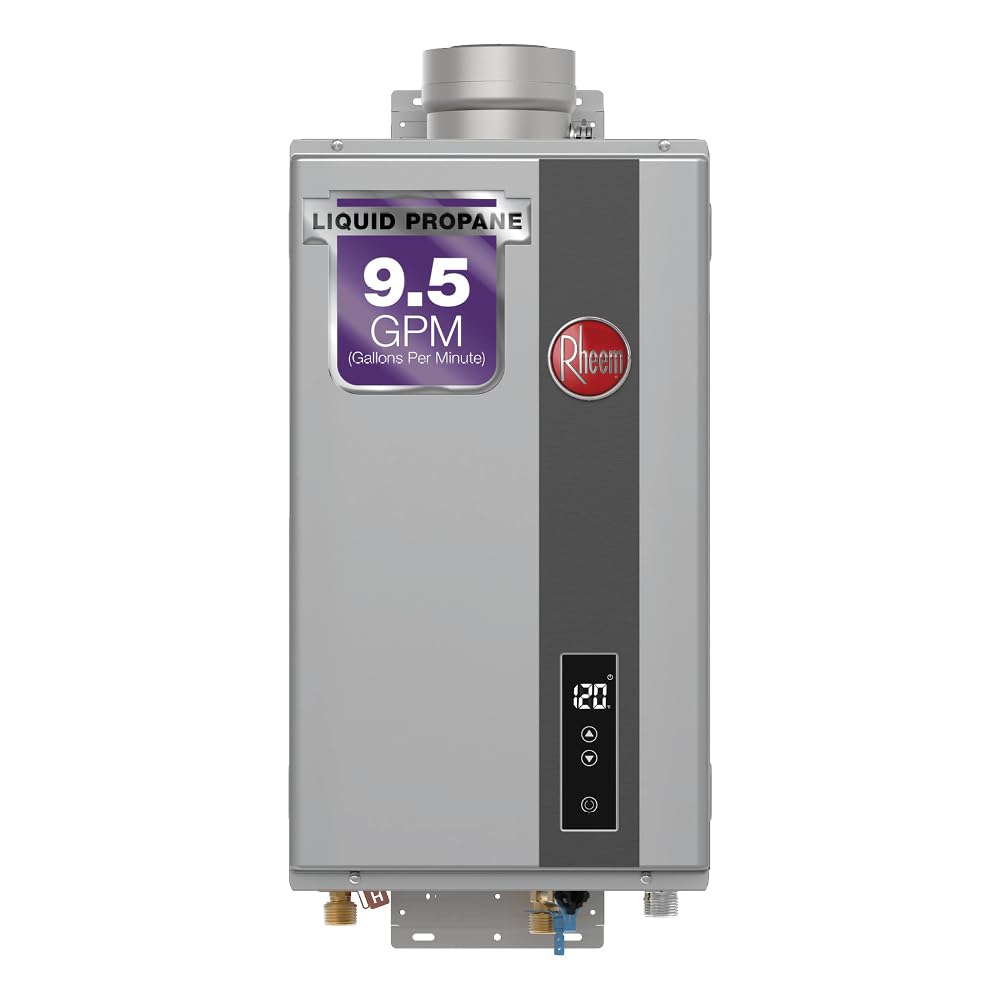
The RTG-95DVLP-3 is a non-condensing unit — a critical distinction for radiant floor buyers. It runs at higher return water temperatures, meaning you cannot feed it directly into a warm slab without a mixing valve and careful temperature management. The 9.5 GPM flow and 199,900 BTU output are solid, but the non-condensing design means flue gas temperatures stay high, which prevents condensation damage to the heat exchanger only if the return water is kept above 130°F. For radiant flooring operating at 100-120°F supply, that’s a challenge.
Owners praise the easy installation and hot-start programming that prevents cold water bursts between showers. The 15-year heat exchanger warranty is decent, and the compact metal cabinet is durable. However, the unit is noticeably loud — multiple users describe it as louder than a dishwasher. At 46.5 pounds, it’s lighter than many tankless units, making wall mounting simpler for one person.
If you must use this for radiant, install a primary-secondary loop with a mixing valve to keep the boiler return water high enough to prevent condensation. This adds cost and complexity. Better to spend a bit more on a condensing unit that’s designed for low-temperature operation. The RTG-95DVLP-3 is best reserved for applications where the boiler feeds only high-temperature zones (baseboard, radiators) or for domestic hot water only.
Why it’s great
- Easy DIY installation with intuitive instructions
- Hot-start programming prevents cold water bursts
- 15-year heat exchanger warranty
Good to know
- Non-condensing design requires external mixing valve for radiant
- Noticeably noisy in operation
8. Warming Systems 300 sqft 240V Electric Radiant Floor Kit
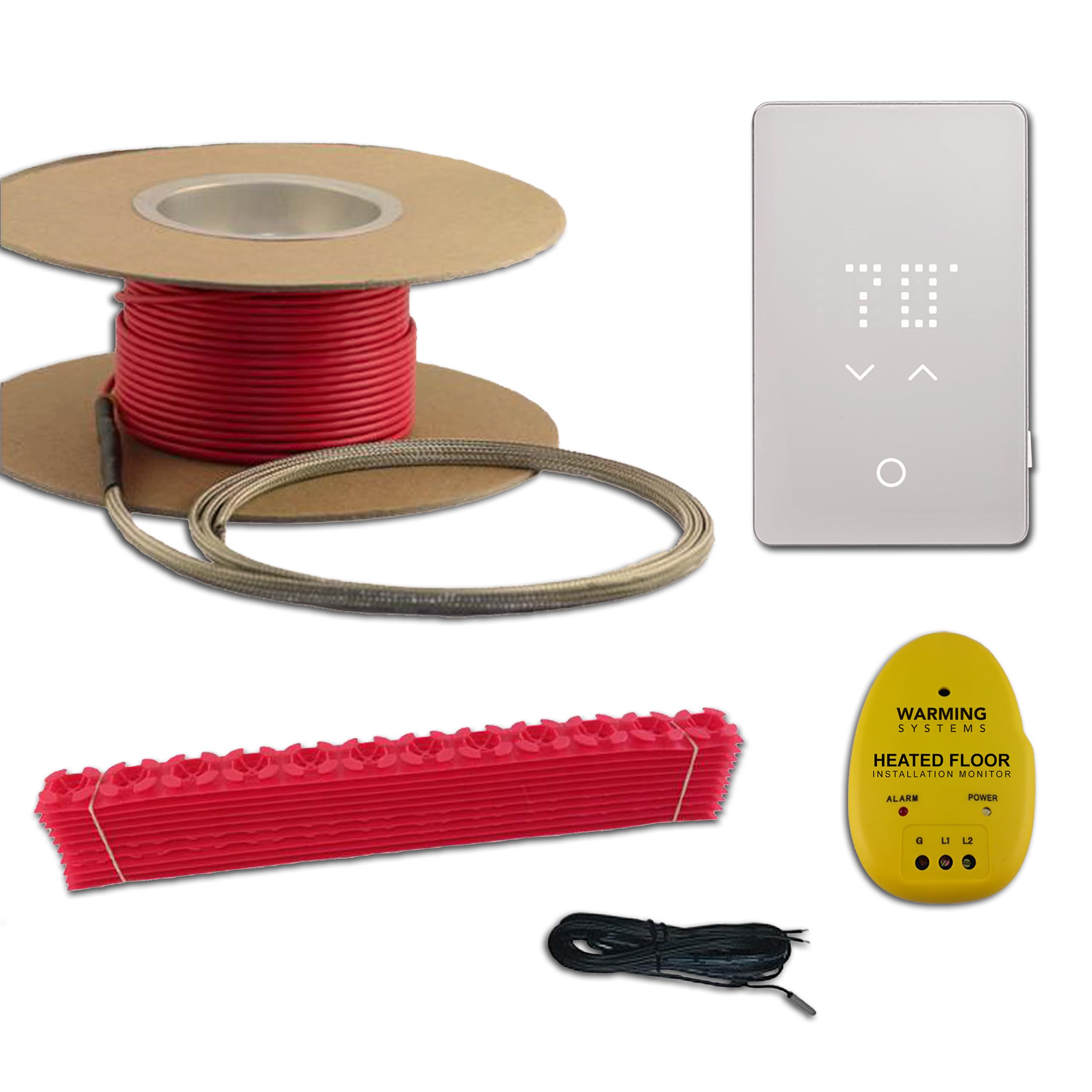
This is an electric radiant heating system, not a boiler — included here because many radiant floor shoppers evaluate electric mats alongside hydronic setups for small areas. The Warming Systems kit covers 300 square feet with 1200 feet of heating cable, a WiFi-LED programmable thermostat, floor sensor, and an installation monitor that sounds an alarm if the wire is damaged during embedding. At 3600W (15A on 240V), it delivers 12 watts per square foot, which is sufficient for tile floors in bathrooms, kitchens, or small additions.
DIY users consistently report a straightforward installation. The cable on a spool is more flexible than pre-spaced mats, handling odd-shaped rooms well. The included “screamer” monitor provides real-time feedback during mortar work — if you nick the wire, an alarm sounds before the problem is buried. Several owners note the thermostat works well but the timer logic takes a day or two to dial in. The cable is 1/8″ thick, embedding smoothly in thin-set mortar without raising tile height noticeably.
This is not a replacement for a hydronic boiler heating an entire house. It’s a spot solution for a single room where trenching PEX into an existing slab is impractical. The 25-year warranty from US-based Warming Systems adds peace of mind. For a cold bathroom floor or a small home office, this cable system delivers consistent, zoned comfort without the complexity of gas piping, pumps, and venting.
Why it’s great
- Cable format allows custom layout for irregular room shapes
- Installation monitor prevents damage during mortar work
- 25-year warranty from US manufacturer
Good to know
- Electric — higher operating cost than gas hydronic per BTU
- Not designed for whole-home heating, only single rooms
9. Sunfire SF80 Radiant Heater

The Sunfire SF80 is a portable radiant heater, not a hydronic boiler — but it earns a mention because it solves a distinct heating scenario: warming a concrete shop floor in a garage or pole barn without installing a permanent hydronic system. The dish-style infrared design heats objects and floors directly rather than the air, creating a radiant warmth that feels similar to in-floor heat. It runs on diesel, kerosene, or #2 fuel oil and delivers 80,000 BTUs, covering up to 1,900 square feet for about 10 hours on one 6-gallon tank.
Users report impressive performance. One heated an 800-square-foot greenhouse from 18°F to the low 40s overnight using roughly a third of a tank with a thermostat. Another warmed a 980-square-foot metal building from 32°F to 60°F in 50 minutes. The unit is relatively quiet compared to forced-air torpedo heaters, and the clean burn produces minimal odor. However, it requires regular maintenance — one owner needed an injector replacement after 20 hours, and the fuel filter coupling on some units arrives loose, preventing prime.
For a workshop or temporary construction site, the SF80 provides radiant warmth without the major investment of a boiler and PEX loops. It’s best set up with an external thermostat for automatic cycling. The 80-pound weight means it’s movable but not truly portable for daily repositioning. This is a niche solution best suited for uninsulated spaces where a permanent radiant slab isn’t feasible.
Why it’s great
- Radiant heat warms floors directly, not just the air
- 10-hour runtime on one tank saves refueling trips
- Quieter than forced-air torpedo heaters
Good to know
- Requires regular nozzle and filter maintenance
- Not a replacement for a permanent hydronic boiler system
10. Hydronic Radiant Heat Control Panel (1-Zone)

This is a pre-assembled hydronic distribution panel — the intermediary that connects your boiler to the radiant floor loops. It includes a mixing valve, circulator pump, expansion tank, pressure relief valve, and air eliminator all mounted on a backplate. For a DIY installer or a pro looking to save time, this panel eliminates the guesswork of sourcing individual components and ensures proper flow and temperature mixing for radiant floor temperatures.
The panel is designed for single-zone systems up to a certain loop count, and it accepts supply water from any boiler — condensing or non-condensing — and mixes it down to the appropriate floor temperature (typically 85-130°F). The build quality is solid, with brass and stainless components rated for longevity. Owners consistently praise the company’s customer service: clear communication, detailed instructions, and responsive support if issues arise.
At 110 pounds and 44″ x 33.5″, this panel is a major physical installation. You need a wall or framework that can support the weight. The price reflects the convenience of a fully engineered system — sourcing equivalent parts individually would cost similar or more when you factor in shipping and the time to assemble and pressure-test. For anyone building a single-zone radiant system from scratch, this panel simplifies the job significantly.
Why it’s great
- Complete pre-assembled distribution center saves installation time
- Includes mixing valve for proper radiant floor temps
- Exceptional customer support from the manufacturer
Good to know
- Heavy — requires sturdy mounting location
- Single-zone only; multi-zone homes need additional panels
11. Pentair EC-462024 Natural Gas Heater

The Pentair EC-462024 is a pool and spa heater, not a hydronic boiler. It appears in radiant floor research because some users attempt to repurpose pool heaters for slab heating in small structures. This unit delivers 125,000 BTU with 82% thermal efficiency and pre-mixed combustion for fast heat-up. The digital controller is straightforward, and the 1.5-inch plumbing connections are common in pool hydraulics, not standard PEX radiant manifolds.
Reviewer experiences are polarized. Many report extended swimming seasons with zero issues. But a concerning number describe units that never worked from day one — ignition failures, loose internal gas connections, and unplugged electrical assemblies that suggest poor factory quality control. One buyer reported a defect that created both an explosion and electrocution hazard. Pentair’s warranty support drew criticism for refusing return labels and pressuring buyers to pursue warranty repairs with the manufacturer directly.
For radiant floor heat, this is not the right tool. The heat exchanger is not designed for low-temperature continuous circulation, the pump connections are non-standard for floor loops, and the warranty is not written for space heating applications. If you already own one, you could theoretically feed a buffer tank, but buying a purpose-built radiant boiler from Rinnai or Takagi will deliver better efficiency, longer life, and safer operation.
Why it’s great
- Affordable entry price for high BTU output
- Pre-mixed combustion provides fast heat rise
- Digital controller is intuitive to operate
Good to know
- Not designed for hydronic radiant loops — use with caution
- Quality control issues reported — inspect thoroughly on arrival
12. Comfortbilt HP22-N Pellet Stove

The Comfortbilt HP22-N is a freestanding pellet stove, not a boiler. It’s listed here because some homeowners use pellet stoves to supplement radiant floor systems by heating a central area and reducing the load on the hydronic boiler. With an 80-pound hopper and 50,000 BTU output, it can heat up to 2,800 square feet of open space. The smart controller with auto-ignition and programmable thermostat makes it relatively set-and-forget compared to older stoves.
Owners report exceptional heat output — one noted their 1,200-square-foot home was too warm on setting 2. The build quality is stout (320 pounds), and the bay window design is visually impressive. However, the hopper opening is small, making refilling awkward. Instruction manuals are poorly translated, lacking critical torque specs and maintenance intervals. Pellet consumption runs about 40 pounds per 24 hours on level 2, and performance varies noticeably by pellet brand — cheap pellets produce more ash and clinkers.
For radiant floor heat, a pellet stove can offload the boiler during shoulder seasons, but it won’t directly heat your slab. It’s a space heater that warms the air, not the thermal mass. If you’re looking for a primary heat source, a dedicated condensing boiler remains the correct choice. The Comfortbilt works well as a backup or supplemental heater in a home that already has a radiant hydronic system.
Why it’s great
- Massive heat output for the fuel cost of pellets
- Smart controller with auto-ignition and programmable thermostat
- Very quiet on low settings
Good to know
- Does not heat the slab directly — air-only heat source
- Hopper opening is small and awkward to fill
13. Kohler K-5535-NA Invigoration Steam Generator

The Kohler K-5535-NA is a steam generator for luxury showers, not a radiant floor boiler. It produces hot steam in under 60 seconds for an enclosed shower enclosure up to 500 cubic feet. The 15 kW heating element is controlled by an external kit (sold separately) that integrates with Kohler’s DTV+ shower system. This is a niche appliance for a specific spa-like application: warming a steam shower enclosure, not a concrete floor slab.
Users rave about the experience — “a sanctuary for health and relaxation” — and note that the unit itself is well-built, compact, and reliable. One reviewer reported their fourth unit, each lasting about four years, suggesting the water quality and maintenance schedule significantly impact lifespan. The stainless steel construction resists corrosion in the humid environment, and the Power Clean technology automates descaling cycles.
This has zero application for heating a radiant floor slab. It’s included here for completeness when evaluating different types of “radiant” heat. If your goal is steam in a shower, this Kohler unit is premium. If your goal is warming a floor, skip this entirely and invest in a proper hydronic condensing boiler like the Rinnai i150SN. The two technologies serve completely different thermal purposes.
Why it’s great
- Fast-response power delivers steam in under 60 seconds
- Power Clean automates descaling for easier maintenance
- Premium stainless steel construction from a trusted brand
Good to know
- Requires separate control kit — add to total cost
- Not a hydronic boiler — cannot heat floor slabs
FAQ
Can I use a tankless water heater for radiant floor heat?
What BTU size boiler do I need for 1500 square feet?
Why does my radiant floor need a mixing valve?
Can a non-condensing boiler work with radiant floors?
What is the best heat exchanger material for a radiant floor boiler?
Final Thoughts: The Verdict
For most users, the boiler for radiant floor heat winner is the Rinnai i150SN Condensing Gas Boiler because its 5:1 turndown, stainless heat exchanger, and built-in outdoor reset make it purpose-built for low-temperature slab operation without short cycling. If you want combined domestic hot water and radiant heating in one wall-hung unit, grab the Rinnai RXP199iN — the built-in recirculation and Versa Vent flexibility are unmatched. And for the ultimate in efficiency and flow capacity for a large home with high demand, nothing beats the Rinnai CX199iN with its 97% thermal efficiency and 11.1 GPM output.