
Our readers keep the lights on and the weekend projects moving. As an Amazon Associate, I earn from qualifying purchases.
A freezing chairlift ride or a long hike up a powdery slope is miserable when your toes are numb. The right boot warmer does more than just take the chill off — it prevents the kind of deep cold that cuts a ski day short by keeping your feet dry, comfortable, and responsive in temperatures well below freezing.
I’m Rikta — the co-founder and writer behind FitlyFast. I’ve analyzed dozens of product listings, hours of real-user feedback, and the technical specs that actually matter so you can quickly tell the difference between a unit that merely gets warm and one that reliably keeps your feet dry and comfortable all day long.
Whether you need a fast-drying boot dryer or a pair of rechargeable heated socks, this guide to the best boot warmers for skiing breaks down the heating technology, power specs, and real-world performance to help you choose with confidence.
How To Choose The Best Boot Warmers For Skiing
Your choice depends entirely on your routine. Do you park the car and ski a full day, or do you crash in a lodge overnight between runs? The fundamental split is between a plug-in boot dryer that removes moisture from the liner, and a pair of battery-powered heated socks that put active warmth at your toes while you move. Many skiers eventually own both, but the starting point is being honest about your setup.
Heating technology — convection versus battery-powered elements
A convection boot dryer uses heat rising through the liner to evaporate sweat and melt ice crystals trapped in the foam. It does not blow air, so it operates silently and safely, but it typically needs 6–12 hours to fully dry a soaked ski boot. Battery-powered heated socks, by contrast, place carbon-fiber or metal-alloy heating elements directly across your toes, delivering warmth within seconds regardless of liner dampness. If you ski back-to-back days and need dry boots every morning, a dryer is your tool. If you simply want warm feet on the hill, heated socks are the direct solution.
Voltage and battery capacity in heated socks
Standard USB-powered heated socks run on 3.7V or 5V batteries, which produce moderate heat and shorter run times. Premium socks use 7.4V 2200mAh lithium-polymer packs, which deliver higher temperatures (up to 149–150°F) and can sustain low heat for 8–10 hours. A 7.4V system with a dedicated charger (not a USB-C cable) will outperform a 5V system in both intensity and consistency, especially on a chairlift in single-digit temperatures.
Heating element coverage
Cheaper heated socks often place the heating panel only on the top of the foot or the ankle. Look for models that wrap the entire toe box and extend to the top and bottom of the foot. Carbon-fiber elements are thinner and more flexible than metal coils, which reduces bulk inside the boot and avoids pressure points that can cut circulation — the exact opposite of what you want.
Drying method — fan-assisted versus silent convection
A boot dryer with a fan moves warm air through the liner much faster, typically drying a pair of boots in 3–6 hours. The trade-off is noise and moving parts that can fail after heavy use. A fanless convection dryer has no moving parts, runs silently, and is safer for delicate liners, but it requires overnight patience. For a ski instructor or patroller who needs boots dry for a dawn start, a fan-assisted model is the smarter choice.
Quick Comparison
On smaller screens, swipe sideways to see the full table.
| Model | Category | Best For | Key Spec | Amazon |
|---|---|---|---|---|
| SAVIOR HEAT App Control | Heated Socks | All-day warmth with smartphone control | 7.4V 2200mAh, up to 10h low heat | Amazon |
| SAVIOR HEAT Classic | Heated Socks | Toe-focused warmth for deep cold | 150°F max, 7.4V 2200mAh | Amazon |
| SNOW DEER Heated Socks | Heated Socks | Extended battery life in frigid conditions | 7.4V 2200mAh, up to 10h low heat | Amazon |
| Boot Dryer Shoe Dryer | Boot Dryer | Fast, fan-assisted drying for ski instructors | Fan-based, adjustable tubes, timer | Amazon |
| DryGuy Travel Dry | Boot Dryer | Compact travel and overnight drying | Hybrid forced air/convection, 99°F | Amazon |
| Everlasting Comfort Electric | Boot Dryer | Silent overnight drying on a budget | Fanless convection, 36W, 8–12h dry time | Amazon |
| ZUOYI Heated Socks | Heated Socks | Entry-level heated socks for casual skiing | 5V USB rechargeable, 4 heat levels | Amazon |
In‑Depth Reviews
1. SAVIOR HEAT Heated Socks with APP Control

These socks combine a premium 7.4V 2200mAh battery system with the convenience of a Bluetooth app. You can change heat levels, check remaining battery, and switch between three modes without fumbling with your pant leg or gloves. The low setting delivers 9–10 hours of warmth at 104–113°F, which is enough for a full day on the mountain plus apres-ski recovery.
The carbon-fiber heating elements cover the entire toe area without the bulk of older coil-based designs. Real users report that the socks are thick and durable even when unpowered, and the Coolmax knit effectively wicks sweat. The battery pockets sit above the boot cuff, so they don’t create pressure points inside the shell.
The only catch is the battery pocket insertion: a few users found the opening tight and the wire connection finicky during the first few uses. Once seated, the connection holds well. If you value precise temperature control and want the longest possible runtime in a single charge, this is the most advanced option available.
Why it’s great
- Bluetooth app provides on-the-fly heat adjustments without removing gloves or boots.
- Low setting lasts 9–10 hours, covering even the longest ski days.
- Thin carbon-fiber elements eliminate bulk and pressure inside ski boots.
Good to know
- Battery pocket can be tricky to close initially; practice before a cold morning.
- App relies on Bluetooth range — phone must be on your person, not in a pack.
2. SAVIOR HEAT Electric Ski Socks

This model uses the same 7.4V battery architecture as the app-controlled version but focuses the heating element exclusively on the toes — no calf heat, no wasted energy. The max temperature hits 150°F on the high setting, which is aggressive enough to warm frozen toes within seconds, but the intelligent controller automatically drops from high to medium after five minutes to prevent overheating.
The thicker, cushioned build adds a layer of insulation that improves warmth even when the socks are off, but it also makes the fit snugger inside a tight performance boot. Several long-term reviews mention that the socks have held up for multiple seasons without losing battery capacity or developing loose threads.
Battery display lights show 100%, 75%, 50%, and 25% levels, so you can plan your heat usage during a long day. A few users noted that the socks run long (reaching the knee on average-height adults), but the extra length helps secure the battery pocket above the boot line. For skiers who prioritize raw toe heat over phone connectivity, this is the straightforward winner.
Why it’s great
- Toe-focused carbon fiber reaches 150°F fast, then auto-trims to a sustainable medium level.
- Battery indicator lights give clear readouts at 25% intervals.
- Durable construction that holds up well over years of regular use.
Good to know
- Long sock shaft may bunch under tight ski pants; tuck carefully.
- Thick cushioning reduces wiggle room in narrow-performance ski boots.
3. SNOW DEER Heated Socks

SNOW DEER’s heated socks use the same 7.4V 2200mAh battery platform as the SAVIOR HEAT models, but they distinguish themselves with a four-size range (S–XL) and a CoolMax fabric blend that dries five times faster than cotton. The heating elements cover the entire toe, top, and bottom of the foot, providing more surface area than many competitors at this price tier.
Real-world tests in 24°F conditions with significant elevation gain show that these socks keep feet warm on low heat for a full hiking day. Several users report 10-hour runtimes on the low setting, and the 6-hour recharge time means you can rotate a second pair of batteries for multi-day backcountry trips.
The main complaint is sizing inconsistency — some users found the size large ran significantly smaller than previous batches, and the small size fits loosely on women’s US 6 feet. If you order, measure your foot carefully against the included chart and consider sizing up if you plan to wear thick ski socks underneath.
Why it’s great
- Full-foot heating (toes, top, and bottom) provides even warmth across the entire foot.
- CoolMax fabric actively pulls moisture away from the skin, reducing chill from sweat.
- Choice of four sizes improves fit consistency compared to one-size-unisex designs.
Good to know
- Sizing has been inconsistent across production batches; verify fit immediately on arrival.
- Batteries require 6 hours to fully recharge — plan ahead for consecutive ski days.
4. Boot Dryer Shoe Dryer with Adjustable Tubes

This is the dryer to pick if you need boots dry the next morning and you are willing to trade a little noise for speed. The forced-air fan system circulates warm air through adjustable tubes that fit ski boots, snowboard boots, hockey skates, and gloves. The timer dial lets you set cycles from 30 minutes to several hours, so you don’t have to guess when the gear is ready.
Reviews from ski instructors who run the unit 6–7 days a week confirm that it holds up under heavy use. The airflow is audible but not disruptive — more of a low hum than a whine — and the heat output is consistent across both tubes. Users also appreciate that it dries gloves and hats simultaneously, reducing the clutter of wet gear around the house.
The unit weighs nearly 7 pounds, so it is not a travel-friendly option. It is designed for a dedicated spot in the mudroom or garage. If you have the space and ski multiple days in a row, the fan-assisted drying cycle will keep your boot liners fresh and odor-free between outings.
Why it’s great
- Adjustable tubes accommodate a wide range of boot shapes, from slim ski boots to bulkier work boots.
- Timer dial offers flexible cycle lengths, preventing over-drying or wasted energy.
- Capable of drying gloves and hats simultaneously, reducing wet-gear clutter.
Good to know
- Heavy design (7 lbs) makes it unsuitable for packing in a car or carrying to a lodge.
- Fan noise is present throughout the drying cycle — not for use in a sleeping area.
5. DryGuy Travel Dry Boot and Shoe Dryer

The DryGuy Travel Dry uses a hybrid forced-air and convection system that heats to 99°F — lower than most plug-in models, but enough to dry ski boots overnight without damaging liners or footbeds. At just over 12 ounces and small enough to fit inside a shoe for packing, it is the most portable option for skiers who travel to resorts and need a lightweight solution for the hotel room.
Real-world testing confirms that it fits small ski boots easily and dries sweat-soaked liners in a single overnight session. The absence of a fan means it runs silently, and the compact size lets you pack it in carry-on luggage without sacrificing space. However, it is not intended for use with gloves or socks, and the lower heat output means it takes longer to dry thoroughly soaked boots compared to a full-size fan dryer.
A few users reported receiving incomplete packages (a single dryer instead of the pair), but this appears to be an occasional fulfillment error rather than a design flaw. For the skier who wants a no-fuss, packable dryer that fits in a duffel, the DryGuy is the right call.
Why it’s great
- Ultra-portable at 12.3 ounces — small enough to pack inside a shoe or carry-on bag.
- Silent operation with no moving parts, ideal for shared hotel rooms.
- Safe for boot liners and footbeds; no risk of overheating or shrinking.
Good to know
- Not compatible with gloves or socks — limited to footwear only.
- Lower heat output (99°F) extends drying time for heavily saturated boots.
6. Everlasting Comfort Electric Boot Dryer
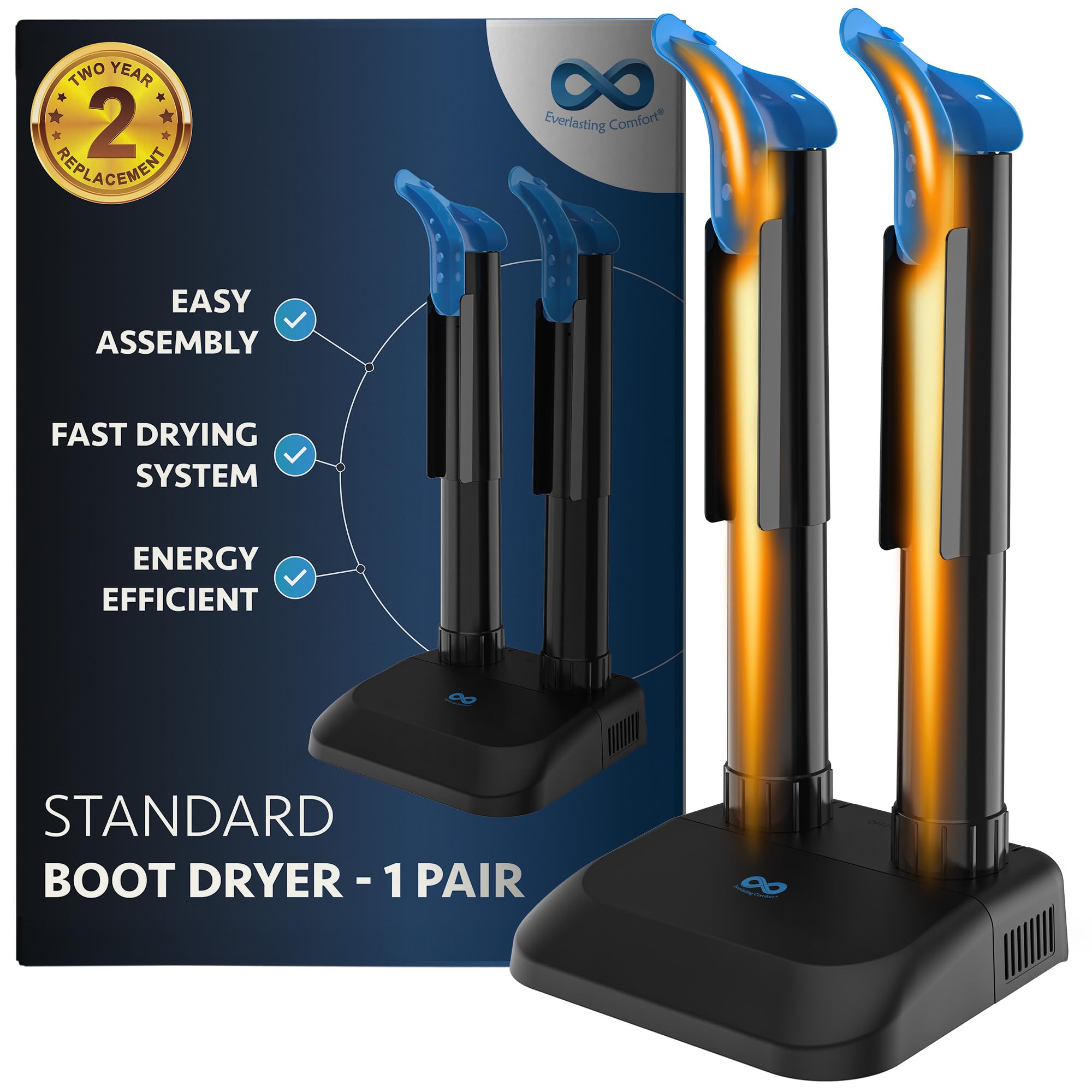
The Everlasting Comfort Electric Boot Dryer is a fanless convection model that relies on rising heat rather than forced air. At just 36 watts, it uses less electricity than a standard light bulb, making it the most energy-efficient option in this list. The trade-off is a drying time of 8–12 hours — you need to plan ahead and plug it in before bed.
It accommodates ski boots, work boots, sneakers, and gloves, and the gentle heat won’t shrink or damage leather, neoprene, or synthetic liners. Users consistently praise the silent operation — no hum, no fan noise — and the compact footprint that fits easily on a bathroom floor or mudroom shelf.
Assembly is straightforward (under 10 minutes with no tools), and the stable base prevents tipping even with heavy boots. The main limitation is the slow drying speed. If you get home late and need dry boots by dawn, this model may not deliver. But for routine overnight maintenance and odor reduction, it is a reliable, budget-friendly workhorse.
Why it’s great
- Dead-silent operation with no fan, safe for use in a bedroom overnight.
- Extremely low power draw (36W) — cheaper to run than a household light bulb.
- Compatible with a wide range of materials including leather, neoprene, and microfiber.
Good to know
- Slow 8–12 hour drying cycle requires overnight planning; not suitable for quick turnaround.
- Fanless design lacks active air circulation, so moisture removal is gradual.
7. ZUOYI Heated Socks

ZUOYI’s heated socks use a 5V USB-rechargeable battery platform with four heat levels (104°F to 149°F). They are the most affordable way to try electric heated socks without committing to a high-voltage system. The carbon-fiber heating elements cover the toes, and the moisture-wicking polyester fabric reduces the risk of athlete’s foot by drying faster than cotton.
Battery life is rated at 3–4 hours on the highest setting and up to 8 hours on the lowest. Real-world testing on a 18-hour winter fishing trip confirmed that the low setting keeps feet comfortable for extended periods, though the 6-hour charge time is noticeably slower than the premium 7.4V models. The one-size-unisex design fits US sizes 6–14, but users with smaller feet may experience excess fabric at the toes.
The battery pockets are thin and secure with a button flap, preventing the batteries from slipping off during active use. The socks are machine-washable (remove batteries first), which adds convenience for regular maintenance. If you ski recreationally a few weekends a year and want a low-cost entry point, these socks deliver reliable toe warmth without a hefty investment.
Why it’s great
- Lowest price point for entering the heated-sock category without sacrificing toe coverage.
- Four adjustable heat levels let you fine-tune warmth from mild to very hot.
- Machine-washable design (batteries removed) makes cleaning straightforward.
Good to know
- 5V system delivers less heat intensity and shorter run time than 7.4V models.
- Slow 6-hour recharge limits back-to-back day use unless you buy extra batteries.
FAQ
Can I use heated socks as my only boot warmer, or do I still need a dryer?
Will 7.4V heated socks feel too hot inside a ski boot?
How do I clean rechargeable heated socks without damaging the electronics?
Is a fan-assisted boot dryer better for winter sports than a fanless one?
Final Thoughts: The Verdict
For most users, the best boot warmers for skiing are the SAVIOR HEAT App Control Heated Socks because they combine the highest battery voltage with the flexibility of smartphone control, all packed into a durable, ski-boot-friendly sock. If you want raw toe warmth without requiring a phone connection, the SAVIOR HEAT Classic Electric Ski Socks deliver the same 7.4V power in a simpler package. And if your priority is drying wet liners overnight after every ski day, the Boot Dryer Shoe Dryer with Adjustable Tubes is the fastest, most durable option for repeated heavy use.