
Our readers keep the lights on and the weekend projects moving. As an Amazon Associate, I earn from qualifying purchases.
A wet, frozen foot is a productivity killer—and a safety hazard—on any winter job site. Whether you’re standing in a cold puddle in a seafood plant, walking a frozen oil field, or climbing a snowy roof, the right winter work boot must deliver three things simultaneously: reliable waterproofing, serious insulation that doesn’t overheat when you move, and a sole that grips ice and steel without cracking. One wrong choice and you’re fighting blisters, frostnip, and a slip that can end your shift early.
I’m Rikta — the co-founder and writer behind FitlyFast. I’ve spent years digging through customer data on work-site footwear, analyzing insulation grams, waterproof membranes, outsole compounds, and break-in timelines across dozens of brands to separate the boots that actually perform from the ones that just look tough on a shelf.
This guide cuts through the marketing to focus on the nine pairs that earned real trust on real shifts. Whether you need sub-zero warmth or a steel-toe frame that survives pressure washes, these are the boots for winter work that won’t let you down.
How To Choose The Best Boots For Winter Work
Winter work boots are not fashion items. They are protective equipment that must balance four conflicting demands: warmth without sweat, waterproofing without weight, traction without stiffness, and safety-toe protection without pain. The wrong balance leads to cold feet, tired arches, or a dangerous slip in a wet zone. Here’s how to weigh the trade-offs that actually matter on a job site.
Insulation Weight And Activity Level
Insulation is measured in grams of Thinsulate or similar synthetic fill per boot. The common range is 200g to 1200g, sometimes reaching 2000g in extreme boots. Here is the problem: 1200g insulation keeps you toasty at -20°F if you are standing still, but if you are carrying materials and climbing ladders, those same boots will soak your feet in sweat, which then freezes when you stop moving. For active winter work (construction, roofing, framing), 200g to 600g is usually enough with a good wool sock. For stationary or low-activity shifts (security, surveying, ice fishing, equipment operation), 800g to 1200g is the safer bet. Never assume more grams equals warmer—sweaty feet are cold feet.
Waterproofing Method And Standing Water
“Waterproof” on a label can mean different things. A fully rubber or neoprene boot (like a classic Wellington) is genuinely waterproof to the top of the shaft—you can stand in two inches of water all day and stay dry. A leather boot with a waterproof membrane (Gore-Tex or proprietary film) is water-resistant for splashes, puddles, and light rain, but it will leak eventually if submerged above the stitching. For wastewater plants, seafood processing, or muddy outdoor sites, a full rubber construction with sealed seams is mandatory. For dry-cold environments (frozen ground, snow, light rain), a membrane leather boot is lighter, more breathable, and more comfortable for walking.
Safety Toe: Steel Vs. Composite Vs. Aluminum
Steel toes are the classic choice: strong, impact-resistant, and cheap, but they conduct cold, making your toes colder in winter. Composite toes (carbon fiber, Kevlar, fiberglass) are lighter and do not conduct cold or heat, but they require a slightly larger toe box and can be less impact-resistant in extreme crush scenarios. Aluminum toes are lighter than steel and thinner than composites, but they are more expensive and conduct cold almost as badly as steel. For winter work where you are walking on frozen ground or cold concrete all day, a composite toe reduces that ice-block feeling on your toes. If your work involves heavy falling objects (steel beams, concrete forms), stick with steel. For mixed work, composite is the smarter winter choice.
Traction Outsole: Rubber Compound And Lug Pattern
Not all rubber outsoles grip ice and wet steel the same way. Soft, sticky rubber compounds (like Vibram Arctic Grip or proprietary formulations with silica additives) provide superior friction on wet ice and slick surfaces, but they wear down faster on concrete and asphalt. Harder compounds last longer on abrasive surfaces but slide on ice and oil. Look for boots specifically listed as “safe for wet ice” or “oil-and-slip-resistant” with deep, self-cleaning lugs that eject mud and snow rather than packing it solid. A flat, shallow lug pattern is dangerous on any winter job site with standing water, frost, or snow.
Quick Comparison
On smaller screens, swipe sideways to see the full table.
| Model | Category | Best For | Key Spec | Amazon |
|---|---|---|---|---|
| Timberland PRO Gravel Pit | Premium | Heavy industrial, concrete | Steel toe, 6-prong metatarsal guard | Amazon |
| Irish Setter Elk Tracker | Premium | Sub-zero, deep snow, hunting | 1000g insulation, 12″ shaft | Amazon |
| Georgia Boot Low Heel Logger | Premium | Logging, wet mud, cold | Gore-Tex, welted construction | Amazon |
| KEEN Utility Dover | Premium | All-day walking, wet decks | Composite toe, 600g insulation | Amazon |
| Carhartt RugFlx CMF8058 | Mid-Range | Lightweight daily wear, wide feet | Rugged Flex, soft-toe, waterproof | Amazon |
| Carhartt Ground Force Wellington | Mid-Range | Oil field, ankle support | Composite toe, waterproof, EH rated | Amazon |
| Timberland PRO Endurance 8″ | Mid-Range | Construction, snow/ice traction | Steel toe, puncture resistant | Amazon |
| ROCKY Blizzard Stalker 1200G | Mid-Range | Stationary cold, ice fishing | 1200g insulation, waterproof | Amazon |
| HunThor Rubber Work Boot | Budget | Wet concrete, standing water | 6mm neoprene, steel toe, puncture-proof | Amazon |
In‑Depth Reviews
1. Timberland PRO Men’s Gravel Pit Steel Toe Waterproof Insulated Boots

The Gravel Pit is overbuilt by design. It packs a steel toe, a robust 6-prong metatarsal guard, and a puncture-resistant outsole into a package that feels like a tank on your feet. Users report that the steel toe is cavernous even for 3E widths, and the aggressive tread digs into mud and gravel without hesitation. The rubber toe guard adds a layer of scuff protection that keeps the leather looking fresh after months of kneeling and dragging.
At roughly 4.5 pounds per boot, this is not a lightweight option. Several reviews note a stiff break-in period, especially around the metatarsal guard, which relaxes after about a week of daily wear. The boot is rated water-resistant, not fully waterproof—users confirm it sheds rain and puddles but is not designed for immersion. Electrical hazard (EH) rating adds an extra layer of safety for anyone working near live circuits.
For workers who need maximum impact protection on concrete and steel sites, the Gravel Pit delivers a level of security that lighter boots simply cannot match. The included extra laces and the rubberized toe cap show Timberland PRO understands that this boot will be abused. If you are carrying steel beams, pouring concrete, or working around heavy machinery in winter, this is the shell you want between your feet and danger.
Why it’s great
- Metatarsal guard provides top-of-foot crush protection rarely seen in this price range
- Aggressive self-cleaning outsole grips mud and loose gravel effectively
- Extremely durable leather and rubber toe cap resist scuffs and cuts
Good to know
- Heavy—over 4 lbs per boot—tiring for walking-heavy shifts
- Not fully waterproof; only water-resistant for puddles and rain
- Metatarsal guard and steel toe require a deliberate break-in period
2. Irish Setter, Elk Tracker, 12″, Waterproof, Insulated 1000g, Hunting Boot

The Elk Tracker is a 12-inch tall, 1000-gram insulated boot that feels purpose-built for standing still in sub-zero temperatures. Users consistently report comfort down to -40°F with proper socks, making it one of the warmest options in this lineup. The full-grain leather upper and waterproof membrane keep moisture out during snow crossings and creek wading, though users note that regular sealant maintenance (Sno-seal) is required to maintain that waterproof integrity over the long term.
Fit runs about half to a full size large, which is intentional—it allows for heavy wool socks without compressing the toes. Several reviews mention that the boot is narrow through the midfoot but accommodates wide flat feet surprisingly well once broken in. The sole is stiff and aggressive, designed for uneven backcountry terrain rather than smooth concrete. At over 4 pounds per boot, the weight is noticeable, but users who own them for years say the durability justifies the heft.
One five-year review noted that the soles eventually cracked after two months of extreme use, but the manufacturer replaced them promptly, and the same user then wore the replacement pair for 11 years without failure. That kind of longevity makes the Elk Tracker a buy-it-for-life option for anyone who works outdoors in genuinely cold conditions—ice fishing, utility line work, or remote job sites where retreating to a warm truck is not an option.
Why it’s great
- 1000g Thinsulate handles -40°F with heavy socks, among the warmest here
- 12-inch shaft keeps deep snow and slush out during extended exposure
- Full-grain leather with welt construction rebuildable by a cobbler
Good to know
- Very heavy—carrying fatigue on long walking shifts is real
- Narrow midfoot may feel tight for users with wide arches
- Leather requires periodic waterproofing treatment to stay effective
3. Georgia Boot Men’s Low Heel Logger GORE-TEX Waterproof Insulated Work Boots
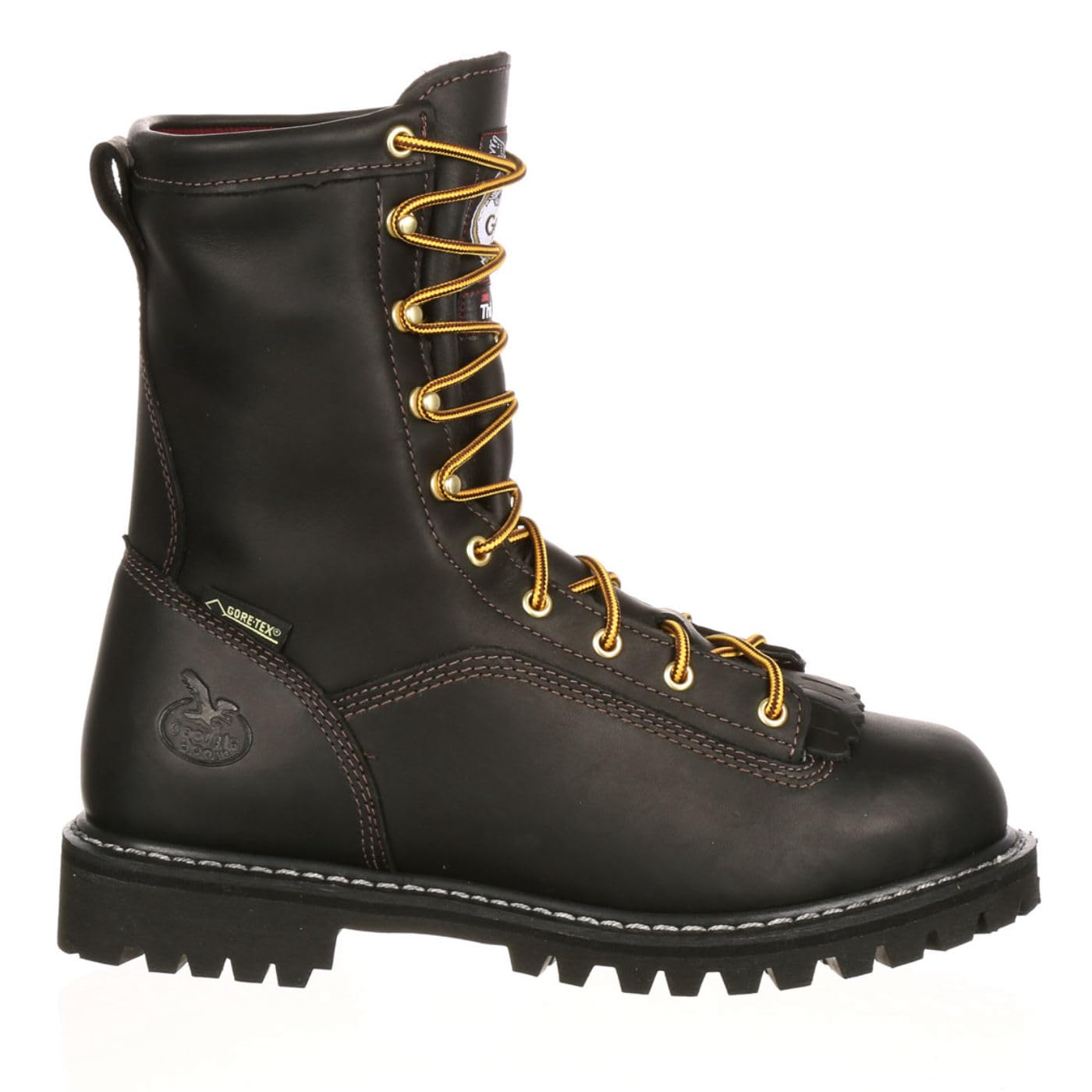
The Georgia Logger is a traditional welted work boot built around a thick, rugged sole that outlasts most cemented constructions. The Gore-Tex membrane provides reliable waterproofing for puddles and wet grass, and the low heel logger profile offers a stable platform for climbing ladders and walking sloped terrain. Users with wide feet (EE and wider) report a roomy fit without slippage, which is uncommon for logger-style boots that often run narrow.
Break-in is stiff—several reviews note a full two weeks of wear before the ankle and shaft soften to a comfortable flex. Once broken in, the boot molds to the foot and provides excellent ankle stability for carrying heavy loads on uneven ground. The leather is mid-weight; a direct comparison with Danner Rainforest shows thinner leather and slightly rougher stitching, but the savings make it a smart buy for anyone who wears through boots annually.
Users working in wet mud, cutting logs, or doing general construction in cold climates report the boot stays dry even after six months of hard use. The outsole is not designed for polished concrete or wet tile—it is a mud-and-dirt lug that packs snow but clears out easily. For the price of a premium logger, this boot delivers the durability and warranty of a traditional welted boot without the premium brand tax.
Why it’s great
- Welted construction allows resoling, extending boot life beyond the upper
- Gore-Tex membrane provides proven breathable waterproofing for active use
- Wide sizing accommodates EE and EEE feet comfortably
Good to know
- Stiff ankle requires a deliberate two-week break-in period
- Leather is thinner than premium competition like Danner Red Wing
- Outsole lugs are aggressive for mud, but slippery on polished concrete or ice
4. KEEN Utility Men’s Dover 8″ 600g Leather Waterproof Composite Toe Work Boots

The KEEN Dover hits a sweet spot for anyone who needs warmth without the sweat overload that comes from high-gram insulation. At 600g, it keeps feet comfortable in freezing temperatures during active work, but does not cause overheating when you are moving between truck and site. The composite toe is a major winter advantage—it does not conduct cold like steel, so your toes stay significantly warmer on frozen concrete and steel decks.
The leather upper seals well against puddles and light standing water, though users note it is not designed for constant submersion (periodic waterproofing helps). KEEN’s signature wider toe box gives toes room to splay, which reduces cold-induced cramping and improves blood flow. Several reviews from construction and deck work report the boot lasts over a year of daily abuse, which is double the lifespan of cheaper alternatives tested back to back.
Ankle support is firm without being restrictive—users transitioning from lower-cut boots notice the difference immediately. One minor manufacturing issue surfaced: a hard knot at the end of the tongue seam that required flattening with pliers. That aside, the Dover is one of the few boots that balances cold-weather protection with the flexibility and comfort needed for day-long walking on hard surfaces.
Why it’s great
- Composite toe stays warmer than steel in sub-freezing conditions
- 600g insulation is perfect for active winter work without overheating
- Roomier toe box reduces cold-induced foot cramping
Good to know
- Not designed for prolonged standing water submersion
- Occasional minor QC issues like stiff tongue seam knots
- Some users report warmth is slightly less than expected for 600g rating
5. Carhartt Men’s Cmf8058 Rugflx 8″ Wht Soft Work Boot

The Carhartt RugFlx is a rare boot that requires zero break-in. Users describe it as “pillow-soft” out of the box, with a flexible sole that bends immediately with the foot’s natural motion. This is a soft-toe boot, so it will not satisfy safety-toe requirements, but for workers who need all-day comfort without steel or composite weight, the RugFlx delivers an experience closer to a hiking boot than a traditional work boot.
Waterproofing holds up well for daily use in snow and light rain, and users report staying dry and warm with a pair of wool socks down to 0°F. The wheat leather upper is durable enough for construction and roofing, though the soft toe means no protection from dropped objects. Multiple reviews from users who repurchase annually confirm the boot lasts about 365 days of daily use before the tread wears down to a level that compromises grip.
For wide-footed users, this boot is a standout. Several reviews note that the D width feels genuinely roomy compared to other brands, and the breathable upper prevents the swamp-foot feeling common in fully insulated boots in warmer climates like Florida. If your winter work site is cold but not wet, and you do not require a safety toe, the RugFlx offers the most comfortable out-of-box experience in this list.
Why it’s great
- Zero break-in required, comfortable from the first step
- Lightweight and flexible, feels like a hiking boot on concrete
- Excellent for wide feet, with roomy D width and breathable upper
Good to know
- Soft toe offers no protection against dropped heavy objects
- Tread wears down after about a year of daily use
- Not designed for standing water or heavy mud work
6. Carhartt Ground Force 10″ Waterproof Wellington Boot

The Ground Force Wellington is a 10-inch pull-on boot that has become a staple in oil fields and ranch work. The composite toe provides good winter cold insulation (no cold-conducting steel), and the waterproof membrane handles mud, water, and chemical fluids without leaking. Users consistently report that these boots outlast Red Wings in the same conditions, with one reviewer calling them the best oilfield boot after a decade of testing different brands.
Ankle support is surprisingly strong for a pull-on boot—the 10-inch shaft stabilizes the ankle in mud and on uneven ground without the stiffness of a lace-up logger. The EVA midsole offers decent cushioning for long standing shifts, though it is not as plush as the RugFlx. Getting the boots off after a muddy day takes some effort, as the rubber sole tends to grip the ground tenaciously.
One minor but recurring issue: sizing can be inconsistent. Several reviews mention receiving the wrong size from Amazon. When the correct size arrives, users describe a fit that runs slightly large, which accommodates thick socks perfectly. For anyone working in wet, cold conditions where ankle stability and easy on/off are priorities, this Wellington is a proven, durable choice that has earned multi-year loyalty from its users.
Why it’s great
- Composite toe reduces cold transfer on frozen ground
- 10-inch shaft provides excellent ankle support for a pull-on boot
- Durable waterproofing holds up in mud, water, and chemical fluids
Good to know
- Sizing is inconsistent; verify you receive the correct size
- Difficult to remove after muddy shifts, rubber sole grips hard
- Not as cushioned as soft-toe work boots for walking-heavy jobs
7. Timberland PRO Men’s Endurance 8 Inch Steel Safety Toe Waterproof Work Boots

The Endurance 8″ provides strong protection for its lighter-than-expected weight. The steel toe and puncture-resistant plate offer reliable safety, yet the boot feels noticeably easier to lift and walk in than the Gravel Pit. This makes it a smarter choice for workers who log miles on concrete—construction, framing, or surveying—rather than standing in one place.
Waterproofing is solid for puddles and wet grass, and the outsole grips well on snow and ice, though a few users mention it slips slightly on grease and wet tile. The cushioning is generous enough that one 65-hour-per-week construction worker reported zero blisters and no foot pain after the initial short break-in. Speed laces are a practical feature for getting in and out quickly, and the leather cleans up easily with a damp rag.
Over six months of daily use, the only cosmetic wear is on the orange accent strip; the rest of the boot holds up well. Users compare it favorably to Red Wings costing twice as much, noting the Endurance matches the premium feel at a mid-range price. If you need a steel-toe boot for active winter work on hard surfaces and want to avoid the fatigue of overly heavy boots, this is a balanced performer.
Why it’s great
- Lighter than typical steel-toe boots; reduces walking fatigue on concrete
- Excellent traction on snow and ice for a mid-range boot
- Speed laces and quick break-in make it ready for immediate daily use
Good to know
- Steel toe conducts cold on frozen surfaces
- Slightly slippery on grease and wet tile, not for oily environments
- Leather looks less premium than more expensive competitors
8. ROCKY Blizzard Stalker Waterproof 1200G Insulated Boot

The Blizzard Stalker is built for one job: keeping feet warm when you are not moving. The 1200g Thinsulate insulation makes it one of the warmest options here, with users reporting comfortable toes at 6°F and below. The boot runs about half to a full size large, which is actually useful—it gives space for thick wool socks without compressing the insulation layer and reducing its effectiveness.
The outsole provides good traction on light snow and improves on hard-packed snow, but users caution that it is not great on sheet ice—you will want studs or ice cleats for slick parking lots. The boots are lighter than they look, which surprises users expecting the weight of a full logger. A two-year review confirms they remain comfortable, dry, and intact after constant use on frozen concrete and in woodlands.
One known weak point: the bootlace hooks are fragile. Multiple reviews report a hook breaking after a handful of wears. This is a quality-control miss on an otherwise solid boot. If you are willing to replace the lacing system with aftermarket hooks or eyelets, the Blizzard Stalker delivers arctic-level warmth at a mid-range price. Use it for ice fishing, standing security posts, or any winter work where you are not generating much body heat.
Why it’s great
- 1200g insulation retains heat effectively for low-activity work
- Lighter than they look, reducing foot fatigue for such a warm boot
- Runs large, allowing thick sock layering without restricting circulation
Good to know
- Bootlace hooks are fragile and prone to breaking
- Outsole is not safe on sheet ice; cleats are recommended
- Too warm for active jobs; sweat builds up quickly when moving
9. HunThor Rubber Work Boots, Puncture-Proof with Steel Toe & Shank, Waterproof Insulated 6mm Neoprene

The HunThor is a full rubber Wellington-style boot with a steel toe, puncture-proof plate, and 6mm neoprene insulation. This boot is built specifically for environments where standing water is unavoidable—wastewater treatment, seafood packing, farming, and fishing. Users report staying completely dry after 12-hour shifts in 2 to 7 inches of water, which is a level of waterproofing that leather membrane boots simply cannot match.
The thick, pliable rubber sole resists cracking from foot-dragging, a common failure point in cheaper rubber boots. The steel toe meets safety standards, and the puncture-proof shank protects against nails and sharp debris on construction sites. Sizing is straightforward—order a half size up if you plan to wear thick socks, as the neoprene liner takes up some internal volume. Users with thicker calves should note that the boot opening is slightly narrower than other Wellingtons.
One early production unit arrived with cosmetic glue residue on the back, which did not affect function but annoyed the buyer. Multiple reviews confirm these boots match or exceed the durability of Red Wings costing several times more, making them a smart budget-friendly choice for any job site where water is the primary enemy. The top strap makes on/off easy even with gloved hands, and the warmth holds steady in cold water conditions without overheating.
Why it’s great
- Full rubber construction is genuinely waterproof in standing water all day
- Steel toe and puncture-proof shank provide comprehensive foot protection
- Excellent warmth-to-weight ratio for wet, cold environments
Good to know
- Narrow calf opening may not accommodate thick calves
- Occasional cosmetic imperfections from the manufacturing process
- Steel toe conducts cold; add an insulated insole for extreme conditions
FAQ
How many grams of insulation do I need for a typical outdoor construction job in the 20s to 30s Fahrenheit?
Can I wear steel toe boots in extreme cold without losing toes?
Do I need to reapply waterproofing on winter work boots?
Final Thoughts: The Verdict
For most users, the boots for winter work winner is the KEEN Utility Dover because it combines composite toe warmth, 600g insulation that suits active shifts, and a comfortable all-day fit that handles concrete and frozen ground equally well. If you need maximum sub-zero warmth for stationary outdoor work, grab the Irish Setter Elk Tracker. And for wet environments with standing water where rubber boots are non-negotiable, nothing beats the HunThor Rubber Work Boots for the price.