
Our readers keep the lights on and the weekend projects moving. As an Amazon Associate, I earn from qualifying purchases.
If you are feeding a newborn, the bottle you choose directly affects whether your baby spits up, gets gassy, or refuses the nipple. The real challenge is finding one that mimics breastfeeding while keeping air out of your baby’s tummy. This guide breaks down six bottles that actually deliver on these promises, using the specs and real parent feedback to separate the effective from the frustrating.
I’m Rikta — the co-founder and writer behind FitlyFast. This guide is built by comparing the manufacturers’ published specifications and the patterns across verified customer reviews, so you get each pick’s real strengths and trade-offs instead of marketing spin.
Whether you are a first-time parent or looking to switch bottles for a colicky baby, this guide covers the top contenders to help you find the right fit for your little one. Finding the very best bottles for babies comes down to understanding nipple flow, anti-colic systems, and the material that suits your feeding style.
How To Choose The Best Bottles For Babies
The right bottle can make feeding time peaceful instead of stressful. Pay attention to these key areas before you buy.
Nipple Flow Rate
The nipple hole size controls how fast milk comes out. For a newborn, you want the slowest flow so they do not gag or choke while drinking. Many brands label these as “Slow Flow,” “Level 1,” or “SS” for extra slow. If your baby breastfeeds, a very slow flow nipple helps them control the pace, just like at the breast.
Anti-Colic Systems
Colic happens when a baby swallows too much air while feeding. A built-in vent or internal straw system directs air away from the milk and out of the bottle, so your baby swallows less air and experiences less gas, spit-up, and fussiness. Some systems are more complex to clean than others, so weigh the benefit against the extra pieces.
Material Safety
You have two primary choices: glass or plastic. Glass is chemically inert, meaning it will not leach anything into the milk, and it is easy to clean without scratches that can harbor bacteria. The catch is weight and the risk of breakage. Medical-grade plastics like PPSU are lightweight and unbreakable, making them great for older babies who throw things, but they cost more.
Breastfeeding Transition
If you are mixing breast and bottle, look for a wide, breast-shaped nipple that encourages a deep latch. A nipple that is too short or too firm can cause “nipple confusion,” where a baby struggles to switch between the breast and the bottle. The best bottles for breastfed babies have a soft, flexible nipple that mimics the natural feel and movement of a breast.
Quick Comparison
On smaller screens, swipe sideways to see the full table.
| Model | Category | Best For | Key Spec | Amazon |
|---|---|---|---|---|
| NUK Perfect Match | Best Overall | Breastfed babies and colic relief | Integrated anti-colic vent + SafeTemp indicator | Amazon |
| Philips Avent Natural | Premium Pick | Combination feeding | Natural Response nipple (Flow 2) | Amazon |
| Dr. Brown’s Options+ | Top Performer | Reducing colic and gas | Internal anti-colic vent system | Amazon |
| Gulicola Small Glass | Best for Newborns | Breastfeeding twins or preemies | 3 oz capacity and extra slow flow (SS) | Amazon |
| Evenflo Feeding Classic Glass | Budget Champion | Budget-friendly glass bottles | 6 bottles at 4 oz each | Amazon |
| Pigeon PPSU Nursing Bottle | Most Versatile | Durable, unbreakable travel bottles | PPSU material and SS nipple (0m+) | Amazon |
In‑Depth Reviews
1. NUK Perfect Match Natural + Anti-Colic Bottle, 8 oz, 4 Pack

8 oz capacity and a 2x softer nipple make the NUK Perfect Match the top pick for breastfeeding parents who need a bottle that mimics the breast and reduces nipple confusion.
Its integrated anti-colic vent routes air away from the baby’s stomach to minimize spit-up, while the SafeTemp indicator in the nipple changes color if milk is too hot — a safety feature absent from other bottles at this price.
The vent requires occasional scraping after heating to stay effective, per buyer reports, but the leak-proof design and easy assembly keep that chore minor. For most families, this bottle delivers a comfortable latch, effective colic relief, and a smooth breast-to-bottle transition.
Why it’s great
- 98% baby acceptance rate minimizes nipple confusion
- SafeTemp indicator prevents accidental burns
- Leak-proof and easy to clean with just a few parts
Good to know
- Vent may need scraping after heating milk
- Triangular shape may feel unusual at first
2. Philips Avent Natural Baby Bottles with Natural Response Nipples (Slow Flow, Flow 2), 4oz, 2-Pack

Compared to the NUK Perfect Match, the Philips Avent Natural is slightly more expensive for fewer bottles per pack, but it wins on a different front: the Natural Response nipple design only releases milk when your baby actively sucks and pauses, mimicking the breastfeeding rhythm more precisely than any other bottle here. While the NUK focuses on a soft latch, the Avent focuses on controlling the pace of milk flow, which is critical for babies who tend to gulp too fast. One reviewer noted, “My baby doesn’t choke while drinking and the nipple flow is perfect.”
Its strength is combination feeding: the wide, breast-shaped nipple and anti-colic valve let you switch between breast and bottle without your baby developing a preference for one over the other. The no-drip design prevents milk from leaking from the tip, which keeps things clean when you are on the go. At just 4 oz and a slim shape, these bottles are easy for small hands to hold and heat up quickly in a bottle warmer.
Choose the Philips Avent over the NUK if your baby is a fast drinker who needs a bottle that paces itself, or if you want a simpler two-bottle set to keep in rotation for daycare trips. It is a premium choice that earned a “Best Bottle for Newborns” award in 2024, and its ease of cleaning (no fiddly vents) makes it a favorite for busy parents.
Where it shines
- Natural Response nipple controls flow based on baby’s suck
- Anti-colic valve reduces air intake
- No-drip design keeps things mess-free
Worth noting
- Only 2 bottles in the pack, less value than NUK
- Nipple flow may be too slow for some older babies
3. Dr. Brown’s Anti-Colic Options+ Narrow Glass Baby Bottle with Level 1 Slow Flow Nipple, 8 oz, 4-Pack
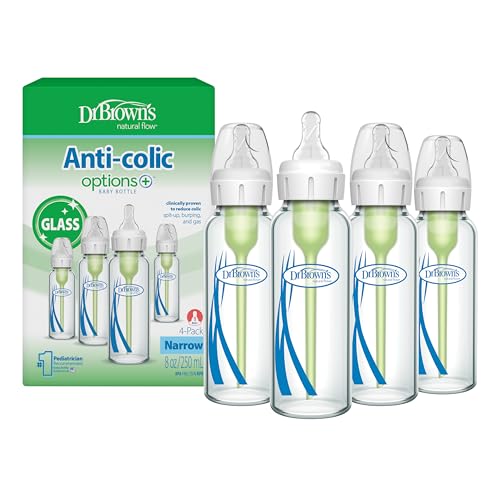
The parent who has a colicky baby who spits up frequently will find the Dr. Brown’s Options+ a lifesaver. Its internal vent system is clinically proven to reduce colic by creating a vacuum-free feeding environment that mimics breastfeeding, so your baby swallows less air. Buyers consistently report that the “anti-colic vent reduces air, gas, spit-up,” and the durable borosilicate glass construction resists thermal shock, meaning you can take it from a hot dishwasher to cold milk without cracking.
The glass retains heat better than plastic, keeping milk warm longer during longer feeds, and it is chemically inert — no worries about microplastics or BPA leaching into your baby’s milk. The downside is the cleaning: the vent system has multiple small parts that need soaking or hand-washing, especially the internal inserts that trap milk residue. However, Dr. Brown’s has designed a removable vent system that allows you to use the bottle without it once your baby outgrows colic, simplifying the bottle over time.
In terms of sheer colic-fighting performance, the Dr. Brown’s leads the pack, but its extra pieces make it the most work to clean. If gas and spit-up are your baby’s primary issues, this is the bottle that delivers results, and the option to remove the vent later adds versatility that the NUK and Avent cannot match.
What stands out
- Clinically proven internal vent system reduces colic
- Durable borosilicate glass resists thermal shock
- Removable vent grows with your baby
The trade-offs
- Vent system requires thorough cleaning with extra parts
- Heavier than plastic bottles, especially when full
4. Gulicola Small Glass Baby Bottle for Newborn Breastfeeding Babies, 3 oz, 2 Pack

For a newborn, the single number that matters most is the nipple flow rate, and the Gulicola scores a 1 (Extra Slow SS) — far slower than the standard Level 1 on the Dr. Brown’s or the medium flow on some kits. This makes it ideal for premature babies, twins who need tiny feeds, or breastfed newborns who are still learning to coordinate sucking and swallowing. At only 3 oz, these are about 2.7 times smaller in capacity than the Dr. Brown’s 8 oz bottles, which is perfect for the first few weeks when babies take just a few ounces per feed.
The trade-off is that the 3 oz bottles are very small, so your baby will outgrow them within two to three months. The borosilicate glass is remarkably tough — buyers report the “glass bottle survived multiple drops in sink and on floor without breaking” — and the nipple shape includes guide points to train a healthy latch. The wide neck makes cleaning easy with just 4 pieces, and the bottle can go in a sterilizer or microwave.
At its price point, the Gulicola offers serious value for the specific use case of a preemie or a very young newborn who needs an ultra-slow flow — it is not a budget bottle for the long haul, but it is the most targeted tool for making breastfeeding work in those critical early weeks.
The upsides
- Extra slow flow nipple prevents gagging in newborns
- Boronsilicate glass survives multiple drops
- Nipple guide points train correct latch habits
Keep in mind
- 3 oz capacity outgrown quickly as baby’s appetite grows
- Only 2 bottles in the pack
5. Evenflo Feeding Classic Glass, Twist Bottles, 4 Oz, 6 Bottles
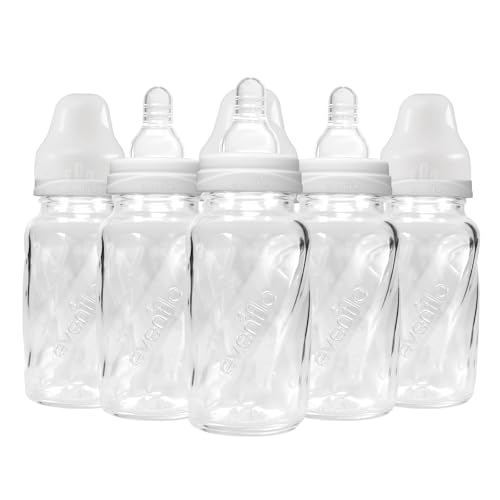
At this lower price point, you get tempered glass that is recyclable and BPA-free, a classic ergonomic twist shape for easy holding, and the ability to pump directly into the bottle from most standard-neck breast pumps. Owners mention the bottles “held up through drops from table height onto LVP” floors, showing surprisingly good durability for the price.
What you give up is any sophisticated anti-colic system — the Evenflo bottles rely on a simple nipple to manage airflow, which may not be enough for a colicky baby. The nipple flow is slow, which some buyers noted, recommending buying faster flow nipples separately as the baby grows. The 4 oz size is great for newborns, but you will likely need larger bottles (like the NUK or Dr. Brown’s) by the time your baby reaches 3-4 months.
This is the perfect choice for a budget-conscious parent who wants a safe, glass bottle without spending a lot. If you are not dealing with severe colic and your baby feeds well, this six-pack will last through the newborn stage with no leaks and easy cleaning — just three pieces per bottle.
Why we’d pick it
- Lowest cost per bottle in this guide — six bottles for a great price
- Ergonomic twist shape is easy to grip while feeding
- Compatible with standard-neck breast pumps for direct pumping
A few caveats
- No separate anti-colic system; venting depends on nipple
- Nipple flow is slow; faster nipples sold separately
6. Pigeon PPSU Nursing Baby Bottle Wide Neck, Anti-Colic, 5 Oz, Pack of 2
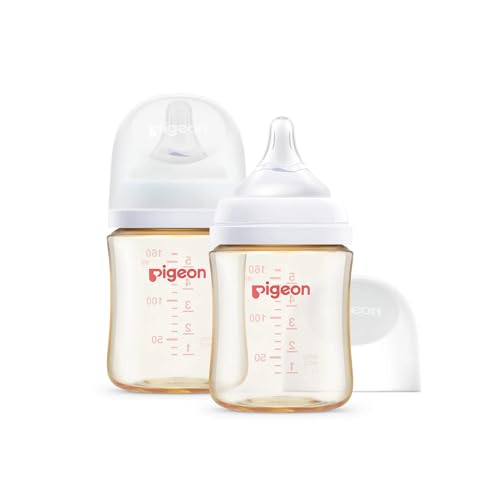
This Pigeon PPSU bottle is perfect for parents of older babies who throw their bottles, or for anyone who wants a lightweight, virtually unbreakable bottle that can handle boiling water and dishwasher cycles without degrading.
What the higher price gets you is research-backed nipple design that replicates the three natural sucking movements of a baby during breastfeeding — the Pigeon nipple is soft and flexible, with a latch-on line to guide proper positioning. Customers note it eased the breastfeeding transition significantly, with faster feeding times and less milk leakage compared to other brands like Dr. Brown’s or Hegen. The SS nipple (0m+) is extra slow, and the wide neck makes filling and cleaning simple.
The one reason to choose Pigeon over the NUK or Avent is if you prioritize unbreakable durability above all else, or if a lactation consultant specifically recommended it for your baby’s latch issues. However, be aware that this premium bottle costs more than glass options from Evenflo and Dr. Brown’s, so it is a bigger upfront investment.
Strong points
- Unbreakable PPSU material survives drops and high heat
- Researched nipple design improves latch and reduces milk leakage
- Extra slow flow nipple (SS) suitable for newborns
Before you buy
- Higher price point than glass options
- Only 2 bottles per pack; fewer than bargain sets
Understanding the Specs
Nipple Flow Rate
This is the speed milk comes out of the bottle, determined by the size and number of holes in the nipple. For a newborn, always start with the slowest flow (Level 1, Slow, or SS). If milk drips out when the bottle is turned upside down without the baby sucking, the flow is too fast. A proper slow flow requires active sucking to release milk, which mimics breastfeeding and prevents overfeeding or choking.
Anti-Colic Vent Systems
These systems reduce air bubbles in the milk by creating a vacuum-free environment. Some bottles use a simple nipple valve (like Philips Avent), while others use a complex internal straw or tube (like Dr. Brown’s). The more effective the system, the fewer pieces to the bottle? Generally, the complex vents are better at reducing colic but require more cleaning steps. Simple vents are easier to clean but may not help a very colicky baby.
Material and Safety
Bottles are made from glass or plastic. Glass is chemically inert, meaning it does not leach chemicals into milk, and it is scratch-resistant, so bacteria cannot hide in scratches. Plastic bottles, especially those made from PPSU (polyphenylsulfone), are lightweight, unbreakable, and can withstand repeated sterilization. Avoid bottles made from polycarbonate (marked with a #7 recycling symbol) as they may contain BPA, a chemical linked to health risks.
Bottle Capacity
Newborns take 1-3 oz per feed, so 4 oz bottles are fine for the first few months. By 3-4 months, most babies take 4-6 oz per feed, and by 6 months, 6-8 oz. A good strategy is to buy a set of smaller bottles for the newborn stage and a set of larger (8 oz) bottles that will last until the baby transitions to sippy cups. Many brands sell both sizes.
FAQ
How often should I replace baby bottle nipples?
Are glass bottles really safer than plastic bottles?
Can I use different brand nipples on the same bottle?
What do I do if my baby refuses a bottle after breastfeeding?
Final Thoughts: The Verdict
For most people, the best bottles for babies winner is the NUK Perfect Match because it combines a breast-like nipple with an effective anti-colic vent and a built-in temperature indicator at a reasonable price for a 4-pack. If you want a bottle that paces your baby’s drinking rhythm like breastfeeding, grab the Philips Avent Natural. And for a colicky baby who needs maximum air reduction, the standout is the Dr. Brown’s Options+ Glass Bottle.