
Our readers keep the lights on and the weekend projects moving. As an Amazon Associate, I earn from qualifying purchases.
A bouldering crash pad is the single most important piece of safety gear you will take to the rocks—it is not a soft play mat or a gym mat, but a specialized, portable landing system engineered to absorb the kinetic energy of a fall from height onto uneven terrain. The wrong pad can mean a rolled ankle, a bruised heel, or worse, while the right one gives you the confidence to commit to a sketchy top-out.
I’m Rikta — the co-founder and writer behind FitlyFast. I’ve spent years analyzing outdoor gear specifications, comparing foam densities, closure mechanisms, and carrying systems to determine which bouldering crash pads deliver the most protection per pound for real-world climbing.
Whether you are projecting highball problems in the backcountry or building a home spray wall, finding the best bouldering crash pad means balancing foam thickness, surface area, and packability for your specific style of climbing.
How To Choose The Best Bouldering Crash Pad
Choosing a crash pad for outdoor bouldering is fundamentally different from buying a gym mat or a kid’s sensory cushion. You need a pad that packs down small enough to hike miles, unfolds into a large enough landing zone to cover rocks and roots, and absorbs repeated hard impacts without transferring force through your ankles.
Foam Construction and Thickness
Dedicated bouldering pads use a hybrid foam system: a firm closed-cell bottom layer to prevent bottoming out on sharp rocks, paired with a softer open-cell top layer that slows deceleration. The critical number is total thickness. For outdoor bouldering, look for at least four inches of total pad depth; any thinner and you risk injury from a high fall onto an uneven surface. The cheapest crash pads often use a single layer of stiff EPE foam that is fine for a gym floor but inadequate for real rock.
Fold Style and Hinge Design
There are three main folding configurations: single-fold (a simple hinge in the middle), tri-fold (two hinges that allow the pad to fold into a compact backpack shape), and hinged foam panels with overlapping closure flaps. Tri-fold pads offer the best portability and often the largest surface area when fully open. The hinge system is critical—if the pad folds in a way that leaves a gap between the hinges when placed on sloping terrain, that gap becomes an ankle trap. Look for pads with tuck-tab designs or double-layer hinges that eliminate the gap between panels.
Carrying System and Portability
You will carry your crash pad across parking lots, up steep trails, and sometimes between boulders half a mile apart. The carrying system matters as much as the foam. Look for padded backpack straps with a waist belt and a sternum strap—this system transfers the pad’s weight off your shoulders and onto your hips. Also consider non-slip shoulder straps (smooth webbing slips on loose shirts) and the presence of gear loops or daisy chains for clipping chalk bags and shoes. Some pads include duffel-style side handles for short carries or loading vehicles, which is a thoughtful bonus.
Quick Comparison
On smaller screens, swipe sideways to see the full table.
| Model | Category | Best For | Key Spec | Amazon |
|---|---|---|---|---|
| Meister Boulder Beast XL Tri-Fold | Tri-Fold | Highball outdoor bouldering | 72” x 44” x 5” – 4-layer foam | Amazon |
| Metolius Session Pad II | Single-Fold | Lightweight crag missions | 36” x 48” x 4” – 9 lbs | Amazon |
| Cheer Collection Crash Pad | Sensory Pad | Home spray wall / gym use | 48” x 48” – high-density foam | Amazon |
| WOUDY Crash Mat | Sensory Pad | Indoor sensory & gym area | 5 ft – high-density PU foam | Amazon |
| JOYWOO Crash Pad | Sensory Pad | Large indoor play space | 48” x 48” x 14” – shredded foam | Amazon |
| GYMMALL Crash Sensory Pad | Sensory Pad | Safe fall zone at home | 5 cm EPE mat + foam pellets | Amazon |
| SaferBounce Crash Pad | Sensory Pad | Kids active play / therapy | 4 ft x 3 ft – high-density foam | Amazon |
| FBSPORT Crash Sensory Pad | Sensory Pad | Lightweight sensory room use | 4 ft x 3 ft – 4” EPE layer | Amazon |
| Homewell Crash Pad | Sensory Pad | Soft landing for toddlers | 5 ft x 5 ft x 12” – 37 lbs | Amazon |
In‑Depth Reviews
1. Meister Boulder Beast XL Tri-Fold Rock Climbing Crash Pad

The Meister Boulder Beast XL is a serious tool for serious bouldering, measuring a massive 72 inches by 44 inches with a full five inches of four-layer hybrid foam. This tri-fold design offers the largest landing zone in this roundup, covering uneven ground at the base of highball problems without needing a second pad to plug gaps.
The foam layering strategy combines open and closed cells to manage both the initial impact and prevent the pad from bottoming out on sharp rocks. The reinforced all-weather polyester outer skin shrugs off dirt, brush, and light rain, and the large hook-and-loop side flaps let you link multiple pads together for even more coverage on exposed landings.
The removable backpack straps include a waist belt and chest strap, making the 27-pound pad manageable for longer approaches. Integrated gear loops let you clip your shoes, chalk bag, and water bottle directly to the pad. The padded duffel-style handles are a nice touch for quick carries between boulders without strapping on the full harness.
Why it’s great
- Five-inch total thickness with layered open/closed cell foam provides premium impact absorption
- Tri-fold design packs into a compact backpack shape for easy transport
- All-weather polyester cover with reinforced stitching handles rough outdoor terrain
- Side flaps with hook-and-loop fasteners allow linking to other pads
Good to know
- At 27 pounds it is heavier than a small single-fold pad
- The tri-fold hinge design leaves a small gap between panels when opened on uneven ground
2. Metolius Session Pad II

The Metolius Session Pad II is the quintessential lightweight option for climbers who value speed and simplicity on approach-heavy days. It measures 36 inches by 48 inches at four inches thick and folds in half to a carry-friendly 36 by 26 by 8 inches, weighing just nine pounds.
The closed-cell foam is notably firm from the factory and requires deliberate break-in—usually two to three outdoor sessions—before it softens to its full cushioning potential. This firmness gives it excellent resistance to bottoming out on small rocks, but it means the first few landings can feel harder than expected.
The carrying system includes padded shoulder straps, a detachable waist belt, and suitcase-style handles. The integrated cross-clipper logo rug provides a small dedicated spot to clean your climbing shoes before a boulder problem, a thoughtful detail that keeps the pad itself clean. The single-fold design eliminates hinge gaps that plague some tri-fold pads.
Why it’s great
- Extremely lightweight at 9 lbs for long approach walks
- Single-fold hinge design leaves no ankle gap on uneven ground
- Durable polyester cover resists tears from gravel and sharp bushes
- Integrated shoe cleaning rug is a practical addition for outdoor sessions
Good to know
- Foam is very stiff when new and requires a break-in period
- At 4 inches thick, it offers less cushion than thicker premium pads
3. Cheer Collection Crash Pad
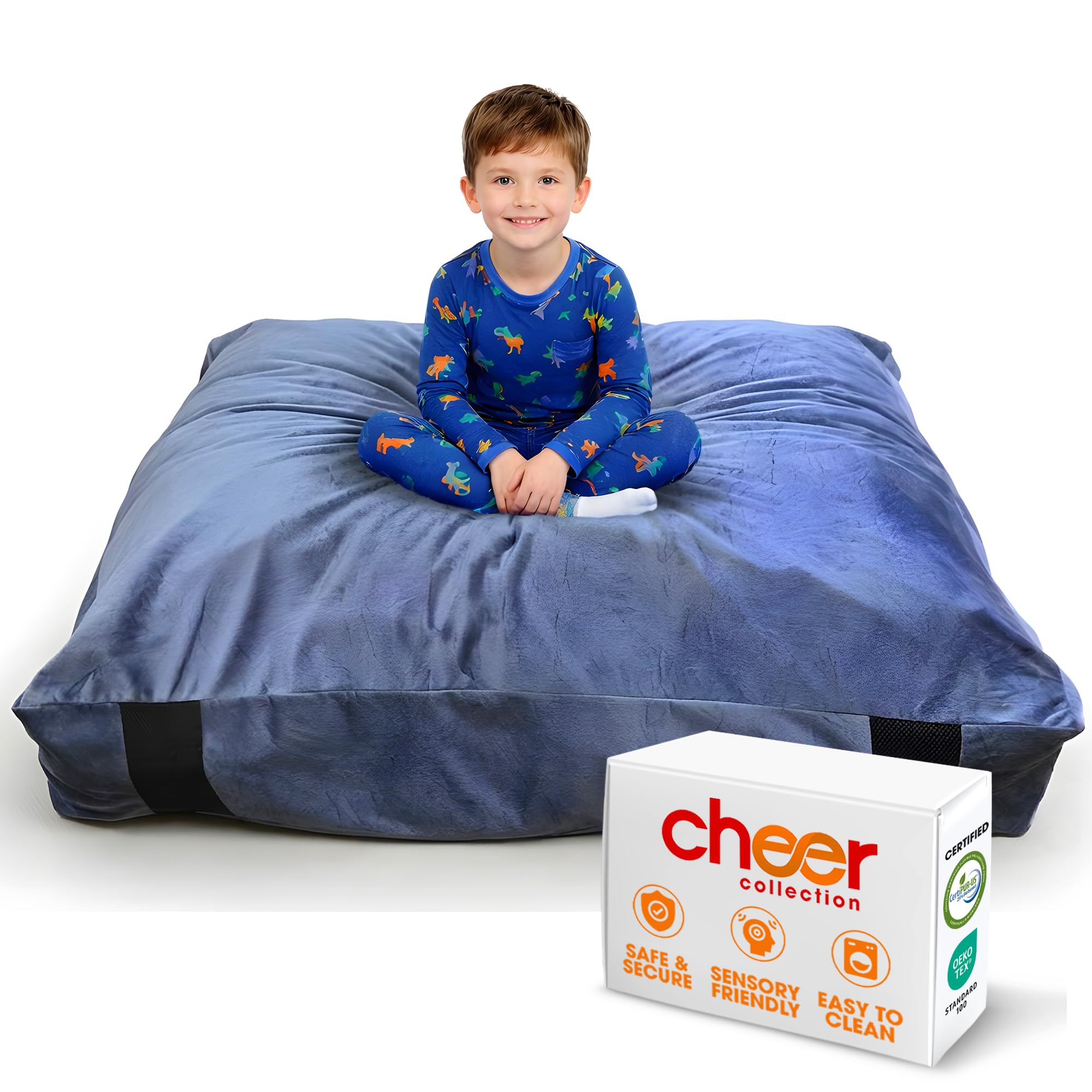
The Cheer Collection Crash Pad is a premium sensory-style pad that works extremely well as a landing zone for a home spray wall or indoor climbing area. It measures 48 by 48 inches and uses high-density shredded foam pieces that provide a soft, supportive surface without being overly bouncy.
Mesh vents on the sides allow controlled air release with each impact, preventing the pad from feeling like a sealed air bag and reducing feedback on fast landings. The removable outer cover is machine-washable, which is a practical feature for pads that live in a basement or garage where dust and chalk accumulate.
This pad is not designed for outdoor bouldering—it lacks backpack straps, a folding hinge, and the tough outer shell needed to handle gravel and sharp rock. However, for indoor use as a crash mat for climbing training, it provides an excellent combination of safety, comfort, and durable construction.
Why it’s great
- High-density shredded foam provides soft yet supportive landing surface
- Machine-washable cover makes cleaning easy for indoor use
- Mesh vents allow controlled air release for stable landings
- Large 4×4 ft size gives a wide landing zone for spray wall falls
Good to know
- Not portable for outdoor climbing — no backpack straps or folding hinge
- Outer cover is not rugged enough to resist tears on sharp rock
4. WOUDY Crash Mat 5 ft
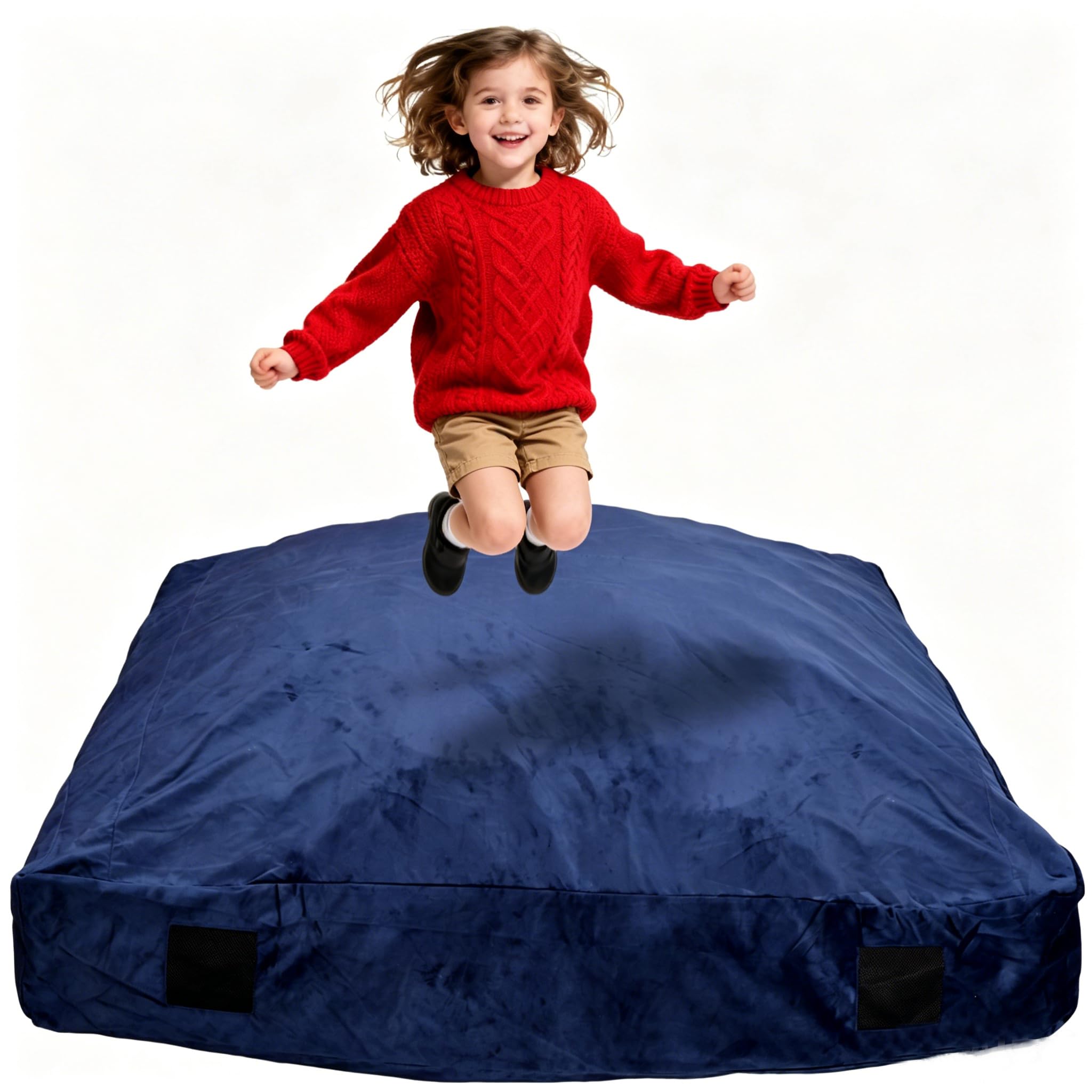
The WOUDY Crash Mat is a large 5-foot square sensory pad built with high-density polyurethane foam blocks encased in a durable blue polyester cover. It offers a generous landing area that can cover a home spray wall fall zone without breaking the bank.
Four mesh ventilation ports release air gradually on impact, giving the pad a controlled, non-bouncy feel that mimics the damping of a premium gym floor mat. The PU foam blocks hold their shape well over repeated use, and the cover has a hidden zipper for machine washing.
This pad is best suited for indoor climbing areas, therapy spaces, or general active play—the foam density and lack of a rigid outer frame mean it does not offer the rock-protection of a dedicated outdoor bouldering pad. But for its price point, it delivers a surprisingly thick and durable surface for at-home training falls.
Why it’s great
- Large 5 ft square provides ample coverage for home spray wall landings
- High-density PU foam blocks maintain shape and support over time
- Mesh vents give a stable, non-bouncy landing feel
- Machine-washable cover with hidden zipper simplifies maintenance
Good to know
- Not designed to handle sharp rocks or abrasive outdoor terrain
- No carrying straps or folding mechanism for portability
5. JOYWOO Crash Pad 4×4 ft
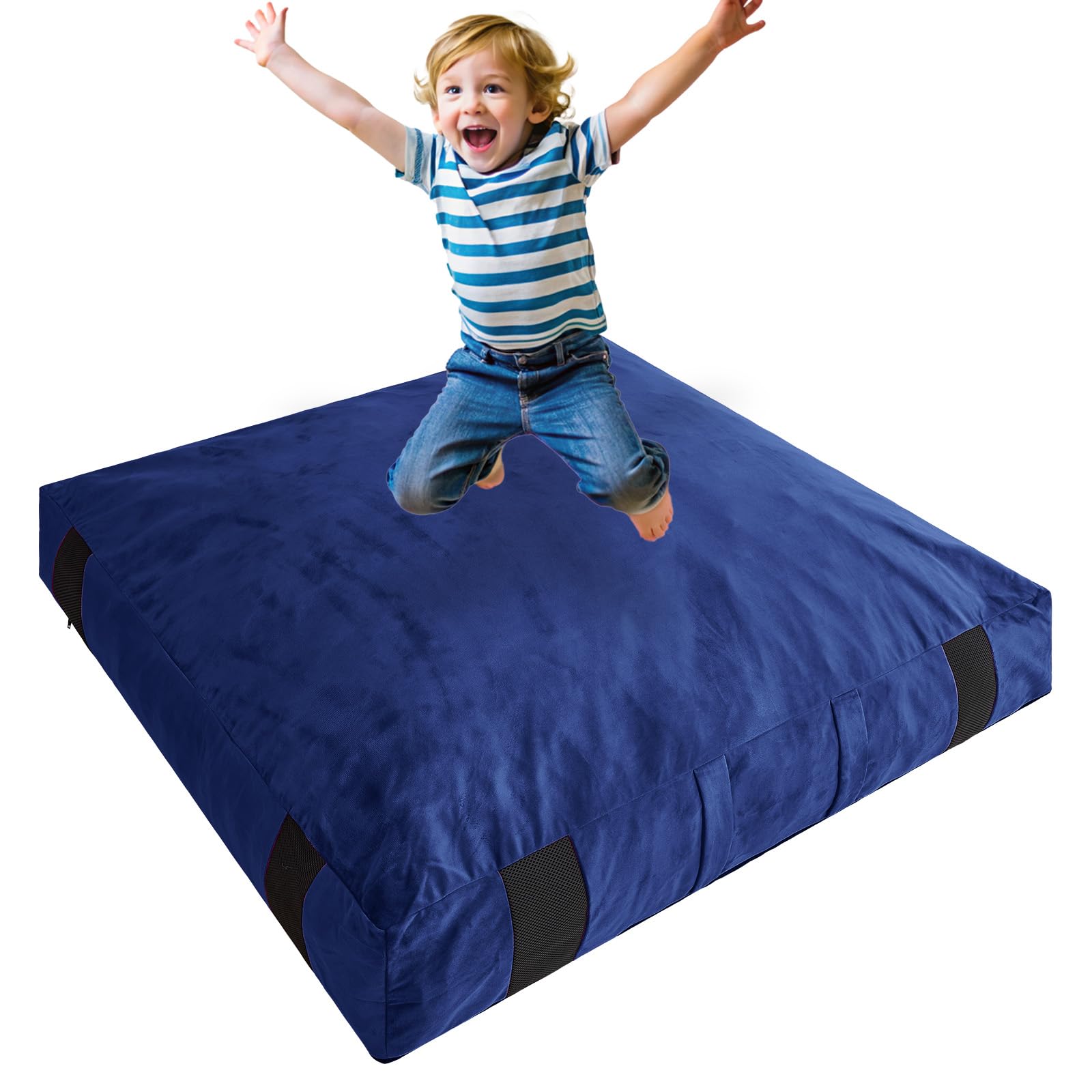
The JOYWOO Crash Pad is a generously thick 14-inch sensory-style pad filled with shredded foam and wrapped in a soft microfiber cover. While it targets sensory play rather than outdoor bouldering, its extreme thickness makes it a compelling option for any landing zone where maximum absorption is the priority.
The shredded foam construction conforms to the body on impact, distributing force over a wider surface area than block foam. The pad includes four reinforced handles for moving between rooms and a non-slip bottom that keeps it in place during active use. At 48 inches square, it provides a fairly compact footprint.
This pad is best used as a thick crash mat for a home gym, a yoga studio, or a safe play area. The microfiber cover is soft to the touch but not rugged enough for outdoor rock. The pad also does not fold, which makes storage a challenge if floor space is tight.
Why it’s great
- 14-inch thickness provides exceptional impact absorption for high falls
- Shredded foam conforms to the body for a cushioned, supportive landing
- Reinforced handles allow easy relocation around the home
- Non-slip bottom keeps the pad stable on smooth floors
Good to know
- Cannot fold or compress for compact storage
- Microfiber cover is not durable enough for outdoor climbing use
6. GYMMALL Crash Sensory Pad 5’x5′

The GYMMALL Crash Sensory Pad stands out among indoor crash pads because of its integrated 5cm EPE foam mat layer that rests beneath the shredded foam filling. This dual-layer design gives the pad a firm base that resists bottoming out on hard floors while the shredded top layer absorbs the direct impact.
Small EPE pellets make up the top filling, providing a dense, slightly heavy feel that does not shift as much as larger foam blocks. The outer cover is a water-resistant nylon with double-stitched seams—significantly tougher than the standard polyester found on most sensory pads.
This pad is a strong choice for a home spray wall or gymnastics area where users will be jumping from height. The built-in EPE layer ensures that when a climber or gymnast lands hard, the force is dissipated across the firm mat rather than punching straight through to the floor.
Why it’s great
- Built-in 5 cm EPE foam mat provides a firm base that prevents bottoming out
- Small EPE pellets offer dense, stable filling that resists shifting
- Water-resistant nylon cover with double-stitched seams is tougher than typical sensory pads
- Removable cover is machine-washable for easy maintenance
Good to know
- Not designed for outdoor bouldering — lacks backpack straps and hinge
- Filling can feel lumpy if not allowed to fully expand after unboxing
7. SaferBounce Crash Pad 4×3 ft
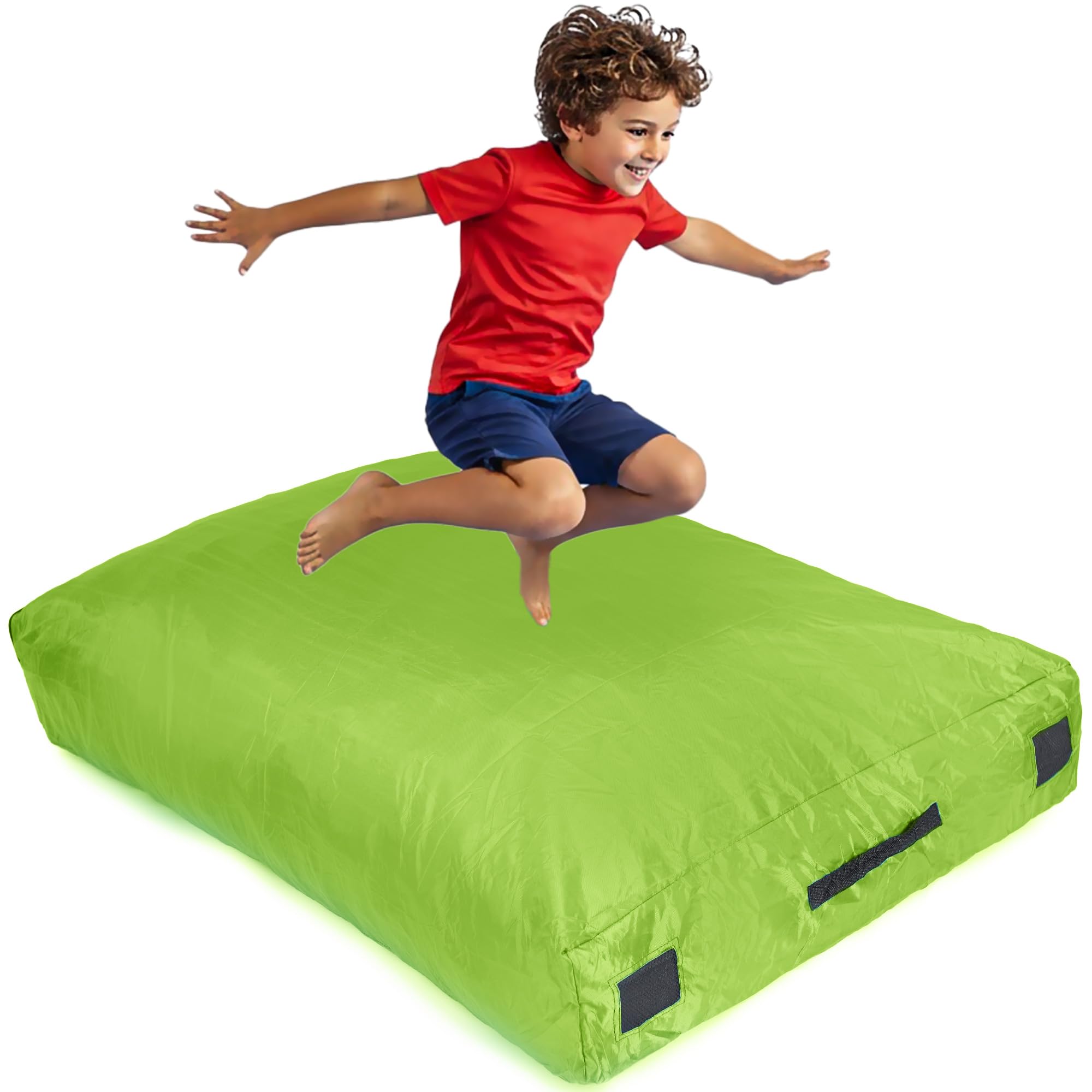
The SaferBounce Crash Pad is a compact 4×3 foot sensory pad filled with high-density foam blocks and covered in a removable, machine-washable green cover. Its small footprint makes it easy to fit into tight corners of a playroom or between climbing gym equipment, and the foam blocks absorb impact well for a pad in this price bracket.
The foam arrives vacuum-sealed and requires several hours to fully expand—users report the cover is slightly tedious to install but fits snugly once in place. The pad is lightweight enough for a child to drag around the house, and the cover’s surface is soft but has a slick texture that some kids prefer using without the cover for extra grip.
This pad is not suitable for outdoor bouldering. The cover is not rugged enough for rock, and the small size provides an insufficient landing zone for any fall from height. It works best as an introductory crash mat for young climbers or as a general play safety mat for indoor use.
Why it’s great
- Compact 4×3 ft size fits easily in small playrooms or home gyms
- High-density foam blocks absorb impact effectively for its size class
- Machine-washable cover is easy to maintain
- Lightweight enough for children to move around the house
Good to know
- Small surface area is inadequate for outdoor bouldering or adult falls
- Cover material is slick — some users prefer using the pad without it
8. FBSPORT Crash Sensory Pad 4×3 ft
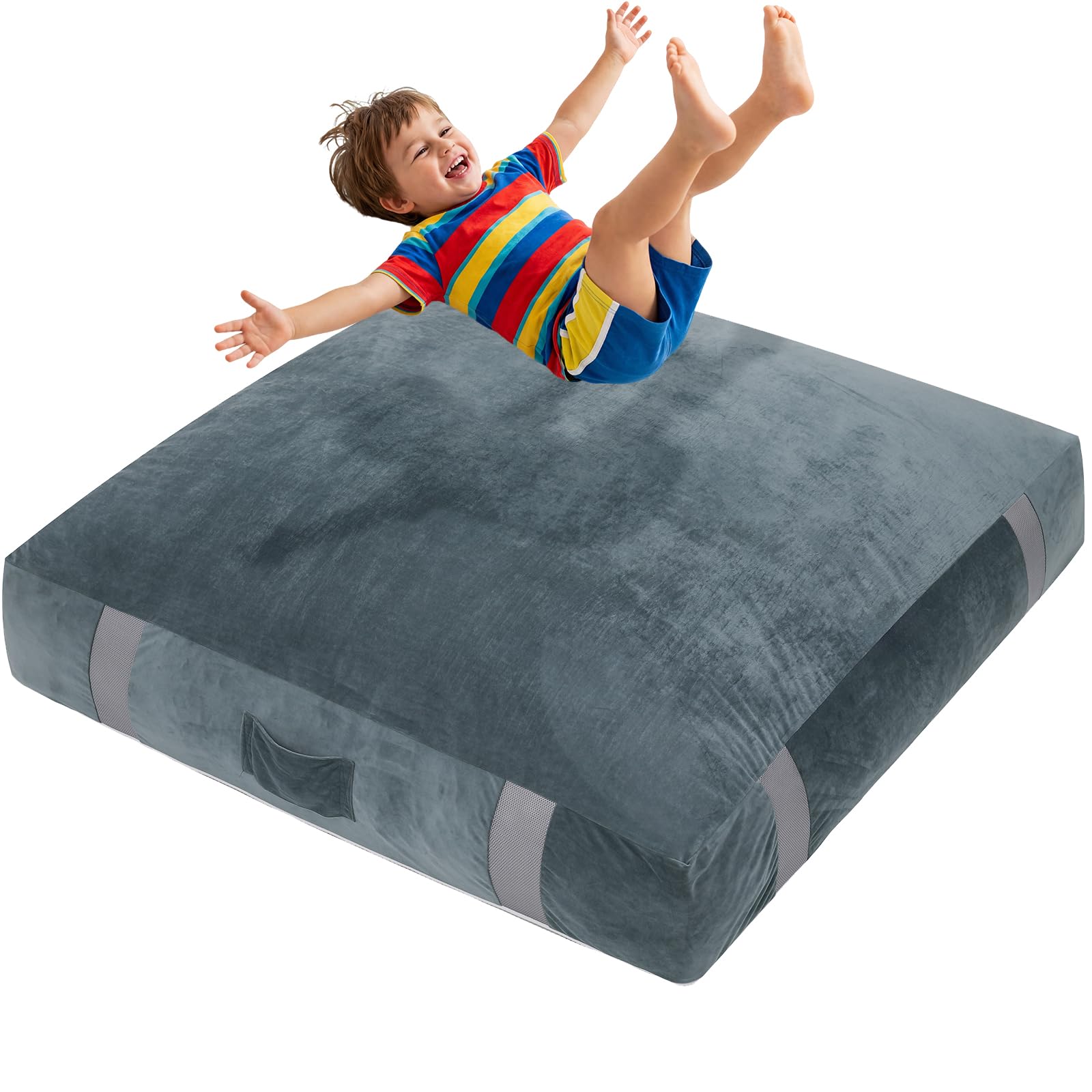
The FBSPORT Crash Sensory Pad brings a built-in 4-inch EPE foam layer beneath its shredded foam filling, offering a surprising amount of support for an entry-level price point. The 4×3 foot size is modest, but the EPE base prevents the user from bottoming out on hard surfaces in a way that cheaper shredded-foam-only pads do not.
The outer velvet cover is soft to the touch and features a hidden zipper for easy removal and machine washing. Mesh vents along the sides allow the EPE foam to rebound quickly between impacts, reducing heat buildup during extended play sessions. The pad comes vacuum-sealed and requires manual fluffing to distribute the foam blocks evenly.
This pad is best suited for sensory therapy rooms, school settings, or as a small crash mat for a child’s home climbing bar. It is not built for outdoor bouldering—the cover is too soft and the surface area too small—but for indoor use where the priority is fall safety on a budget, it delivers reliable coverage.
Why it’s great
- Built-in 4-inch EPE layer prevents bottoming out on hard flooring
- Soft velvet cover is comfortable and machine-washable
- Mesh vents promote airflow and quick foam rebound
- Lightweight at 18 lbs for easy indoor portability
Good to know
- 4×3 ft size is too small for adult bouldering or outdoor use
- Foam blocks require manual fluffing after opening to distribute evenly
9. Homewell Crash Pad 5×5 ft
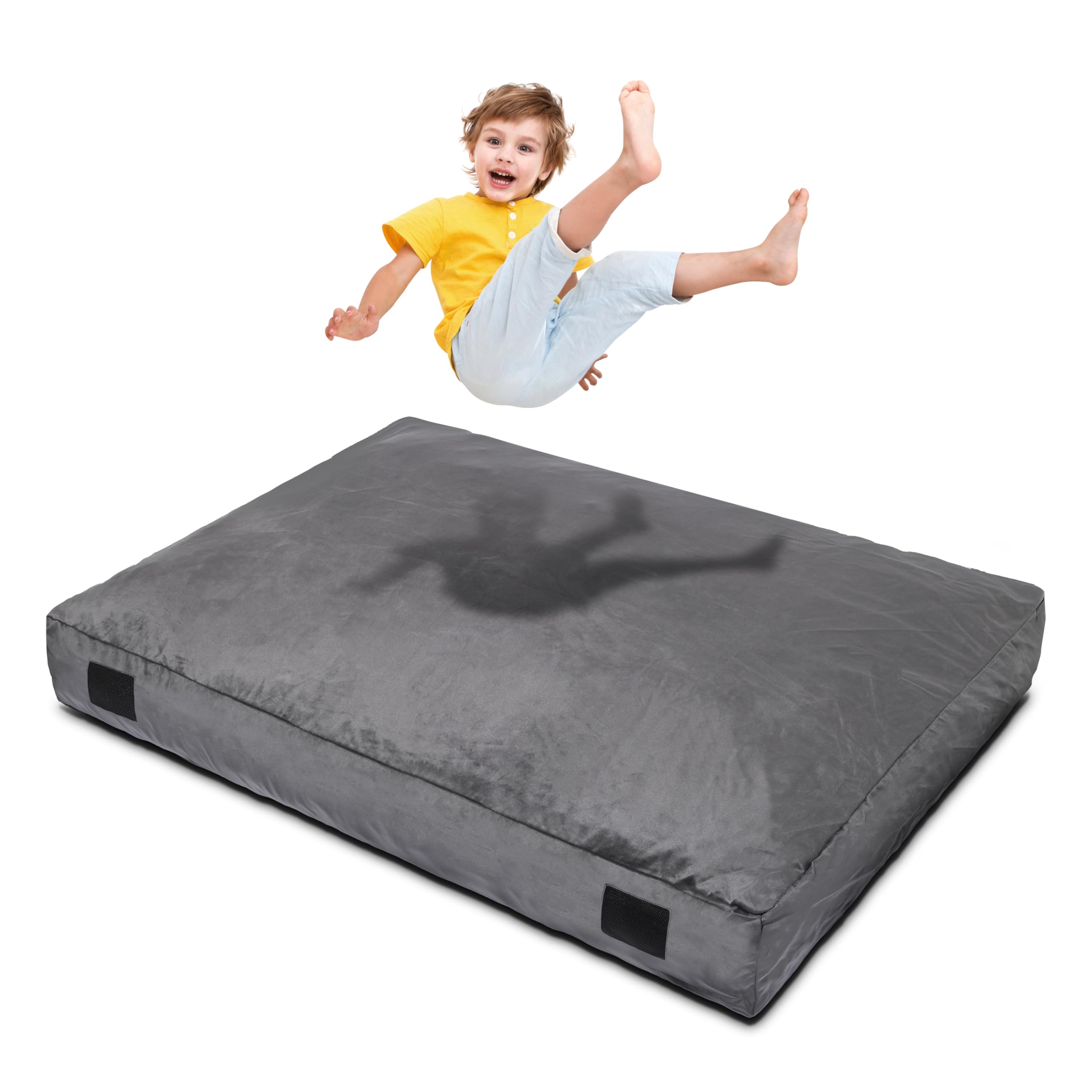
The Homewell Crash Pad is a massive 5×5 foot sensory pad with a 12-inch thickness, making it the deepest pad in this entire list. Its generous dimensions and deep fill make it a fantastic landing mat for toddlers and young children who need a large, forgiving surface for active play, climbing, or sensory integration.
The dual-layer cover combines a soft velvet top with a durable oxford fabric bottom, and the waterproof inner polyester liner protects the foam from accidents. Four mesh vents maintain airflow to keep the pad cool during extended use, and the hidden zipper hood creates a polished, finished look.
At 37 pounds, this pad is the heaviest on the list and lacks any carrying straps or a folding mechanism, making it essentially a stationary piece of equipment. It is not suitable for outdoor bouldering or climbing gym use, but for a family with a dedicated playroom or therapy space, the Homewell pad provides an extremely safe and comfortable crash zone.
Why it’s great
- 12 inches of foam depth offers exceptional impact cushioning for children
- Large 5×5 ft landing zone covers a wide play area
- Velvet top layer is soft and comfortable for lounging and crashing
- Waterproof inner liner protects foam from spills and accidents
Good to know
- Very heavy at 37 pounds with no carrying straps or handles for portability
- Not designed for outdoor bouldering or climbing falls from height
FAQ
Is a sensory crash pad the same as a bouldering crash pad?
How thick should a bouldering crash pad be for outdoor use?
What is the ankle gap problem with tri-fold crash pads?
Final Thoughts: The Verdict
For most users, the best bouldering crash pad winner is the Meister Boulder Beast XL Tri-Fold because it combines a massive 72×44 inch landing zone with five inches of premium layered foam and a sturdy carrying system that handles real approaches. If you want a lightweight, gap-free pad for fast missions, grab the Metolius Session Pad II. And for an indoor home spray wall, nothing beats the Cheer Collection Crash Pad for sheer durability and washability.