
Our readers keep the lights on and the weekend projects moving. As an Amazon Associate, I earn from qualifying purchases.
Tracking blood pressure at home removes the guesswork from managing your cardiovascular health. A quality monitor provides consistent, reliable data that helps you and your doctor spot trends, adjust medication, and avoid the pitfalls of “white coat syndrome” — where anxiety in a clinical setting artificially inflates readings.
I’m Rikta — the co-founder and writer behind FitlyFast. My research for this guide involved analyzing technical specs, user feedback, and clinical accuracy data across dozens of models to find the monitors that deliver trustworthy results for daily home use.
Whether you want simple readings, smart app tracking, or advanced detection features, choosing the right device means focusing on cuff fit, validated accuracy, and ease of use. This guide details the best bp monitor for home use across different needs and budgets.
How To Choose The Best BP Monitor For Home Use
Not every blood pressure monitor delivers the same accuracy. Three factors separate a reliable home device from a frustrating one: cuff fit, clinical validation, and usability. Ignore these, and you risk trusting numbers that don’t reflect your true health.
Cuff Size and Fit
The single biggest source of error in home BP monitoring is the wrong cuff size. Too small inflates your reading; too large deflates it. Measure the circumference of your upper arm mid-bicep. Most standard cuffs fit 8.7–16.5 inches, but if your arm is smaller or larger, look for monitors offering extra-small or XL cuff options.
Clinical Validation and Accuracy Protocols
Look for models validated by organizations like the British Hypertension Society (BHS), European Society of Hypertension (ESH), or FDA clearance. Advanced features like Microlife’s MAM (Averaging Mode) take three consecutive readings and average them, reducing variability. Omron’s AFib detection adds another layer by flagging irregular heart rhythms during measurement.
Data Management and Ease of Use
A clear, backlit display matters — especially for seniors. Multi-user memory (120+ readings per user) eliminates manual logging. Bluetooth sync with a companion app turns raw data into trend charts you can share with your doctor. Avoid models with small buttons or confusing menu navigation if simplicity is your priority.
Quick Comparison
On smaller screens, swipe sideways to see the full table.
| Model | Category | Best For | Key Spec | Amazon |
|---|---|---|---|---|
| Omron Gold BP5360 | Premium | AFib detection & app tracking | AFib detection, 9-17″ cuff | Amazon |
| Greater Goods Bluetooth | Mid-Range | Wirecutter pick & app integration | 8.7-16.5″ cuff, backlit LCD | Amazon |
| Microlife Series 800 | Mid-Range | Averaging mode for stability | MAM tech, 8.7-16.5″ cuff | Amazon |
| Urion U80A | Mid-Range | Large LED display for seniors | 4.5″ LED, 199-reading memory | Amazon |
| A&D Medical UA-767PSAC | Premium | Small arms & quiet operation | Small cuff 6.3-9.4″, AC adapter | Amazon |
| VOLUETH Pediatric 3-Cuff | Budget | Family & pediatric monitoring | 3 cuffs (4-17″), USB-C power | Amazon |
| Acenis AOJ-30F | Budget | Simple, low-cost tracking | Large color screen, 3-user | Amazon |
In‑Depth Reviews
1. Omron Gold Blood Pressure Monitor BP5360
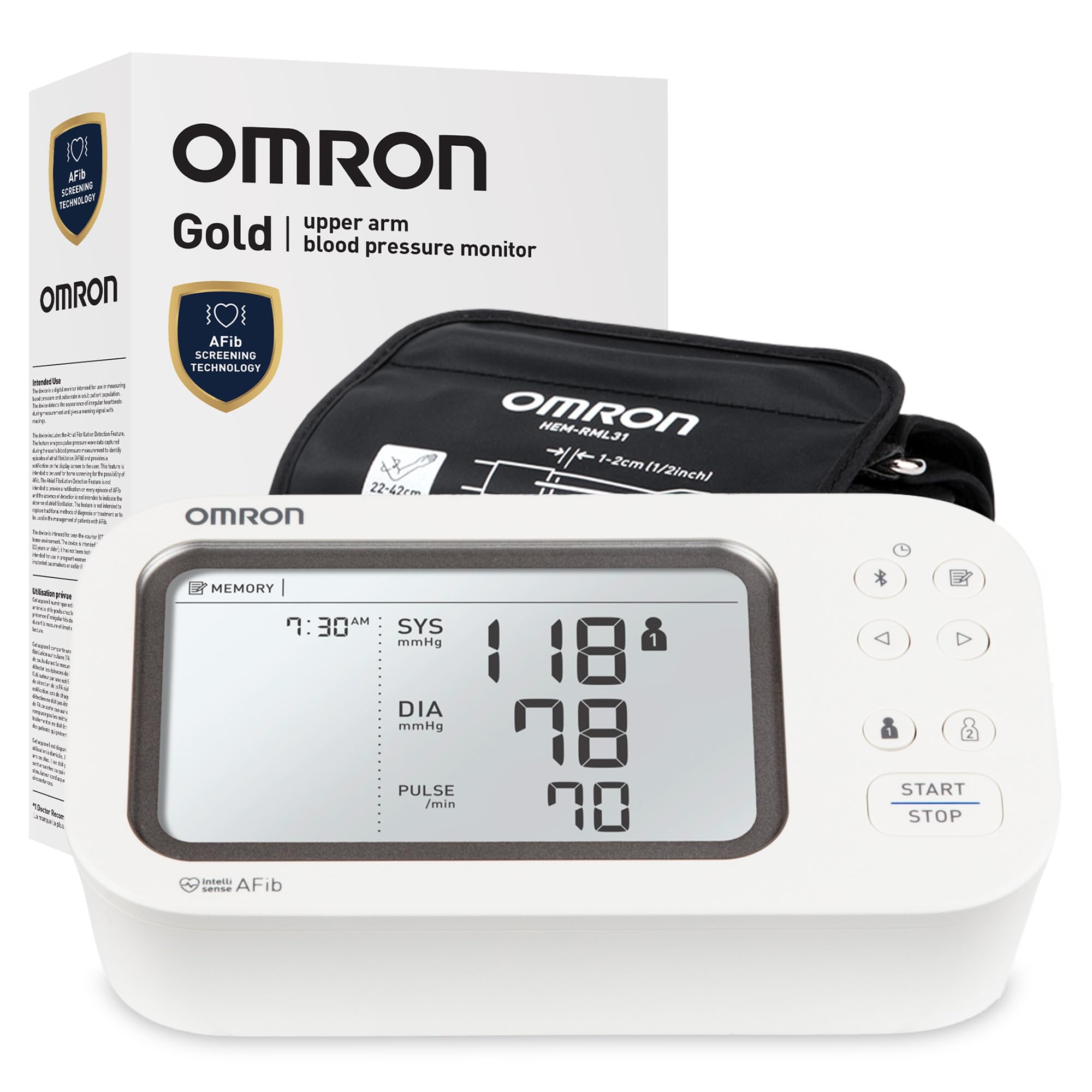
The Omron Gold BP5360 is the most feature-rich monitor on this list, backed by the brand most trusted by doctors. Its standout feature is atrial fibrillation detection during every reading — a crucial early warning system for irregular heart rhythms. The Bluetooth sync to the Omron Connect app turns raw numbers into shareable trend reports, and the wide-range 9–17 inch D-ring cuff accommodates most arm sizes comfortably.
This model also includes a High Morning Average Indicator, alerting you to blood pressure spikes linked to elevated cardiovascular risk. The quiet pump operation and bright screen make it unobtrusive for daily use. Dual user profiles with unlimited app storage allow two people to track independently without confusion.
Be aware that the AFib detection feature can prevent the device from displaying a reading if an irregular rhythm is detected — some users with known AFib found this frustrating. Customer reports of inconsistent readings exist, though most reviews praise its consistent accuracy. It is best suited for users who want medical-grade data sharing capabilities.
Why it’s great
- Clinically validated AFib detection at home
- Seamless app integration with unlimited history
- High Morning Average Indicator for risk monitoring
Good to know
- AFib detection blocks reading display — potential issue for arrhythmia patients
- Some users report variance from office readings
2. Greater Goods Bluetooth Smart Blood Pressure Monitor
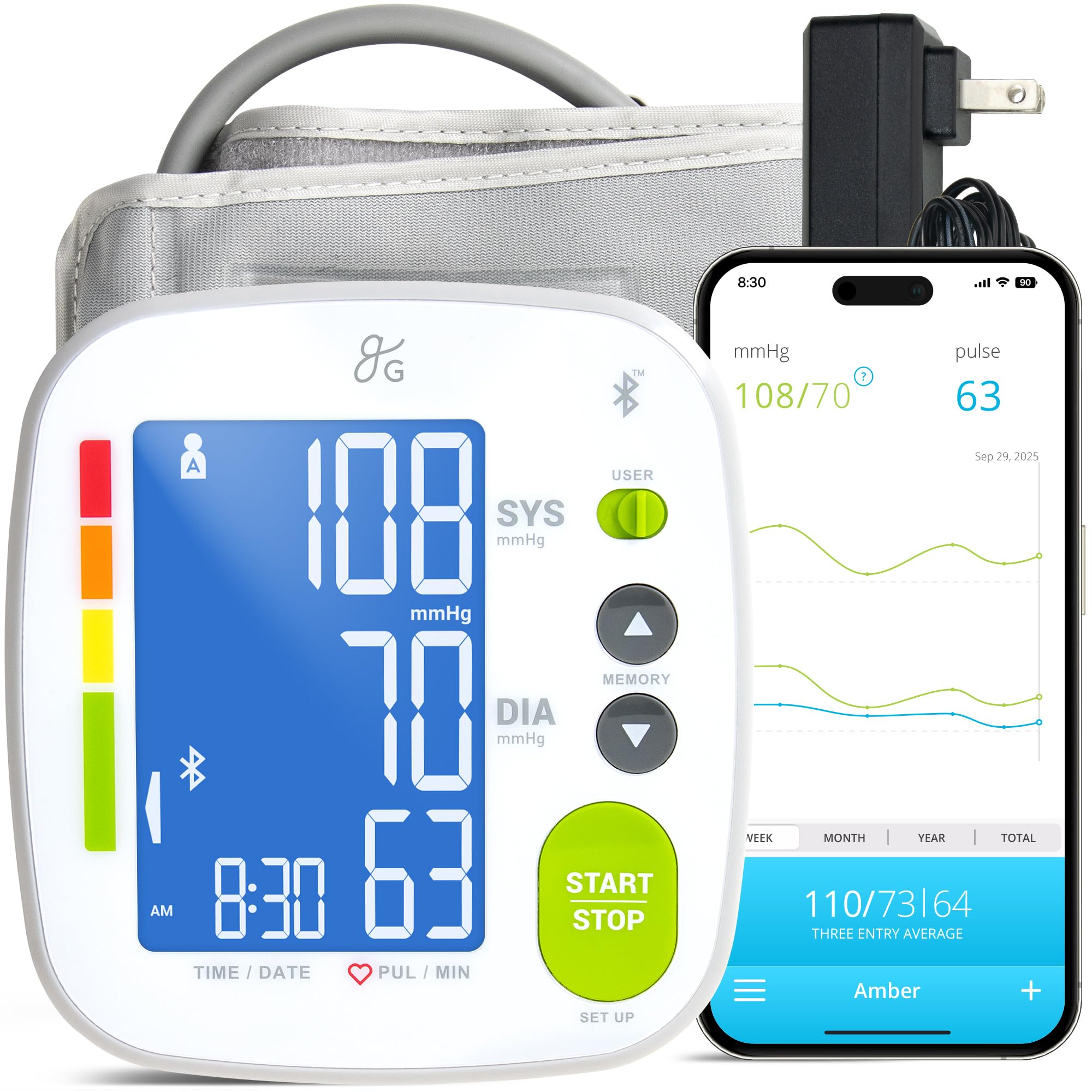
Five-time Wirecutter pick, the Greater Goods monitor has earned its reputation through consistent accuracy and thoughtful design. The large backlit display makes readings legible from across the room, and the included travel case and AC adapter mean you can keep it plugged on your nightstand. The Balance Health app integrates with Apple Health, enabling long-term trend tracking across your ecosystem.
The 8.7–16.5 inch cuff includes an artery alignment guide to reduce placement errors — a common source of incorrect readings. Built-in memory stores 60 readings per user (120 total) even without Bluetooth, so your data is never lost if you forget your phone. Compatible smaller and larger cuff options are available through the support team.
Some users noted the A/B user toggle can be confusing — pressing the wrong button syncs the wrong data. The start button is also vulnerable to accidental activation when stored. Overall, this is the best balance of smart features and ease of use for most households.
Why it’s great
- Wirecutter top pick for five consecutive years
- Large backlit display with bold numbers
- Syncs with Apple Health for comprehensive tracking
Good to know
- A/B user toggle placement can cause data misalignment
- Start button position makes accidental inflation possible
3. Microlife Series 800 Smart Upper Arm Monitor

Microlife’s MAM (Microlife Averaging Mode) sets this monitor apart — it automatically takes three measurements in succession and calculates the average, filtering out single-read anomalies. This is especially valuable for people whose readings fluctuate due to anxiety or movement. The Series 800 is clinically validated for accuracy even in diabetic patients, adding a layer of credibility few competitors match.
The wide-range cuff fits arms 8.7–16.5 inches, and a larger XL cuff is available separately for arms up to 20.5 inches. Bluetooth sync with the Microlife app allows you to store unlimited readings and generate PDF reports for your doctor. Two user slots hold 120 readings each, plus a guest mode for occasional measurements without cluttering your data.
Some users report that systolic readings run 5–10 points higher than other machines, suggesting potential calibration variance. The arm band can feel large for slender arms, and the dual-power option (batteries or AC adapter) is convenient but the adapter plug is bulky. For users wanting averaged reliability, this is a strong mid-range option.
Why it’s great
- MAM averaging mode reduces reading variability
- Clinically validated for diabetic patients
- Bluetooth app exports PDF reports for doctors
Good to know
- Systolic may read high for some users
- Wide cuff can be loose on very thin arms
4. Urion U80A Blood Pressure Monitor
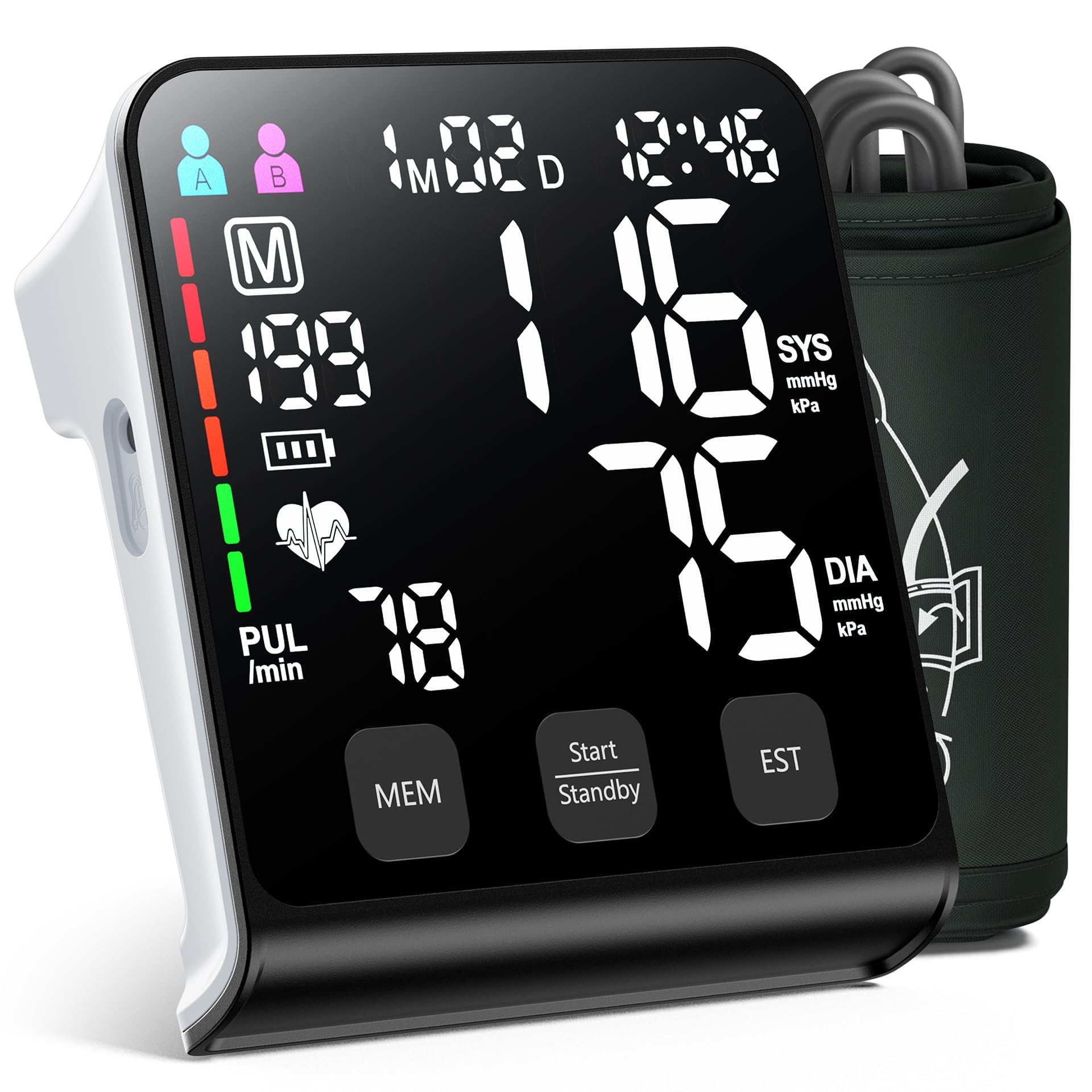
The Urion U80A prioritizes visibility above all else. Its 4.5-inch LED screen delivers oversized, bright digits that are readable even without glasses — a genuine advantage for seniors or anyone with declining vision. The blood pressure classification bar (green/yellow/red) offers an instant visual interpretation of your reading, removing the need to remember what numbers mean.
One-button operation simplifies the process: wrap, press, and read results in seconds. The dual user memory stores up to 199 readings per user, and the adjustable cuff accommodates a range of arm sizes. Powered by 4 AAA batteries or USB-C, this monitor works on the road or plugged next to your bed. It’s also FSA/HSA eligible, making it a practical investment.
Accuracy is rated within ≤±3mmHg for pressure, and the scratch-resistant acrylic panel adds durability. However, this unit lacks Bluetooth — there is no app sync or trend graphing. It is a straightforward, high-visibility monitor for users who prefer simplicity over digital features.
Why it’s great
- Massive 4.5-inch LED display with color coding
- One-button operation, ideal for seniors
- USB-C and battery dual power options
Good to know
- No Bluetooth or app connectivity
- Memory limited to 199 readings total
5. A&D Medical UA-767PSAC Blood Pressure Monitor

The A&D Medical UA-767PSAC is a purpose-built solution for people with smaller arms — its included cuff fits 6.3–9.4 inches (16–24 cm), a range that standard cuffs miss. This matters because cuff misfit is the primary cause of inaccurate readings at home. The device is quiet during operation, compact, and runs on 4 AA batteries or the included detachable AC power cord.
One-button inflation and deflation make it extremely simple to use, and the large LCD results screen prioritizes clarity. The monitor has been on the market since 2005 and remains a consistent performer, with many users reporting it matches the readings taken by clinical staff. It features irregular heartbeat detection as a basic safety check.
Accuracy is occasionally questioned — a small number of users noted readings that did not match their doctor’s equipment. The cuff is specific to small arms, so it won’t suit most adults with standard arm circumference. For its target user (someone with slender arms needing reliability), this is an excellent specialized choice.
Why it’s great
- Specific small cuff for accurate readings on slender arms
- Very quiet operation for unobtrusive use
- Includes AC adapter for consistent power
Good to know
- Small cuff only — not suitable for standard arm sizes
- Some user reports of accuracy variance vs. clinic readings
6. VOLUETH Pediatric Blood Pressure Monitor 3-Cuff Set

The VOLUETH monitor solves one of the biggest challenges in home BP monitoring: fitting multiple arm sizes across a family. It comes with three cuffs — small (4–8 inches), medium (6–10 inches), and large (7–17 inches) — enabling accurate readings for children, teenagers, and adults. The upgraded ASP (Accurate Signal Processing) technology aims to provide fast, consistent results in around 30 seconds.
Two user modes store up to 300 readings each, with date and time stamps and a last-3-group average function. The LCD backlight makes readings clear in any light, and the one-button start keeps operation simple. Dual power via 2 AAA batteries or USB-C (cable included) adds flexibility, and the included carry bag makes transport convenient.
Some users reported that the supplied AAA batteries were dead on delivery, though the unit works when plugged in. The pediatric focus means the medium/large cuffs may not fit very large adult arms. For households with kids needing regular monitoring, this is the most versatile and affordable option.
Why it’s great
- Three cuff sizes for the whole family from children to adults
- Fast 30-second readings with signal processing tech
- USB-C power for travel and home use
Good to know
- Supplied batteries may be dead; use USB-C power immediately
- Largest cuff may not suit very large adult arms
7. Acenis Blood Pressure Monitor AOJ-30F
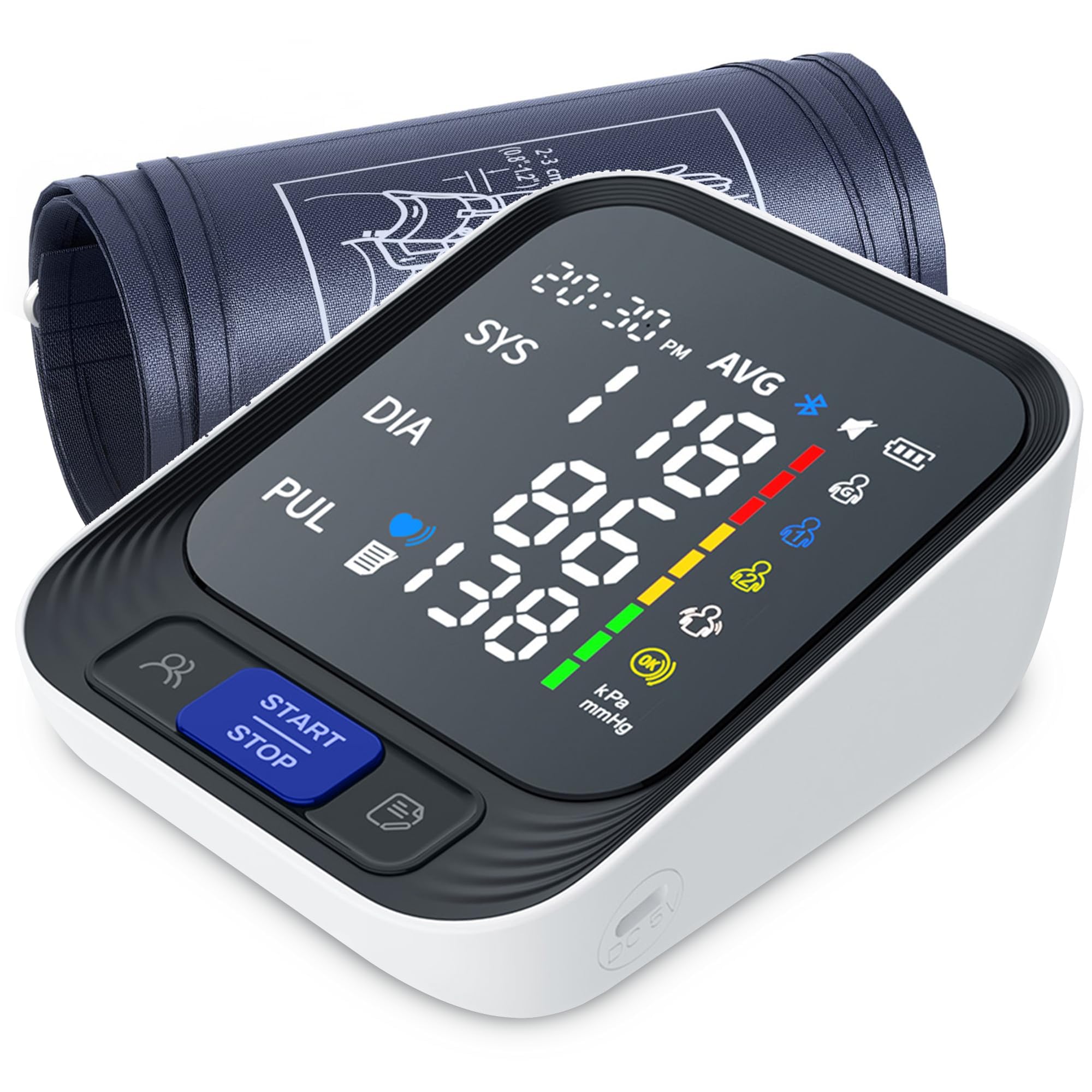
The Acenis AOJ-30F is a no-frills monitor that delivers reliable basics at a low entry point. Its large color screen displays results with clear, bold digits, making it serviceable for seniors. The device supports three user profiles — unusual at this price level — with memory tracking for two readings per user, plus a guest mode. One-touch operation delivers results in about 40 seconds.
The large adjustable cuff is designed for comfort and aims to fit most arm sizes. It includes 4 AAA batteries and a power cord, so you can use it immediately out of the box. The compact design (5 x 2.87 x 3.66 inches) makes it easy to store in a drawer or cabinet without taking up space.
Setup of date and time can be fiddly — some users found the menu navigation confusing. The build feels light and functional rather than premium. It does not offer Bluetooth, averaging modes, or clinical validation claims beyond standard accuracy. For anyone needing the most affordable way to track trends without app sync, this is a competent starter device.
Why it’s great
- Large color display with clear results
- Three user memory for multi-person households
- Batteries and power cord included
Good to know
- Date/time setup is not intuitive
- No Bluetooth or smart features
FAQ
What is the proper way to take a reading with an upper arm monitor?
Why does my home monitor give different readings than the doctor’s office?
Can I use a standard cuff on a child or petite adult?
What does AFib detection do and do I need it?
Final Thoughts: The Verdict
For most users, the bp monitor for home use winner is the Omron Gold BP5360 because it combines AFib detection, smooth app integration, and doctor-recommended reliability in one package. If you want Wirecutter-validated simplicity with excellent app support, grab the Greater Goods Bluetooth monitor. And for households with varying arm sizes, nothing beats the versatility of the VOLUETH 3-cuff set.