
Our readers keep the lights on and the weekend projects moving. As an Amazon Associate, I earn from qualifying purchases.
A separated AC joint doesn’t just ache — it destabilizes your entire shoulder complex, turning every reach, lift, or side-sleep into a gamble. The right brace does more than compress; it mechanically locks the clavicle in place, preventing the upward migration that defines a Type II or Type III separation. Without it, every minor movement risks re-injury and a longer recovery curve.
I’m Rikta — the co-founder and writer behind FitlyFast. I’ve analyzed dozens of shoulder braces, cross-referencing thousands of customer reports on fit retention, strap tension, and material fatigue to isolate the models that actually stabilize a separated AC joint rather than just squeezing the deltoid.
Whether you’re managing a recent Grade II separation or bracing against re-injury during activity, this guide breaks down the construction, anchor points, and material science that define a true brace for ac joint separation.
How To Choose The Best Brace For AC Joint Separation
Not every shoulder brace addresses the unique mechanical failure of an AC separation. A typical rotator cuff sleeve compresses the muscle belly — useless when the clavicle is free to piston upward. You need a brace with a cross-chest anchor that pulls the humeral head and clavicle down and into the joint socket. Here is exactly what to check.
Independent Chest and Bicep Straps
The number one differentiator is whether the chest strap and bicep strap are independent adjustments or a single continuous loop. Dual-strap designs let you tension the downward pull on the clavicle separately from the arm compression, which is essential for managing a separation where the distal clavicle is elevated. A single-strap system will either overtighten the arm or under-support the AC joint — neither is acceptable.
Non-Elastic Anchor Material
Elastic cross-body straps look comfortable on paper but stretch under load, allowing the clavicle to migrate during activity. The best braces for AC separation use a rigid or semi-rigid strap across the chest — typically heavy-duty webbing or a reinforced neoprene laminate — that maintains its length under tension. Measure the chest strap width: a strap narrower than 2 inches tends to roll and dig, reducing its effective holding power.
Bicep Cuff Length and Grip
A short bicep cuff (under 6 inches) provides a poor lever arm for maintaining downward traction on the humerus. Ideally, the brace’s arm sleeve extends at least 8 inches below the shoulder joint, with a high-friction inner lining or silicone grip strip to prevent sliding. When the bicep cuff migrates, the entire stabilization system fails because the downward vector shifts.
Quick Comparison
On smaller screens, swipe sideways to see the full table.
| Model | Category | Best For | Key Spec | Amazon |
|---|---|---|---|---|
| FIGHTECH Shoulder Brace | Premium | High-stability sleep & daily wear | Integrated hot/cold pack pocket | Amazon |
| ORTONYX Compression Sleeve | Mid-Range | Active recovery & low-profile wear | 3D knitted gradient compression | Amazon |
| ZENKEYZ Shoulder Brace | Mid-Range | Versatile work & gym support | Dual independent strap system | Amazon |
| Copper Compression Recovery Brace | Mid-Range | All-day wear with copper infusion | 4-way stretch copper-knit fabric | Amazon |
| Comfytemp Ice Pack Wrap | Mid-Range | Integrated cold therapy sessions | 2 included gel packs | Amazon |
| POAGL Shoulder Brace | Budget | Plus-size large frame stabilization | Chest range 48-72 inches | Amazon |
In‑Depth Reviews
1. FIGHTECH Shoulder Brace

The FIGHTECH brace delivers medium-to-strong compression through a perforated neoprene wrap that anchors the shoulder without restricting the rib cage. Its cross-chest strap is wide enough to prevent rolling, and the independent arm band lets you dial in downward traction on the humerus — exactly what an AC separation needs to keep the clavicle seated. The built-in pocket fits a standard 6×6 therapy pack, which is a practical add-on for controlling acute inflammation in the first weeks post-injury.
Customer reports highlight its effectiveness for sleep stability: users with full-thickness tears and separations report 7 hours of uninterrupted rest, a major win given how AC injuries typically flare during side-sleeping. The velcro is substantially stronger than budget alternatives, though some users note that the sleeve length is shorter than competitors, which may affect leverage for very tall individuals. The four-size range (S through XL) accommodates a wide variety of builds, and the universal left/right design simplifies ordering.
For a brace that balances AC-specific stabilization with the option for simultaneous hot or cold therapy, the FIGHTECH is the most complete package in this list. It is not the cheapest option, but its material density and strap integrity justify the premium positioning.
Why it’s great
- Genuinely strong hook-and-loop that doesn’t slip during sleep
- Therapy pocket is large and positioned directly over the AC joint
- Four sizes with broad chest/bicep range for a precision fit
Good to know
- Shorter sleeve may limit downward leverage for taller users
- Requires tight cinching for full effect, which some find uncomfortable
2. ORTONYX Shoulder Stability Brace
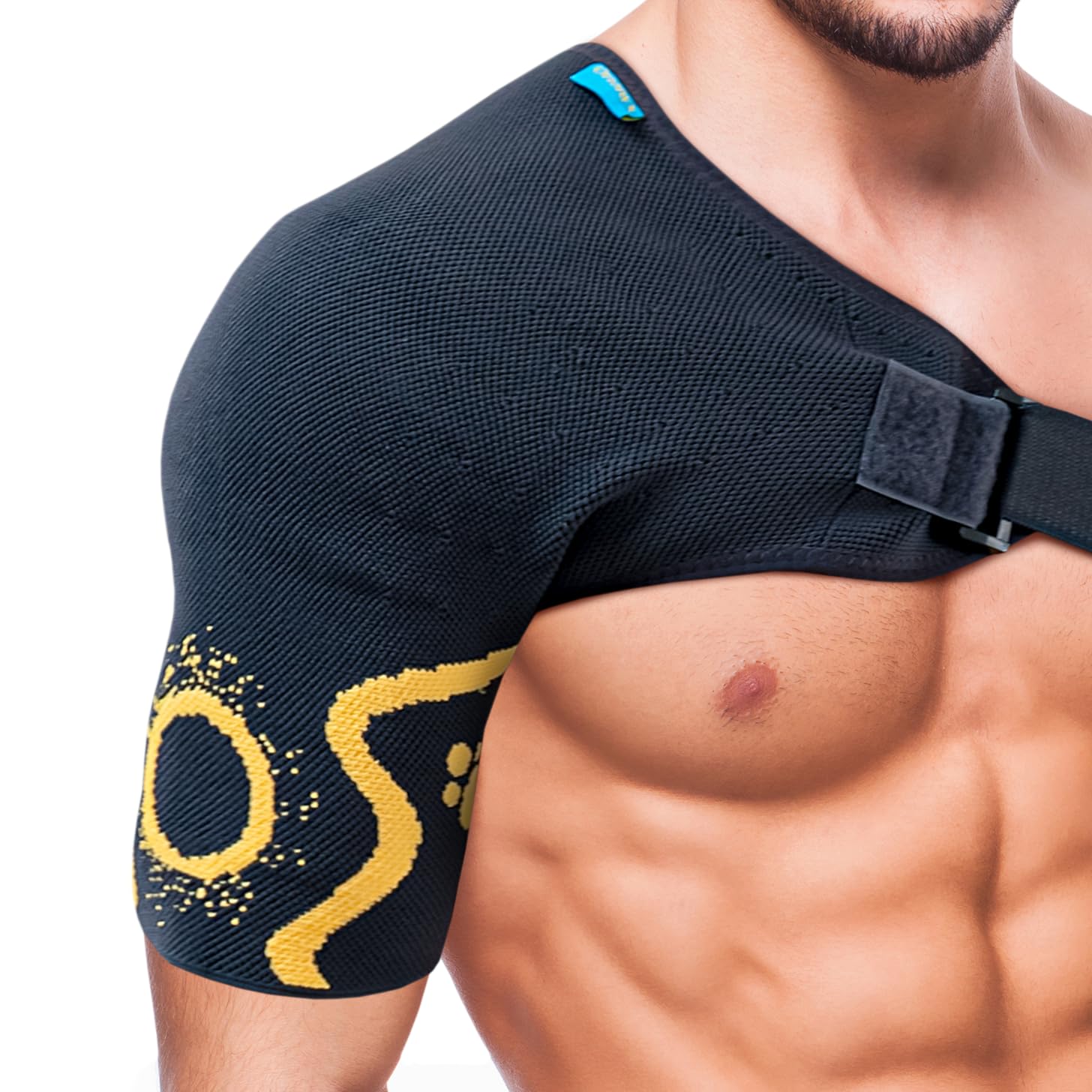
The ORTONYX takes a fundamentally different approach: instead of a thick neoprene wrap, it uses a 3D-knitted compression sleeve with zone-specific tension. The knit pattern applies higher compression over the deltoid and AC joint area while remaining more elastic over the armpit and trapezius. This gradient design is ideal for users who need moderate AC support during activity but cannot tolerate the bulk of a wrap-style brace under clothing.
The adjustable strap is thinner than the FIGHTECH, which some users report limits its ability to cinch down the trapezius for a truly locked-in feel. On the plus side, the moisture-wicking fabric stays cool during workouts, and the slim profile means you can wear it under a shirt without an obvious bulge. The reversible design (fits left or right) adds convenience, though the Velcro patch is not as aggressive as premium models.
This brace is best for low-grade Type I separations or as a secondary support after the acute phase has passed. It will not replace a rigid anchor for a Type III separation, but for daily proprioceptive feedback and mild compression, the ORTONYX is the most wearable option here.
Why it’s great
- Breathable 3D knit construction prevents overheating
- Very low-profile, fits discreetly under most shirts
- Good for active recovery without restricting motion
Good to know
- Thinner strap may not provide enough downward traction for Grade II+
- Some users report the cross-strap binds at the opposite armpit
3. ZENKEYZ Shoulder Brace

The ZENKEYZ brace uses perforated neoprene with independent chest and arm straps, giving you the same dual-tension adjustability as premium models at a more accessible price point. The chest strap anchors across the sternum, while the bicep strap tightens independently — a critical feature for managing AC separation because it lets you pull the humerus downward without over-compressing the shoulder capsule. The integrated 6×6 pocket holds a therapy pack directly over the joint, bridging the gap between bracing and active recovery.
Customer feedback is strong across multiple injury types: SLAP tear recovery, post-surgical support, and chronic osteoarthritis all report measurable pain reduction. Some users note an initial rubber smell from the neoprene that dissipates after airing, and the sizing chart can be confusing for petite frames — the S/M version’s pad may ride high on shorter torsos. The diagonal strap can slip over synthetic fabrics, but against bare skin or cotton, it stays planted.
For someone managing a moderate AC separation who wants both stability and cold therapy capability without spending at the top of the market, the ZENKEYZ delivers the best functional overlap of features and price.
Why it’s great
- True independent strap system for separate chest and bicep tension
- Built-in therapy pocket holds standard-size cold or hot packs
- Heavy-duty construction that feels more expensive than it is
Good to know
- Initial neoprene odor requires airing out before first use
- Pad placement may feel choking on shorter torsos
4. Copper Compression Recovery Shoulder Brace

Copper Compression builds this brace around a copper-infused knit fabric that wicks moisture and resists odor — practical for users who need to wear a brace for 10+ hours daily during AC separation recovery. The 4-way stretch material provides even compression without the pinching associated with neoprene wraps, and the cross-chest strap is wide enough to distribute tension across the rib cage rather than digging into a single point.
Real-world reports are mixed on fit precision. Some users praise the underarm comfort and shoulder-blade realignment, while others note that the sleeve fit feels sloppier than the product photography suggests, with no amount of adjustment achieving a truly snug lock. The copper content adds longevity to the fabric’s elasticity, and the label explicitly mentions compatibility with heating pads and ice packs, though there is no dedicated pocket — you must position the pack manually under the strap.
This brace suits low-grade separations where all-day compliance matters more than rigid mechanical restraint. It will not hold a Type III clavicle down against gravity, but for Type I or post-acute Type II, the comfort-to-compression ratio is strong.
Why it’s great
- Copper-infused fabric stays fresh during extended wear
- 4-way stretch allows natural movement during daily tasks
- Compatible with ice/heat packs for layered therapy
Good to know
- Sleeve fit can be loose and difficult to dial in for a locked feel
- Underarm chafing reported when cinched tight enough for real support
5. Comfytemp Shoulder Ice Pack Wrap
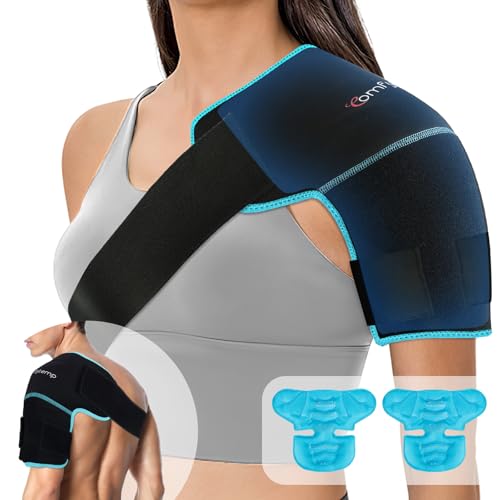
The Comfytemp is primarily a cold therapy wrap that also provides mild compression, making it a strong complementary tool during the acute inflammatory phase of an AC separation. It ships with two reusable gel packs, which is a meaningful advantage — you can keep one in the freezer while the other is in use, enabling continuous rotation during flare-ups. The sleeve itself is neoprene with adjustable chest and arm straps, and the gel pack pocket locks in place to prevent shifting during light movement.
User feedback emphasizes the contoured fit and sturdy strap width, which helps the wrap stay secure even when the gel pack adds weight. The fabric is easy to clean and maintains flexibility as long as you don’t over-freeze the packs. The main limitation is that the brace component is not designed for high-tension stabilization — it provides compression but not the rigid downward anchor needed for an unstable AC joint. As a purely therapeutic tool for pain and swelling management, however, it excels.
If your AC separation is in the first 72 hours or you experience recurrent swelling after activity, the Comfytemp should be in your rotation. It pairs well with a separate stabilization brace for daytime use and handles the ice-therapy job better than any all-in-one brace on this list.
Why it’s great
- Includes two large gel packs for rotation therapy
- Secure pocket keeps the pack directly over the AC joint
- Wide straps prevent rolling and maintain position
Good to know
- Not a standalone stabilization brace for unstable separations
- Strap length may be restrictive for users with larger chests
6. POAGL Adjustable Shoulder Brace
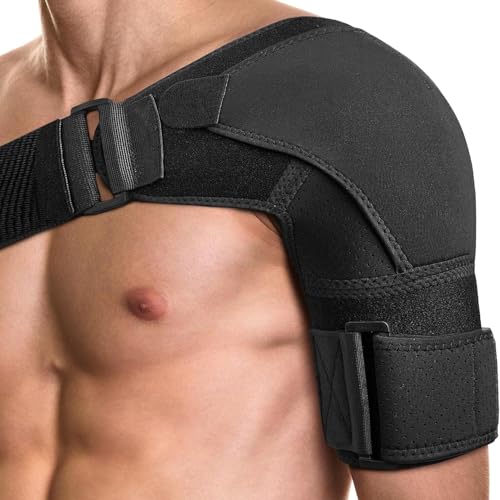
The POAGL brace covers the largest size range in this review — chest circumference up to 72 inches and bicep up to 26 inches — making it one of the few options for larger-framed individuals managing an AC separation. The sleeve extends further down the arm than most competitors, providing a longer lever for downward traction on the humerus, which is mechanically beneficial for keeping the clavicle seated against the acromion.
Customer reviews highlight the comfortable fabric and effective bicep-strap design that enables one-handed cinching. However, there are durability concerns: multiple users report that the Velcro patches lose holding power over time, particularly under the strain of daily tightening. The fabric is not perforated, which can lead to sweat buildup during physical activity. Additionally, delivery times have been inconsistent, with some customers waiting several weeks.
For hard-to-fit users with broad chests and arms, the POAGL offers coverage that no other brace here matches. It is best suited for home or light activity use where you can monitor strap tension. If you need a brace for high-intensity training or have a history of Velcro failure, you may want to budget for a replacement within a few months.
Why it’s great
- Exceptional size range fits very large chests and biceps
- Long arm sleeve provides better mechanical leverage
- Comfortable fabric for extended wear periods
Good to know
- Velcro can pop open under tension after repeated use
- Non-perforated fabric traps heat and sweat during activity
FAQ
Can I sleep in a brace for AC joint separation?
Will a brace fix a Type III AC separation without surgery?
How tight should the bicep strap be on an AC brace?
Final Thoughts: The Verdict
For most users, the brace for ac joint separation winner is the FIGHTECH Shoulder Brace because it combines wide, non-rolling straps with an integrated therapy pocket in a package that offers real downward traction. If you want a slim, breathable option for low-grade separations and daily wear, grab the ORTONYX Shoulder Stability Brace. And for the best feature-per-dollar value with independent strap adjustment, nothing beats the ZENKEYZ Shoulder Brace.