
Our readers keep the lights on and the weekend projects moving. As an Amazon Associate, I earn from qualifying purchases.
A dislocated shoulder isn’t just a painful injury—it’s a joint that wants to escape again. The first weeks of recovery depend on one thing: holding that ball joint steady inside the socket. A standard sling often lets the arm drift forward, which is exactly the motion that triggers a re-dislocation. You need a brace that locks the humeral head in place without cutting off your circulation or making you feel like a mummy.
I’m Rikta — the co-founder and writer behind FitlyFast. I’ve analyzed the biomechanics, compression specs, and real user outcomes across dozens of shoulder support designs to find which braces actually prevent re-injury during the critical healing window.
Whether you’re recovering from a first-time dislocation or managing chronic instability, finding the right support is non-negotiable. This guide breaks down the top contenders to help you pick the best brace for dislocated shoulder for your specific recovery phase.
How To Choose The Best Brace For Dislocated Shoulder
Choosing a shoulder brace for a dislocation isn’t the same as picking one for general rotator cuff tendonitis. A dislocated joint has stretched out the capsule—ligaments are lax, and the ball can easily pop back out if you reach, rotate, or sleep wrong. Your brace must provide active positional restraint, not just mild compression.
Immobilization vs. Stabilization: Knowing the Phase
In the first 2 to 4 weeks post-dislocation, an immobilizer sling that prevents all external rotation and abduction is essential. After that, a compression sleeve with a stabilizer strap allows controlled movement while protecting against risky arm positions. Buying a stabilization sleeve too early leads to re-injury; buying an immobilizer too late prolongs stiffness.
The Strap System: Where Real Support Comes From
Look beyond the main body of the brace. The critical feature is a secondary strap that crosses your back or wraps under the opposite armpit to prevent the shoulder from rolling forward. A brace without this cross-body strap cannot fully secure a dislocated joint—simple tube sleeves don’t cut it for true instability.
Material and Fit Demands
Neoprene provides excellent support and warmth for later-stage recovery but traps heat. For all-day wear, breathable knit blends with moisture-wicking properties are better. Fit is paramount: a brace that is too loose offers zero protection, while one that is too tight can compress nerves. Measure chest circumference and bicep girth, not just height and weight.
Quick Comparison
On smaller screens, swipe sideways to see the full table.
| Model | Category | Best For | Key Spec | Amazon |
|---|---|---|---|---|
| DonJoy UltraSling IV | Premium Immobilizer | Post-surgery & acute dislocation | Cross-body strap system | Amazon |
| EVS SPORTS SB04 | Premium Stabilizer | Active recovery & sports | Removable plastic guard shield | Amazon |
| Vital Salveo Shoulder Brace | High-Tech Compression | Chronic instability & warmth | Far-infrared thermal fiber | Amazon |
| ORTONYX Shoulder Stability Brace | Compression Sleeve | Mild support & everyday wear | 3D Knitted Nylon/Elastane | Amazon |
| Brownmed Joslin Sling | Entry-Level Sling | Budget-friendly child/small adult | 22.68g spandex fabric | Amazon |
| Cheer Collection Pillow | Sleep Support | Comfort while lying down | W-shaped 23.5″ x 14″ | Amazon |
| DouHeal Kids Arm Sling | Pediatric Immobilizer | Children under 5 feet | Crossing sling with chest belt | Amazon |
In‑Depth Reviews
1. DonJoy UltraSling IV
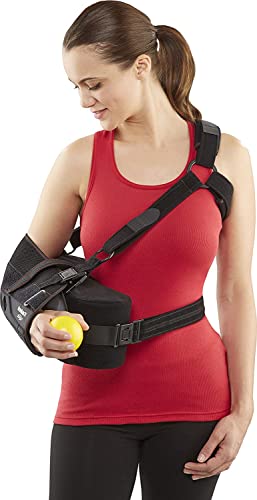
The DonJoy UltraSling IV is the gold standard for post-dislocation and post-surgical immobilization, with a design that truly eliminates the neck strain typical of basic slings. Its wide, padded strap distributes the arm’s weight across your opposite shoulder, and the supportive underarm cradle keeps the humerus from sliding anteriorly—the exact motion that provokes re-dislocation. Several users recovering from rotator cuff repairs and Hill-Sachs lesions reported that this sling gave them the first decent sleep they’d had in weeks, thanks to the stable positioning.
The adjustable body strap wraps around your torso to lock the arm against your side, preventing accidental abduction. This is critical for acute-phase dislocation recovery where any outward arm movement can tear the healing capsule. The foam-padded arm cradle is contoured to avoid pressure on the ulnar nerve, and the entire system is secured with heavy-duty hook-and-loop that survives daily adjustments. One user noted that the large size felt slightly long for the arm cradle, but a simple roll at the end of the fabric solved the hand access issue.
Setup requires a quick read of the instructions—the strap routing is more sophisticated than a standard sling—but once adjusted, it stays put. The color-coded sizing labels make it easy for clinics to dispense, and the inclusion of a stress ball encourages hand exercises without removing the sling. For the premium investment, you get a brace that feels medical-grade and is repeatedly described by customers as “10 times more comfortable than the hospital sling.”
Why it’s great
- Zero neck pressure due to cross-body weight distribution
- Prevents anterior arm drift that triggers re-dislocation
- Medical-grade build with color-coded sizing and stress ball
Good to know
- Initial fitting requires studying the strap diagram
- Arm cradle length may roll for users with shorter forearms
2. EVS SPORTS SB04 Shoulder Brace

The EVS SPORTS SB04 is built for the recovery phase when you need to stop immobilizing and start stabilizing. This brace uses a 4mm neoprene compression sleeve as the base, overlaid with an adjustable X-strap system that cinches the humeral head directly into the glenoid. A removable hard plastic guard shell adds impact protection for athletes returning to contact sports, making it a genuinely dual-purpose unit for both support and safety.
Users recovering from AC separations, torn rotator cuffs, and chronic dislocations consistently report that the adjustable straps eliminate the need for ice packs and pain relievers by restricting shoulder movement to a safe range of motion. The brace’s design prevents the arm from reaching the abduction and external rotation positions that most commonly cause re-injury. The hook-and-loop closures are industrial-strength, though the sizing runs small—a user with a 44-inch chest found the Large fit tightly, suggesting the XL for larger frames.
The removable shield is a standout feature for anyone who worries about falling on the shoulder again. One customer who had six previous shoulder surgeries reported wearing the SB04 daily for three years of skiing without a re-injury. The neoprene does retain heat and moisture during intense activity, so this brace is best for structured activity periods rather than all-day lounging. For the premium tier, the SB04 offers unmatched versatility from early rehab to full-return sport.
Why it’s great
- X-strap system provides targeted humeral head stabilization
- Removable hard plastic guard for impact protection
- Adjustable compression reduces need for pain medication
Good to know
- Sizing runs small—measure carefully and size up if between sizes
- 4mm neoprene gets warm and damp with extended wear
3. Vital Salveo Shoulder Brace Compression Sleeve
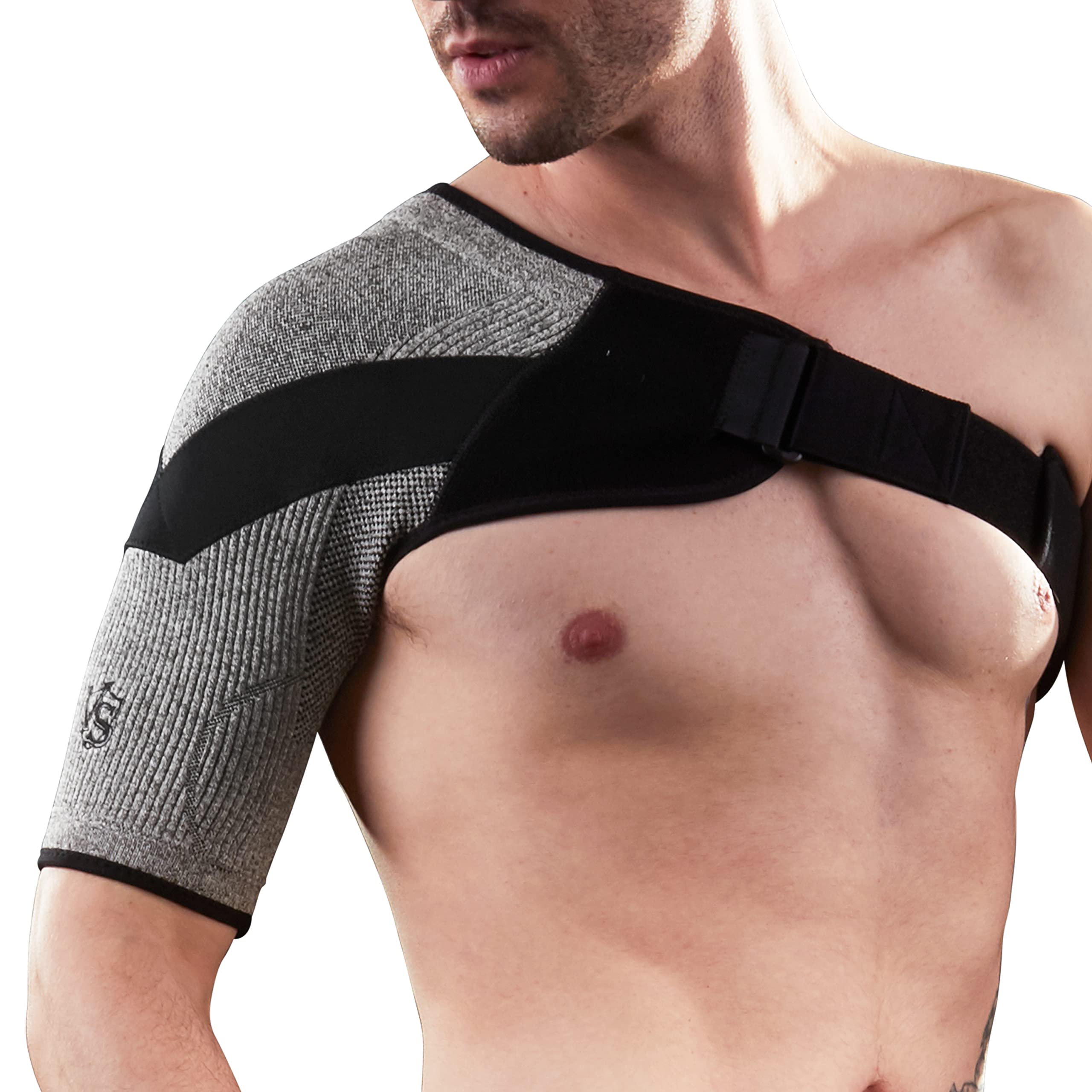
The Vital Salveo Shoulder Brace takes a bio-dynamic approach to shoulder recovery, embedding Germanium and Carbon fibers into its core that activate at body temperature to emit far-infrared waves. This isn’t a gimmick—the goal is to warm the deep tissue of the shoulder capsule, increasing blood flow and potentially reducing stiffness in the joint without any external power source. For the later stages of dislocation recovery when stiffness is the main complaint, this thermal support is genuinely helpful.
The 3D seamless knit construction provides a second-skin fit that won’t shift during the day. It’s designed for continuous wear under clothes, making it suitable for office work, light household tasks, and driving. The adjustable strap cinches across the chest to prevent the brace from riding up, though some users with a larger trapezius found the strap length too short to get a firm grip on that muscle group. The sleeve is reversible, fitting either left or right shoulder.
The most consistent feedback comes from users managing chronic bursitis and frozen shoulder stiffness—they report more relief from this brace than from over-the-counter pain medications. However, for a freshly dislocated shoulder, the Vital Salveo provides support, not immobilization. It won’t stop your arm from rotating externally, so it’s best used in the subacute phase (weeks 4+) when the capsule has begun to tighten. The far-infrared feature is subtle, not dramatic, but adds genuine comfort for daily wear.
Why it’s great
- Embedded far-infrared fibers provide gentle deep-tissue warmth
- Seamless 3D knit is breathable and comfortable under clothing
- Reversible for left or right shoulder use
Good to know
- Not rigid enough for acute immobilization—use in later recovery
- Adjustment strap may not cinch tightly on all body types
4. ORTONYX Shoulder Stability Brace Compression Sleeve
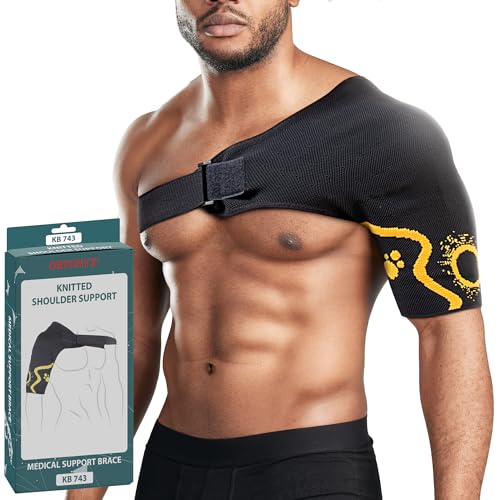
The ORTONYX Shoulder Stability Brace is a mid-range compression sleeve that prioritizes comfort and discreet wear over brute-force stabilization. Its 3D knitted fabric is a blend of 85% nylon and 15% elastane, offering four-way stretch that contours perfectly to the shoulder. The integrated adjustable strap allows you to dial in the level of compression, providing a gentle reminder to keep your shoulder back and down—good proprioceptive feedback for someone prone to slumping their shoulder forward.
Several users with sprains and tendonitis found immediate relief from the even pressure distribution. The slim profile is the standout advantage here: it slides easily under a t-shirt or work shirt without adding bulk, making it practical for all-day wear during desk work or light errands. The moisture-wicking knit kept users cool even during moderate physical activity, and the fabric’s flexibility means arm movement isn’t pinched.
The key limitation is that the single cross-strap is elastic, not rigid, and for some users it was not long enough to cinch the shoulder down on the trapezius as effectively as needed. One user with a larger frame found the strap rode up into the opposite armpit. For a true dislocation, this brace is best used as a secondary support after the immobilization phase—it provides reassurance and mild compression, not the structural lock-down that a fresh dislocation requires.
Why it’s great
- Ultra-thin 3D knit fits easily under regular clothing
- Breathable nylon/elastane blend resists overheating
- Adjustable strap allows customized compression level
Good to know
- Elastic cross-strap may be too short for full stabilization
- Not designed for acute-phase immobilization
5. Brownmed Joslin Sling Ultimate Arm Sling

The Brownmed Joslin Sling is an entry-level arm sling that delivers surprising comfort for its lightweight build, but it is critical to understand its intended audience: the “Child” sizing fits small adults and children, not the average full-grown adult. Made from stretchy spandex with hook-and-loop adjustment, this sling is wildly comfortable for petite frames—customers reported that their 8-year-old daughters and slender 5’3″ women found it far more bearable than the stiff canvas slings from the hospital.
The design includes thumb loops that prevent the sling from migrating up the forearm, a common annoyance with basic slings. It’s machine washable and dryer-safe, which is a practical necessity for long-term use on kids. The reversible design works for either arm, and the total weight of only 22.68 grams means it feels like wearing a cotton t-shirt rather than medical gear. Multiple users with clavicle fractures and broken elbows praised the comfort level during four to eight weeks of continuous wear.
The major caveat is the narrow shoulder strap. Several adult users noted that the strap stretches under the full weight of an average-sized arm, digging into the shoulder and causing discomfort over time. The forearm support is also thin—users with heavy casts found the fabric needed more reinforcement. This sling is best viewed as a budget-friendly, high-comfort option for children or small-framed adults with minor fracture or dislocation recovery, not as a heavy-duty immobilizer for significant shoulder instability.
Why it’s great
- Exceptionally lightweight and breathable spandex material
- Thumb loops keep the sling from slipping off the elbow
- Machine washable and reversible for either arm
Good to know
- Narrow shoulder strap may cause discomfort for average or larger adults
- Best suited for children and smaller frames, not full-sized adults
6. Cheer Collection Rotator Cuff Pillow

The Cheer Collection Rotator Cuff Pillow is not a brace in the traditional sense, but it solves one of the biggest problems after a shoulder dislocation: sleeping without rolling onto the injured arm. This W-shaped support cushion measures 23.5 by 14 by 6 inches, creating a physical barrier that keeps you from turning onto your side during the night. For anyone who has woken up in a panic after rolling onto their dislocated shoulder, this pillow is a legitimate recovery accessory.
Filled with soft hollow fiber and covered in a velour fabric with a hidden zipper, the pillow is easy to clean—the cover removes for machine washing, which is important during the sweaty discomfort of recovery. Users with frozen shoulder, rotator cuff tears, and even ALS reported improved sleep quality and reduced daytime pain after using this pillow. It also serves as an armrest support while sitting on the sofa or reading in bed, keeping the elbow slightly elevated and the shoulder in a neutral position.
The pillow is quite puffy, and some petite users found it too tall for comfortable use, wishing for a smaller size or the ability to remove stuffing. It is a sleep aid and posture supporter, not a primary brace—it won’t stabilize the shoulder during walking or daily tasks. For the recovery phase when rest is the main prescription, the Cheer Collection pillow provides targeted comfort that a standard brace cannot offer.
Why it’s great
- Prevents side-rolling onto injured shoulder during sleep
- Removable, machine-washable velour cover
- Supports arm while sitting for reading or TV
Good to know
- May be too high for petite users—no smaller size available
- Not a substitute for an active-wear brace or sling
7. DouHeal Kids Arm Sling

The DouHeal Kids Arm Sling is designed specifically for children under 5 feet tall, with an adjustable chest circumference that fits 20 to 30 inches. Its key differentiator from other kids’ slings is the crossing sling system that lifts the scapula and holds the forearm in a functional position, combined with a chest fixation belt that prevents the shoulder from swinging outward. For an active child recovering from a dislocation or fracture, this dual-layer restraint offers the stability a basic tube sling lacks.
The ergonomic open design makes it easier to get onto a wiggly child compared to traditional slings that require threading an arm through. It is reversible for left or right arm use, and the fabric is breathable to prevent overheating during school days or bus rides. Parents of children with full arm casts and pins reported that the sling held up well through eight weeks of daily wear, surviving machine washing in a mesh bag without losing hook-and-loop adhesion.
The main stability limitation is that for very young or small children (around 3 years old), the sling can still shift or slide off the shoulder slightly despite the chest belt. Some parents rated it a 4 out of 5 for this reason, noting it worked “much better” than the basic clinic sling but wasn’t perfect for their toddler’s proportions. For children aged 5 to 12 with dislocated shoulders or fractures, it provides a noticeable upgrade in comfort and immobilization over standard slings, but proper fit is essential—measure your child’s chest before ordering.
Why it’s great
- Crossing sling system lifts scapula and fixes forearm in position
- Chest belt prevents shoulder from swinging outward
- Breathable fabric and open design for easy wearing
Good to know
- May still slide slightly on very small toddlers
- Designed for children under 5 feet tall only
FAQ
Can a compression sleeve prevent a re-dislocation?
How long should I wear an immobilizer sling after a dislocation?
What does the metal-free or X-ray safe designation mean for shoulder braces?
Final Thoughts: The Verdict
For most users, the best brace for dislocated shoulder winner is the DonJoy UltraSling IV because it delivers true immobilization without neck pain, making it the safest option during the critical early weeks of healing. If you want to transition to active stabilization with impact protection, grab the EVS SPORTS SB04. And for late-stage comfort and deep tissue warmth during daily wear, nothing beats the Vital Salveo Shoulder Brace.