
Our readers keep the lights on and the weekend projects moving. As an Amazon Associate, I earn from qualifying purchases.
When your knee buckles during a simple pivot or gives out on stairs, it’s not just painful — it erodes the trust you have in your own body. A hinged brace with side stabilizers is the single most effective tool to restore that trust, but the difference between a sleeve that slips and a brace that actually locks down your joint comes down to the hinge quality, strap architecture, and frame rigidity. This guide separates the flimsy wraps from the real stability hardware.
I’m Rikta — the co-founder and writer behind FitlyFast. I’ve spent hundreds of hours dissecting the mechanical specs, reading through thousands of verified buyer experiences, and comparing hinge systems, strap patterns, and frame materials to find the brace that genuinely delivers on its promise of knee stability.
Whether you’re recovering from an ACL reconstruction, managing a degenerative meniscus tear, or just want to prevent your knee from hyperextending during sport, this analysis of the best brace for knee stability will save you time, money, and wheeled trips to the orthopedist.
How To Choose The Best Brace For Knee Stability
Not every brace sold as “stability” actually resists the two movements that cause re-injury: medial-lateral (side-to-side) sway and anterior-posterior (forward/backward) translation. The right choice depends on the specific ligament you need to protect and the load you plan to put on the joint.
Hinge Architecture: The Stability Engine
The hinge is not a gimmick — it’s the brace’s core functional part. A single-axis hinge is better than no hinge at all, but it can bind during deep flexion. Triaxial or polycentric hinges track the femur’s natural rollback over the tibia, allowing a smooth bend while still blocking side-to-side movement. For high-load sports like basketball or hockey, bi-lateral aluminum hinges with a polycentric pivot point offer the best combination of natural motion and forced stability. For post-surgical recovery, look for a brace with a ROM (range of motion) lockout dial that lets you control extension and flexion angles as the surgeon directs.
Strap System vs. Sleeve Design
A pull-on sleeve might feel snug, but it cannot resist lateral sway forces the way a cross-strap system can. The most effective stability braces use two or more adjustable straps above and below the knee joint — often a figure-8 or crossover pattern — that anchor into the frame and create a rigid connection between the brace shell and your leg. This prevents the brace from rotating around your thigh or calf during movement. If you have large or small calves, a strap-based system is also more adjustable than a fixed sleeve.
Frame Rigidity and Material Choice
The frame material determines how much load the brace can absorb before flexing. Aluminum hinges encased in a semi-rigid plastic or carbon-fiber chassis give the highest structural integrity for heavy-duty protection. A flexible fabric-only brace with thin metal spring inserts is lighter and more comfortable for daily wear but offers significantly less resistance against strong lateral forces. Match the frame stiffness to your activity: level 1 (daily walking, light hiking) can use spring-stabilized fabric braces; level 2 (running, basketball, volleyball) needs aluminum or rigid plastic hinges; level 3 (post-op, severe instability) requires a full ROM-adjustable hinged brace.
Quick Comparison
On smaller screens, swipe sideways to see the full table.
| Model | Category | Best For | Key Spec | Amazon |
|---|---|---|---|---|
| Bauerfeind Sports Knee Support NBA | Premium Sleeve | Basketball & pivoting sports | Omega pad + compression knit | Amazon |
| Galvaran Professional Knee Brace | Mid-Range Strap | Meniscus & ACL recovery | 4 memory spring stabilizers | Amazon |
| MUELLER Hg80 Hinged Knee Brace | Mid-Range Sleeve | Side-to-side movement prevention | Triaxial aluminum hinges | Amazon |
| DonJoy Drytex Sport Hinged Knee Brace | Mid-Range Sleeve | Ligament & meniscus stability | Drytex moisture-wicking fabric | Amazon |
| GHORTHOUD Hinged ROM Knee Brace | ROM Adjustable | Post-surgery rehab | 0-120° ROM lockout dial | Amazon |
| Shock Doctor Bionic Knee Brace | Heavy Duty Hinged | High-impact sports & hyperextension | Bi-lateral aluminum hinges | Amazon |
| Ovation Medical Game Changer | OA Unloader | Arthritis pain & offloading | Single upright adjustable offloader | Amazon |
In‑Depth Reviews
1. Bauerfeind Sports Knee Support NBA

This is the brace that sports medicine professionals and NBA athletic trainers actually recommend — it’s not a hinge-and-strap contraption but a precision compression knit with an integrated Omega pad that surrounds the kneecap and absorbs impact while maintaining natural movement. The 3D AirKnit fabric is lightweight, moisture-wicking, and machine-washable, and the grip technology on the inner cuff prevents it from sliding down your leg during aggressive pivots and jumps.
Users consistently report that this is the only brace that eliminated knee pain during high-level basketball and pickleball, and multiple reviews note that it still feels supportive after over a year of daily use. It does not have rigid side hinges, so it won’t stop hyperextension the way a post-op brace will, but for rotational stability and proprioceptive feedback, it’s in a class of its own.
The main trade-off is sizing: you must measure both thigh and calf circumference 14cm above and 12cm below the kneecap, and the pull-on design means it may not fit large-calved athletes who struggle to slip it over the foot. It’s also the most expensive compression-style brace on this list, but the construction quality justifies the investment for active users who need a durable everyday stability solution.
Why it’s great
- Omega pad distributes patellar force evenly for targeted relief
- Lightweight 3D AirKnit breathes better than neoprene alternatives
- Stays in place during high-intensity lateral movement
Good to know
- Pull-on design can be difficult for users with large calves
- No rigid hinges — not suitable for severe post-op instability
- Premium price reflects German engineering and NBA licensing
2. Galvaran Professional Knee Brace
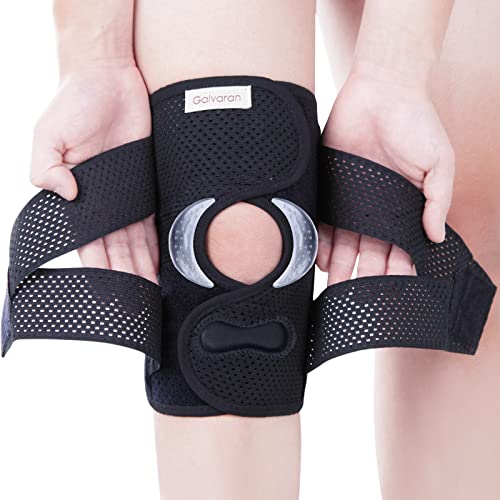
The Galvaran stands out in the budget-mid-range zone because it doesn’t cut corners on the components that actually matter for stability: four memory spring stabilizers flank both sides of the knee, and the brace features sewn-in EVA pads positioned specifically at the outer meniscus. This is a strap-based design with two adjustable cross-straps that allow a customized fit around the thigh and calf, which keeps the brace from migrating during movement.
Buyers recovering from ACL and meniscus repair surgeries report that the front wrap provides excellent compression and the straps stay in place without loosening during activity. The open-patella design with silicone pads reduces pressure on the kneecap, and the mesh weave fabric prevents the heat buildup that often makes neoprene braces unbearable for long wear. Several verified purchasers call this the best brace they’ve tried among many — one reviewer specifically noted it boosted confidence when their knee buckled.
The sizing runs small, so users with larger thighs should order at least one size up from their measurement. The metal spring stabilizers are not as rigid as aluminum hinges, meaning this brace is ideal for medium-stability needs like hiking, gym work, and daily walking rather than high-impact lateral sports. At its price point, it’s an exceptional entry-level stability brace.
Why it’s great
- Targeted meniscus EVA pads provide direct relief for outer knee pain
- Cross-strap system stays secure during active movement
- Breathable mesh weave prevents allergic reactions and odor
Good to know
- Runs small — size up for thicker thighs
- Spring stabilizers lack the rigidity of true hinged braces
- Not designed for high-impact sports or post-op stability
3. MUELLER Hg80 Hinged Knee Brace
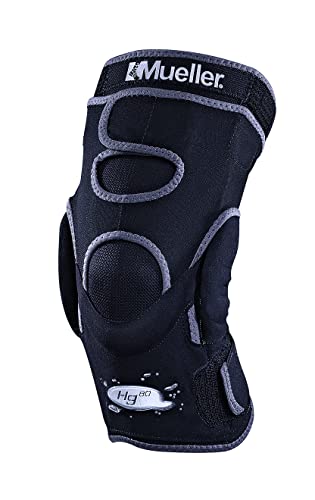
Mueller’s Hg80 has been a staple in sports medicine for decades because its triaxial hinge system — three moving points per side — tracks the natural rolling motion of the knee joint better than any single-pivot hinge in its price range. The HydraCinn fabric wicks moisture and the brace is designed as a pull-on sleeve with external hinges, making it one of the slimmest profiles you can wear under regular clothes without looking bulky.
Real-world feedback from a physical therapist with 25 years of experience: they called this the best low-end brace they’ve ever used, noting that a patient with an acute meniscus injury experienced an 80% reduction in walking pain immediately after putting it on. Other buyers with MCL tears have successfully skied within a week of injury while wearing this brace, citing firm support with more comfortable movement than neoprene alternatives.
The biggest limitation is sizing — you must slip your foot through the sleeve, and users with calf circumferences above 17.5 inches may find even the XXL too tight. After a year of daily use, some users report the aluminum hinges can loosen and fall out, though the sleeve itself continues to provide good compression. It’s not suitable for post-op ROM control since it has no lockout dial.
Why it’s great
- Triaxial hinge tracks knee joint more naturally than single-pivot braces
- Slim profile fits under pants without visible bulk
- Highly breathable HydraCinn fabric reduces sweat buildup
Good to know
- Pull-on design restricts access for users with large calves
- Hinges may loosen and require reinsertion after extended use
- No ROM lockout for post-surgical rehabilitation
4. DonJoy Drytex Sport Hinged Knee Brace
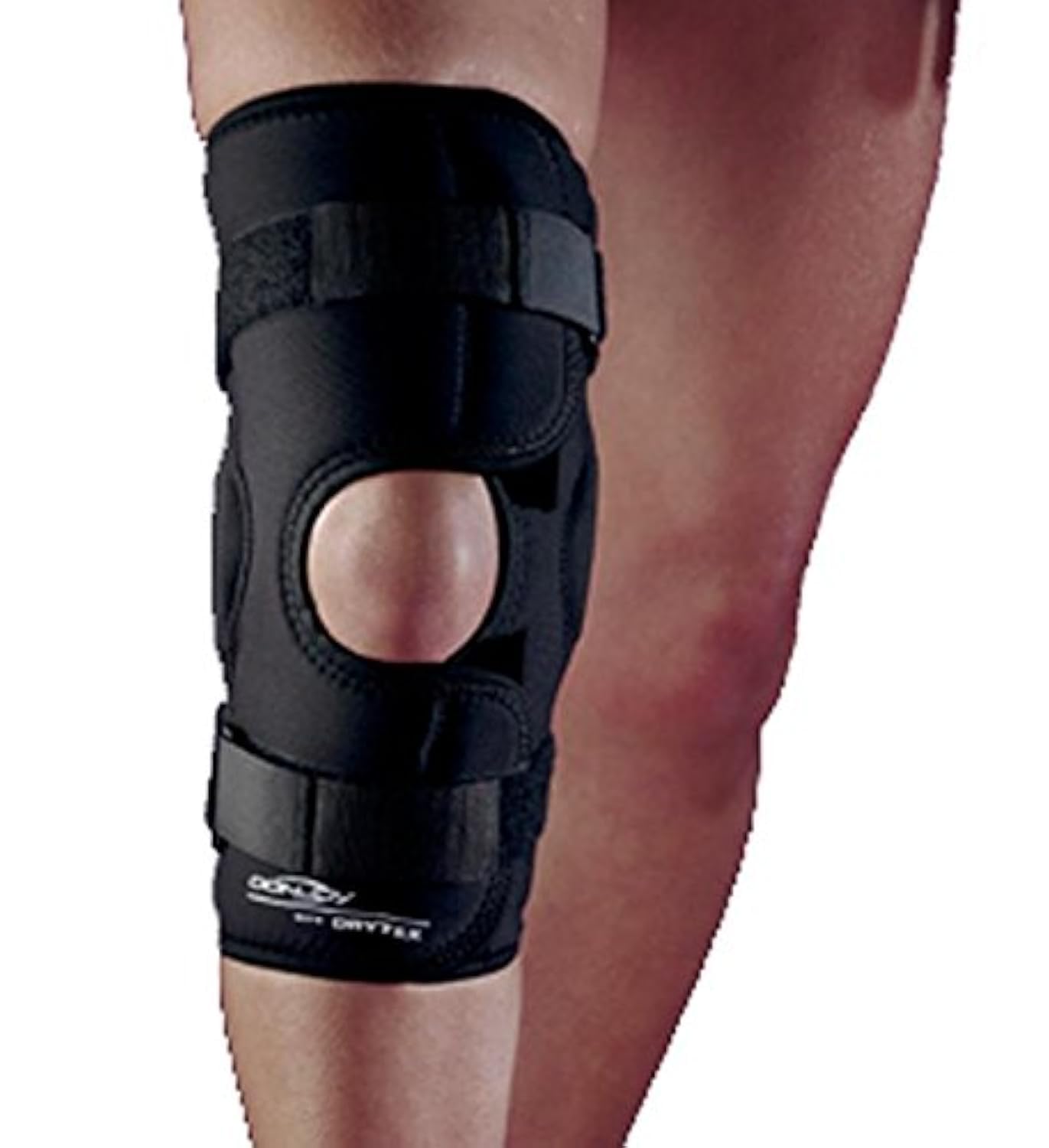
DonJoy is a name synonymous with durable orthopedic bracing, and the Drytex Sport carries that reputation into a hinged sleeve that balances compression with breathability. The Drytex fabric is designed to wick sweat away from the skin, making this brace viable for all-day wear during physical activity or long shifts on your feet. It includes lateral hinges that resist medio-lateral movement while still allowing full knee flexion.
Buyers who have used DonJoy braces for years consistently order this model as a replacement for worn-out units, citing consistent quality and reliable hinge performance. One reviewer noted a rubbing sensation on the seam behind the knee cutout when worn on bare skin, but still recommended the brace overall for its comfort and reasonable price. The moisture-wicking properties are a standout feature for those who experience skin irritation with neoprene.
Measured fit is critical — DonJoy recommends taking thigh and calf circumference 6 inches above and below the kneecap. Some users report that the sizing chart runs small, and the pull-on sleeve design can be challenging for those with calf-to-thigh ratios outside the standard bell curve. It’s not designed for post-op ROM control or extreme instability, but for day-to-day ligament support and return-to-sport protection, it’s a solid mid-range workhorse.
Why it’s great
- Drytex fabric breathes exceptionally well for all-day comfort
- Hinges resist lateral movement without restricting activity
- Consistent quality trusted by long-term DonJoy users
Good to know
- Seam behind knee can rub on bare skin during activity
- Pull-on sizing may not fit disproportionate calf-thigh measurements
- No ROM adjustment controls for rehab protocols
5. GHORTHOUD Hinged ROM Knee Brace

If you’re in the post-surgery phase where your surgeon wants controlled flexion and extension, this brace’s locking dial — adjustable from 0° to 120° — is a critical feature you won’t find in most sleeve-style braces. The GHORTHOUD uses a wrap-around design with four adjustable straps (two above the knee, two below), which allows a custom fit that resists migration better than any pull-on sleeve. The hinges and locking dials are removable, so once your knee has healed, you can convert the brace into a lighter sports support.
User reports highlight that the brace stays in place during activity without constant readjustment — a common complaint with cheaper wrap-style braces. A quadriceps tendon tear patient locked the brace at 45° and reported it completely prevented their knee from giving out during walking, providing fall-prevention stability. The squeaking of the hinges is a frequent minor complaint, but several buyers found that applying graphite powder to the hinge mechanism silenced it for several days of use.
The Lycra fabric provides good compression and the open patella design reduces pressure on the kneecap. However, the strap hook closures can feel unpleasant against bare skin, and some users report difficulty keeping the brace positioned correctly without periodic adjustments. The included straps offer ample customization for different leg shapes, making this a versatile option for rehab that transitions to daily activity.
Why it’s great
- 0-120° ROM lockout dial gives surgical-level control for rehab
- Four-strap wrap design provides superior fit for varied leg shapes
- Removable hinges convert brace to lighter activity support
Good to know
- Hinges may squeak during movement
- Strap hook closures can irritate exposed skin
- Some users report gradual sliding during extended wear
6. Shock Doctor Bionic Knee Brace

When your knee instability is severe enough that a simple sleeve feels useless, the Shock Doctor Bionic enters the conversation with bi-lateral aluminum hinges encased in a semi-rigid frame. This is the most structurally robust brace on this list — it includes a separate compression sleeve that you wear under the brace to prevent chafing, and the hinge system uses a dual-pivot design that allows fluid natural movement while providing exceptional resistance to medio-lateral sway and hyperextension.
Hockey players, basketball athletes, and heavy laborers report that this brace restored their ability to push hard without the knee giving out. Several buyers noted that after switching to the Bionic from cheaper wrap-around braces, their knee, hip, and back pain all decreased because the brace corrected their gait. The strap system is highly adjustable, with multiple points of tension control that let you fine-tune the fit.
The main drawback is the hard plastic upright that presses into the shin — one reviewer reported severe pain from this contact point, and it may not be suitable for long wear in hot weather when swelling increases. Sizing is also critical: buyers frequently need to re-measure and exchange sizes because leg swelling after injury can change circumference dramatically. It’s not a brace you forget you’re wearing, but for the stability it provides, most users find the trade-off worthwhile.
Why it’s great
- Bi-lateral aluminum hinges offer maximum lateral resistance
- Includes compression sleeve to prevent skin chafing
- Adjustable strap system allows precise tension customization
Good to know
- Hard plastic upright can press painfully into the shin
- Bulkier than sleeve-style braces — not discreet under clothing
- Sizing must account for leg swelling post-injury
7. Ovation Medical Game Changer Unloader

This is the brace for the arthritis patient — the person who has bone-on-bone pain in one compartment of the knee and needs to unload that side to walk without a limp. The Game Changer uses a single upright frame with an adjustable tension mechanism that you can turn with a supplied key to either push weight away from the medial or lateral compartment. It is not a general stability brace; it’s a highly specialized unloading brace for osteoarthritis, degenerative meniscal tears, and uni-compartmental pain.
Users describe the relief as “game-changing” — one reviewer with a broken tibia and old knee injury reported that intense pain was greatly reduced, and that the brace was comfortable enough to wear all day without taking off. The push-button release buckles are designed for people with hand mobility limitations, and the single upright frame avoids the inner-knee rubbing that dual-upright braces cause. The brace defaults to right-side orientation, so left-knee users must confirm compatibility before ordering.
It does not prevent hyperextension or resist lateral sway the way a hinged sports brace does — its function is purely to offload the arthritic compartment. The straps and buckles require some initial setup, and users with very small legs may find the straps too long and need to trim them. For the specific population of knee OA sufferers, this represents a fraction of the cost of custom-fitted unloader braces from a clinic.
Why it’s great
- Adjustable offloading mechanism provides targeted pain relief for OA
- Single upright design avoids inner-knee pressure common in dual braces
- Push-button buckles are easy to operate with arthritic hands
Good to know
- Not designed for general instability or sport — unloading only
- Default right-side orientation; left-knee users must verify
- Straps may be long for users with small leg circumference
FAQ
Can a brace for knee stability prevent my knee from buckling during everyday walking?
Should I get a brace with removable hinges if I plan to use it for both recovery and eventual sport?
My knee pain is on the inside (medial) compartment from arthritis. Which brace type helps most?
How tight should the knee brace straps be for optimal stability without restricting blood flow?
Final Thoughts: The Verdict
For most users, the best brace for knee stability winner is the Bauerfeind Sports Knee Support NBA because its Omega pad and precision compression knit provide superior proprioceptive feedback and rotational stability without the bulk of rigid hinges. If you want targeted meniscus support at a budget-friendly price, grab the Galvaran Professional Knee Brace. And for post-surgery rehab where you need controlled range of motion that transitions to daily activity, nothing beats the GHORTHOUD Hinged ROM Knee Brace.