
Our readers keep the lights on and the weekend projects moving. As an Amazon Associate, I earn from qualifying purchases.
Sleeping, driving, or simply standing still with a torn rotator cuff turns every second into a negotiation with pain. The wrong brace adds pressure on the ulnar nerve, shifts weight onto your neck, or fails to hold the shoulder at the abduction angle needed for real healing. A properly designed brace for torn rotator cuff does more than compress—it immobilizes the shoulder at a precise angle, distributes load away from the cervical spine, and keeps the arm stable during sleep and daily activity without cutting off circulation.
I’m Rikta — the co-founder and writer behind FitlyFast. I’ve spent hundreds of hours analyzing orthopedic support hardware, comparing foam densities, abduction angles, strap systems, and breathable fabric constructions to separate medical-grade recovery tools from cheap imitations.
Whether you’re recovering from a post-surgical repair, managing a labrum tear, or dealing with chronic subluxation, the right support changes your recovery trajectory. This guide breaks down the seven most effective options available today to help you choose the best brace for torn rotator cuff.
How To Choose The Best Brace For Torn Rotator Cuff
Not every brace delivers the same support profile. A simple compression sleeve helps with minor tendonitis, but a full-thickness rotator cuff tear demands a structured immobilizer that holds the arm at a specific abduction angle. Understanding the functional difference between a sling, an abduction brace, and a compression sleeve is the first step to making a choice that actually aids healing.
Abduction Angle Adjustability
Post-surgical rotator cuff repairs require the arm to be held at a 15° to 30° angle away from the body. This position reduces tension on the repaired tendon and prevents re-tear during sleep. Fixed-angle braces work for standard recoveries, but adjustable models let you progress from 30° down to 15° as healing advances. A brace with a removable foam wedge gives you that flexibility without buying a second device.
Weight Distribution and Neck Pressure
The worst brace shifts the entire weight of the arm onto the cervical spine, causing neck spasms and shoulder pain on the healthy side. Look for a 3-point strapping system—a waist belt, a cross-body strap, and an opposite shoulder anchor—that redistributes load evenly. The DonJoy UltraSling IV and the Velpeau abduction sling use this architecture to eliminate neck strain during extended wear.
Breathability and Skin Sensitivity
Wearing a brace for 6–8 weeks means your skin will spend thousands of hours against foam, nylon, and hook-and-loop material. Neoprene traps heat and sweat, leading to irritation and rashes. Choose braces with breathable mesh lining, moisture-wicking inner fabric, and removable, machine-washable covers. The ORTONYX 3D knitted sleeve is a good option for active recovery because its nylon-elastane blend allows airflow while providing even compression.
Quick Comparison
On smaller screens, swipe sideways to see the full table.
| Model | Category | Best For | Key Spec | Amazon |
|---|---|---|---|---|
| DonJoy UltraSling IV | Post-Surgery Sling | Premium neck-sparing support | 3-point strapping system | Amazon |
| Velpeau Abduction Sling | Abduction Immobilizer | Sleep comfort with dual pillows | 15°–30° adjustable abduction | Amazon |
| Alpha Medical Immobilizer | Removable Pillow Brace | Versatile left/right use | Removable abduction pillow | Amazon |
| POAGL Adjustable Brace | Compression Sleeve | Daily activity & gym recovery | Neoprene, chest 48-72 in | Amazon |
| Cheer Collection Pillow | Sleep Support Cushion | Side-sleeping arm support | W-shaped 23.5 x 14 x 6 in | Amazon |
| ORTONYX Stability Sleeve | Compression Sleeve | Light activity & pain relief | Nylon 85%, Elastane 15% | Amazon |
| FAMILY HEALTH Heated Wrap | Heated Massager Brace | Tension relief & muscle soreness | 3 heat levels, vibration | Amazon |
In‑Depth Reviews
1. DonJoy UltraSling IV Shoulder Support Sling

The DonJoy UltraSling IV is the benchmark for post-surgical shoulder immobilization. Its contoured foam cushion eliminates pressure on the ulnar nerve while providing comfortable abduction that keeps the repaired tendon in a low-tension position. The 3-point strapping system distributes the arm’s weight evenly across the waist, opposite shoulder, and side pillow, so the cervical spine never bears the load—critical for avoiding secondary neck spasms during the 6–8 week recovery window. The inner lining uses breathable polyester-spandex mesh that wicks moisture and prevents heat buildup, making it tolerable for all-day and all-night wear.
Surgeons and physical therapists frequently recommend this sling over hospital-issued alternatives because of how well it holds its position during sleep. The thumb strap keeps the forearm from drifting, and the wide padded shoulder strap prevents digging. Users who have tried Breg and DonJoy’s own previous models consistently report that the UltraSling IV offers the most stable arm position without requiring constant re-adjustment. The bilateral design works for either arm, and the adjustable straps accommodate a wide range of torso sizes without needing to be cut—excess strap length tucks away via detachable Velcro tabs.
At this price point, the DonJoy is an investment in recovery speed. Patients who used it after rotator cuff repair noted zero neck pain compared to previous slings, and the durable construction held up to two months of daily use without frayed edges or failed hook-and-loop closures. The only frequent note is that the forearm pocket can tilt downward when sitting upright for long periods, requiring a quick re-tightening of the waist belt. For anyone facing a serious rotator cuff repair or shoulder replacement, this is the sling that minimizes complications and maximizes sleep quality.
Why it’s great
- Padded ulnar nerve relief cushion reduces numbness risk
- 3-point weight distribution prevents neck and back strain
- Breathable liner stays comfortable through full-day wear
- Sturdy build survives months of daily use without failure
Good to know
- Forearm support may tilt downward and need occasional re-tightening
- Higher investment compared to basic slings
2. Velpeau Shoulder Abduction Sling with Two Removable Pillows
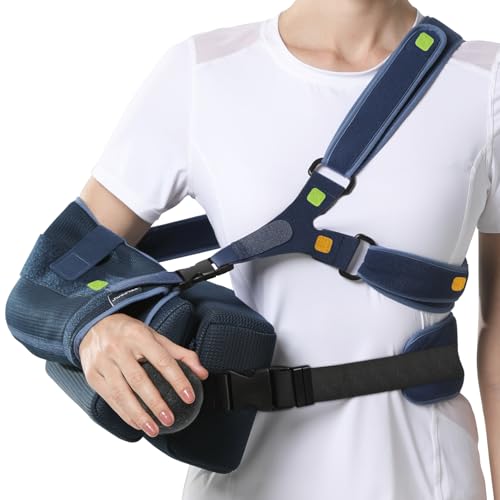
The Velpeau abduction sling differentiates itself with two removable foam pillows that let you customize the abduction angle from 15° to 30°. This is the only mid-range brace that gives you progressive angle reduction as healing advances—start at 30° to protect the repair during the first weeks of fragile tendon healing, then remove one pillow to drop to 15° as range of motion increases. The Y-shaped shoulder straps are wide and padded, distributing load away from the trapezius and eliminating the neck digging that plagues the cheap hospital-issued slings. The breathable mesh and sponge padding across the chest and waist keep air circulating, reducing the sweaty, irritated skin that often leads patients to abandon their brace.
A built-in pocket on the front panel holds your phone or keys, which sounds minor but becomes a significant convenience when you’re one-armed for weeks. The hand sports ball with a support splint keeps the wrist in neutral position and gives the fingers something to do, which helps maintain blood flow and prevent stiffness. Users recovering from open subscapular repair and biceps tenodesis rated this sling more comfortable than the DonJoy UltraSling II and Breg Slingshot 3, specifically praising how easy it is to sleep on your back with the abduction pillow maintaining the correct position. The aluminum alloy support frame is sturdy yet lightweight at 1.6 pounds, and the entire setup can be converted for left or right arm use by swapping the arm support sleeve and pillows to the opposite side.
The main trade-off is that the foam pillows add bulk, making the sling feel larger than a simple pouch-style immobilizer. Some users found the hand ball slightly stiff to squeeze, though that improved with use. One reviewer noted that a hook-and-loop attachment point ripped after extended wear, though the sling remained functional. For anyone who needs to sleep well during rotator cuff recovery, the Velpeau delivers the most versatile angle management in its tier.
Why it’s great
- Two removable pillows offer 15°–30° abduction progression
- Wide Y-shaped straps prevent neck and trapezius strain
- Built-in pocket adds one-armed convenience
- Hand sports ball maintains wrist neutrality and circulation
Good to know
- Bulky pillow design feels larger than basic slings
- Hand ball is initially stiff to squeeze
3. Alpha Medical Abducted Shoulder Immobilizer with Removable Abduction Pillow

The Alpha Medical immobilizer is a complete recovery system that includes the abduction sling, a removable foam pillow, and an exercise ball for early rehabilitation. The pillow keeps the shoulder at a fixed abduction angle to protect the repair during the initial healing phase, and it can be removed once the surgeon clears you for gentle range-of-motion exercises. The waist wrap is a standout feature—it cinches securely around the torso and provides a stable anchor for the arm cup, preventing the sling from sliding upward when you stand or sit. Users recovering from rotator cuff repair and frozen shoulder procedures found this sling more comfortable and supportive than what their orthopedic office provided.
The construction uses high-density foam padding that maintains its shape over weeks of daily use, and the fabric is soft enough against the skin that most users wear it directly over a t-shirt without irritation. The exercise ball is a simple but functional addition—squeezing it during the day helps maintain grip strength and forearm circulation, which speeds overall recovery. For smaller-framed individuals, the pillow fits well at 5’2″ and 114 pounds, though the overall sling dimensions lean slightly large. The hook-and-loop closures make adjustments straightforward, and the sling works for both left and right arms without any conversion steps.
The primary complaint is that the Velcro backing can grab hair and skin when unfastening, which is uncomfortable for users with hairy arms or sensitive skin. A few users with lymphedema found the pillow pressure distribution unsuitable. For the price, this offers more components than any other brace in its tier—abduction support, removable pillow, and rehab tool—making it a smart choice for anyone who wants a single purchase that covers the entire post-surgery period.
Why it’s great
- Removable abduction pillow adapts to recovery phase
- Exercise ball aids grip and circulation rehab
- Waist wrap keeps sling stable and prevents upward slide
- High-density foam retains shape through weeks of wear
Good to know
- Velcro backing can snag hair and skin
- Pillow size may feel bulky for petite frames
4. POAGL Adjustable Shoulder Brace for Men
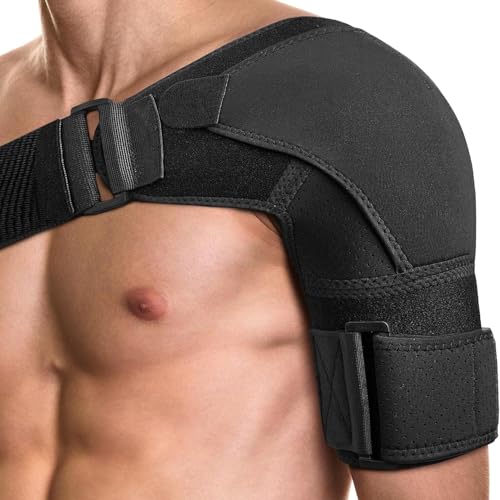
The POAGL brace is a compression sleeve-style support designed for managing chronic rotator cuff pain, bursitis, and tendonitis during daily activities rather than post-surgical immobilization. The X-Large size accommodates chest circumferences up to 72 inches and bicep sizes up to 26 inches, making it one of the few braces that fits broader body types without cutting off circulation. The hook-and-loop straps allow you to dial in compression at three points—across the chest, over the shoulder, and around the bicep—creating a customized fit that stays put during gym sessions and work. The neoprene fabric is lightweight and machine washable, though it does retain more heat than a mesh-based sleeve.
Users recovering from labrum tears and mild dislocations found the brace provided enough stability to return to light lifting and daily chores without the arm drifting into painful positions. The slim profile means it fits under loose clothing without looking bulky, which matters for professionals who need to wear it during the workday. One reviewer specifically praised the bicep strap design that enables one-handed cinching like a belt—a small detail that makes a big difference when your other arm is injured. The brace works for both left and right shoulders, and the ergonomic cut reduces bunching at the armpit.
The main durability concern is that the hook-and-loop patches can lose grip over time, especially if the brace is machine washed frequently. Some users reported that the Velcro popped open during intense activity, requiring re-fastening. The fabric breathability is adequate for moderate activity but falls short during sweaty workouts, where moisture gets trapped against the skin. For anyone needing a versatile daily support sleeve that won’t break the bank, the POAGL brace covers the essentials.
Why it’s great
- One-handed cinching bicep strap for easy adjustment
- Fits large chest sizes up to 72 inches
- Slim profile fits under clothing discreetly
- Works for both left and right shoulders
Good to know
- Hook-and-loop grip may weaken with frequent washing
- Neoprene fabric traps heat during intense activity
5. Cheer Collection Rotator Cuff Pillow – Shoulder Surgery Recovery Pillow

The Cheer Collection pillow isn’t a brace in the traditional sense—it’s a W-shaped body pillow that keeps your shoulder and arm in a neutral position while you sleep on your back or the uninjured side. After a rotator cuff tear, sleeping flat on your back causes the arm to roll outward, pulling on the injured tendon and waking you with sharp pain. This pillow creates a physical barrier against side-rolling while cradling the bicep and elbow in a gentle trough that prevents internal rotation. The hollow fiber fill offers balanced firmness—soft enough to not pressure the ribs, dense enough to maintain its shape through the night.
Users with frozen shoulder, rotator cuff repairs, and general shoulder impingement found immediate relief during the first night of use. The velour cover is soft against the skin and zips off for machine washing, which is essential when you’re using it nightly for weeks. At 23.5 inches long, the pillow works equally well supporting the arm while sitting on the couch, reading in bed, or riding in a car. Several reviewers noted that the pillow helped them sleep through the night for the first time since their injury, reducing daytime pain associated with poor sleep posture.
The main limitation is that the pillow is pre-filled and cannot be adjusted for firmness or height. Petite users under 5’4″ found the pillow slightly too puffy, and there is no way to remove stuffing without cutting the fabric shell. It also does not secure to the body, so restless sleepers may push it out of position during the night. For anyone whose primary struggle is sleeping comfortably with a torn rotator cuff, this pillow is a low-cost, high-impact solution that directly addresses that specific pain point.
Why it’s great
- W-shape prevents side-rolling and arm drift during sleep
- Machine-washable removable velour cover
- Balanced firmness supports arm without rib pressure
- Versatile for bed, sofa, car, and desk use
Good to know
- Fill cannot be removed to adjust firmness
- Not secured to body, may shift during restless sleep
6. ORTONYX Shoulder Stability Brace Compression Sleeve
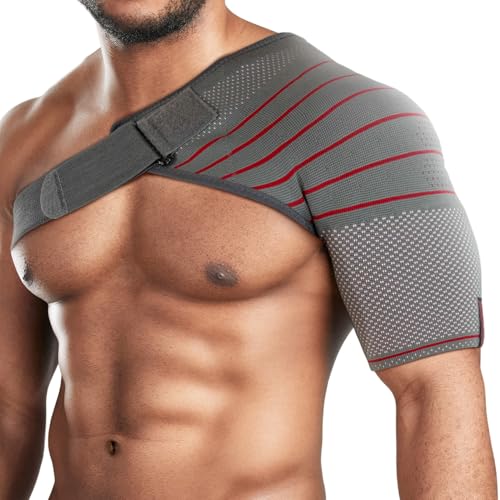
The ORTONYX brace uses 3D knitted construction with 85% nylon and 15% elastane to deliver graduated compression across the deltoid and rotator cuff without the bulk of a neoprene sleeve. The knit pattern creates zones of varying tension—firmer compression over the joint capsule, lighter support over the trapezius and bicep—so the brace stays in place without riding up or pinching. The adjustable cross-body strap adds a secondary layer of stability for activities like overhead reaching or lifting, but the sleeve itself provides enough support for everyday movement and light exercise. The gray and red color scheme is subtle enough to wear under a shirt during work hours.
This brace is best suited for early recovery from a mild sprain, tendonitis flare-up, or post-surgery rehabilitation where you’ve been cleared for active movement but still need proprioceptive feedback. The compression helps reduce swelling and gives the shoulder joint a sense of stability that discourages triggering movements. Users healing from AC joint separation and labrum tears reported that the brace reduced pain during daily tasks like reaching for a seatbelt or carrying groceries. The moisture-wicking fabric keeps the skin dry during light activity, making it more wearable during warm weather than neoprene alternatives.
The sizing inconsistency is the most common complaint—some users found the fit looser than expected, particularly around the trapezius, and the adjustment strap isn’t long enough to cinch down on smaller frames. The elastic cross strap is thin and can roll up, causing irritation in the opposite armpit. For active individuals who need a low-profile compression sleeve with added stability, the ORTONYX works well, but those with broader shoulders should measure carefully and consider sizing up.
Why it’s great
- 3D knitted fabric provides graduated compression without bulk
- Moisture-wicking nylon-elastane blend stays cool during activity
- Adjustable cross strap adds targeted stability
- Low profile fits under regular clothing
Good to know
- Sizing runs large for some body types
- Cross strap is thin and may roll up at the armpit
7. FAMILY HEALTH Cordless Portable Shoulder Heating Pad & Massager
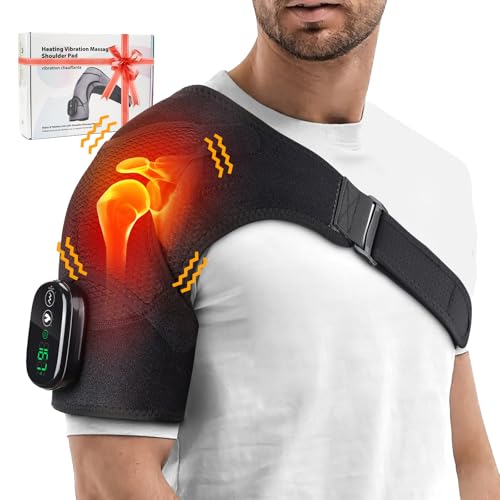
The FAMILY HEALTH shoulder wrap combines a neoprene compression brace with three heat levels and three vibration modes, all powered by a built-in 5000mAh rechargeable battery. The heat range goes from 104°F up to 167°F, which is sufficient to increase blood flow to the rotator cuff muscles and reduce stiffness before activity. Vibration can be used alone or layered with heat, and the motor placement targets the posterior deltoid and upper trapezius—the areas that tighten up most after a rotator cuff injury. The starfish-shaped tightening structure uses multiple hook-and-loop straps to contour the wrap closely to the shoulder curve, preventing the heating elements from shifting out of position.
This device is not a substitute for a medical immobilizer, but it works well as a complementary tool for pain management during the chronic phase of a rotator cuff tear or after the immobilization period ends. Users dealing with daily shoulder ache from overuse or post-surgical stiffness found that a 30-minute heat-and-vibration session significantly reduced pain for several hours afterward. The cordless design means you can wear it while driving, working at a desk, or watching TV without being tethered to a wall outlet. The LED display shows the current temperature clearly, and the low-battery alert prevents unexpected shutdowns.
The two biggest drawbacks are battery life and noise. On the highest heat and vibration setting, the battery lasts roughly two hours, which isn’t enough for all-day use without recharging. The vibration motors produce a hum that sits close to the ear, which some users found distracting or loud. The hook-and-loop straps are adequate for the chest but can feel loose on the upper arm for thinner users, reducing the wrap’s ability to stay in position during movement. For targeted heat therapy and vibration massage to complement a structured recovery program, this wrap offers solid value.
Why it’s great
- Combination of adjustable heat and vibration in one wearable
- 5000mAh battery offers cordless portability
- Starfish strap system keeps heating elements in place
- LED screen and low-battery alert for safe operation
Good to know
- Battery lasts about two hours on high settings
- Vibration motors are audible and sit close to the ear
FAQ
Can I sleep in a rotator cuff brace?
How long should I wear a brace for a torn rotator cuff?
What is the difference between a sling and an abduction brace?
Final Thoughts: The Verdict
For most users, the brace for torn rotator cuff winner is the Velpeau Shoulder Abduction Sling because it combines dual removable pillows for progressive abduction angles with a comfortable, neck-sparing Y-strap design at a manageable price point. If you want maximum surgical-grade construction and the best neck pressure distribution on the market, grab the DonJoy UltraSling IV. And for a complete post-surgery kit that includes an exercise ball and removable pillow in one package, nothing beats the Alpha Medical Immobilizer.