
Our readers keep the lights on and the weekend projects moving. As an Amazon Associate, I earn from qualifying purchases.
Specs are compiled from manufacturer listings and verified buyer reviews and can change over time — please confirm the key details on the product page before buying.
If you have ever peeled off a pair of work gloves after twenty minutes only to find your hands soaked in sweat, you already know the real enemy isn’t the job — it is the heat trapped inside the fabric. Breathable work gloves solve this by letting air circulate so your palms stay dry, your grip stays secure, and you do not have to stop every few minutes to air out your hands. This guide breaks down five pairs that actually let your skin breathe, keeping you cool across everything from warehouse shifts to summer yard work.
I’m Rikta — the founder and writer behind FitlyFast. This guide is built by comparing the manufacturers’ published specifications and the patterns across verified customer reviews, so you get each pick’s real strengths and trade-offs instead of marketing spin.
After looking at the materials, coating types, and real-world feedback on each option, here is the short version: the best breathable work gloves for most people balance a ventilated back-of-hand with a durable nitrile or synthetic leather palm that does not trap moisture.
Quick Picks
- Mechanix Wear: The Original Coyote Tactical Work Gloves — Best Overall
- Klein Tools 60188 Professional Grade Leather Gloves — Pro Grade
- Kebada W2-6 Pairs Safety Work Gloves — Best Value
- toolant 6 Pairs Work Gloves MicroFoam Nitrile Coated — Breathable Champion
- TitanFlex Work Gloves Microfoam Nitrile Coated 6 Pairs — Budget Champ
How To Choose The Best Breathable Work Gloves
Choosing a breathable work glove depends on looking past the brand name and understanding three key factors: the coating type, the liner gauge, and how the back of the glove handles heat. Here is what you should pay attention to when shopping.
Coating Type — Microfoam Nitrile vs. Synthetic Leather vs. Standard PU
The coating on the palm and fingers is what contacts your tools, but it also determines how much heat builds up inside the glove. Microfoam nitrile has a porous, sponge-like structure that lets air pass through while maintaining a solid grip in oily or wet conditions — translating to noticeably less sweat on hot days. Standard PU coats are thinner and cheaper but trap more heat because they form a solid film. Premium synthetic leather gloves like those from Mechanix Wear use a breathable mesh across the back of the hand, with the leather only on the palm, giving you abrasion resistance where you need it and ventilation everywhere else.
Liner Gauge — How the Nylon Base Affects Dexterity and Airflow
The “gauge” number (like 15-gauge or 18-gauge) refers to how many needles per inch are used to knit the liner — a higher number means a finer, thinner, and more breathable fabric. Most microfoam nitrile gloves in this range use a 15-gauge nylon-spandex liner, which offers a good balance between airflow and durability. It stretches to fit your hand like a second skin, so you can still feel small screws or bolts without the glove bunching up. Thicker liners (7-gauge or 10-gauge) are tougher but trap more heat and reduce finger movement, so for breathability, stick with 15-gauge or finer.
Back-of-Hand Construction — Mesh vs. Solid Fabric
The back of the glove is where most of the heat escapes. If you are working in direct sun or doing repetitive motion tasks, a mesh or stretchable fabric back panel makes a huge difference — it allows evaporative cooling to happen instead of trapping sweat against your skin. Some gloves use a TrekDry material or similar moisture-wicking fabric that pulls sweat away from the skin and dries fast. Solid synthetic leather backs offer more protection against scrapes and debris but will run hotter. For jobs that require arm movement (warehouse scanning, automotive repair), prioritize a glove with a clearly ventilated or mesh-like back panel.
Quick Comparison
| Model | Best For | Liner Gauge / Material | Coating Type | EN388 Abrasion Level | Amazon |
|---|---|---|---|---|---|
| Mechanix Wear: The Original Coyote Tactical | Tactical & multi-purpose grip | Medium-weight synthetic leather | Synthetic Leather (TrekDry back) | ANSI 6 (impact L3) | Amazon |
| Klein Tools 60188 | Professional trades with knuckle protection | Unlined goatskin leather (mesh back) | Goatskin Leather | — | Amazon |
| Kebada W2-6 Pairs | Long-lasting precision work | 15-gauge nylon-spandex | Microfoam Nitrile | Level 4 | Amazon |
| toolant 6 Pairs MicroFoam Nitrile | Warm-weather all-day wear | 15-gauge nylon-spandex | Microfoam Nitrile | EN388 certified | Amazon |
| TitanFlex Microfoam Nitrile 6 Pairs | Budget-friendly multi-pack | Lightweight nylon-spandex | Microfoam Nitrile | ANSI Level 4 | Amazon |
In‑Depth Reviews
1. Mechanix Wear: The Original Coyote Tactical Work Gloves

The glove that defined the category keeps your hands cool with evaporative TrekDry material.
If you need a pair of gloves that handles everything from shooting range trips to hauling brush without making your palms sweat, this is the one. Mechanix Wear built its reputation on the Original Coyote Tactical, and it holds up because of the.8mm synthetic leather palm mated to a breathable TrekDry back — a moisture-wicking fabric that pulls heat away from your skin instead of trapping it. Unlike the microfoam nitrile gloves further down this list, where the entire palm is coated, this design puts ventilation exactly where your hand needs it most: the back.
Buyers report excellent fit, grip, protection, and dexterity, and many say the gloves last about two years with regular laundering. The TPR wrist closure keeps out dirt without being bulky. At an ANSI abrasion level of 6 versus Level 4 on the microfoam nitrile gloves, it holds up better to rough materials like concrete or metal. The trade-off? The palm leather is thicker than a microfoam coating, so you lose a bit of fingertip sensitivity for very small parts, and one reviewer noted the sizing chart runs slightly off — if between sizes, size up.
Why It Dominates
- ANSI abrasion Level 6 versus Kebada’s Level 4
- TrekDry back keeps hands cool during extended wear
- Reinforced thumb and index for high-wear areas
One Real Limit
- Synthetic leather palm has less tactile feel than microfoam nitrile
- Sizing chart can be off — check measurements carefully
Reach for these if: you want a single glove for tactical, yardwork, and shop use that outlasts coated-nylon options.
Give them a pass if: you need pinpoint fingertip sensitivity for electronics or tiny fasteners — the nitrile-coated gloves below are better for that.
2. Klein Tools 60188 Professional Grade Leather Gloves

Professional goatskin leather with a mesh back that breathes and PVC guards that protect.
Klein Tools is a name electricians know, and the 60188 model shows why a cut-and-sewn leather glove can still be breathable. Instead of a dip-coated palm, it uses goatskin leather — naturally softer and more flexible than cowhide — combined with a mesh back panel that lets air flow freely across your knuckles. If you work around sharp edges or rough surfaces where a microfoam coating would tear, this is the upgrade. It also adds EVA foam palm padding for vibration dampening and PVC guards over the knuckles and fingers.
One buyer mentioned these gloves insulate against 110v lines for basic safety when power cannot be shut off, though Klein does not market them as electrical-insulating gloves. Several reviewers mention they are comfortable for yardwork and general construction, but they are not meant for heavy-duty demolition — the goatskin wears faster than synthetic leather if you drag it across concrete all day. A mesh back means less splash protection, so expect dust and grit to pass through.
Where It Excels
- PVC knuckle and finger guards protect against impact
- Goatskin leather is softer and more comfortable than cowhide
- Mesh back provides serious ventilation
What To Know
- Goatskin wears faster on rough surfaces than synthetic leather
- Mesh back lets in debris — not ideal for dusty environments
Best for: electricians, carpenters, and professionals who need knuckle protection with a leather palm that breathes.
Skip them if: your job involves constant abrasion (concrete, metal grinding) — the Mechanix Wear or a fully coated glove will last longer.
3. Kebada W2-6 Pairs Safety Work Gloves

A 15-gauge liner with microfoam coating that hits 18,000 abrasion cycles — the durability king.
Kebada’s W2 model is for buyers who want the breathability of a microfoam nitrile glove but need it to last through daily abuse. The 15-gauge nylon-spandex liner is the same foundation you see in many breathable gloves, and Kebada says the glove passes EN388 Level 4 abrasion testing. That means it handles sand, oil, and rough metal edges without the coating peeling off after a week. If you compare it to the toolant pair below, the Kebada holds up noticeably longer before the nitrile starts wearing thin at the fingertips.
Owners mention the gloves lasting about two years with normal use, or several months with daily tire and battery changes. One mail carrier mentioned they are breathable up to 95°F, still comfortable down to 40°F in low humidity, and the full five-finger touchscreen works well with scanners and phones. The catch: the coating can degrade if left wet for long periods, and fingertip coating may wear off after about four weeks of heavy scanning work. Hand-wash only to preserve the nitrile.
The Long Haul Winner
- EN388 Level 4 abrasion rating
- 5-finger touchscreen works with scanners and phones
- Breathable microfoam keeps hands cool in summer heat
The Trade-Off
- Coating degrades faster if left wet for long periods
- Hand-wash only — machine washing may damage the coating
Pick these if: you need a breathable microfoam glove that survives daily abuse in a warehouse, shop, or delivery route.
Move on if: you want a glove that dries fast after getting wet — the toolant and TitanFlex options handle moisture better.
4. toolant 6 Pairs Work Gloves MicroFoam Nitrile Coated
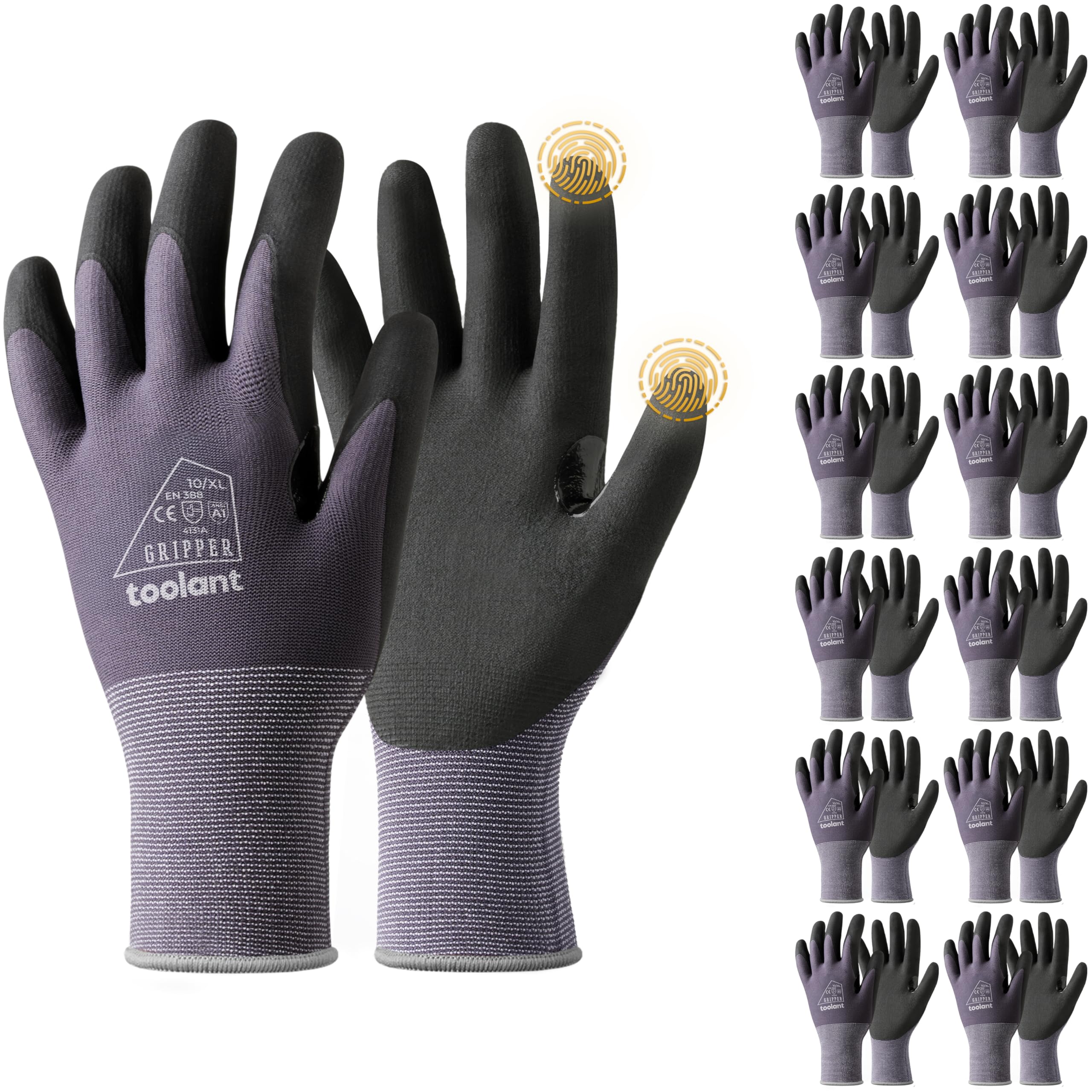
A microfoam nitrile glove designed to stay cool and skin-friendly all day.
The toolant gloves lean hard into breathability — the microfoam layer has a deliberately porous structure (DMF-free, so it is gentle on skin) that lets air flow through while you grip oily parts or dusty boxes. This is a glove for warm, dry weather where sweat is the main problem. Customers note that it “doesn’t feel like you have gloves on” and that the size medium fits skin-tight without restricting movement. The 15-gauge liner gives you enough dexterity for precise work, and the reinforced thumb crotch adds durability where the glove usually tears first.
One owner mentioned that while the gloves are great for warm dry weather, they got wet in winter and did not dry quickly — a common limit of microfoam coatings that trap moisture inside if the glove itself gets saturated. Another reviewer noted a strong odor from the start that dissipated after a few wears. Compared to the TitanFlex below, the toolant gloves have a slightly more breathable liner but the coating feel is similar. Good for indoor warehouse shifts or summer landscaping.
Why It Works
- Porous microfoam is DMF-free and feels less sweaty than standard PU
- Reinforced thumb crotch extends life at a common stress point
- Ambidextrous design fits either hand
The Limitation
- Does not dry quickly once fully wet — poor for wet winter use
- Odor from the start reported by several buyers
Reach for these: when you need max breathability in dry, warm conditions and value skin comfort over extreme durability.
Skip them: if your work involves heavy moisture or you need gloves that dry within minutes — consider the Klein or Mechanix options instead.
5. TitanFlex Work Gloves Microfoam Nitrile Coated 6 Pairs
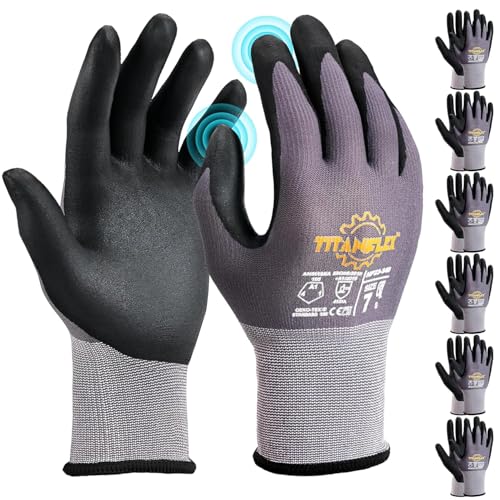
Six pairs of ANSI Level 4 gloves for the price of one premium pair — no kidding.
If you need to outfit a team or keep multiple pairs scattered across your truck and garage without blowing the budget, the TitanFlex pack is absurdly practical. For the same cash as a single premium glove, you get six pairs of microfoam nitrile-coated gloves with an ANSI ISEA abrasion level of 4 and a 15-gauge nylon-spandex liner. That Level 4 rating matches the Kebada’s ANSI spec (though the Kebada hits 18,000 cycles on the EN388 test, where TitanFlex’s certified cycles are not published). The grip in oily and greasy conditions is excellent — reviewers point out it outperforms bare hands and standard PU-coated gloves.
A reviewer noted the fit is “like a second skin” and that the flexible rubberized coating allows good dexterity with nuts and bolts. The gloves are machine-washable below 40°C, which brings them back to like-new condition. The catch is that the palm coating is slightly thinner than the Kebada’s, so heavy daily use will wear through the nitrile faster — one owner mentioned the label fades after washing, though the rubber stays intact. Touchscreen compatibility works on all five fingers, but the sensitivity is good for typing, not precise screen navigation.
The Value Play
- Six pairs at a budget-friendly price — great for team use or spares
- ANSI Level 4 abrasion resistance in a lightweight nitrile coating
- Machine-washable up to 40°C to restore like-new feel
One Concern
- Coating is thinner than the Kebada — will wear faster under daily abuse
- Touchscreen sensitivity is functional but not as responsive as some
Go for it if: you want a bulk set of breathable gloves that protect well and cost very little per pair for light-to-moderate work.
Buy a different pair if: you need one glove that endures 8-hour daily abuse for months — the Kebada or Mechanix will outlast this pack.
Understanding the Specs
EN388 Abrasion Rating and Cycles
This European standard tests how many rubs a glove’s material survives before wearing through. In everyday terms, a higher abrasion level means the glove will last longer before holes appear in the palm or fingertips, especially when handling rough surfaces like brick, sanded metal, or concrete block.
15-Gauge Nylon-Spandex Liner
The “gauge” is the density of the knit: 15-gauge means 15 needles per inch, creating a thin, stretchy, and breathable fabric that hugs your hand closely. This is the standard for microfoam nitrile gloves because it balances dexterity (you can feel small parts through the glove) with enough structure to keep the coating in place. Thicker gauges like 10 or 7 are tougher but trap heat and reduce finger movement — so if breathability is your priority, 15-gauge is the balance.
Microfoam Nitrile vs. Standard Nitrile vs. PU Coating
Standard nitrile and PU (polyurethane) coatings form a solid film on the glove — they block liquids but also trap heat. Microfoam nitrile is whipped with air during manufacturing to create a porous, sponge-like structure. Those tiny air pockets let sweat evaporate while maintaining grip in oily conditions. The trade-off: microfoam is slightly less oil-resistant than a solid nitrile dip, but for breathability and general-purpose grip, it outperforms both PU and standard solid nitrile hands down.
Touchscreen Compatibility on Work Gloves
Capacitive touchscreens (phones, tablets, scanners) rely on the electrical conductivity of your skin to register a touch. Microfoam nitrile gloves and many synthetic leather gloves now incorporate conductive threads in the fingertips so the screen detects your finger through the fabric. “Full-finger touchscreen” means all five fingers work, while some gloves only embed the conductive material in the index finger and thumb. For warehouse workers using scanners or drivers using phones, full-finger touch compatibility saves you from having to strip off a glove every time you need to log a package or check a map.
FAQ
Will these gloves work with a touchscreen phone?
How long do breathable work gloves typically last?
Can I machine-wash my breathable work gloves?
Are breathable work gloves also waterproof?
What does EN388 4131X mean on a glove label?
Which size should I order if I am between sizes?
Can I use these gloves for electrical work?
Why do some gloves have a “15-gauge” liner and is it better?
Are ambidextrous gloves as comfortable as fitted left/right pairs?
What is the difference between microfoam nitrile and standard nitrile coating?
Final Thoughts: The Verdict
For most people, the winner in the breathable work gloves category is the Mechanix Wear Coyote Tactical because its TrekDry back and ANSI Level 6 synthetic leather palm deliver the best balance of ventilation, durability, and grip across tactical, automotive, and yard tasks. If you want maximum breathability with microfoam comfort for all-day warm-weather wear, grab the toolant 6 Pairs. And for a budget-friendly multi-pack that still offers ANSI Level 4 protection, the standout is the TitanFlex 6 Pairs for value.
How We Picked
We do not accept paid placement. Every pick is matched to a real buyer and a real use-case; we do not hands-on test units.
Sources & Methodology
Specifications: manufacturer listings and product documentation. Review insights: verified customer reviews, as of July 2026. Pricing: not shown on this page (it changes often); check the current price via the retailer link.
As an Amazon Associate, FitlyFast earns from qualifying purchases. This does not affect which products we feature.