
Our readers keep the lights on and the weekend projects moving. As an Amazon Associate, I earn from qualifying purchases.
Cutting the cord is liberating, but nothing kills that feeling faster than a pixelated picture in the middle of a fourth-quarter touchdown or a key weather update. The core problem isn’t the broadcast signal — it’s picking up the right one consistently, without the constant re-scanning and repositioning that cheap antennas demand. You need hardware that understands the physics of VHF and UHF propagation.
I’m Rikta — the co-founder and writer behind FitlyFast. I’ve analyzed the technical specs and field-tested reviews of dozens of antenna models to understand which designs actually deliver reliable signal gain versus those that just inflate their mile range on the box.
Whether you’re in a dense urban core or deep fringe reception territory, choosing the right broadcast tv antenna is the single most important decision you’ll make for a reliable, high-definition viewing experience that truly replaces cable.
How To Choose The Best Broadcast TV Antenna
Success starts with mapping your local broadcast towers. Apps like AntennaWeb or the FCC’s DTV Reception Maps tell you the compass direction and signal strength for every station. A directional antenna pointed precisely at those towers almost always beats a multi-directional unit that tries to listen everywhere at once.
Directional vs. Omni-Directional: The Gain Trade-Off
A directional Yagi design (like the Televes or Five Star Yagi) concentrates all its receiving power in one direction, giving you higher forward gain and better rejection of multipath interference that causes ghosting. An omni-directional antenna (like the 1byone) pulls signals from 360°, which is convenient for installation but typically delivers lower gain to any single station. If your towers are all clustered in one region, go directional.
The Role of the Pre-Amplifier and Filtering
A built-in amplifier can cleanly boost a weak signal, but if you’re close to the towers (say under 20 miles), an amp can actually overload your tuner and cause dropouts. Look for antennas with “intelligent gain control” or models where the amp and antenna are sold as a matched system, not a generic booster box. Also, an LTE/4G/5G filter is essential if you live near a cell tower to prevent those signals from swamping your VHF channels.
Quick Comparison
On smaller screens, swipe sideways to see the full table.
| Model | Category | Best For | Key Spec | Amazon |
|---|---|---|---|---|
| Antennas Direct ClearStream 2V | Multi-Directional | Indoor/Attic versatility | 60+ mile range, 18″H | Amazon |
| Televes DAT BOSS Mix LR | Directional Yagi | Deep fringe reception | 46 dBi UHF gain, 100 mi | Amazon |
| Five Star Upgraded Yagi | Directional Yagi | Clean 4K picture at range | 200-mile claim, 40ft coax | Amazon |
| PBD Motorized | Motorized Omni | Remote direction adjustment | 150-mile claim, dual TV out | Amazon |
| Five Star Multi-TV | Directional Yagi | Connecting 4 TVs | 200-mile claim, J-pole mount | Amazon |
| PIBIDI UHD-8903 | Directional Yagi | Budget directional performance | 200-mile claim, 51″ length | Amazon |
| 1byone Omni-Directional | Omni-Directional | No-adjust installation | 100+ mile claim, 39ft coax | Amazon |
In‑Depth Reviews
1. Antennas Direct ClearStream 2V
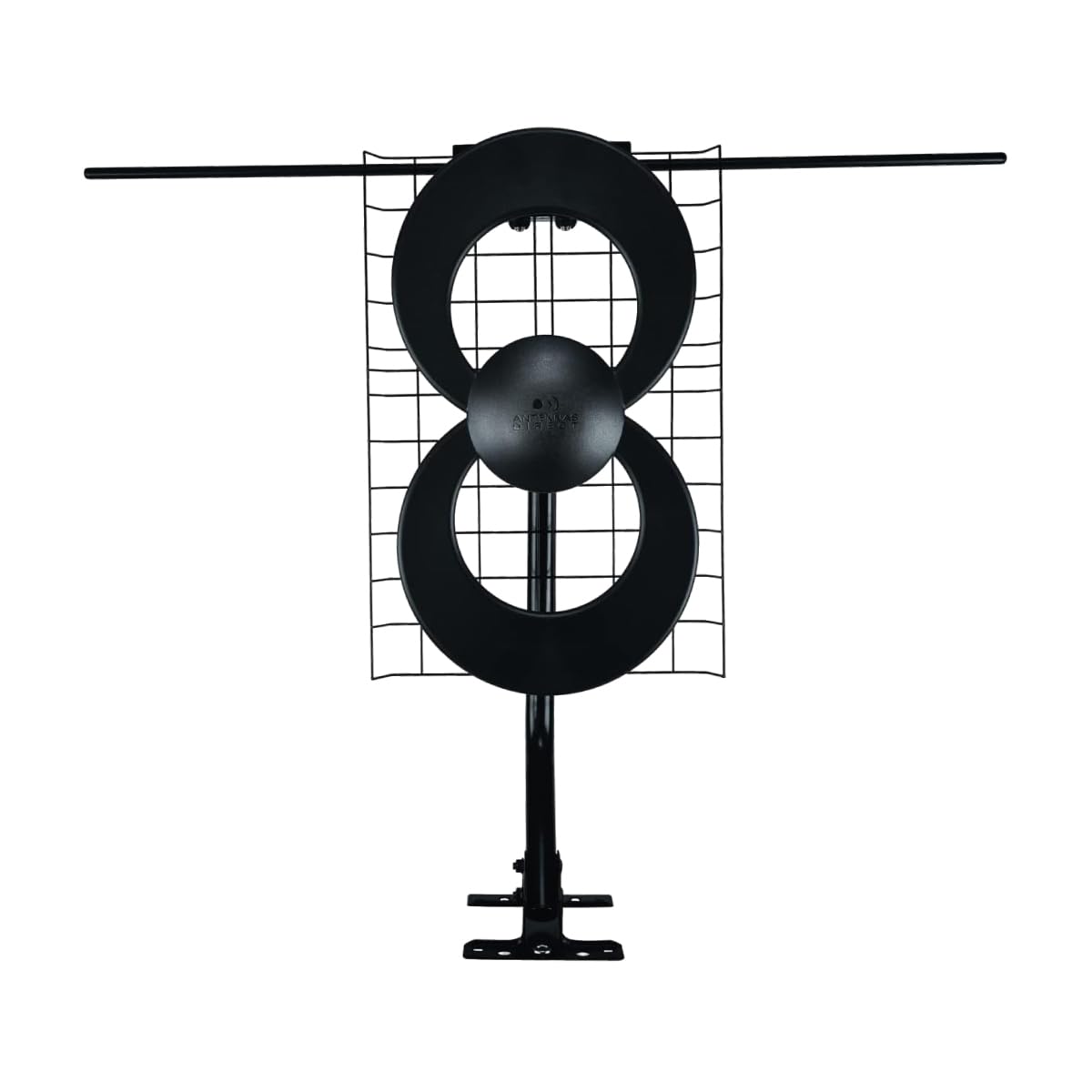
The ClearStream 2V uses a balanced double-loop UHF element paired with a separate VHF dipole, giving it the flexibility to work indoors in an attic or mounted outdoors on a mast. Its included reflector adds forward gain and helps shield the elements from rear interference, which is a smart touch for multi-directional reception in suburban areas with scattering trees.
Real-world reports from buyers 30 to 40 miles from towers show 60 to 85 channels with excellent video quality, even when the antenna is placed inside on an upper floor. The lifetime manufacturer warranty on the antenna itself also signals confidence in build quality that cheap plastic units simply cannot match.
Keep in mind that the coax cable is not included, and its performance on low-VHF channels (channels 2-6) is notably weaker than a full-size Yagi. Pairing it with a dedicated pre-amp helps if your signals are borderline, but for most users inside the 60-mile comfort zone, it works cleanly as-is.
Why it’s great
- Versatile indoor/outdoor/attic installation
- Included reflector reduces rear interference
- Lifetime antenna warranty
Good to know
- No coax cable included in the box
- Weak on low-VHF channels
- Pre-amp recommended for fringe areas
2. Televes DAT BOSS Mix LR 149884
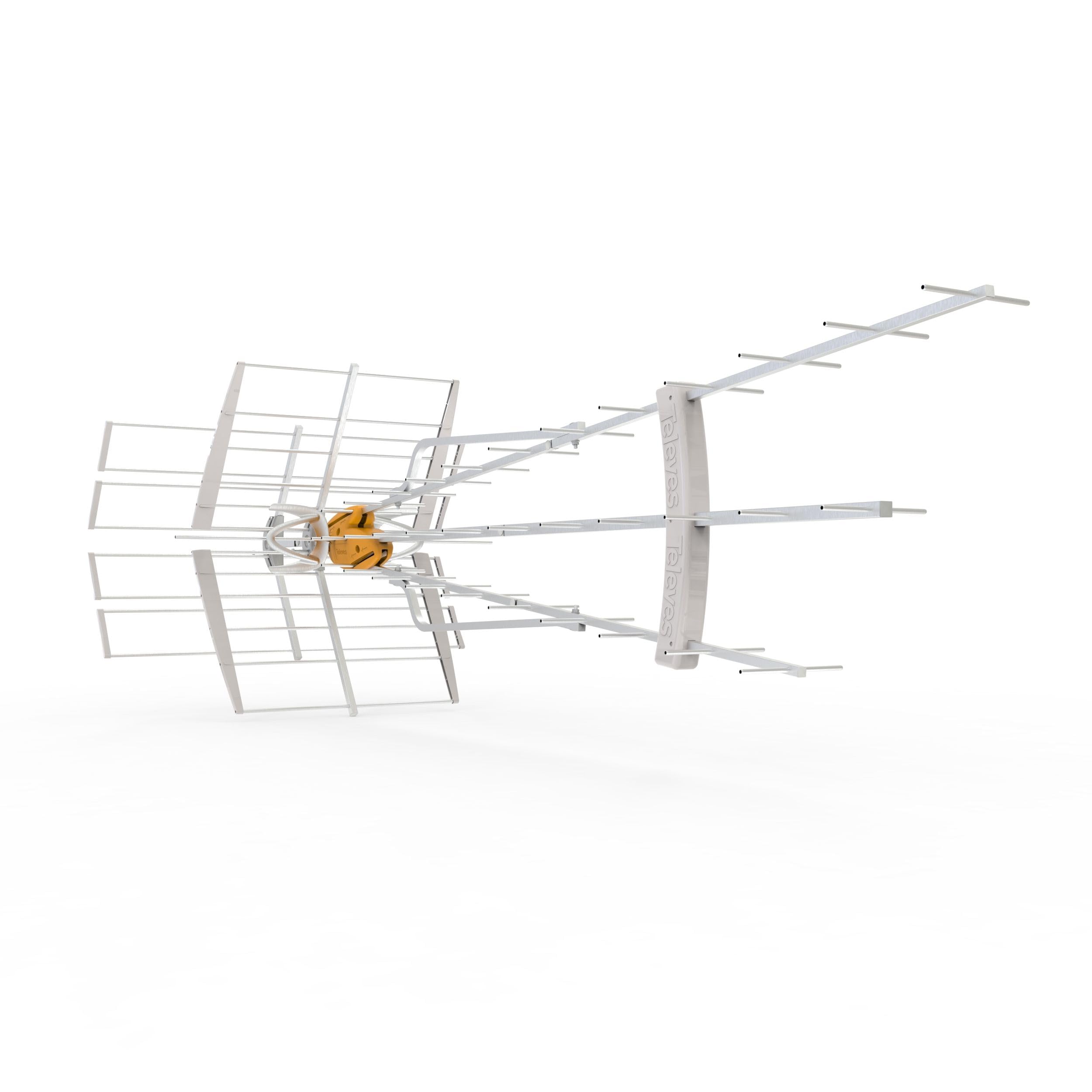
The Televes DAT BOSS Mix LR is a purpose-built directional Yagi for users who live in deep fringe areas — think 40 to 80 miles from towers with hills or tree lines in the way. Its stacked triple-boom design and massive 84-inch length provide the raw aperture needed to capture weak distant signals, and the integrated TForce amplifier uses intelligent gain control to avoid overload when a strong station is also present.
What makes this antenna exceptional is its proprietary filtering: it rejects FM radio and LTE/4G/5G cell signals that plague many rural installations. Buyers in extreme fringe locations like rural Wisconsin, 70 miles from stations, report pulling in 37 usable OTA channels after replacing satellite service. Users in the Seattle fringe areas also noted that the Televes eliminated pixelation on upper-UHF stations that prior antennas could not lock.
The construction is all aluminum with stainless steel hardware, and the included power inserter supplies 12V through the coax. It is large and requires a stable mast, but the assembly is straightforward with online video guides. The front-to-back ratios of 25 dB on UHF mean it rejects signals from behind the antenna, making it ideal for installations where towers are clustered in a single direction.
Why it’s great
- Highest available UHF gain (46 dBi)
- Built-in LTE/4G/5G and FM filtering
- Intelligent amp prevents overload
Good to know
- Very large (84 inches long)
- Higher price point
- Requires a stable mast mount
3. Five Star HDTV Antenna Upgraded Version

The Five Star Upgraded version is a Yagi-style antenna that splits the difference between the budget PIBIDI and the premium Televes. It includes a 40ft RG6 coaxial cable, a J-pole mount, and a splitter for multi-TV setups, making it a complete install kit. The extended element length aims to stabilize reception on both VHF and UHF bands, and the silver aluminum elements feel substantial.
Buyers 25 to 30 miles from Detroit towers reported picking up 50 stations in full HD while feeding four televisions through an external amplifier. Another user mounted it just four feet off the ground and still pulled 81 channels from LA towers 59 to 73 miles away, demonstrating that height is less critical than clear line of sight in many cases.
Some users have noted that its real-world range under 75 miles is more honest than the 200-mile claim, and that VHF interference from nearby LED lights can degrade the signal. It also lacks the built-in active filtering of the Televes, so LTE interference is possible in dense cell areas. Still, for the mid-range price, it delivers a strong, clear picture for most cord-cutters.
Why it’s great
- Includes 40ft RG6 coax and J-mount
- Supports multi-TV installations
- Solid build with aluminum elements
Good to know
- 200-mile claim is optimistic
- No built-in LTE filter
- Sensitive to LED interference
4. PBD Amplified Outdoor TV Antenna

The PBD antenna stands out because it integrates a 360° motorized rotator directly into the kit, controlled by a wireless remote. This is a massive time-saver if you have broadcast towers scattered at different compass points — you can fine-tune the direction without climbing a ladder. The dual TV outputs are also genuinely useful, letting you feed two televisions without an external splitter.
Buyers have noted that it performs well in difficult OTA areas, with one user replacing a Mohu Sky 60 and picking up more channels without pixelization. The manufacturer claims a 150-mile range, but practical reception from users in the Detroit area (25 miles out) confirmed 80 channels with good clarity, and the built-in amp helps overcome signal loss from longer cable runs.
The assembly is straightforward, but some users have noted that the coax cable included was shorter than expected and the motorized function adds a point of failure over time. It also lacks the LTE filtering that the Televes provides, so cell tower interference may be an issue in urban fringe zones. For users who need remote direction control, however, this is a very competitive option.
Why it’s great
- Wireless remote for direction adjustment
- Dual TV outputs with no splitter needed
- ATSC 3.0 ready
Good to know
- Motor adds potential failure point
- No built-in LTE/5G filter
- Coax cable may be shorter than expected
5. Five Star Outdoor HDTV Antenna (B0B7R81MFX)

This earlier Five Star model is almost identical to the upgraded version but is sold with a J-pole mount and a TV splitter, making it a turnkey solution for households wanting to feed up to four televisions. The 46-inch width and 28-inch height give it a substantial element surface area, which theoretically improves gain compared to smaller omni-directional units.
Buyers approximately 45 miles from Houston towers pulled in 128 OTA channels with good clarity, and a user in a mountainous area 45 miles from Albuquerque’s Sandia Crest reported 72 clear channels when pole-mounted seven feet above the roof. The assembly is straightforward but requires careful alignment of the VHF vibrator elements, and the included hardware is adequate for most roof and attic installations.
The main drawback is that it comes without a built-in amplifier, so long cable runs (over 80 feet) can degrade low-power stations. The 200-mile range claim should be taken as aspirational; practical performance shines under 75 miles. If you need to feed multiple rooms without buying extra distribution gear, this is a strong, cost-effective starting point.
Why it’s great
- Includes J-pole and splitter for multi-TV
- Large element surface for better gain
- Proven 100+ channel reception at 45 miles
Good to know
- No built-in amplifier
- Long cable runs degrade weak stations
- 200-mile claim is aspirational
6. PIBIDI Outdoor TV Antenna UHD-8903

The PIBIDI UHD-8903 is a no-frills directional Yagi that delivers real performance at a budget-friendly price point. It comes mostly pre-assembled — just a few elements need clicking together — and with no electronics built in, there is nothing to fail. Buyers in upstate South Carolina reported excellent reception of many unknown OTA channels, and a rural user replaced a large expensive antenna and got better results from the PIBIDI, pulling stations 40 to 100 miles away.
Its biggest strength is also its biggest limitation: no rotator included. To aim for different tower clusters, you must climb up and manually adjust the direction. This is fine for installations where all towers sit in one arc, but worthless if you need to split reception between two distant groups. The lack of a built-in amp also means that long cable runs may need a separate pre-amp to maintain signal strength.
Buyers have noted that the 200-mile advertised range is unrealistic — one user stated bluntly it will not get that range — but for the entry-level price, it pulls as many channels as many mid-range units when mounted in an open location. If you are close to towers and want a pure, passive, no-fail antenna, this is a solid choice.
Why it’s great
- Very easy assembly, no tools needed
- Passive design — no electronics to fail
- Good reception 40+ miles from towers
Good to know
- 200-mile claim is inaccurate
- No built-in rotator
- No amplifier included
7. 1byone Outdoor TV Antenna Omni-Directional

The 1byone omni-directional antenna is the go-to option for anyone who values installation speed over raw gain. It includes a built-in pre-amplifier and a 4G LTE filter, so you get a clean, boosted signal without buying extra components. The 39-foot RG6 coax cable and moisture-proof, flame-retardant housing make it suitable for outdoor, attic, and RV use right out of the box.
Buyers in Manhattan reported pulling 60 channels without a south-facing window, though they noted ABC was missing and some stations were weak. A suburban user got 58 initial channels after placing it in a window facing outdoors, while another saw 124 channels initially (though the count later dropped to 70 with many foreign-language stations). The wide variations highlight that omni-directional antennas are more dependent on placement and local obstructions than directional units.
Some long-term users noted that the housing is not fully sealed, with water intrusion causing the pre-amp to fail after two years of constant outdoor exposure. The gold-plated connectors it lacks would help corrosion resistance. For quick, no-tool installation in an attic or temporary setup, it is excellent; for a permanent outdoor install in a wet climate, the weather sealing is questionable.
Why it’s great
- Pre-assembled with built-in pre-amp
- Includes LTE filter and 39ft coax
- Easy no-tool installation
Good to know
- Weather sealing may fail over time
- Performance varies greatly with placement
- Not ideal for fringe reception
FAQ
Should I mount the antenna in my attic or on the roof?
Can I use the same antenna for two televisions?
What does ATSC 3.0 (NextGen TV) compatibility mean?
Final Thoughts: The Verdict
For most users, the broadcast tv antenna winner is the Antennas Direct ClearStream 2V because it balances indoor/attic versatility with a proven 60-mile range and a lifetime warranty. If you need to pull stations from deep fringe territory, grab the Televes DAT BOSS Mix LR, which offers market-leading UHF gain and built-in LTE filtering. And for a turn-key multi-TV setup without buying extra gear, the Five Star Outdoor HDTV Antenna with J-pole is your best bet.