
Our readers keep the lights on and the weekend projects moving. As an Amazon Associate, I earn from qualifying purchases.
Dandelions, clover, and creeping charlie turning your lawn into a patchy mess. The right broadleaf weed killer targets the invader without torching the turf you work to maintain. Here is a no-nonsense look at the formulas that actually deliver.
I’m Rikta — the founder and writer behind FitlyFast. I analyze lawn care chemistry the way others analyze nutrition labels, comparing active ingredient ratios and real-world application data to separate marketing hype from genuinely effective weed control.
After digging through hundreds of verified buyer reports and technical specs, I have narrowed the field to the seven most reliable options for your search for the best broadleaf weed killer.
How To Choose The Best Broadleaf Weed Killer
Broadleaf herbicides are not one-size-fits-all. Matching the active ingredients to your weed type and grass species is the difference between a clean lawn and a chemical burn. Here are the three factors that determine success.
Active Ingredient Profile
The most effective formulas use a three-way blend of 2,4-D, Dicamba, and MCPP (or MCPA). Each targets different weed families — 2,4-D hits dandelions and plantains, Dicamba gets clover and ground ivy, while MCPP goes after chickweed and spurge. Single-active products often leave surviving weeds that require a follow-up spray.
Grass Type Compatibility
Cool-season grasses like Kentucky bluegrass, tall fescue, and perennial ryegrass tolerate most broadleaf formulas. Warm-season grasses like St. Augustine, centipede, and Bahia are more sensitive — look for products explicitly labeled for your turf. Applying the wrong chemistry can thin or yellow your lawn faster than any weed.
Rainfast and Reseeding Window
Rainfast time — the period the product needs to dry without washing off — ranges from one hour to six hours. Shorter rainfast windows are better for unpredictable spring weather. Also check the reseeding interval: some formulas require four weeks before you can overseed, which matters if you plan to patch bare spots after the weeds die.
Quick Comparison
On smaller screens, swipe sideways to see the full table.
| Model | Category | Best For | Key Spec | Amazon |
|---|---|---|---|---|
| SpeedZone EW | Concentrate | Fast visual results in hours | Carfentrazone-ethyl speed booster | Amazon |
| Fertilome Weed Free Zone | Concentrate | Creeping charlie removal | Dicamba-based formula | Amazon |
| PBI/Gordon Trimec | Concentrate | Large-area hose-end application | One gallon covers 32,000+ sq ft | Amazon |
| Bonide Weed Beater Ultra | Concentrate | Warm and cool weather reliability | Rainproof within hours of drying | Amazon |
| Roundup For Lawns₂ | Concentrate | Crabgrass control on northern lawns | Up to 3 months of weed control | Amazon |
| Spectracide Large Plot | Concentrate | Budget-friendly large-yard treatment | 128 oz treats up to 42,500 sq ft | Amazon |
| Southern Ag Trimec | Concentrate | Budget entry for nine turf types | Triple-active Trimec blend | Amazon |
In‑Depth Reviews
1. SpeedZone EW Lawn Weed Killer

SpeedZone EW uses carfentrazone-ethyl as a speed-boosting adjuvant that produces visible weed injury within hours of application, not days. This is the fastest-acting broadleaf killer in this lineup, curling clover, spurge, and oxalis within 48 hours. The four-active-ingredient stack (2,4-D, Dicamba, Mecoprop-p, and carfentrazone) covers over 90 weed types including ground ivy and goosegrass that stump single-ingredient formulas.
Performance in cool weather sets SpeedZone apart — most broadleaf herbicides lose efficacy below 60°F, but the carfentrazone component maintains activity down into the 50s. The reseeding window is a tight seven days, so you can patch bare spots almost immediately after the weeds collapse. Labeled for both cool-season grasses and Bermudagrass, giving it broad turf compatibility.
The concentrate costs more per ounce than entry-level options, but one bottle treats roughly 11,000 square feet depending on grass type. Users consistently report that stubborn perennials like star of Bethlehem and nimblewill require spot-spray follow-ups, and the cap lacks measurement markings — you will need a graduated cup for accurate mixing.
Why it’s great
- Visible weed distress within hours of spraying
- Effective in cool weather when other formulas stall
- Reseed in only 7 days after application
Good to know
- No measuring cap included; needs separate graduated cup
- Heavy infestations may require a second spray
2. Fertilome Weed Free Zone (32 oz)
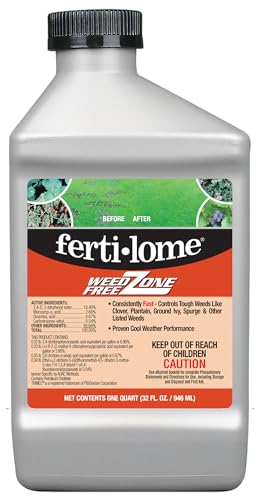
The Fertilome Weed Free Zone has earned a reputation as the go-to for creeping charlie (ground ivy) — a weed that shrugs off most consumer-grade herbicides. Its Dicamba-heavy formulation penetrates the waxy leaf surface of hard-to-kill perennials while staying safe on Kentucky bluegrass, Bermudagrass, Bahia, and Zoysia. Users report visible injury to dandelions and spurge within hours and full die-off in under a week.
This concentrate is versatile enough for careful use around flower beds — several reviews confirm it did not harm hostas, sedums, or lilies when spot-sprayed. The trade-off is that clover and some annual weeds may require a double-strength mix. Adding a few drops of dish soap to the tank improves droplet adhesion on waxy leaves, a trick veteran lawn caretakers have adopted.
The 32-ounce bottle is more expensive per ounce than mid-range options, but the concentration allows significant dilution. Some users note that to achieve full kill on creeping charlie, a second application at 7-10 days is needed. The rainfast window is short enough to survive a passing shower, but label instructions are clear about avoiding spray drift onto desirable broadleaf ornamentals.
Why it’s great
- One of the few consumer products that kills creeping charlie reliably
- Safe on multiple cool- and warm-season turf types
- Can be used around ornamentals with careful spot-spraying
Good to know
- May need double-strength mix for clover
- Premium pricing compared to standard 2,4-D blends
3. PBI/Gordon Trimec Lawn Weed Killer (1 Gallon)

The classic Trimec blend — a three-way combination of 2,4-D, MCPP, and Dicamba — has been a professional-grade standard for decades. PBI/Gordon’s one-gallon jug offers the best cost-per-square-foot value here, treating 32,000 to 64,000 square feet depending on the target weed. This makes it the logical choice if you are covering a full acre or dealing with a widespread infestation across a large property.
Users report excellent results on Virginia buttonweed and creeping charlie in St. Augustine turf — a notoriously sensitive grass — when applied at the label rate. The hose-end sprayer method is straightforward, though the concentrate is thick and requires thorough shaking to ensure even mixing. Some long-time users recommend doubling the concentration for deep-rooted perennials like wild violet or thistle that have built partial resistance.
The 128-ounce bottle is primarily designed for cool-season grasses. While some users have had success on warm-season lawns, the label focuses on northern turf types. A small percentage of users received the sister product “Weed-Out” instead of “Trimec” — both contain similar active stacks but verify the label upon arrival. The reseeding interval is not explicitly listed, so plan for a standard two- to three-week wait before overseeding.
Why it’s great
- Massive coverage area for the price per gallon
- Proven three-way Trimec formula with decades of use data
- Effective on tough weeds like buttonweed and creeping charlie
Good to know
- Primarily labeled for cool-season grasses
- Thick concentrate requires thorough mixing before application
4. Bonide Weed Beater Ultra (32 oz)

Bonide Weed Beater Ultra lists over 200 weed species on the label, making it the broadest-spectrum option in this lineup. The formula is rainproof once dry — typically within a few hours — which matters when you are working around unpredictable spring showers. It works in both warm and cool weather, maintaining activity through temperature swings that slow down single-active formulas.
Mix ratio is flexible: one pint of concentrate treats roughly 10,000 square feet. Users applying it at 3 ounces per gallon via pump sprayer report visible wilting within a week and complete die-off of dandelions, clover, and ground ivy within 14 days. Several reviews note that tough perennial weeds like oxalis and ragweed need a follow-up spray three to four weeks later, which is consistent with the repeated-treatment approach that most broadleaf killers require for established root systems.
The price lands in the middle of this group — not the cheapest per bottle, but the coverage ratio is good for the volume. The product mixes instantly with water and works through backpack, compression, or knapsack sprayers without clogging. A minority of users reported that heavy weed infestations needed three applications to achieve full eradication, so set expectations accordingly for neglected lawns.
Why it’s great
- Kills over 200 listed weed species
- Rainproof once dry, ideal for unpredictable weather
- Works well in both warm and cool temperatures
Good to know
- Tough perennials may require three applications
- Coverage requires careful mixing to avoid under-application
5. Roundup for Lawns₂ Concentrate (32 oz)

Roundup for Lawns₂ is not the same as the original Roundup — this version is formulated to kill broadleaf weeds and crabgrass without harming Northern grass types like Kentucky bluegrass, fescues, perennial ryegrass, and Zoysia. The label claims 253 weed types and up to 3 months of control, making it a strong choice for ongoing suppression rather than one-time knockdown.
Users switching from Weed-B-Gone report noticeably better results on clover and dollar weed, with visible effects in 48 hours. The rainfast window is a tight 3 hours. The trade-off is the reseeding interval — you must wait 4 weeks before overseeding, which is longer than some competitors. Southern users in Texas confirm it handles crabgrass effectively but note it often takes two bottles to fully clear a badly infested yard.
The 32-ounce concentrate treats up to 5,000 square feet, placing it in the smaller-coverage tier. Some reviews report that a second application is needed for persistent crabgrass patches, and there is concern about weeds developing resistance with repeated use over multiple seasons. For Northern lawns with a mix of broadleaf weeds and crabgrass, this is a solid all-in-one, but heavy infestations will strain the bottle size.
Why it’s great
- Controls both broadleaf weeds and crabgrass in one product
- Up to 3 months of residual weed suppression
- Rainproof in 3 hours
Good to know
- 4-week reseeding interval delays lawn repair
- 32 oz bottle covers only 5,000 sq ft
6. Spectracide Large Plot Weed Stop for Lawns (1 Gallon)

The Spectracide Large Plot concentrate delivers the most coverage per dollar in this lineup — 32,000 square feet for Northern grasses or 42,500 square feet for Southern grasses from a single gallon. The formula kills over 200 types of broadleaf weeds including dandelion, chickweed, and clover while leaving lawns intact when applied at label rates.
Users with centipede and Bermuda grass report the product does not damage the lawn, which is a common concern with more aggressive herbicides on warm-season turf. Results appear within hours on tender annual weeds like dollar weed and chickweed, though tougher rosette weeds and foxtails may resist even after a second spray. Some users have increased the mix rate to 1.5 ounces per gallon for stubborn perennials, which is a common workaround for under-strength formulas.
The rainfast window is 6 hours, which is the longest here — you need a clear forecast to avoid washout. The 1-gallon container is cumbersome for spot-spraying but ideal if you plan to use a hose-end sprayer for full-yard treatments. A small number of reviews note that the product is slower than expected on broadleaf weeds, requiring three applications for complete eradication in heavily overgrown lawns.
Why it’s great
- Exceptional coverage value for large properties
- Safe on centipede, Bermuda, and other Southern grasses
- Kills over 200 listed weed species
Good to know
- 6-hour rainfast window requires dry weather planning
- Tough perennials may need stronger mix ratio
7. Southern Ag Lawn Weed Killer with Trimec (32 oz)

The Southern Ag Trimec formula is the most affordable way to access the proven three-way blend of 2,4-D, Mecoprop, and Dicamba. Made for use on 9 different turf types — including all the common cool-season grasses plus Zoysia and Bermuda — it offers the widest grass compatibility in this budget tier. The 32-ounce bottle treats 5,000 square feet and can be applied through both conventional sprayers and hose-end applicators.
Users report strong knockdown on spurge, chickweed, and dandelions when mixed at 2 ounces per gallon with a 24-hour rain-free window for best absorption. Surfactant is recommended to improve adhesion on waxy weeds — a common requirement for Trimec-based products. Clover and onion grass may need a spot respray after the first week, which is typical for multi-active formulas that prioritize lawn safety over aggressive root burn.
The biggest complaint is that weeds return relatively quickly, requiring reapplication every few weeks for sustained control. This is not a season-long solution — treat it as a knockdown tool for spot maintenance rather than a full-season program. The bottle weight listed as 0.01 ounces is a data error on the listing; the actual product is a standard 32-ounce liquid concentrate bottle.
Why it’s great
- Low barrier to entry for the proven Trimec blend
- Safe on 9 different turf types including Zoysia and Bermuda
- Works well for spot treatment of common lawn weeds
Good to know
- Weeds return relatively fast; requires frequent reapplication
- Surfactant recommended for best adhesion on waxy leaves
FAQ
Can I use a broadleaf weed killer on St. Augustine grass?
Why do my weeds die but then come back after spraying?
How long should I wait before reseeding after applying weed killer?
Is it safe to spray broadleaf killer on a newly seeded lawn?
Final Thoughts: The Verdict
For most users, the best broadleaf weed killer winner is the SpeedZone EW because it delivers visible results in hours, works in cool weather, and allows reseeding in just 7 days. If you need to eliminate creeping charlie or other tough perennials, grab the Fertilome Weed Free Zone. And for covering a large property on a budget, nothing beats the Spectracide Large Plot for sheer coverage per gallon.