
Our readers keep the lights on and the weekend projects moving. As an Amazon Associate, I earn from qualifying purchases.
Specs are compiled from manufacturer listings and verified buyer reviews and can change over time — please confirm the key details on the product page before buying.
The real problem with brush trimmers is not power — it is that most buyers pick a gas engine when a battery would serve them better, or they pick a battery model that runs out of steam halfway through the first thick patch. You need a tool that matches the actual thickness of your growth and the size of your property, not one that looks tough in the aisle. This guide matches each pick to a specific yard scenario — from fence-line touch-ups to clearing an overgrown hillside.
I’m Rikta — the founder and writer behind FitlyFast. This guide is built by comparing the manufacturers’ published specifications and the patterns across verified customer reviews, so you get each pick’s real strengths and trade-offs instead of marketing spin.
The short version is that the crowd favorite — the best brush trimmers pick — is the Makita XUX01ZM5, a 36-volt system that owners say matches a 25cc gas engine without the pull-cord hassle.
Our Picks at a Glance

How To Choose The Best Brush Trimmer
The right brush trimmer depends on the thickness of the growth you fight and how long you want to spend mixing fuel. Property size, your existing tool battery platform, and your tolerance for engine maintenance are the real deciding factors.
Battery vs. Gas: The Real Difference
Battery-powered brush trimmers have closed the gap dramatically. A quality 80V or 36V system now delivers power that competes with a 30cc gas engine, with instant start and zero fuel mixing. The catch: runtime is limited by the capacity of the battery you own. Gas trimmers, especially 4-cycle models, run as long as you have fuel and are better suited for acres of heavy brush, but they require pull-starting, fuel mixing (for 2-cycle), and annual maintenance.
RPM and Cutting Width: What the Numbers Mean
The RPM (revolutions per minute) of the motor or engine determines how aggressively the line or blade cuts through thick material. Trimmers in the 6,000 to 8,500 RPM range are usually adequate for heavy weeds and light brush. The cutting width, measured in inches, tells you the swath of grass you clear in one pass — a 15-inch or 16-inch head covers more ground faster than a 13-inch head.
Engine Type: 2-Cycle vs. 4-Cycle
Two-cycle engines are lighter for the power they produce, but they require you to mix oil into every tank of gas. Four-cycle engines have a separate oil sump, like a car — no mixing needed, but the engine itself is heavier and more complex. The best pick for you depends on whether you value a lighter weight (2-cycle) or the convenience of straight gas (4-cycle).
Quick Comparison
| Model | Best For | Power Source | Max RPM | Cutting Width | Amazon |
|---|---|---|---|---|---|
| Makita XUX01ZM5★ Best Overall | Cordless gas-like power | 36V Battery | 7,100 RPM | 15 Inches | Amazon |
| WeGofly 13″ CordlessBest Value | Budget versatility | 21V Battery | 15,000 RPM | 13 Inches | Amazon |
| PowerSmart 25.4ccBudget Gas | Reliable gas entry | Gas (2-cycle) | — | 16 Inches | Amazon |
| Lazenry 20,000 RPM | Wheeled edging | 21V Battery | 8,500 RPM | 6 Inches | Amazon |
| Wild Badger Power 26cc | Multi-attachment gas kit | Gas (2-cycle) | — | 17 Inches | Amazon |
| PROYAMA 40cc | No-mix heavy duty | Gas (4-cycle) | — | 18 Inches | Amazon |
| Husqvarna 122RJ | Brand-reliable brush cutter | Gas (2-cycle) | — | 17 Inches | Amazon |
| Milwaukee 2825-20ST | Pro battery platform | 18V Battery | 6,200 RPM | 16 Inches | Amazon |
| Greenworks 80V | Lightweight cordless pro | 80V Battery | 6,000 RPM | 16 Inches | Amazon |
| DEWALT FLEXVOLT 60V | DeWalt ecosystem users | 60V Battery | — | 15 Inches | Amazon |
| Echo SRM-2620 | Long-term gas investment | Gas (2-cycle) | 8,500 RPM | — | Amazon |
In‑Depth Reviews
1. Makita XUX01ZM5 36V (18V X2) LXT® Brushless Couple Shaft Power Head with String Trimmer Attachment
Our pick — over 4.5★ from 350+ verified ratings; the strongest balance of quality and price.
The battery-powered trimmer that convinced gas die-hards to leave the fuel can behind.
The defining spec here is the 7,100 RPM brushless motor — and owners say it genuinely delivers gas-rivaling power, with one noting it runs up to 2 hours against a 25cc gas trimmer. You get three speed options (Low at 4,200, Medium at 6,000, and High at 7,100 RPM) via a variable-speed trigger, so you can dial the power down for delicate flowerbed edges and crank it up for thick weeds at the fence line.
At 9.8 pounds, it is noticeably heavier than some cordless options, but the leverage-style quick-attach system makes swapping to other couple-shaft attachments tool-less and fast. The thing everyone raves about is the power (37 owners single it out), with quality (36) right behind. Buyers report that it shares batteries with other Makita LXT tools, which is a major win if you are already in that ecosystem. The recurring trade-off: the weight — some owners recommend the optional shoulder harness for longer sessions. The 15-inch cutting width also beats the 13-inch WeGofly below, covering more ground per pass.
Cordless shaft flexibility
- Runs up to 2 hours per charge, matching gas runtime
- 3-speed variable trigger gives precise control for light trimming and heavy brush
- Quick-change attachment system is tool-less and secure
- Comes with a free storage bag, which owners value at around
Heavy dual-battery setup
- 9.8 pounds is heavier on the battery end; a harness helps for long jobs
- Batteries and charger are sold separately, so factor that into the total cost
- Some early units shipped without the advertised harness
Versatile system: you want true gas-like power without pull cords and you already own or plan to buy into the Makita LXT battery platform.
Weight penalty: the initial buy-in is higher when you add batteries and a dual charger, but owners who make the leap say the performance outlasts and outpowers cheaper cordless options.
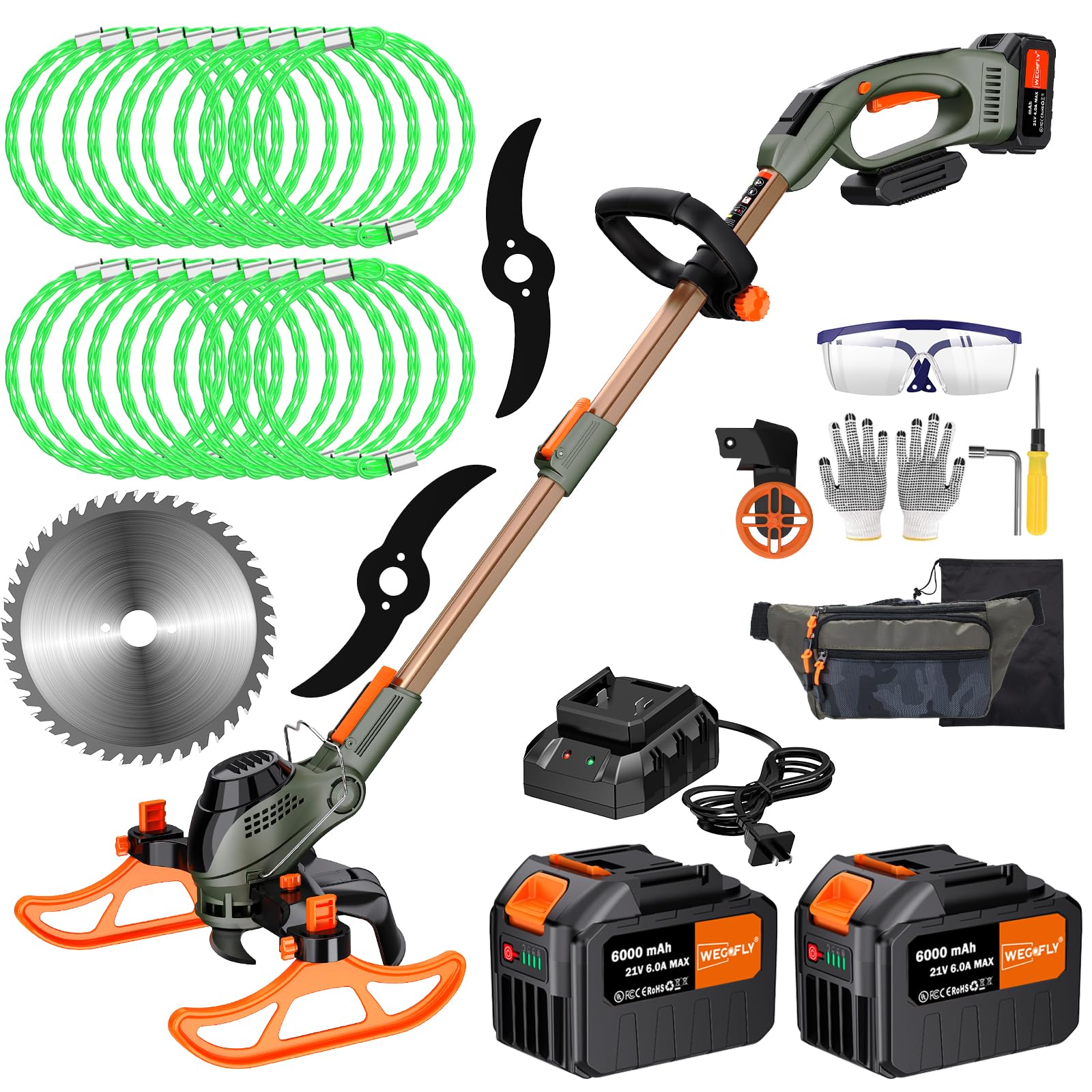
2. 13″ Electric Weed Wacker, 4-in-1 Cordless String Trimmer/Lawn Edger/Lawn Mower/Brush Cutter
A surprisingly capable four-in-one that punches well above its price tag with metal blades.
At 15,000 RPM, this trimmer spins faster than almost anything else on this list, and it is not just marketing — owners mention the metal blade “went right through heavy grass and some brush mixed in with the long grass” and that the battery “still had lots of power left” after the job. The inclusion of two 21V 6.0Ah batteries is a real-world advantage: you can swap and keep going without waiting for a charge, and the claimed battery average life is 2 hours.
The kit includes trimmer line, metal blades, and saw blades, making it a 4-in-1 tool (trimmer, edger, mower, brush cutter) that adapts to the task at hand. The thing owners praise most is the battery life (66 owners mention it), followed closely by power (56) — a strong sign for a cordless unit at this price tier. It is also lightweight at 5.2 pounds, which owners consistently call out as a major plus for women, seniors, and anyone tired of lugging a gas tank. The honest note: the cutting width of 13 inches means you need more passes than a 16-inch head, and some owners question the long-term durability of the plastic gear housing.
4-in-1 electric versatility
- 15,000 RPM brushless motor with steel gears handles thick undergrowth
- Dual 6.0Ah batteries deliver claimed 2-hour runtime
- 3 blade types (line, metal, saw) tackle everything from grass to small bamboo
- Only 5.2 pounds, making it one of the lightest cordless options
Limited runtime
- 13-inch cutting width is narrower than most gas models
- Some owners question how the plastic components hold up over multiple seasons
- Adjustable head and telescopic pole add versatility but can feel slightly less rigid than a one-piece shaft
Multi-function pick: you want a cordless trimmer with genuine brush-cutting power for under a certain mid-range threshold, and you value the convenience of two batteries.
Battery life: you have more than an acre of thick brush; the 13-inch head and plastic construction are better suited to standard residential lots.
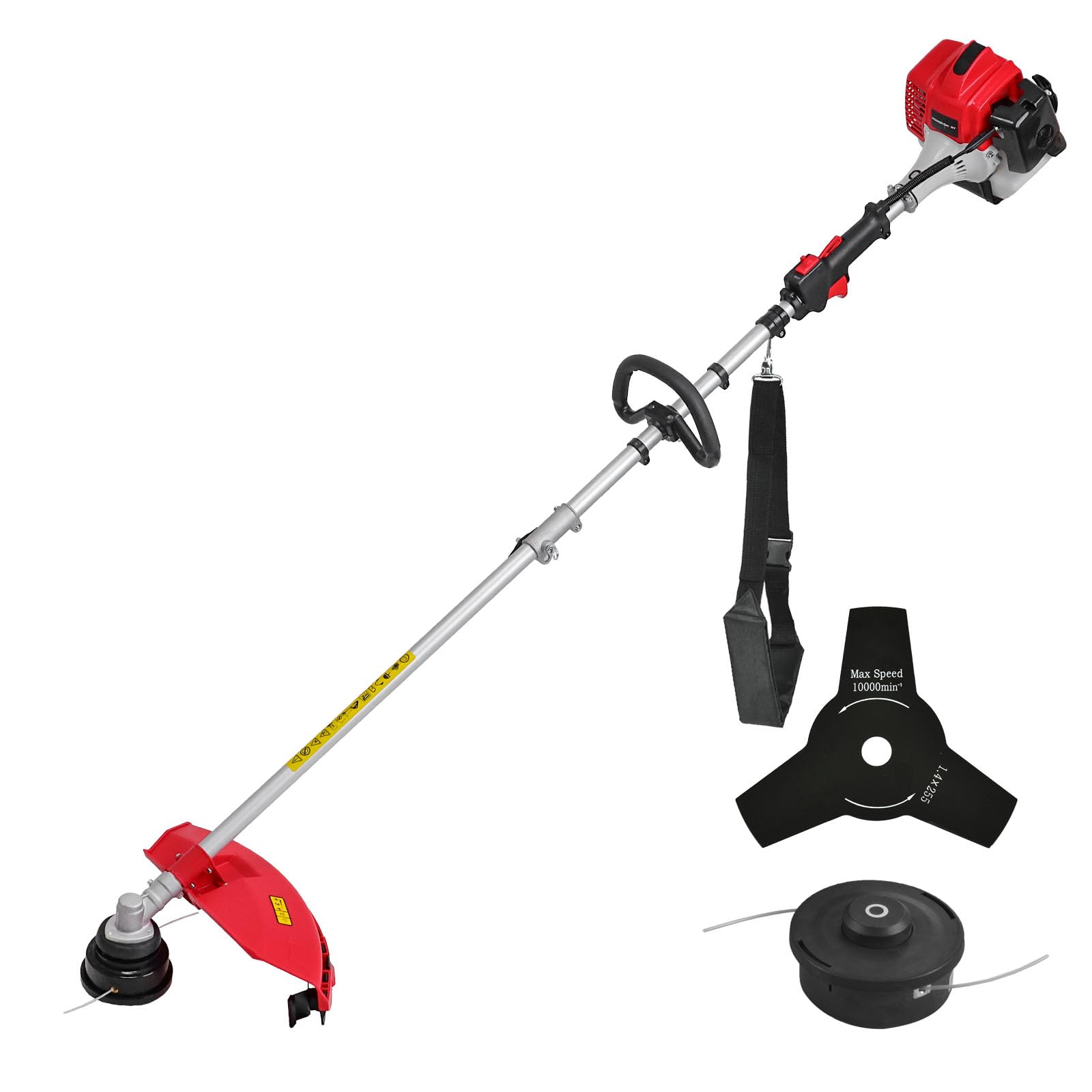
3. PowerSmart 25.4cc Gas Weed Wacker, String Trimmer/Edger 16-Inch with 10-Inch Brush Cutter
A gas workhorse that proves reliability does not have to cost as much as a pro brand.
The 25.4cc 2-cycle engine here is a straightforward, low-emission design that owners consistently describe as reliable — in fact, reliability is the top praised aspect by a wide margin (69 owners mention it), with quality (63) right behind. At 16 inches of cutting width, it clears a noticeably wider path than the 13-inch cordless options, trimming roughly 23% more grass per pass. The kit includes a 10-inch brush blade alongside the 0.095-inch trimmer line, so you can switch to thick weeds and saplings without buying extra accessories.
Assembly takes about 20 minutes, according to owners, and the “5-times pulling starter” is designed to get the engine running quickly — most report it starts on the second or third pull. At 18.8 pounds, it is heavier than every battery model here, but the included shoulder strap helps distribute the load. The honest downsides are worth noting: a few owners received units that failed within weeks, and the plastic string head durability is cited as a weak point (one owner said it fell apart mid-use, though it was repairable). For the price, the consensus is clear: it does the job of name-brand gas trimmers at a lower entry cost.
Budget gas: anyone who needs gas-level cutting power on a budget and wants a reliable 16-inch cutting width for a standard suburban lot.
Noise level: you are not comfortable with basic engine maintenance or if your priority is the lightest possible tool — this is 18.8 pounds before fuel.
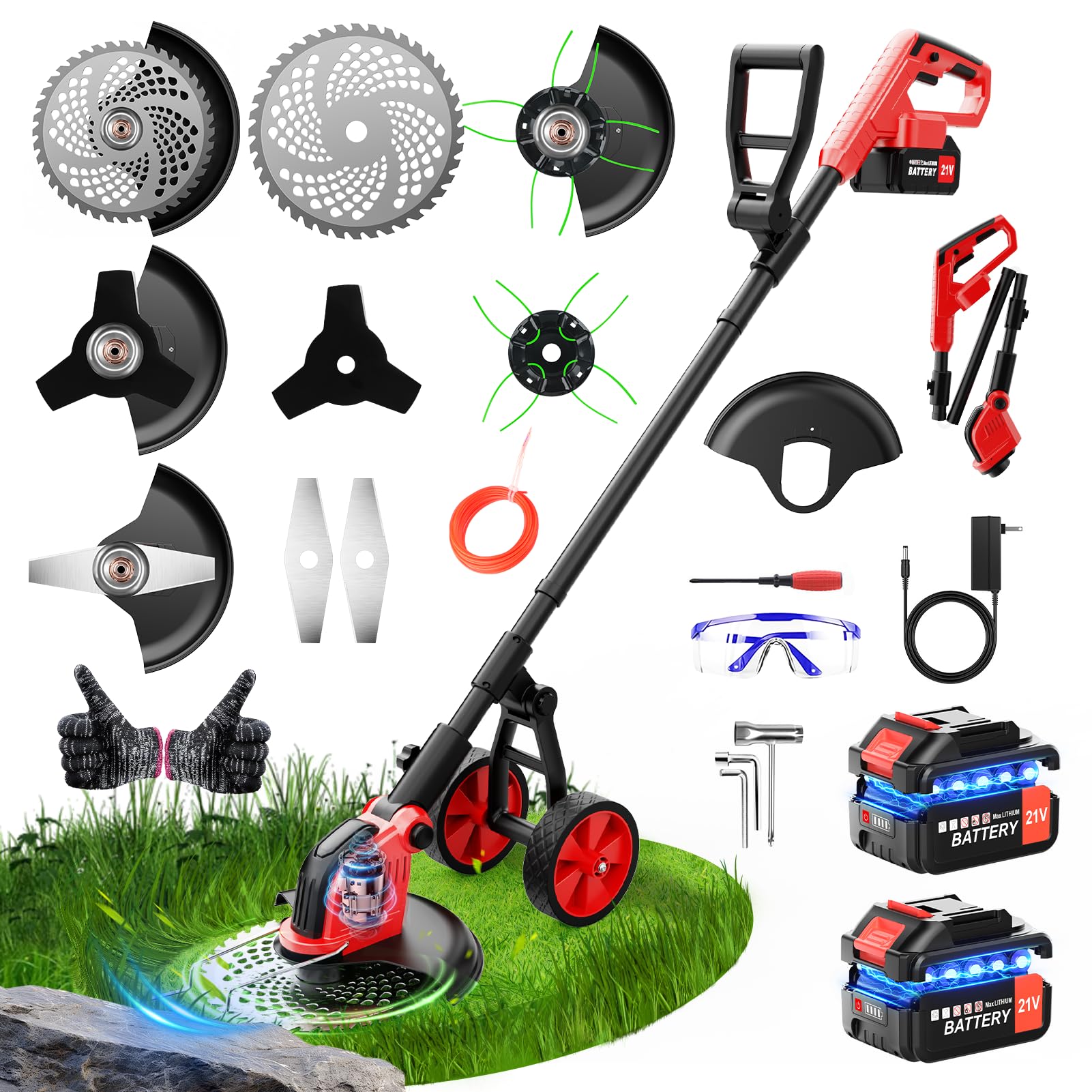
4. 20,000 RPM Electric Weed Wacker with Wheel, 12″ Brushless Cordless Weed Eater, 4-in-1 Stringless Trimmer
The stringless trimmer that turns edging into a walk in the park.
This unit is an outlier in the best way: it is primarily a blade-based cutter (plastic, stainless steel, and alloy saw blades) that eliminates the need for string entirely for most jobs. The 650W motor delivers 8,500 RPM, and the real standout is the removable wheel kit — it turns the trimmer into a mini lawn mower, so you walk it along fence lines and driveways instead of swinging it. The head also adjusts 0 to 90 degrees vertically and 360 degrees horizontally, reaching under shrubs and around obstacles without stooping.
At roughly 11 pounds total it is not the lightest cordless option, but the wheel takes the weight off your shoulders entirely. The cutting width is listed at 6 inches, which is narrow — this is clearly a detail trimmer and small-lot tool, not a wide-swath brush clearer. Owners appreciate the quality and appearance most, though the deep well of praise (quality is top at 47 mentions) suggests the fit-and-finish exceeds expectations at this price point. The stringless design means no bump-feed headaches, but you do lose the versatility of a standard line trimmer for light grass trimming between mows.
Speed with wheel: you want a no-bend, no-swing tool for edging and trimming on a small to mid-sized lot, especially if you have back or shoulder concerns.
Narrow swath: the narrow 6-inch cutting width makes it slow for open-area brush clearing; it excels along borders and tight spots.
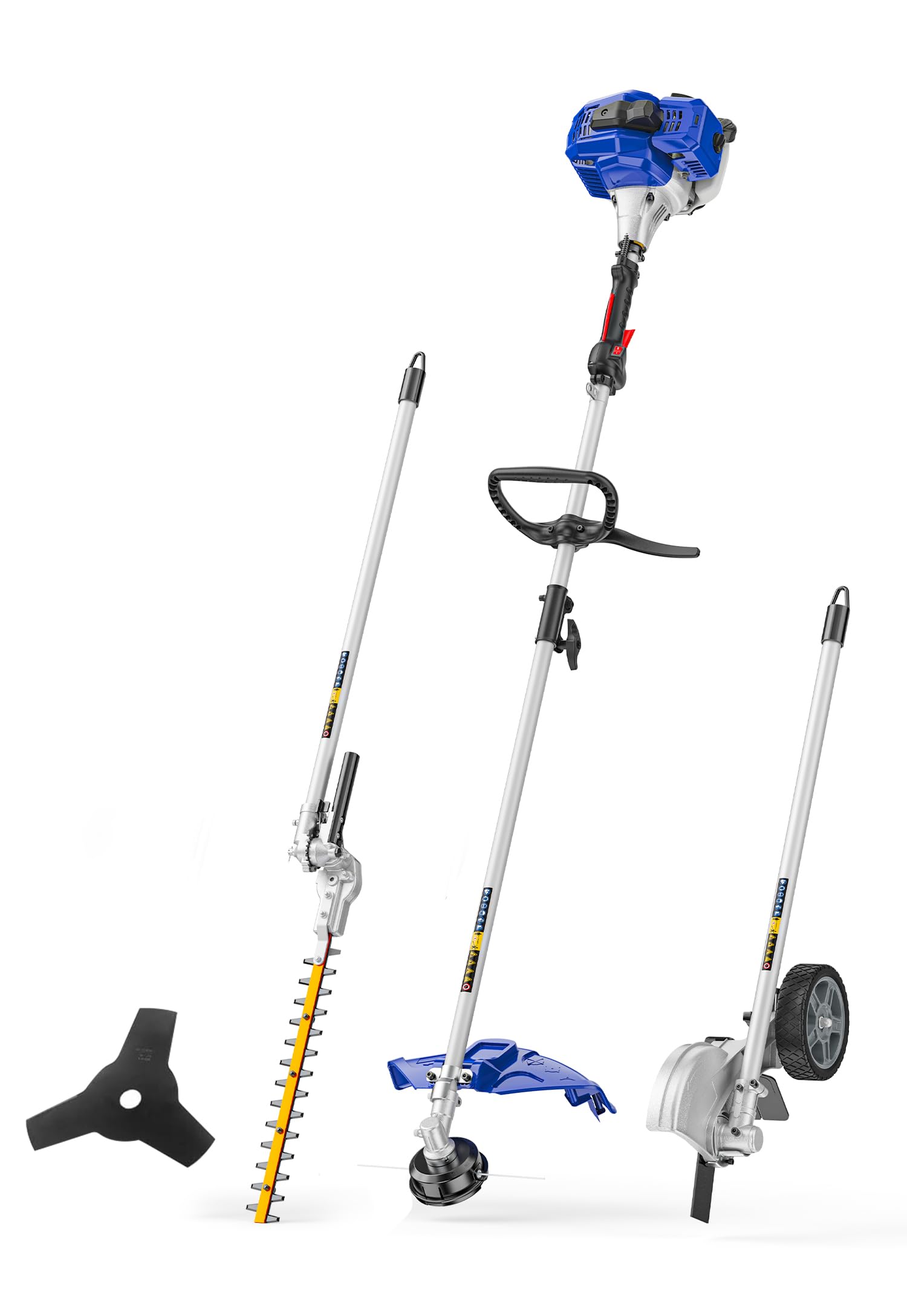
5. Wild Badger Power 26cc 2-Cycle Gas Weed Wacker, 4-in-1 Wheeled Edger Kit
A complete yard-care system in one box, from string trimming to hedge shaping.
The Wild Badger comes with four exact attachments: a 17-inch string trimmer, a 9-inch wheeled edger, a 16-inch hedge trimmer, and a 10-inch brush-cutter blade. The 26cc 2-cycle full-crank engine powers all of them through a quick-change system that owners say is sturdy and secure. The 17-inch cutting width is the widest of the gas trimmers here, which translates to fewer passes across a lawn.
The thing owners praise most is the value — the kit replaces four separate tools. The trimmer starts within five pulls, per the specs, and the aluminum transmission support helps reduce vibration. At 23.85 pounds it is the heaviest unit on our list, but the included shoulder harness makes longer sessions manageable. The honest word: a few owners have reported the attachment locking button breaking after limited use, and the power-to-weight trade-off is real. For the price of a single premium gas trimmer, you get a full yard-care arsenal that, when maintained, owners expect to last for years.
Light gas: someone who wants one power head to handle trimming, edging, hedge shaping, and brush clearing without buying separate tools.
Frequent refills: at 23.85 pounds and requiring fuel mixing, it is a serious tool — not the right choice if you only need occasional string trimming.
6. PROYAMA 40cc 4 Cycle Gas Weed Wacker Eater, Heavy Duty String Trimmer, 3-in-1 Brush Cutter

The 40cc monster that lets you pour straight gas and clear acres of brush.
The largest-displacement engine on our list is the PROYAMA’s 40cc 4-cycle unit, which delivers an estimated 1.5 HP. The biggest practical advantage of a 4-cycle engine is simple: you never mix oil with the gasoline. This makes it as convenient to refuel as a car. The 18-inch cutting width is the widest here, giving you the fastest coverage in open areas. Owners describe it as a “monster” and “beast of a machine,” with one noting the chainsaw blade cut through thick weeds and vines without slowing.
At 16 pounds, it is lighter than the Wild Badger despite the larger engine, thanks to the 4-cycle design. The included shoulder harness, ear defenders, gloves, and glasses add real value. The catch is reliability: some customers note units that start and then die under throttle, requiring mechanical troubleshooting. The split-shaft design makes storage easier, though assembly is required and the instructions are described as slim. Owners who get a good unit are thrilled; those who hit a defect face the one-year warranty process.
Tough jobs: your property means serious brush clearing on a regular basis, and you want the convenience of no fuel mixing with a massive 18-inch cutting swath.
Heavy build: the one-year warranty and occasional quality-control issues mean you should test it thoroughly at the start of the season.
7. Husqvarna 122RJ Gas Weed Eater and Brushcutter, Multi-Purpose Tool with String Trimmer Head and Grass Blade
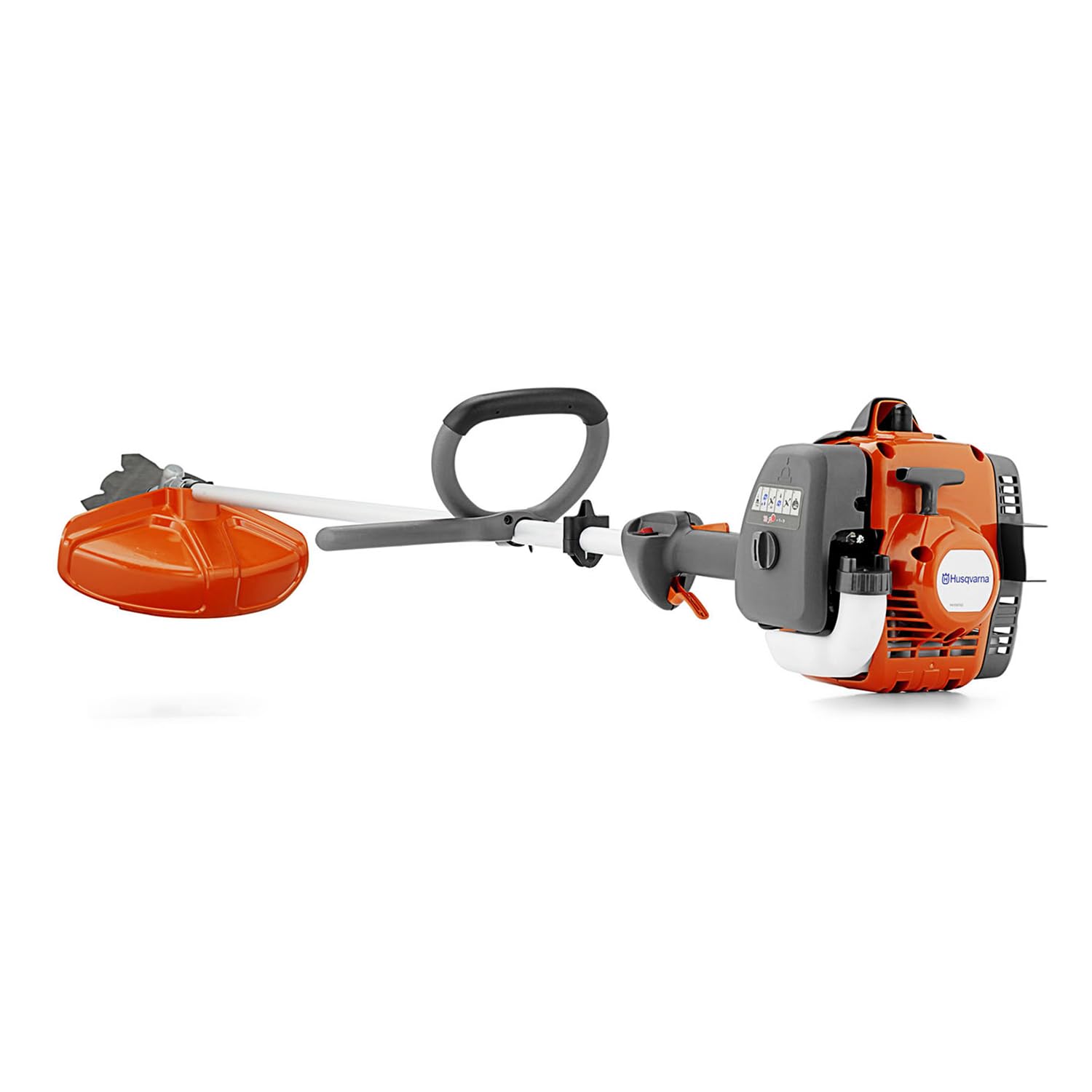
The brand known for pro-grade outdoor power — now accessible for serious homeowners.
Husqvarna’s Smart Start technology is the headline here: a specially designed engine and starter that makes the pull-cord effort noticeably lower than older 2-cycle designs. The air purge bulb removes air from the carburetor, so the first pull of the day is usually the last you need. The barrier bar with a J-handle encourages safer handling, and the straight shaft provides additional reach for ditch banks and overgrowth.
At just 12.58 pounds, this is one of the lighter gas trimmers, and owners confirm it feels balanced. Performance (24 mentions) and quality (20) are the top praised aspects. Reviewers point out it cuts through half-inch brush and one-inch branches in a few passes, which is serious capability for a 17-inch consumer-trimmer class tool. The honest note: some owners received units with a broken guard or front plate in the box, and a few report hard starting after several weeks of use. When it works, it is a beast — but the quality control on arrival could be more consistent.
Pro durability: you trust the Husqvarna brand and want a light, powerful gas trimmer for a mix of grass trimming and light brush clearing on a medium-to-large lot.
High cost: a small number of units arrive with damage or develop starting issues; buy from a seller with easy returns.
8. Milwaukee 2825-20ST 18V Cordless Brushless String Grass Trimmer with Attachment Capability

Milwaukee’s answer to gas — a brushless motor that pros say equals a gas engine.
This trimmer uses a brushless motor purposely built for the power head to “generate the power and performance of high voltage platforms,” per the spec. It spins at 6,200 RPM and cuts a variable swath of 14 to 16 inches, accepting 0.080-inch or 0.095-inch line diameters. The attachment capability means you can add edgers, pole saws, and other heads using Milwaukee’s Quik-Lok system — a major advantage if you are already invested in the MX FUEL ecosystem.
Functionality (64 mentions) and quality (59) are the top praised aspects, with owners explicitly saying it works like a gas trimmer. An 18-year pro reported using a 12.0 battery for 3-4 lawns a day over three days and still having 75% charge left. The downside is mixed battery life reviews (43 mentions) and weight (30) — owners note the 12.7-pound weight is heavier than some gas trimmers, and the battery/charger costs add up fast. The guard also does not stop all debris; owners recommend long pants and goggles.
Compact power: you own Milwaukee M18 batteries and want a trimmer that matches gas performance while staying in your battery platform.
Short runtime: you are starting from scratch — the battery and charger investment is substantial, and the weight may be a surprise if you are used to sub-10-pound trimmers.
9. Greenworks 80V 16″ Carbon Fiber Brushless Cordless String Trimmer

The 80-volt system that delivers gas power in a frame that is 23% lighter.
The Greenworks uses an 80V brushless motor delivering 6,000 RPM, which the company says is equivalent to a 30cc gas trimmer. The real-world number owners care about is the 11.2-pound total weight with the battery attached — a carbon fiber frame makes it 23% lighter than a comparable gas trimmer. The variable-speed trigger (Speed 1 for delicate trimming, Speed 2 for thick weeds) gives you fingertip control, and the 0.095 dual-line bump feed system handles up to 2 miles of fence line or 1.5 acres per charge.
Battery life (9 mentions) and quality (8) are the top praised aspects, with owners noting it charges in about 45 minutes and lasts roughly an hour of continuous use. The 16-inch cutting width is generous for a cordless model. The honest deficiency: a few owners note that the lack of a front guard can be a problem — the stronger line can damage siding or pots if you are not careful. The 4-year full coverage warranty (including “if you hit rocks or flood the motor”) is a standout peace-of-mind feature that is rare at this level.
Lightweight: you value the lightest possible cordless setup with enough 80V power to handle thick underbrush on a property of up to 1.5 acres.
Expensive: the 80V system is not cross-compatible with common 40V or 60V platforms — you are buying into the Greenworks 80V line.
10. DEWALT FLEXVOLT 60V MAX* String Trimmer, Two Speed, 15-Inch

A 60-volt trimmer that powers through overgrowth for anyone already in the yellow ecosystem.
The DEWALT uses a high-efficiency brushless motor and a gear drive design to boost torque through tough overgrowth. It provides a 15-inch cutting swath using 0.080-inch line, and the included kit comes with a 3-Ah battery, charger, and 225 feet of extra trimmer line. The two-speed trigger lets you choose between more runtime or more power.
Quality (7 mentions) and power (5) are the top praised aspects, with owners confirming it is “top quality” and “very powerful.” The 60V FLEXVOLT battery works across DEWALT’s 60V and 20V tools, which is a real ecosystem advantage. The honest mixed note: performance gets a mixed reception (9 mentions), and owners specifically highlight the bump feed mechanism as finicky. The unit is also noticeably heavy — owners describe it as comparable to a gas trimmer, with the motor weight at the string end, which can feel unbalanced. It also has no attachment capability, which limits its versatility compared to the Milwaukee or Makita.
High torque: DEWALT users who want a straightforward, powerful cordless trimmer that shares batteries with their existing 60V or 20V tools.
Heavy battery: it is heavy, the bump feed can be frustrating, and there are no add-on attachments — this is a dedicated string trimmer only.
11. Echo SRM-2620 ProXtreme Trimmer
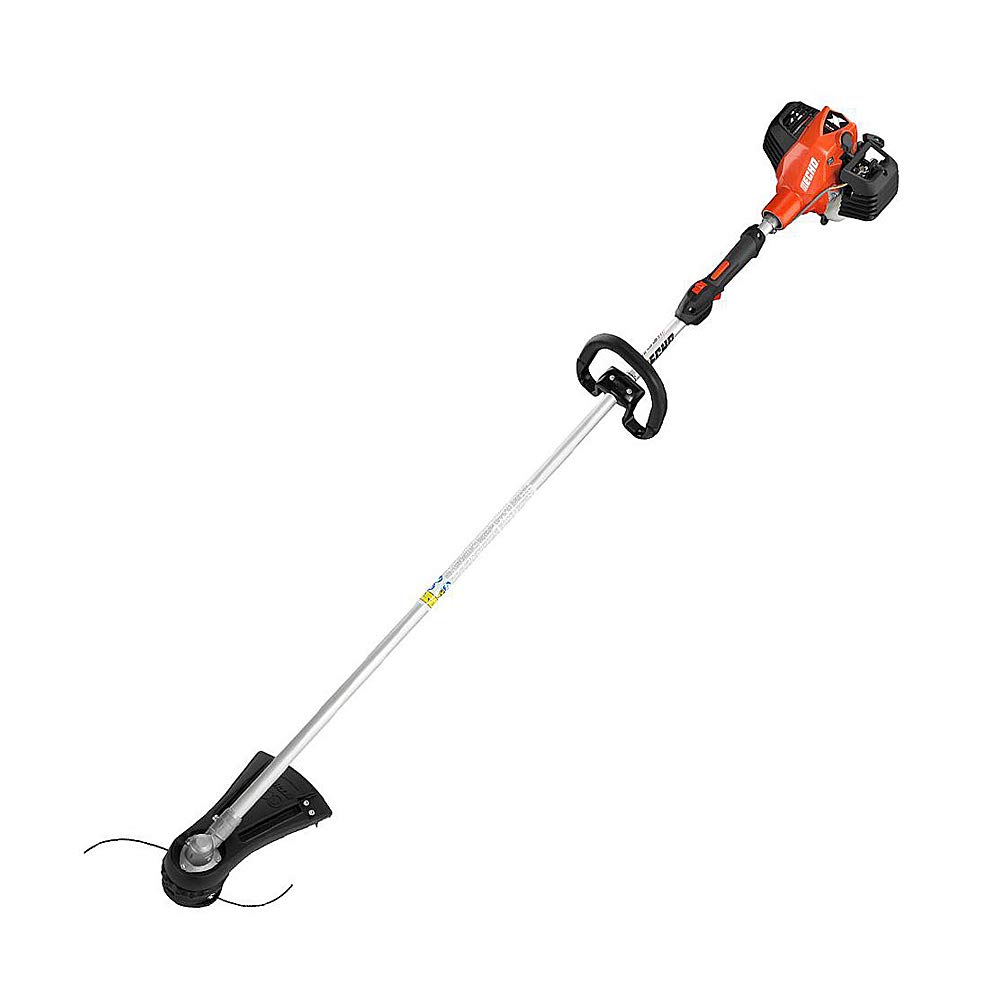
The professional-grade gas trimmer that owners keep running for 20 years.
The Echo SRM-2620 is powered by a 25.4cc professional-grade 2-cycle engine that spins at 8,500 RPM — the highest max RPM on our list, providing aggressive cutting speed. The straight shaft design gives you extended reach, and the engine is built for commercial use with a 1-year commercial / 5-year consumer warranty. Performance (32 mentions) is the top praised aspect, with owners noting it handles 5 acres of weeding without slowing down.
The defining story from owners: one buyer reports owning the previous model (SRM260S) for 20 years, and it is “still running by the way.” That is the level of longevity Echo buyers expect. At 13 pounds, it is competitive with lighter gas models, and the 8,500 RPM motor chews through heavy growth that would bog down lower-RPM units. The honest trade-off: the trimmer head wears faster than owners would like — one buyer described it looking “like it’s 10 years old” after 10-12 hours. Owners also wish it had a loop for hooking onto a harness vest. If you want a trimmer that might outlast your current house, the Echo is the candidate.
Investment grade: you need a pro-grade gas trimmer for heavy, regular brush clearing and want the 5-year consumer warranty that echoes the brand’s reputation for longevity.
Costly upkeep: a replacement trimmer head early on — the stock head is the only component that consistently draws owner criticism.
Understanding the Specs
RPM (Revolutions Per Minute)
This is the speed at which the cutting head spins. Higher RPM (like 7,100 or 8,500) gives you cleaner cuts through thick brush and reduces the chance of the line stalling. Lower RPM (around 4,900 to 6,200) is often fine for standard grass and light weeds and can extend battery runtime.
Cutting Width (Swath)
Measured in inches, this tells you how wide a path the trimmer clears in a single pass. A 16-inch or 17-inch width covers considerably more ground per swing than a 13-inch model. If you have a large property, a wider cutting width can shave significant time off the job.
Battery Voltage (V) vs. Gas Engine Displacement (cc)
Higher voltage (80V, 60V, 36V) generally means more torque and longer runtime from a battery system. For gas, the displacement in cubic centimeters (cc) indicates engine size — a 40cc engine produces more power than a 25.4cc unit, but also adds weight and fuel consumption.
Brushless Motor
A brushless motor uses electronic controls instead of physical brushes to drive the motor. It typically delivers more torque per watt, runs cooler, lasts longer, and is more efficient than a brushed motor. Nearly every high-performing cordless trimmer on this list uses a brushless motor.
FAQ
Can I use a battery-powered brush trimmer for thick brush and saplings?
What is the difference between a 2-cycle and a 4-cycle gas engine on a trimmer?
How long does a battery charge typically last on a cordless brush trimmer?
Can I use metal blades on a string trimmer?
What does “tool only” mean?
How do I choose the right line diameter for my trimmer?
Is a heavier trimmer always more durable?
Can I use attachments from other brands on a multi-tool power head?
Final Thoughts: The Verdict
For most people, the best brush trimmers pick is the Makita XUX01ZM5 because it delivers genuine gas-like power at 7,100 RPM with three speed options, a 15-inch cutting width, and the ecosystem advantage of Makita’s 36V platform — all without mixing fuel or dealing with pull cords. If you want the best value for your dollar, grab the WeGofly 4-in-1 — its 15,000 RPM motor and dual batteries make it a genuine brush cutter at a budget-friendly entry point. And for untamed acres where only gas will do, the Echo SRM-2620 is the long-haul champion, with owners reporting 20 years of service from the previous generation.
How We Picked
We do not accept paid placement. Every pick is matched to a real buyer and a real use-case; we do not hands-on test units.
Sources & Methodology
Specifications: manufacturer listings and product documentation. Review insights: verified customer reviews, as of July 2026. Pricing: not shown on this page (it changes often); check the current price via the retailer link.
As an Amazon Associate, FitlyFast earns from qualifying purchases. This does not affect which products we feature.