
Our readers keep the lights on and the weekend projects moving. As an Amazon Associate, I earn from qualifying purchases.
Specs are compiled from manufacturer listings and verified buyer reviews and can change over time — please confirm the key details on the product page before buying.
Building a budget gaming rig means every dollar you spend on a graphics card has to show up on screen as smooth, playable frames. The good news is that you no longer need to spend a fortune to get a smooth 1080p experience, and this guide cuts through the specs to show you which cards genuinely deliver at resolutions that matter.
I’m Rikta — the founder and writer behind FitlyFast. This guide is built by comparing the manufacturers’ published specifications and the patterns across verified customer reviews, so you get each pick’s real strengths and trade-offs instead of marketing spin.
If you are hunting for the best budget 1080p gpu that balances raw performance with a price that won’t wreck your build, this breakdown is your starting line.
Our Picks at a Glance


How To Choose The Best Budget 1080P GPU
Picking a budget card is less about finding the cheapest option and more about finding the one that won’t choke on the games you actually play. A card that is too weak will force you into low settings, while a card with too little memory will stutter and hitch, especially if you like to keep a browser or Discord open while you game.
Prioritize VRAM for Texture-Heavy Games
For smooth 1080p gaming in 2024 and beyond, you want 8GB of memory. Modern games use high-resolution textures that fill up memory fast, and a 6GB card can stutter when you crank settings. If you stick to esports titles like Fortnite or Valorant, 6GB is fine, but for the newest AAA releases, that 8GB cushion stops the card from constantly swapping data, so your frame rate stays steady.
Check Your Power Supply Before You Buy
A common rookie mistake is buying a card that demands more power than your PC can supply. Some of these cards need an 8-pin connector and a 500W power supply, while others, like some RTX 3050 models, are slot-powered and only draw 70W. Always check what connectors your power supply has before you order, especially if you have a pre-built office PC that was never designed for a gaming GPU.
Architecture Matters More Than Clock Speed
Newer graphics architectures bring features like hardware ray tracing and advanced upscaling (a technology that renders at a lower resolution and upscales to look better). While a higher boost clock sounds impressive on paper, a newer card with a lower clock speed often beats an older, higher-clocked card in real games because it processes instructions more efficiently. This generation-to-generation leap is why the entry-level RTX 3050 can beat an older high-end card.
Quick Comparison
| Model | Best For | GPU Clock | VRAM | Memory Type | Amazon |
|---|---|---|---|---|---|
| Kelinx AISURIX RX 580★ Best Overall | Raw Value & Legacy Perf | 1750 MHz | 8 GB | GDDR5 | Amazon |
| MOUGOL RX 580 2048SPBest Value | Starter Builds | 1206 MHz | 8 GB | GDDR5 | Amazon |
| maxsun RX 580 2048SPStyle Pick | White Theme Builds | — | 8 GB | GDDR5 | Amazon |
| AISURIX RX 5500 XT | Newer Architecture | 1750 MHz | 8 GB | GDDR6 | Amazon |
| ASRock Intel Arc A580 | Tech & Future Proofing | 2000 MHz | 8 GB | GDDR6 | Amazon |
| ZER-LON GTX 1660 Super | Casual & Esports | 1530 MHz | 6 GB | GDDR6 | Amazon |
| GIGABYTE RTX 3050 6G | Low-Power Systems | 1477 MHz | 6 GB | GDDR6 | Amazon |
| MSI RTX 3050 Ventus 6G | Slot-Powered Only | 1492 MHz | 6 GB | GDDR6 | Amazon |
In‑Depth Reviews
1. Kelinx AISURIX RX 580
The highest-clocked RX 580 on this list, delivering a massive performance lead for the money.
This card leads our list because it pairs a genuine 8GB of GDDR5 memory with a screaming 1750 MHz GPU clock. That clock speed is a full 45% higher than the MOUGOL RX 580, which tops out at 1206 MHz, making this the pick for anyone who wants maximum raw processing power without stepping up to a premium-tier card.
The fan system here is semi-automatic, meaning the fans literally stop spinning when the GPU is cool or under light load. That gives you a zero-noise office experience, and it only spins up when you fire up a game, which extends the life of the fans.
The performance is the headline, but the reliability is where buyers are split. The good news is that most buyers report it is a big upgrade over integrated graphics, with crisp colors and easy installation. However, a notable chunk of reviews mention the card is not completely stable on the most demanding AAA games, with one buyer reporting, “First unit failed after 2 boots (graphical glitch, then dead).”
What Wins People Over
- Blazing 1750 MHz clock handles high FPS in most titles
- 8GB GDDR5 memory prevents stutters in modern textures
- Fans stop completely when idle for silent office work
The Trade-Offs
- Potential stability issues in the most demanding AAA games
- Requires a dedicated 8-pin power connector
- Draws up to 185W, so check your PSU quality
Reach for this if: you want the most raw power for your budget and play a mix of esports and slightly older titles where the high clock speed shines.
Look elsewhere if: you only play the newest, most demanding AAA releases and need guaranteed stability at max settings.
2. MOUGOL AMD Radeon RX 580
A compact 8GB card that punches well above its weight as a true “drop-in” starter upgrade.
If you are coming from an ancient card like a GTX 960 2GB, the upgrade here is massive. As owners mention: “this is a big boost,” and that sentiment is echoed across the reviews, where the standout features are the value for money and the solid performance in popular titles like Fortnite, GTA V, and Valorant.
This MOUGOL card handles texture-heavy games and multitasking smoothly at 1080p, thanks to its 256-bit bus width (the data path between the GPU and memory) and 8GB of Samsung GDDR5 memory, so you won’t hit memory bottlenecks. It’s also among the most compact cards here at 240x135x45mm, so it slides into standard ATX Mid-Towers and even Micro-ATX cases without clearance issues.
Owners consistently praise the cooling, noting the intelligent fan control keeps it quiet during light office work and provides maximum airflow during intense gaming. The recurring advice in the reviews is to make sure you have a 500W minimum PSU, and if you have a black screen on boot after install, it is almost always a power supply issue.
The Highlights
- Triple monitor support with HDMI, DisplayPort, and DVI
- Compact 9.45-inch size fits in smaller cases
- Owners consistently praise the quiet, cool operation
Watch Out For
- A 500W power supply is required for stable performance
- Needs a 6-pin power connector to run
Best for: first-time builders upgrading a pre-built office PC who want a reliable, well-cooled 1080p card that is easy to install.
Not for: anyone with an older or underpowered power supply, since the 500W requirement is non-negotiable.
3. maxsun AMD Radeon RX 580 2048SP
The only white card in this lineup, built for builders completing a clean white theme.
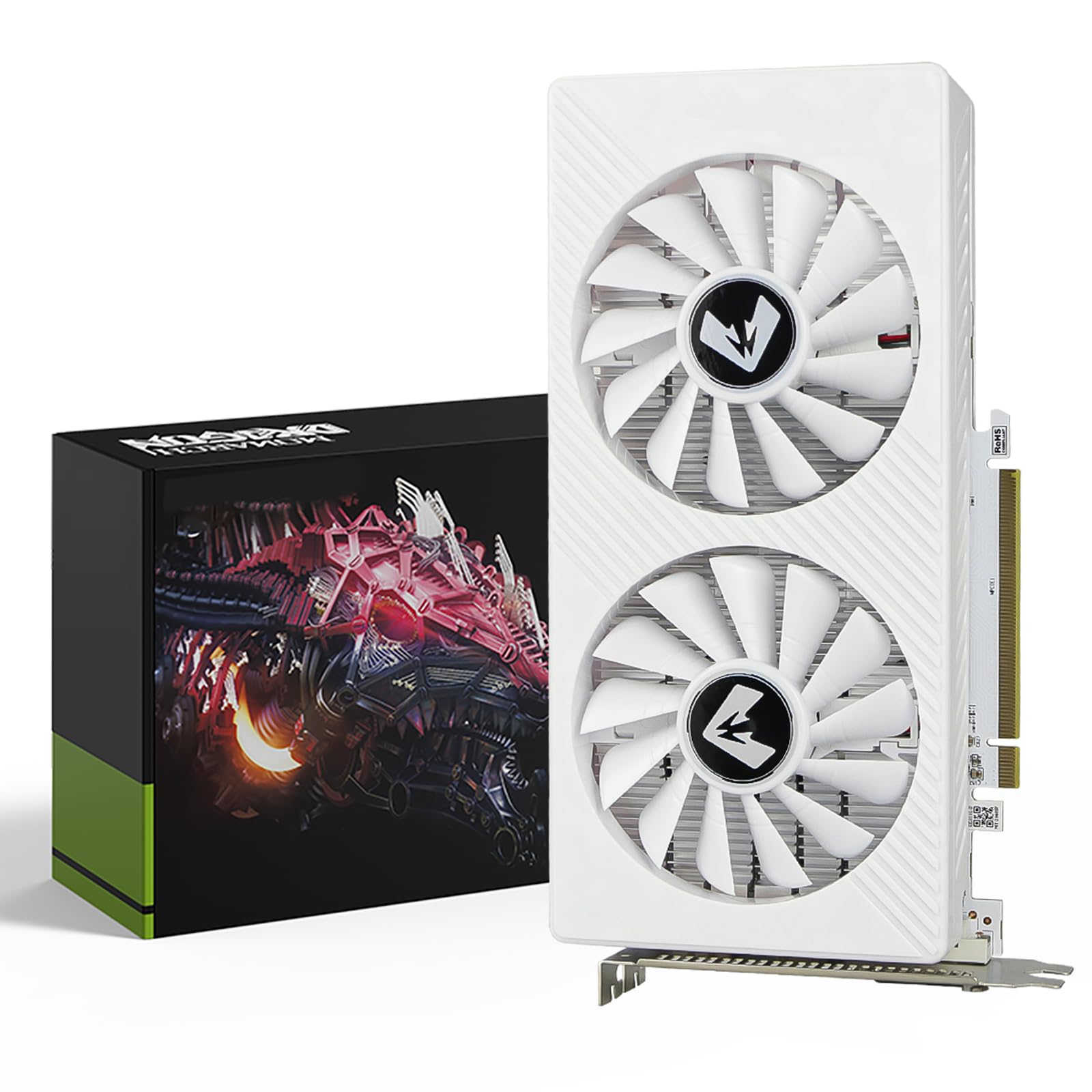
This maxsun RX 580 is the go-to pick if you are building a PC with a white aesthetic, and it brings the 8GB GDDR5 256-bit memory interface along for the ride. The triple digital output of HDMI, DP, and DVI gives you multi-monitor extend support.
It is also a bit of a chameleon due to its build quality. Customers note using it as an excellent 6-monitor trading workstation where it runs 16 charts and 3 watchlists while keeping temperatures near idle. Others have put it into an HP Victus 15L and run most games at max settings flawlessly.
The biggest concern here is reliability, as a handful of reviewers point out the card failing after a few weeks with screen artifacts. That said, the overall consensus from the 650+ ratings is that it is an excellent value for a budget GPU, and the white color is the defining reason to choose it over the others.
Why It Stands Out
- Unique white design for themed PC builds
- Excellent for multi-monitor setups like trading stations
- Supports DirectX 12, Vulkan, and OpenGL 4.6
The Risk
- Some units reportedly fail with screen artifacts
- Plastic dual-fan cooler can feel cheap
Choose this one if: color coordination matters to you and you want a solid 1080p performer that blends into a white build.
Think twice if: you are risk-averse, as the quality control appears more inconsistent here than on the RTX 30-series cards.
4. AISURIX RX 5500 XT

A step into newer RDNA architecture with faster GDDR6 memory that runs cooler and cleaner.
While the RX 580 is based on the older Polaris architecture, this AISURIX RX 5500 XT uses a newer RDNA design. That brings better performance-per-watt, which means you get a card that runs cooler and draws less power—rated at just 130W maximum—while still delivering a solid 1080p experience.
You get 8GB of the faster GDDR6 memory here, compared to the GDDR5 on the RX 580 cards, and the output array is strong with 3X DisplayPort 1.4a and 1X HDMI 2.0b. For budget gaming rigs, shoppers say it works perfectly from the start, with exceptionally good video quality.
The buyers are clear that for the price, you can’t beat it, and it runs newer games at decent frames in 1080p. The main issue reported is a physical one—the card can arrive bent from shipping, which can cause problems fitting it in the slot and even prevent the PC from booting until bent back.
The Upside
- Newer RDNA architecture is more power-efficient
- 8GB of faster GDDR6 memory
- Runs cooler thanks to composite heat pipes
The Downside
- Reports of cards arriving bent in packaging
- Some units have crashed systems after the return period
Choose it for: a more modern foundation that sips power, ideal if your PSU is older or you want lower heat output.
skip it if: you want absolute confidence, since buyers report shipping damage more often with this brand than with bigger names.
5. ASRock Intel Arc A580 Challenger
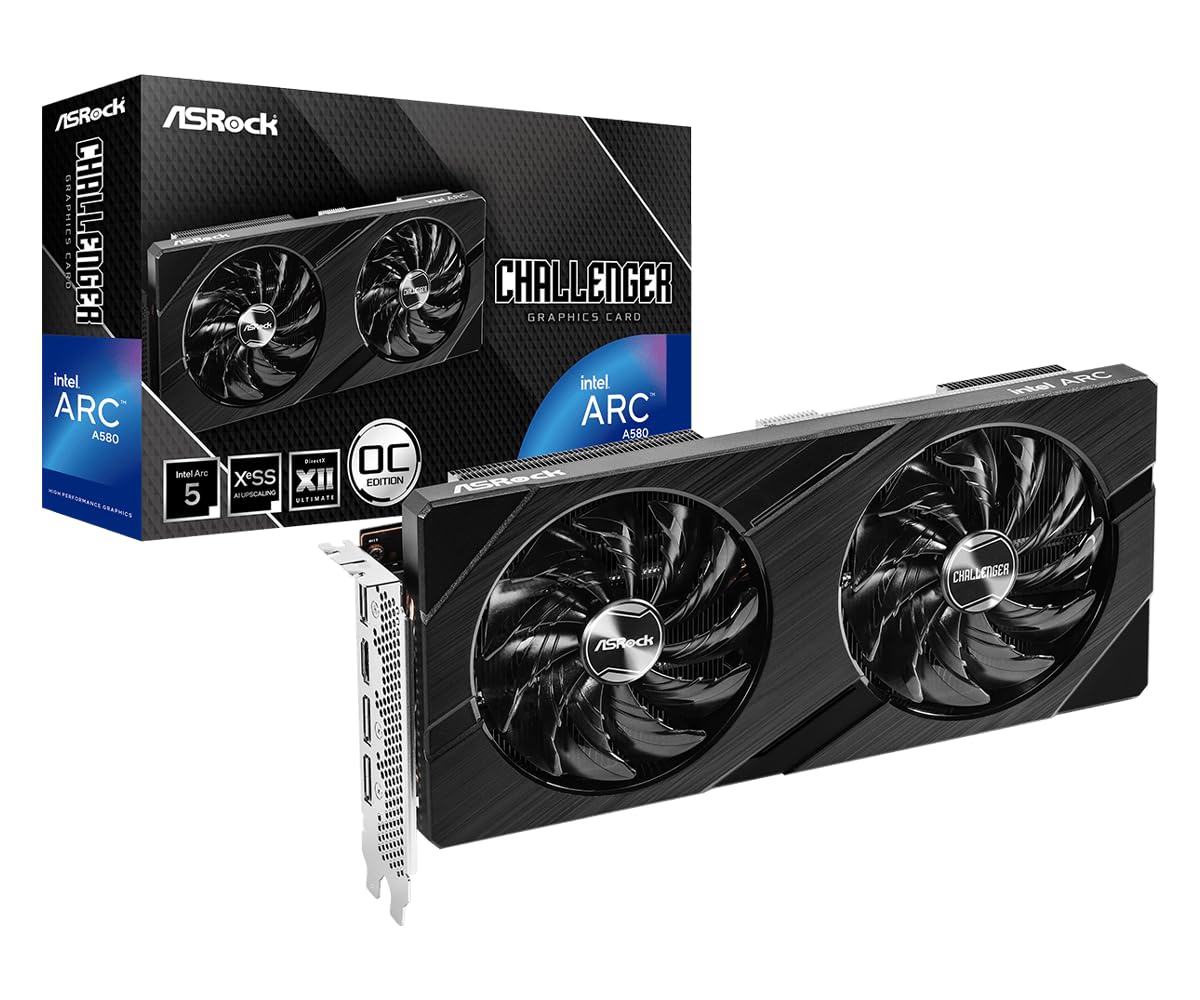
Intel’s bold entry with the highest factory clock here and next-gen DisplayPort 2.0 support.
This ASRock card brings Intel Arc graphics to the budget table, and it is the most technically advanced pick in this roundup. The Arc A580 GPU is clocked at 2000 MHz from the start—higher than any other card on this list—and it pairs that with 8GB of GDDR6 running at 16 Gbps on a 256-bit interface.
You get modern features that the older cards simply don’t have, including hardware ray tracing and Intel Xe Super Sampling (XeSS), which is an upscaling tool that boosts frame rates in supported games. The display connectivity is also a generation ahead, featuring 3 x DisplayPort 2.0 (up to UHBR 10) and 1 x HDMI 2.0b.
The owners are unanimous that this is excellent quality for the price, with one noting it “runs smoothly most of the game on 1080p (at least 60 FPS in high/ultra graphics)” while keeping temperatures between 64-68°C. The catch is power: it requires 2 x 8-pin PCIe power connectors and a recommended 650W power supply, so this is not a drop-in card for old office PCs.
Why It’s Special
- 2000 MHz factory overclock is the fastest here
- Hardware ray tracing at a budget price
- DisplayPort 2.0 support is future-ready
What It Demands
- Needs 2 x 8-pin power connectors
- Recommended 650W power supply is a high bar
- 2.4-slot design is physically large
Get this if: you have a modern power supply and want the most future-proof budget card with ray tracing and modern AI upscaling.
Avoid it if: you are trying to upgrade an older pre-built PC with a limited power supply, as it simply will not have the connectors.
6. ZER-LON GeForce GTX 1660 Super

An NVIDIA workhorse that tackles esports and streaming with impressive efficiency and style.
If your gaming diet is mostly Fortnite, Valorant, CS:GO, or Roblox, the ZER-LON GTX 1660 Super is a phenomenal fit.
The 1660 Super supports up to 8K display output with 1X DVI, 1X Display Port, and 1X HDMI, and it is even VR-Ready with NVIDIA VRWorks. Owners praise its quiet operation, noting the fans tend to stay off under light load, and the cooling system uses copper powder sintered composite heat pipes to keep things stable.
This card has proven itself a reliable workhorse, with owners running it for months on end without issues. It shines as a kids’ starter card for Roblox and Fortnite, and it has even been used for Plex transcoding and running 4 HD Homerun tuners. The only real gripes are that ZER-LON includes zero accessories in the box and the packaging feels generic.
Strengths
- Excellent high FPS performance in popular esports titles
- Fans stay off under light load for silent operation
- VR-Ready with NVIDIA VRWorks support
Weaknesses
- Comes with no accessories or documentation in the box
- 6GB VRAM may limit the newest AAA games
Perfect for: a casual gamer or a kid’s first gaming PC that will run the most popular games online at high speeds.
Not ideal for: playing the newest AAA titles at high settings, where the 6GB VRAM will feel the squeeze.
7. GIGABYTE GeForce RTX 3050 WINDFORCE

RTX 30-series performance that runs on pure slot power, making it a savior for OEM PCs.
This GIGABYTE card is the answer for anyone with a Dell, HP, or Lenovo office PC that lacks power supply cables. It runs entirely on the 75W provided by the PCIe slot itself, meaning you do not need to upgrade your power supply to enjoy a modern RTX card with hardware ray tracing.
It uses NVIDIA’s Ampere architecture with 2nd Generation RT Cores and 3rd Generation Tensor Cores, which open up features like DLSS (Deep Learning Super Sampling, a technology that uses AI to boost frame rates). The dual WINDFORCE fans keep it cool during long sessions, and buyers consistently describe it as quiet and easy to install.
For budget-minded gamers, this is a perfect entry point, running Steam games at around 60 FPS on systems where no other modern card would physically fit or function. The only limitation is the 96-bit memory interface and 6GB VRAM, which means for the most demanding games, you will need to dial down the settings.
Why It’s a Lifesaver
- No external power connection required at all
- Hardware ray tracing for a budget price
- Fits in media center PCs and small office cases
Limitations
- 6GB VRAM and 96-bit bus limit high-end performance
- Some BIOS versions can be picky during initial install
Reach for this if: you have a pre-built office PC with a weak power supply and want to add modern ray tracing without any other upgrades.
Think twice if: you plan to play the newest AAA games at high settings, where the limited memory bandwidth will hold you back.
8. MSI Gaming RTX 3050 Ventus 2X

A 70-watt slot-powered GPU that sips power while delivering surprisingly smooth 1080p gameplay.
The final pick is another slot-powered RTX 3050, but from MSI, and it brings a 1492 MHz boost clock and a 14 Gbps memory speed. It is perfect for constrained situations like a Dell Inspiron 3670 with a 290W power supply, where no other card on this list could even be considered.
Owners mention it runs Cyberpunk 2077 at 50-60 FPS on high settings, which is remarkable for a card that pulls just 70W and requires no PSU cables. It also fixes PCIe bottleneck issues that some users had with older cards, and it is fully compatible with Windows 11 and even Linux (RHEL 10).
The cooling is a highlight, with the card hitting under 62°C at full load and just 30-35°C at idle, all while the fans stay very quiet. The review consensus is that it is a great entry-level RTX GPU and a solid alternative to the higher-priced 8GB version if you need to stick to a strict power budget.
The Masterstroke
- Ultra-low 70W draw runs on almost any PSU
- Plays Cyberpunk 2077 at 50-60 FPS on high
- Runs cool and quiet, under 62°C under load
The Catch
- 6GB VRAM means ray tracing should be avoided
- 1x DisplayPort and 2x HDMI limits display count
Get it for: breathing new life into an old, low-wattage office PC without replacing the power supply, making it the ultimate budget rescue card.
pass on it if: you want to enable ray tracing effects, as the 6GB frame buffer is too tight for that feature.
Understanding the Specs
GPU Clock Speed
Measured in megahertz (MHz), this is how fast the graphics processor runs. A higher number, like 2000 MHz on the ASRock Arc A580, usually means faster raw processing, but it is not the only factor—a newer architecture can do more work at a lower clock speed than an older one.
VRAM and Memory Type
Your video memory (VRAM) holds the textures and frame data. More memory, like 8GB, helps newer games load high-resolution textures without stuttering. The type matters too: GDDR6 is faster and more efficient than the older GDDR5, meaning smoother gameplay for the same amount of memory.
FAQ
Will a slot-powered RTX 3050 work in an old Dell OptiPlex?
Is 8GB of VRAM necessary for 1080p gaming?
What is the difference between GDDR5 and GDDR6 memory?
My PC won’t boot after installing a new GPU, what should I check?
Can these budget cards handle 4K video or displays?
Is ray tracing worth it on a budget GPU?
I have an 8GB RX 580 with a 1750 MHz clock, is that faster than a 1206 MHz one?
What powersupply wattage do I need for a new budget GPU?
Final Thoughts: The Verdict
For most people, the budget 1080p gpu winner is the Kelinx AISURIX RX 580 because its 1750 MHz clock speed offers the most raw performance per dollar of anything on this list. If you want the most future-proof option with ray tracing, grab the ASRock Intel Arc A580. And for upgrading an old office PC without touching the power supply, the MSI RTX 3050 Ventus is the one to reach for.
How We Picked
We do not accept paid placement. Every pick is matched to a real buyer and a real use-case; we do not hands-on test units.
Sources & Methodology
Specifications: manufacturer listings and product documentation. Review insights: verified customer reviews, as of July 2026. Pricing: not shown on this page (it changes often); check the current price via the retailer link.
As an Amazon Associate, FitlyFast earns from qualifying purchases. This does not affect which products we feature.