
Our readers keep the lights on and the weekend projects moving. As an Amazon Associate, I earn from qualifying purchases.
Specs are compiled from manufacturer listings and verified buyer reviews and can change over time — please confirm the key details on the product page before buying.
You want to wake up your factory stereo without spending much, but pick the wrong budget 4-channel amp and you get a clipped, hot mess that cuts out halfway down the road. The Recoil DI550.4 is the one that stays cool, runs clean, and lasts—at 80 watts RMS x 4 at 4 ohms, it gives you honest power for the price.
I’m Rikta, the writer behind FitlyFast. I built this guide by comparing the manufacturers’ published specs and patterns across verified customer reviews, so you get real strengths and trade-offs instead of marketing words.
The secret to buying a budget 4 channel amp is ignoring inflated peak-power numbers. Focus on the RMS rating (continuous power you can use every day without overheating). That tells you how much clean wattage you actually get.
Our Picks at a Glance

How To Choose The Best Budget 4 Channel Amp
Picking a budget-friendly four-channel amp depends on a few key decisions about power, size, and how you plan to wire it. Here is what to look for before you click buy.
RMS Power vs Max Power
The most important number on a budget amp is its RMS wattage — that is the power it can deliver continuously without distortion. The flashy “max” or “peak” number you see on the box is a brief, unrealistic burst. For clean daily volume, look at the RMS rating at your speaker’s impedance (usually 4 ohms). A true 60 watts RMS x 4 will sound noticeably fuller and clearer than a box that claims 1000 watts max but delivers only 20 watts RMS.
Class D vs Class A/B Topology
Class D amplifiers are much more efficient, meaning they run cooler and draw less current from your car’s electrical system. They are the modern choice for a quiet, compact install. Class A/B amps, like the Pioneer GM-A6704, can sound very musical and warm, but they run hotter and need more space and air circulation. For a tight budget build with stock wiring, a Class D is often safer.
Impedance and Bridging
Most budget 4-channel amps are stable down to 2 ohms per channel, which lets you run two speakers per channel or a single subwoofer in bridged mode. Bridging combines two channels into one more powerful channel — handy if you want to drive a small subwoofer. Just check the amp’s bridged RMS rating at 4 ohms to make sure it matches your sub’s requirements.
Quick Comparison
| Model | Best For | RMS Power | Topology | Weight | Amazon |
|---|---|---|---|---|---|
| Yaeccc 400W★ Best Overall | Ultra-budget starter | 25W x 4 @ 4Ω | Class D | 2.1 lb | Amazon |
| Recoil DI550.4Also Great | Reliable daily driver | 80W x 4 @ 4Ω | Class D | 1.85 lb | Amazon |
| Taramps TS 800×4 | Big power, small space | 200W x 4 @ 2Ω | Class D | 1.91 lb | Amazon |
| Pioneer GM-A6704 | Entry-level simplicity | 60W x 4 @ 4Ω | Class A/B | 4.9 lb | Amazon |
| BOSS OX4.400 | Subwoofer-focused builds | 65W x 4 @ 4Ω | Class A/B | 6.4 lb | Amazon |
In‑Depth Reviews
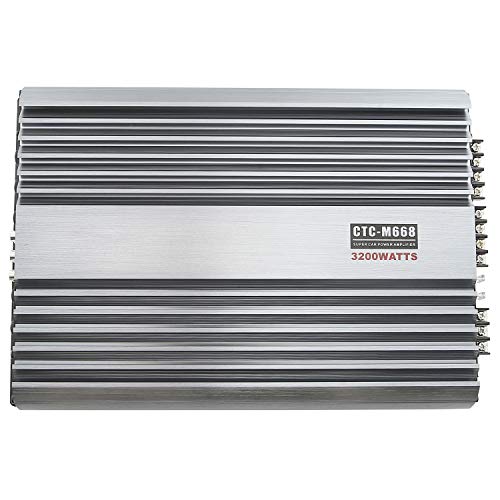
1. Yaeccc 3200W 4 Channel Amplifier
The cheapest option that works fine at low volume but quickly hits its limit.
This is the amplifier that starts the conversation about “you get what you pay for.” The Yaeccc 400-watt amp is the most affordable pick here by a wide margin, and some owners have great things to say about it — easy to install, sounds amazing at low to moderate listening levels, with a slim aluminum alloy chassis that is simple to mount. For casual background music or a starter build on a very tight budget, it can get the job done.
The other side of that coin is reliability. This amp has the lowest rating of any pick here, and the most-discussed feedback is mixed: some reviewers point out overheating and power cuts when the volume goes past 70%, and there are accounts of rear channels failing after a month of powering moderately sized speakers. The build quality feels lightweight and functional rather than sturdy. The 400-watt max rating compared to the Recoil’s 1040 watts highlights the power gap: the Yaeccc delivers roughly 25 watts RMS x 4, which is fine for small coaxial speakers but will struggle to drive aftermarket component sets or a subwoofer.
The upside
- Extremely affordable entry point for a first car audio project
- Slim aluminum design is easy to mount in tight spaces
- Easy installation with basic tools and knowledge
The honest limit
- Reports of overheating and power loss above moderate volume levels
- Very low real-world RMS power; not suitable for demanding speakers or subs
- Reliability is a gamble — some units arrive defective or fail quickly
Last-resort budget build: Only reach for this amp if your absolute maximum spend is and you are powering basic factory-replacement speakers at low volume.
Do not buy it for: Any setup where you want clean volume above 70%, or for powering aftermarket speakers that need real wattage — save up for the Recoil instead.
2. Recoil DI550.4 Class-D 4-Channel Amplifier
The tiny amp that stays ice-cold while delivering honest, clear power for years.
This is the amp you buy when you want something that just works — no fuss, no overheating, no cutting out. The Recoil DI550.4 puts out a real RMS of 80 watts x 4 at 4 ohms, which is a clean, usable 320 watts total that will drive a full set of door speakers or a pair of components with authority. The Class D design means it runs remarkably cool even after hours of use, so you don’t have to worry about tucking it into a tight space without airflow.
What makes this a true budget champion is the build quality and protection circuitry. It includes a high-speed MOSFET power supply and 4-way protection against shorts and overheating. Buyers report running this amp for two years straight with “never had problems,” driving four 6.5-inch speakers and tweeters at high volume for hours at a time. It bridges to 260 watts x 2 at 4 ohms, giving you enough grunt for a small subwoofer. The only honest caveat is the signal-to-noise ratio — while marketed at 95dB, some listeners detect a slight hiss at idle, though it disappears once music plays. That is a minor trade-off for an amp that has proven itself over the long haul.
Why it wins
- Reliable build with 4-way protection that keeps it running for years
- Runs cool in tight spaces thanks to efficient Class D topology
- Compact 7.5 x 5.9-inch footprint makes installation a breeze
Know before you buy
- Slight hiss at idle on some units when no music is playing
- High-level input requires sacrificing a cable, not plug-and-play
Your everyday workhorse: Reach for the Recoil if you want a dependable amp that stays cool, sounds clear, and won’t leave you stranded.
Think twice if: You need built-in Bluetooth or a remote bass knob — this is a straightforward, feature-light amplifier.
3. Taramps TS 800×4 Multichannel Amplifier

A palm-sized monster that replaces a much larger amp with the same clean authority.
The Taramps TS 800×4 is the amp that surprises everyone the first time they hear it. It delivers a genuine 200 watts RMS x 4 at 2 ohms, which is enough to power a serious set of speakers or even a pair of subwoofers when bridged — and it does it from a chassis that weighs just 1.91 pounds. Buyers consistently describe swapping out bulky Sony and Crunch amps for this Taramps and getting “the same clean power and quality in a smaller size.”
Sound quality is the most frequently praised feature here, with 30 positive mentions from owners who love the punchy highs and clear output. The compact size is the second most-loved trait — it slips into places a traditional amp cannot go. That said, the performance and durability do get mixed feedback. While the majority of owners are thrilled, a few report units that stopped working. The amplifier includes built-in short-circuit and overheating protection, and the manual recommends a 40A fuse or circuit breaker. Pair it with quality wiring and you are unlikely to have issues.
What wins people over
- Genuine 800 watts RMS in a package smaller than most lunchboxes
- Sound quality is the #1 thing owners rave about — clean, punchy, detailed
- Bridged mode gives you flexibility to run a sub without a second amp
The honest trade-off
- A small share of units have reliability issues; use a 40A fuse as recommended
- Requires 7 AWG power wire, which is thicker than typical budget wiring kits
The power-to-size champion: Best if you want maximum RMS output in a tiny footprint and plan to run 2-ohm speakers or a bridged sub.
Look elsewhere if: Reliability is your absolute top concern and you cannot risk an occasional defective unit — the Recoil above is safer in that regard.
4. Pioneer GM-A6704 4-Channel Amplifier

The entry-level benchmark that trades raw heat for warm, honest sound.
Pioneer has been making solid car audio for decades, and the GM-A6704 is a great example of why their reputation sticks. This Class A/B amplifier puts out 60 watts RMS x 4 at 4 ohms — not the most powerful number on the list, but delivered with the low distortion and smooth tonality that makes vocals and mids shine. The most-discussed aspect among owners is sound quality, with 43 people calling it out positively. It also scores high for value and power, especially when used in bridged mode where it delivers 190 watts RMS x 2.
Installation is straightforward, and a number of owners mention running this amp for three years or more without issues. It includes variable high-pass and low-pass filters so you can dial in exactly the right frequency range for your speakers or sub. The recurring note from the community is that this amp runs warmer than a Class D design — it is an A/B topology, so it generates more heat. Buyers have successfully used it to power door speakers and a small subwoofer with no overheating trouble, as long as it has some airflow around it.
Strong points
- Sound quality is the top praised feature — clean mids and detailed highs
- Versatile bridging lets you run 1, 2, or 3 channels for different setups
- Proven Pioneer reliability with many units lasting 3+ years
Worth noting
- Class A/B runs hotter than Class D; needs good ventilation
- At 60W RMS x 4, it is not as powerful as the Taramps in a 2-ohm setup
Gentle introduction to clean sound: Grab the Pioneer if you want a trustworthy brand and great sound quality from a simple, proven design.
skip it if: You are trying to drive high-power 2-ohm speakers or need a compact amp that stays cool in a sealed console — the Recoil is a better fit there.
5. BOSS Audio Systems OX4.400 4-Channel Amplifier

A flashy, feature-packed amp best for powering subwoofers on a tight budget.
The BOSS OX4.400 is a Class A/B amplifier rated at 1600 watts max power, but the real-world RMS is around 65 watts x 4 at 4 ohms. Owners generally appreciate the value and the solid sound it produces for the price, and the variable bass boost and low-pass crossover make it particularly well-suited for driving subwoofers. The included remote subwoofer control is a nice touch that lets you adjust bass from the driver’s seat without reaching behind the stereo.
The clearest lesson from owners is that this amp demands proper wiring. Multiple customers note overheating and protection mode issues when using thin 8-gauge wire, but those same issues disappear with 4-gauge OFC (oxygen-free copper) wire. The amplifier itself seems to perform well once given proper power and ground. A few owners note that the power ratings are exaggerated compared to real output, and the bass knob on some units arrived non-functional. It is heavier than the other amps here at 6.4 pounds, so plan for a sturdy mounting spot.
What it does well
- Remote bass knob gives you bass control from the driver’s seat
- Low-pass crossover makes tuning a subwoofer easy
- Bridged mode offers strong power for a sub or midbass speakers
Crucial warning
- Requires 4-gauge wiring to avoid overheating and protection mode shutdowns
- Rated power numbers are optimistic — real output is closer to 65W RMS x 4
- Heavier and larger than all other picks here
Perfect for bass builds: Choose the BOSS if your main goal is to drive a pair of subwoofers and you already have or will buy a proper 4-gauge wiring kit.
Think twice if: You want to power full-range door speakers with clean highs — the Recoil or Pioneer deliver better clarity for vocals.
Understanding the Specs
RMS vs Peak Power
RMS (Root Mean Square) is the amount of power an amplifier can produce cleanly and continuously — think of it as the engine’s cruising speed. Peak or max power is a short burst the amp can handle for a split second. A budget amp that claims 3200 watts but only delivers 25 watts RMS is misleading. Always compare RMS ratings at your speaker’s impedance (measured in ohms) to know what you are actually getting.
Class D vs Class A/B
Class D amplifiers use switching technology to be highly efficient, meaning they convert more of the car’s electrical power into sound and less into waste heat. They run cool and are small. Class A/B amps are less efficient but can offer a warmer, very musical tone. They generate more heat and require good ventilation. For a budget 4-channel amp in a confined space, Class D is usually the safer choice for reliability.
Impedance (Ohms) and Bridging
Impedance, measured in ohms, is the electrical resistance of your speakers. Most budget amps deliver their highest RMS rating at 2 ohms per channel. If your speakers are 4 ohms, you will get less power but better sound quality and less strain on the amp. Bridging combines two channels into one, doubling the voltage swing to drive a more powerful single speaker. Always check the amp’s minimum impedance when bridged.
Protection Circuitry
Good protection circuitry guards the amplifier against overheating, short circuits, and low impedance (too much load). This is especially important in a budget amp where internal components may not be as sturdy. Look for amps that mention thermal protection, short-circuit shutdown, or 4-way protection. These features are why amps like the Recoil and Taramps survive years of use while cheaper models fail.
FAQ
What is the difference between RMS and peak power on a budget amp?
Will a budget 4 channel amp run my car speakers and a subwoofer?
Does a Class D amp sound worse than a Class A/B amp?
What size power wire do I need for a 4 channel amp?
Why does my budget amp go into protection mode?
Can I use a budget 4 channel amp with a factory car stereo?
How long should a budget car amplifier last?
What does bridging an amp do?
Final Thoughts: The Verdict
For most people, the budget 4 channel amp winner is the Recoil DI550.4 because it combines real 80W x 4 RMS power, cool-running Class D efficiency, and a proven track record of lasting for years without issues. If you want the absolute maximum power in a tiny footprint, grab the Taramps TS 800×4. And for a simple, trustworthy entry-level build with great vocal clarity, the Pioneer GM-A6704 is the one to reach for.
How We Picked
We do not accept paid placement. Every pick is matched to a real buyer and a real use-case; we do not hands-on test units.
Sources & Methodology
Specifications: manufacturer listings and product documentation. Review insights: verified customer reviews, as of July 2026. Pricing: not shown on this page (it changes often); check the current price via the retailer link.
As an Amazon Associate, FitlyFast earns from qualifying purchases. This does not affect which products we feature.