
Our readers keep the lights on and the weekend projects moving. As an Amazon Associate, I earn from qualifying purchases.
Specs are compiled from manufacturer listings and verified buyer reviews and can change over time — please confirm the key details on the product page before buying.
Buying a 5.1 system on a budget usually means one of two things: a soundbar with fake rear speakers, or a tangled mess of wires that promises cinema sound and delivers muffled dialogue. Today, a true 5.1 setup with real rear channels and a thumping subwoofer fits within a modest budget. This guide ranks the best budget 5.1 systems, highlighting where each saves money and where it cuts corners.
I’m Rikta — the founder and writer behind FitlyFast. This guide is built by comparing the manufacturers’ published specifications and the patterns across verified customer reviews, so you get each pick’s real strengths and trade-offs instead of marketing spin.
Everything here is judged on real-world value: does it fill a room, is the dialogue clear, and do the rear speakers actually do their job within a budget 5.1 surround sound system that won’t break the bank.
Our Picks at a Glance


How To Choose The Best Budget 5.1 Surround Sound System
Before you click buy, there are a few traps in this category that catch almost everyone. The biggest one is the word “surround” on a soundbar — many bars claim 5.1 or Atmos but have no physical speakers behind you, so the effect is simulated. The second trap is peak wattage, which manufacturers love to inflate. Here is what actually matters.
Real rear speakers vs virtual surround
A true 5.1 system has five speakers and one subwoofer — the critical part is that two of those speakers sit behind you. Some bars, like the ULTIMEA M60, use side-firing drivers to fake rear sound. That works reasonably well, but a setup with physical wired rears, like the Hisense HS5100 or the Sony HT-S40R, creates real depth you can feel. Know which one you’re buying before you order.
Wattage: peak vs RMS
Peak wattage is a marketing number — it’s the absolute maximum for a split second. The RMS (continuous power) is what you actually hear. A system claiming 1000W peak might only deliver 250W RMS. For a budget system, focus on whether it can fill your room at moderate volume without distortion, not whether the box says “1500W” in bold letters. Check the frequency response (like 45 Hz–18 kHz on the ULTIMEA) to see if it covers deep bass and clear highs.
Connections: HDMI ARC vs optical
To get true 5.1 sound from your TV, you need the right cable. HDMI ARC (Audio Return Channel) is the best — it carries full surround and lets your TV remote control the volume. Optical is a step down but still delivers surround from most TVs. The cheapest RCA cables only carry stereo, so if a system relies on those for TV connection, you won’t get true 5.1 from broadcast TV. Most systems here include the right cables in the box, which saves you a trip to the store.
Quick Comparison
| Model | Best For | Peak Power | Subwoofer | Rear Speakers | Amazon |
|---|---|---|---|---|---|
| Hisense HS5100★ Best Overall | Easy TV setup | 540W | 6.5″ Wireless | Wired Kit | Amazon |
| ULTIMEA Poseidon M60Top Performer | Dolby Atmos clarity | 300W | 5.25″ Wired | Side-firing | Amazon |
| Rockville HTS56Karaoke King | Karaoke parties | 1000W | 8″ Built-in | Wired | Amazon |
| Bobtot 800W | Big rooms, loud bass | 800W | 6.5″ Built-in | Wired | Amazon |
| Rockville HTS820 | High-end output | 1500W | 8″ Built-in | Wired | Amazon |
| Bobtot Wireless | No rear wires | 1000W | 8″ Built-in | Wireless | Amazon |
| Sony HT-S40R | Brand reliability | 600W | Wireless | Wired | Amazon |
| Logitech Z906 | PC gaming | 1000W | 165W | Wired, Wall-mount | Amazon |
In‑Depth Reviews
1. Hisense HS5100 5.1ch Soundbar
The plug-and-play 5.1 that auto-configures with your Hisense TV for easy setup.
This is the pick for anyone who wants true 5.1 — including a rear speaker kit and a center speaker — without a wiring project. The headline number is 540W of max power spread across 8 speakers, and the 6.5-inch wireless subwoofer means you can tuck the bass away out of sight. Setting it up is the star feature here: buyers consistently report that it’s genuinely plug-and-play, especially when paired with a Hisense TV, where it auto-configures itself.
You get Bluetooth 5.3 (a wireless standard for stable music streaming) and EzPlay, which lets your Hisense TV remote control the soundbar, so this feels like a complete package. The catch is the surround experience. Buyers praise the main output, but many note the rear speakers are quiet. One owner puts it bluntly: “the surround speakers are so quiet they might as well not exist.” If dialogue and front sound matter most, you’ll love it; if you want aggressive rear effects, skip this one.
Compared to the Rockville systems below, the Hisense trades raw wattage for pure convenience and a tighter, more integrated feel. It’s the easiest true-5.1 system on this list to live with daily.
Why it wins
- True 5.1 with a rear speaker kit for real depth
- Wireless 6.5″ subwoofer hides anywhere
- EzPlay lets your Hisense TV remote run everything
- Bluetooth 5.3 for clean wireless music
The trade-offs
- Rear speakers are too quiet for some owners
- No subwoofer level adjustment — only bass/treble
- Best experience locked to Hisense TVs
Reach for this if: you have a Hisense TV and want the simplest true 5.1 upgrade with zero fuss.
Look elsewhere if: you’re a bass-head who cranks rear channels — the satellites won’t satisfy you.
2. ULTIMEA Poseidon M60
The budget Atmos bar that delivers dialogue clarity rivaling systems three times its price.
If you watch movies with the volume low or struggle with mumbling actors, this is the system for you. The ULTIMEA M60 delivers genuine Dolby Atmos via HDMI eARC, which carries far more data than standard ARC — up to 37 Mbps — for richer, more detailed surround. Its VoiceMX technology isolates vocals in real time, so dialogue stays crisp even during loud action scenes. That clarity is the thing owners rave about most.
Now, the honest catch: this is a 5.1 soundbar, not a true 5.1 with rear satellites. It uses five built-in drivers, including two side-firing units, to fake the surround effect. It’s convincing — reviewers describe it as “mindblowing” for the price — but a purist will notice. The wired wooden subwoofer delivers a solid 300W of peak power with a frequency response of 45 Hz–18 kHz and a maximum SPL of 99 dB, which is plenty for a living room. Compared to the Hisense above, it has a smaller sub (5.25 inches vs 6.5 inches) but far better tuning control.
A couple of quirks: firmware updates reportedly take 15+ minutes, and if you adjust bass or treble via the remote, your custom EQ resets. But with a 10-band equalizer and 121 sound presets in the app, you can dial it in exactly how you like.
Standout strengths
- Real Dolby Atmos with HDMI eARC support
- VoiceMX keeps dialogue crisp
- App control with 121 sound presets
- Compact bar fits under most TVs
Know before you buy
- No physical rear speakers — surround is simulated
- Sub is wired, not wireless
- Firmware updates are slow
Choose this for: movie nights where vocal clarity and Atmos effects matter more than physical rear channels.
skip it if: you insist on real satellite speakers behind the couch — this bar can’t deliver that.
3. Rockville HTS56 1000W
A 1000W party system with karaoke mics, LED lights, and an 8-inch sub for garage-shaking bass.
This is the system to buy when “home theater” means “party.” The Rockville HTS56 delivers 1000W peak power through five satellites and an 8-inch subwoofer — the largest sub on this list at this price tier. It’s a 3.3x power gap over the ULTIMEA M60’s 300W, and you feel it when the bass drops. Buyers describe installing it in a garage and being genuinely impressed by the bass output for the price.
what separates it is the feature set: two 1/4-inch mic inputs with echo control, a 5-band EQ (a five-band equalizer for adjusting sound frequencies), FM radio, USB and SD inputs, and LED lights that pulse to the beat. It’s a complete entertainment hub, not just a TV speaker. The trade-off is refinement. There’s no channel separation — it uses a stereo matrix rather than true discrete 5.1, so pinpoint surround effects are limited. At high volumes, some buyers report distortion and rattling, and the LED lights can’t be turned off if you find them distracting.
For the money, though, the Rockville is a fantastic value. The visual punch of the 8-inch sub (which is 52% larger than the ULTIMEA’s 5.25-inch unit) makes action movies and music feel huge. If you want a system that does everything — karaoke, music, movies — this is the most versatile pick here.
The fun factor
- 1000W peak with a powerful 8″ subwoofer
- Built-in karaoke with 2 mic inputs and echo
- LED lights sync to the music
- USB, SD, optical, and Bluetooth inputs
Keep in mind
- Not true discrete surround — stereo matrix only
- Distortion creeps in at very high volume
- LED lights can’t be switched off
Best for: parties, karaoke nights, and anyone who wants maximum bass and features per dollar.
Think twice if: you want pinpoint rear-channel effects for cinematic surround — this is more of a party PA.
4. Bobtot 800W 5.1 System
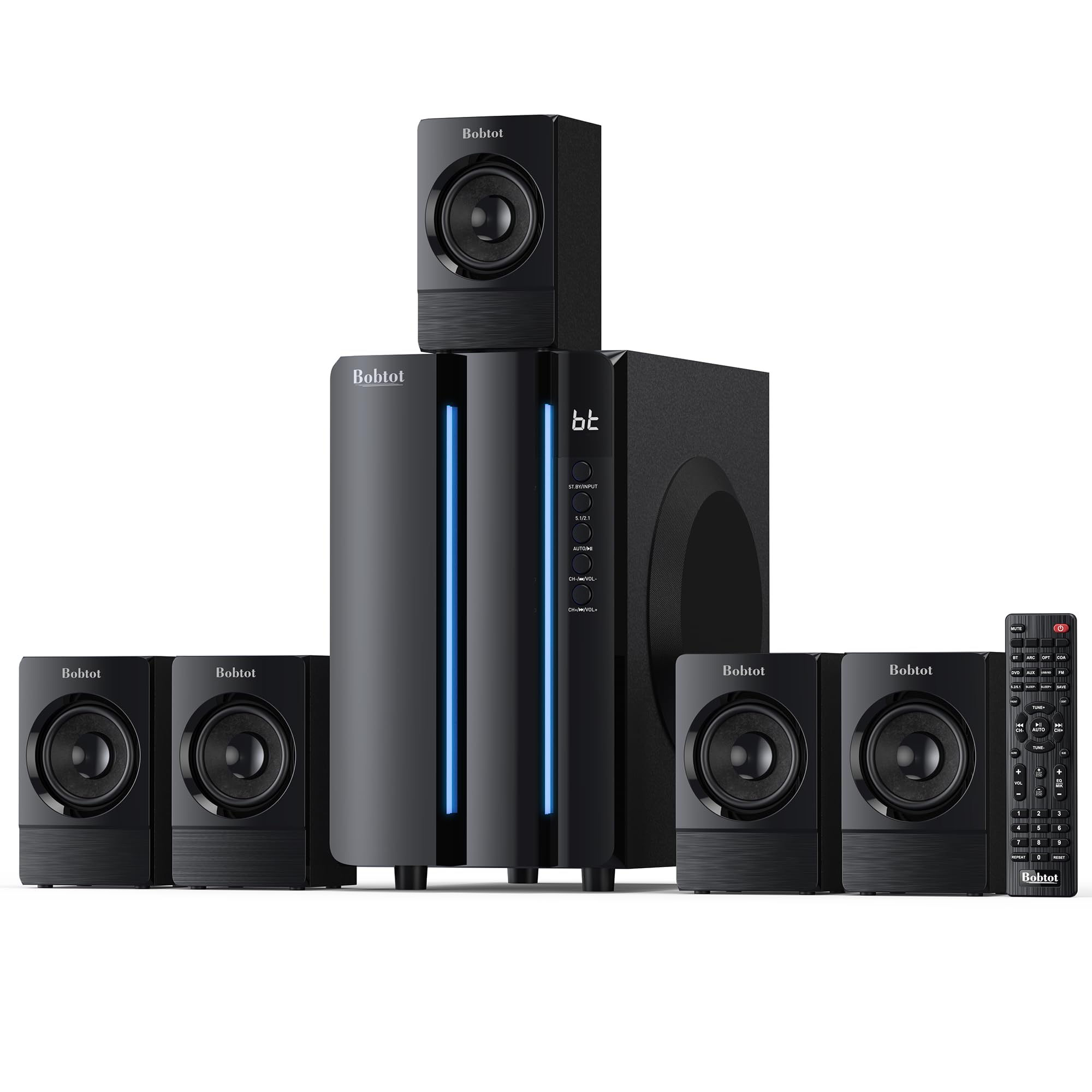
The 800W system that fills a 550-square-foot room with floor-shaking bass.
If you want to feel your movies, this Bobtot system delivers raw output. It pushes 800W of peak power through a 6.5-inch subwoofer with a built-in receiver, and owners mention that at 50-75% volume it easily fills a 550-square-foot room and shakes the floor. The bass is adjustable by ±10, so you can dial it to match your space without rattling your neighbors’ walls.
The wiring is generous — front speakers get 13-foot cables and rears get 31-foot cables, which is more than enough to route around a large living room. It connects via ARC, optical, coaxial, and aux, so it works with almost any TV or projector. Setup is genuinely easy, and the included remote lets you adjust sub and speaker levels independently.
The honest concern here is reliability. While many owners love it, a few report that their unit failed after a handful of uses, with one noting it “only worked for two hours.” That’s not the norm — the majority praise it — but it’s a real durability risk to weigh. Cable-wise, though, the 31-foot rears beat the Rockville HTS820’s 30-foot runs, so you have flexibility for big rooms.
Raw power
- 800W peak fills a 550 sq ft room
- Adjustable bass (±10) and speaker levels
- Long cables: 31 ft rears, 13 ft fronts
- ARC, optical, coaxial, and aux inputs
Watch out for
- Durability is inconsistent — some units fail early
- Volume control quirks with some TV remotes
Aim for this if: you have a large open room and want serious bass without spending premium money.
Be cautious if: you need guaranteed long-term reliability — the track record is mixed.
5. Rockville HTS820 1500W

The 1500W powerhouse with an 8-inch sub and 108 dB max SPL for chest-thumping output.
This is the upgrade pick for anyone who outgrew the HTS56. The Rockville HTS820 pushes 1500W peak (375W RMS continuous) through MDF wood cabinets with plastic fronts, and each satellite has a 3-inch midrange driver plus a 0.75-inch dome tweeter for clearer highs. The 8-inch subwoofer is the star, with a frequency response of 20 Hz–20 kHz and a maximum SPL of 108 dB — loud enough to feel in your chest.
Owners confirm the bass is thumping, with one using it in a 600-square-foot room with 12-foot vaulted ceilings and describing it as shaking the furniture. The HTS820 also keeps the karaoke features (dual 1/4-inch mic inputs with echo) and adds independent volume controls for each speaker and the sub, so you can balance the mix precisely.
The trade-off is setup complexity and some quirks. The rear speakers can feel underpowered relative to the sub, and Bluetooth lag makes it unsuitable for movies or gaming where audio sync matters — stick to wired connections for that. The signal-to-noise ratio is rated at ≥75 dB, which is solid but not audiophile-grade, and some users report static at very high volumes. Still, for a dedicated home theater room, the 1500W output is a serious step up from the 1000W HTS56.
Serious output
- 1500W peak with 375W continuous RMS
- Independent volume for every speaker
- 108 dB max SPL from a 20 Hz–20 kHz range
- MDF cabinets reduce resonance
Consider this
- Rear speakers can feel quiet vs the sub
- Bluetooth lag — use wired for movies
- Static reported at very high volume
Step up to this if: you have a dedicated theater room and want proper headroom without moving to component separates.
Stay away if: you’re in a small apartment — 1500W will overwhelm a compact space.
6. Bobtot 1000W Wireless Rear System
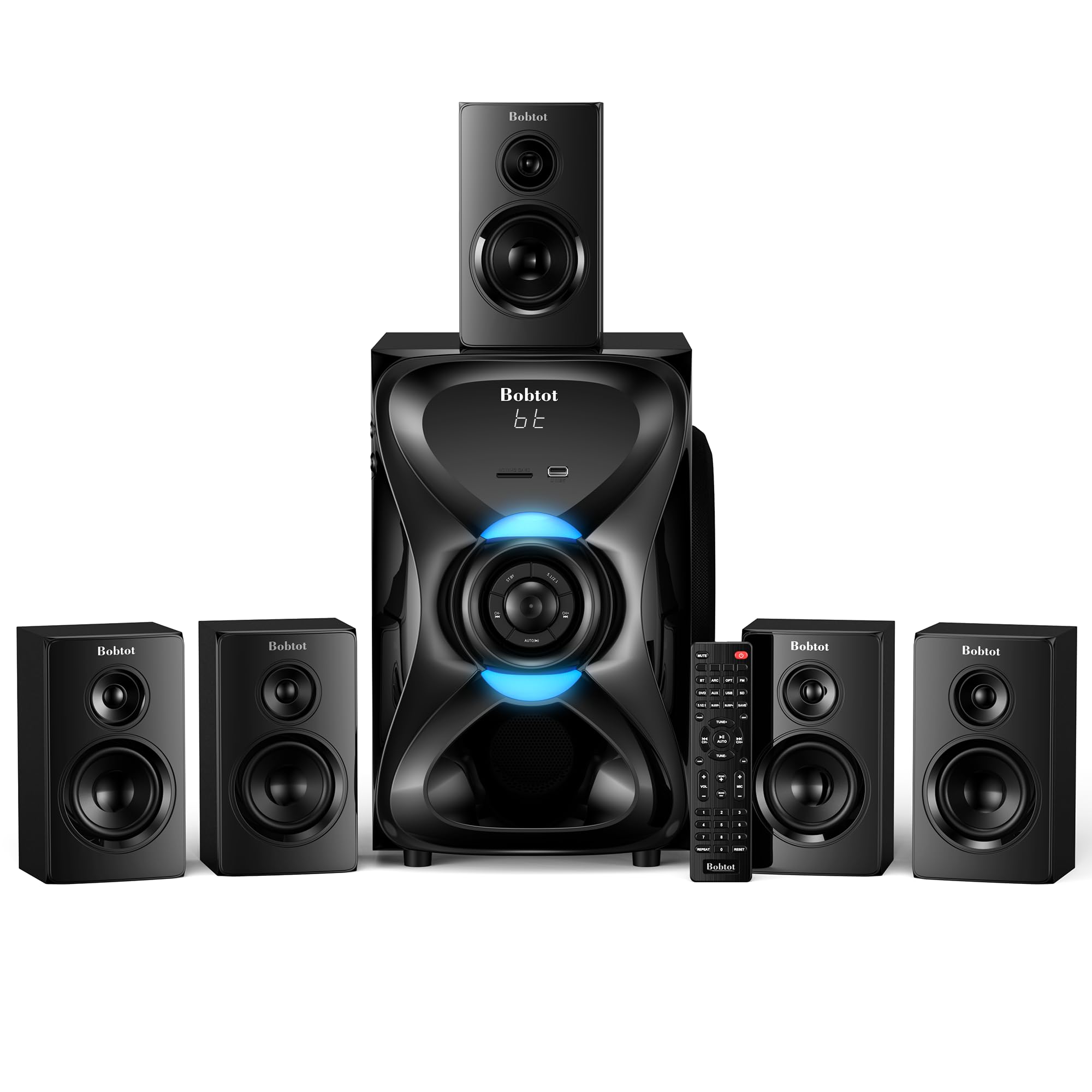
The system that eliminates rear speaker wires with a 32-foot wireless range.
Renting an apartment or just hate running cables across the floor? This Bobtot is the answer. It’s the rare budget 5.1 that gives you two truly wireless rear satellite speakers, with a wireless cover range of 32 feet so you can place them anywhere in the room. The 8-inch subwoofer with a built-in receiver delivers 1000W of peak power, and the front and center speakers are wired with long cables (13 feet for the center, 31 feet for fronts).
The convenience factor is enormous — no more tripping over rear wires, and you can switch between 5.1 and 2.1 modes via the remote for late-night listening. It supports Bluetooth 5.3, TV ARC, optical, aux, and even has a built-in FM receiver. Owners genuinely love the sound, describing it as “crisp tone and an astounding bass” that’s totally worth the money. Being a wire-free setup makes it great for bedrooms or RVs (it’s explicitly RV-compatible).
Here’s the honesty: reliability is the gamble. With a small review pool, a few units arrived with dead channels, and one owner had a wireless speaker that just didn’t work. On the flip side, Bobtot’s customer service earned praise for responding quickly and even paying for a repair. If you get a good unit, it’s outstanding — just know the early-failure rate is higher than the big brands. Unlike the Sony below, this gives you wireless rears at a much friendlier price.
Setup freedom
- Wireless rear speakers with 32 ft range
- 1000W peak from an 8″ subwoofer
- Switch between 5.1 and 2.1 modes
- RV-compatible with multiple inputs
A word of caution
- Higher risk of a dead channel on arrival
- Small review pool — less proven long-term
Perfect for: renters and RV owners who can’t run rear wires but still want true surround.
Prepare for: a small chance of an early defect, though support has been responsive in those cases.
7. Sony HT-S40R

The trusted-name 600W system that gives you real rear speakers and a wireless sub.
If the thought of an off-brand system makes you nervous, the Sony HT-S40R is the safe harbor. It’s a proper 5.1 setup — a soundbar, a wireless subwoofer, and two wired rear speakers that deliver real physical surround sound — all backed by Sony’s engineering. The 600W output is conservative but clean, and the rear speakers complete the home cinema effect in a way soundbars alone can’t.
The biggest practical feature is its simplicity. Setup uses color-coded connections, so even a first-timer can have it running in minutes. Dialogue enhancement options let you boost speech or reduce bass for late-night viewing without waking the house. You can connect via HDMI, optical, or analog, and Bluetooth handles music streaming from your phone.
Here’s where it gets complicated. The review community is split: plenty of owners call it easy to set up and excellent value, but a meaningful number report rear speakers making loud chirping sounds or the subwoofer simply stopping. Some units required the rear speakers to be activated via a PCM setting on the TV. It’s the most polarizing pick here — when it works, it’s great, but the failure reports are frequent enough to give pause. Compared to the Hisense at nearly half the price, you’re paying for the Sony name and the wireless sub, not necessarily better sound.
Sony strengths
- Real rear speakers for true 5.1
- Wireless subwoofer for placement freedom
- Color-coded, easy setup
- Dialogue enhancement for clear speech
Read the fine print
- Reports of rear speakers chirping or failing
- Some units need a TV setting to activate rears
- Sounds thin at low volumes for some owners
Reach for this if: you want a recognizable brand name backing your first 5.1 system.
Think carefully if: you can’t tolerate the risk of a finicky rear speaker setup — the cheaper Hisense is more reliable.
8. Logitech Z906

The THX-certified PC gaming legend that turns your desk into a cinema.
The Logitech Z906 is THX-certified — a rigorous quality standard for true cinema sound — and delivers a continuous 500W with peaks up to 1000W. The subwoofer pumps 165W on its own, and the four satellites are each rated at 67W and wall-mountable. This is a genuine 5.1 system, not a soundbar approximation.
Where it truly shines is gaming and PC use. Owners describe game audio as phenomenal, with floor-vibrating bass even at 40% volume. The connectivity is a major plus: it accepts up to six devices — two optical inputs (up to 1080p), digital coaxial, RCA, and 3.5mm — so you can hook up a PC, console, and TV simultaneously and switch between them. The signal-to-noise ratio of >95 dB (a measure of background hiss; higher is cleaner) means clean, hiss-free output.
The catch is that it’s designed for a desk, not a living room. There are no mounting brackets or speaker stands included, the speaker wire is thin, and the amplifier inside the subwoofer runs hot with no ventilation — a design flaw that worries some owners about longevity. It’s also the priciest pick here by a clear margin. If you’re a PC gamer who wants positional audio, it’s worth it. For a TV-centric living room, the cheaper options above give you a wireless sub and easier TV integration for less money.
Desktop dominance
- THX-certified for accurate cinema sound
- 165W subwoofer with thunderous bass
- Connect up to 6 devices at once
- Wall-mountable satellite speakers
Know the limits
- No mounting brackets or stands included
- Amp runs hot — longevity concern
- Thin speaker wire; may want to upgrade
Buy this for: a serious PC gaming rig where positional audio and clean power matter more than TV convenience.
Choose something else if: your primary use is TV and movies — you’ll overpay for features you don’t need.
Understanding the Specs
Peak Power vs. RMS
Peak wattage (often written as “1000W” or “1500W”) is the maximum power a system can handle for a split second. It’s the number manufacturers put on the box because it’s big and impressive. RMS (Root Mean Square) is the continuous power you actually hear during a movie or song. A system with 1000W peak might only deliver 250W RMS. For everyday listening, focus on whether the system sounds clean at your normal volume, not the peak number on the front of the box.
Subwoofer Size & Material
The subwoofer driver size (measured in inches) is the most direct guide to bass depth. An 8-inch sub, like on the Rockville and Bobtot systems, moves more air and produces deeper, more physical bass than a 6.5-inch unit. The enclosure material matters too — MDF wood cabinets (as seen on the Rockville HTS820) resonate less than plastic, giving you tighter, cleaner low-end. A wireless sub also frees you from running a cable across the room.
HDMI ARC & eARC
ARC (Audio Return Channel) is an HDMI feature that lets your TV send audio back to a soundbar through a single cable, and lets your TV remote control the volume. eARC is the newer, faster version that carries much more data — the ULTIMEA M60 uses eARC to open up full lossless Dolby Atmos. If you want the best audio quality from modern streaming apps, prioritize a system with HDMI ARC or eARC over one that relies on optical or RCA.
Speaker Configuration
A true 5.1 system has five speakers and one subwoofer. The critical detail is where those five speakers are: two front, one center (for dialogue), two rear (for surround effects), plus the sub. Some soundbars claim 5.1 but have no physical rear speakers — they use side-firing drivers to simulate the effect. This can sound convincing, but it’s not the same as real speakers behind you. Check whether rear speakers are physically included before you buy.
FAQ
What is the difference between a 5.1 soundbar and a true 5.1 system?
Do I need HDMI ARC to get 5.1 sound from my TV?
Why are the rear speakers on my system so quiet?
Can I use a 5.1 system with my computer or gaming console?
What does Dolby Atmos add over standard 5.1?
What is the difference between peak wattage and RMS wattage?
How big of a subwoofer do I need for a large room?
Are wireless rear speakers as good as wired ones?
Can I add a 5.1 system to a TV that only has a headphone jack?
How important is dialogue enhancement in a budget surround system?
Final Thoughts: The Verdict
For the majority of shoppers, the budget 5.1 surround sound system winner is the Hisense HS5100 because it delivers true 5.1 with a rear speaker kit and wireless subwoofer at an unbeatable price, with the easiest setup of any option here. If you watch a lot of dialogue-heavy movies and want Dolby Atmos, grab the ULTIMEA Poseidon M60. And for parties or karaoke nights where raw bass and features matter most, the Rockville HTS56 is the one to reach for. Whichever you choose, you’re getting a genuine upgrade over your TV’s built-in speakers — just be honest about if you want the convenience of a soundbar or the depth of true wired surround.
How We Picked
We do not accept paid placement. Every pick is matched to a real buyer and a real use-case; we do not hands-on test units.
Sources & Methodology
Specifications: manufacturer listings and product documentation. Review insights: verified customer reviews, as of August 2026. Pricing: not shown on this page (it changes often); check the current price via the retailer link.
As an Amazon Associate, FitlyFast earns from qualifying purchases. This does not affect which products we feature.