
Our readers keep the lights on and the weekend projects moving. As an Amazon Associate, I earn from qualifying purchases.
Specs are compiled from manufacturer listings and verified buyer reviews and can change over time — please confirm the key details on the product page before buying.
Upgrading your car’s factory speakers is the single biggest improvement you can make to your daily drive, but the fear of spending hundreds on something that might not fit or sound much better stops most people cold. This guide cuts through that worry by focusing on real-world value — speakers that genuinely outperform what came with your car while staying affordable.
I’m Rikta — the founder and writer behind FitlyFast. This guide is built by comparing the manufacturers’ published specifications and the patterns across verified customer reviews, so you get each pick’s real strengths and trade-offs instead of marketing spin.
Whether you are swapping blown-out door speakers or building a budget system from scratch, these picks represent the most reliable options for anyone searching for the best budget 6.5 speakers that deliver clear highs and punchy bass without requiring a second mortgage.
Our Picks at a Glance


How To Choose The Best Budget 6.5 Speakers
Picking the right 6.5-inch car speaker is simpler when you know what the numbers on the box actually mean for your ears. Here are the three specs that separate a great upgrade from a disappointing one.
Power Handling: RMS vs. Max Wattage
The number that really tells you how a speaker performs is RMS (Root Mean Square) power — the amount of wattage the speaker can handle continuously without distorting. Max power is the brief burst it can survive before blowing. A speaker with 40W RMS is perfectly fine for a standard head unit, while 80W RMS means you should run it with an external amplifier to hear its full potential.
Sensitivity: Why 91 dB Matters for Factory Stereos
Sensitivity (measured in dB) tells you how loud a speaker gets from a given amount of power. A higher rating — like 91 dB — means the speaker produces clear sound even with the low power from a factory radio, making it an easy upgrade without extra gear. Lower sensitivity speakers often require an amplifier to sound lively.
Mounting Depth and Fitment
A 6.5-inch speaker is the standard size, but not all 6.5-inch speakers mount the same way. The mounting depth (how far the magnet sticks into your door) is critical — too deep and it hits the window track or inner panel. Always check your vehicle’s factory speaker depth before ordering to avoid a frustrating return.
Quick Comparison
| Model | Best For | RMS Power (Pair) | Sensitivity (dB) | Speaker Type | Amazon |
|---|---|---|---|---|---|
| MB Quart FKB-116★ Best Overall | Crisp, clear highs on a budget | 40W | — | 2-Way Coaxial | Amazon |
| RECOIL MS65-4PPro-Level Midrange | Loud mid-bass with an amp | 300W | — | Midrange Pro Audio | Amazon |
| BOSS P65.4C PhantomFull-Range Value | 4-way full-range upgrade | 200W | 84 dB | 4-Way Coaxial | Amazon |
| Pioneer TS-A1671F | Easy factory upgrade with included brackets | 70W | 91 dB | 3-Way Coaxial | Amazon |
| BOSS 2-Pair Set | Filling four door spots cheaply | 200W | 90 dB | 4-Way Coaxial | Amazon |
| Pioneer TS-A1681F | Detailed sound with enhanced bass | 80W | 91 dB | 4-Way Coaxial | Amazon |
| Rockford Fosgate R165-S | Component clarity with separate tweeters | 40W | — | 2-Way Component | Amazon |
| Infinity REF-6532EX | Shallow mount, smooth highs | — | — | 2-Way Coaxial | Amazon |
| Alpine S2-S65 | Hi-Res certified entry-level audiophile sound | 80W | — | Coaxial | Amazon |
In‑Depth Reviews
1. MB Quart FKB-116 6.5″ 150W 2-Way Coaxial Pair
Titanium dome tweeters that deliver crisp highs without the usual budget speaker harshness.
The thing that wins people over with this MB Quart pair is the sound clarity: the 6.5-inch polypropylene cones and titanium dome tweeters produce smooth, detailed highs and solid mids that, as owners put it, “compete with speakers more than twice the price.” Running on just a factory head unit and 40W RMS, they outperformed more expensive brands like Kenwood and JBL in head-to-head comparisons from real installs. The basket runs large (it fits more like a 6.75-inch speaker), which means you might need to stretch the mounting bracket slightly in tight spaces — the main trade-off for a speaker this good at this price.
What everyone raves about is the sound quality, with over three dozen mentions giving it top marks for value and build quality. One owner swapped out 320-watt Pioneers for these and described the difference as “much deeper and more of a surround sound to them.” A minority note that the included grille can arrive cracked, though MB Quart sent replacements quickly. The brightness of the highs is manageable with a simple treble adjustment on your radio.
Surprisingly Refined: For drivers replacing factory speakers on a tight budget, the MB Quart FKB-116 delivers genuinely audiophile-adjacent clarity — crisp mids and smooth highs that make vocals and guitars come alive — at an entry-level price.
Reach for this if: you want noticeably clearer highs and mids than stock without needing an amplifier.
Think twice if: your car has very tight 6.5-inch cutouts — the large basket requires a bit of room.
2. RECOIL MS65-4P 6.5-Inch Midrange Pro Audio Speakers (Pair)
Serious mid-bass punch that needs amplifier power to wake up.
The RECOIL MS65-4P is not a typical do-everything coaxial — it is a dedicated midrange driver designed to handle the meat of the audio spectrum from your door location. With a massive 300W RMS power handling at 4 Ohms and a 1.5-inch high-temperature Kapton voice coil that resists heat buildup, these are built for high-output systems where most budget speakers would fry. The crowd’s verdict is clear: “good budget mid-bass speakers” that deliver clear, crisp, and loud sound when paired with an amplifier delivering over 100W RMS per channel.
The build quality draws mixed feedback: some owners praise the construction for the price, while others note the paper cone and basic feel could be better. The real catch is that these need an amp to shine — several owners running them on 200W/channel setups (like the Taramp 2ohm) report performance comparable to speakers costing much more. A few found the fitment required a small cut for their Audi or needed Dynamat to improve mid-bass presence in the cabin.
What Powers Them
- 300W RMS per pair handles serious amplifier power
- 1.5″ Kapton voice coil resists heat for long life
- Clear, loud mid-bass with no distortion at high volumes
The Fine Print
- Needs an amplifier (100W+ RMS per channel) to perform
- Not a full-range speaker — missing dedicated tweeters for highs
- May require minor vehicle modifications for fitment
Best for: audiophiles building a component system who want powerful mid-bass from the doors.
Look elsewhere if: you are running a stock head unit with no amplifier — these will sound quiet and thin.
3. BOSS Audio Systems P65.4C Phantom Series 6.5″ 4-Way Coaxial Pair
A 4-way design that brings surround-sound depth to a budget price.
The BOSS Phantom P65.4C stands out for its complex 4-way system — a 1.38-inch midrange and two 0.60-inch tweeters mounted on a single frame — which produces a wider, more rich soundstage than typical two-way speakers. Buyers report that these sound “way better than the 320 watt pioneers that I replaced” and describe the sound as “much deeper and more of a surround sound.” The cast aluminum basket and rubber surround add durability, with a 3-year platinum warranty from BOSS providing extra confidence.
Build quality and fit generate mixed reactions — some find the speakers well-built, while others describe them as fragile for certain vehicles. The sensitivity sits at 84 dB, meaning they might not get loud enough on a weak factory radio without an amplifier. A 2004 BMW 325i owner noted the rear deck fit was fine, but the front doors required trimming the panel and removing the rubber magnet cover. These are best for someone with a moderate amp or a head unit putting out clean power.
Grab these for: a full-range sound upgrade with dedicated midrange and double tweeters — great for rock and acoustic music.
Pass if: your car has shallow doors or you are sticking strictly with a low-power factory stereo.
4. Pioneer A-Series Standard TS-A1671F 6.5″ 3-Way Coaxial Pair

Factory-grade installation adapters included means zero trips to the hardware store.
The Pioneer TS-A1671F is designed to make your life easy: it ships with multi-fit mounting adapters that let you drop these into most common vehicles without custom drilling or brackets. Its high sensitivity of 91 dB ensures you get clear, loud sound from even a basic head unit — the 3-way design with a dedicated tweeter produces balanced mids and smooth treble. Owners specifically praise the tight bass response and note they hit volume without distortion, a direct result of the 70W RMS and 320W max power handling.
The included adapters are a real bonus — a Gen 1 Tacoma owner confirmed they installed without needing extra parts. A couple of owners found the build quality slightly underwhelming for the price tier, but the overwhelming consensus is that these deliver strong value for money. The 37 Hz to 31 kHz frequency response range means they reproduce deep bass notes and airy highs across most music genres without rolling off the extremes.
easy Upgrade: If you want recognizably better sound from your car without breaking out the Dremel or buying adapters, this Pioneer pair is the simplest path to improvement.
Ideal for: anyone doing their first speaker swap who wants a guaranteed fit and easy wiring.
skip it if: you already have an amplifier — these are tune for standard radio power and may not match higher-end gear.
5. BOSS Audio Systems 6.5″ Full Range Coaxial 4-Speaker Set (2 Pairs)

Four speakers for the price of two — the entry-level choice for a full-car refresh.
If you need to replace all four door speakers and your budget is tight, this BOSS 2-pair set delivers the most value per dollar. Each pair rates at 400W max (200W RMS) and uses a poly-injection woofer cone with a rubber surround to keep sound clean over time. The 90 dB sensitivity means they play respectably loud on a factory stereo without distortion — a quality that the majority of buyers highlight as “good sound and clarity” for the money.
The package includes four complete speakers with stamped steel baskets and metal mesh grilles, plus the installation hardware. A 2004 Trailblazer owner who replaced failing factory speakers noted these lack deep low bass but perform “better than factory” and stay clean at high volume. The trade-off is that these are entry-level drivers — no titanium tweeters, no high-end crossover network. If you listen to bass-heavy music at high volume, you may find them thin compared to the Pioneer or MB Quart picks.
Best for: covering all four doors on a minimal budget — especially for older cars where any upgrade is a big step up.
Not for: critical listeners seeking punchy bass or crisp high-frequency detail.
6. Pioneer A-Series Plus TS-A1681F 6.5″ 4-Way Coaxial Pair

Four separate drivers per speaker for sound detail that rivals more expensive brands.
The TS-A1681F takes Pioneer’s A-Series design and adds an extra driver for a true 4-way system, handling a broad frequency range from a deep 35 Hz all the way up to 29 kHz. With 80W RMS and a 91 dB sensitivity, these handle clean power from an amplifier beautifully — owners mention crisp audio with solid bass and crisp highs that outperform stock Toyota OEM speakers by a massive margin. One reviewer who paired these with Morel speakers in the front doors said the cheaper Pioneers “sound better” than the much pricier competition.
These include the same multi-fit mounting adapters as the 3-way model, making installation straightforward. The only complaint is a slight midrange distortion at very high volume according to one owner, but the vast majority praise the balanced sound and easy wiring. The 35 Hz low-end extension gives you actual bass you can feel, something most budget speakers skip entirely.
Standout Features
- 80W RMS handles moderate amplifier power with ease
- 4-way design with separate drivers for deep bass and clear highs
- 91 dB sensitivity works well with factory radios
Honest Note
- Midrange can distort slightly at maximum volume with high-powered amps
- Some owners prefer pairing these with an aftermarket head unit for best results
Reach for these if: you have a modest amplifier and want a detailed, balanced soundstage without spending +.
Think twice if: you plan to only use a low-power factory radio — the extra drivers need clean power to shine.
7. Rockford Fosgate Prime R165-S 6.5″ 2-Way Component System

Separate tweeters with integrated crossovers give you true stereo imaging from your doors.
The Rockford Fosgate R165-S is a 2-way component system — meaning the 6.5-inch woofers and 1-inch tweeters are separate units, allowing you to mount the tweeters higher in the door or dash for a much better soundstage. The mica-injected polypropylene cones deliver extended frequency response, while the Mylar balanced dome tweeters produce “crisp highs” according to owners. This kit includes grilles, tweeter mounting hardware, and inline crossovers, making a proper component install accessible.
What owners praise most — and there are over 120 mentions of sound quality — is the refined, crisp sound that works perfectly with both factory radios and amplifiers. A 2004 Monaro owner replaced eight factory speakers with the R165S and achieved excellent performance without an external amp, noting the woofers fit with zero modifications. The bass is adequate for reference listening but not overpowering; a few owners specifically note “not much bass” from these, making them better suited if you value clarity over thump.
Best for: listeners who prioritize clear mids and highs and want the flexibility of separate tweeter placement.
Skip if: you need deep, chest-thumping bass from your door speakers alone — pair these with a subwoofer instead.
8. Infinity REF-6532EX Reference 6.5″ Shallow Mount 2-Way Coaxial
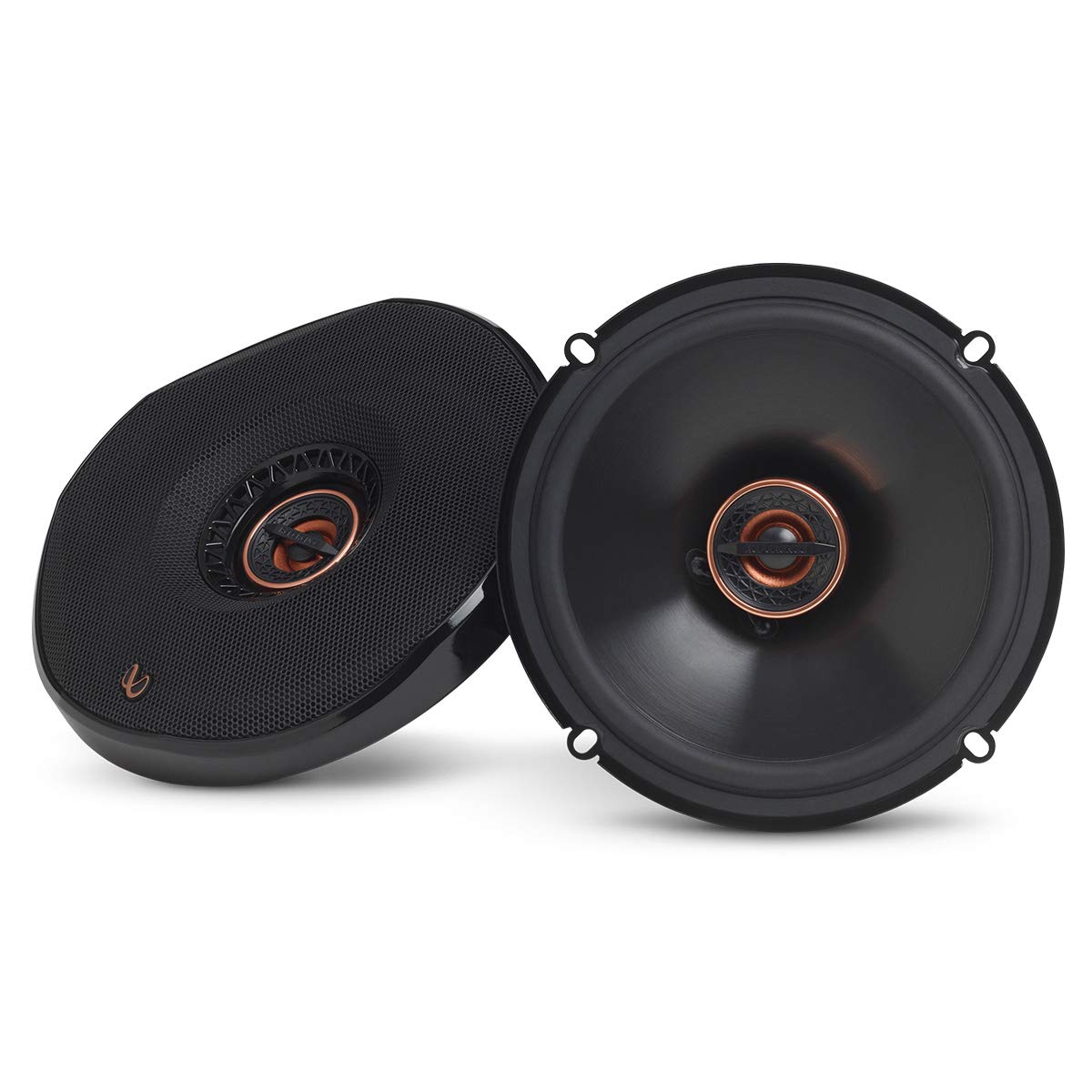
Edge-driven textile tweeters that deliver smooth, non-fatiguing highs for long drives.
The Infinity REF-6532EX solves the problem of shallow door cavities with a specially engineered basket that fits most factory speaker locations, including tight spots where deeper magnets would hit the window. The oversized Plus One woofer cone gives you more surface area than a standard 6.5-inch driver, resulting in higher bass output and better midrange performance — all from a slim profile. The edge-driven textile tweeters deliver a warm, smooth high end that owners describe as “crisp” without being harsh.
The clear winner in the reviews is sound quality, with over 70 owners praising these as a huge improvement over factory speakers. A 1999 Tacoma owner noted the install was easy once they cut a bracket tab, and a 2015 F150 owner called them “amazing” with zero rattle and lots of bass. The one consistent negative — from 8 mentions — is the mounting hardware, which some say is missing or inadequate, so pick up a set of Metra adapters for your vehicle. A few also note that these benefit from sound deadening in the door panel to tame midrange resonance.
Shallow and Sweet: For cars with limited mounting depth, these Infinities deliver surprising bass and detailed highs without requiring you to cut up your door panel.
Grab these for: a vehicle with tight door clearance that still needs real sound quality from a coaxial speaker.
Be ready to: buy separate mounting adapters and sound deadening for the best results.
9. Alpine S2-S65 S-Series 6.5″ Coaxial Speaker Set

Hi-Res Audio certification means these reproduce frequencies up to 40kHz — beyond what your ears can hear, but what your music contains.
The Alpine S2-S65 is a genuine step-up in engineering, packing Alpine’s Hi-Res Audio certification and the proprietary HAMR (High Amplitude Multi-Roll) surround technology that allows the cone to move farther for deeper, more accurate bass. The cone material is a unique blend of Polypropylene, Glass Fiber, and Mica — a combination that keeps the speaker lightweight and rigid for low distortion. With 80W RMS and a maximum peak power of 240W, these handle clean power gracefully while delivering “clear, balanced, fuller” sound at high volumes without distortion, as a Ford Bronco owner reported.
Owners are emphatic about the build quality: Alpine’s mid-line S-Series still “places them above many competitors’ top line offerings,” and one owner said a set lasted ten years in a previous truck. The main downgrade is the price — this is the most expensive pick here, and you will want to pair it with a decent amplifier to hear the full benefit. A small number of buyers found they still wanted an extra tweeter for even more sparkle in the highs, though most are satisfied with the built-in 1-inch tweeters.
The Engineering Edge
- Hi-Res Audio Certified for frequencies up to 40kHz
- HAMR surround technology for deeper, more accurate bass
- Composite cone (poly/glass fiber/mica) for low distortion
Price of Entry
- Costs more than any other speaker on this list
- Needs a good amplifier to reach full potential
- Some owners feel a dedicated tweeter is a worthwhile addition
Choose this if: you are building a quality audio system and want true entry-level audiophile performance with future upgrade potential.
Stick with a simpler pick if: you just need a functional replacement for blown factory speakers and want to keep costs low.
Understanding the Specs
RMS Power vs. Max Power
RMS (Root Mean Square) is the continuous wattage a speaker can handle all day without damage. Think of it as the speaker’s cruising speed. Max power is the absolute ceiling — hit it for a moment and the speaker survives, but sustained exposure blows the coil. For a factory stereo, 40-70W RMS per pair is plenty. For an amplifier, match the speaker’s RMS to your amp’s output per channel for clean, distortion-free sound.
Sensitivity (dB)
Sensitivity tells you how efficiently a speaker converts power into volume. A rating of 91 dB means you get 91 decibels of sound from just 1 watt of power, measured at 1 meter distance. Higher sensitivity (90+ dB) is ideal for running off a basic car stereo. Lower sensitivity speakers (84-87 dB) need more power from an amplifier to reach the same volume level.
Frequency Response (Hz – kHz)
This range shows the lowest and highest sounds a speaker can reproduce. A lower number (like 35 Hz) means deeper bass — close to the rumble of a kick drum. A higher number (like 31 kHz) means extended treble detail beyond the normal 20 kHz human hearing limit, which some Hi-Res recordings contain. For most music, a range of 50 Hz to 20 kHz covers everything.
Speaker Design: Coaxial vs. Component
Coaxial speakers have the tweeter mounted on top of the woofer in a single unit — easier to install, good for a simple swap. Component systems separate the woofer and tweeter so you can mount the tweeter higher for better soundstage and imaging. Components generally sound better but require more installation work. Two-way systems have a woofer and one tweeter; 3-way and 4-way add dedicated midrange drivers for more detail.
FAQ
What does 6.5 inches refer to in a car speaker?
Can I run 6.5 speakers off my factory radio without an amplifier?
How do I know if a speaker will fit in my car door?
What is the difference between 2-way, 3-way, and 4-way speakers?
Do I need an amplifier for budget 6.5 speakers?
What does Hi-Res Audio certified mean for car speakers?
Will aftermarket 6.5 speakers work with Bose or premium factory systems?
How long do budget car speakers typically last?
Final Thoughts: The Verdict
For most buyers, the budget 6.5 speakers winner is the MB Quart FKB-116 because it delivers genuine clarity and build quality that punches far above its price tier — the crowd favorite with over 250 ratings praising its sound. If you want easy installation with included mounting adapters, grab the Pioneer TS-A1671F. And for serious mid-bass output from an amplifier-driven system, the RECOIL MS65-4P is the one to reach for.
How We Picked
We do not accept paid placement. Every pick is matched to a real buyer and a real use-case; we do not hands-on test units.
Sources & Methodology
Specifications: manufacturer listings and product documentation. Review insights: verified customer reviews, as of July 2026. Pricing: not shown on this page (it changes often); check the current price via the retailer link.
As an Amazon Associate, FitlyFast earns from qualifying purchases. This does not affect which products we feature.