
Our readers keep the lights on and the weekend projects moving. As an Amazon Associate, I earn from qualifying purchases.
Specs are compiled from manufacturer listings and verified buyer reviews and can change over time — please confirm the key details on the product page before buying.
You do not need to spend a fortune to get that warm, detailed, engulfing sound you hear in expensive setups. A great budget audiophile receiver delivers the clarity, power, and connectivity that makes your music and movies come alive, without the flagship price tag. This guide cuts through the marketing noise to show you the receivers that genuinely deliver high-fidelity sound for your money.
I’m Rikta — the founder and writer behind FitlyFast. This guide is built by comparing the manufacturers’ published specifications and the patterns across verified customer reviews, so you get each pick’s real strengths and trade-offs instead of marketing spin.
From streaming amps to classic stereo units, we’ve found the budget audiophile receiver that fits your setup and your ears.
Our Picks at a Glance


How To Choose The Best Budget Audiophile Receiver
Picking your first hi-fi receiver gets confusing fast with all the specs and jargon. But you only need to answer three simple questions: what you want to plug in, how loud you need it to go, and if you want stereo or surround sound.
Stereo vs. AV Receivers
Your first big choice: a two-channel stereo receiver or a multi-channel AV receiver for surround sound. Stereo receivers put all their engineering into making two speakers sound amazing, which is why many audiophiles pick them for music. AV receivers add more channels (like 5.1 or 7.2) for movies and gaming, but they often lose that pure stereo focus.
Matching Power to Your Speakers
Power, measured in watts per channel, tells you how loud the receiver can drive your speakers. But a higher number isn’t always better. A receiver with 35 watts per channel can easily fill a room if your speakers are sensitive (efficient). Think about the size of your room and the type of speakers you own to find the right power match.
Quick Comparison
| Model | Best For | Power (Watts/Ch) | Key Inputs | Streaming | Amazon |
|---|---|---|---|---|---|
| Rockville BluTube LED★ Best Overall | Hybrid tube sound | 25W @ 8Ω | HDMI, Optical, RCA | Bluetooth | Amazon |
| WiiM AmpSmart Streamer | Hi-Res streaming | 60W @ 8Ω | HDMI ARC, RCA, USB | Wi-Fi, AirPlay 2 | Amazon |
| Yamaha RX300AAtmos Entry Point | Entry-level Atmos | 70W | HDMI, Optical | Bluetooth | Amazon |
| Onkyo TX-8470 | Hi-Fi network stereo | 100W+ | HDMI, Phono | Wi-Fi, Roon Ready | Amazon |
| Cambridge Audio AXA35 | Pure analog sound | 35W @ 8Ω | RCA, Phono, 3.5mm | None | Amazon |
| Denon PMA-600NE | Warm integrated amp | 70W @ 4Ω | Optical, Coaxial, Phono | Bluetooth | Amazon |
| Yamaha RX-V6A | 7.2ch gaming & movies | — | 7x HDMI, RCA | Wi-Fi, AirPlay 2 | Amazon |
| Onkyo TX-NR6100 | THX Select cinema | 210W/Ch | 8x HDMI, RCA | Wi-Fi, Bluetooth | Amazon |
| Denon AVR-S670H | 8K value surround | 75W x 5 | HDMI, Phono | HEOS, Wi-Fi | Amazon |
In-Depth Reviews
1. Rockville BluTube LED 70W
The affordable path to glowing tubes and that sought-after analog warmth.
If you want the visual romance and sonic character of tubes without triple-digit spending, the Rockville BluTube is the receiver that gets you there. It’s a hybrid design, meaning the preamp section uses tubes for that warmth while a solid-state stage handles the heavy lifting, which helps it avoid the hard-clipping that can plague cheaper amps at high volume. The blue-lit tubes and VU meter (a needle gauge that dances with the music) make it a centerpiece you’ll actually want to look at.
For connectivity, it’s a jack-of-all-trades with HDMI, Optical, Coaxial, and RCA inputs, plus a sub output for adding a powered subwoofer. The built-in Bluetooth has a 33-foot range, so you can stream from your phone across the room. Owners consistently praise its sound quality and value, noting excellent clarity even at maximum volume with multiple pairs of speakers connected.
The trade-off is in the long-term. It delivers 25 watts x 2 RMS @ 8 ohm, which is plenty for efficient bookshelf speakers in a small room, but the build is on the cheaper side. While the sound wins people over, a few buyers report reliability issues down the line, with one unit overheating and shutting down after months of use. If you’re a tinkerer, you should know the tubes are Chinese-made 6P15 types, and some owners have successfully swapped them for higher-quality Russian tubes.
What wins people over
- Warm, rich sound that stays clean at high volume
- Versatile inputs: HDMI, Optical, USB, and Bluetooth
- Striking blue tube aesthetic with a VU meter
Where it cuts corners
- Cheaper plastic/metal build quality
- Reports of units failing after several months
- Hybrid design can’t match full tube amp warmth
Best for: First-time tube-curious buyers who want the look and warmth on a strict budget.
Think twice if: You need a workhorse that will run all day, every day for years.
2. WiiM Amp
The compact powerhouse that turns your regular speakers into a high-res streaming system.
The WiiM Amp pairs a 60W-per-channel amplifier with a built-in streaming platform for high-res audio. In one small box you get 60 watts per channel at 8 ohms, and a hefty 120 watts per channel at 4 ohms, which is enough to drive most floor-standing and bookshelf speakers with real authority. It replaces the traditional radio tuner with app-based streaming and room-correction software.
You control everything through the WiiM Home App, which streams up to 24-bit/192 kHz audio (a high-resolution format that captures more detail than standard CD quality) from Spotify, TIDAL, or your own library. It also includes room correction and EQ settings that adjust the sound to fit your room’s acoustics. You can even use voice commands with Alexa, Google Assistant, or Siri. For TV, the HDMI ARC port (the one that lets your TV send audio to the receiver over a single cable) connects to your television for clean, movie-worthy stereo sound.
Buyers rave about the sound quality and reliability, calling it crisp and a huge upgrade over basic amps. The main limitations for a purist: there’s no headphone jack and no phono preamp (the input for a record player), so vinyl lovers will need an external preamp. But for the money, the feature set — including built-in DSP (digital signal processing, which shapes the sound digitally) and room correction — is genuinely hard to match.
The high points
- crisp sound with 24-bit/192 kHz high-res streaming
- Simple app-based setup with advanced room correction
- Versatile HDMI ARC, USB, and subwoofer outputs
Keep in mind
- No headphone jack or built-in phono preamp
- 60W at 8 ohms limits very high-volume listening in large rooms
The smart choice for: Streamers who want a compact, app-driven hub for music and TV.
A gap to note: Vinyl fans must factor in the cost of an external phono preamp.
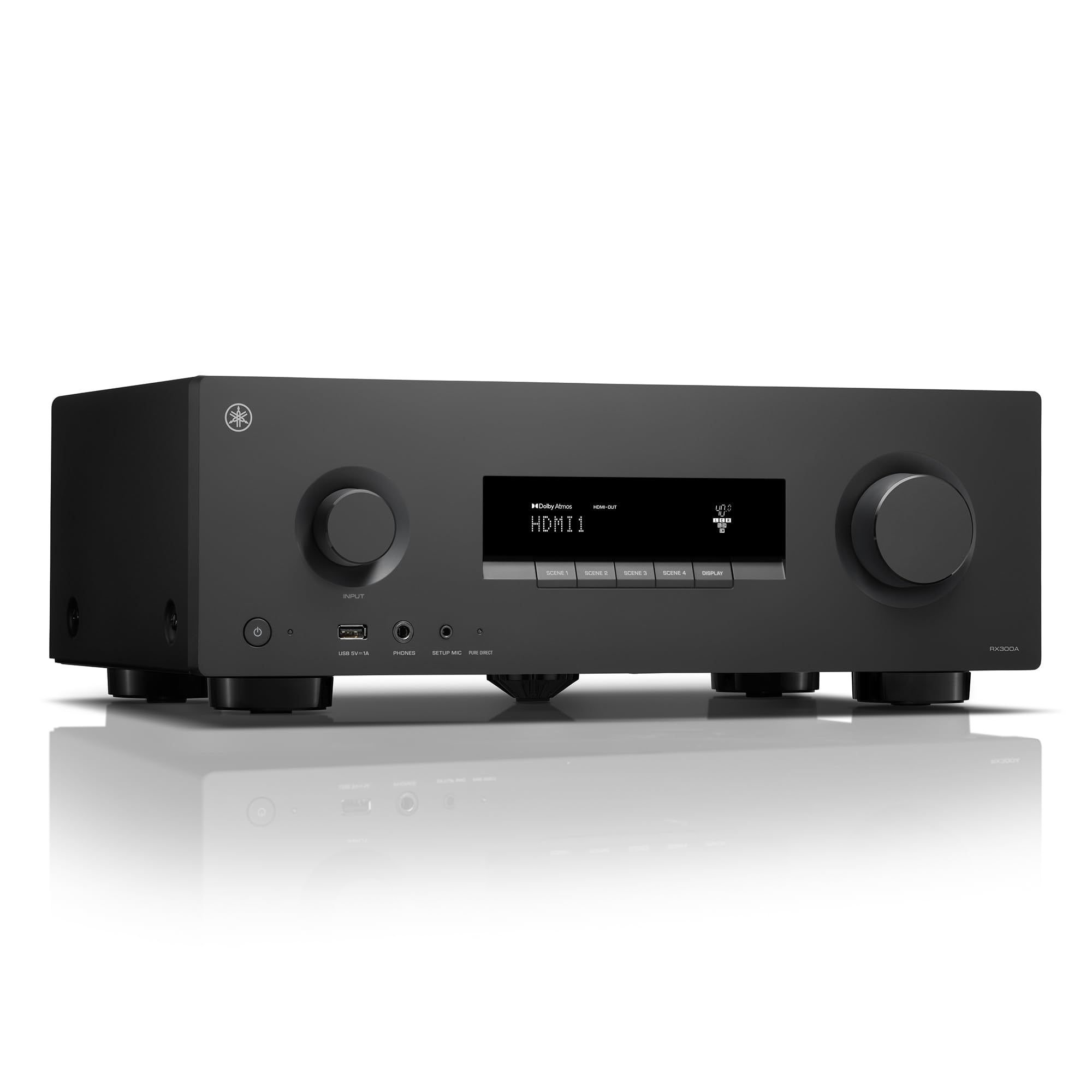
3. Yamaha RX300A
The gateway to 3D movie sound without the high-end price tag.
If you watch movies and play games, not just listen to music, the Yamaha RX300A is your best entry ticket to Dolby Atmos (the surround format that adds overhead sound). It’s a 5.2-channel receiver delivering 70W of power, and it supports a flexible 3.1.2-ch setup with up-firing or in-ceiling height speakers. This means you get that rich, object-based audio bubble around you, a feature usually reserved for much pricier units.
On the video side, it’s future-proofed with 4K/120 and 8K/60 HDMI (so it can handle the latest gaming consoles and TVs), Dolby Vision and HDR10+ (for better picture contrast and color). Setup is designed to be painless: the included microphone measures your room’s acoustics and automatically tune the sound through room correction. Bluetooth Multipoint is another nice touch, letting you connect two phones and switch between them.
Owners stepping into Atmos praise it as a great entry-level unit with flawless performance when paired with modern TVs and Apple TV boxes. The honest downsides are minor: the remote has a slide switch that must be up for buttons to work, and one owner noted a “protect mode” issue that required a replacement. Overall, it delivers excellent EQ and crossover controls for the money.
Why it stands out
- Dolby Atmos and DTS Virtual:X for rich height sound
- Auto room correction via included microphone
- 4K/120 and 8K/60 HDMI for next-gen gaming
Minor quirks
- Remote slide switch must be in the correct position
- Premium features like Wi-Fi streaming are absent
Grab it for: Home theater newcomers who want Atmos and 8K video on a budget.
Pass it by if: You need built-in Wi-Fi to stream music without a separate device.
4. Onkyo TX-8470

A modern two-channel hub that honors your vinyl while embracing hi-res network streaming.
The Onkyo TX-8470 is built for the listener who takes their music seriously and wants a dedicated stereo setup. By focusing on just two channels, the engineering goes into delivering cleaner, more refined audio rather than spreading power across many surround channels. It’s specifically designed with a high current drive to handle a wide range of speakers, and owners note it easily drives vintage and modern floor-standing speakers with power output of over 100 watts per channel.
It’s a true hybrid for modern connections: a phono input with an isolated MM/MC board (which keeps the delicate signal from your record player clean) sits right next to built-in Wi-Fi. It’s certified Roon Ready, which means it works flawlessly with the premium Roon music management software, and it supports high-resolution streaming from TIDAL and Deezer. Bluetooth and native Apple and Google assistant support round out the smart home integration.
Owners rate its CD and vinyl inputs as “incredible,” with sound quality rivaling amps three times the price. The most frequent criticism is the lack of clear instructions, with some finding the manual confusing to navigate. Its two-channel design prioritizes audio purity, ideal for a dedicated listening room.
Built for the love of music
- 100+ watts per channel of clean, high-current power
- Excellent phono stage for serious vinyl collectors
- Roon Ready with Wi-Fi for hi-res network streaming
The hurdle
- Setup can be confusing due to the lacking manual
- Premium price point for a stereo-only receiver
A natural fit: Audiophiles blending a high-quality turntable with modern music streaming.
Proceed with caution if: You prefer a simple plug-and-play setup without reading a manual.
5. Cambridge Audio AXA35

A straight-ahead analog amplifier that proves simplicity sounds spectacular.
For the purist who wants nothing between the music and their ears, the Cambridge Audio AXA35 is a statement of purpose. It delivers 35 watts per channel into 8 ohms, which is more than enough for a moderate-sized room, and it does this with a warm, rich, spacious sound that owners say reveals detail even at low volumes. It is purely analog, so there’s no Bluetooth, no Wi-Fi, and no DAC — just a clean signal path from your sources to your speakers.
It’s brilliantly equipped for a physical media setup, featuring 4x RCA inputs (for CD players or streamers), a high-quality built-in phono stage for your turntable, and a handy 3.5mm aux input on the front panel. The frequency response (-3dB) runs from 5Hz to 50kHz (a wide range that covers all audible sound plus a bit extra), and the signal-to-noise ratio is >82dB, meaning very low background hiss. It’s a bulletproof design from a respected British brand.
Reviewers consistently compare its punchy bass and crisp highs to amplifiers costing far more. The most obvious trade-off is the lack of digital inputs or wireless connectivity; you’ll need to add a separate streamer or DAC if you want to play files from your TV or laptop. For a two-channel vinyl setup, it’s widely regarded as the best value pick.
The essence of hi-fi
- Warm, open, and detailed analog sound signature
- Excellent built-in phono stage for turntables
- Simple, intuitive controls with a solid metal build
Digital dead zone
- No Bluetooth, Wi-Fi, or digital inputs built-in
- Display is not legible from across the room
Pick this if: Your music lives on vinyl and CDs, and you want uncomplicated sonic purity.
Skip it for: Streaming-centric listeners who don’t want to buy extra boxes for Wi-Fi.
6. Denon PMA-600NE

A vintage-sounding integrated amp with a modern digital heart.
Denon’s PMA-600NE is a crowd favorite because it delivers that warm, tube-like “70s receiver” sound with rock-solid modern reliability. It’s a 2-channel integrated amplifier (meaning it has a preamp and power amp in one box) rated at 70W x 2, but it’s famous for having more dynamic headroom than that number suggests. It powers the widest range of speakers, including 4-ohm loads, making it a versatile choice for many setups.
One of its smartest features is the Analog Mode, which completely disengages the digital circuits and Bluetooth. This gives you a pure, undivided analog experience when you want to listen without any digital noise. It also handles digital duties with a built-in DAC (Digital-to-Analog Converter) and 2 optical and 1 coaxial input, so you can connect a TV, CD player, or game console directly. The built-in phono preamp also handles moving magnet cartridges easily.
Listening impressions are glowing, with owners praising its airy treble, deeper soundstage, and tight bass control when adding a subwoofer. At 18 pounds, its solid build reflects Denon’s century of audio engineering. The main mixed feedback is the volume control, which some describe as “awful” due to a laggy remote, and there’s no loudness or EQ customization beyond basic tone controls.
The headline act
- Warm, rich “audiophile” sound with excellent detail retrieval
- Analog Mode for a pure, digital-free listening path
- Built-in DAC, phono, and subwoofer output for flexible system building
The chorus of complaints
- Volume control via remote is laggy and coarse
- Dim input LEDs and clunky input relay switches
the balance for: Listeners wanting a warm, musical amplifier that handles both analog and digital sources.
A word of caution: If you rely heavily on the remote for volume, the feel may frustrate you.
7. Yamaha RX-V6A

The multi-room maestro for gamers and movie buffs who want it all.
The Yamaha RX-V6A is the full-featured AV receiver that does everything, making it a fantastic anchor for a living room entertainment center. With 7.2 channels and support for Dolby Atmos and DTS:X, it creates a deep, three-dimensional soundscape. It’s a workhorse for gamers, offering 4K/120 and 8K/60 HDMI 2.1 passthrough for smooth, high-refresh-rate gaming, as well as ALLM and VRR (features that reduce input lag and screen tearing).
Beyond movies, it’s a powerful music streamer thanks to MusicCast, Yamaha’s multi-room audio system. You can stream from Spotify, TIDAL, Amazon Music HD, and more, and group it with other MusicCast speakers around your home. It also supports AirPlay 2 and voice control via Alexa or Google Assistant. The included YPAO room correction uses a microphone to analyze your room and adjust the sound automatically.
Owners praise its extensive features and clear sound upgrade over older receivers, with one buying three units. However, the setup process gets mixed reviews. It is complicated, often requiring a firmware update from the start, and relies heavily on a mobile app for some features like Bluetooth and internet radio. There’s no physical manual, and some find the cheap-feeling front display and capacitive buttons a step down.
All-singing, all-dancing
- Extensive audio features with Dolby Atmos and DTS:X
- 8K/60 HDMI with ALLM and VRR for serious gaming
- MusicCast for excellent multi-room wireless audio
Set-up snags
- Complex, app-dependent setup with firmware updates required
- No physical manual and a somewhat cheap front display
A perfect match for: Tech-savvy users building a versatile 7.2-channel system for movies, music, and next-gen consoles.
Look elsewhere if: You want basic, physical-button simplicity without a smartphone involved.
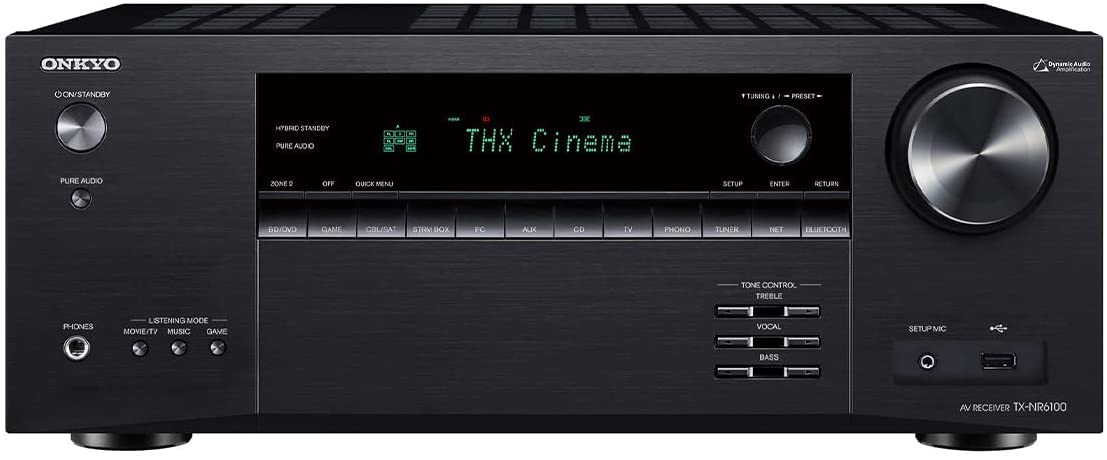
8. Onkyo TX-NR6100
Certified cinema-grade sound for the home theater purist.
If you’re building a serious home theater and want the confidence that comes with a certification, the Onkyo TX-NR6100 is a standout. It’s THX Select Certified, meaning it’s been tested and approved to deliver reference-quality sound in a medium-sized room. With a powerful 210 W/Ch Dynamic Audio Amplification system, it can drive demanding speaker setups to cinematic levels, with owners noting it gets louder than some higher-priced Denon models.
It supports a 5.2.2-channel setup with Dolby Atmos and DTS:X, which allows you to add two overhead speakers for truly rich effects. The audio is precise and effective, with owners reporting superb upmixing and clean highs and lows. For video, it has 8K with HDMI 2.1 40Gbps on 3 inputs, making it a solid gaming companion with features like 4K/120Hz pass-through and crisp HDR. A discrete Zone 2 lets you play different audio in another room entirely.
The receiver is packed with 8 HDMI ports and app control with per-device sound modes, which owners find incredibly useful. But it’s not without its issues. There are mixed reports of reliability, with some long-term owners experiencing random sound drops or, in a few cases, input failures and a unit dying after two years. It’s a feature-packed powerhouse, but one where a handful of owners have had less-than-stellar luck with longevity.
Why it commands respect
- THX Select Certification for guaranteed performance
- 8 HDMI ports and excellent 8K/60 HDR video support
- rich 5.2.2 Dolby Atmos and DTS:X sound
The reliability question
- Mixed feedback on long-term reliability and sound dropouts
- Bi-amping uses up channels, reducing to 5.1 sound
A top pick for: Dedicated cinephiles who want THX-certified, high-impact surround sound.
A fair warning: Expect occasional sound dropouts; a small minority report more serious failures.
9. Denon AVR-S670H

Your future-proof ticket to 8K movies and music throughout the house.
The Denon AVR-S670H is an excellent benchmark for what a modern budget receiver should include. It’s a 5.2-channel receiver with 75 watts per channel, but its real a neat extra is 8K/60Hz and 4K/120Hz pass-through. This means it’s ready for the newest 8K TVs and can handle the high frame rates of the PlayStation 5 or Xbox Series X with features like VRR and ALLM for lag-free gaming.
For music, it’s built around Denon’s HEOS platform, which lets you stream from Spotify, TIDAL, and more, and connect to other HEOS speakers in different rooms for a multi-room setup. It also has a dedicated phono input, which is a fantastic find at this level for hooking up a turntable. Setup is designed to be easy, and owners confirm it’s very simple, working smoothly with TVs via eARC and offering a clean, clear sound with zero hiss or static.
It’s a great all-rounder for a first-time surround system, especially since it drives bookshelf and floor-standing speakers with ease. The reviews consistently praise its sound quality and ease of use, noting that it surpasses basic TV speakers dramatically. The main limitation is that Bluetooth connectivity gets mixed feedback for occasional issues, and it’s an entry-level unit if you’re a Denon purist, but for the vast majority of homes, it’s a “correct choice” that delivers superb performance.
The modern essentials
- 8K/60 and 4K/120 HDMI for future TVs and gaming
- Surprisingly strong phono input for vinyl lovers
- HEOS multi-room streaming and voice control support
Minor growing pains
- Bluetooth connectivity has occasional mixed reports
- More entry-level than higher-end Denon models
The smart buy for: Families wanting one easy receiver that handles 8K video, vinyl, and multi-room streaming.
Something to be aware of: Bluetooth streaming can occasionally be finicky, so a wired connection is more reliable.
Understanding the Specs
Power Output (Watts)
This tells you how loud a receiver can get. It’s measured in watts per channel, often stated like “60W x 2 @ 8 ohms.” Higher wattage generally means more headroom and cleaner sound at higher volumes, but the sensitivity of your speakers also matters. An efficient pair of speakers will play loudly with just 35 watts, while less efficient towers might prefer 100 watts or more.
Phono Input
If you have a turntable, this is a crucial feature. A phono input (also called a phono stage or preamp) boosts the very quiet, raw signal from your record player’s cartridge to a level the receiver can use, while also correcting the sound curve. If your receiver lacks this, you will need to buy a separate phono preamp.
HDMI ARC / eARC
This is the single-cable connection between your receiver and your TV that sends audio back to the receiver. ARC (Audio Return Channel) lets your TV send sound to the receiver, so you can use your nice speakers for streaming apps built into the TV. eARC is an enhanced version that supports higher-quality, lossless audio formats.
Streaming & DAC
Built-in streaming (Wi-Fi, Bluetooth, AirPlay 2) turns your receiver into a wireless hub for your music apps. When you stream digital audio, a DAC (Digital-to-Analog Converter) is needed to translate the 1s and 0s into the analog sound your speakers can play. A good DAC with high-res support (like 24-bit/192kHz) makes a noticeable difference in clarity.
FAQ
What is the difference between a receiver and an integrated amplifier?
Will a 35-watt amplifier be powerful enough for my room?
Can I connect a turntable to any of these receivers?
What does Dolby Atmos do and do I need special speakers?
Is a stereo receiver better for music than an AV receiver?
How important is a built-in DAC for streaming music?
Do I need an 8K receiver if my TV is only 4K?
Will the Rockville BluTube sound as good as a full tube amplifier?
What’s the catch with very low-priced receivers?
Can I use a subwoofer with these stereo receivers?
Final Thoughts: The Verdict
For the majority of shoppers, the budget audiophile receiver winner is the WiiM Amp because it delivers crisp, high-resolution sound with a level of streaming and room-correction features that are class-leading at this price. If you want a purely analog setup for vinyl, grab the Cambridge Audio AXA35 for its legendary warm sound and excellent phono stage. And for a dramatic home theater experience with Dolby Atmos, the Yamaha RX300A is the one to reach for.
How We Picked
We do not accept paid placement. Every pick is matched to a real buyer and a real use-case; we do not hands-on test units.
Sources & Methodology
Specifications: manufacturer listings and product documentation. Review insights: verified customer reviews, as of August 2026. Pricing: not shown on this page (it changes often); check the current price via the retailer link.
As an Amazon Associate, FitlyFast earns from qualifying purchases. This does not affect which products we feature.