
Our readers keep the lights on and the weekend projects moving. As an Amazon Associate, I earn from qualifying purchases.
Specs are compiled from manufacturer listings and verified buyer reviews and can change over time — please confirm the key details on the product page before buying.
You want a home theater that shakes the room without shaking your bank account. The right entry-level or mid-range AV receiver gives you clear dialog, surround sound, and modern 4K or 8K video support without a high price tag.
I’m Rikta — the writer behind FitlyFast. This guide compares published specs from each brand and patterns from verified customer reviews. You get each pick’s real strengths and trade-offs, not marketing spin.
To get the most from a budget av receiver, you need to understand power ratings (watts), channel counts (how many speakers it drives), and HDMI features (how it connects to your TV). These three specs decide how well it fits your room.
Quick Picks
- Denon AVR-S670H 5.2 Ch Home Theater Receiver — Best Overall
- JBL MA510 5.2 Channel 8K AV Receiver — 8K Ready
- Pioneer VSX-935 7.2 Channel Network Receiver — Atmos Upgrade
- Onkyo TX-NR5100 7.2-Channel 8K Smart AV Receiver — Gaming Focus
- JBL MA310 5.2 Channel 4K AV Receiver — Best Value
- Sony STRDH590 5.2 Channel Surround Sound Receiver — Budget Champion
How To Choose The Best Budget AV Receiver
Three specs decide if a receiver works in your room: power output, channel count, and HDMI connectivity. Ignore marketing numbers. Focus on how these match the speakers you own or plan to buy.
Power Output and Speaker Sensitivity
Receiver power is measured in watts per channel. More watts matter only if your speakers are inefficient. For most home speakers with a sensitivity (how loud they get from one watt of power) around 88 dB or higher, 60 to 75 watts per channel is plenty for a living room. The key number is the power rating with two channels driven — not the peak wattage on the box.
Channel Count and Room Layout
A 5.2 channel receiver drives five speakers and two subwoofers. That is the minimum for a proper surround sound experience. If you plan to add ceiling speakers for Dolby Atmos (a technology that adds height effects so sound feels like it comes from above) later, a 7.2 channel model gives you room to expand.
HDMI Features and TV Compatibility
Check that your receiver has HDMI ARC or eARC so your TV remote can control the volume. ARC (Audio Return Channel) sends sound from your TV back to the receiver over a single cable. If you have a 4K or 8K TV, look for HDCP 2.3 support (a copy-protection standard that ensures 4K content plays correctly) and 4K pass-through to avoid buying an adapter later.
Quick Comparison
| Model | Best For | Power per Channel | Channels | HDMI Version | Amazon |
|---|---|---|---|---|---|
| Denon AVR-S670H | 8K readiness and HEOS multi-room | 75W x 5 | 5.2 | 8K/60Hz, 4K/120Hz | Amazon |
| JBL MA510 | 8K passthrough with a shallow chassis | 75W x 5 | 5.2 | 8K, eARC | Amazon |
| Pioneer VSX-935 | Dolby Atmos height virtualization | — | 7.2 | 8K | Amazon |
| Onkyo TX-NR5100 | Gaming features like VRR and ALLM | — | 7.2 | 8K, eARC | Amazon |
| JBL MA310 | Shallow depth for tight media consoles | 60W x 5 | 5.2 | 4K, ARC | Amazon |
| Sony STRDH590 | Virtual surround from a 2-speaker setup | — | 5.2 | 4K HDR | Amazon |
In‑Depth Reviews
1. Denon AVR-S670H 5.2 Ch Home Theater Receiver

The receiver that brings 8K video and multi-room audio without leaving the budget zone.
This Denon delivers 75 watts per channel across 5 channels. It supports 8K pass-through (a technology that passes the video signal from your source to your TV without altering it). That means you can connect a PlayStation 5 or Xbox Series X and get smooth, lag-free gameplay. Buyers report that finding a renewed (refurbished) unit saved them money, making this an even stronger value for those willing to buy refurbished.
Compared to the JBL MA310 which offers 60 watts per channel, the Denon gives you extra headroom (75W vs 60W) to drive less efficient speakers at higher volumes without distortion. The built-in HEOS platform lets you stream music via Wi-Fi (a wireless network connection more stable than Bluetooth) to other rooms — something the Sony STRDH590 cannot do. One reviewer noted the menu is intimidating at first but learnable. The auto speaker calibration using the included microphone makes setup much easier than the manual calibration on the Pioneer VSX-935.
The trade-off? Some owners mention HEOS and Apple AirPlay (Apple’s wireless streaming protocol) can be laggy or drop connections, though wired performance is flawless. If you plan to stream mostly over Wi-Fi, keep this in mind.
Denon’s smart versatility
- 8K support for future-proof gaming
- HEOS multi-room streaming via Wi-Fi and Bluetooth
- Auto speaker calibration with included microphone
- Phono input (a specialized input for a turntable) for vinyl
limited subwoofer outputs
- HEOS and AirPlay wireless performance can be laggy
- Menu is deep and can be intimidating at first
the smart all-rounder: If you want a receiver that works with a modern 8K TV, streams music to other rooms, and includes a phono input for vinyl, this is the most complete budget pick.
the one limitation: Reliable streaming requires a wired network connection rather than pure Wi-Fi.
2. JBL MA510 5.2 Channel 8K AV Receiver

A shallow chassis with 8K passthrough that fits tight media consoles without overheating.
The JBL MA510 puts out 75 watts per channel, matching the Denon AVR-S670H. It supports 8K video passthrough and eARC (Enhanced Audio Return Channel — a faster version of ARC that sends high-quality audio, like Dolby Atmos, from the TV back to the receiver over a single HDMI cable). At 4.3 inches tall and 13.7 inches deep, it is more compact than the Pioneer VSX-935, which is 6.81 inches high and 14.56 inches deep, which matters if your cabinet is tight. Customers note it drives 4 in-wall Polks, a center speaker, and a powered sub with impressive quality for the total system cost.
Unlike the JBL MA310 at 5.1 kilograms, the MA510 weighs 5.4 kilograms and adds network streaming via Apple AirPlay 2 and Google Chromecast (a technology that lets you cast audio from your phone directly to the receiver without Bluetooth pairing). The MA310 lacks these network features entirely. One buyer mentioned the only firmware update was from a year ago. Like the MA310, the MA510 does not mix down DTS-HD Master Audio (a high-definition audio format on Blu-ray discs) to 2.1 channels, which matters if you run a two-speaker setup.
The catch? The remote is not backlit, which several buyers find frustrating in a dark room — one owner glued a dot on the volume button for tactile feel. The auto shut-off defaults to 20 minutes and must be changed manually in the menu.
best for compact setups: If your media console is shallow and you have an 8K TV, this receiver delivers the power and video support you need in a smaller footprint than most competitors.
watch out for: The non-backlit remote and lack of DTS-HD downmixing to 2.1 channels.
3. Pioneer VSX-935 7.2 Channel Network Receiver
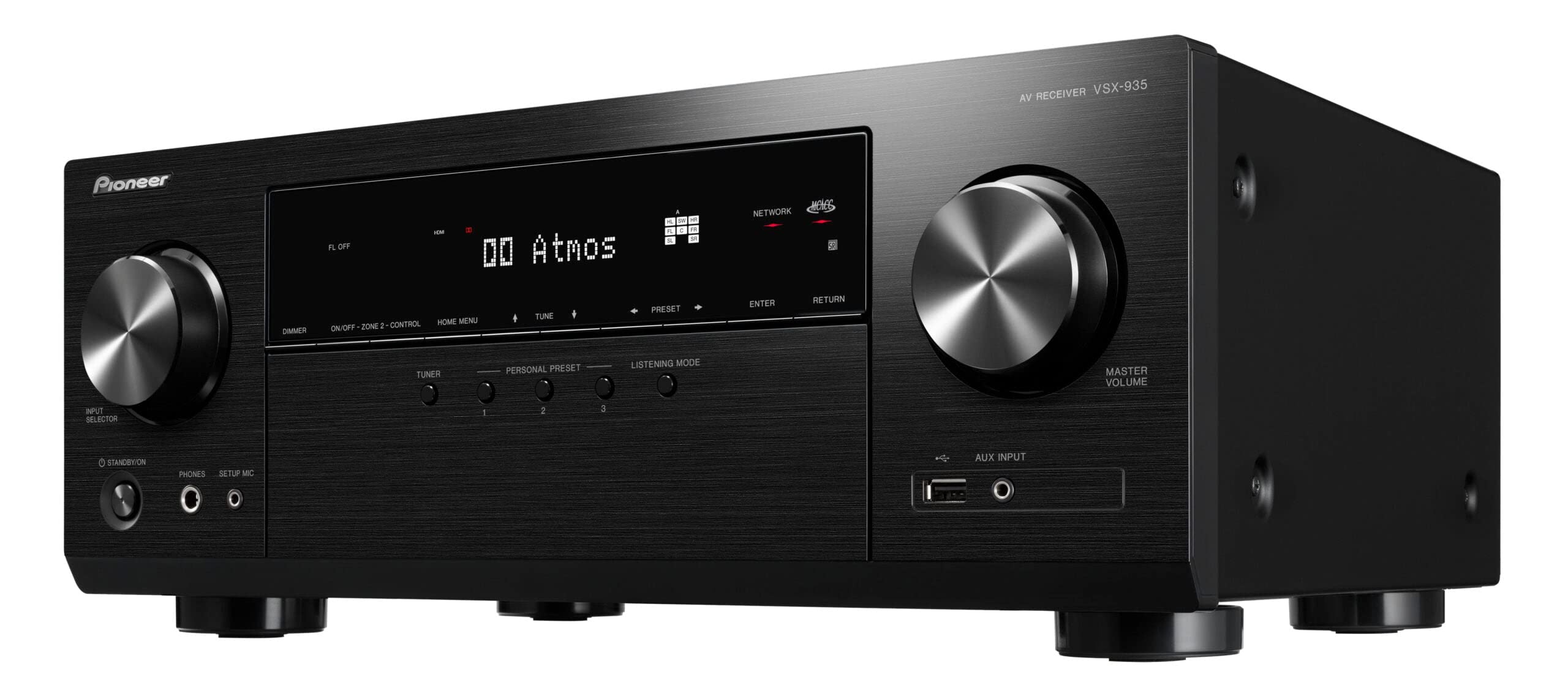
A 7.2 channel receiver that creates height effects without needing ceiling speakers.
The Pioneer VSX-935 gives you two extra channels over the 5.2 models above. It supports Dolby Atmos Height Virtualization (a technology that simulates overhead sound effects using only your regular speakers). This means you get a more rich movie experience without cutting holes in your ceiling. It also has HDMI 2.1 with 8K support and enhanced gaming features, similar to the Onkyo TX-NR5100.
At 14.56 inches deep and 6.81 inches tall, it is the largest receiver on this list — significantly bigger than the JBL MA510 (13.7 inches deep, 4.3 inches tall). Reviewers point out that speaker wire placement is tricky and that manual setup is needed for good sound, making it less beginner-friendly than the Denon AVR-S670H with its auto calibration. One owner mentioned that firmware updates are USB-only and have failed with error codes.
The main concern from reviews: HDMI video failure with computers. One owner reported the screen snows, blacks out, and refreshes constantly. Another said they got no sound from rear or side surround speakers. This inconsistency makes the VSX-935 a more risky pick than the Denon or JBL MA510 for anyone who values reliability.
for the enthusiast who wants a: If you want Dolby Atmos effects without adding ceiling speakers, the virtual height processing is unique at this price level.
best to avoid if: You want a simple plug-and-play setup or plan to connect a computer via HDMI.
4. Onkyo TX-NR5100 7.2-Channel 8K Smart AV Receiver

HDMI 2.1 gaming features like VRR and ALLM wrapped in a 7.2 channel package.
The Onkyo TX-NR5100 is built for gamers who want Variable Refresh Rate (VRR — a technology that eliminates screen tearing by syncing the display refresh rate to the console’s frame rate) and Auto Low Latency Mode (ALLM — which automatically switches the TV to its lowest-lag mode when you start a game). It also supports Quick Frame Transport (QFT) for smoother motion. At 12.9 inches deep, it is shallower than the Pioneer VSX-935 (14.56 inches), making it easier to fit into a media cabinet.
One buyer flagged a critical issue: the receiver is advertised as a 7.2 but is actually a 7.1 unit — it only has one subwoofer pre-out (an output that sends an audio signal to a powered subwoofer) despite the label. This is a meaningful difference if you plan to use two subwoofers for more even bass across the room. Another reviewer reported that after 18 months the unit stopped outputting to TV, Xbox, or DVD player entirely, and that AirPlay interferes with Bluetooth on a Mac.
On the plus side, sound quality is strong and setup is straightforward. The speaker connections are unusual — twist-lock terminals on the front channels and spring-loaded on the rear — and buyers recommend getting speaker wire clips because the screw-down posts are close together.
for the competitive gamer: If VRR and ALLM are critical for your PlayStation 5 or Xbox Series X, the Onkyo has the highest-end gaming features in this budget range.
the catch: It is a 7.1 receiver despite being labeled 7.2, so you get only one subwoofer output.
5. JBL MA310 5.2 Channel 4K AV Receiver

The entry-level JBL that outperforms pricier rivals for smaller living rooms.
The JBL MA310 delivers 60 watts per channel across 5 channels, while the MA510 delivers 75 watts per channel. In a small to medium room with efficient speakers, that 60 watts still fills the space with clear sound. At 5.1 kilograms versus the MA510 at 5.4 kilograms, it shares the same shallow chassis that fits tighter media consoles. Shoppers say it powers 4 in-wall Polks, a center speaker, and a powered sub with quality sound for the total system investment.
The MA310 supports 4K video and has 4 HDMI inputs with ARC (Audio Return Channel — a feature that lets audio travel from your TV back to the receiver over the same HDMI cable, so you can use your TV remote to control volume). Unlike the MA510, it lacks 8K support, eARC, and network streaming — it only has Bluetooth v5.1 with Low Energy for wireless music. One customer observed the remote is not backlit, making it hard to navigate in a dark room, and the auto shut-off defaults to 20 minutes.
Like the MA510, the MA310 does not mix down DTS-HD Master Audio to 2.1 channels. If you run a two-speaker setup and watch many Blu-rays, this is a real limitation — Dolby TrueHD works fine, but DTS-HD discs may play as silent or distorted audio.
Best for the budget-conscious with 4K: If you have a 4K TV and do not need 8K, the MA310 gives you the same core JBL sound and compact footprint for less money.
skip it if: You need 8K passthrough, network streaming (AirPlay/Chromecast), or plan to use DTS-HD audio with a 2.1 speaker system.
6. Sony STRDH590 5.2 Channel Surround Sound Receiver
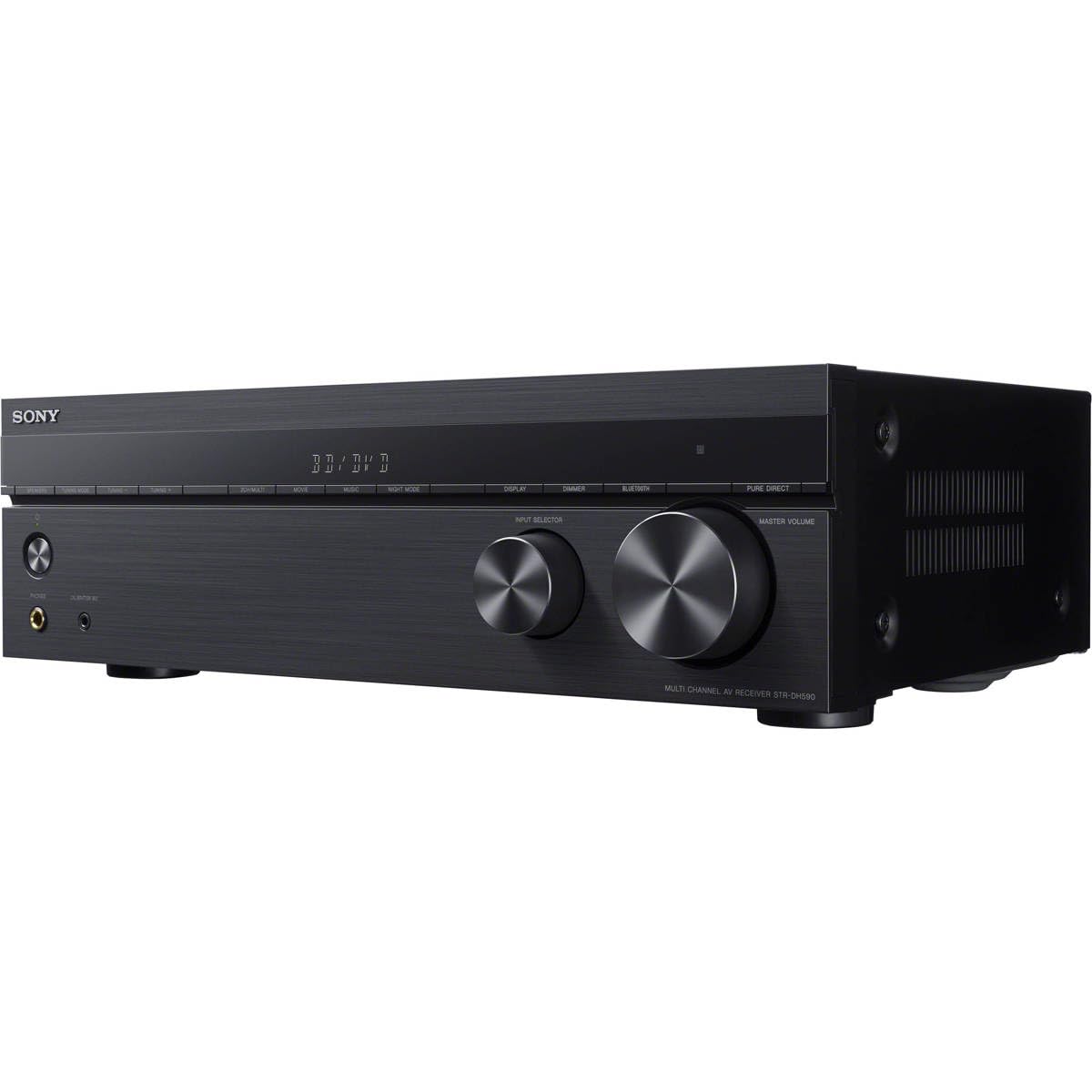
Sony’s entry-level receiver uses virtual surround to give you theater sound from just two speakers.
The Sony STRDH590 uses S Force PRO (a technology that creates a virtual surround effect with only a front left and right speaker) and 4K HDR pass-through with HDCP 2.2 support (a copy-protection standard that ensures 4K content plays correctly). It is a 5.2 channel receiver with 4 HDMI inputs and 1 output, and it has a built-in FM radio tuner — a feature missing on the JBL MA310 and MA510. At 11.75 inches deep and 5.25 inches tall, it is shallower than the Pioneer VSX-935 (14.56 inches) but taller than the JBL MA510 (4.3 inches).
Reviewers report the FM antenna wire looks flimsy, but it picks up stations 45 miles away, which is impressive for a basic wire antenna. The setup has a steep learning curve — one user highlighted they had to enable audio passthrough on their Roku to get 2.0 content to use all 5 speakers. The receiver lacks a dedicated clear-voice or dialogue enhancement feature; instead, it uses a dynamic compression setting in the amp menu that only works with 5.1 content. The main speakers use screw-type connectors, while the center and rear speakers use pinch-style connectors.
The Sony does not have a phono input for a turntable, and it has no AM tuner. Unlike the Denon AVR-S670H, it cannot stream music over Wi-Fi or multi-room audio — you get Bluetooth only. For a lower price, you trade away streaming options and advanced room calibration for a reliable, straightforward 5.2 channel experience with virtual surround as a bonus.
best for the pure entry-level : If you want a simple 5.2 channel receiver with 4K video support and do not need network streaming, the Sony is the most affordable way into surround sound.
not for you if: You need Wi-Fi streaming, a phono input, or want an AM radio tuner.
Understanding the Specs
Power Per Channel (Watts)
This number tells you how much raw power the receiver sends to each speaker. For a typical living room, 60 to 75 watts per channel is enough. The catch: most receivers advertise power with only one or two channels driven, but real-world usage drives all channels simultaneously — so the actual power is often lower. Look for the rating with two channels driven for a realistic comparison.
HDMI ARC vs eARC
ARC (Audio Return Channel) sends sound from your TV back to the receiver over a single HDMI cable, so you can use the TV remote for volume. eARC (Enhanced Audio Return Channel) is a faster version that supports high-bitrate audio formats like Dolby Atmos and DTS-HD Master Audio. If you have a newer TV, eARC ensures you get the best sound quality from built-in apps like Netflix or Disney+.
Channel Count (5.2 vs 7.2)
A 5.2 channel receiver powers five speakers and two subwoofers. A 7.2 channel receiver adds two more speakers for rear or height channels. For most living rooms, 5.2 is plenty. Go for 7.2 only if you plan to add ceiling speakers for Dolby Atmos or have a dedicated home theater room.
Speaker Calibration
Many budget receivers include a microphone that listens to test tones from each speaker. It automatically adjusts volume levels, crossover frequencies, and distance delays for your room. This takes the guesswork out of setup and usually sounds better than manual tuning. Receivers without this feature require a sound pressure level meter and patience.
FAQ
What is the difference between a 5.1 and a 5.2 channel receiver?
Can I use a 4K receiver with an 8K TV?
Do I need a receiver with Dolby Atmos for a good home theater?
How many HDMI inputs do I need on a budget receiver?
What does HDMI ARC do and why does it matter?
Can I connect a turntable to a budget AV receiver?
Is a 60-watt receiver powerful enough for a large living room?
Will my old speakers work with a new AV receiver?
What is the difference between Bluetooth and Wi-Fi streaming on a receiver?
How long does a budget AV receiver typically last?
Final Thoughts: The Verdict
For most people, the best Budget AV Receiver is the Denon AVR-S670H because it combines 8K video support, HEOS multi-room streaming, and a phono input at a price that undercuts the competition while still delivering 75 watts per channel. If you want 8K passthrough in a shallower chassis, grab the JBL MA510. And for the pure entry-level buyer who just wants 4K surround sound without streaming features, the Sony STRDH590 is the most affordable way in.
How We Picked
We do not accept paid placement. Every pick is matched to a real buyer and a real use-case; we do not hands-on test units.
Sources & Methodology
Specifications: manufacturer listings and product documentation. Review insights: verified customer reviews, as of July 2026. Pricing: not shown on this page (it changes often); check the current price via the retailer link.
As an Amazon Associate, FitlyFast earns from qualifying purchases. This does not affect which products we feature.