
Our readers keep the lights on and the weekend projects moving. As an Amazon Associate, I earn from qualifying purchases.
Specs are compiled from manufacturer listings and verified buyer reviews and can change over time — please confirm the key details on the product page before buying.
You don’t need a Garmin-sized budget to know how fast you’re actually going. The best budget bike computer trades fancy color maps for the core numbers that matter—speed, distance, time, and your route—all without the messy wheel magnets of old wired units. This guide cuts through the spec noise to the handful of pickups that consistently nail GPS locks and hold a charge across a weekend of riding.
I’m Rikta — the founder and writer behind FitlyFast. This guide is built by comparing the manufacturers’ published specifications and the patterns across verified customer reviews, so you get each pick’s real strengths and trade-offs instead of marketing spin.
Here are the budget bike computer models that deliver dependable GPS tracking and long battery life without emptying your wallet, ranked for every kind of rider.
Our Picks at a Glance

How To Choose The Best Budget Bike Computer
Every budget bike computer here will show your speed. The real differences show up in three places: how the unit gets its data, how long it lasts between charges, and whether the screen stays readable when the sun is in your eyes. Deciding on those three things first will narrow the field faster than any spec sheet comparison.
Wired or Wireless: It’s Not Just About Cables
A wireless GPS computer needs zero wheel sensors stuck to your spokes and no cable run up your fork. You mount the unit, switch it on, and wait for the satellite lock. A wired computer like the CATEYE Enduro uses a physical sensor on the fork, which means no battery charging at all—but you do have to route the wire carefully and set your wheel size correctly. GPS units cost more but install in under a minute.
Battery Life Math for Real Riders
Manufacturer battery claims assume the backlight is off and the screen is in power-saving mode. If you ride with the auto backlight on, expect less than the headline number. Look for units advertising 25 hours or more if you do long weekend rides and hate carrying a cable. A 40-hour unit like the iGPSPORT BSC100S can practically go a full week of commuting between charges.
Readability Is a Safety Feature
A dim screen forces you to stare longer than you should. The key spec is the display size in inches—bigger digits mean quicker glances. An auto backlight that senses low light is a genuine upgrade if you ride at dawn or dusk. The IPX7 waterproof rating (meaning it survives rain and splashes) is standard on most picks here, but it’s worth confirming before you get caught in a downpour.
Quick Comparison
| Model | Best For | Battery Life | Display Size | Weight | Amazon |
|---|---|---|---|---|---|
| COOSPO BC26★ Best Overall | First-time GPS riders | 25 hours | 2.3 inches | 54 g | Amazon |
| Bikevee Wireless GPSBest Value | Clear day-and-night screens | 28 hours | 2.4 inches | 50 g | Amazon |
| Bikevee Auto Backlight GPSTop Performer | Reliable tracking on any ride | 28 hours | 2.4 inches | 50 g | Amazon |
| XOSS G+ | Heart rate and cadence fans | 25 hours | 1.8 inches | 101 g | Amazon |
| CATEYE Enduro Wired | No-charging minimalists | 3 years | — | 27.22 g | Amazon |
| Navihood S1 | Big-screen data junkies | 21 hours | 2.8 inches | 58 g | Amazon |
| iGPSPORT BSC100S | Multi-day touring endurance | 40 hours | 2.6 inches | — | Amazon |
| CATEYE Urban Wireless | Quick commuter data | — | — | 1.12 oz | Amazon |
| Planet Bike Protégé 9.0 | Simple wheel-sensor tracking | 1 year | 5.5 cm | 3.2 oz | Amazon |
In-Depth Reviews
1. COOSPO BC26 Cycling Computer
The entry-level GPS unit that quietly beats the pricey names on accuracy.
You get a wide 2.3-inch screen that stays readable in direct sun thanks to the FSTN glass, and it auto-senses when the light drops to fire up the backlight. For a first GPS computer, that removes the annoying squint-and-fumble routine. It reads your current, max, and average speed, plus total distance, trip distance, ride time, and altitude—the full dashboard a casual rider actually checks.
Dual GPS positioning locks onto satellites quickly, which reviewers consistently praise, and it pushes your rides to Strava through the CoospoRide app via Bluetooth. The 25-hour battery handles a full week of commutes or one very long adventure. It weighs just 54 g, so you won’t feel it on your bars.
There’s a catch worth knowing: this model does not pair with any sensors, so no heart rate or cadence data, and it won’t track indoor rides. The extension mount also isn’t in the box. Battery reports are mostly glowing, though a handful of owners mention drain issues—so turn it off after your ride.
What wins riders over
- Sunlight-readable 2.3-inch display with auto backlight
- Dual GPS positioning locks fast and uploads to Strava
- 25-hour battery covers serious distance
Know before you buy
- No sensor support for heart rate or cadence
- No indoor ride tracking
- Mount sold separately
Reach for this if: you want a fuss-free GPS computer with a big readable screen at an entry-level price.
Look elsewhere if: heart rate or cadence sensors are must-haves for your training.
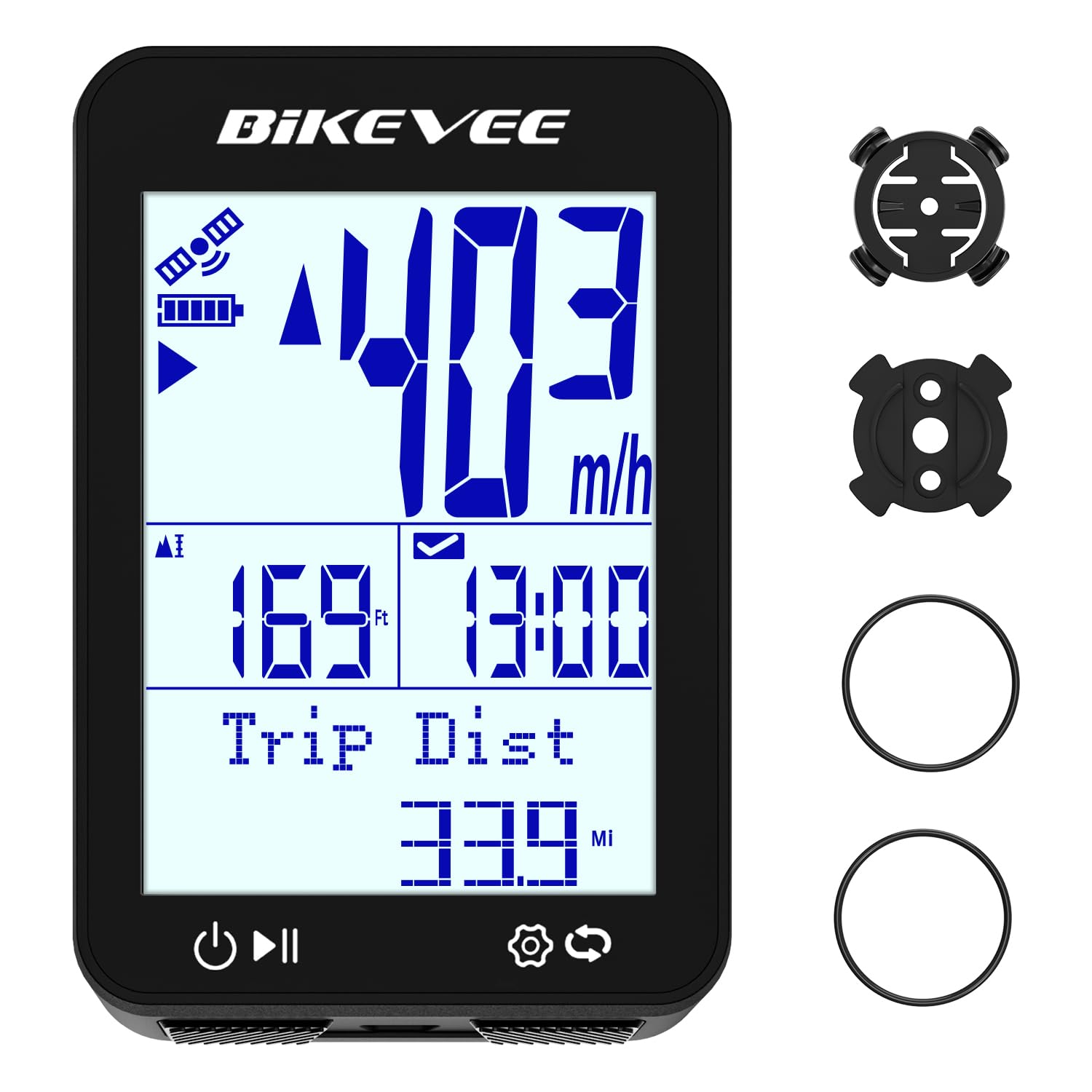
2. Bikevee Wireless Bicycle Speedometer
A featherweight 50 g GPS unit that outlasts the competition by three hours.
The 2.4-inch LCD keeps a clear read day or night, with an auto backlight that brightens as the sun drops.
Setup is genuinely wireless: no wheel magnet, no wiring, just GPS positioning. Buyers report it links to satellites quickly and delivers accurate speed, distance, and elevation. It speaks nine languages and counts MPH and KMH, so it suits riders worldwide. Charging is modern USB-C, not the old micro-USB you’ll find elsewhere.
The trade-off for the price: there’s no Bluetooth, no maps, and no heart rate monitor support. That’s acceptable when you just want clean ride data without the app ecosystem. As buyers put it, “Excellent battery life (7+ hours with minimal drain).”
Why it stands out: the longest runtime in this budget tier at 28 hours, paired with a 2.4-inch auto-backlit screen and USB-C charging in a 50 g body.
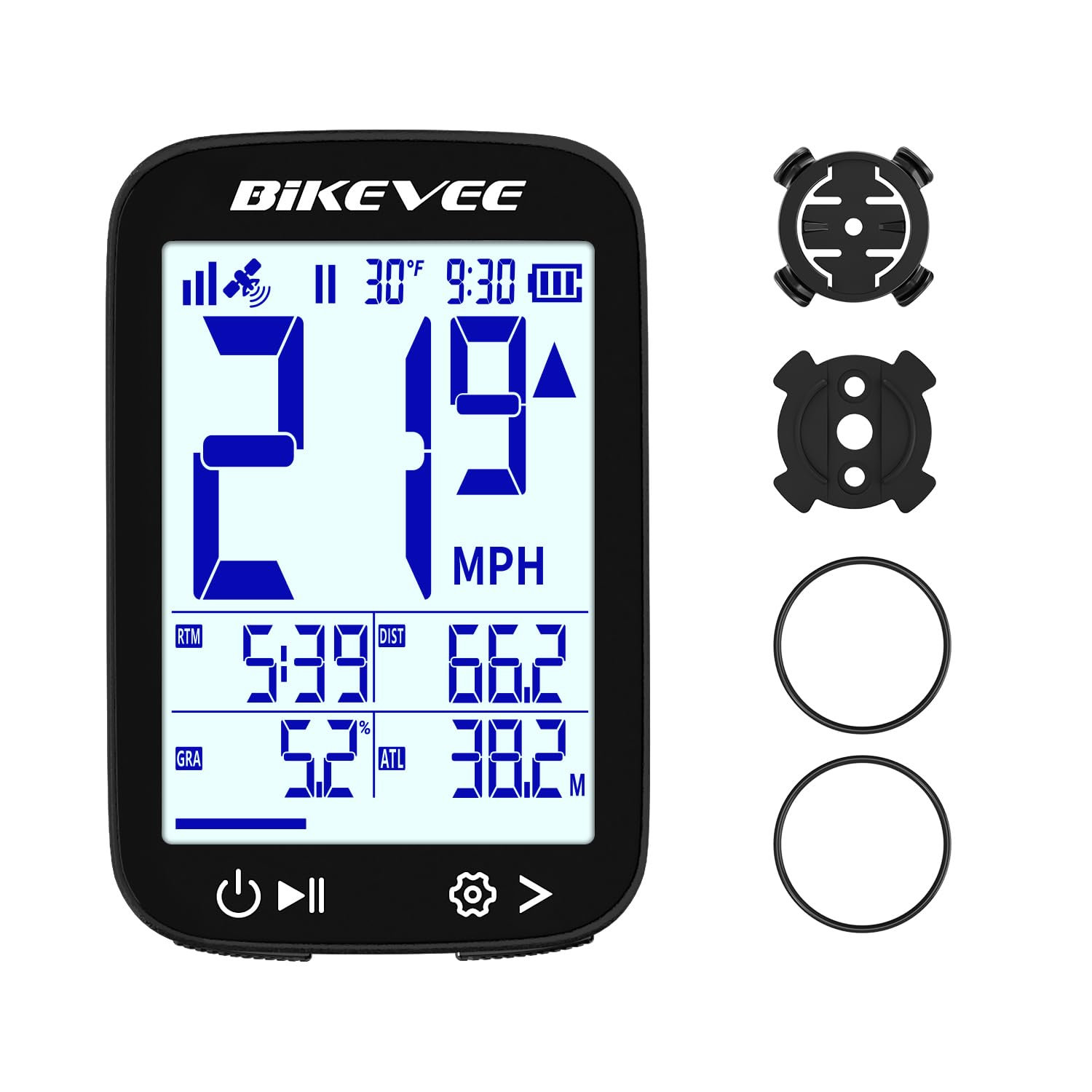
3. Bikevee Auto Backlight Cycling Computer
Reliability is the word owners keep repeating about this budget GPS screen.
This Bikevee model earns its praise on consistency—riders describe it as accurate and dependable, with elevation readings that landed within 1 foot of a separate GPS reference. The 2.4-inch LCD auto-backlights at night, and the tool-free mount fits snugly and stays put at speed. That matters most when you’re scanning the road ahead.
It tracks speed, distance, ride time, temperature, altitude, gradient, and ascent with the same 650mAh battery and 28-hour runtime as its sibling. A USB-C charging cable, standard mount, rubber pad, and rubber rings come in the box, so it’s ready to ride out of the package. The automatic start/stop recording means you never forget to hit a button at a red light.
Keep expectations level: there’s no heart rate connectivity and no.fit file export for Strava. It also maxes out its speed reading at 65 mph, which only matters if you plan to tape it to a motorcycle. For bicycle duty, owners mention it “goes a long time without needing charging.”
Standout feature: the auto start/stop recorder plus accurate gradient tracking make every ride logged without a second thought.
4. XOSS G+ GPS Bike Computer

The budget computer that talks to your heart rate and cadence sensors.
If you’ve already invested in a heart rate monitor or cadence sensor, the XOSS G+ is the rare budget unit that actually connects to them via ANT+ and Bluetooth. That dual-protocol support is the reason it stands apart from the simpler GPS-only picks—it pairs cleanly with Garmin speed and cadence sensors, and auto-syncs your ride to Strava through the XOSS app.
The 1.8-inch screen is smaller than the 2.4-inch displays above, which makes it a compact choice for mountain bikers who don’t want a big brick on the bars. It’s IPX7 waterproof for rainy trail days, and the 500mAh battery runs 25 hours on a charge. GPS locks in under 10 seconds when the sky is clear, and customers note solid tracking even under tree cover.
The honest catch: reliability has some mixed reports, with occasional units stopping after a couple of months and some app-pairing headaches on certain phones. Indoor distance doesn’t record since it’s GPS-driven, and the display is compact at 1.8 inches. It’s brilliant if you want sensor support on a budget, but those who value dead-simple consistency may prefer a more basic unit.
The sensor-ready edge
- ANT+ and Bluetooth pair with HR and cadence sensors
- Fast GPS lock and clean Strava upload
- IPX7 waterproof for mountain bike use
Where it trips up
- Small 1.8-inch screen for dense data
- Mixed long-term reliability reports
- No indoor distance tracking
Pick it for: budget riders who already own or plan to buy heart rate and cadence sensors.
Think twice if: you want the simplest possible grab-and-go GPS with the fewest moving parts.
5. CATEYE Enduro Wired Bike Computer
Forget charging cables entirely with a battery that lasts three years.
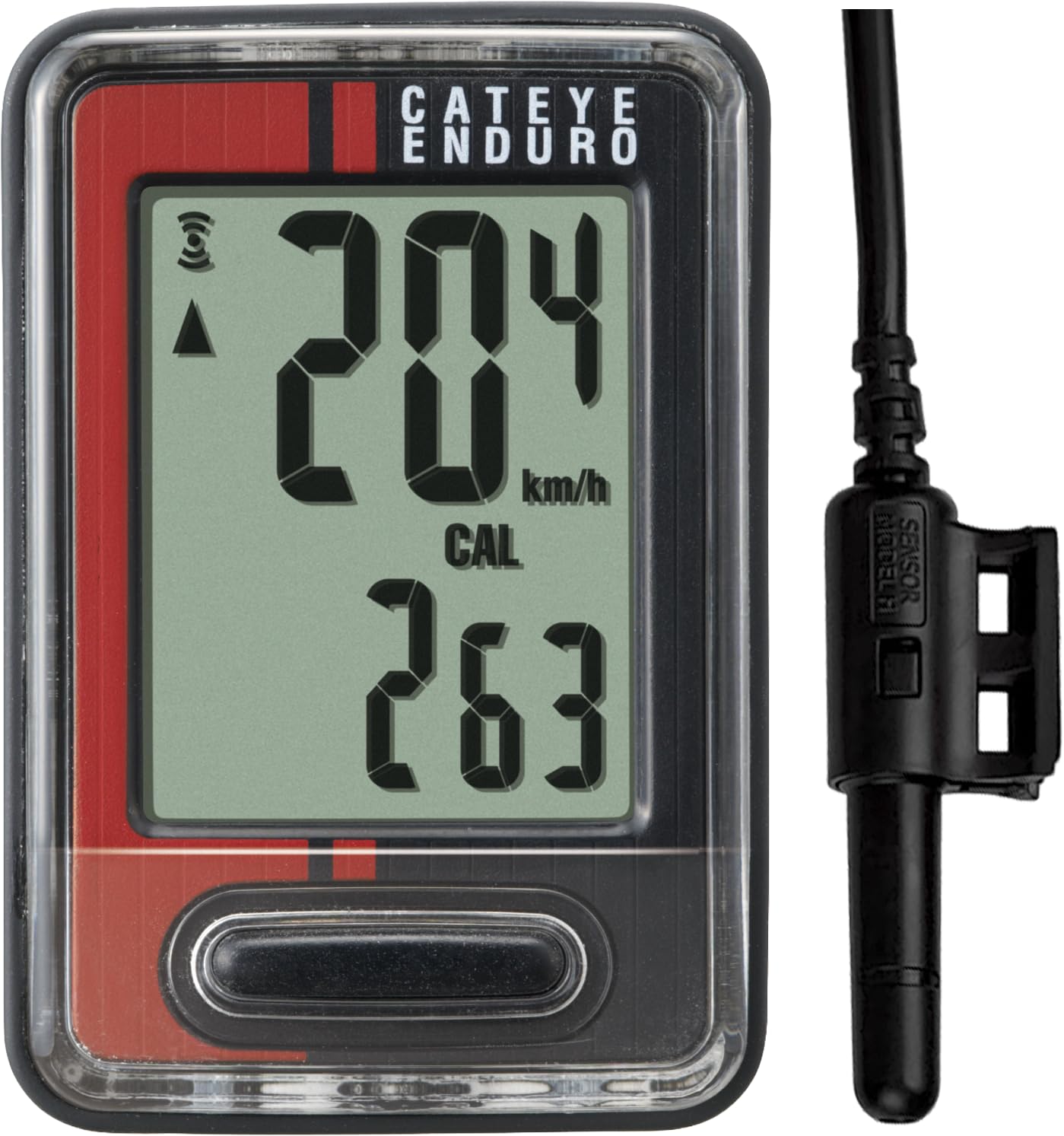
Among all these GPS units that need weekly charging, the CATEYE Enduro is the brilliant contrarian: a wired computer that runs on a single battery rated for three years. If your idea of a bike computer is “fit it, forget it, and just ride,” this is your unit. The heavy-duty wire is built for off-road abuse, and the single front-facing button cycles through all your stats without menu diving.
It tracks current, max, and average speed, total and trip distance, elapsed time, calories, and even carbon offset. The auto start/stop pauses your average when you’re caught at a red light or stopped for coffee. Setup is straightforward: mount the sensor to your fork, route the wire, and enter your wheel size.
The upside of a wired unit is zero charging and zero satellite lock wait. The downside is the wire itself—it needs careful routing, and the included cable runs short if you want to mount it on a rear wheel for a stationary bike. A few owners also note the reading can double if you somehow exceed 50 mph, which only concerns true downhill sprinters.
Best for: riders who want a set-and-forget speedometer without ever thinking about a charging cable or GPS signal again.
6. Navihood S1 Entry Level GPS Bike Computer
The thinnest unit here packs the largest screen for one-glance data.
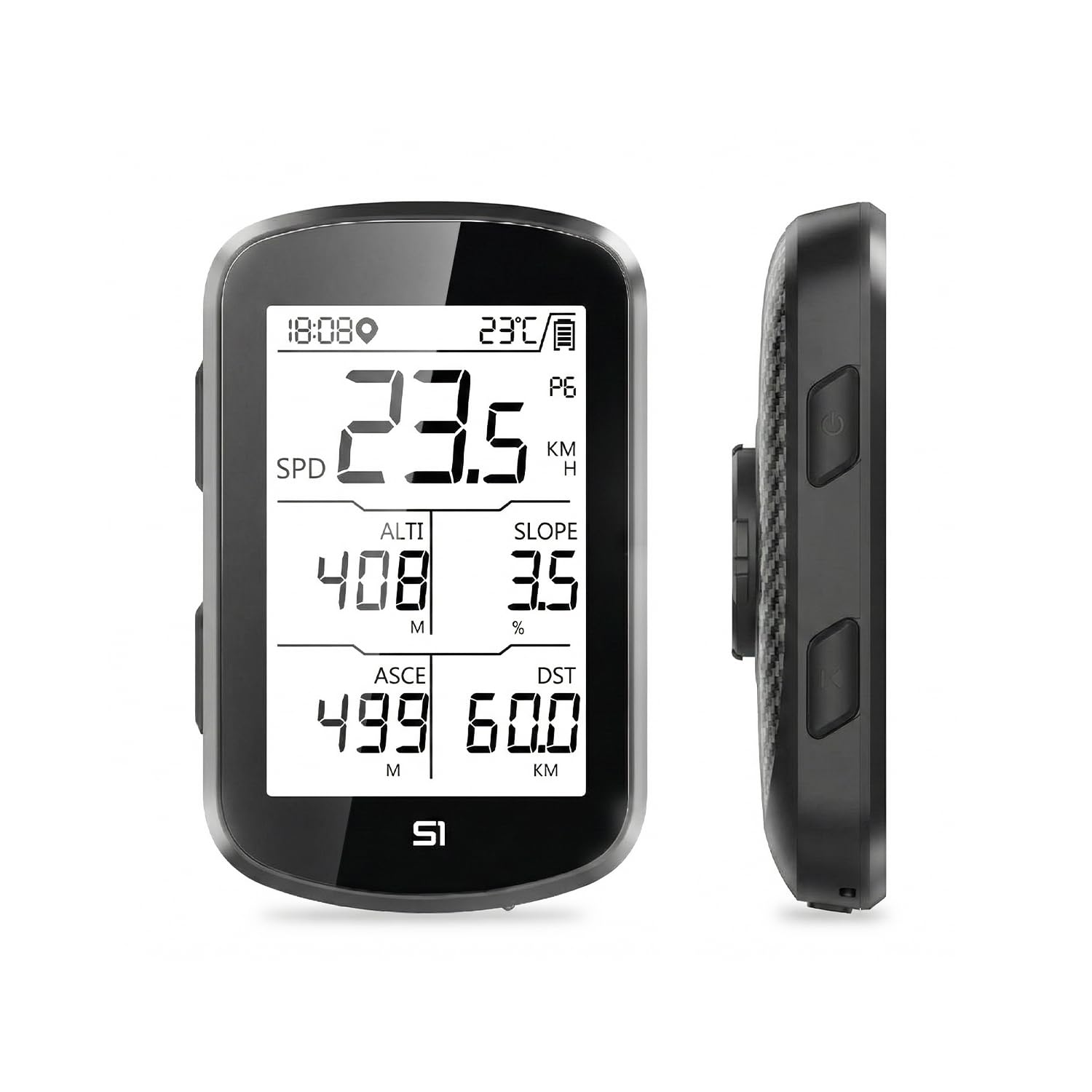
If readability tops your list, the Navihood S1 delivers the biggest display in this roundup at 2.8 inches, wrapped in a laminated anti-glare layer that stays clear in bright sunlight. It’s also remarkably slender at just 14mm thick and 58g, so you barely notice it on the bars. The auto backlight kicks in for low-light rides.
Using the Navihood APP, you can build your own dashboard across 9 pages and 14 data types, arranging speed, distance, slope, and temperature however you like. It uses GPS and GLONASS satellites, with a 30-second cold start and a fast 5-second warm start. The 21-hour battery handles long rides, and it stores up to 1000 kilometers of ride data before you need to sync.
Bluetooth 5.0 syncs your rides to Strava neatly. The realistic downside: the limited menu navigation can feel slow, with one owner noting a full minute to reset between rides, and phone pairing needs patience and perhaps a tutorial video. It’s a great screen, but it asks a little more effort than the dead-simple picks.
Why the screen wins
- 2.8-inch laminated anti-glare display is the biggest here
- Ultra-thin 14mm body at 58g
- 9-page customizable dashboard via app
The patience required
- Slow menu navigation between rides
- Phone pairing can be finicky
- 21-hour battery trails the 28-hour rivals
Choose it for: the largest, clearest display in the budget class and full dashboard customization.
skip it if: you want instant, no-menu simplicity every single ride.
7. iGPSPORT BSC100S GPS Bike Computer
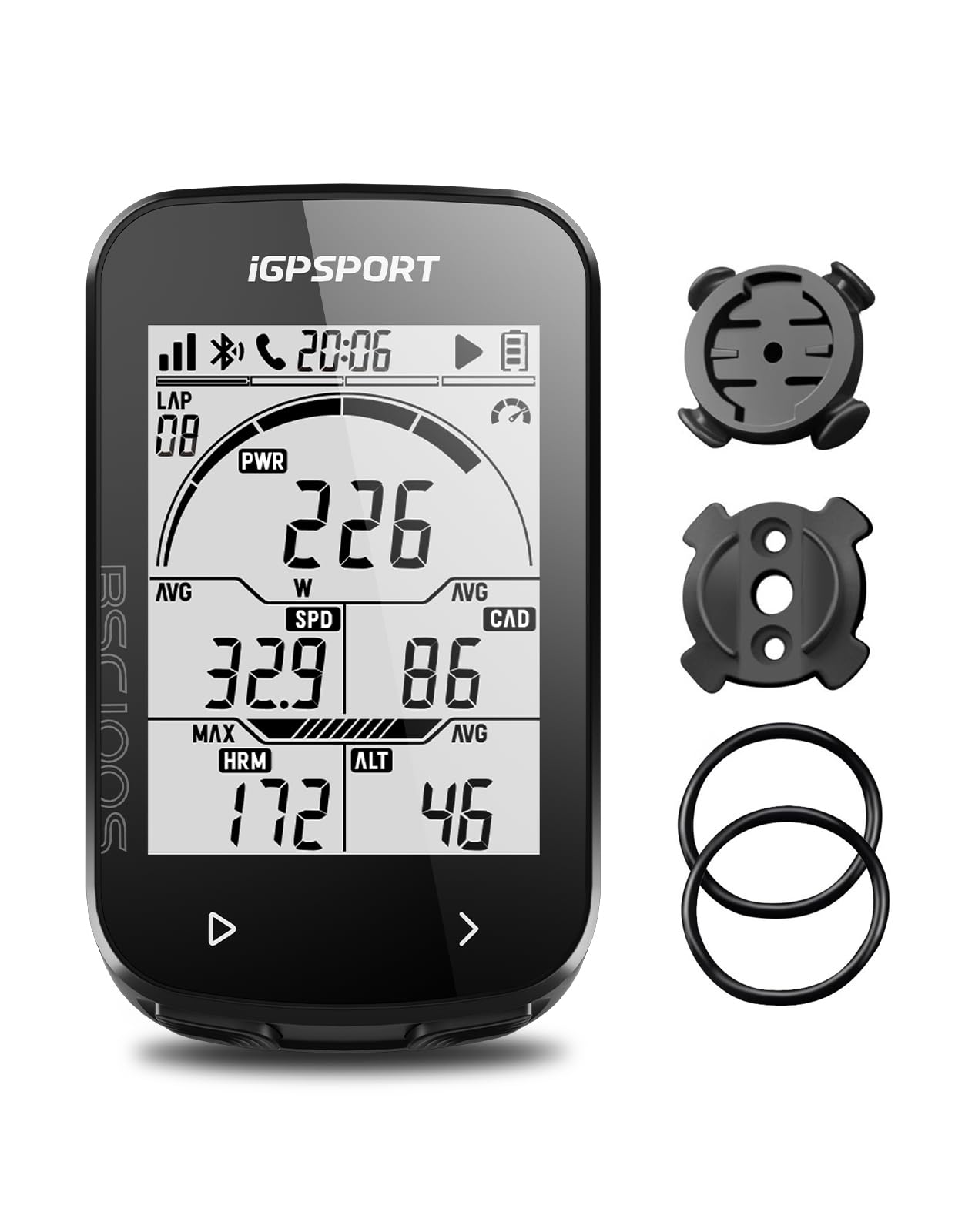
A 40-hour battery turns multi-day touring into a single-charge affair.
This is the endurance champion of the budget class. The 600mAh battery is rated for a stunning 40 hours—more than any other unit on this list—so a week of commuting or a full multi-day tour needs just one charge. The 2.6-inch anti-glare screen pairs with a USB-C port that charges faster than the old micro-USB standard.
Positioning uses five satellite systems—GPS, Beidou, GLONASS, GALILEO, and QZSS—for faster locks and more accurate tracking. The BSC100S displays over 40 riding metrics, and the iGPSPORT app analyzes and shares your data to Strava and Komoot. It also supports ANT+ and Bluetooth 5.0, so it connects to speed, cadence, heart rate sensors, and even smart watches.
What it doesn’t do is navigate: there’s no routing or color maps, which is a reasonable trade at this level. Owner feedback is strong on reliability—one notes it never drops satellite signals—though the included manual is rough and the rubber-band mount can annoy. A few also report battery drain faster than the 40-hour claim when the backlight runs often.
The endurance edge: 40 hours of runtime plus 5-satellite GPS and ANT+ sensor support make this the touring rider’s budget ally.
8. CATEYE Urban Wireless Bike Computer
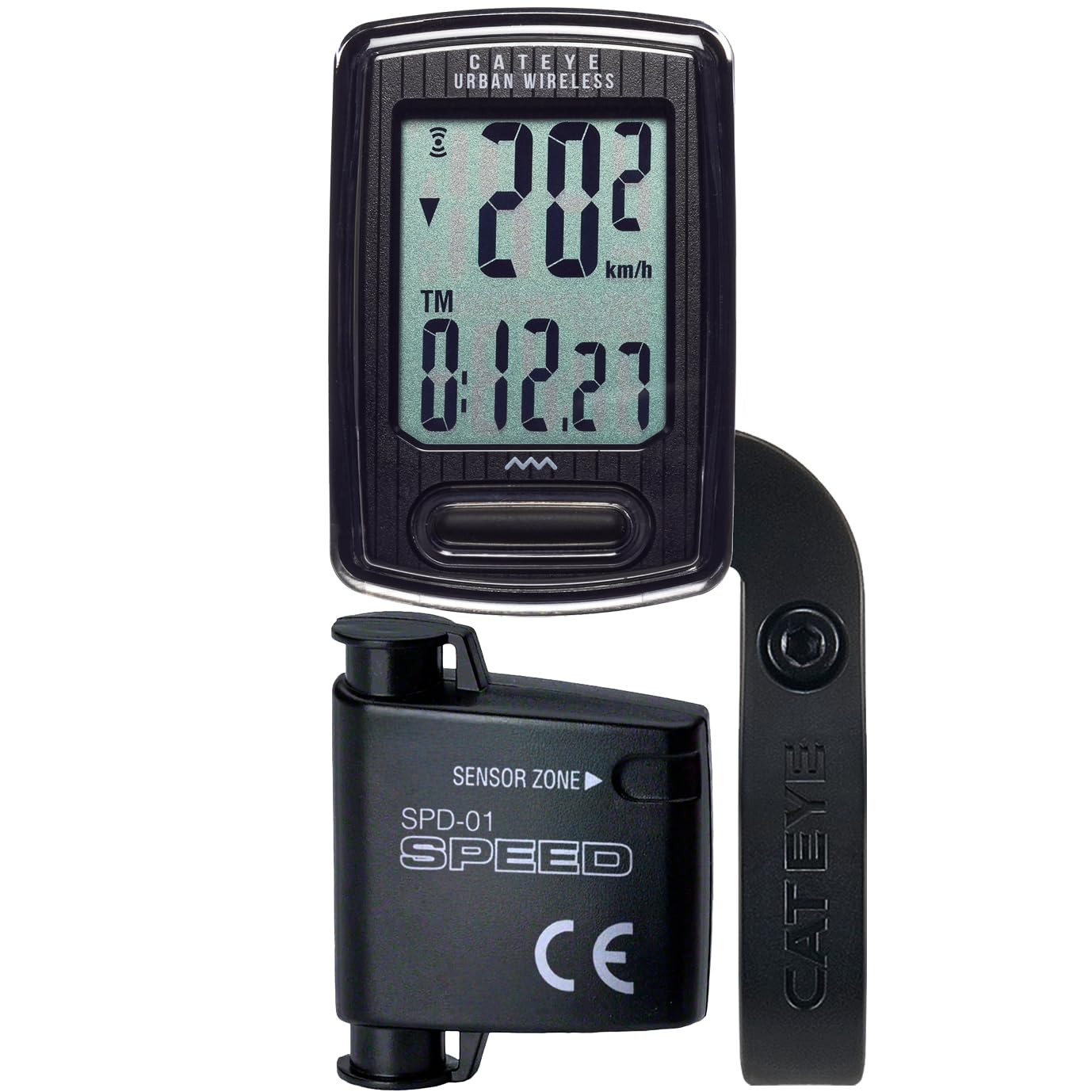
A compact wireless speedometer that keeps commute data one glance away.
The CATEYE Urban Wireless keeps things simple and handlebar-forward. It ships with the OF-100 out-front bracket, so the screen sits right in your line of sight without you taking your eyes off the road. It tracks current, max, and average speed, total and trip distance, elapsed time, calories burned, a pace arrow, and the clock.
Auto start/stop pauses your average speed when you’re stuck at a light, and the FlexTight mount makes tool-free installation quick. It’s compatible with road, gravel, and mountain bikes, and a 2-year warranty backs it. Owners who’ve had the unit for over two years report the battery still running strong on what appears to be standard cell power.
The mixed note is reliability: while many units work flawlessly, some reviewers point out the speedometer function working only occasionally. It’s also genuinely compact—several owners were surprised by how small it is. If a GPS unit feels like overkill and you want a dependable wheel-sensor computer with a proper brand name, this holds up.
What it nails: a compact out-front wireless setup with auto start/stop and a 2-year warranty for everyday commuters.
9. Planet Bike Protégé 9.0 Wireless Bike Computer

A 4-line wireless screen that shows five data points without scrolling.
Planet Bike’s Protégé 9.0 packs nine functions into one 4-line LCD that displays up to five pieces of data at a glance—speed, ride time, trip distance, average, and max speed all on one screen. That’s notably less menu-scrolling than most budget units. It tracks two wheel sizes with a dual odometer, plus a clock and thermometer.
You get clean handlebars because the sensor sends data wirelessly, so no messy wires to route. The universal bracket fits handlebars from 25 to 31.8mm, so it mounts on most road and mountain bikes. Shoppers say the distance readings match GPS apps closely, calibrating to within 30 feet over half a mile, so your mileage stays accurate on long rides. The thermometer, once settled, matches weather channel readings, giving you reliable temperature data. A limited lifetime warranty covers defects, so you are protected for years.
The quirks are real: the thermometer runs about 12°F high until it adjusts, the computer blanks to just the clock after a few minutes of inactivity, and the sliding mount can be sticky. It’s a wheel-sensor unit, so it needs that spoke magnet and a battery change roughly every year (the included CR2032 cells). For classic, no-app simplicity, it’s a solid budget choice.
The appeal: a single 4-line screen showing five ride stats at once, backed by a lifetime warranty and proven accuracy.
Understanding the Specs
Battery Life Ratings
Manufacturer battery numbers like 25 or 28 hours assume moderate use without constant backlight. In real riding, the auto backlight and GPS actively drain the cell faster. A 40-hour unit like the iGPSPORT BSC100S is genuinely different—it can span a full week of commutes or a multi-day tour on one charge. Check charging ports too: USB-C is quicker and more universal than micro-USB.
Display Size and Readability
The display size in inches directly controls how fast you can read your speed at a glance. Budget units range from 1.8 inches on the XOSS G+ to 2.8 inches on the Navihood S1. A laminated or anti-glare screen keeps digits crisp in direct sun, and an auto backlight that senses low light is a genuine safety upgrade for dawn or dusk rides. Larger screens often mean a heavier, bulkier unit on your bars.
IPX7 Waterproof Rating
IPX7 means the unit survived being submerged in water about a meter deep for half an hour during testing. For a bike computer, that translates to full confidence in heavy rain, spray, and puddle splashes. Every GPS pick on this list carries IPX7, so you can ride through a downpour without worrying about your data or the unit itself.
Sensor Support vs. GPS-Only
GPS-only units like the Bikevee models give you speed, distance, and elevation from satellites alone—no wheel magnets, no installation fuss. If you want heart rate or cadence data, you need a unit with ANT+ or Bluetooth sensor support, like the XOSS G+ or iGPSPORT BSC100S. Wired units like the CATEYE Enduro use a physical fork sensor instead of GPS, trading satellite locks for a battery that lasts years.
FAQ
Is a GPS bike computer better than a wired or wheel-sensor one?
How long does a budget bike computer battery actually last?
Will a budget GPS bike computer work with my heart rate monitor or cadence sensor?
Does a budget bike computer need a wheel magnet to work?
Can I upload my rides from a budget bike computer to Strava?
Is the IPX7 waterproof rating enough for heavy rain?
What’s the difference between auto backlight and a standard display?
Why do some budget bike computers need a mount, and is it included?
Can a budget bike computer track indoor or stationary bike rides?
How do I know if a budget bike computer fits my handlebar?
Final Thoughts: The Verdict
For most riders, the budget bike computer winner is the COOSPO BC26 because it pairs a sunlight-readable 2.3-inch screen with reliable dual GPS and 25 hours of battery at an entry-level price. If you want the longest runtime in the class, grab the Bikevee Wireless GPS for 28 hours of satellite tracking on a 50 g build. And for multi-day touring endurance, the iGPSPORT BSC100S is the one to reach for with its 40-hour battery and five-satellite positioning.
How We Picked
We do not accept paid placement. Every pick is matched to a real buyer and a real use-case; we do not hands-on test units.
Sources & Methodology
Specifications: manufacturer listings and product documentation. Review insights: verified customer reviews, as of July 2026. Pricing: not shown on this page (it changes often); check the current price via the retailer link.
As an Amazon Associate, FitlyFast earns from qualifying purchases. This does not affect which products we feature.