
Our readers keep the lights on and the weekend projects moving. As an Amazon Associate, I earn from qualifying purchases.
Specs are compiled from manufacturer listings and verified buyer reviews and can change over time — please confirm the key details on the product page before buying.
You want a camera that makes your YouTube videos look sharp and sound clear without draining your savings. The first thing to know: a built-in gimbal (a motorized handle that keeps the camera steady as you move) matters more than almost any other spec for talking-head and walk-and-talk vlogs. The Xtra Muse pairs that stability with a 1-inch sensor for a cinematic look at a budget price.
I’m Rikta — the founder and writer behind FitlyFast. This guide is built by comparing the manufacturers’ published specifications and the patterns across verified customer reviews, so you get each pick’s real strengths and trade-offs instead of marketing spin.
You want a camera that keeps you in focus while you move and adjusts quickly when light shifts, whether you’re filming at a desk or sprinting down a street. The best budget camera for youtube for you depends on three things: stabilization, autofocus reliability, and battery endurance that matches how you shoot.
Our Picks at a Glance


How To Choose The Best Budget Camera For YouTube
Your first YouTube camera needs to solve three problems at once: keeping you in focus while you talk, keeping the frame steady while you move, and keeping the battery alive long enough to actually film. Everything else is a bonus.
Stabilization: The Built-In Gimbal Advantage
A gimbal is a motorized arm that counteracts your hand movements, so a walk down the sidewalk looks like you used a tripod. Without one, you are either locked to a desk or buying a separate stabilizer that eats your budget. The best budget picks build this right into the camera body, which means one less thing to charge and one less thing to carry.
Sensor Size and Low-Light Behavior
The sensor is the light-catching surface inside the camera. A larger 1-inch CMOS sensor (CMOS is the chip that converts light into the image) lets in more light than the tiny sensor in your phone, so evening shots stay clean instead of turning grainy. If you film indoors under lamps rather than studio lights, this is the spec that saves you from buying extra lighting gear.
Autofocus That Tracks Faces
Face and eye tracking (a system that locks onto a person’s face and keeps it sharp as they move) is non-negotiable for a vlogger who talks to the camera. You want the camera to do the focusing work so you can talk naturally without checking the screen. Look for fast focusing described on the spec sheet, because slow autofocus ruins more takes than any other issue.
Quick Comparison
| Model | Best For | Sensor | Video Specs | Stabilization | Amazon |
|---|---|---|---|---|---|
| Xtra Muse Vlogging Camera★ Best Overall | All-in-one steady vlogging | 1-inch CMOS | 4K/120fps | 3-axis gimbal | Amazon |
| Canon PowerShot V10Compact Pick | Pocket-size simplicity | 1-inch back-illuminated CMOS | 4K up to 30 fps | Three IS modes (software) | Amazon |
| DJI Osmo Pocket 3Top Performer | Pro-level pocket gimbal | 1-inch CMOS | 4K/120fps | 3-axis mechanical | Amazon |
| Sony Alpha ZV-E10 (Renewed) | Interchangeable lenses on a budget | 24.2MP APS-C Exmor CMOS | 4K oversampled from 6K | Software (lens-dependent) | Amazon |
| Sony ZV-1F | Selfie-friendly wide-angle | 1-inch | 4K Video | Software (digital) | Amazon |
| Canon EOS R50 (Bundle) | Hybrid photo and video | 24.2MP APS-C CMOS | 4K uncropped up to 30 fps | Dual Pixel CMOS AF II (software) | Amazon |
| Canon EOS R50 V | Creator-focused mirrorless | 24.2MP APS-C CMOS | 4K/30p, Full HD 120p | Dual Pixel CMOS AF (software) | Amazon |
| Fujifilm X-M5 | High-res video and stills | 26.1MP APS-C X-Trans CMOS 4 | 6.2K/30p, 4K/60p | Hybrid AF (software) | Amazon |
| Nikon Z fc | Retro style with modern autofocus | 20.9 MP DX CMOS | 4K UHD | Eye-detection AF (software) | Amazon |
In‑Depth Reviews
1. Xtra Muse Vlogging Camera
This pocket-sized camera’s 3-axis gimbal eliminates shaky handheld footage.
The headline here is a 1-inch CMOS sensor shooting 4K at 120fps — that frame rate (120 frames per second, meaning how many images the camera captures each second) gives you buttery slow-motion clips for your b-roll. The built-in 3-axis gimbal does the stabilizing work for you, so a jogging shot looks like you ran on rails. Owners specifically describe the footage as crisp and vivid, with steady results even in bright and low-light conditions.
Focus is handled by fast autofocus with face and object tracking, which means the camera locks onto you as you talk and stays on you if you spin or dance mid-take. The 2-inch touch screen swings between horizontal and vertical shooting, so a single camera covers both a YouTube landscape upload and a Shorts or TikTok portrait clip. It even records in 10-bit X-Log color, a mode that preserves up to one billion colors for easier grading in post-production — a feature usually reserved for pricier gear.
The crowd favorite here is clearly the construction and overall build quality, with video quality close behind as the second-most-praised trait. On the battery front, reviews split — some find the 161-minute average life plenty, while others want more. Buyers also note the microphone connection took a firmware update to work smoothly, so plan to update the camera before your first serious shoot.
What owners rave about
- Gimbal stabilization smooths out walking and running shots
- Fast autofocus keeps faces locked while you move
- Pocket-sized body with a simple touchscreen interface
- 4K/120fps delivers smooth slow-motion footage
Where it stumbles
- Battery life has mixed reviews, so carry a spare
- Microphone connectivity needed a software update
Reach for this if: you want a single all-in-one camera that stabilizes, tracks your face, and records smooth 4K without buying extra gear.
Look elsewhere if: you plan marathon 4-hour filming days — the battery needs frequent top-ups.
2. Canon PowerShot V10
A fanny-pack-friendly camera that puts a 1-inch sensor in your pocket.
The PowerShot V10 lives by its shape: a pocket-sized body you can slip into a small bag — buyers literally mention it fitting in a fanny pack. Inside sits a 15.2-megapixel 1-inch back-illuminated CMOS sensor (back-illuminated means the wiring sits behind the light-catching layer, which helps low-light shots) that records 8-bit 4K video at up to 30 fps. It is a point-and-shoot experience, with a retractable front-facing screen so you can see yourself while recording.
Audio gets real attention here: a pair of stereo microphones captures the room, and a third mic in the middle filters out unwanted background noise. The fixed 19mm wide-angle lens (35mm equivalent) frames your face and a bit of the room at arm’s length, which is exactly the angle a solo creator wants. There is no zoom ring, so composition happens by moving the camera, not by dialing a lens.
Stabilization comes as a software feature — after a firmware update (version 1.2.0 or later) you get three image stabilization modes to choose from while filming. The recurring trade-off is the battery: buyers report it dying after roughly 1 to 2.5 hours of recording, and the exposed lens collects fingerprints without a lens cover in the box. Camera quality is the top praised trait, with video quality a close second.
Steady and simple: this is the easiest camera on the list to just pick up and press record — no gimbal setup, no lens choices, just a flip screen and a big red button.
Plan your power: for a full day of filming, budget for a USB power bank since the battery is the weakest link.
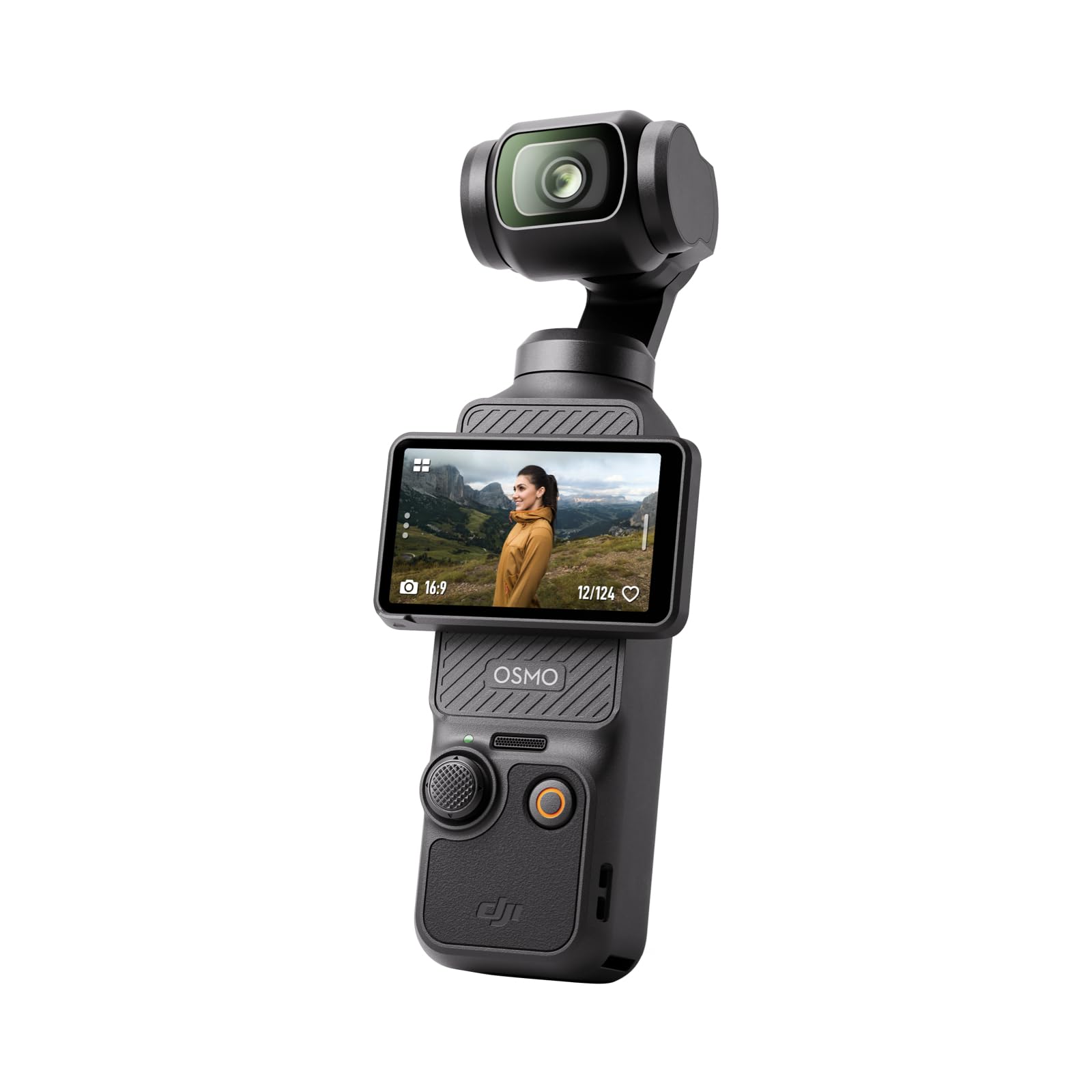
3. DJI Osmo Pocket 3
DJI’s 3-axis gimbal camera delivers pro-grade stability in a pocket-sized body.
If the Xtra Muse is the budget take on this idea, the Osmo Pocket 3 is the original it imitates — and it executes the concept with polish. It pairs a 1-inch CMOS sensor with 4K/120fps capture and a 3-axis mechanical stabilization system (a physical motorized mount, not a software trick). The result is footage steady enough that owners describe it as exceeding expectations, with sharp 4K and strong colors even in low light.
The 2-inch touchscreen rotates for horizontal and vertical framing, and ActiveTrack 6.0 keeps you center-frame as you jump, spin, or chase a pet. Unlike the Xtra Muse, this one connects directly to two DJI Mic 2 or Mic Mini transmitters, so you can wirelessly clip a mic to your shirt and get high-quality audio without a receiver dangling from the camera. It records in D-Log M with 10-bit color depth — again, up to one billion colors for grading.
Owners describe it as “in a class of its own,” praising the stabilization, the rotating screen, and the way it rivals larger cameras for social clips. The honest caveats: the narrow field of view means no fisheye sweep, and the gimbal head is fragile enough that you should treat it gently. The 166-minute rated battery is solid for a day of vlogging, and it charges fast when you top it up.
The pro side
- Mechanical gimbal delivers genuinely cinematic stability
- Direct wireless connection to DJI mics for clean audio
- Rotating touchscreen handles portrait and landscape easily
The trade-offs
- Gimbal head is delicate — it needs careful handling
- Narrow field of view, so no wide sweeping shots
The standout-spec mic drop: 3-axis mechanical stabilization plus wireless mic pairing in a body that fits your jeans pocket.
The single caveat: it is not waterproof and the gimbal needs a protective case when traveling.
4. Sony Alpha ZV-E10 (Renewed)

A renewed mirrorless body that open up Sony’s huge lens lineup for budget creators.
If you already know you’ll outgrow a fixed-lens camera, the Sony ZV-E10 lets you swap lenses later, so your body grows with your skills. It’s a mirrorless body (no flipping mirror inside, so it stays compact while accepting different lenses) with a 24.2MP APS-C Exmor CMOS sensor and a BIONZ X processor. It records 4K oversampled from 6K with full pixel readout and no pixel binning, meaning the 4K footage uses the whole sensor for extra detail instead of cropping down, so your videos look sharper than a typical 4K capture.
The vlogger-specific tricks are built in: a Product Showcase setting shifts focus from your face to an object you hold up, and a Background Defocus button toggles a blurred-background look with one press. Being a renewed unit, the box holds the camera body and a 16-50mm zoom lens, and the huge Sony community means endless setup tutorials on YouTube to dial in your settings.
Since renewed units vary, owners advise checking the shutter count (how many photos the shutter has taken) and confirming the firmware is current before relying on it for paid work. Battery life is the recurring complaint — owners wish it lasted longer, but accept it as the trade-off for the large sensor and lens options.
Built to grow: the 425 autofocus points and huge lens ecosystem mean this camera can carry you from your first vlog to paid client work.
Expect to tinker: a renewed body demands a careful inspection, and you will buy an extra battery almost immediately.
5. Sony ZV-1F

Its 20mm ultra-wide lens frames your face and background at arm’s length.
The ZV-1F earns its place with a 20mm ultra-wide lens that gets everything in the frame when you hold the camera close. That is the single biggest difference from the V10 above: you do not need a selfie stick to fit your face and some background. Its large 1-inch sensor with an F2 lens (F2 is the aperture, or how wide the lens opens to let in light) helps in low-light scenes and lets you defocus the background to blur a messy room.
Focusing is Sony’s strength here: Eye-AF locks onto eyes and autofocus tracking follows a moving subject, which owners describe as reliable for solo filming. The side-articulating touchscreen flips out for selfie composition, and the directional 3-capsule mic with a windscreen accessory keeps your voice clear outdoors. A red recording light on the front tells you the camera is rolling — a small detail that saves wasted takes.
The most-praised trait is camera quality, with photo quality second — owners mention crisp, vibrant pictures with natural skin tones. The honest downsides are no optical zoom (you zoom by moving) and a battery that drains quickly, with several owners clocking roughly 45 minutes of continuous recording. The built-in stabilization is digital-only, so fast walking can look shaky unless you hold the camera steady.
What converts owners
- 20mm ultra-wide lens frames selfie shots perfectly
- One-press background defocus for instant depth-of-field
- Eye-AF keeps your face sharp as you talk
What to watch
- Battery life is short — expect around 45 minutes of recording
- No optical zoom and digital-only stabilization
Best for: one-person creators who film themselves talking or demonstrating products and want that wide, flattering framing.
Who should skip: anyone filming long sit-down conversations without a power outlet nearby.
6. Canon EOS R50 (Bundle)
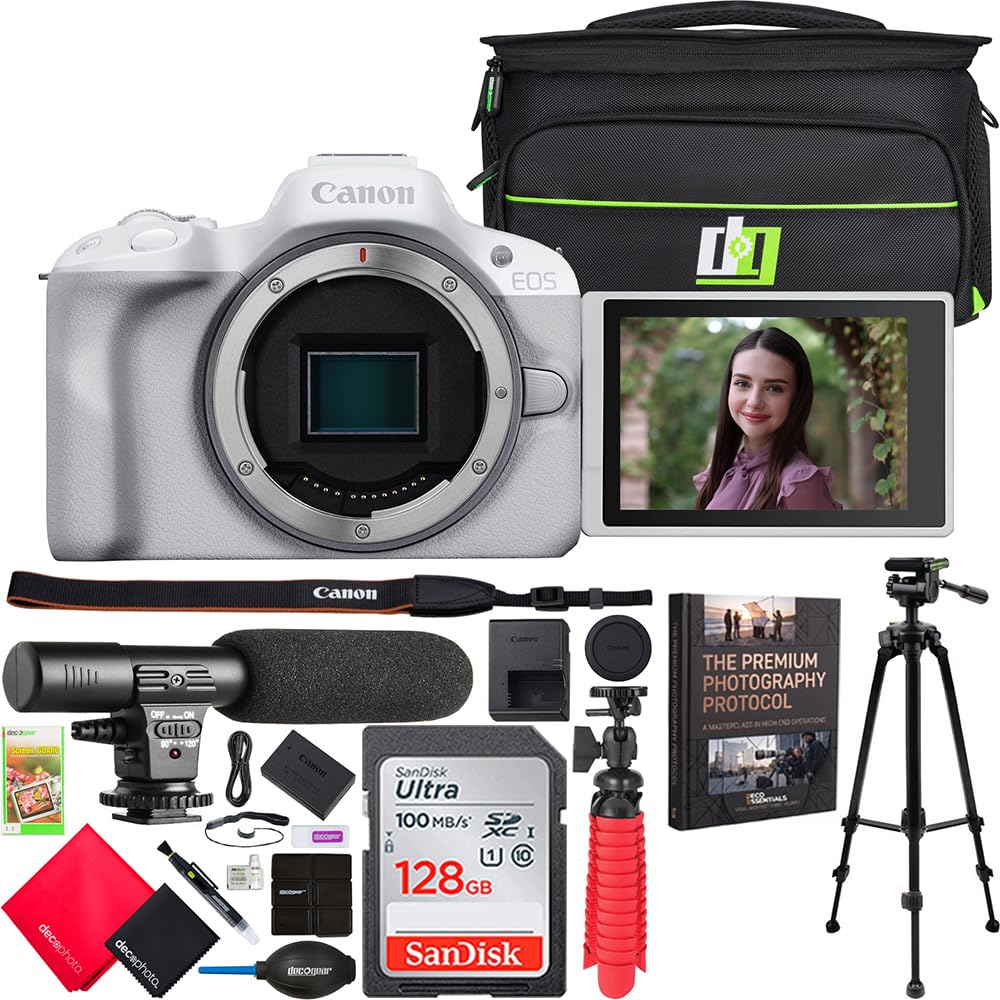
This interchangeable-lens mirrorless excels at both 4K video and still photography.
This bundle gives you a full mirrorless camera plus everything a beginner needs to start creating: the Canon EOS R50 body, an 18-45mm lens, a Deco Gear photography bag, a mini condenser microphone, a 50-inch tripod, a 12-inch vlogging grip, and a 128GB SD card. The camera itself has a 24.2MP APS-C CMOS sensor with the DIGIC X processor, shooting uncropped 4K at up to 30 fps oversampled from 6K, so your 4K files use extra data from a larger capture for sharper detail.
Autofocus is Dual Pixel CMOS AF II, with 121 autofocus points and phase detection (a fast focusing method that measures light split across the sensor). Owners describe the image quality as comparable to much more expensive Canon bodies at a fraction of the cost, and they love how simple it is to switch between photo and video mode. The articulating touchscreen and built-in viewfinder make it a true hybrid for someone who wants one camera for YouTube and travel photography.
The catch: a 14-bit color depth body this capable is held back by its bundle accessories. Multiple owners note the tripod is unstable outside, and the extra tools are “barely functional” — the real value sits in the camera and lens. It records longer than 30 minutes per clip, and its UVC/UAC compatibility lets you use it as a webcam by plugging in a single USB cable.
The all-rounder: if you want one camera that films your vlog in the morning and shoots landscape photos in the afternoon, this is the most versatile pick on the list.
Buy it for the body: treat the bundled tripod and tools as freebies, not gear you will rely on for serious shoots.
7. Canon EOS R50 V
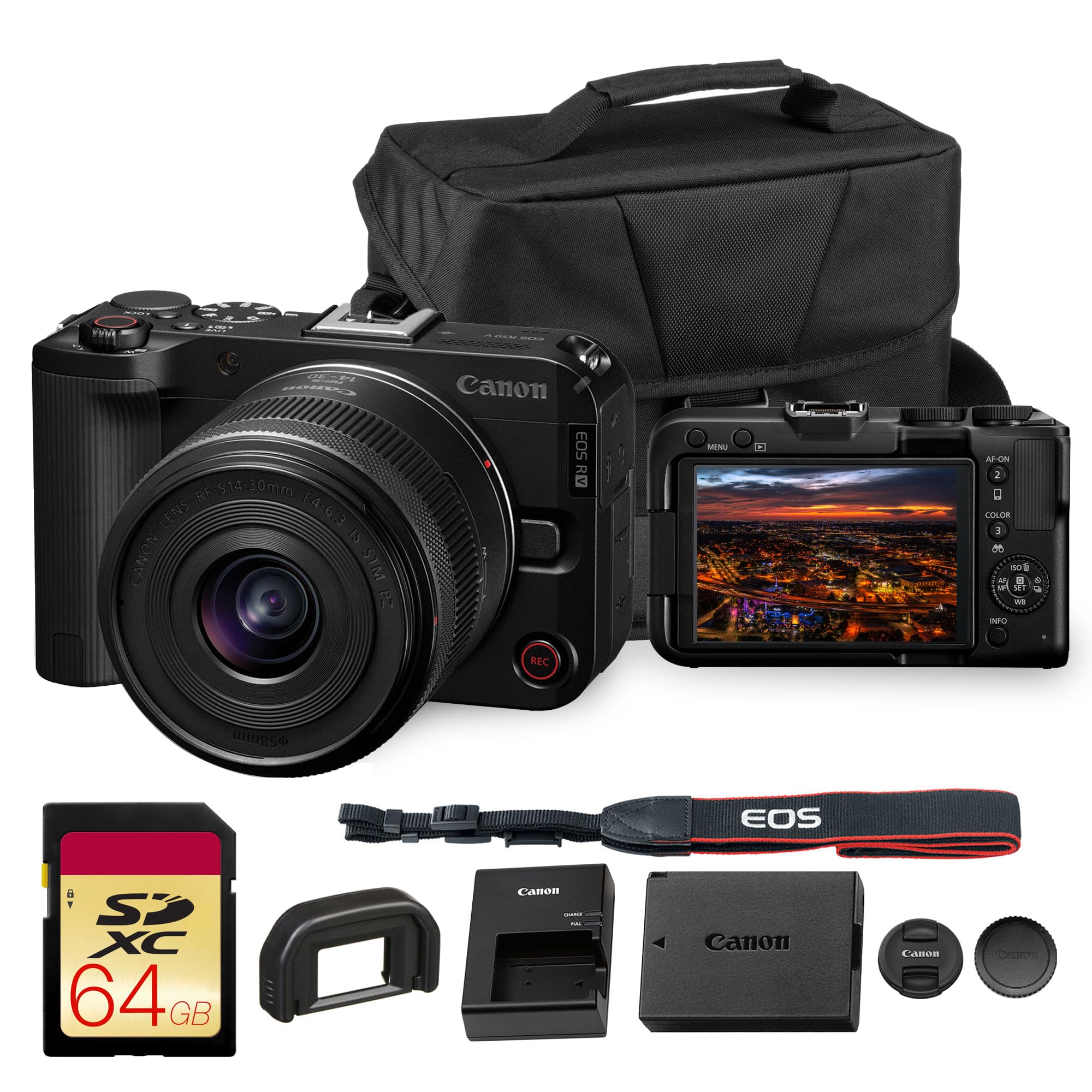
This creator-focused mirrorless includes a power-zoom lens for smooth video zooms.
If you want a real mirrorless camera but don’t want to learn manual exposure, the Canon R50 V handles that for you. It ships with a Canon RF-S 14-30mm f/4-6.3 IS STM PZ lens — the PZ stands for power zoom, so you can zoom smoothly by pressing a button instead of twisting a ring, which looks more polished in video. The 24.2MP APS-C CMOS sensor with DIGIC X processor records 4K uncropped video at 30p and Full HD at 120p, so you can add slow-motion effects to your footage.
The vlogger-specific touches are everywhere: a fully articulating flip screen for front-facing and high-angle shots, a vertical video mode for Shorts and Reels, and livestream-ready USB-C connectivity. Its hybrid autofocus with 179 points tracks eyes, faces, and subjects in both photo and video, with a Creative Assist mode that lets beginners dial in a look without understanding histograms. The included 64GB memory card and shoulder bag round out the kit.
Owners praise the Canon build quality and the user-friendly menu compared to some rivals, noting the body is extremely light and small. The recurring gripes are the tiny size — one owner says it is “too small” for larger hands — and the kit lens, which is fine for beginners but something you will eventually swap for a sharper prime. The grip is described as slightly awkward, so a cage or grip accessory helps on long shoots.
The creator toolkit
- Vertical video mode built in for Shorts and Reels
- Power zoom lens gives smooth, professional zooms
- Fully articulating flip screen for any angle
The honest limits
- Body is small — uncomfortable for large hands
- Kit lens is entry-level; plan an upgrade later
Pick this if: you are moving up from smartphone shooting and want a camera that handles vertical video, streaming, and slow-motion without complex menus.
Pass if: you have large hands or already own better RF-S lenses — consider the body-only route instead.
8. Fujifilm X-M5

This compact body shoots 6.2K video, the highest resolution on this list.
The X-M5 is the spec-sheet champion on this list. Its 26.1MP APS-C X-Trans CMOS 4 sensor with the X-Processor 5 engine records internal 6.2K/30p 10-bit video, plus 4K/60p and Full HD up to 240 fps. That 6.2K resolution means you can crop into your footage in editing and still deliver crisp 4K, which is a huge advantage for fixing framing mistakes after the fact. The 10-bit color depth (10-bit refers to how many color steps each pixel can record) also gives you room to grade your footage without banding.
Focusing uses a hybrid system with phase- and contrast-detection plus deep-learning subject detection (an AI model trained to recognize people, animals, and other subjects). The fully articulating 3-inch touchscreen folds out for selfie framing, and built-in Wi-Fi and Bluetooth let you transfer clips to your phone wirelessly. It records for a rated 2 hours on a charge, which is respectable for a camera this small.
Owners split sharply: many call it a “great camera in a very small and easy to carry size,” praising the compact body and feature set. But the limited owner pool includes a dissenting voice calling the build quality thin, so check the reviews carefully if you plan to use it heavily. Body-only means you will need to budget for a separate Fujifilm X-mount lens before you can record anything.
Why it stands out
- 6.2K/30p internal recording lets you crop in post
- Full HD up to 240 fps for extreme slow motion
- Deep-learning autofocus tracks people and animals
Weigh the cost
- Body only — the lens is a separate purchase
- Only 17 ratings so far, so the owner experience is still forming
Go for it if: maximum video resolution and slow-motion capability matter more to you than bundle convenience.
Think twice if: you want a ready-to-shoot kit — you will need to add a lens, a memory card, and a spare battery to the cost.
9. Nikon Z fc

This retro-styled mirrorless pairs vintage looks with modern eye-detection autofocus.
The Nikon Z fc wins on sheer desire. Its classic design with analog dials for shutter speed, ISO, and exposure compensation makes it look like a film camera from the 1980s, and owners call it the camera that makes them “want to shoot more.” Under the retro shell sits a 20.9 MP DX CMOS sensor with the EXPEED 6 processor, a 4K UHD video mode, and a flip-out vari-angle LCD — the high-resolution screen that folds out and rotates for selfie shots, so you can frame yourself easily.
For vlogging, it brings full-time autofocus with eye detection (a system that locks onto and follows a person’s eye) plus a built-in stereo microphone and an external mic jack. The included 16-50mm zoom lens covers a practical range for talking-head shots and travel b-roll, and it is compatible with NIKKOR Z lenses as well as F-mount lenses with an adapter. Menus are described as intuitive, with a help guide built in for beginners.
The most-praised trait is appearance, with quality a close second — owners love the vintage look and report crisp photos, brilliant colors, and reliable low-light autofocus. The battery earns praise too, with owners noting excellent endurance and cold-weather durability. The honest complaint: the wireless SnapBridge transfer can be unreliable, so many owners just pull the SD card and use a reader instead.
The emotional buy: this is the camera you carry for the joy of shooting, with vintage dials that make every vlog feel intentional.
Keep a card reader handy: wireless transfer is spotty, so a physical SD reader is the faster daily workflow.
Understanding the Specs
Sensor Size: The 1-Inch vs APS-C Difference
The sensor is the light-catching chip inside the camera, and its size drives low-light performance and background blur. A 1-inch CMOS sensor like the one in the Xtra Muse, Canon V10, and DJI Osmo Pocket 3 is a big step up from a phone and handles evening vlogs cleanly. APS-C sensors are larger still — found in the Sony ZV-E10, Canon R50 series, Fujifilm X-M5, and Nikon Z fc — and they capture more light for even better low-light footage and more natural background blur. Larger sensors mean larger cameras, so that is the trade-off to weigh.
Frame Rate and Slow Motion
The frame rate, measured in frames per second (fps), tells you how many images the camera captures each second. Standard video runs at 24 or 30 fps. When a camera records 4K/120fps, it captures 120 frames each second, so when you slow that footage down to 24 or 30 fps in editing, the motion stays smooth instead of stuttering. That is your secret weapon for cinematic walking shots and product reveals. The Xtra Muse and DJI Pocket 3 hit 4K/120fps; the Canon R50 V hits Full HD 120p; the Fujifilm X-M5 goes up to 240 fps at Full HD.
FAQ
Is a built-in gimbal worth it on a budget vlogging camera?
How long does a budget vlogging camera battery last?
Do I need a mirrorless camera for YouTube or is a compact fine?
Can I use a renewed camera as my main YouTube camera?
What does 4K/120fps mean for my edits?
Is the built-in microphone good enough for vlogging?
Will a camera with no optical zoom be a problem?
What memory card do I need for 4K video?
Final Thoughts: The Verdict
For the majority of shoppers, the best budget camera for youtube is the Xtra Muse Vlogging Camera because it bundles a 1-inch sensor, 4K/120fps, and a 3-axis gimbal at an entry-level price — a combination that would cost twice as much from a bigger brand. If you want the name-brand version of that same idea, grab the DJI Osmo Pocket 3. And for creators who want to grow into interchangeable lenses later, the Sony ZV-1F delivers a flattering ultra-wide selfie angle from the start, while the Canon EOS R50 is the hybrid that films your vlog and shoots your travel photos in one body.
How We Picked
We do not accept paid placement. Every pick is matched to a real buyer and a real use-case; we do not hands-on test units.
Sources & Methodology
Specifications: manufacturer listings and product documentation. Review insights: verified customer reviews, as of July 2026. Pricing: not shown on this page (it changes often); check the current price via the retailer link.
As an Amazon Associate, FitlyFast earns from qualifying purchases. This does not affect which products we feature.