
Our readers keep the lights on and the weekend projects moving. As an Amazon Associate, I earn from qualifying purchases.
Specs are compiled from manufacturer listings and verified buyer reviews and can change over time — please confirm the key details on the product page before buying.
A wobbly tripod ruins a perfect shot every time — the blurry sunrise, the shaky vlog intro, the group photo that needs a retake. Picking the right budget tripod means knowing which one holds your gear steady without emptying your wallet, and which one folds up small enough to actually bring along. This guide looks at the real specs that keep your camera or phone rigid — the max load (the heaviest setup it can carry), the leg locks (the mechanism that secures each leg section), the head smoothness — so you walk away with a tripod that earns its spot in your bag.
I’m Rikta — the founder and writer behind FitlyFast. This guide is built by comparing the manufacturers’ published specifications and the patterns across verified customer reviews, so you get each pick’s real strengths and trade-offs instead of marketing spin.
Every tripod here shares one thing in common: it delivers solid stability without the premium price tag. Here is your honest breakdown of the best budget camera tripod options that actually hold up when you press the shutter.
Quick Picks
- K&F Concept 76 inch Camera Tripod — Best Overall
- Victiv 80/85 inches Heavy Duty Tripod — Premium Pick
- NEEWER Basics Camera Tripod Monopod, 71″ (TP15) — Top Performer
- NEEWER Basics 66.5″/169 cm Travel Tripod (TP12) — Compact Pick
- NEEWER Basics 72″/182 cm Travel Tripod Monopod — Best Value
- XXZU 75″ Camera Tripod with Remote & 360° — Most Versatile
- Lamicall Camera Tripod – 17.6LBS Max Load Tripod — Budget Champion
How To Choose The Best Budget Camera Tripod
The most important thing is matching the tripod’s weight limit to your actual camera gear. A heavy DSLR (a digital single-lens reflex camera) with a telephoto lens needs a higher max load than a phone or a compact mirrorless camera. If the tripod is too light for the gear, the frame will shake with every breeze and every button press.
Stability First: Max Load and Leg Thickness
Every tripod lists a max load capacity, usually in pounds or kilograms. This number tells you the heaviest camera setup it can hold without sagging or tipping. A tripod rated for 13.2 lb will feel stable under a crop-sensor DSLR and a modest lens. A 17.6 lb rating gives you room for a full-frame body and a longer lens. The leg tube thickness also matters — thicker aluminum tubes resist twisting better, especially at full height.
Head Type: Ball Head vs Pan Head
Almost every tripod on this list uses a ball head (a single joint that swivels in all directions, letting you frame a shot with one knob). You tilt and rotate the camera with one knob. You frame a shot and then lock the angle. Pan heads have separate controls for horizontal and vertical movement, which is smoother for video but slower for photography. For general use, a ball head with a 360-degree panning base is the most versatile choice.
Leg Locks and Setup Speed
Flip locks (levers that snap open and closed) are faster to use than twist locks (collars that you rotate). If you are setting up and breaking down often — during a hike, on a city walk, between vlog locations — flip locks save you time and frustration. Twist locks are more compact and often feel more secure, but they take slightly longer to work.
Height and Portability Trade-off
A tripod that extends to 72 inches gets the camera to eye level for a tall person, but it also folds down to a larger package. A shorter tripod is easier to pack but forces you to crouch. Look at the folded length on the spec sheet. A tripod that folds to 14-17 inches fits in a carry-on bag or a daypack. One that folds to 18 inches or more may need checked luggage.
Bonus Features: Monopod Mode and Center Column Hooks
A detachable center column (the vertical tube that lifts the camera above the legs) that becomes a monopod (a single pole you hold) is a genuine bonus if you shoot events or hikes where a full tripod is overkill. A hook under the center column lets you hang your bag to add weight and improve stability in wind — a smart, free upgrade to keep your shots sharp.
Quick Comparison
| Model | Best For | Max Load | Max Height | Folded Size | Amazon |
|---|---|---|---|---|---|
| K&F Concept 76″ | Versatility / Boom Arm | 17.6 lb | 76.7″ | 15.3″ | Amazon |
| NEEWER TP15 | Heavy Load / Monopod | 17.6 lb | 71″ | — | Amazon |
| Victiv 80″/85″ | Max Load / Height | 35 lb | 85″ | ~18.5″ | Amazon |
| NEEWER TP12 | Compact Travel | 11 lb | 66.5″ | 2.4″ diameter | Amazon |
| NEEWER TP14B | Light Travel / Monopod | 13.2 lb | 72″ | 17″ | Amazon |
| XXZU 75″ | Tall / Phone & Camera | 17.64 lb | 75″ | 14.37″ | Amazon |
| Lamicall 67″ | Fast Setup / Vlog | 17.63 lb | 67″ | — | Amazon |
In‑Depth Reviews
1. K&F Concept 76 inch Camera Tripod with Rotatable Multi-Angle Center Column

The tripod that brings a bonus boom arm for overhead flat-lay shots without charging extra.
What makes this pick stand out is the removable extension boom arm that moves from 0 to 180 degrees and rotates 360 degrees horizontally. That means you can shoot product flat-lays, overhead video tutorials, or top-down food shots without buying a separate arm. Buyers report the tripod is “solidly built” and easy to carry in the included case. The 28mm metal ball head rotates to any angle, and the 360-degree panning dial helps you line up precise landscape shots.
It extends from a minimum of 17.3 inches up to 76.7 inches, so it reaches well above eye level for tall users. Folded, it measures 15.3 inches and weighs 3.63 lbs. The four-section legs use quick flip locks that you can open with one hand — saving time when you are trying to catch the light. Max load is 17.6 lb, which covers most DSLR and mirrorless setups with room for a medium lens. The standard 1/4-inch screw fits most cameras and Arca-Swiss quick release plates (a standard shape for quick release plates that lets you swap between different tripod heads).
At 17.6 lb, this matches the XXZU’s vertical load capacity but adds the boom arm versatility that none of the other budget options here offer. The catch is that the carrying bag is just a bit snug — owners mention you may need to partially disassemble the head to fit it in.
Boom Arm Advantage: The detachable extension arm lets you shoot overhead angles (product photos, flat lays, video tutorials) without a separate jib or arm. Minor Fit Issue: The included carry bag is a tight squeeze — you may need to remove the phone holder before stowing.
Best for: Content creators who shoot both overhead product shots and standard landscapes, and want one tripod that does both. Look elsewhere if: You need the smallest possible folded size — the boom arm adds bulk over a simpler design.
2. Victiv 80/85 inches Heavy Duty Tripod for Camera and Phone

A heavy-duty workhorse that holds 35 lb yet still folds into a travel-friendly package.
This is the tripod to pick when your gear is heavier than the rest. The max load of 35 lb is more than double what most budget tripods handle — it supports a full-frame DSLR with a long telephoto lens, a spotting scope (a portable telescope for viewing distant objects), even binoculars. The 38mm ball head is larger than average (the K&F uses a 28mm head), which adds torsional stability and prevents the camera from sagging. The leg tubes are 28mm thick aluminum with twist locks, which customers note feel “secure” and “built to last.”
It extends from 18.5 inches up to 80 inches as a tripod, and an extra tube allows it to reach 85 inches in monopod mode. The center column detaches and combines with one leg to form a monopod adjustable from 31 to 85 inches — a genuine bonus for hiking or events. It weighs 3.75 lb, which is modest for its capacity. The center column is reversible for macro and low-angle shooting.
One reviewer noted it is “a bit heavier than I thought and that is good since I have dogs around a lot” — heavier means more stable with unpredictable movement. The standard 1/4-inch quick release plate fits all DSLRs. The twist locks are less convenient than flip locks for fast setup, but they look cleaner and resist dirt better over time.
class-leading Load Capacity: At 35 lb, it carries heavy telephoto lenses and spotting scopes that would overwhelm the 17.6 lb models like the K&F and XXZU. Twist Lock Trade-off: Twist locks are slower to deploy than flip locks, so expect an extra ten seconds per setup.
Reach for this if: You shoot with a heavy DSLR, a long lens, or need to support binoculars — and you want room to grow your gear. skip it if: You prioritize ultra-fast setup and a tiny folded size over load capacity.
3. NEEWER Basics Camera Tripod Monopod, 71″ (TP15)
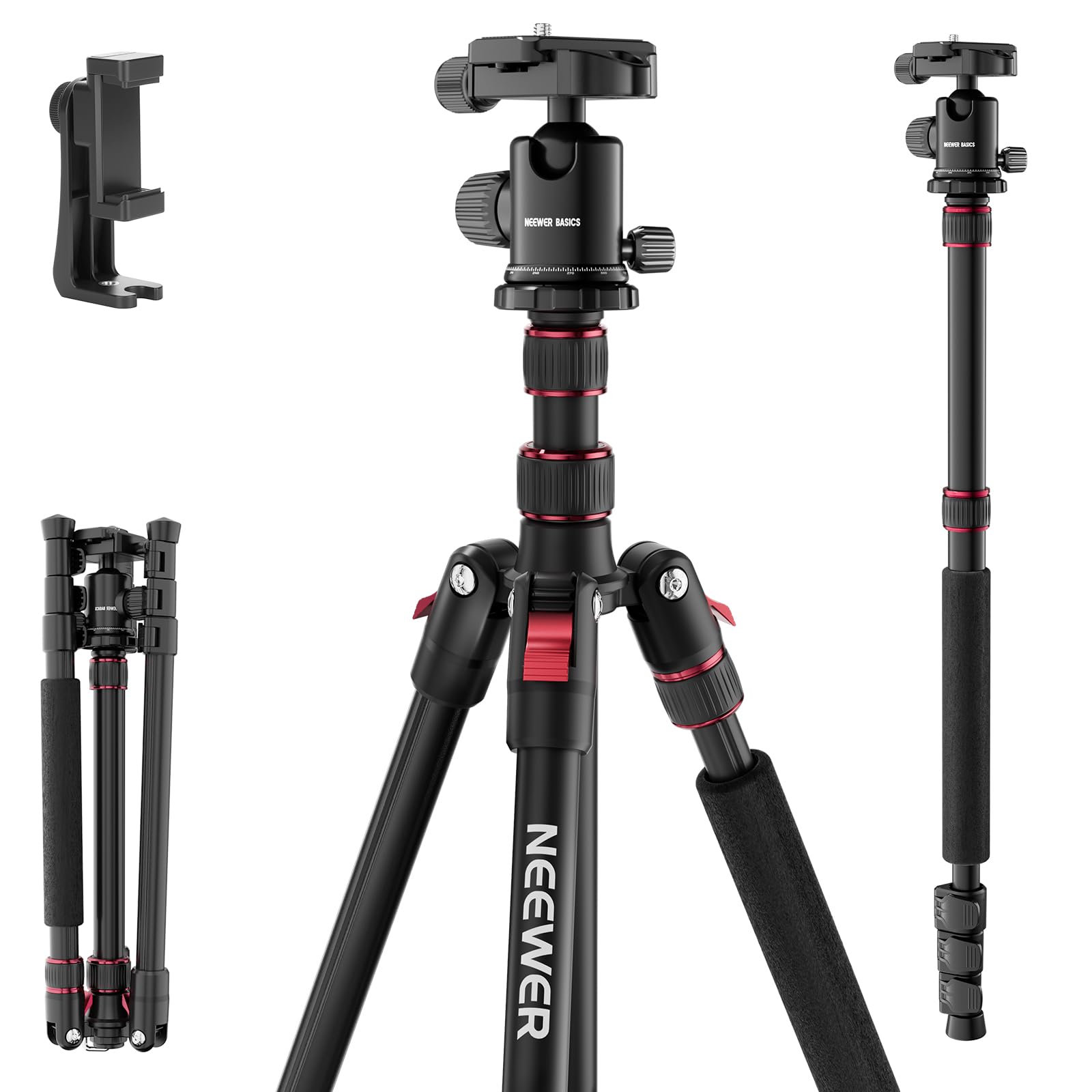
Heavy duty meets travel-friendly with a 2-axis center column that goes from 17 to 71 inches.
This NEEWER TP15 carries up to 17.6 lb (matching the K&F and XXZU) but adds a 2-section center column that lifts higher and a monopod conversion for when you want to move faster. The 36mm ball head rotates 360 degrees and tilts 90 degrees. The legs have reversible design with non-slip feet and metal spikes — the metal spikes dig into soft ground like grass or dirt for extra grip, a feature the NEEWER TP14B lacks. It weighs 3.1 lb, making it roughly half a pound lighter than the K&F.
Transform it into a monopod adjustable from 31.5 to 74.4 inches by detaching the center column and one leg. This is useful for hiking, events, or any situation where a full tripod feels cumbersome. Reviewers point out it feels “sturdy” and the flip locks are “strong.” The included phone holder fits most smartphones, and the standard 1/4-inch screw works with Canon, Nikon, and Sony DSLRs. One landscape photographer noted the round center column rotates slightly during panoramic use — you need to tighten the screw firmly to avoid drift. Unlike the XXZU, this model does not include a Bluetooth remote, so plan for a separate trigger.
What Stands Out
- 17.6 lb load capacity matches pricier models
- Converts to monopod (31.5″ to 74.4″)
- Metal spikes for outdoor grip
What to Know
- Round center column may rotate during panos if not tightened
- No remote control included
Who it fits: Shooters who want heavy-duty capacity for a DSLR but also need a monopod mode for hiking or events. The caveat: The center column’s round shape can rotate during precise panoramas — tighten the adjustment screw to hold it still.
4. NEEWER Basics 66.5″/169 cm Travel Tripod (TP12)
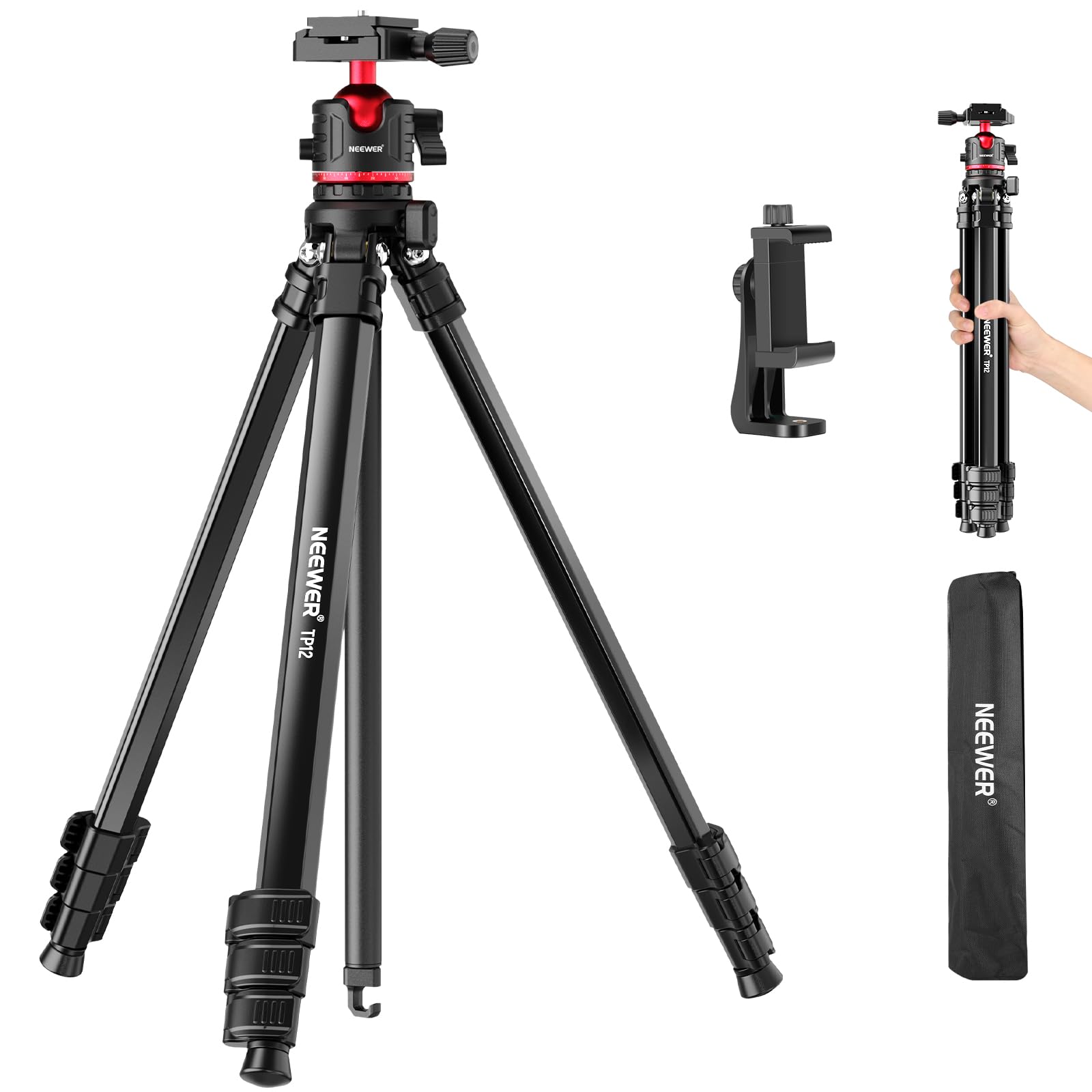
The slimmest folded tripod here, with a 2.4-inch diameter that fits one-handed carry.
If your priority is portability above all else, this is the tripod that disappears into a backpack. When folded, the legs collapse to a diameter of just 2.4 inches — you can wrap your hand around it. It weighs 2.9 lb and extends from 20.1 inches to a maximum of 66.5 inches using a liftable center column. That center column is invertible for low-angle and macro shots. Buyers call it “shockingly good for the price” and note it “feels like carbon fiber” despite being aluminum.
The max load is 11 lb (5 kg), which is lower than the 17.6 lb models — enough for a mirrorless camera with a medium lens or a compact DSLR, but not enough for a full-frame body with a heavy telephoto. The 40mm pan base has a U-shaped groove for smooth 90-degree vertical shots. The Arca-Swiss compatible quick release plate is also compatible with PD backpack clip mounts (Peak Design clip system that attaches a camera plate to backpack straps). One buyer mentioned the ball head stays stiff even when loosened, so precise micro-adjustments need a second hand on the knob. The phone holder rotates 360 degrees for portrait to landscape switching.
Why It Shrinks
- Folded 2.4″ diameter — easiest to pack
- Only 2.9 lb but still feels sturdy
- Arca-Swiss compatible plate with PD clip support
Where It Limits
- 11 lb max load is too low for heavy DSLR + telephoto
- Ball head knob can feel stiff during small adjustments
Best for: Travelers, hikers, and mirrorless camera users who need the smallest possible tripod without giving up a full 66-inch height. Not for: Anyone using a heavy full-frame camera or a long telephoto — the 11 lb limit gets tight fast.
5. NEEWER Basics 72″/182 cm Travel Tripod Monopod (TP14B)

A travel tripod that reaches 72 inches and converts to a monopod, all at a price that undercuts most rivals.
This pick is the budget traveler’s balance. It extends from 22.8 inches up to a full 72 inches thanks to a 2-section center column, yet folds to 17 inches and weighs 2.9 lb. The included phone holder fits most smartphones, and the 360-degree ball head with 90-degree tilt covers standard angles.
Buyers consistently call it “sturdy” and “lightweight yet surprisingly sturdy.” One owner said, “The adjustable height up to 71 inches is a huge advantage, allowing for a wide range of shooting angles.” It includes a phone holder and a well-made carrying bag. The red color makes it easy to spot in a gear bag. The three leg-angle adjustments help level the tripod on stairs or uneven ground. Unlike the TP15, this model lacks metal spikes on the feet, so it relies on rubber feet for grip. The 13.2 lb max load falls short of the 17.6 lb Lamicall and XXZU models, so heavier gear is out of bounds.
Best Height-to-Price Ratio: At 72 inches maximum height for a mid-range price, it reaches eye level for most users without the premium cost. Load Limitation: At 13.2 lb, it handles smaller DSLRs and mirrorless cameras but not heavy full-frame setups with long lenses — the XXZU and Lamicall both hold 34% more weight.
Best for: Travel photographers and vloggers who want a tall, lightweight tripod that converts to a monopod without spending much. pass on it if: You shoot with heavy gear — the 13.2 lb limit is well below the 17.6 lb models.
6. XXZU 75″ Camera Tripod with Remote & 360° Ball Head

The tallest budget tripod here at 75 inches, with a Bluetooth remote for solo shooting.
The XXZU tops the height chart among the budget picks at 75 inches — a full 12% taller than the Lamicall’s 67 inches. That extra height lets you shoot full-body portraits, group shots, and overhead angles without crouching. The max load is 17.64 lb (vertical) or 6.61 lb at a 45-degree tilt, which matches the Lamicall’s 17.63 lb. One buyer called it the “most solid and stable of 3 tripods” they had tried. The built-in Bluetooth remote works up to 10 meters (about 33 feet), so you can trigger the shutter without running back to the camera.
The 3-in-1 detachable center column converts into a monopod (max height 43.9 inches) or can be inverted for low-angle macro shooting. The legs have three angle adjustments and independent locks, which means each leg can sit at a different angle on rocky or uneven ground. Folded, it measures 14.37 inches and weighs 2.18 lb — the lightest of any pick here. The included phone holder fits smartphones from 4 to 7 inches. Shoppers say the remote only works with a phone, not a dedicated camera’s shutter release, so plan accordingly if you shoot mostly with a DSLR.
What Makes It Tall
- 75″ max height — tallest in the budget group
- Bluetooth remote for solo phone shooting (10m range)
- Folds to just 14.37″ and weighs 2.18 lb
Limitations
- Remote works only with phone, not DSLR shutter
- Some buyers wish vertical phone rotation was smoother
Who this fits: Solo content creators who shoot mostly with a phone and need the tallest possible tripod plus a remote trigger. Who should pass: DSLR shooters who need a remote release for the camera — the Bluetooth remote only controls the phone.
7. Lamicall Camera Tripod – 17.6LBS Max Load Tripod for Camera with Rapid Leg Deployment
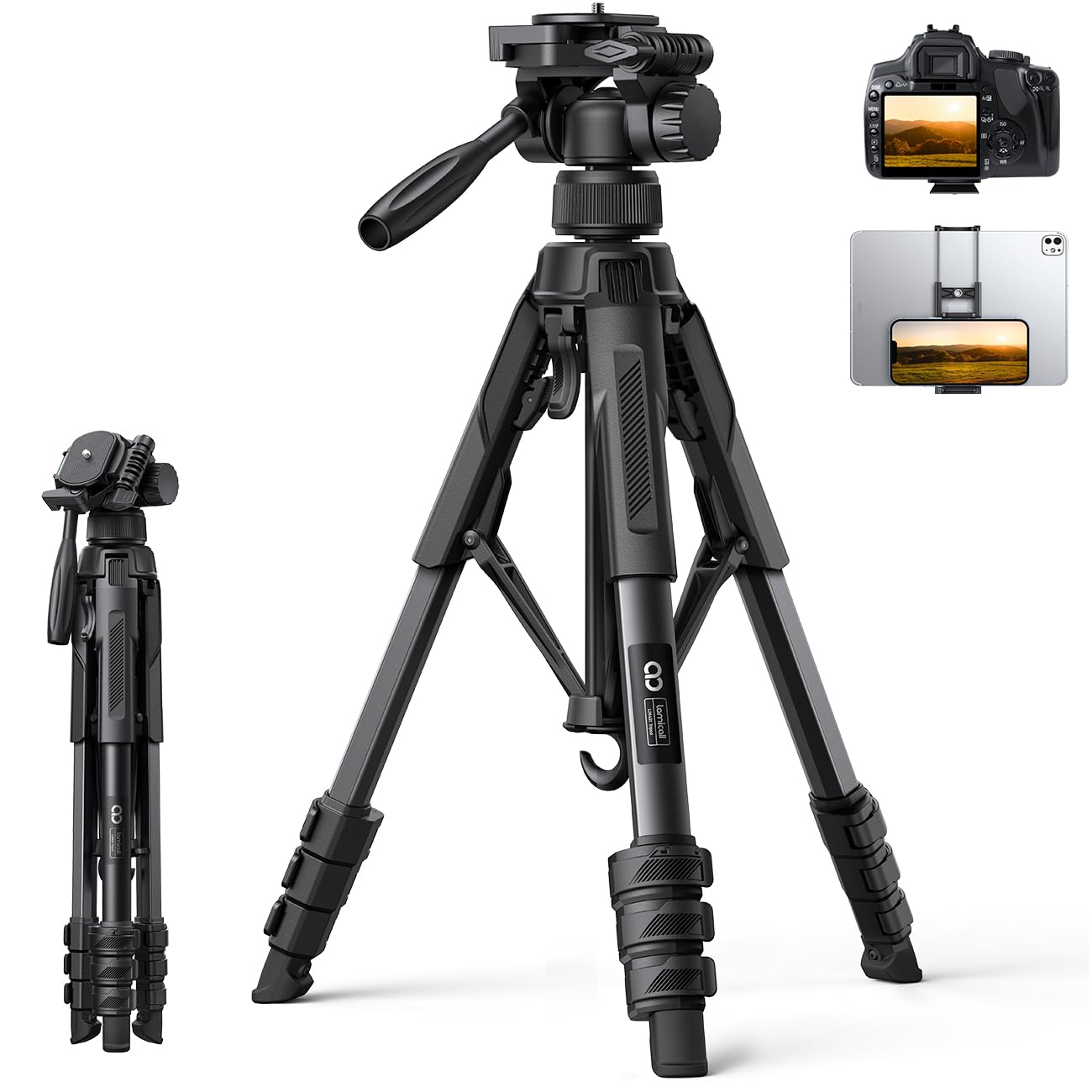
A 17.63 lb capacity tripod with patented rapid leg deployment that collapses in one motion.
This is the fastest tripod to set up and break down of any pick here. The patented rapid leg deployment system uses externally-mounted locking levers — you engage all three latches at once to deploy or collapse the legs in a single motion. No individual twist locks, no four-section fumbling. The legs have adjustable angles from 24 to 75 degrees, which helps level the tripod on uneven terrain without needing to adjust leg length first. Buyers call it “sturdy yet lightweight” and note “no finger pinching.”
The max load is 17.63 lb (matching the XXZU’s 17.64 lb), supported by 0.3mm-thick steel leg tubes and anti-slip rubber feet. It extends from 19 inches to a maximum of 67 inches — shorter than the 75-inch XXZU but still enough for most users to shoot at eye level. The 3-way pan head offers 360-degree horizontal rotation, 180-degree up/down tilt, and 90-degree vertical flip. It has dual spirit levels (small bubble levels that show if the tripod is perfectly horizontal — one on the head, one on the center column) for precise framing. The phone clamp accommodates devices from 4.7 to 7 inches, but buyers report it does not open wide enough for an iPhone 15 in an Otterbox case without removing the case first.
Setup Speed: The external latches let you deploy or collapse all three legs at once — faster than any twist-lock or individual-flip system. Phone Clamp Width: The spring-loaded phone clamp maxes out at 7 inches, which means thick cases (like an Otterbox on an iPhone 15) require case removal — plan for that when you shoot.
Best for: Vloggers and event shooters who set up and break down their tripod dozens of times in a day — the rapid leg deployment saves real time. Look elsewhere if: You never take your phone out of a thick protective case; you will need to remove it to fit the clamp.
Understanding the Specs
Max Load Capacity
This is the heaviest camera setup the tripod can hold without sagging, drooping, or tipping over. Measured in pounds (lb) or kilograms (kg). If your camera body plus your heaviest lens exceeds this number, the tripod will not stay stable. A rule of thumb: add 30% to your camera+lens weight to account for wind, reaching, and off-center tilting. A 17.6 lb tripod gives safe room for a DSLR with a standard zoom. A 35 lb tripod can handle a full-frame body, a 70-200mm lens, and a flash.
Ball Head vs Pan Head
A ball head (a single spherical joint inside a locking collar) lets you tilt and rotate the camera in any direction with one knob. It is fast and intuitive for photography. A pan head has separate controls for horizontal pan and vertical tilt, giving smoother video movements but slower adjustments. Almost every budget tripod uses a ball head. Look for a ball head with a 360-degree panning base (marked on the spec sheet) so you can rotate the camera horizontally without moving the tripod legs.
Leg Locks: Flip vs Twist
Flip locks are spring-loaded levers that snap open and closed. They are faster to use — you can undo all sections in seconds. Twist locks are threaded collars that you rotate to loosen and tighten. They are more compact on the leg and less likely to snag on gear, but each section takes a few seconds longer. If you set up the tripod frequently (multiple locations in a shoot), flip locks save time. If you pack the tripod tightly, twist locks lie flatter against the leg.
Center Column and Monopod Mode
The center column is the vertical tube that lifts the camera above the legs. Extending it adds height but reduces stability because the weight is farther from the tripod’s base. A hook under the center column lets you hang a bag for extra weight to counteract wind. Some tripods have a detachable center column that becomes a monopod when combined with one leg. That gives you a lighter, faster option for walking shots or events, but the monopod’s height is usually shorter than the full tripod.
FAQ
Will a budget tripod hold my DSLR with a telephoto lens?
How tall should a budget tripod be for eye-level shooting?
What is the difference between a ball head and a pan head?
Are flip locks better than twist locks for a budget tripod?
Can I use a budget tripod with my phone?
What does the center column hook do on a tripod?
How does a tripod convert into a monopod?
Is a heavier tripod always more stable?
Will the ball head sag over time on a budget tripod?
What does Arca-Swiss compatible mean on a tripod plate?
Final Thoughts: The Verdict
Across the board, the best budget camera tripod winner is the K&F Concept 76 inch because its removable boom arm adds real versatility for overhead product shots and flat lays that no other tripod at this price offers. If you want the tallest possible height for full-body portraits, the XXZU 75 inch delivers 75 inches plus a remote for solo phone shooting. And for maximum load capacity that handles heavy gear with confidence, the Victiv 80/85 inch carries up to 35 lb — more than double most budget options — while still folding down for travel.
How We Picked
We do not accept paid placement. Every pick is matched to a real buyer and a real use-case; we do not hands-on test units.
Sources & Methodology
Specifications: manufacturer listings and product documentation. Review insights: verified customer reviews, as of July 2026. Pricing: not shown on this page (it changes often); check the current price via the retailer link.
As an Amazon Associate, FitlyFast earns from qualifying purchases. This does not affect which products we feature.