
Our readers keep the lights on and the weekend projects moving. As an Amazon Associate, I earn from qualifying purchases.
Specs are compiled from manufacturer listings and verified buyer reviews and can change over time — please confirm the key details on the product page before buying.
A great night under the stars or a stiff, sleepless one on the cold ground — the difference is often just a few inches of padding between you and the dirt. You do not need to spend a lot to sleep well, but you do need to pick the right type of pad for the way you camp. This guide breaks down the best budget camping pad options for everyone, from car campers who want thick foam to backpackers who count every ounce.
I’m Rikta — the founder and writer behind FitlyFast. This guide is built by comparing the manufacturers’ published specifications and the patterns across verified customer reviews, so you get each pick’s real strengths and trade-offs instead of marketing spin.
Whether you are a side sleeper needing 4 inches (10.2 cm) of lift or an ultralight hiker trying to shave ounces, finding the right budget camping pad depends on matching thickness, weight, and inflation style to your actual sleeping setup.
Our Picks at a Glance

How To Choose The Best Budget Camping Pad
Picking a camping pad on a budget means knowing which spec actually matters for your sleep style. The biggest mistake is buying an inflatable pad that is too thin for side sleeping or a foam pad too bulky for your pack. Here is what to focus on.
Thickness and Comfort
If you sleep on your side, you need at least 3 inches (7.6 cm) of air or foam under your hips and shoulders to keep them off the ground. Back sleepers can get away with 2 inches (5 cm) or even a thin closed-cell foam pad (a solid foam sheet that never deflates). Inflatable pads give you more loft for the weight, while foam pads are puncture-proof but often thinner — the AceCamp is just 0.5 inches (1.3 cm) thick, while the Oramoose delivers a full 4 inches (10.2 cm).
Inflation Method
Self-inflating pads use foam inside that expands when you open the valve, but they still need a few puffs of air to reach full firmness. Foot-pump pads (like the Oramoose and Amazon Basics) let you step on the valve to inflate, saving your lungs but taking about 30–60 seconds. Closed-cell foam pads need zero inflation — just unroll and lie down. Your choice depends on whether you value setup speed or bulletproof reliability.
R-Value and Insulation
R-value (a measurement of how well the pad stops heat loss to the ground) tells you how much cold the pad blocks. For summer-only camping, an R-value of 2.0 (like the NEMO Switchback or the AceCamp) is fine — it keeps you warm enough when the ground is not freezing. For three-season use (spring, summer, fall), aim for 3.0 or higher. Most budget inflatables do not list an R-value at all, which means they offer minimal insulation — you will feel cold ground more easily overnight.
Quick Comparison
| Model | Best For | Thickness | Weight | Capacity | Amazon |
|---|---|---|---|---|---|
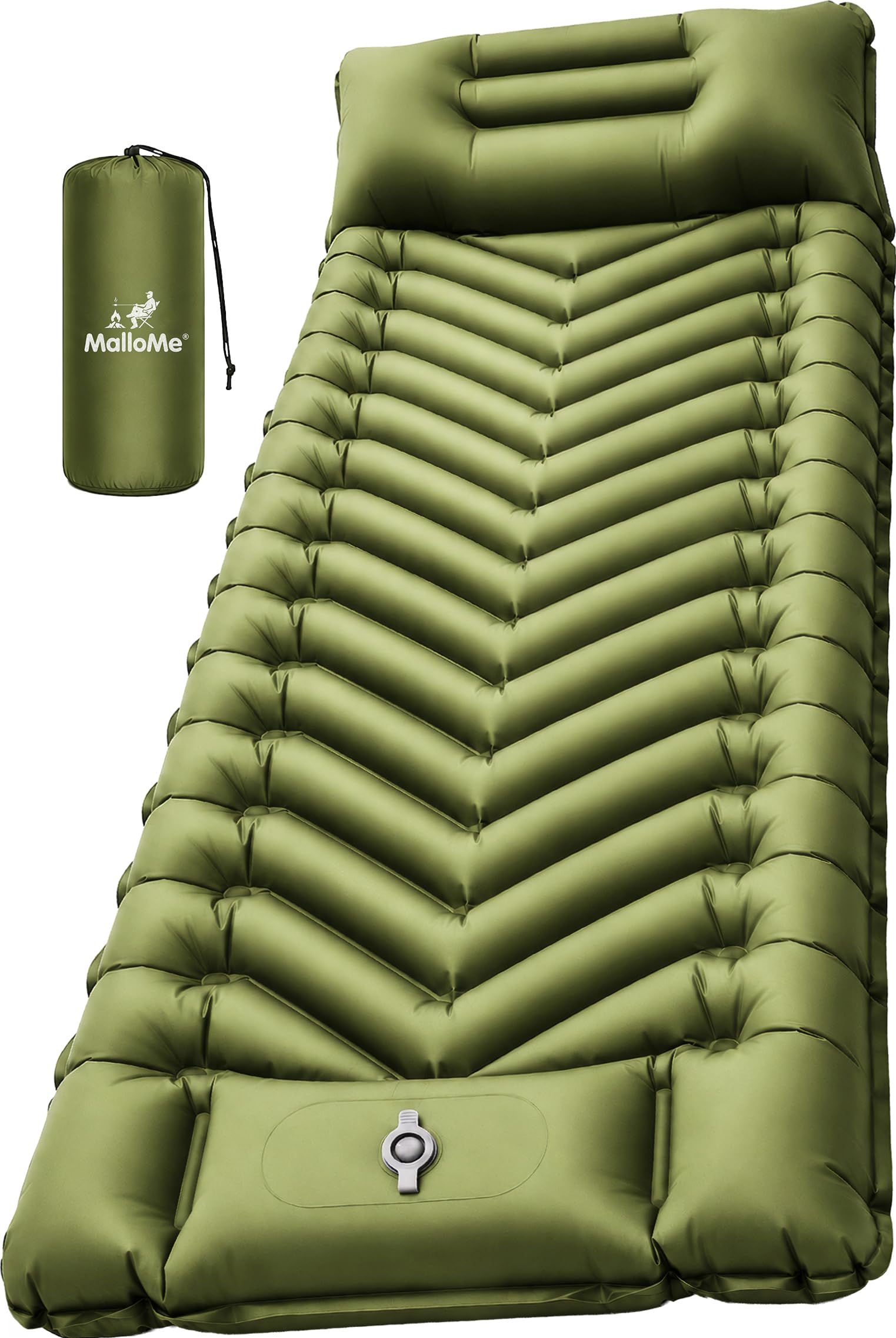
| MalloMe Self-Inflating Pad★ Best Overall | Balanced comfort and packability | 1.5 in | Not listed | Not listed | Amazon |
| Oramoose 4in Inflatable PadAlso Great | Side sleepers wanting max loft | 4 in | 1.9 lbs | 400 lbs | Amazon |
| Amazon Basics Foot Pump Pad | Ultralight backpacking trips | 2.2 in | 1.4 lbs | 220 lbs | Amazon |
| AceCamp Foam Pad | Budget-friendly closed-cell reliability | 0.5 in | 11 oz | — | Amazon |
| Fochier F Peanut Foam Pad | Compact closed-cell with insulation | Not listed | 0.86 lb | — | Amazon |
| CYMULA 3in Memory Foam Pad | Car camping luxury on a cot | 3 in | 6.4 lbs | — | Amazon |
| NEMO Switchback Foam Pad | Warm, durable closed-cell for all seasons | 0.9 in | 0.93 lb | — | Amazon |
In‑Depth Reviews
1. MalloMe Self-Inflating Sleeping Pad
A self-inflating hybrid that packs small and gives warm, plush support for tent campers — but at only 1.5 inches thick.
The MalloMe uses a patent-pending Chevron V-shape air-cell design that spreads your weight evenly and reduces pressure points. The foam inside expands when you open the valve, so the bed self-inflates after the first mouth-inflated setup. Buyers mention these mats are 1.5 inches (3.8 cm) thick, not 2 inches — so while the pillow section is taller, the main sleeping area is thinner than the Oramoose. At 1.5 inches, back sleepers find it comfortable, but side sleepers may feel the ground under their hips after a few hours. The 50D polyester cover (a medium-weight fabric) with anti-leak TPU (thermoplastic polyurethane, a tough plastic) reinforcement resists punctures, and the pad rolls up small for backpacking. One buyer mentioned it was way more comfortable than most self-inflating pads on the market and kept them warm on their first camping trip. You will need about 10 puffs of mouth air to finish inflation after the foam expands — it is not fully hands-free.
What it does well
- Self-inflating foam saves effort after first use
- Compact roll size fits easily in a backpack
- Water-resistant 50D fabric (a durable polyester) holds up on damp tent floors
One honest drawback
- Only 1.5 inches (3.8 cm) thick — side sleepers may bottom out
- Not truly self-inflating; needs mouth puffs to top off
Best for: back sleepers who want a lightweight, warm pad that packs small and sets up without a pump.
skip it if: you sleep on your side and need more than 2 inches (5 cm) of cushion to stay off the ground.
2. Oramoose 4in Thick Ultralight Inflatable Pad
Four inches of air lift — compared to the MalloMe pad’s 1.5 inches — that keeps side sleepers off the ground without emptying your wallet.
The Oramoose pad gives you 4 inches (10.2 cm) of air between you and the dirt. That is more than twice the 1.5 inches (3.8 cm) you get from the MalloMe pad, so your hips and shoulders stay fully suspended instead of pressing into hard ground — a real advantage for side sleepers. The built-in foot pump fills the pad in about 30 seconds, and buyers report inflating both pads for two people took maybe 3 minutes, leaving them very happy with the purchase. An integrated pillow contours to your neck so you do not wake up stiff after a hike. The 40D nylon (a durable fabric weight) base resists punctures from rocks and branches. The whole pad folds to 9.4 x 4.3 inches (23.9 x 10.9 cm) at just 1.9 pounds (0.86 kg), and its 400-pound (181-kg) weight capacity supports larger body types without bottoming out. One downside: some owners mention the foot pump is slow — one reviewer noted the self-blow-up takes forever, so they ended up blowing by mouth. The pad also lacks a stated R-value (insulation rating), so you will likely feel cold ground seep through in sub-40°F weather.
Why it leads the pack
- Class-leading 4-inch (10.2 cm) thickness at a budget price
- 40D nylon (a tough fabric) bottom resists punctures on rough terrain
- Holds 400 pounds (181 kg), suitable for larger campers
The catch
- Foot pump can be slow; some users revert to mouth inflation
- No listed R-value (insulation rating) for cold-weather camping
Reach for this if: you are a side sleeper or a heavier person who needs thick, reliable cushioning without spending premium cash.
Look elsewhere if: you sleep in sub-40°F (4°C) weather — the lack of a stated R-value means you will feel cold ground seep through.
3. Amazon Basics Camping Sleeping Pad

At 1.4 pounds (0.64 kg) with a built-in foot pump, it is the lightest inflatable in this roundup, made for backpackers who count grams — but reliability varies.
The Amazon Basics pad weighs just 1.4 pounds (0.64 kg) and packs to 12 by 4 inches (30.5 x 10.2 cm), fitting into a backpack’s side pocket. The Insta-Pump foot pump inflates it in under 60 seconds. At 2.2 inches (5.6 cm) thick and 22 inches (55.9 cm) wide, it offers decent comfort for back sleepers, but its 220-pound (99.8-kg) weight capacity is noticeably lower than the Oramoose’s 400-pound limit — larger campers may feel the ground more. The built-in pump can fail, according to buyer feedback. One reviewer wrote “built-in pump non-functional; easy to blow up manually,” and another reported the pad failed after 5 nights. So while the design is clever, quality control is inconsistent. The 190T polyester fabric (a lightweight nylon-polyester blend) feels decent for the price but lacks the puncture resistance of the Oramoose’s 40D nylon.
Why backpackers like it
- Ultralight 1.4-pound (0.64-kg) weight beats most inflatables
- Foot pump inflation is fast when it works
- Packs smaller than a water bottle
The reliability risk
- Some units have pump failures or seam leaks
- 220-pound (99.8-kg) capacity limits larger sleepers
Grab it for: ultralight backpacking trips where every ounce counts and you are willing to accept some quality risk.
Pass if: you need a pad that will survive hardcore bushcraft or weekly use — the failure rate is too high for that.
4. AceCamp Portable Foam Sleeping Pad

At 11 ounces (312 g) and just a few dollars, this closed-cell foam (solid foam sheet) pad is the cheapest reliable sleep insurance you can carry — but at only 0.5 inches (1.3 cm) thick, it is not plush.
The AceCamp pad is old-school simplicity — closed-cell polyethylene (PE) foam (a lightweight, waterproof plastic foam) that does not inflate, does not leak, and does not fail. It weighs only 11 ounces (312 g) and folds like an accordion into a compact bundle secured by two compression straps. The foam is 0.5 inches (1.3 cm) thick, so it offers minimal cushion alone, but buyers often pair it under an inflatable pad as a protective, insulative layer. One owner reported it doubles as a portable seat on the trail. With an R-value of 2.0 (a basic barrier against cold ground), it works for summer camping but not for frosty nights. A few owners noted light wear after a 12-day hiking trip, but at this price you can replace it without wincing.
Where it shines
- 11 ounces (312 g) — lighter than almost any inflatable
- No inflation, no valves, no failure points
- R-Value 2.0 adds insulation under another pad
The obvious limit
- Only 0.5 inches (1.3 cm) thick — side sleepers will feel every rock
- Bulky when folded despite being lightweight
Use it as: a base layer under an inflatable pad for extra insulation and puncture protection, or as a summer-only solo pad for back sleepers.
Not for: anyone who needs a standalone comfortable pad for side sleeping or cold-weather camping.
5. FOCHIER F Peanut-Shape Closed Cell Foam Pad

A peanut-shaped closed-cell pad (solid foam in a wavy pattern) that balances compact folding with real insulation for chilly ground — but still thin for the comfort-minded.
The Fochier F uses IXPE foam (a denser, more insulating foam than standard polyethylene) and shapes it into a peanut profile with peaks and valleys that trap air. This design helps it fold smaller than a flat foam pad while providing better thermal separation from the ground. Buyers in military field conditions say it is the best lightweight, compact foam pad they have used in 7 years, noting it survived multiple events without breaking down. At 0.86 pounds (0.39 kg), it is slightly heavier than the AceCamp but offers better insulation and a more compact folded bundle. It is waterproof, so morning condensation or a damp tent floor does not soak through. One customer observed that despite good temperature isolation, there is not really a difference from just lying on mother earth in terms of plushness.
Why it stands out
- IXPE foam (a denser insulation foam) provides better insulation than standard PE foam
- Peanut shape folds smaller than flat accordion pads
- Waterproof construction blocks damp ground
The downside
- Still thin — not for campers wanting plush cushioning
- Narrow width may not suit broad-shouldered sleepers
Pick this for: ultralight hikers and military-style campers who need a durable, insulating foam pad that packs tight and never fails.
Choose something else if: comfort is your top priority — this is a survival pad, not a luxury mattress.
6. CYMULA 3 Inch Memory Foam Camping Pad
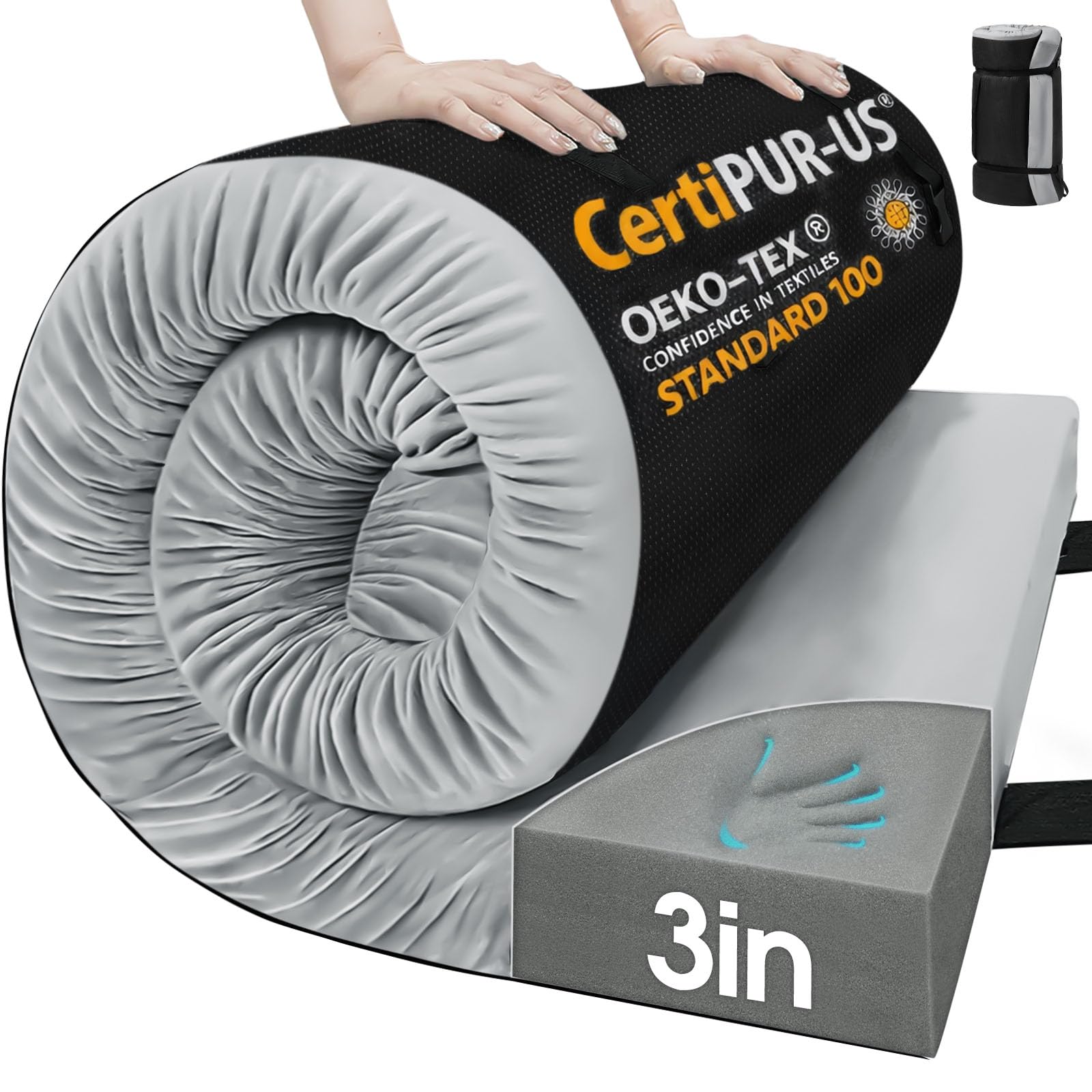
Three inches (7.6 cm) of carbon-fiber memory foam that turns a camp cot into something close to your bed at home — but at 6.4 pounds (2.9 kg), it stays in the car.
The CYMULA pad is a solid 3-inch (7.6 cm) slab of high-elasticity memory foam with a dense base layer, designed for car camping or topping a cot. At 6.4 pounds (2.9 kg), it is not backpackable, but for driving to a campsite and wanting real mattress feel, this is the most comfortable option in this list. Customers note it provided excellent warmth in 30°F (-1°C) temperatures on a wooden platform with a cot, calling it the most comfortable camping sleep they have had. The removable polyester cover zips off and goes in the washing machine. A waterproof bottom with rubberized anti-slip dots stops the pad from sliding. One owner mentioned the included straps are weak and replaced them with tension straps, and the pad is bulky when rolled — it takes up real car space. Some units also have a strong chemical smell out of the package that needs ventilation.
What car campers love
- Real memory foam comfort — 3 inches (7.6 cm) of cushion without air leaks
- Machine-washable cover keeps it fresh after muddy trips
- Waterproof non-slip bottom stays put on cots
Where it falls short
- 6.4 pounds (2.9 kg) and bulky — not for backpacking
- Some units have a strong chemical odor initially
Ideal for: car campers, RV travelers, and anyone using a cot who wants true mattress-level comfort without the hassle of inflation.
Not for: backpackers or anyone who needs to carry their sleep system on foot — this stays in the car.
7. NEMO Equipment Switchback Foam Sleeping Pad
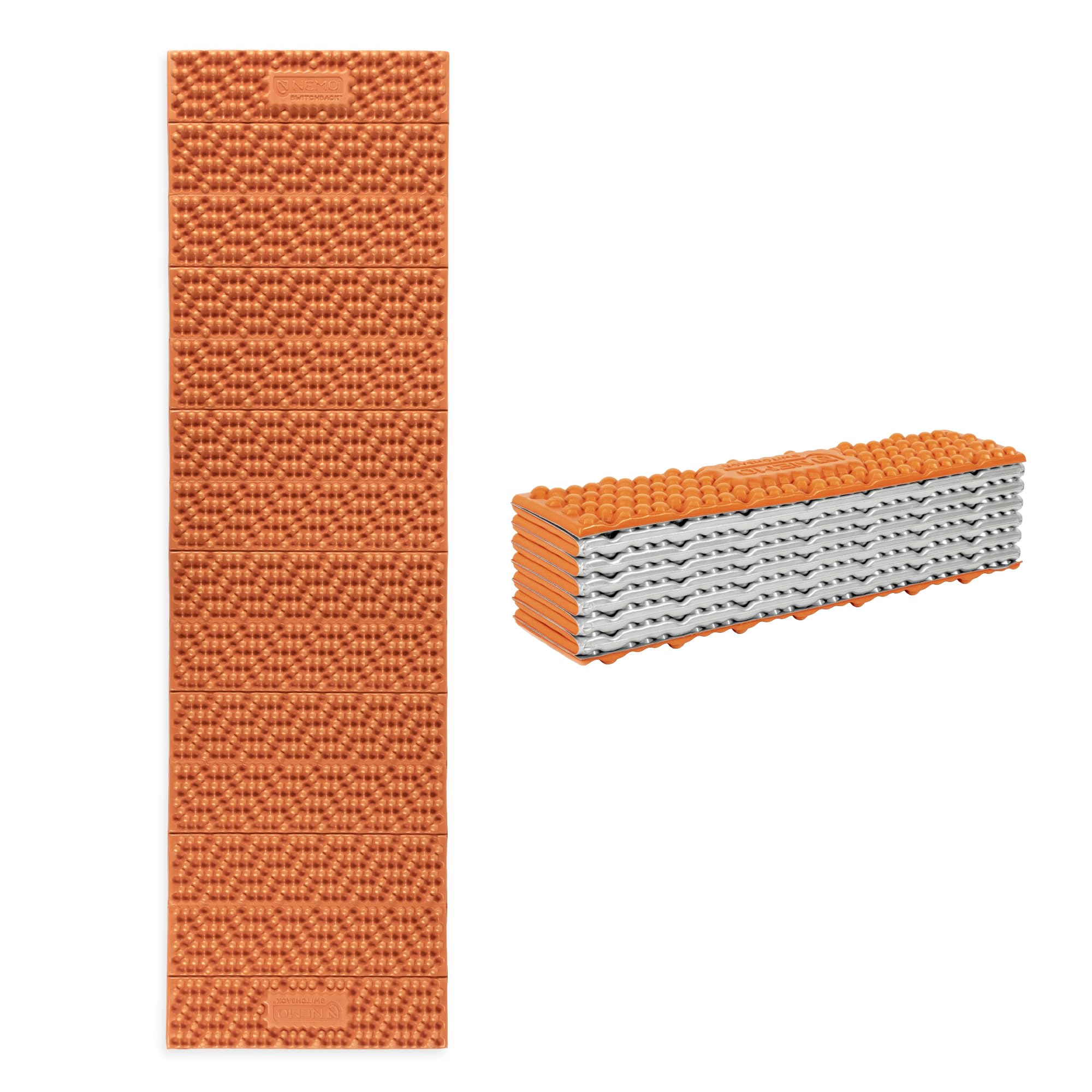
A premium closed-cell pad (solid foam with raised bumps) that earns 4.7 stars from 675 reviews — plusher than flat foam and backed by a lifetime warranty.
The NEMO Switchback uses a hexagonal nesting pattern that allows the nodes (the raised bumps) to be taller and more closely packed, so the pad is plusher than a flat foam mat while folding down compactly. The dual-density Axiotomic foam (a mix of soft top foam for comfort and firm bottom foam for support) plus a metallized thermal reflective film on the underside bounces body heat back at you. With an R-value of 2.0, it is warm enough for three-season use, and buyers often pair it under an inflatable pad in winter to extend the temperature range into the teens Fahrenheit. At 0.93 pounds (0.42 kg), it is only slightly heavier than the AceCamp foam pad, but the build quality makes it noticeably more comfortable. One user highlighted it performed great on a concrete floor, blocking pressure points for side sleeping. The main trade-off is that it takes up more pack space than an ultralight inflatable — one owner noted it takes up a lot of space but is light enough to strap to a pack. The NEMO lifetime warranty gives confidence no other budget pad here offers.
what separates it
- Taller hexagonal nodes (raised bumps) provide noticeably more plushness than flat foam pads
- Metallized reflective film adds warmth without weight
- Lifetime warranty against defects
The one compromise
- Bulky packed size — larger than an equivalent inflatable
- Less cushioned than a thick air pad for side sleepers
Choose this if: you want a tough, warm, no-fuss foam pad that will outlast several inflatables and comes with a lifetime guarantee.
Pass if: your number one priority is maximum cush for the weight — an inflatable like the Oramoose gives more loft per gram.
Understanding the Specs
Thickness (Inches)
Thickness is the single most important spec for comfort. Inflatable pads (like the Oramoose at 4 inches / 10.2 cm) give you an air gap that keeps your hips and shoulders off the ground. Closed-cell foam pads (solid foam sheets, like the AceCamp at 0.5 inches / 1.3 cm) are far thinner and work best as insulation layers under an inflatable pad or for back sleepers who do not need much lift. If you are a side sleeper, aim for at least 3 inches (7.6 cm).
R-Value (Insulation Rating)
R-value measures how well the pad resists heat loss to the cold ground. A pad with an R-value of 2.0 (like the NEMO Switchback or the AceCamp) is fine for summer camping when the ground is not freezing. For fall and shoulder-season trips, look for R-Value 3.0 or higher. Most budget inflatable pads do not list an R-value, which means they offer almost no insulation — you will feel the cold ground through the air layer overnight.
Weight and Packed Size
For backpackers, every ounce matters. The Amazon Basics pad weighs 1.4 pounds (0.64 kg), while the Oramoose is 1.9 pounds (0.86 kg). Foam pads like the AceCamp (11 ounces / 312 g) and the NEMO Switchback (0.93 pounds / 0.42 kg) are lighter but bulkier when strapped to a pack. Car campers can ignore weight and focus on comfort, which is where the CYMULA memory foam pad (6.4 pounds / 2.9 kg) shines.
Inflation Type
Foot-pump pads have a valve you step on to push air in — fast when it works, but the mechanism can fail (some Amazon Basics users reported pump issues). Self-inflating pads (MalloMe) use internal foam that expands, but you still top off by mouth. Closed-cell foam pads need zero inflation — just unroll. Straight mouth-inflate pads are the lightest but require lung power.
FAQ
How thick does a budget camping pad need to be for side sleepers?
Can I use a closed-cell foam pad alone for comfortable sleep?
What does R-value mean and do I need it for summer camping?
How long do budget camping pads last?
Are foot pump pads better than self-inflating pads?
Will a budget camping pad fit inside my sleeping bag?
What is the difference between closed-cell foam and inflatable pads?
How do I clean and store a camping pad to make it last longer?
Final Thoughts: The Verdict
If you want one dependable pick, the budget camping pad winner is the Oramoose 4-inch Inflatable Pad because it delivers premium-level thickness and support at a price that rivals thinner options. If you want the lightest possible carry for backpacking without inflatables, grab the NEMO Switchback Foam Pad for its warmth and lifetime warranty. And for car campers who want real memory foam comfort, the standout is the CYMULA 3-inch Memory Foam Pad.
How We Picked
We do not accept paid placement. Every pick is matched to a real buyer and a real use-case; we do not hands-on test units.
Sources & Methodology
Specifications: manufacturer listings and product documentation. Review insights: verified customer reviews, as of July 2026. Pricing: not shown on this page (it changes often); check the current price via the retailer link.
As an Amazon Associate, FitlyFast earns from qualifying purchases. This does not affect which products we feature.