
Our readers keep the lights on and the weekend projects moving. As an Amazon Associate, I earn from qualifying purchases.
Specs are compiled from manufacturer listings and verified buyer reviews and can change over time — please confirm the key details on the product page before buying.
Fat tires let you float over sand, snow, and mud without sinking in — and the price tag doesn’t have to sink either. The trick is knowing which budget-friendly build actually holds up on the trail and which one leaves you stranded with a broken derailleur.
I’m Rikta — the founder and writer behind FitlyFast. This guide is built by comparing the manufacturers’ published specifications and the patterns across verified customer reviews, so you get each pick’s real strengths and trade-offs instead of marketing spin.
After combing through the build specs and hundreds of real-world owner experiences, these are the picks that deliver true off-road capability while staying affordable — our definitive list of the best budget fat tire bike options available right now.
Our Picks at a Glance


How To Choose The Best Budget Fat Tire Bike
The extra-wide tires that make fat tire bikes so capable on loose terrain also make them heavier and slower on pavement than a standard mountain bike. Before you click buy, match these five specs to your riding plans.
Frame Material
High-carbon steel absorbs vibrations well and keeps costs down, but it adds noticeable weight. Alloy steel or aluminum frames weigh less and resist rust better — a meaningful difference if you live near salt water or carry the bike up stairs. Most entry-level fat tire bikes use some form of steel; an aluminum frame typically raises the price into the mid-range tier.
Drivetrain Gearing
A 7-speed drivetrain keeps things simple and needs less tuning, but the gap between gears feels wider — you may find yourself wishing for a lower gear on steep climbs. A 21-speed drivetrain offers a finer range of gears, making hills easier to conquer and flats more efficient, but the front derailleur adds complexity and one more part that can go out of adjustment.
Tire Width and Tread
The defining spec here is the 4-inch-wide tire. That width gives you floatation on sand and snow, plus natural shock absorption that smooths out roots and rocks. Knobby treads dig in on loose trails, while a less aggressive tread pattern rolls faster on packed dirt and pavement. The trade-off is rolling resistance — those wide tires will slow you down on paved roads compared to a narrower tire.
Brake Type
Mechanical disc brakes are the standard on modern fat tire bikes. They offer consistent stopping power in wet, muddy, or snowy conditions where rim brakes would lose grip. Dual disc brakes (front and rear) give you more control than a single disc, especially on steep descents.
Weight and Assembly
A fat tire bike typically weighs 40 to 50 pounds. That heft makes it stable and durable but tiring to lift onto a car rack or carry over obstacles. Most budget bikes arrive 80 to 85 percent assembled. Expect to tighten bolts, adjust the brakes and derailleur, and inflate the tires. A few buyers report misaligned parts that require extra patience or a trip to a local bike shop for a tune-up.
Quick Comparison
| Model | Best For | Drivetrain | Frame Material | Brake Style | Amazon |
|---|---|---|---|---|---|
| MarKnig 26″ Fat Tire★ Best Overall | Taller riders on a tight budget | 21-speed | Carbon Steel | Dual Disc | Amazon |
| Outroad 26″ Fat TireBest Value | Value hunters wanting 21 speeds | 21-speed | Carbon Steel | Dual Disc | Amazon |
| Mongoose DolomiteTop Performer | Heavier riders and snowy commutes | 7-speed | Alloy Steel | Disc | Amazon |
| HILAND 24/26″ Fat Tire | First-time fat tire buyers needing simplicity | 7-speed | Carbon Steel | Dual Disc | Amazon |
| Huffy 26″/27.5″ Fat Tire | Riders who prioritize brand and Shimano shifting | 7-speed | Alloy Steel | Dual Disc | Amazon |
| Mongoose Aztec | Beach cruising with a proven name | 7-speed | Alloy Steel | Disc | Amazon |
| MICARGI SLUGO SS | Tall, heavy riders wanting cruiser comfort | 7-speed | Hi-Ten Steel | Disc | Amazon |
In‑Depth Reviews
1. MarKnig 26″ Fat Tire Mountain Bike
Twenty-one speeds and a recommended height range up to 7-foot-3.
The MarKnig is one of the few budget fat tire bikes that explicitly accommodates very tall riders — the recommended height range of 5-foot-5 to 7-foot-3 is generous and backed by an owner report of a 12-year-old grandson who found a “sturdy build” and good fit. The high carbon steel frame and 21-speed transmission give you the gearing range to tackle varied terrain, and the dual disc brakes and front suspension provide trail-appropriate stopping power and bump absorption. It arrives 85 percent pre-assembled with all tools included; one owner put it together in 15 minutes.
The reliability record is thin — with a small owner base, the durability feedback is split. An owner reports the bike is “sturdy and well made” but another notes the gear broke after a few rides, and a separate account describes alignment issues where the front tire drifts to one side while riding. The seat adjustment is also a weak point: tightening does not lock it in place, leaving the saddle prone to shifting. Compared to the Outroad (which has a much larger owner base), the MarKnig lacks the same volume of positive confirmation, making it a higher-risk pick. The 21-speed drivetrain gives it an edge over the 7-speed Huffy and HILAND models, but the frame quality and component reliability are less proven.
The appeal is straightforward: a 21-speed fat tire bike with a frame that fits riders up to 7-foot-3 at a price that undercuts most competitors. Tall riders who struggle to find an affordable fat tire bike that fits will find the MarKnig worth considering, but should budget time for a thorough post-assembly check of the gears, brakes, and seat post.
Height-friendly
- 21-speed drivetrain offers wide gearing for hills and varied terrain
- Recommended height range up to 7’3″ — one of the tallest-friendly options
- 85% pre-assembled; owner report of 15-minute installation
Reliability unknowns
- Small owner base makes long-term durability hard to assess
- Reported gear breakage after a few rides and front tire alignment drift
- Seat post does not tighten securely, allowing saddle movement
Best for: Very tall buyers (over 6-foot-2) who need a budget fat tire bike that actually fits their height without a custom frame.
Measured risk: The thin owner feedback means you are an early adopter — inspect every bolt and gear before your first real ride.
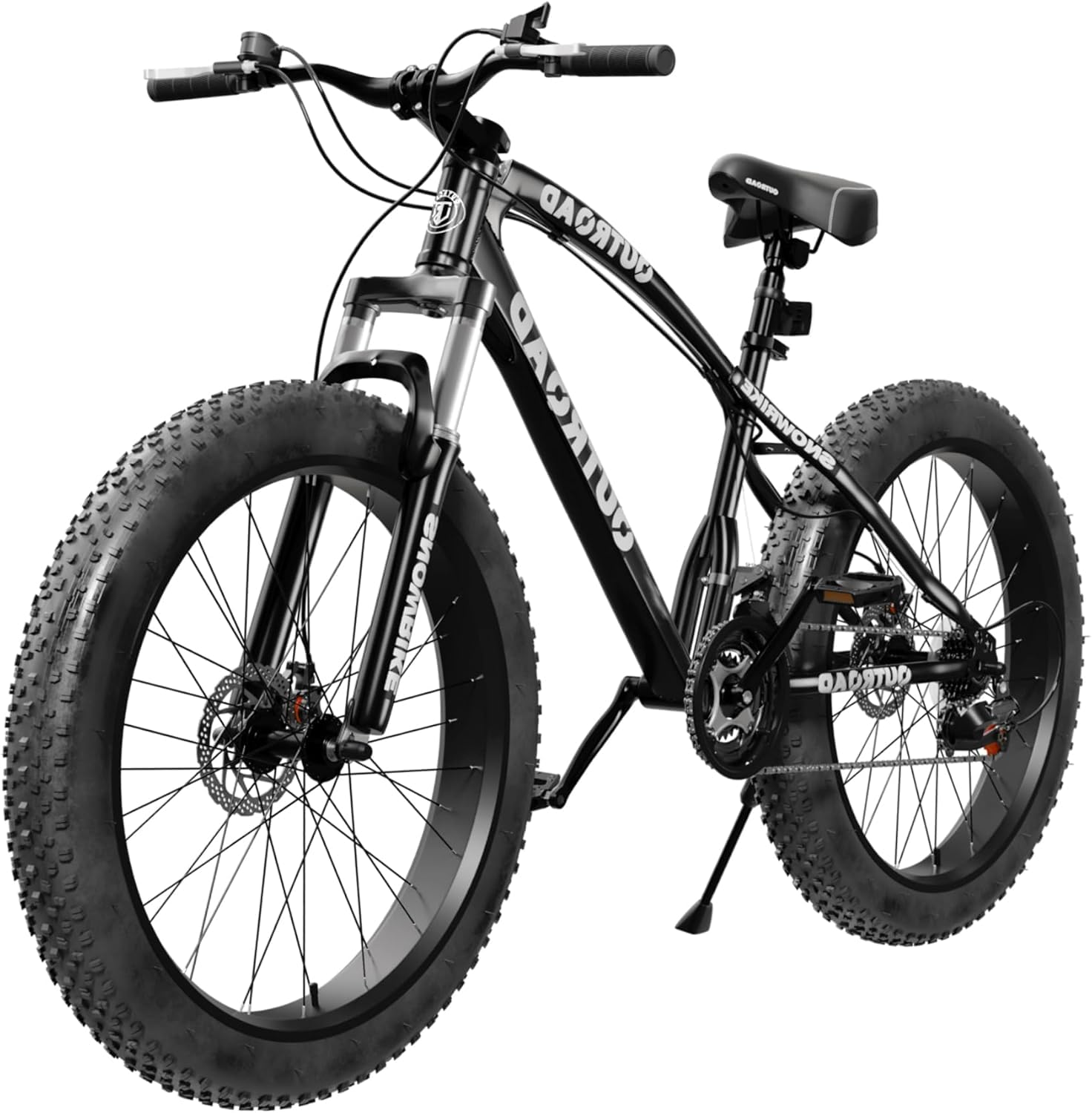
2. Outroad Fat Tire Mountain Bike with 26 inch Wheels, 21 Speed
Twenty-one speeds and a front shock absorber for the price of a basic cruiser.
The Outroad delivers the widest gear range at this price tier — a full 21-speed drivetrain against the 7-speed setups on most similarly priced bikes. That extra gearing range makes a real difference when you hit a steep hill: you drop into a low gear and keep pedaling instead of walking. The 4-inch knobby tires (width up to 4 inches) provide the grip you need for loose gravel, mud, or sand, and the shock-absorbing front fork smooths out bumps from roots and rocks. Owners consistently call it an “excellent budget fat tire MTB” — the carbon steel frame is heavy but sturdy, and a 6-foot rider reports it fits well and rides nicely after tightening all the bolts and adjusting the brakes.
Assembly is straightforward if you watch the installation video, though you will want to lubricate the chain and cables right away. The heavy carbon steel frame is expected at this price — it holds up to rough terrain but you will feel every pound carrying it up stairs. A few owners mention the seat post can drop under a heavier rider’s weight and the pedals feel less sturdy, so average-sized riders get the best experience here. Unlike the Huffy below, the Outroad gives you more gears to find the right cadence on varied terrain, but like the Huffy, the seat is stiff and you will probably want to swap it out for longer rides.
The thing everyone raves about is the value — a 21-speed fat tire bike with front suspension that actually works on the trail for this kind of money. The crowd favorite among the budget options, with over 260 owners weighing in, the Outroad is the pick for riders who know they need more than seven gears to enjoy the ride.
Gearing advantage
- 21-speed drivetrain beats the 7-speed options on hills and flat stretches
- Front suspension absorbs trail chatter you feel on rigid forks
- 4-inch knobby tires grip sand, snow, and mud confidently
Know before you ride
- Carbon steel frame is heavy — expect to work for it on climbs and carrying it
- Seat post may drop under heavier riders; pedals feel less sturdy
- Requires a thorough post-assembly check of all bolts and brakes
Who it fits: Budget-focused riders who ride mixed terrain and want a usable gear range for hills without spending mid-range money.
Watch out for: Heavier or taller riders may find the seat post and pedals need upgrading for a secure, long-term build.
3. Mongoose Dolomite Fat Tire Mens Mountain Bike
The most-reviewed fat tire bike on the list — and for good reason.
The Dolomite has been around long enough to earn a loyal following, and the numbers back it up: owner after owner highlights the build quality (over 370 mentions) and solid assembly experience (over 210). The 1×7 drivetrain keeps shifting simple — one shifter, seven gears, no front derailleur to fuss with. The 4-inch knobby tires and mechanical disc brakes handle sand, mud, dirt, and snow with authority. As owners put it: the bike “excelled” in 3 inches of snow at 8 psi, pedaling easily with no slipping, averaging 6.3 mph over 14- to 18-mile winter rides. At 265 pounds, a 6-foot-2 rider found the bike “heavy-duty” and “sturdy” after tightening the seat and tuning the brakes.
It arrives about 80 percent assembled, and you will need a Phillips screwdriver, Allen wrenches, an adjustable wrench, and pliers to finish the job. The stock seat is notoriously narrow and uncomfortable — a Cloud 9 replacement is a common upgrade. The bike is also very heavy; that’s a feature for stability on loose terrain but a pain if you need to lift it onto a rack. A few customers note the chain breaking after a couple of rides and some mention the front brake caliper snapping, though those complaints sit alongside thousands of positive experiences. Compared to the Outroad’s 21 speeds, the Dolomite’s 7-speed setup is simpler but limits your gearing on steep climbs.
What wins people over is the combination of rock-solid stability and straightforward assembly. This is the choice for heavier riders (multiple owners over 260 pounds confirm it holds up) and anyone who wants to ride confidently on snow, sand, or mud without overthinking the machine. The Dolomite leads on sturdiness (over 110 positive mentions) and remains a strong contender for the most proven budget fat tire bike on the market.
Built for the rough stuff
- 1×7 drivetrain is simple and reliable with no front derailleur to adjust
- Owners praise the build quality and ride quality on sand, mud, and snow
- Proven track record — the highest review count on the list
Plan for these upgrades
- Stock seat is narrow and uncomfortable — budget for a Cloud 9 replacement
- Very heavy; lifting onto a car rack or over obstacles is a real effort
- Some reviewers point out chain breakage and front brake caliper issues
Reach for this if: You ride snow, sand, or mud regularly and want a simple, proven fat tire bike that larger riders have tested and approved.
Think twice if: You need an easy lift onto a rack or you dislike swapping uncomfortable stock parts.
4. Mongoose Aztec Fat Tire Bike, 26-Inch Wheels

Built for the beach, not the race — and that is exactly the point.
The Aztec is a dedicated cruiser designed to float on sand. The 4-inch knobby tires provide excellent traction on soft surfaces, and the 7-speed twist shifter delivers quick, precise gear changes for the kind of casual riding you do along the shoreline. The comfort saddle and threadless headset keep the ride relaxed, and the alloy Super wide rims keep the weight lower than a full-steel build. Owners who ride daily report the Aztec handles sand and beach terrain beautifully, noting it is not fast (the wide tires and roughly 40-pound weight see to that) but it is durable. The frame fits riders from 5-foot-3 to 6-foot-1, which covers a wide range of builds.
The downside is the gearing. Multiple owners point out that the lowest gear is not low enough for serious hill climbing — one rider solved it with a freewheel upgrade to a wider-range 14-34T cassette. The stock seat is also a common swap target, and some owners spend upgrading to a rapid-fire shifter for easier thumb shifting. Final assembly is straightforward, with quality packaging and paintwork reported. Compared to the Dolomite, the Aztec feels more maneuverable and lighter, but it gives up some of the Dolomite’s rugged durability for that beach-friendly agility.
What the owners praise most (over 15 mentions) is the overall build quality — the bike feels solid from the start, the Shimano shifters are smooth, and the disc brakes stop reliably. The Aztec is the best pick for casual beach-goers who want a fat tire bike that rides more like a traditional cruiser and are willing to spend a little extra on a seat and shifter upgrade to make it their own.
Sand-ready cruiser
- Trail-tested on beach sand with daily-rider durability confirmed by owners
- Alloy rims and comfort saddle make it more civilized on long rides
- Easy assembly with quality packaging and paint
Two known quirks
- Lowest gear is too high for any significant hill climbing from the start
- Stock seat and twist shifter often get replaced for better comfort and control
Best for: Riders who spend most of their time on sand or flat pavement and want a comfortable cruiser that is easy to assemble and ride.
Not ideal for: Anyone who needs to climb steep hills without spending extra on gearing upgrades.
5. MICARGI SLUGO SS Cruiser Bike, 26″
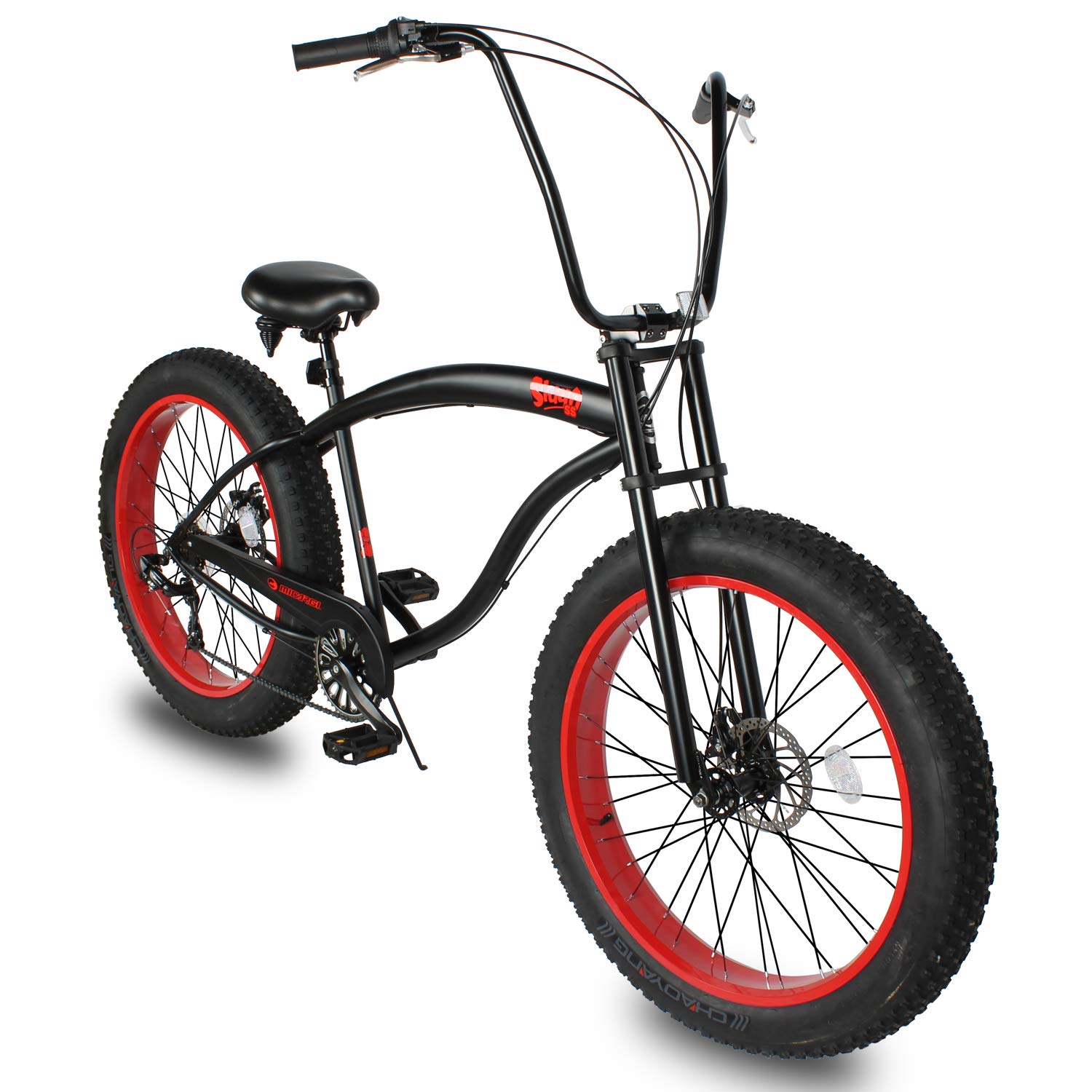
An upright riding position that is kind to your back over 20-mile days.
The MICARGI SLUGO SS is built around rider comfort. The high-rise handlebars keep your body upright, minimizing strain on your shoulders and lower back — a design that owners say makes it “excellent for long rides (20 miles)” and back-friendly. The 26-by-4-inch star tread tires float over rough pavement and packed dirt, and the Triple Tree Fork and oversized Hi-Ten steel frame provide a stable, planted feel. The Shimano 7-speed drivetrain offers a wide enough range for leisurely to moderate-distance cruising, though owners caution it is not built for steep hills. One owner at 6-foot-2 and 350 pounds confirms the bike fits comfortably, which is a standout spec for larger riders.
The assembly booklet is notorious for being wrong — owners universally recommend YouTube for the setup. The front disc brake rotor may arrive warped and the caliper misaligned, so factor in either a DIY tune-up or a local bike shop visit (owners quote roughly for professional assembly). The bike is heavy and the high-rise handlebar design makes it awkward to fit on standard bike racks. Unlike the Mongoose Aztec, which is nimble on sand, the SLUGO SS is a pavement and smooth-trail cruiser through and through — it does not excel on rocky singletrack. An occasional buyer notes cracked plastic on the handlebars upon arrival.
Owners who love it (and they do — build quality gets the most praise) describe it as a “great looking bike” that is sturdy and easy to assemble for anyone comfortable with a wrench. This is the pick for taller, heavier riders who prioritize an ergonomic seated position and want a fat tire cruiser that can handle multi-hour paved rides without punishing their back.
Comfort specialist
- Upright geometry with high-rise handlebars reduces back strain on long rides
- Fits taller and heavier riders — owner-verified at 6’2″ and 350 lbs
- 26×4.0 star tread tires provide a smooth, stable ride on pavement
Assembly quirks
- Wrong assembly booklet — YouTube setup is essential
- Front disc brake rotor and caliper may arrive misaligned
- Heavy and not easy to carry on standard bike racks
Choose it for: Long, comfortable pavement rides where back-friendly posture matters more than off-road capability.
skip it if: You want a bike that is ready to ride from the start without extra tuning or you need to tackle steep hills or rocky trails.
6. Huffy 26″ Fat Tire Mountain Bike
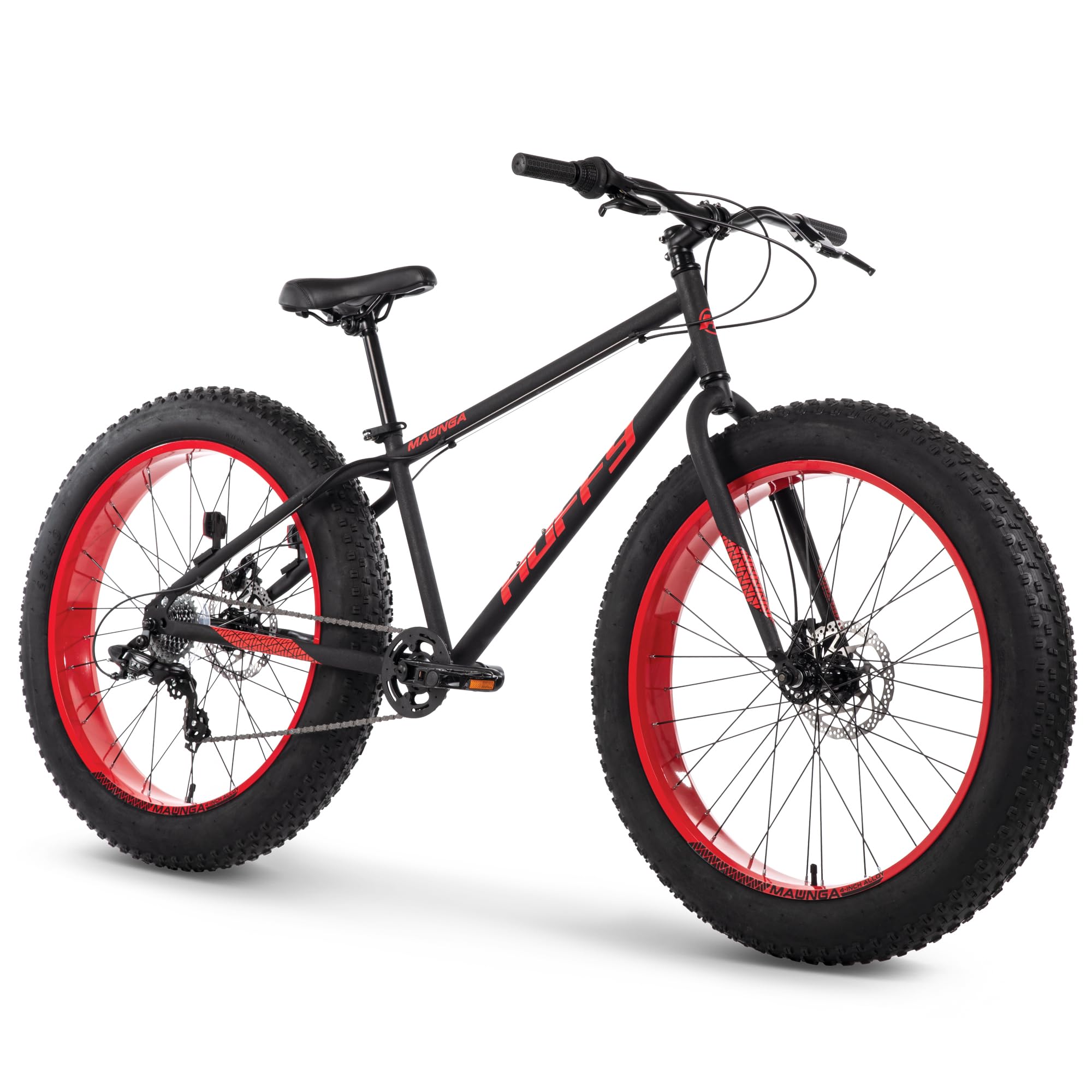
A name brand with Shimano shifting at the entry-level price.
The Huffy fat tire bike brings Shimano 7-speed drivetrain reliability and a sturdy alloy steel frame to the budget tier. The 4-inch knobby tires provide the grip you need for sand, snow, mud, and rocky trails, and the dual disc brakes deliver stopping power in all conditions. Owners consistently call it good quality (over 60 positive mentions) and good value for the price (over 40 mentions). A padded saddle and Kraton comfort grips help reduce fatigue on longer rides — a detail the cheaper Outroad and MarKnig models lack from the start.
The recurring issue is durability — over 45 owners flag it as a concern, with multiple reports of pedals breaking within weeks of light use. Assembly draws mixed reviews (over 45 mentions): some find it straightforward, others struggle with poorly fitting tires. A front tire that refuses to seat straight and a rear tire that pops off the rim at normal inflation pressures pop up in several accounts. The seat is also a common complaint — owners describe it as “very hard” and painful within 15 minutes, and the grips are described as minimalist. Compared to the Outroad, the Huffy has fewer gears (7-speed vs. 21-speed) and a heavier feel on the trail, but it offers a more established brand and wider availability of replacement parts.
What wins people over here is the combination of Shimano shifting and a recognizable name at a price that undercuts most competitors. The Huffy works best for casual paved and moderate off-road riders who expect to do some assembly tuning and may want to budget for a softer seat and better pedals. The stability and durability scores are mixed, so this is one to inspect carefully upon delivery.
Brand confidence
- Shimano 7-speed drivetrain for smooth, reliable shifting
- Owners rate the quality and value-for-money positively
- Padded saddle and comfortable grips included from the factory
Inspect on arrival
- Durability concerns — pedals reported breaking after weeks of light use
- Mixed assembly experience; some front and rear tires do not seat properly
- Seat is very hard; expected to be an immediate swap for most riders
Works for: Shorter casual rides on pavement and moderate trails where having a known brand with Shimano parts gives you confidence.
Not for: Anyone who expects a trouble-free out-of-box experience or wants a bike that will survive frequent off-road abuse.
7. HILAND 24/26 Inch Fat Tire Mountain Bike
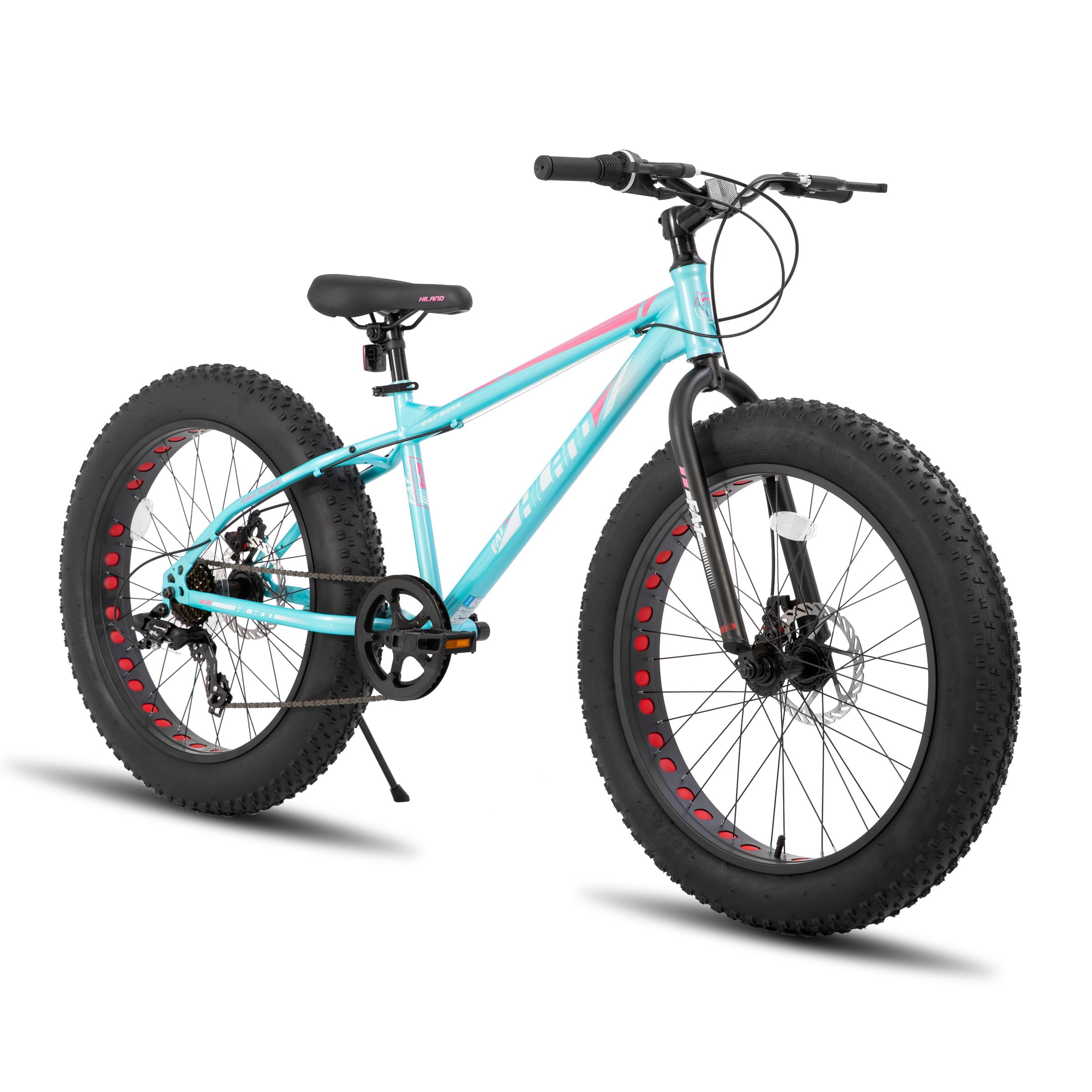
Seven speeds and dual disc brakes — no fuss, no front derailleur.
The HILAND keeps it simple: a 7-speed rear derailleur with MICROSHIFT MS25 shifters, dual disc brakes, and a high carbon steel frame. The wide 4-inch tires provide grip on beach, snow, gravel, rain, mud, and sand. The 24-inch version fits riders 47 to 67 inches tall, while the 26-inch model fits riders 60 to 72 inches tall — so you can pick the right wheel size for your height. Buyers report easy assembly and kids who “love” their new bike, with one buyer noting the gears simply need a quick adjustment from the start.
The big red flag here is the return policy, not the bike itself. As one owner puts it, returning it, so you need to be sure the bike fits your needs before buying. The other common complaint is careless packing: one owner found the handlebar shaft bearings scattered loose in the box with no instructions on how to reassemble them. The 7-speed drivetrain is noticeably simpler than the 21-speed setups on the Outroad and MarKnig — the trade-off is fewer gears for hills but also fewer parts that can break or need tuning. The bike is built for simplicity, comfort, and riding enjoyment rather than technical trail performance.
The thing owners praise most is the overall quality for the price — a solid, straightforward fat tire bike that gets beginners and casual riders out on loose terrain without complications. If you want a simple, reliable 7-speed fat tire bike and you are confident in the fit and your assembly skills, the HILAND is a strong entry-level value. Just be certain it is right for you before you finalize the purchase.
KISS principle
- 7-speed drivetrain with MICROSHIFT shifters is simple and easy to maintain
- Dual disc brakes for reliable stopping in wet and loose conditions
- Available in 24-inch and 26-inch wheel sizes for better rider fit
Assembly gotchas
- Return shipping is expensive — be sure of fit and condition before buying
- Some units arrive with bearings loose in the box and no reassembly guide
- 7-speed gearing lacks the hill-climbing range of 21-speed competitors
Reach for it: If you want the simplest fat tire bike possible — fewer gears mean fewer headaches — and you are confident in your ability to check the bike immediately upon arrival.
Hesitate if: You are not comfortable assembling a bike or you live in a very hilly area where the 7-speed range will leave you wishing for a lower gear.
Understanding the Specs
Drivetrain Speeds
The number of gears — 7-speed versus 21-speed — determines how fine your control is over pedaling effort. A 7-speed drivetrain uses only a rear derailleur, which is simpler and requires less maintenance. A 21-speed adds a front derailleur, giving you a wider range of low and high gears. On a fat tire bike, the extra low gears matter because the wide tires create more rolling resistance on loose terrain. The catch: front derailleurs need more frequent tuning to shift cleanly.
Frame Material
High-carbon steel is the most common material on budget fat tire bikes. It absorbs vibration well and is inexpensive, but it adds several pounds. Alloy steel is a stronger, lighter alternative that still sits in the mid-price range. Aluminum is the lightest option you will find at an entry-level price — usually reserved for models in the upper half of the budget bracket. The material directly affects how the bike feels when you lift it onto a rack or carry it over a fallen log.
Tire Width and Tread
Fat tire bikes are defined by tires at least 3.8 inches wide — every bike here uses 4-inch-wide tires. That width creates a large contact patch that keeps you from sinking into sand, snow, or mud. The tread pattern matters too: deeply knobby tires dig into loose surfaces for traction, while a less aggressive star tread or cruiser tread rolls faster on pavement. Wider tires also act as natural shock absorbers, reducing the need for a complicated rear suspension system at this price point.
Brake Type
Mechanical disc brakes use a cable to squeeze pads against a metal rotor attached to the wheel hub. They stop reliably in wet weather, mud, and snow — conditions where traditional rim brakes lose effectiveness as the rim gets wet or coated in grime. Dual disc brakes (front and rear) provide balanced stopping power and shorter stopping distances, which is important on a heavy fat tire bike that builds speed on descents. The trade-off is that disc brakes can require occasional rotor truing and pad adjustments to avoid rubbing.
FAQ
Can I ride a budget fat tire bike on pavement every day?
How much assembly does a budget fat tire bike require?
Is a 7-speed fat tire bike enough for hills?
What is the weight limit on a budget fat tire bike?
Do I need to upgrade the seat on a budget fat tire bike?
How do fat tire bikes handle snow?
Is it worth paying more for an aluminum frame on a fat tire bike?
What tools will I need to assemble a budget fat tire bike?
Final Thoughts: The Verdict
For most buyers, the budget fat tire bike pick is the Outroad 26″ 21-Speed because it delivers the widest usable gear range at this price, paired with front suspension and proven owner satisfaction from over 260 ratings. If you want a simpler, time-tested build that handles snow and heavier riders with confidence, the Mongoose Dolomite is the crowd favorite. After factoring in owner experiences across all seven picks, the Outroad stands as the strongest all-around value — good gearing, functional suspension, and a large owner base that confirms it actually works on the trail.
How We Picked
We do not accept paid placement. Every pick is matched to a real buyer and a real use-case; we do not hands-on test units.
Sources & Methodology
Specifications: manufacturer listings and product documentation. Review insights: verified customer reviews, as of July 2026. Pricing: not shown on this page (it changes often); check the current price via the retailer link.
As an Amazon Associate, FitlyFast earns from qualifying purchases. This does not affect which products we feature.