
Our readers keep the lights on and the weekend projects moving. As an Amazon Associate, I earn from qualifying purchases.
Specs are compiled from manufacturer listings and verified buyer reviews and can change over time — please confirm the key details on the product page before buying.
Finding a card that runs modern games at 1440p without draining your bank account is the real challenge of PC building today. The honest answer is that you want at least 8GB of video memory and a modern architecture that supports upscaling tech like DLSS or FSR, which boosts frame rates with AI. This guide cuts through the marketing to compare ten cards that genuinely hit playable frame rates at this resolution, sorted by what each one does best.
I’m Rikta — the founder and writer behind FitlyFast. This guide is built by comparing the manufacturers’ published specifications and the patterns across verified customer reviews, so you get each pick’s real strengths and trade-offs instead of marketing spin.
Here is the plain-English breakdown of the best budget gpu for 1440p gaming so you can match a card to your actual PC and the games you play.
Our Picks at a Glance


How To Choose The Best Budget GPU For 1440p Gaming
To get smooth 1440p gaming without stutters, you need to balance three things: video memory, upscaling technology, and your power supply. More memory (measured in GB) lets you crank up texture details without the game freezing or dropping frames. Upscaling tech like DLSS (Deep Learning Super Sampling) renders the game at a lower resolution, then uses AI to sharpen it, boosting your frames per second (FPS) without sacrificing visual quality.
Video Memory is the Real Gatekeeper
Modern game textures are huge, and 8GB is the bare minimum for 1440p. A card with 12GB or 16GB gives you headroom for today’s titles and tomorrow’s, meaning you will not have to turn texture quality down in a year. The ASRock Arc B580 offers 12GB while the GIGABYTE RTX 5060 and ASUS RTX 5060 both feature 8GB, a difference that shows up in demanding games.
Upscaling Tech Level the Playing Field
DLSS (Deep Learning Super Sampling) on NVIDIA cards and FSR (FidelityFX Super Resolution) on AMD cards both boost frame rates by rendering games at a lower resolution and upscaling them with AI. This matters for budget builds because a mid-range card with DLSS can often match a more expensive card running native resolution.
Power Supply Compatibility
Before you buy, check your power supply’s wattage—every GPU has a recommended minimum. The ASRock Arc B580 needs a 650W power supply, while the PowerColor RX 9060 XT runs on just 500W. Matching the card to your existing power supply can save you from buying a new one.
Quick Comparison
| Model | Best For | VRAM | Boost Clock | Memory Type | Amazon |
|---|---|---|---|---|---|
| ASRock Arc B580★ Best Overall | Best Overall Value | 12 GB | 2740 MHz | GDDR6 | Amazon |
| GIGABYTE RTX 5060Top Performer | Raw Framerates | 8 GB | 2512 MHz | GDDR7 | Amazon |
| ASUS RTX 5060Compact Pick | Compact Builds | 8 GB | 2535 MHz | GDDR7 | Amazon |
| XFX RX 9060 XT | High Framerates | 16 GB | 3320 MHz | GDDR6 | Amazon |
| PowerColor RX 9060 XT | Small Form Factor | 16 GB | 2620 MHz | GDDR6 | Amazon |
| ASUS RX 9060 XT | Quiet Gaming | 16 GB | 3250 MHz | GDDR6 | Amazon |
| PNY RTX 5070 | Premium Performance | 12 GB | 2685 MHz | GDDR7 | Amazon |
| MSI RTX 5070 | Top-Tier Cooling | 12 GB | 2625 MHz | GDDR7 | Amazon |
| Sapphire RX 9070 XT Pulse | High-End 1440p | 16 GB | 2970 MHz | GDDR6 | Amazon |
| Sapphire RX 9070 XT Nitro+ | Ultra Premium | 16 GB | 3060 MHz | GDDR6 | Amazon |
In‑Depth Reviews
1. ASRock Intel Arc B580 Challenger 12GB
The value king that pairs 12GB of memory with genuinely quiet fans.
Buyers repeatedly call the ASRock Arc B580 the budget performance balance, with one owner’s verdict landing on “1440p high settings, excellent value.” Its 12GB of GDDR6 memory on a 192-bit bus gives it a 50% memory advantage over the 8GB GIGABYTE and ASUS RTX 5060 cards, so you can push texture quality higher before hitting a wall. It’s also extremely power-efficient—one owner reports running it on a 450W power supply with a Ryzen 7 7700X processor.
The dual-fan cooling with 0dB Silent Technology stops the fans completely under light load, so everyday desktop use produces zero noise. The Intel Xe2-HPG architecture with 20 Xe cores and 160 XE Matrix eXtension engines handles modern titles like God of War and Forza Horizon 6 at ultra settings, according to owner reports. You get three DisplayPort 2.1 outputs plus one HDMI 2.1a port, supporting up to four displays at resolutions up to 8K.
The catch is driver support, which reviewers describe as a work in progress. For the card to perform well, your system must support ReBAR (Resizable BAR), a BIOS setting usually found on 10th-gen Intel processors or newer. Without it, performance drops noticeably, so check your motherboard’s BIOS before committing.
Why Owners Love It
- 12GB memory handles 1440p textures with headroom
- Fans stop spinning entirely under light load
- Runs cool and quiet on a modest power supply
What To Check First
- Requires ReBAR enabled in BIOS to perform well
- Driver support is still maturing
Reach for it when: you want the most memory and quiet operation per dollar spent.
Look elsewhere if: your motherboard predates ReBAR support or you want plug-and-play drivers.
2. GIGABYTE GeForce RTX 5060 WINDFORCE OC 8G
A frame-rate monster that owners say tops 250 FPS in some titles.
If raw speed is your priority, the GIGABYTE RTX 5060 is the crowd favorite—owners praise its performance above all else. Built on NVIDIA’s Blackwell architecture with DLSS 4, it delivers frame rates owners describe as “Over 250 FPS in some games; handles Cyberpunk and DOOM well.” Its 8GB of GDDR7 memory on a 128-bit interface uses a newer, faster memory type than the ASRock’s GDDR6, and it weighs 1.6 pounds—slightly heavier than the ASUS RTX 5060 at 1.4 pounds.
The WINDFORCE cooling system keeps the dual fans quiet during operation, with noise level being a recurring positive in owner feedback. The card runs well at both 1440p and 1080p with high settings, and one owner noted it delivers roughly twice the performance of an older 3060 card. Installation is straightforward, with one buyer noting the card fit without clearance issues in their case.
The trade-off is the 8GB VRAM, which requires some settings management in heavy applications. Owners also recommend running a display driver uninstaller before swapping the card in to avoid initial setup glitches.
Built For Speed
- DLSS 4 delivers massive frame-rate boosts
- Quiet dual-fan cooling under load
- Simple installation with good case fit
Know Before Buying
- 8GB VRAM needs settings tweaks in heavy games
- Run a driver uninstaller before swapping in the card
Best for: competitive and fast-paced gamers who want maximum frames with DLSS 4.
Think twice if: you plan to keep a card for years and want more than 8GB of memory.
3. ASUS Dual NVIDIA GeForce RTX 5060 8GB GDDR7
The SFF-ready 5060 that slips into small cases without sacrificing speed.
This ASUS Dual card is built for tight spaces, carrying an SFF-Ready Enthusiast GeForce Card designation that means it fits small form factor builds. It is the lightest of the three RTX 5060 cards at 1.4 pounds, and the 2.5-slot design keeps it short enough for compact cases. Performance is the thing owners praise most, with one owner’s detailed breakdown rating it roughly on par with a 2080 Ti or 3070 in rasterization while running “1080p strong, ~80% titles 1440p.”
The Axial-tech fan design uses a smaller fan hub that allows longer blades and a barrier ring that increases downward air pressure, which pushes more air onto the card. The 0dB Technology stops the fans entirely under light load, so quiet desktop use comes standard. Power efficiency is a highlight, with the 150W typical power draw running around 100W in real use, according to owner reports.
The ASUS card carries a 3-year warranty and a USB-C style design without RGB, which some buyers see as a clean, professional look. The 8GB VRAM is the same limitation as the GIGABYTE version, so heavy texture packs at 1440p will require some settings management.
Small But Mighty
- SFF-Ready design fits compact cases
- Fans stop under light load for silence
- Efficient power draw around 100W typical
Watch Out For
- 8GB VRAM limits future-proofing
- No RGB lighting for flashy builds
Choose this when: you are building in a small form factor case and want a quiet, efficient card.
skip it if: you plan to use ultra texture packs that need more than 8GB of memory.
4. XFX Swift AMD Radeon RX 9060 XT OC 16GB

A 16GB triple-fan card that owners call a huge leap from older GPUs.
Double the memory of the RTX 5060 cards, a 3320 MHz boost clock, and a 16GB GDDR6 frame buffer make this XFX card a strong 1440p contender. Owners describe it as “great 1440p-4K ultra performance” and a huge upgrade from older cards like the RTX 3060, playing games at max settings. The triple-fan SWFT cooling solution earns praise for keeping the card cool even in tropical heat, with gaming temperatures reported at or below 50°C on the GPU in 37-45°C ambient conditions.
The 16GB of memory is where this card pulls ahead of the 8GB RTX 5060 options, giving you room for high-resolution textures without stuttering. Buyers report smooth 70 fps or higher frame rates at 1440p, and the card handles 4K resolution completely, according to one buyer. It is quiet in operation, another point that comes up repeatedly in owner feedback.
The trade-off is physical size — the card is large and needs a support bracket to prevent sagging, according to owners. It also draws more power than smaller cards, with one owner noting 180W consumption compared to 100W on their previous card.
Memory To Spare
- 16GB VRAM handles 1440p ultra textures easily
- High 3320 MHz boost clock for smooth framerates
- Excellent cooling even in hot environments
Plan Your Build
- Large card needs a support bracket
- Higher power draw than smaller cards
Grab this for: 1440p ultra settings with plenty of VRAM for future games.
Pass on it if: your case lacks space for a long triple-fan card.
5. PowerColor Reaper AMD Radeon RX 9060 XT 16GB

A tiny 200mm card that packs 16GB of memory into the smallest cases.
At just 200mm long with a single 8-pin power connector, this PowerColor Reaper is the card small form factor builders dream about. Owners consistently praise its compact size, noting it is the only card under 202mm and 2-slot width for compact builds, and describe it as ideal for Steam OS machines. Despite its small size, it delivers strong performance, with one owner reporting World of Warcraft at 5120×1440 running between 100-175 FPS in delves.
Owners mention the ASUS RX 9060 XT runs silent at full load, making it a near-silent option. Performance is what owners praise most, with one noting it works better than their old RX 580 while consuming less power. Its minimum system power is 500W, making it among the most power-supply-friendly 16GB cards on this list.
The compact design does mean less cooling surface area, and customers note GPU temps around 72-76°C under load. One owner found that disabling e-cores on their system fixed stuttering and added about 10% more FPS.
Small Footprint
- 200mm length fits tiny SFF cases
- Near-silent operation at full load
- Only needs a 500W power supply
Compact Trade-offs
- Runs warmer than larger cards at ~72-76°C
- Older games may have compatibility issues
Perfect for: small form factor builds and Steam OS machines where space is precious.
Not ideal if: you want maximum cooling headroom or play very old titles.
6. ASUS Dual Radeon RX 9060 XT 16GB
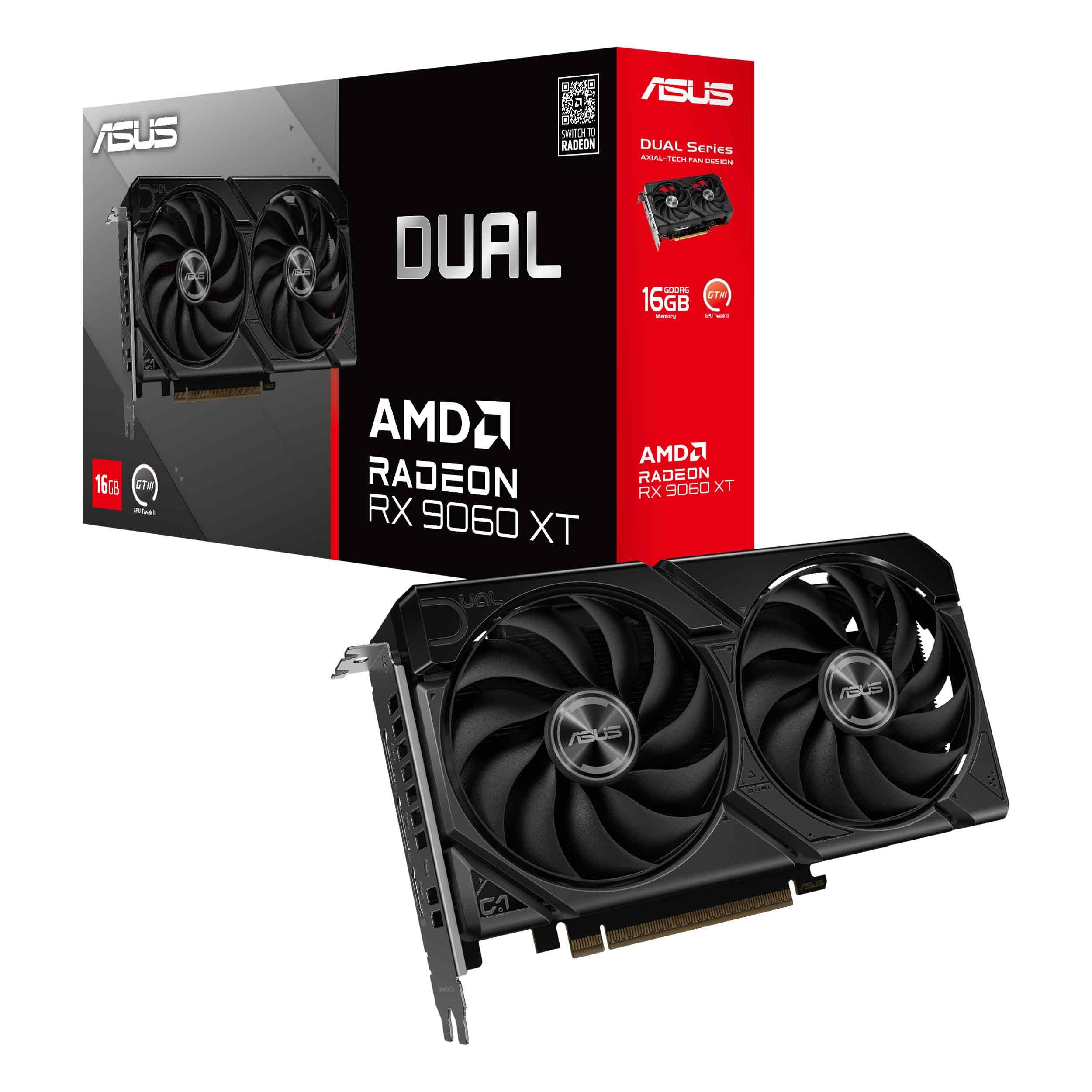
A 16GB card that owners call the best budget 1440p option available.
Owners are emphatic about this ASUS card, with feedback highlighting its excellent 1440p gaming performance and ability to handle indie games at 4K with over 100 FPS. The 16GB of GDDR6 memory makes it a future-proof choice, and the price-performance ratio is the second most-praised aspect after raw performance. The 3250 MHz GPU clock speed is one of the highest on this list, and reviewers point out smooth 1440p high settings with over 100 FPS in titles like Battlefield 6.
The 2.5-slot design with Axial-tech fans stays consistently cool, and the 0dB technology lets you enjoy light gaming in silence. A dual BIOS switch lets you toggle between Quiet and Performance profiles, and the dual ball fan bearings are rated to last up to twice as long as sleeve bearing designs. At 1.3 pounds, it is also the lightest 16GB card here.
One owner noted the card is 2.5-slot thick but short, fitting small cases easily. The main consideration is that 1440p performance is excellent, but the card is not designed for 4K ultra in demanding titles.
Best In Value
- 16GB VRAM with excellent 1440p performance
- Dual BIOS switch for Quiet or Performance modes
- 0dB technology for silent light gaming
Note This
- 2.5-slot thickness may not fit every case
- Not aimed at 4K ultra gaming
Pick this for: the best price-to-performance ratio in the mid-range 1440p class.
Look past it if: you need 4K capability or have an ultra-slim case.
7. PNY NVIDIA GeForce RTX 5070 Epic-X ARGB OC
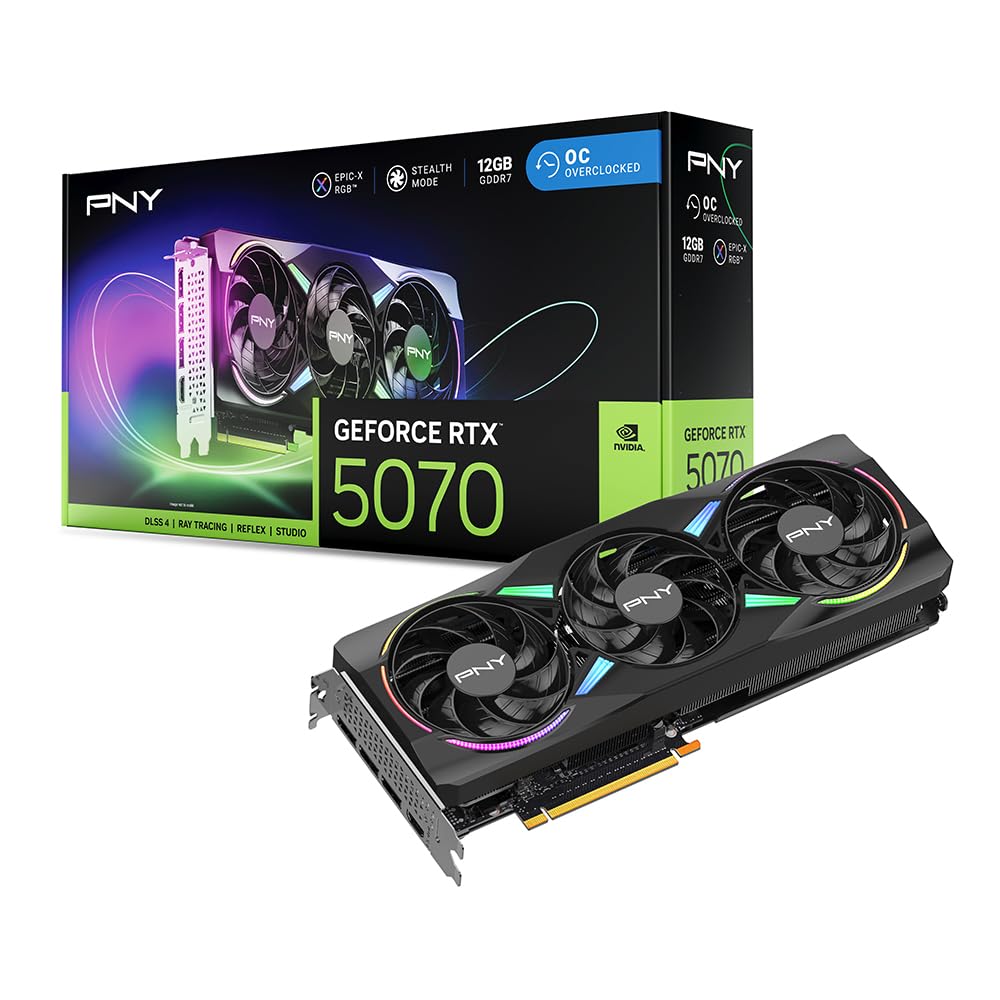
The 12GB RTX 5070 that brings ARGB flair and serious 1440p muscle.
This PNY RTX 5070 steps up into premium territory while still being a 1440p-focused card, with owners reporting excellent results at that resolution. Performance is the most-praised aspect, with one buyer noting the card handles any game you throw at it, and another reporting a massive upgrade from an older RTX 3060. The 12GB of GDDR7 memory on a 192-bit bus with a 2685 MHz boost speed gives it substantial headroom over the 8GB RTX 5060 cards.
The triple-fan design with ARGB lighting adds visual flair, which owners appreciate, with one noting extensive color customization options and easy-to-use software controls. The card runs quiet and cool, with one owner reporting idle temperatures between 35-45°C and a maximum of 73°C under load. Reflex technologies tune the pipeline for competitive gaming, providing faster target acquisition and improved aim precision.
The card includes a 16-pin to dual 8-pin power adapter, making it compatible with 750W fully modular power supplies. Owners caution that the card is large, so measuring your case clearance before buying is essential.
Premium Touches
- 12GB GDDR7 with strong 1440p performance
- Customizable ARGB lighting
- Runs cool and quiet under load
Before You Buy
- Large card needs case clearance verification
- Requires dual 8-pin power connections
Choose this for: 1440p gaming with a touch of RGB style and room to grow.
Scip it if: you are on a strict budget or have a cramped case.
8. MSI RTX 5070 12G Gaming Trio OC

A premium 5070 where build quality and whisper-quiet cooling take center stage.
MSI’s Gaming Trio line has a reputation for build quality, and owners confirm the hype, with build quality being the second most-praised aspect after performance. One owner upgrading from a 3070 Ti called the performance improvement “insane,” and another runs all their games at 4K settings without needing upscaling. The TRI FROZR 4 thermal design uses upgraded fans and a nickel-plated copper baseplate to capture heat from the GPU and memory effectively.
The STORMFORCE fans feature seven blades with claw texturing designed for optimal airflow with minimal noise, and owners consistently describe the card as quiet during 1440p gaming with excellent temperatures. The 12GB of GDDR7 memory on a 192-bit bus with a 2625 MHz extreme performance clock makes it a strong 1440p performer with headroom for 4K in many titles. Installation is straightforward, with owners noting the card fits securely without clearance issues.
The Core Pipes feature a square design to boost contact with the GPU baseplate for optimal thermal management. This is a premium card, so it commands a premium price relative to the RTX 5060 options on this list.
Built To Last
- Premium build quality owners rave about
- Quiet operation with excellent cooling
- 12GB GDDR7 handles 1440p easily
Consider This
- Premium price over the RTX 5060 cards
- Larger card needs case space
Best for: buyers who want a premium-feeling card with outstanding cooling.
Not for: strictly budget builders who want to spend less.
9. Sapphire Pulse AMD Radeon RX 9070 XT 16GB

A 16GB beast that owners say runs everything on ultra without breaking a sweat.
This Sapphire Pulse is where 1440p gaming gets seriously powerful, with owners reporting consistent 100 FPS at ultra settings and calling it a beast for the money. Performance is the most-praised aspect by a wide margin, and the card’s 2970 MHz GPU clock speed with 16GB of GDDR6 memory on a 256-bit interface delivers smooth frame rates at 1440p and even 4K. Owners compare it favorably to the RTX 4070 Ti Super, noting better value for the money.
Cooling is a standout feature, with one owner reporting the card stays around 60°C under load and another noting stable performance under 50°C during gaming sessions. The card is also notably quieter than the RTX 5070 Ti and 5080, according to owners, making it a strong choice for quiet builds. Power efficiency is impressive, with idle draw between 10-30W and gaming draw between 140-250W at 1440p with 60-120 FPS.
The card is larger than expected, and one owner noted a tight fit in their micro-ATX case. Linux users should know that RDNA 4 setup on Arch Linux with ROCm requires some tweaking, though owners say it is worth the effort.
Serious Performance
- 16GB VRAM handles ultra settings at 1440p
- Excellent cooling around 60°C under load
- Quieter than comparable NVIDIA cards
Know The Size
- Larger card needs case clearance
- Linux setup requires driver tweaking
Get this for: high-end 1440p and occasional 4K gaming with cool, quiet operation.
Look around if: your case is compact or you want plug-and-play Linux support.
10. Sapphire Nitro+ AMD Radeon RX 9070 XT OC 16GB

The top-shelf 9070 XT that owners call the best version you can buy.
Owners are unequivocal about the Sapphire Nitro+ card, calling it “the best version of the 9070 XT you can buy.” With a 3060 MHz GPU clock speed and 16GB of GDDR6 memory on a 256-bit interface, it delivers exceptional performance for high-end 1440p gaming—shoppers say it handles everything at peak fps. The triple-fan cooling is top-tier, keeping the card whisper quiet even in the overclocked profile, with zero coil whine reported.
Build quality is exceptional, and the rear-connected 12V HPWR power connector makes for a super clean install. Owners describe a roughly 60-90% performance uplift over a 6750 XT, making 1440p and 4K both viable options. The premium build and feature-rich Adrenalin software round out the package, with one owner calling it one of the best GPUs they have owned.
The trade-offs are physical size and power requirements. The card is over 300mm long and takes up 3+ slots, and owners recommend an 850W power supply. The included support bracket is described as weak, with owners advising additional support due to the card’s weight.
Top Shelf Build
- Premium build quality with clean rear power connector
- Whisper quiet even when overclocked
- 16GB VRAM handles 1440p and 4K
Plan For It
- Over 300mm long, needs 3+ slots
- Requires 850W power supply
Invest in this when: you want the absolute best 9070 XT money can buy and have the case space.
pass on it if: you have a mid-size case or a power supply under 850W.
Understanding the Specs
VRAM Size
Video memory holds the textures and shaders a game needs to draw each frame. At 1440p, 8GB is the minimum, 12GB is comfortable, and 16GB gives you headroom for ultra settings and future titles. More memory means you can push texture quality higher without stuttering.
Upscaling Tech
DLSS on NVIDIA cards and FSR on AMD cards render games at a lower internal resolution and use AI to upscale the image to your screen. This gives you significantly higher frame rates with minimal visual loss, making mid-range cards feel more powerful than their raw specs suggest.
FAQ
Is 8GB of VRAM enough for 1440p gaming?
Does DLSS or FSR actually improve performance at 1440p?
What power supply do I need for a budget 1440p GPU?
Will these cards fit in my small form factor case?
Is the Intel Arc B580 driver support really that bad?
What is the difference between GDDR6 and GDDR7 memory?
Can a budget 1440p card also handle 4K gaming?
How important is the boost clock speed on a GPU?
Should I upgrade from an RTX 3060 to a budget 1440p card?
What is ReBAR and why does the Arc B580 need it?
Final Thoughts: The Verdict
For most buyers, the budget gpu for 1440p gaming winner is the ASRock Arc B580 because it pairs a full 12GB of VRAM with genuinely silent fans at a value price—and owners agree, giving it 4.4 stars across 300+ ratings. If you want raw frame-rate dominance with DLSS 4, grab the GIGABYTE RTX 5060. And for the most future-proof 16GB option that still respects a budget, the ASUS RX 9060 XT is the one to reach for.
How We Picked
We do not accept paid placement. Every pick is matched to a real buyer and a real use-case; we do not hands-on test units.
Sources & Methodology
Specifications: manufacturer listings and product documentation. Review insights: verified customer reviews, as of August 2026. Pricing: not shown on this page (it changes often); check the current price via the retailer link.
As an Amazon Associate, FitlyFast earns from qualifying purchases. This does not affect which products we feature.