
Our readers keep the lights on and the weekend projects moving. As an Amazon Associate, I earn from qualifying purchases.
Specs are compiled from manufacturer listings and verified buyer reviews and can change over time — please confirm the key details on the product page before buying.
Picking a graphics card when every dollar counts is a nerve-racking game of trade-offs. Spend too little and you are stuck with stuttering frames; stretch the budget and you might overshoot what your monitor or power supply can handle. This guide cuts through the noise on nine cards built for tight budgets, covering everything from the best raw gaming value to the quietest cards for a sleeper build.
I’m Rikta — the founder and writer behind FitlyFast. This guide is built by comparing the manufacturers’ published specifications and the patterns across verified customer reviews, so you get each pick’s real strengths and trade-offs instead of marketing spin.
If you are shopping for a new graphics card on a strict budget, you want the most frames per dollar without getting burned by poor drivers or a dead card after six months. That is exactly what this look at the best budget gpu options delivers — real-world performance numbers, honest power-supply notes, and the hidden catches that spec sheets never mention.
Our Picks at a Glance


How To Choose The Best Budget GPU
Finding a great budget graphics card is less about raw power and more about matching the card to your monitor resolution, power supply, and actual game library. You don’t need a card to enjoy a smooth 1080p experience.
VRAM: The Buffer That Saves Your Framerate
Video memory (VRAM) holds textures and scenery data temporarily so the GPU can access them quickly. 8GB is the balance for modern 1080p gaming — 6GB cards can stutter in texture-heavy titles like Hogwarts Legacy or The Last of Us Part I. If you play older or competitive games (Valorant, CS2, Fortnite), 6GB is still fine and saves you money.
Power Supply: The Silent Dealbreaker
Every card draws power — some from the PCIe slot alone (75W max), others requiring a dedicated 6-pin or 8-pin power connector. A card that needs an 8-pin plug but your PSU lacks one forces you into an adapter or a new power supply, adding hidden cost. Always check your PSU’s available cables and total wattage before buying.
Driver Support and Architecture
NVIDIA and AMD both have mature driver stacks, but Intel Arc cards require a modern motherboard with ReBAR (Resizable BAR) support to avoid performance hiccups. If you are building a PC for a kid or a Linux system, AMD and Intel cards often have better open-source driver experience. NVIDIA cards generally offer the best ray-tracing performance, even at the budget level, though you will still want to keep ray tracing at low or off on these cards.
Quick Comparison
| Model | Best For | GPU Clock | VRAM | Memory Type | Amazon |
|---|---|---|---|---|---|
| AISURIX RX 5500 XT 8GB★ Best Overall | Ultra-budget 1080p | 1750 MHz | 8 GB GDDR6 | 128-bit | Amazon |
| GIGABYTE RTX 5060 WF 8GBAlso Great | Next-gen value | 2512 MHz | 8 GB GDDR7 | 128-bit | Amazon |
| ASRock RX 7600 8GBTop Performer | Best 1080p gaming | 2695 MHz | 8 GB GDDR6 | 128-bit | Amazon |
| ZER-LON GTX 1660 Super 6GB | Starter / kid PC | 1530 MHz | 6 GB GDDR6 | 192-bit | Amazon |
| ASRock Intel Arc A580 8GB | Best value newcomer | 2000 MHz | 8 GB GDDR6 | 256-bit | Amazon |
| MSI RTX 3050 Ventus 6GB | Low-power upgrade | 1492 MHz | 6 GB GDDR6 | 96-bit | Amazon |
| GIGABYTE RTX 3050 WF 6GB | Entry-level ray tracing | 1477 MHz | 6 GB GDDR6 | 96-bit | Amazon |
| ASUS RTX 5060 Ti 8GB | SFF compact build | 2632 MHz | 8 GB GDDR7 | — | Amazon |
In‑Depth Reviews
1. AISURIX RX 5500 XT 8GB GDDR6
The lowest-priced 8GB card that still runs BeamNG.drive on Ultra near 60 FPS.
If your budget is rock bottom but you still want 8GB of VRAM, the AISURIX RX 5500 XT is the floor. Built on AMD’s RDNA architecture, it runs at a 1750 MHz core clock and features 8GB of GDDR6 memory on a 128-bit interface. The dual-slot card uses a single 8-pin power connector and draws a maximum of 130 watts. It includes three DisplayPort 1.4a outputs and one HDMI 2.0b for multi-monitor setups.
Shoppers say that it works perfectly from the start for budget PC builds and Ubuntu Linux systems. One owner runs BeamNG.drive on Ultra settings at near 60 FPS on a 165Hz monitor. The card also features semi-automatic intelligent fans that stop spinning at low temperatures for silent operation. The honest risks are that the ports and power connector quality can be inconsistent from unit to unit — a few buyers report only one display output working — and a small number of cards have arrived with bent packaging or failed after the return period.
extreme budget: this is your cheapest path to 8GB VRAM and decent 1080p gaming performance.
reliability seeker: quality control is a concern, so inspect the card on arrival and test all display ports immediately.
2. GIGABYTE GeForce RTX 5060 WINDFORCE OC 8G
The card that brings next-gen GDDR7 memory to a budget-friendly price bracket without compromise.
The jump from GDDR6 to GDDR7 is a real leap you feel in frame times, and this GIGABYTE RTX 5060 delivers that leap. Running on the NVIDIA Blackwell architecture with DLSS 4, it handles 1440p and 1080p high settings smoothly with over 250 FPS in games like Cyberpunk 2077. The dual-fan WINDFORCE cooling keeps things cool and quiet, and the card draws just 8GB of GDDR7 memory on a 128-bit interface.
Buyers report that this card roughly doubles the performance of an RTX 3060, and the fans stay notably quiet even under load. The only recurring advice is to run DDU (Display Driver Uninstaller — a tool that fully removes old GPU drivers) before swapping from an older GPU — skipping that step can cause frustrating install issues. It works smoothly after that.
quiet cool performance
- Delivers over 250 FPS in Cyberpunk with DLSS 4
- Quiet dual-fan cooler with strong thermal performance
- PCIe 5.0 support for future-proofing
limited overclocking headroom
- Requires DDU for a clean driver install
- 8GB VRAM means managing settings in heavy apps
budget 1080p gamer: you want the most modern architecture available without jumping to the top price tier — ideal for 1440p gaming on a budget.
overclocking enthusiast: your power supply is under 650W or you need more than 8GB of VRAM for heavy Ray Tracing workloads.
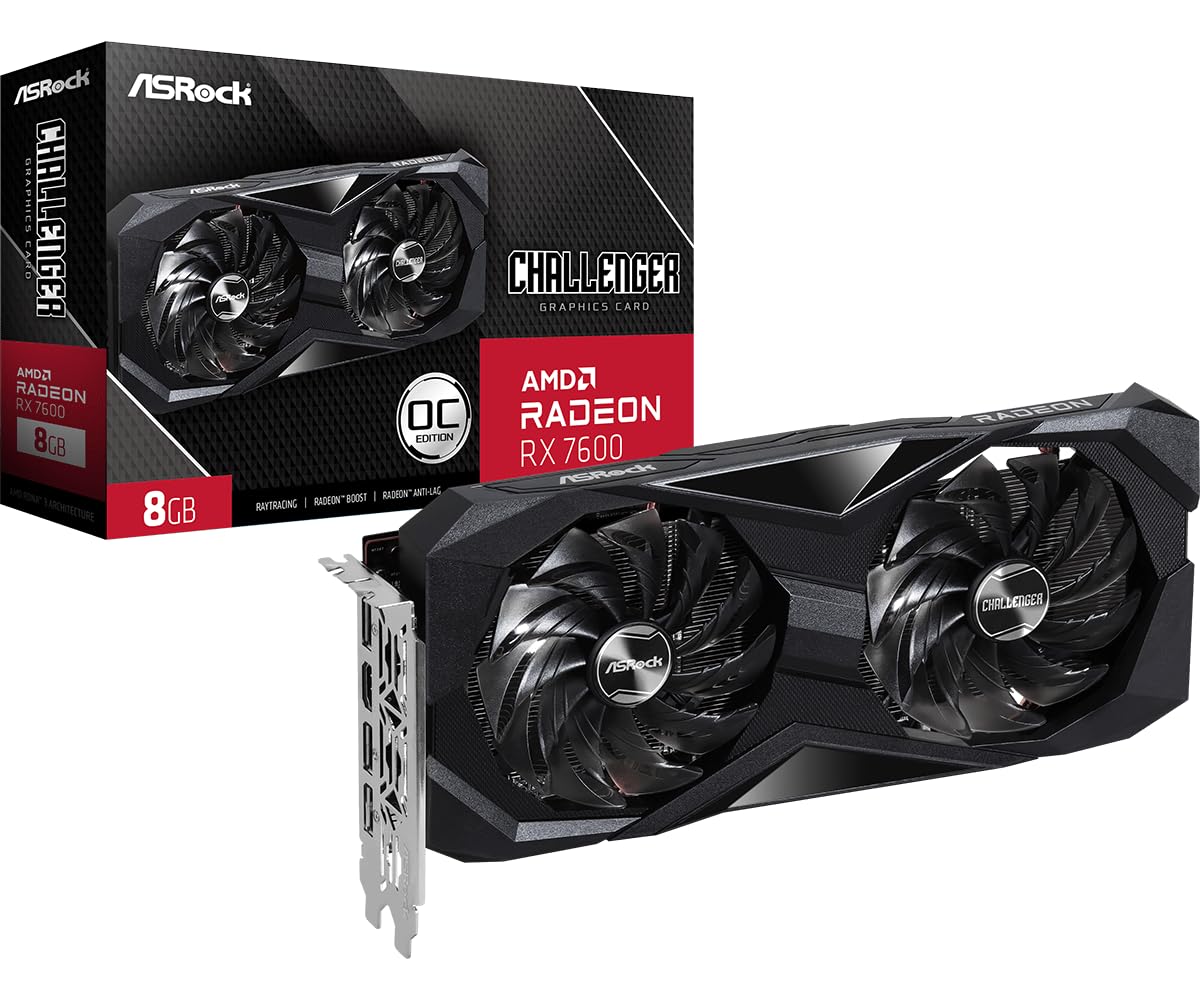
3. ASRock Radeon RX 7600 Challenger 8GB OC
The fastest factory-boosted budget card that runs nearly silent and sips power.
With a boost clock of 2695 MHz and a game clock of 2280 MHz, the ASRock RX 7600 is the raw-performance king of this price range. It runs on AMD’s RDNA 3 architecture, features 8GB of GDDR6 memory on a 128-bit bus, and needs only a single 8-pin power connector. The 0dB Silent cooling stops the fans entirely at low temperatures, meaning it is absolutely silent for light desktop work.
Owners mention that this card reaches up to 180 FPS in many titles and is excellent on Linux — one review called it one of the better budget GPUs for Linux with plug-and-play setup. The 2-slot design and 8.8-inch length make it a comfortable fit in most mid-tower cases. The recurring praise focuses on performance and value, with owners noting it solves VRAM bottlenecks that plagued their older 4GB cards.
1080p gaming rig: gamers at 1080p who want maximum frame rates in esports titles and modern AAA games.
ray tracing fan: users with a power supply under 550W or anyone needing multi-monitor 4K support.
4. ASRock Intel Arc A580 Challenger 8GB OC
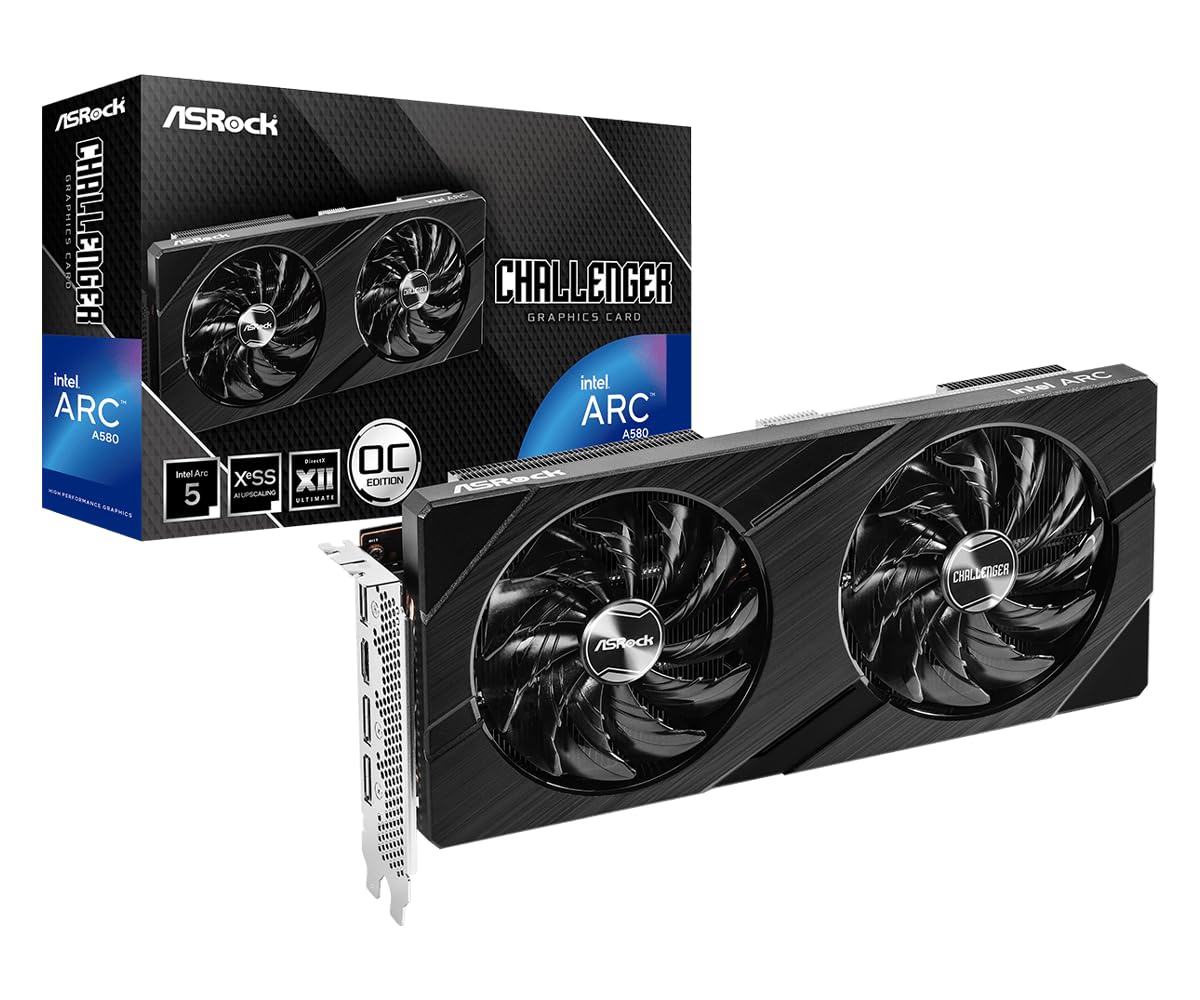
Intel’s dark horse that delivers 1440p-capable 8GB gaming at a price that shocks rivals.
This is the card that changes the script for budget gamers. The ASRock Arc A580 packs a 256-bit memory interface — wider than any other card at this price — paired with 8GB of GDDR6 memory running at 16 Gbps. The factory overclock pushes the engine clock to 2000 MHz, and the dual-fan cooling with 0dB Silent mode keeps acoustics down. It supports DisplayPort 2.0, making it the most display-future-proof option in the budget tier.
Customers note smooth 1080p gaming at 60+ FPS on high and ultra settings in most modern games, with temperatures sitting between 64-68°C. The key caveat is that it requires Resizable BAR (ReBAR) support on your motherboard to perform correctly. It also needs a recommended 650W power supply with two 8-pin connectors, which is more than its competition demands.
budget arc explorer: builders on a tight budget who want a modern architecture with a wide memory bus and future display connectivity.
risk-averse buyer: older pre-built PCs without ReBAR support or anyone unwilling to upgrade their power supply.
5. MSI Gaming RTX 3050 Ventus 2X 6G OC

The only card that works in almost any pre-built desktop without changing the power supply.
The MSI RTX 3050 Ventus draws all its power from the PCIe slot alone — at a mere 70 watts, it never needs a supplementary power connector. That makes it the ultimate drop-in upgrade for HP, Dell, and Lenovo office PCs where the power supply is weak and non-standard. The boost clock hits 1492 MHz, and the 6GB of GDDR6 memory on a 96-bit bus handles 1080p gaming at high settings in most titles.
Buyers running Cyberpunk 2077 report 50-60 FPS on high settings and around 100 FPS on medium. The card is stable on both Windows and Linux, with full-load temperatures staying under 62°C and fans running very quiet. The only trade-off is a narrower 96-bit memory interface, and ray tracing is not recommended at this power level.
small form factor: upgrading a pre-built office PC or any system with a low-wattage power supply under 300W.
texture-heavy games: you need more VRAM for texture-heavy games or plan to run ray tracing at playable frame rates.
6. GIGABYTE GeForce RTX 3050 WINDFORCE OC V2 6G

A reliable RTX 3050 that drops straight into low-power Dell office towers without a fuss.
The GIGABYTE RTX 3050 Windforce OC V2 uses the same NVIDIA Ampere architecture with 2nd Generation RT Cores and 3rd Generation Tensor Cores. It runs at a 1477 MHz boost clock and pairs 6GB of GDDR6 memory with a 96-bit interface. The dual WINDFORCE fans keep the card cool and quiet, and it operates within the 75W power limit of the PCIe slot.
Buyers with Dell Optiplex and similar low-power pre-builts report that this card works within the 75W board limit and runs Steam games at a stable 60 FPS. The NVIDIA software suite provides easy monitoring of power, temperature, and fan speed. The card is easy to install, with several first-time builders noting a headache-free setup experience. The main limitation is the 6GB VRAM, which can cause stutters in the most demanding modern titles.
quiet mid-range: anyone with a standard pre-built desktop who wants a low-stakes, proven RTX upgrade path.
high vram need: you plan gaming at 1440p or need more than 6GB VRAM for texture-heavy AAA games.
7. ASUS Dual NVIDIA GeForce RTX 5060 Ti 8GB OC Edition

A small-form-factor RTX 5060 Ti with 767 AI TOPS and DLSS 4 crammed into a very friendly price.
The ASUS Dual RTX 5060 Ti is built for compact builds, earning the SFF-Ready Enthusiast GeForce Card badge. It uses the NVIDIA Blackwell architecture with DLSS 4 and hits 2632 MHz in OC mode. The 8GB of GDDR7 memory handles 1080p gaming with room to spare, and the Axial-tech fan with a smaller hub and longer blades increases downward air pressure for better cooling.
It supports PCIe 5.0 and features HDMI 2.1b and DisplayPort 2.1b for modern monitors. Reviewers point out that installing it requires proper driver cleanup — using DDU (Display Driver Uninstaller) in Safe Mode to remove old drivers before install. One reviewer successfully runs LLMs like Llama3 on it, with fans keeping temperatures between 30-40°C during AI inference. The biggest honest caution is that 8GB of VRAM limits ray tracing performance despite the card supporting it.
future-proof 1080p: small-form-factor (SFF) PC builders who want top-tier 1080p performance and DLSS 4 in a compact chassis.
tight budget: 8GB VRAM limits ray tracing use cases, and installation demands a clean driver removal process.
8. ZER-LON GeForce GTX 1660 Super 6GB

The tried-and-true 1080p workhorse that still runs rings around integrated graphics years later.
The GTX 1660 Super is a proven budget warrior built on the 12 nm process. This ZER-LON version brings a 1530 MHz core clock and 6GB of GDDR6 memory on a wider 192-bit bus. It supports up to 8K display output and features dual freeze fans for cooling. The card is VR-Ready and handles 1080p gaming at high settings in almost every title.
Buyers praise it for transforming a pre-built Lenovo office PC into a capable gaming machine. One owner uses it to transcode four HD Homerun 4K tuners, eliminating Plex transcoding stress entirely. The fans are very quiet, stopping completely under light load for silent desktop use. The main criticisms are the lack of included accessories (no driver disk, no SATA power adapters) and that the power plug can interfere with case lids in very tight chassis.
esports budget build: budget starter builds, kid PCs, or media servers that also play Fortnite and Minecraft at high settings.
new game support: you need ray tracing support, more than 6GB VRAM, or prefer a card with brand-name box contents.
Understanding the Specs
GPU Clock Speed (MHz)
This tells you how fast the graphics processor runs its internal calculations. A higher number, measured in megahertz, generally means more raw performance — but the number matters most when comparing cards of the same generation. The ASRock RX 7600 hits 2695 MHz boost, while the GIGABYTE RTX 3050 runs at 1477 MHz, but the newer architecture of the 3050 makes the MHz numbers not directly comparable across brands.
VRAM and Memory Bus Width
VRAM is the card’s short-term memory for holding textures and scenery data. 8GB is the balance for modern 1080p gaming; 6GB works well but can cause stutters in the biggest games. Bus width (128-bit, 192-bit, 256-bit) is how wide the data highway is between the memory and the GPU core — wider buses (256-bit) can feed the processor faster, which helps at higher resolutions and detail levels.
Power Connectors and Wattage
Some budget cards (like the MSI RTX 3050) draw all power from the PCIe slot — max 75W — requiring no extra cables. Others need a 6-pin or 8-pin connector from the power supply. An 8-pin connector delivers up to 150W. Always check which cables your power supply has before buying a card that needs them. The Intel Arc A580 needs two 8-pin connectors and a recommended 650W PSU, which is more than most budget cards demand.
Ray Tracing and DLSS
Ray tracing simulates realistic lighting, shadows, and reflections, but it demands heavy processing. Budget cards can run it, but expect frame rates to drop significantly — it is often best left on low or off. DLSS (Deep Learning Super Sampling) is an NVIDIA technology that uses AI to render games at a lower resolution and then upscale them, boosting frame rates while maintaining visual quality. DLSS 4, available on RTX 5060 cards, makes a huge difference in playability.
FAQ
Can a budget GPU run 1440p gaming?
How much VRAM do I really need for a budget build?
Can I upgrade my old Dell or HP office PC with a budget GPU?
Do I need a new power supply for a budget graphics card?
What is the difference between GDDR6 and GDDR7 memory?
Is Intel Arc A580 a good budget GPU?
How do ray tracing and DLSS work on budget GPUs?
What is the easiest budget GPU to install for a first-time builder?
Should I choose AMD or NVIDIA for a budget GPU?
Final Thoughts: The Verdict
For the majority of shoppers, the best budget gpu winner is the GIGABYTE RTX 5060 WINDFORCE OC because it brings next-generation GDDR7 memory and DLSS 4 to a price bracket that typically skips those features. If you want pure raw gaming performance and extremely quiet operation, grab the ASRock RX 7600 Challenger 8GB. And for a low-power drop-in upgrade that works with almost any old office PC, the MSI RTX 3050 Ventus is the one to reach for.
How We Picked
We do not accept paid placement. Every pick is matched to a real buyer and a real use-case; we do not hands-on test units.
Sources & Methodology
Specifications: manufacturer listings and product documentation. Review insights: verified customer reviews, as of July 2026. Pricing: not shown on this page (it changes often); check the current price via the retailer link.
As an Amazon Associate, FitlyFast earns from qualifying purchases. This does not affect which products we feature.