
Our readers keep the lights on and the weekend projects moving. As an Amazon Associate, I earn from qualifying purchases.
Specs are compiled from manufacturer listings and verified buyer reviews and can change over time — please confirm the key details on the product page before buying.
Your phone’s headphone jack may be gone, but your good headphones still deserve real power. A budget headphone amp sits between your device and your cans, delivering the voltage and current that built-in sound chips simply can’t. The right one delivers fuller, cleaner, louder sound with a lower noise floor than a phone’s built-in audio.
I’m Rikta — the founder and writer behind FitlyFast. This guide is built by comparing the manufacturers’ published specifications and the patterns across verified customer reviews, so you get each pick’s real strengths and trade-offs instead of marketing spin.
A great budget headphone amp adds clarity and punch without forcing you to spend like an audiophile—starting with a plug-and-play dongle that weighs less than two ounces.
Our Picks at a Glance


How To Choose The Best Budget Headphone Amp
The biggest mistake first-time buyers make is thinking every amp works with every headphone. That is only half true. The real question is whether the amp can push enough power for your specific headphones, and whether it matches your daily setup — a phone on the go or a desk at home.
Match the power to your headphones
Headphones need different amounts of power depending on their sensitivity and impedance (measured in ohms, Ω). Sensitive in-ear monitors (IEMs) barely need any juice, while high-impedance over-ear headphones like the Beyerdynamic DT880 demand far more. Check the amp’s output in milliwatts (mW) at 32Ω — a higher number means it can drive tougher headphones louder and cleaner. A dongle at 170mW per channel handles most IEMs and efficient cans; a desktop unit like the FiiO K11 at 1400mW takes on virtually anything.
Portable dongle or desktop unit
Dongles plug straight into your phone or laptop via USB-C and weigh next to nothing, so they vanish in a pocket. Desktop amps sit on your desk, need a wall outlet, and offer more inputs like RCA, optical, or coaxial. If you listen mostly on a phone, a dongle is the obvious call. If you have a computer setup and want to drive big headphones all day, desktop power wins. There is also a middle ground — small portable amps with built-in batteries that do both.
Balanced vs single-ended output
A 3.5mm jack is the standard single-ended connection found on nearly everything. A 4.4mm balanced output uses separate channels for left and right, which lowers crosstalk and often delivers more power and a wider soundstage. If your headphones or IEMs come with a balanced cable, an amp with a 4.4mm port is worth prioritizing. If not, a clean 3.5mm output is perfectly enough.
Quick Comparison
| Model | Best For | Output Power | Form Factor | Key Outputs | Amazon |
|---|---|---|---|---|---|
| Fosi Audio DS2★ Best Overall | Phone-first portable listening | 170mW @ 32Ω | USB-C dongle | 3.5mm + 4.4mm | Amazon |
| Douk Audio U3 PROHigh-Power Pick | High-impedance over-ear cans | 1500mW @ 32Ω | Desktop mini amp | 3.5mm + 6.35mm | Amazon |
| EYTSE Portable DAC Amp | Gym and commute IEM survival | — | USB-C dongle | 3.5mm + 4.4mm | Amazon |
| MOONDROP Dawn PRO 2 | App-tuning and IEM detail | 124mW + 124mW | USB-C dongle | 3.5mm + 4.4mm | Amazon |
| FiiO BTR13 | Wireless Bluetooth freedom | 220mW + 220mW | Bluetooth + USB dongle | 3.5mm + 4.4mm | Amazon |
| Fosi Audio SK01 | Bass and treble tone shaping | Up to 2400mW | Portable with battery | 3.5mm + 6.35mm | Amazon |
| FiiO K11 | Desktop setups with many inputs | 1400mW | Desktop DAC/amp | 6.35mm + 4.4mm | Amazon |
In‑Depth Reviews
1. Fosi Audio DS2 USB-C Headphone Amp DAC Dongle
The pocket-sized dongle that turns any USB-C device into a high-res audio source
The Fosi Audio DS2 is the kind of amp that makes you wonder why your phone ever sounded thin. Two Cirrus Logic CS43131 DAC chips handle the conversion, and at 1.92 ounces it is a featherweight — about three times lighter than the desktop-style Douk Audio U3 PRO in this list, so you barely notice it in a pocket. That tiny body hides a serious punch: 170mW at 32Ω per channel, enough to drive high or low-impedance headphones through both a 3.5mm single-ended jack and a 4.4mm balanced port.
The crowd favorite quality here is sound. Owners describe a huge soundstage with clarity, and the device stays dead silent at listening levels thanks to a 1μV noise floor (that is the background hiss you hear when nothing is playing — this one has almost none). It pairs especially well with in-ear monitors: buyers report daily gym use for about 2 hours at a time with IEMs like the Ziigaat Odyssey and Moondrop Dusk, getting added depth, bass, and timbre. Compatibility is broad too — iPhone 15 series, iPads, Android phones, laptops, and Macs all work, and it even ran a PS5 Pro via USB-C.
The honest trade-offs come down to power and cable. It sips battery compared to streaming, but heavy use does drain a phone — one buyer measured about 16% battery drop over 2 hours versus 4% without it. The included USB cable is the one weak link, described as cheap, and the 60-step volume buttons take a moment to learn. None of that stops it from being the most complete, versatile budget dongle you can buy right now.
What wins people over
- Two flagship CS43131 DAC chips deliver clean, detailed sound in a tiny body
- 4.4mm balanced output adds richer bass and more detail for high-end IEMs
- Weighs just 1.92 ounces — disappears in a pocket or gym bag
- Works with iPhone, iPad, Android, Mac, PC, and even game consoles
Fair caveats
- Cheap included USB cable — you may want to swap it
- Heavier phone battery drain than listening without it
- Volume buttons are independent, so you adjust both sides
Reach for it if: you want one dongle that sounds great with both 3.5mm and 4.4mm gear across every device you own.
Look elsewhere if: you need to power very large, high-impedance over-ear headphones — that job suits the desktop amps below.
2. Douk Audio U3 PRO HiFi Mini Class A Headphone Amplifier
A desktop-class powerhouse that makes high-impedance headphones sing without breaking a sweat
If your headphones are the hard-to-drive kind, this tiny Douk is the budget answer. It delivers up to 1500mW at 32Ω, enough to handle impedance from 18Ω all the way up to 600Ω. That is a lot of headroom for a 5.76-ounce box — noticeably heavier than the featherweight Fosi DS2 dongle, but that extra mass and the Class A circuit buy you a warm, delicate sound that owners call immaculate. The voltage boost circuit runs at ±14V from a simple DC 5V input, which keeps distortion ultra-low.
The defining skill here is driving demanding over-ear headphones. Owners mention it powers high-impedance Beyerdynamic DT880s without needing max volume, avoiding distortion and bringing out a fuller sound with more evident bass. It also drove a Hifiman Ananda far better than a Focusrite Scarlett Solo interface — more treble detail, much stronger bass, and louder output. A pluggable op-amp socket means you can swap in upgrades like the AD797 or OPA627 later. Both 3.5mm and 6.35mm headphone jacks, plus RCA and 3.5mm AUX inputs, keep it flexible at a desk.
The catch is control, not sound. The volume knob has no visible level marking, and because it doubles as the power switch, you should lower the volume before powering on to avoid a loud surprise. The same knob you turn to adjust volume also powers the unit on and off. For high-impedance headphone owners on a budget, that quirk is a tiny price for this much power.
Why it impresses
- 1500mW output drives 18–600Ω headphones with ease
- Replaceable op-amp socket lets you upgrade the sound later
- Compact size fits a desk or bedroom shelf without clutter
- Warm Class A sound with strong bass extension
The quirks
- Volume knob doubles as the power switch — easy to forget
- No visible level marking on the knob
- No balanced 4.4mm output, only 3.5mm and 6.35mm
Best for: anyone with high-impedance over-ear headphones who wants desktop-level power without a desktop price.
Skip if: you mostly use sensitive IEMs — the power here is overkill and the Douk lacks a balanced port.
3. EYTSE Portable USB-C Mini DAC Amp Dongle
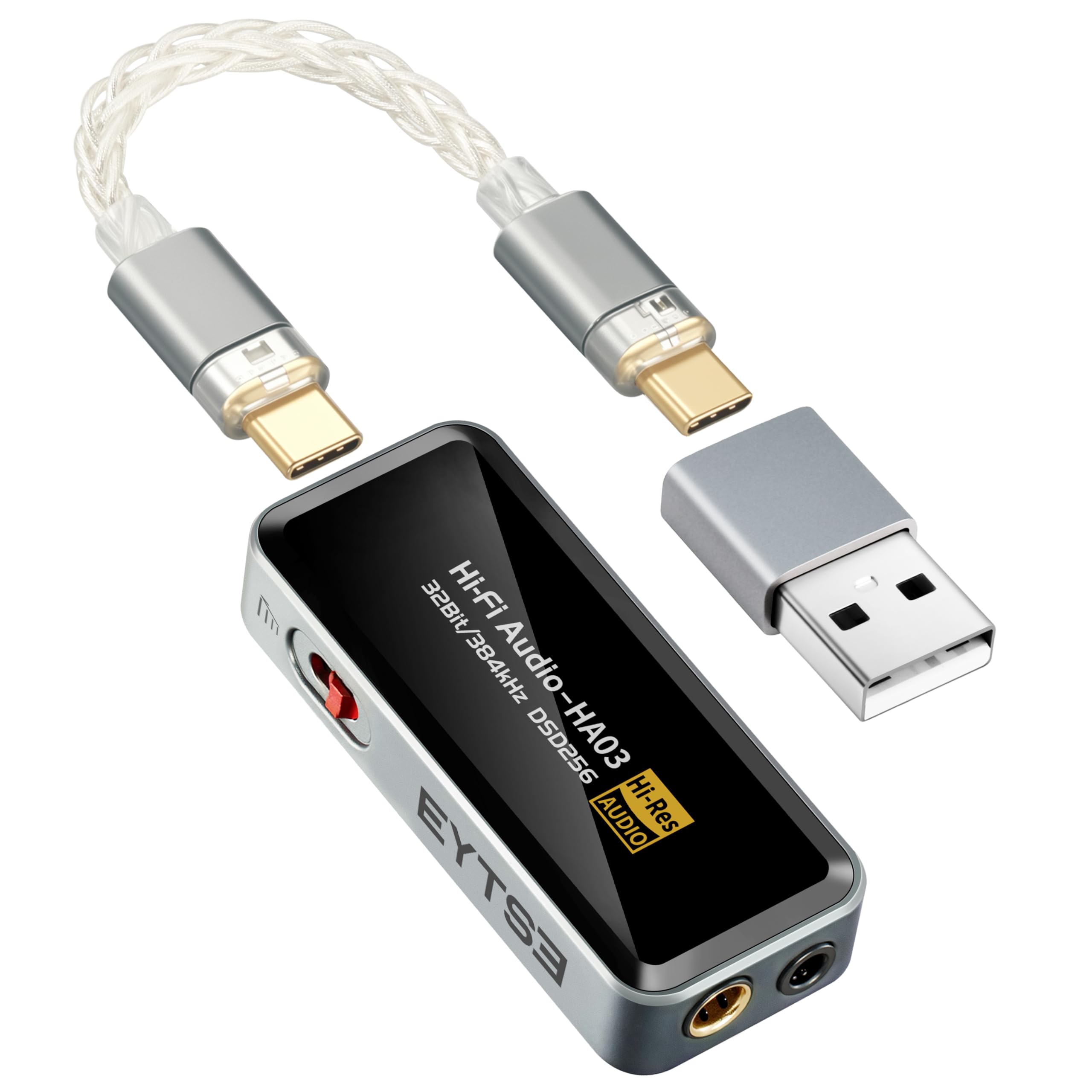
The cool-running dongle with a physical gain switch that saves sensitive IEMs from overdrive
Late-night listeners know the pain of a hissy dongle with sensitive in-ear monitors. The EYTSE attacks that problem directly with a smart gain switch: low gain keeps delicate IEMs from being over-driven, and high gain delivers loud, punchy sound for power-hungry planar magnetic earphones. The dual CS43131 decoder chips keep distortion under 0.0005% THD+N, which buyers describe as a “black” background with rich, detailed, non-fatiguing sound.
Heat is the other enemy of portable DACs, and this one fights it with an aerospace aluminum body and 2.5D glass that dissipate heat exceptionally well — after hours of use it never overheats. At 18 grams it is almost impossibly light, and it pairs with a braided USB-C cable that is soft and flexible instead of the stiff, fragile cords most dongles ship with. Physical play, pause, and volume buttons work on every phone tested, including iPhone and Samsung, so you do not need to pull your phone out to change tracks. Plug-and-play compatibility spans Android, Windows, Mac, and iOS with no drivers required, and it even works through a KVM switch.
The sound leans neutral and smooth, and it served double duty in one buyer’s setup as a line out to a Yamaha amp. A couple of owners noted the output is not overwhelmingly strong, and you cannot rename the device on a computer. But for a well-built, cool-running dongle with both 3.5mm and 4.4mm outputs, this is a strong mid-range value.
Standout strengths
- Physical gain switch prevents over-driving sensitive IEMs
- Aerospace aluminum body stays cool during long sessions
- On-device playback and volume buttons work across phones
- Braided cable is soft, flexible, and durable
Limits to know
- Not the most powerful output for hard-to-drive headphones
- Device name cannot be changed on a computer
- Neutral tuning may not wow bass lovers
Pick this if: you own sensitive IEMs and want a dongle that stays cool, resists hiss, and gives you button control without digging out your phone.
Think twice if: your collection is mostly big over-ear planars — you will want the extra output of a desktop amp.
4. MOONDROP Dawn PRO 2 Portable USB DAC/Amp
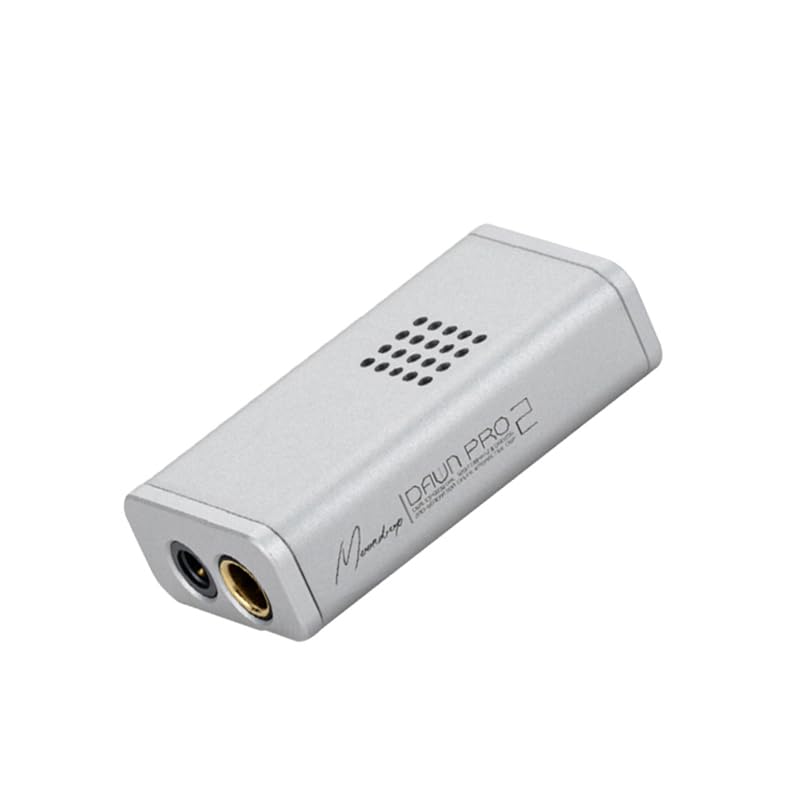
A dongle that puts professional-grade EQ tuning in your pocket via the Moondrop app
The MOONDROP Dawn PRO 2 is for the listener who wants to shape their sound, not just amplify it. Its companion app opens a professional parametric equalizer where you can adjust filter type, frequency point, gain, and Q value, with a headphone frequency-response database to guide you. That kind of tuning power is rare at this level. Dual Cirrus Logic CS43198 DAC chips do the decoding, and three separate LDO power chips feed the decoding and digital circuits independently for lower distortion and better efficiency.
Output sits at 4Vrms with 124mW + 124mW, which owners say is plenty for sensitive full-size headphones like the LCD-X and HD599 on the 3.5mm jack, while the 4.4mm balanced port powers IEMs with ample headroom. The signature trait is a dead-silent black background — no hiss, no digital noise — with micro-details that pop. A 100-level volume control separates volume management from your phone, minimizing the signal compression you get when your smartphone handles it.
Two honest notes stand out. The first is build consistency: buyers mention the balanced cable connection can be a little finicky, requiring the plug to seat just right for full volume. The second is app behavior — EQ settings reset to factory when you unplug the device, which is annoying though useful. If you want tonal control in a pocket, this is one of the few budget dongles that truly deliver.
The strengths
- Professional parametric EQ in the app with a frequency database
- Dead-silent background with no hiss or digital noise
- 100-level volume control keeps phone volume separate
- Aluminum alloy housing with vents for heat dissipation
Watch for
- Balanced cable connection can be finicky to seat properly
- EQ settings reset to factory when unplugged
- Treble can sound digital on some recordings
Great for: tinkerers who want app-based EQ and community tuning support in a portable dongle.
Not for: anyone who wants a true plug-and-forget amp with zero app interaction.
5. FiiO BTR13 Bluetooth Headphone Amplifier

Cut the cable without cutting sound quality — a true wireless amp for balanced IEM users
Wireless sound used to mean compromise, but the FiiO BTR13 refuses that bargain. The Qualcomm QCC5125 Bluetooth chip supports LDAC, aptX Adaptive, aptX HD, and AAC, so high-quality streams stay high-quality over the air. Weighing just 28.6g, it clips to your collar and turns any wired IEM into a wireless one, with a balanced output that pumps 220mW + 220mW — an impressive jump in power that owners say sounds better than some pricier Bluetooth DACs. One dual CS43131 DAC per channel reduces crosstalk for a purer stereo image.
Flexibility is the real story. A three-position switch flips between PC, Bluetooth, and phone modes, so one unit serves as a computer sound card, a wireless receiver, and a mobile amp. The FiiO app adds a 10-band parametric EQ with preset effects and online sharing, and a physical click wheel handles volume and tracks. Owners call the balanced output excellent and the controls easy, with the 4.4mm port recommended for balanced IEM users.
The caveats are software and battery behavior. The app can feel a little buggy and slow to set up, and the parametric EQ is essentially unusable on Apple devices — the app cannot manage audio settings on iOS. Battery life is shorter than some rivals, and the unit ships with an 80% charge cap by default, a setting you have to dig into the app to change. For Android and Windows users who want wireless freedom with wired sound, this is a top-tier budget pick.
What stands out
- LDAC, aptX Adaptive, and aptX HD support for high-res wireless
- 220mW + 220mW balanced output in a 28.6g body
- Three-position switch for PC, Bluetooth, and phone modes
- 10-band parametric EQ with online preset sharing
Know before buying
- EQ app is essentially unusable on Apple devices
- Shorter battery life than rival Bluetooth amps
- 80% charge cap by default — buried in the app settings
Choose this if: you want wireless convenience with genuinely high-fidelity sound and balanced IEM support.
Reconsider if: you are an iPhone user who relies on parametric EQ — the app limitations will frustrate you.
6. Fosi Audio SK01 Headphone Amplifier Equalizer Preamp

A battery-powered amp with physical bass, mid, and treble knobs you can grab mid-song
Some listeners want to sculpt their sound with their fingers, not their phone. The Fosi Audio SK01 answers with physical tri-band tone controls — treble, midrange, and bass — each with a central detent for a neutral starting point. A one-click tone-defeat button instantly restores the original sound, and a loudness function boosts lower frequencies at low volume for late-night listening. It is an amp, a customizable analog preamp, and an acoustic equalizer for instruments all in one aluminum body.
Power is generous, with up to 2400mW available in high-impedance mode and a built-in 2500mAh battery that owners say lasts for days of casual use. One buyer drove an Audeze LCD2 with rumbling bass, and another uses it between a Bluetooth receiver and an AV receiver to restore treble and bass peaks the chain flattens out. The 3.5mm and 6.35mm headphone jacks cover 32–300Ω headphones, and it runs off USB 5V when the battery runs low. The build is sturdy metal with tight knobs, and buyers have bought a second unit just to keep one in another room.
The honest gripes are minor. A few owners found the tone controls can over-accentuate upper frequencies, needing a little EQ tweak, and one unit arrived with a battery fault that the seller quickly replaced. The knobs feel smooth, even slightly slippery, and the headphone jack does not mute the speakers when both are connected. None of that dims its value as the most hands-on, portable amp here.
Why it wins
- Physical bass, mid, and treble knobs for instant tone shaping
- Built-in 2500mAh battery lasts days between charges
- Up to 2400mW power in high-impedance mode
- Works as headphone amp, preamp, or instrument EQ
Fair warnings
- Upper frequencies can sound over-accentuated at defaults
- Headphone jack does not mute speakers when both are connected
- One unit had a battery fault with solid seller support
Grab this if: you love physical EQ knobs and want a portable amp that also preamps speakers and instruments.
Pass if: you prefer a neutral, set-and-forget sound with no tonal adjustment needed.
7. FiiO K11 DAC and Headphone Amplifier

A desktop centerpiece that revives your computer or TV sound with 1400mW of clean power
If your sound lives on a desk, the FiiO K11 is the anchor piece. It pushes 1400mW of output, enough to drive virtually any headphone including high-impedance models, with a neutral, detailed tuning that owners call clean and powerful. The aluminum alloy body is sleek and compact, and a high-contrast VA display shows the sampling rate, volume, gain, and output mode at a glance. Buyers describe hearing new details in CDs they have listened to for years, with no noise during quiet passages.
Connectivity is the K11’s superpower. It takes USB, coaxial, and optical inputs, and offers outputs for 6.35mm and balanced 4.4mm headphone jacks, plus RCA line-out and coaxial out. That means one box can sit between your TV, computer, and speakers, upgrading them all. It handles 384kHz/24-bit and DSD256 resolution, and owners confirm it works with Amazon HD UHD quality streams. One buyer compared it directly to the SMSL C200 and Topping DX3 Pro+, finding the K11 superior in clarity and punch through the 1/4-inch jack at a lower price.
The one recurring complaint is the volume control, with some owners reporting random volume drops. Everything else — build quality, sound, versatility — earns near-universal praise, and the overall rating across more than 700 owners sits above 4.5 stars. It is the most expensive pick here, but it is also the one that improve an entire desktop setup rather than just one pair of headphones.
The highlights
- 1400mW output drives even high-impedance headphones easily
- USB, coaxial, and optical inputs for a full desktop setup
- VA display shows sampling rate, volume, and gain
- Aluminum body with a smooth, premium feel
Shortcomings
- Some customers note random volume drops
- Digital filters can sound compressed — Filter setting matters
- More than you need for a simple phone-and-IEM setup
Buy it for: a desktop or home audio hub that upgrades your computer, TV, and headphones all at once.
skip it if: your listening is mostly on a phone — the dongles above do that job for far less.
Understanding the Specs
Output Power (mW)
This is how much electrical muscle the amp has to push your headphones’ drivers. It is measured in milliwatts (mW), often at a specific impedance like 32Ω. More power means your headphones can play louder before distorting, which matters most for high-impedance over-ear models. A dongle like the Fosi DS2 offers 170mW per channel, plenty for IEMs and efficient headphones; a desktop unit like the FiiO K11 at 1400mW handles almost anything.
Noise Floor and THD
The noise floor is the baseline hiss you hear between songs — a lower number means a quieter, “blacker” background. THD (total harmonic distortion) measures how much the amp alters the original signal; lower is cleaner. The Fosi DS2 boasts a 1μV noise floor and 0.0001% THD, which is why owners describe it as dead silent. Sensitive IEMs amplify flaws, so these specs matter most if you use in-ear monitors.
Balanced vs Single-Ended
A 3.5mm jack is single-ended, the standard on most gear. Balanced 4.4mm output uses separate signal paths for left and right channels, which reduces crosstalk and often increases power and soundstage width. If your headphones have a balanced cable, a 4.4mm port open up more of their potential. The FiiO BTR13, for example, boosts its balanced output to 220mW + 220mW.
DAC Chip and Sample Rates
The DAC (digital-to-analog converter) chip turns digital audio into sound you can hear. Chips like the Cirrus Logic CS43131 and CS43198 are found in quality budget gear because they deliver clean conversion with low distortion. Sample rates like 384kHz/24-bit and DSD256 describe how much detail the DAC can process — higher numbers mean it can handle high-resolution audio files without downsampling.
FAQ
Will a USB-C headphone amp dongle work with my iPhone?
How much power do I need for high-impedance headphones?
What is the difference between 3.5mm and 4.4mm balanced output?
Will a headphone amp drain my phone battery fast?
Can I use a headphone amp with a gaming console?
Does the EYTSE dongle really prevent hiss with sensitive IEMs?
Is the FiiO K11 worth it over a budget dongle?
Can I adjust the sound of my headphone amp?
What is the actual battery life of the portable amps here?
Final Thoughts: The Verdict
For the majority of shoppers, the budget headphone amp winner is the Fosi Audio DS2 because it pairs a featherlight 1.92-ounce body with two flagship CS43131 DAC chips and a 4.4mm balanced output — the most complete sound upgrade under any reasonable budget. If you want to power high-impedance over-ear headphones, grab the Douk Audio U3 PRO at 1500mW. And for a full desktop setup that upgrades your TV and computer at once, the FiiO K11 is the one to reach for. You don’t need audiophile budgets—just the right compact amp between your source and headphones.
How We Picked
We do not accept paid placement. Every pick is matched to a real buyer and a real use-case; we do not hands-on test units.
Sources & Methodology
Specifications: manufacturer listings and product documentation. Review insights: verified customer reviews, as of August 2026. Pricing: not shown on this page (it changes often); check the current price via the retailer link.
As an Amazon Associate, FitlyFast earns from qualifying purchases. This does not affect which products we feature.