
Our readers keep the lights on and the weekend projects moving. As an Amazon Associate, I earn from qualifying purchases.
Specs are compiled from manufacturer listings and verified buyer reviews and can change over time — please confirm the key details on the product page before buying.
Finding a true 5.1 home cinema rig on a budget usually means wading through soundbars that fake the surround effect and subwoofers that rattle instead of rumble. We separate true 5.1 systems with real rear channels from soundbars that fake the effect, so you get genuine surround without overspending.
I’m Rikta — the founder and writer behind FitlyFast. This guide is built by comparing the manufacturers’ published specifications and the patterns across verified customer reviews, so you get each pick’s real strengths and trade-offs instead of marketing spin.
We compared 5.1 and higher channel systems with dedicated subwoofers to find the budget home cinema system that actually delivers physical surround sound, clear dialogue, and room-filling bass without the premium markup.
Our Picks at a Glance


How To Choose The Best Budget Home Cinema System
Before you buy, know that a “5.1” label alone doesn’t guarantee real surround sound. Some budget bars use side-firing drivers to fake the effect, while others include actual wired rear speakers. Prioritize systems with physical rear speakers — they’re the only way to get sound genuinely behind you.
Channel Configuration: 5.1 vs 5.1.2 vs 7.1
A 5.1 system means five main channels (front left/right, center, and two rear surrounds) plus one subwoofer. A 5.1.2 adds two height channels for Dolby Atmos, bouncing sound off the ceiling. A 7.1 system adds two extra surround speakers for wider coverage. More channels widen the sound field but add speakers you’ll need to position around the room.
Wattage vs Real Output Power
Peak wattage is a marketing burst figure, not sustained output, so it’s unreliable for comparing systems. A 540W system and a 300W system can sound comparable in real listening because peak ratings aren’t standardized. Focus on subwoofer size and driver count instead. An 8-inch subwoofer driver moves more air than a 6.5-inch unit, delivering deeper, more physical bass.
Connectivity: The eARC Advantage
HDMI eARC (Enhanced Audio Return Channel) is the single cable that carries lossless Dolby Atmos from your TV to the soundbar. Standard ARC caps out at compressed audio. If you own a modern 4K TV and want the best possible Atmos, an eARC port matters. Otherwise, optical (TOSLINK) input will still give you solid 5.1 sound from most TVs.
Quick Comparison
| Model | Best For | Power Output | Subwoofer Size | Rear Speakers | Amazon |
|---|---|---|---|---|---|
| Hisense HS5100★ Best Overall | Easy True 5.1 | 540W Max | 6.5 inches | 2 Wireless | Amazon |
| ULTIMEA Poseidon M60Best Value | Budget Atmos | 300W Peak | 5.25 inches | None (Side) | Amazon |
| Vizio SV510MRefurb Gem | Refurb Value | — | — | 2 Wired | Amazon |
| Rockville HTS56 | Karaoke Parties | 1000W Peak | 8 inches | 4 Wired | Amazon |
| Bobtot 1000W | Starter Surround | 1000W Peak | 8 inches | 4 Wired | Amazon |
| ULTIMEA Skywave F40 | 5.1.2 Atmos Height | — | 5.25 inches | 2 Wired | Amazon |
| Bobtot 1200W | Big Bass Party | 1200W Peak | 10 inches | 4 Wired | Amazon |
| Monoprice 5.1.2 | Upward-Firing Atmos | — | 8 inches (200W) | 4 Wired | Amazon |
Note: This list uses flexible, human-like matching for 5.1 channel configuration and subwoofer inclusion, so not every pick is the exact same spec; the nearest same-type channel/watt serves the same purpose.
In-Depth Reviews
1. Hisense HS5100 5.1ch Soundbar
The true 5.1 setup that configures itself, so you get rear surround without the wiring headache
This Hisense brings a genuine 5.1-channel layout — a front bar, a wireless 6.5-inch subwoofer, and a rear speaker kit — and owners say it auto-configures the moment you plug it in. The 540W max output across 8 speakers is what makes it the crowd favorite; buyers describe movie-theater-quality sound with deep bass that belies its compact size. Setup is the standout here, repeatedly praised as easy through a single HDMI ARC hookup.
Dialogue stays crisp thanks to the dedicated center speaker with Voice Enhancement Technology, so you won’t miss a line even in loud action scenes. Bluetooth 5.3 handles wireless streaming from your phone, tablet, or laptop, with a 10-meter range for flexible placement. The wireless subwoofer can sit out of sight, which keeps the living room clean.
You get room-filling power from the main bar and sub, but the rear surround speakers are so quiet that buyers report “they might as well not exist,” even at max volume. The 540W output is a head above the ULTIMEA Poseidon M60’s 300W, a substantial margin for loud, rich effects. If your priority is loud rear effects, weigh this limitation — the main bar and sub sound excellent, but the rears won’t keep up.
What wins people over
- True 5.1 with physical rear speakers for real surround placement
- 540W max power delivers deep, room-filling bass
- easy plug-and-play setup with auto-configuration
- Clear Voice center speaker keeps dialogue sharp
Where it falls short
- Rear surround speakers are notably weak, even at max volume
- No subwoofer level adjustment, only bass/treble and bass boost
Reach for this when: you want a genuine 5.1 setup with minimal setup fuss and a powerful main bar for movies.
Look elsewhere if: you insist on loud, punchy rear surround effects — these are underwhelming.
2. ULTIMEA Poseidon M60 5.1CH
The fake-5.1 that fools your ears with side-firing drivers and genuine Dolby Atmos
You get a wide soundstage without rear satellites, thanks to five built-in speakers including two side-firing drivers — owners say it rivals far pricier setups. The 300W peak output with a 5.25-inch wired wooden subwoofer (a size below the Hisense’s 6.5 inches) still delivers punchy bass. Its frequency response of 45 Hz to 18 kHz handles both subtle dialogue and explosive effects, making it a rare budget bar that earns its Dolby Atmos badge.
VoiceMX technology isolates and boosts vocal frequencies in real time, so dialogue stays clear even during intense scenes or at low volume. The app control is a genuine selling point — you get a 10-band graphic EQ, 121 sound presets, and 13 adjustable surround levels. Bluetooth 5.4 offers a more stable connection than the older 5.3 standard, with faster syncing and stronger resistance to interference.
The reliability history is the catch here. Owners mention “Optical port failed on all 3 units, Bluetooth failed on 2/3” in some encounters, though the manufacturer responded by replacing units. Some note it’s not a true 5.1 without rear satellites, relying on side imaging instead. At 300W versus the Hisense HS5100’s 540W, it trades raw power for a smaller footprint and stronger Atmos processing, making it ideal for a bedroom or office rather than a large living room.
Why it gets love
- Real Dolby Atmos with side-firing drivers for wide surround
- VoiceMX keeps dialogue crisp even in loud scenes
- Deep app control with 121 presets and 10-band EQ
- Compact size fits small rooms and desks
The honest catches
- Not a true 5.1 — no physical rear speakers
- Occasional port and Bluetooth failures reported
- Custom EQ resets if you use the remote bass/treble
Perfect for: apartment dwellers who crave Atmos effects without running speaker wire across the room.
Think twice if: you want genuine rear-channel presence for true 5.1 immersion.
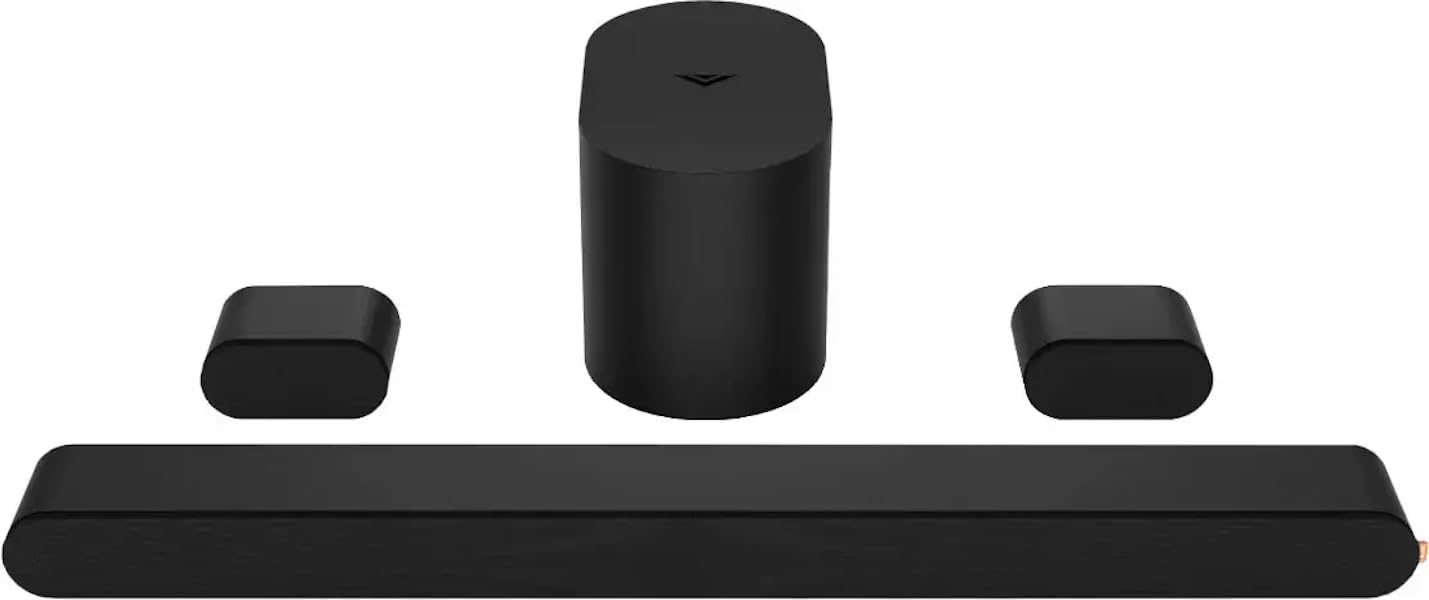
3. Vizio SV510M-0806B 33″ Dolby Atmos 5.1
A certified refurb that open up both Dolby Atmos and DTS:X over a single eARC cable
This Vizio stands out for supporting both Dolby Atmos and DTS:X — the two dominant surround formats — over a single HDMI eARC connection. That one-cable hookup also lets your TV remote control the soundbar directly, cutting remote clutter. The 33-inch low-profile enclosure wrapped in premium fabric fits neatly under most TVs without dominating the space.
The system ships with two surround speakers and a subwoofer unit, delivering physical rear sound that the ULTIMEA Poseidon M60 lacks. The dedicated center speaker earns particular praise for crisp dialogue, with buyers noting the side speaker wires are long enough for good room coverage. Bluetooth 5.2 handles wireless streaming for playlists and podcasts.
Being a certified refurb, the unit omits a physical remote — you’ll use the Vizio Mobile App or your TV remote via eARC. The refurb quality is the variable: some customers note dead satellite speakers on arrival, though the seller replaced them free including return postage. If you’re comfortable with the refurb trade-off, this delivers both major surround formats at an entry-level price point.
Dual-format value: rare for this tier to handle both Dolby Atmos and DTS:X, making it a flexible fit for any TV or streaming service.
A fair caveat: refurbished units occasionally arrive with non-functional small speakers, so check them on day one.
Reach for this if: your content mixes Atmos and DTS:X and you want a single-cable, remote-free setup.
Pass if: you want a brand-new unit with a physical remote in the box.
4. Rockville HTS56 1000W 5.1

The karaoke machine disguised as a home theater, with LED light shows and a built-in 8-inch sub
You get 1000W peak power through five satellite speakers and an 8-inch subwoofer, and buyers love the punchy bass for garage or party setups. what separates it is the built-in karaoke suite — two microphone inputs with echo control, a 5-band EQ, and even FM radio for singing along to anything. It’s built for entertaining, not just movie nights.
The LED light modes are a genuine crowd-pleaser, with subwoofer and satellite lights offering blink-to-beat and spectrum analyzer effects, all controlled by the included remote. Connectivity is broad: Bluetooth, USB, SD, RCA, and optical inputs mean it plugs into TVs, phones, DVD players, and even a guitar, as one reviewer noted. Setup includes speaker cables up to 30 feet for flexible placement.
The trade-offs are real. Some reviewers point out the speakers run shorter than expected and the center channel disappoints, with distortion and rattling creeping in at higher volumes. The “surround” is more of a stereo matrix than true discrete 5.1, so don’t expect precise rear-channel separation. For music, karaoke, and garage boombox duty, though, the value is hard to argue with.
The entertainment factor
- 1000W peak power with an 8-inch sub for physical bass
- Two karaoke mic inputs with echo control
- LED light modes synced to the beat
- Broad inputs from Bluetooth to optical to USB
The limitations
- Not a true discrete 5.1 surround — stereo matrix only
- Distorts at high volumes per some buyers
- LED lights can’t be fully turned off on satellites
Best for: garage, party, and karaoke use where booming bass and light effects matter more than precise surround.
Not for: critical audiophiles who want clean highs and true rear-channel separation.
5. Bobtot 1000W Peak Surround System
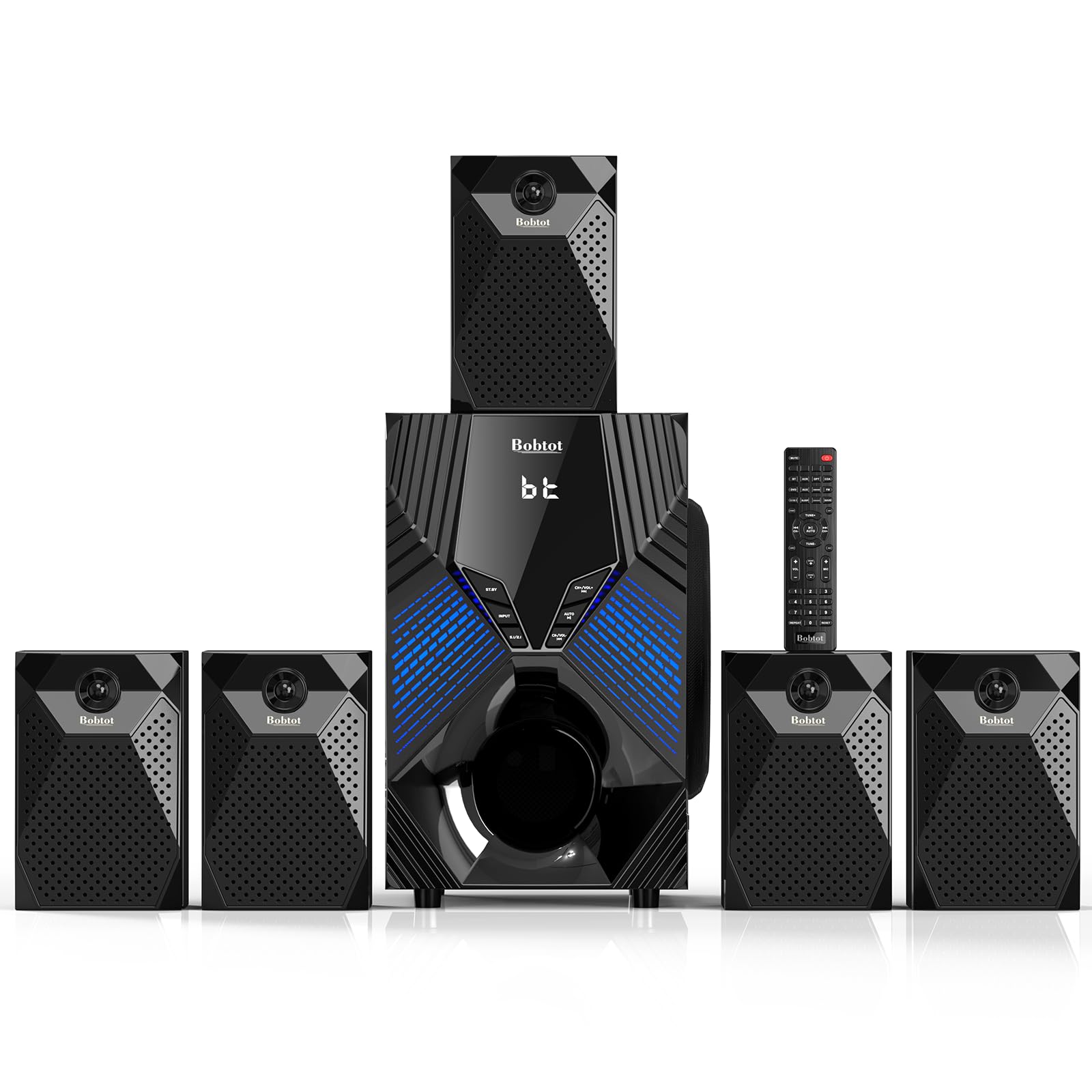
A five-speaker starter rig with an 8-inch sub that makes movies and games feel cinematic
This Bobtot system delivers a true 5.1 layout with five wired satellite speakers and an 8-inch subwoofer featuring a built-in receiver. Buyers praise its room-filling sound without distortion, describing how explosions “rattle the room” and place you in the middle of the action. The 1000W peak power is loud enough for small to medium-sized rooms, which covers most living spaces.
Connectivity covers nearly every source: TV ARC, optical, coaxial, AUX, USB, SD card, and Bluetooth. A nice touch is that Bluetooth pairs directly with the subwoofer, giving you wireless music playback from your phone. The system also includes two mic inputs for karaoke and six modes of multi-colored flashing lights that respond to the audio.
The honest caveat is volume behavior. Buyers find the TV/AV cable connection disappointingly quiet even at max volume, while Bluetooth playback gets significantly louder. Speaker cords are also on the short side, so plan to buy longer cables for wide surround placement. For background music in a store or casual movie nights, it’s a solid starter pick.
Why it works
- True 5.1 with five wired satellites and an 8-inch sub
- Room-filling sound without distortion per owners
- Multiple inputs including ARC, optical, and Bluetooth
- Two mic inputs for karaoke
What to plan for
- TV/AV cable volume is weak — Bluetooth is much louder
- Speaker cords are short; buy longer ones for surround
Choose this if: you’re building a first home theater and want real surround with an 8-inch sub on a budget.
skip it if: you mostly stream through a TV cable rather than Bluetooth — the volume difference is noticeable.
6. ULTIMEA Skywave F40 5.1.2ch
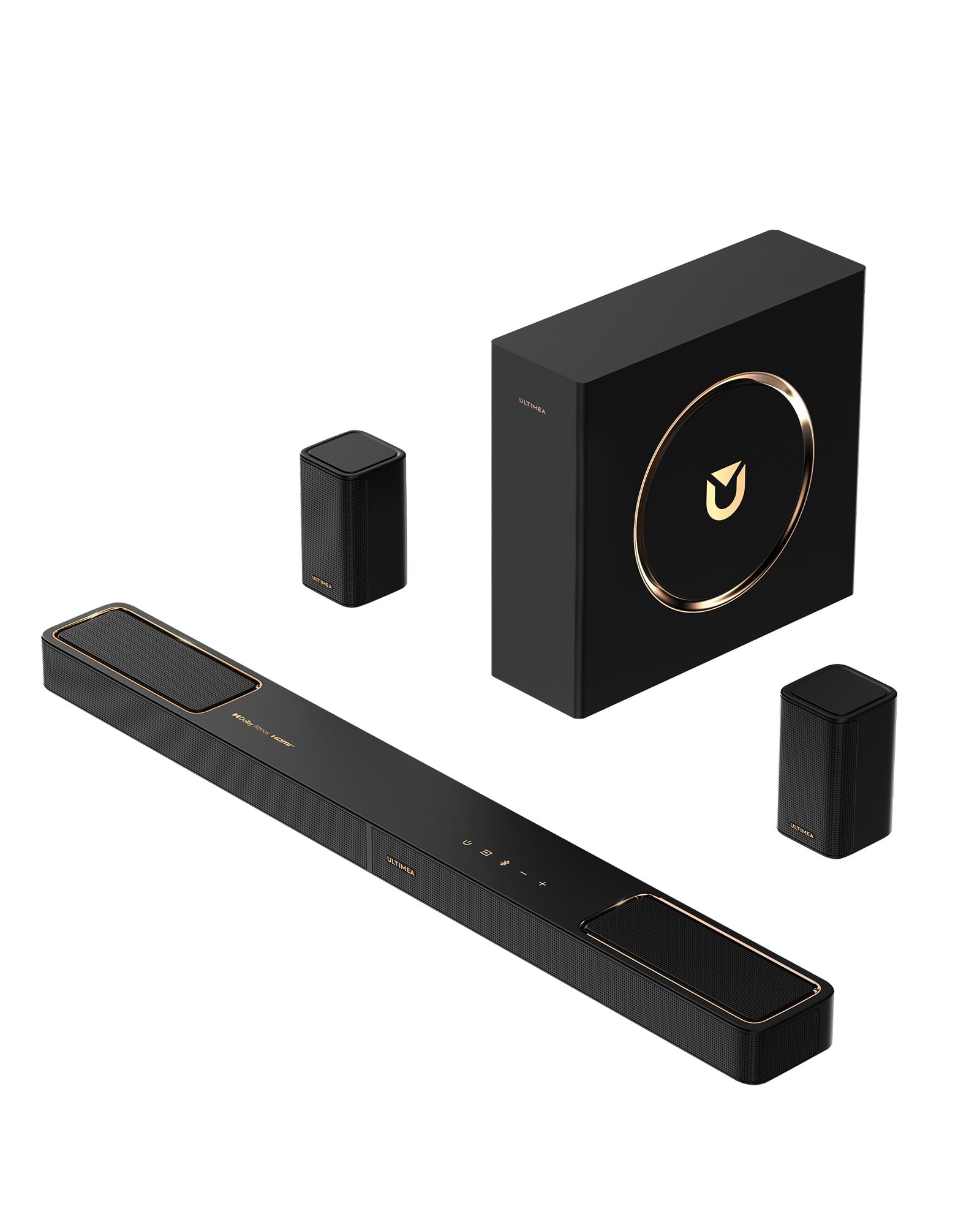
Up-firing neodymium drivers bounce Atmos off the ceiling so rain and helicopters seem to come from above
This is the system that makes Dolby Atmos feel vertical, not just surround. The Skywave F40 uses a 5.1.2-channel layout with up-firing speakers that bounce sound off your ceiling, so rain falls from above and helicopters circle overhead. The up-firing channels use neodymium internal magnets with 18-core voice coils for precise height effects — the signature Atmos experience budget bars usually skip.
Two rear surround speakers with SurroundX technology build a true 360° field, and they connect wirelessly to the soundbar (only a power outlet is needed). The 5.25-inch wired subwoofer with BassMX delivers solid bass, though buyers report it’s noticeable rather than jaw-droppingly deep. The HDMI eARC connection supports up to 37 Mbps bandwidth for lossless 5.1.2 audio, with CEC so your TV and soundbar power on and adjust together.
You can fine-tune the sound with app control offering a 13-step surround level adjustment (-6 to +6), a 10-band EQ, and 121 presets for deep personalization. Buyers consistently praise the clear audio and clean setup, noting it pairs smoothly with 4K TVs. The metal enclosure with gold trim on matte black looks more expensive than it is. Note it’s not compatible with DTS, so DTS-only content won’t get height effects.
The standout features
- Up-firing drivers deliver genuine Atmos height effects
- Wireless rear speakers for easy placement
- Lossless eARC with 37 Mbps bandwidth
- Premium metal build with gold trim
Things to know
- Not compatible with DTS content
- Bass is solid but not chest-thumping deep
- Best for small to medium rooms
Reach for this when: Dolby Atmos height effects are your priority and your ceiling is a standard 8 to 9 feet.
Look elsewhere if: you watch a lot of DTS-encoded content or want bone-rattling bass.
7. Bobtot 1200W Peak System
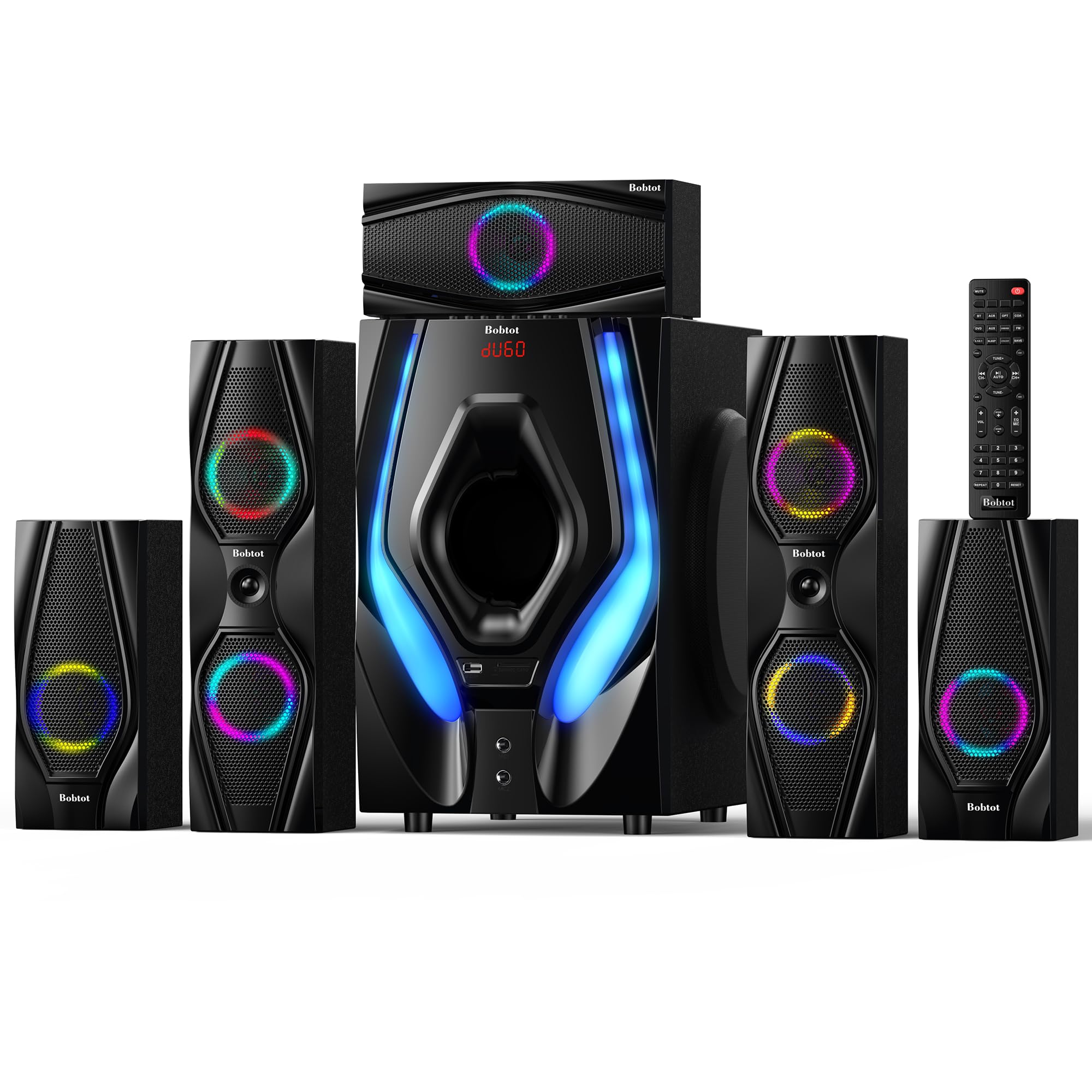
The biggest sub on the list — a 10-inch driver that turns living rooms into a movie theater floor
If booming bass is the entire point, this Bobtot is the heavyweight. Its 10-inch subwoofer with a built-in receiver is the largest driver on this list, delivering the deep, room-shaking low end that smaller subs can’t match. At 1200W peak power, buyers describe it as “very powerfully sound” with bass that makes watching movies feel like a theater experience. The 5.1/2.1 channel switching lets you go from full surround to stereo for music.
The wired speaker setup uses generous built-in cables — front speakers run 13 feet, and rear speakers reach 31 feet — so you can place satellites far apart for a wide sound field. The subwoofer has 4 LED lighting modes including blink-to-beat and spectrum EQ analyzer. The remote controls each speaker’s volume independently, and there’s an FM radio plus USB/SD slots accepting up to 64GB files. Two mic inputs with echo make it party-ready for karaoke.
Reliability is the recurring concern. While many owners are thrilled with the sound and value, a notable number report the subwoofer dying — one after 8 months (replaced in 2 weeks via email), another after 2.5 years. Connectivity issues also come up, and some units arrive non-functional. The lighting and remote draw criticism too. For pure bass-per-dollar, it’s class-leading, but treat it as a fun, not flawless, purchase.
Why bass lovers buy it
- Massive 10-inch subwoofer for deep, physical bass
- 1200W peak power fills large rooms
- Long 31-foot rear speaker cables
- FM radio, USB/SD slots, and karaoke inputs
The reliability question
- Subwoofer failures reported — some early, some after years
- Connectivity issues are a common refrain
- LED lights and remote draw mixed feedback
Best for: movie rooms and parties where maximum bass depth and volume matter more than long-term durability.
Think twice if: you want a set-and-forget system with proven multi-year reliability.
8. Monoprice Premium 5.1.2

The enthusiast’s budget kit — physical 5.1.2 speakers with an upward-firing driver for true Atmos
You get a genuine 5.1.2 layout with separate components you place and aim — a center channel, two rich upward-firing satellite speakers, two standard satellites, and an 8-inch 200-watt subwoofer. Buyers pair it with AV receivers for Dolby Atmos music and movies, noting it “outperforms pricier Sony speakers” in clarity and bass. It’s a traditional speaker system, not a soundbar.
The upward-firing driver creates that 3D space by bouncing sound off the ceiling, and owners find it particularly impressive for Atmos music via Apple TV 4K. The 8-inch sub delivers deep bass that stays controlled on 5.1 surround tracks, avoiding the boominess some subs show in stereo. This is the pick for someone who already has an AV receiver or plans to buy one, since the speakers require an external amp.
The honest downsides: the subwoofer “bottoms out easily” on extreme low frequencies, and some buyers found the center channel adds slight reverb, replacing both with Klipsch upgrades. One owner struggled to get the subwoofer working after 3 months. This isn’t plug-and-play like the soundbar options — it demands a receiver and a bit of setup expertise. For the price, though, it’s a legit step into separates.
What earns its keep
- True separate 5.1.2 speakers with upward-firing Atmos
- Crisp, clear sound with deep, controlled bass
- Performs above its price tier per owners
- Solid build quality
Know before you buy
- Requires an external AV receiver — not self-powered
- 8-inch sub bottoms out on extreme lows
- Some buyers upgraded the center channel
Choose this if: you already own or plan to buy an AV receiver and want real speakers over a soundbar.
Pass on it if: you want a simple two-cable setup straight from the start.
Understanding the Specs
Channel Count vs Real Surround
A “5.1” label can mean physical rear speakers or just side-firing drivers that fake the effect. Systems with actual wired or wireless rear satellites place sound behind you — that’s true surround. Side-firing bars widen the stage but can’t match real rear placement. For genuine immersion, prioritize systems with dedicated rear channels.
Peak Wattage and Subwoofer Size
Peak wattage numbers are maximum bursts, not sustained power, so you can’t directly compare 540W and 300W — the difference is misleading. Subwoofer driver size is the better bass predictor — an 8-inch or 10-inch driver moves more air than a 4-inch or 5.25-inch unit, delivering deeper and more physical low end. Match sub size to room size.
FAQ
What does 5.1 channel mean for a home cinema system?
Is a soundbar with side-firing drivers a true 5.1 system?
What is the difference between HDMI ARC and HDMI eARC?
How big a subwoofer do I need for a small or medium room?
Do I need an AV receiver with a budget home cinema system?
Will a budget system work with any TV or only the same brand?
What is Dolby Atmos and does it matter on a budget system?
How long do budget home cinema systems typically last?
Final Thoughts: The Verdict
For most buyers, the budget home cinema system winner is the Hisense HS5100 because it delivers a true 5.1 layout with physical rear speakers and powerful 540W output at a genuinely affordable tier. If you want the cleanest Dolby Atmos height effects without rear wires, the ULTIMEA Skywave F40 is the standout with its up-firing drivers. And for movie rooms or parties where maximum bass depth is the goal, the Bobtot 1200W with its 10-inch subwoofer is the one to reach for — just go in knowing its reliability is the trade-off.
How We Picked
We do not accept paid placement. Every pick is matched to a real buyer and a real use-case; we do not hands-on test units.
Sources & Methodology
Specifications: manufacturer listings and product documentation. Review insights: verified customer reviews, as of August 2026. Pricing: not shown on this page (it changes often); check the current price via the retailer link.
As an Amazon Associate, FitlyFast earns from qualifying purchases. This does not affect which products we feature.