
Our readers keep the lights on and the weekend projects moving. As an Amazon Associate, I earn from qualifying purchases.
Specs are compiled from manufacturer listings and verified buyer reviews and can change over time — please confirm the key details on the product page before buying.
Finding a true Japanese knife that respects your wallet might feel like hunting for a bargain on a prize cut of Wagyu. Most knives labeled “Japanese” under fifty dollars are stamped imitations that dull fast or chip on the first bell pepper. But there are a few hidden gems — blades forged from high-carbon steel, hand-sharpened to razor edges, and built with hardened steel cores that actually hold up to daily prep work. This guide cuts through the fake claims and points you straight to the models that deliver real Japanese performance without the three-figure price tag.
I’m Rikta — the founder and writer behind FitlyFast. This guide is built by comparing the manufacturers’ published specifications and the patterns across verified customer reviews, so you get each pick’s real strengths and trade-offs instead of marketing spin.
The knives here represent a competitive set of options for cooks who refuse to settle for overpriced mediocrity in their budget Japanese knives. While none of these blades require a second mortgage, several rival the cutting feel of knives several times their price through smart steel selection and careful forging.
Quick Picks
- HOSHANHO 8 Inch Japanese Gyuto Chef Knife — Best Overall
- Kimura Chef Knife, 8 inch, Made in Japan — Japanese-Made
- Huusk Japanese Kitchen Knife Set of 3 — Best Value Set
- kanngou 8.27 Inch Japanese Chef Knife (WA — Traditional Finish
- kanngou 8.27 Inch Japanese Chef Knife (Classic — Full-Tang Comfort
- HOSHANHO 6 Inch Kitchen Knife — Utility Precision
- Sunnecko Nakiri Knife 7 Inch — Vegetable Star
How To Choose The Best Budget Japanese Knives
Picking your first Japanese knife on a budget boils down to three key factors: the steel’s hardness and carbon content, the blade shape (gyuto, nakiri, or santoku), and the handle’s ergonomics. A cheap knife with soft steel will need sharpening after every meal, while the right mid-range option stays sharp for weeks at a time.
Steel Composition and Hardness (HRC)
The steel’s Rockwell Hardness (HRC) tells you how well the blade holds an edge. Most entry-level Western knives sit around HRC 52-54. A true Japanese kitchen knife typically starts at HRC 57 and can go up to 62. At that hardness, the blade stays razor-sharp much longer, but it also becomes more brittle — meaning you never cut through bones or frozen food. For budget models, look for high-carbon stainless steel (like AUS-8 or 10Cr15CoMoV) that balances edge retention with enough toughness to handle daily home use without chipping.
Blade Shape for Your Cooking Style
Japanese knives come in different shapes for different tasks. A Gyuto is the closest to a Western chef’s knife — an all-rounder for slicing, chopping, and mincing everything from meat to vegetables. A Nakiri has a straight, flat edge designed specifically for vegetable chopping; it makes contact with the cutting board along the entire blade, giving you clean, pull-through cuts. A Santoku is a shorter, lighter version of the gyuto with a sheep’s-foot tip. Pick the shape that matches the ingredients you prep most often.
Handle Material Matters
Japanese handles often come in wood (Pakkawood, rosewood, ebony) or synthetic materials like POM resin and polypropylene. Wood handles absorb impact better and feel warmer in the hand, but they require hand-washing and occasional oiling. Synthetic handles are more moisture-resistant and easier to grip when wet, making them a practical choice for busy kitchens. The shape — D-shaped or octagonal — affects how the knife sits in your grip; an octagonal handle, for example, lets you pinch-grip the blade with less fatigue during long prep sessions.
Quick Comparison
| Model | Best For | Steel | Blade Length | Weight | Amazon |
|---|---|---|---|---|---|
| HOSHANHO Gyuto 8″ | Layered steel performance | 10Cr15CoMoV | 8.11 in | 221 g | Amazon |
| Kimura Gyuto 8″ | Japanese-made precision | Mo stainless steel | 7.9 in | 175 g | Amazon |
| Huusk 3-Piece Set | Versatility (3 knives) | High-carbon steel | 8 in (Gyuto) | Amazon | |
| Kanngou WA Series | Traditional Kurouchi finish | AUS-8 alloy | 8.27 in | 5.92 oz | Amazon |
| Kanngou Classic | Full-tang Pakkawood comfort | AUS-8 alloy | 8.27 in | 7.58 oz | Amazon |
| HOSHANHO Utility 6″ | Precision small tasks | 10Cr15CoMoV | 6 in | 4 oz | Amazon |
| Sunnecko Nakiri 7″ | Vegetable chopping master | High-carbon stainless | 7 in | 0.43 kg | Amazon |
In‑Depth Reviews
1. HOSHANHO 8 Inch Japanese Gyuto Chef Knife

The layered-steel powerhouse that turns whole vegetables into easy ribbons.
You get a knife built from 9 layers of high-carbon steel — a core of Japanese 10Cr15CoMoV super steel wrapped in 8 anticorrosion layers — so the edge stays screaming sharp for far longer than a single-stamped blade. The hand-polished V-shaped edge is sharpened to 12-15 degrees per side, letting you glide through onions, potatoes, and even thicker meat cuts with clean, even slices. Buyers report that “chopping onions, potatoes, carrots, and even thicker cuts of meat feels very easy and clean,” and at 221 grams (about 7.8 oz), it has a grounded heft that the 175-gram Kimura below lacks.
HOSHANHO uses wet V-sharpening technology between hard materials and soft water to improve edge toughness, and the hammered blade texture reduces food sticking — sticky potatoes or cucumber slices fall off rather than clinging to the steel. The imported rosewood handle with two copper wires gives you an ergonomic traditional Japanese octagonal shape that naturally fits your palm, so fatigue is minimal during long prep sessions. At an 8.11-inch blade with a 6.1-inch handle, the near golden-ratio balance makes each cut feel guided.
True Steel Credentials
- 9-layer sandwich construction with a 10Cr15CoMoV super steel core for exceptional edge retention
- Hand-polished 12-15° V-edge (sharper than the Kimura’s 15° double bevel)
- Hammered tsuchime finish reduces food sticking during prep
Watch Out For
- Burr or sharp protrusion reported near the bolster on some units (one reviewer noted “sharp flapper hanging off” by the handle)
- Not dishwasher safe — hand wash and dry immediately to protect the rosewood handle
Best for layered-steeel lovers: Anyone who wants premium multi-layer steel and a hammered finish without the premium price.
Possible dealbreaker: Check the blade’s rear edge near the handle when it arrives — a few units need a quick smoothing pass with fine sandpaper.
2. Kimura Chef Knife, 8 inch, Made in Japan

The genuine Japanese-made gyuto that respects both tradition and your budget.
Kimura manufactures this 8-inch gyuto in Seki, Japan — the same city known for centuries of samurai sword crafting — giving you real Japanese origin at a price that undercuts most imports. The blade is high-carbon chrome molybdenum stainless steel, heat-treated to HRC 57, and hand-sharpened to a 15-degree angle. What this means in practice: the knife cuts precisely without needing frequent honing, and the full-tang construction with triple rivets gives it exceptional strength. At only 175 grams (roughly 6.2 oz), it is noticeably lighter than the HOSHANHO’s 221 grams, making it a better pick if you prefer a nimble, wrist-friendly feel for extended chopping sessions.
The handle is made from POM resin — a non-slip synthetic that stays grippy even when your hands get wet or oily. The ergonomic shape lets you switch between a regular grip, a pointed-finger grip, or a pinch grip without discomfort. Unlike the octagonal wood handle on the HOSHANHO or the Pakkawood on the Kanngou Classic, this synthetic handle handles moisture without any risk of warping. A lifetime warranty backs the entire knife, which is rare at this price point.
Real Japanese Heritage
- Made in Seki, Japan, by skilled Kimura craftsmen — genuine origin, not an import stamp
- Full tang with triple rivets and bolstered construction for long-term durability
- Lifetime warranty included, rare for a mid-range knife
A Few Things to Note
- Stamped, not forged — while durable, it lacks the layered steel complexity of the forged HOSHANHO
- POM resin handle, while moisture-resistant, doesn’t offer the warm feel of natural wood
Ideal for origin purists: If having “Made in Japan” on the blade matters to you, this is the most affordable genuine Seki-made gyuto on the list.
The catch: The lighter 175-gram weight may feel insubstantial to cooks who prefer more blade heft for push-cutting through dense squash.
3. Huusk Japanese Kitchen Knife Set of 3
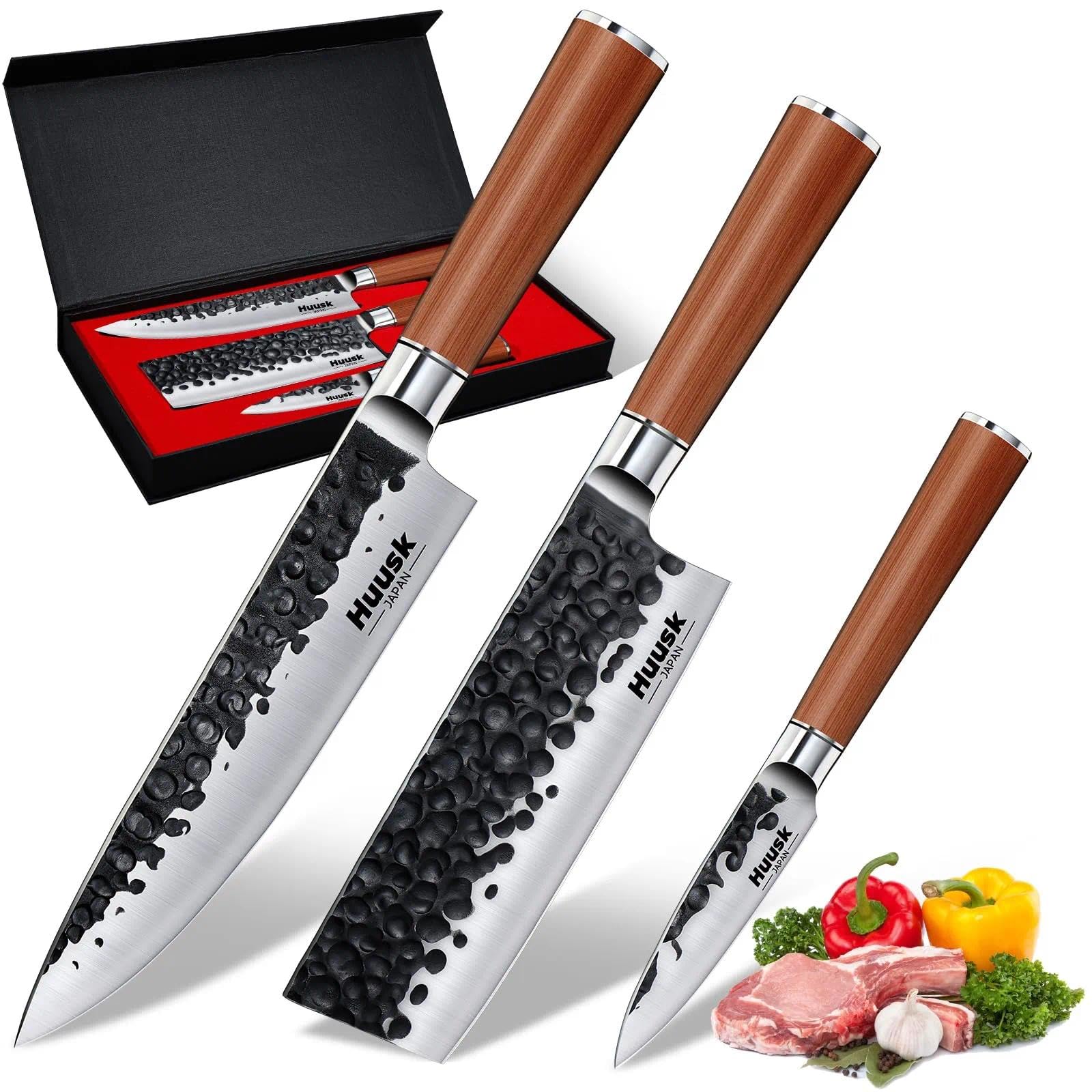
Three handcrafted Japanese blades that make a serious starter arsenal without emptying your account.
Huusk packs a 3.5-inch paring knife, an 8-inch Gyuto chef knife, and a 6.5-inch Nakiri vegetable cleaver into a single purchase — so you can tackle everything from peeling apples to chopping butternut squash with the right blade for the job. Each knife is hand-forged from high-carbon steel with a hammered texture, and a single-piece blade construction reinforced by a thicker spine for resilience. Owners mention that “I have arthritis and this one is perfectly balanced and cuts easily,” which speaks to the ergonomic natural wood handle that minimizes hand fatigue even during heavy prep sessions.
The set’s standout is the balance: the natural wood handles are shaped for a smooth, comfortable grip that gives you excellent control, and the hammered finish on each blade reduces food sticking. At this price point (among the most affordable in the guide), you get three functionally distinct knives instead of one. The 6.5-inch Nakiri is particularly useful if you do a lot of vegetable chopping — its straight edge makes full contact with the board for clean cuts. However, the high-carbon steel requires immediate drying after use to prevent rust, and none of the knives are dishwasher safe.
Complete Starter Set
- 3 essential Japanese knife shapes in one purchase: paring, gyuto, and nakiri
- Hand-forged high-carbon steel with single-piece construction for durability
- Buyers with arthritis praise the balanced feel and easy cutting
Keep in Mind
- Not dishwasher safe, and high-carbon steel needs immediate drying to avoid oxidation
- Wood handles require occasional oiling to prevent drying and cracking over time
Reach for this if: You are equipping a kitchen from scratch or want a nakiri and a paring knife in addition to a gyuto without buying three separate items.
Look elsewhere if: You want a single, higher-performing gyuto rather than a set — the HOSHANHO or Kanngou WA above will outperform the 8-inch Huusk gyuto alone.
4. kanngou 8.27 Inch Japanese Chef Knife (WA Series)
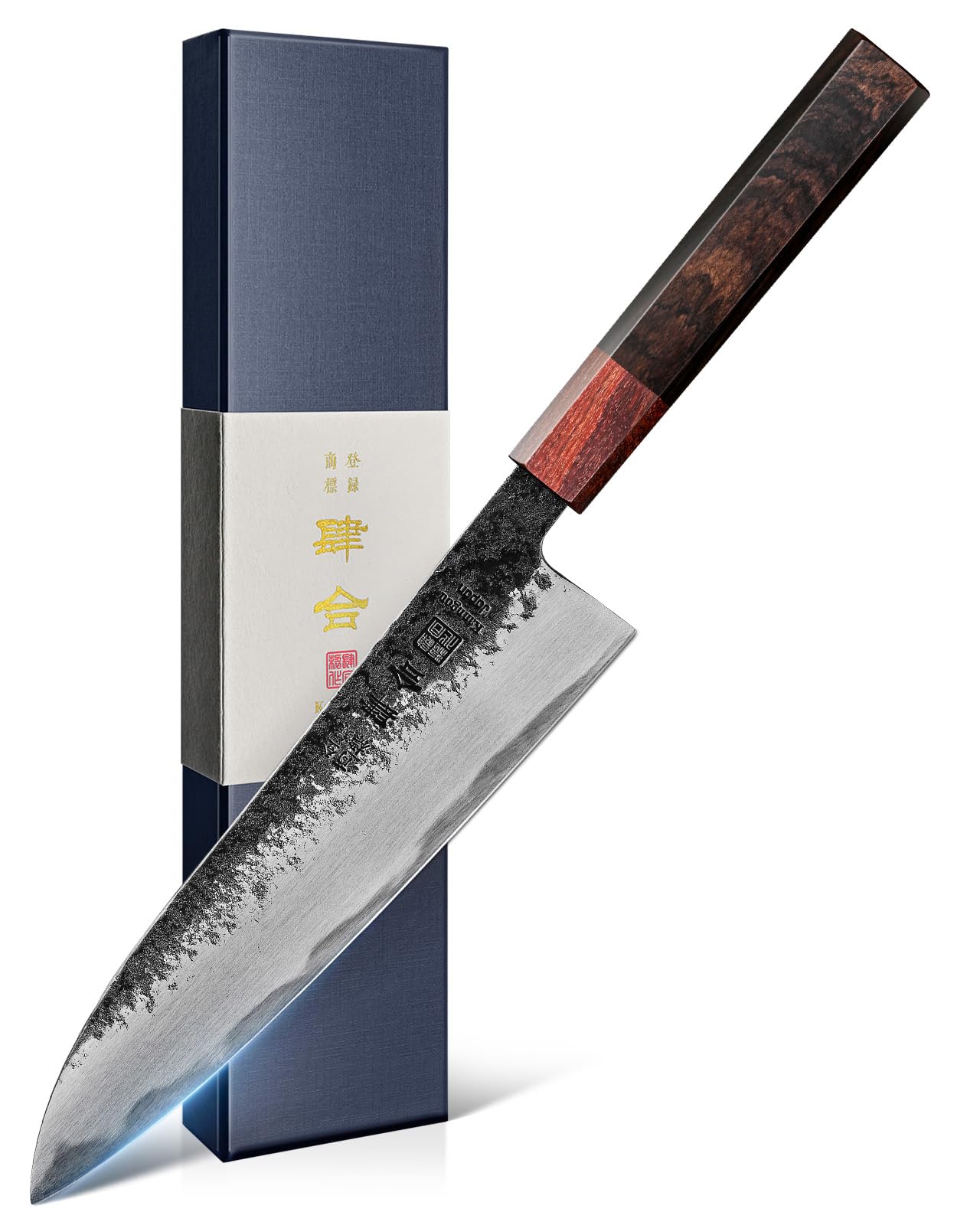
A traditional Kurouchi black-forged blade that looks like a museum piece and cuts like a pro tool.
The Kanngou WA Series uses the Kurouchi Tsuchime (black-forged) technique, which gives the blade a distinctive dark, hammered finish that resists rust and reduces friction as you cut. The core steel is AUS-8 Japanese alloy with a hardness rating of HRC 59±2 — harder than the Kimura’s HRC 57, meaning the edge stays sharp longer between sharpenings. The WA-style handle is a blend of premium ebony and red sandalwood, giving it an elegant two-tone look that stands out in any knife block. One chef reviewer noted that “I like it more than knives I paid 5 times as much for,” praising the comfort of the rounded blade spine.
Kanngou pairs this traditional aesthetic with a micro-concaved edge technology that delivers near-zero-degree sharpness from the start. At 5.92 ounces (about 168 grams), it is slightly lighter than the Classic series Kanngou (7.58 oz), offering a nimble feel that makes precise slicing and mincing easier for home cooks. The knife comes in an elegant gift box, making it a thoughtful present for culinary enthusiasts. However, the AUS-8 steel, while tough and corrosion-resistant, does not reach the same peak sharpness as the 10Cr15CoMoV core in the HOSHANHO.
Artisan Appeal
- Genuine Kurouchi Tsuchime black-forged finish for durability and rust resistance
- Ebony and red sandalwood WA handle — beautiful, comfortable, and balanced
- HRC 59±2 hardness is higher than the Kimura (HRC 57), promising longer edge retention
Things to Check
- One buyer received a knife with a damaged tip from the start (seller reportedly compensated)
- AUS-8 steel, while good, doesn’t edge-hold as well as the 10Cr15CoMoV core in the HOSHANHO
Go for it if: The Kurouchi black finish and two-tone wood handle match your kitchen’s aesthetic and you want a hard, long-lasting edge.
The warning: Inspect the tip immediately on arrival — a small number of units may have shipping damage, though the seller reportedly addresses it quickly.
5. kanngou 8.27 Inch Japanese Chef Knife (Classic Series)

A full-tang Pakkawood handle knife that balances like a much more expensive blade.
The Classic Series from Kanngou uses the same AUS-8 Japanese alloy steel core (HRC 59±2) as the WA Series, but swaps the two-tone ebony/sandalwood handle for a black Pakkawood handle. Pakkawood is a resin-infused hardwood that resists moisture, heat, and corrosion better than natural wood — it does not warp or crack over time even with regular washing (though you should still hand dry it). The full-tang construction extends the steel through the entire handle, giving the knife a grounded, balanced feel that professional cooks prefer. At 7.58 ounces (215 grams), this is the heaviest Kanngou on the list, providing extra cutting momentum for push-chopping through dense vegetables.
The 15-degree cutting angle on a 0.1-inch thick blade makes this a nimble performer for slicing, mincing, and dicing. The 8.27-inch blade is long enough to handle large produce like cabbages or melons, while the Pakkawood handle’s ergonomic shape minimizes fatigue. Compared to the WA Series, this classic series places more weight behind the cut — making it better for cooks who prefer a moderate heft. The sophisticated navy blue gift box adds a premium feel if you are buying this as a gift for a father, husband, or friend who loves to cook.
Solid and Reliable
- Full-tang construction for superior balance and strength over the WA series
- Pakkawood handle resists moisture and won’t warp like natural wood options
- AUS-8 steel holds HRC 59±2 hardness for good edge retention
Consider This
- Does not have the layered steel or higher Rockwell hardness of the HOSHANHO
- Lacks the traditional Kurouchi finish that makes the WA series stand out visually
Best suited for: Cooks who want a full-tang, balanced knife with a durable moisture-resistant handle that can handle heavy daily use.
One trade-off: If you want the visual wow-factor of a hammered or black-forged finish, the Classic series plain silver blade looks more utilitarian.
6. HOSHANHO 6 Inch Kitchen Knife

A smaller, flexible utility knife that outperforms most full-size chef’s knives on precision work.
HOSHANHO’s 6-inch utility knife uses the same premium steel core — Japanese super 10Cr15CoMoV — as its big 8-inch gyuto sibling, but in a lighter, more maneuverable package. Weighing only 4 ounces (113 grams), this knife is designed for precision slicing, paring, and carving rather than heavy-duty chopping. The blade is forged through vacuum heat treatment and nitrogen freezing, reaching a Rockwell hardness of up to HRC 60 — the hardest on this list. The blade edges are hand-sharpened to 15 degrees per side, giving you a razor edge that performs beautifully on smaller meats, cheeses, and detailed vegetable work.
The high-quality Pakkawood handle forms a perfect ridge for a comfortable grip, and the steel’s carbon content of about 0.3% provides exceptional strength without brittleness. One buyer mentioned that “the quality is on par with Shun, and the price is much more affordable,” highlighting the value proposition. While this is a utility knife rather than a chef’s knife, it handles most daily kitchen tasks effectively — one owner reported it “easily cuts through meat and dense vegetables.” Just remember: it is not intended as a heavy chopper, so save the large squash or melon work for the 8-inch gyuto options above.
Precision Powerhouse
- Same 10Cr15CoMoV super steel as the larger HOSHANHO, with HRC 60 hardness — the highest in the guide
- Light 4-ounce weight with a comfortable Pakkawood handle
- Excellent for small hands or detailed slicing, paring, and carving
Its Limits
- At 6 inches, it is too short to serve as a primary chef’s knife for heavy chopping
- Not designed for cutting through bones or frozen foods — the hard edge can chip
Reach for this if: You have smaller hands, need a nimble second knife for detail work, or want a gift for someone who does precision prep like cheese or fruit carving.
Look elsewhere if: You need a single all-purpose knife — the 8-inch gyuto options from HOSHANHO or Kimura cover more ground.
7. Sunnecko Nakiri Knife 7 Inch
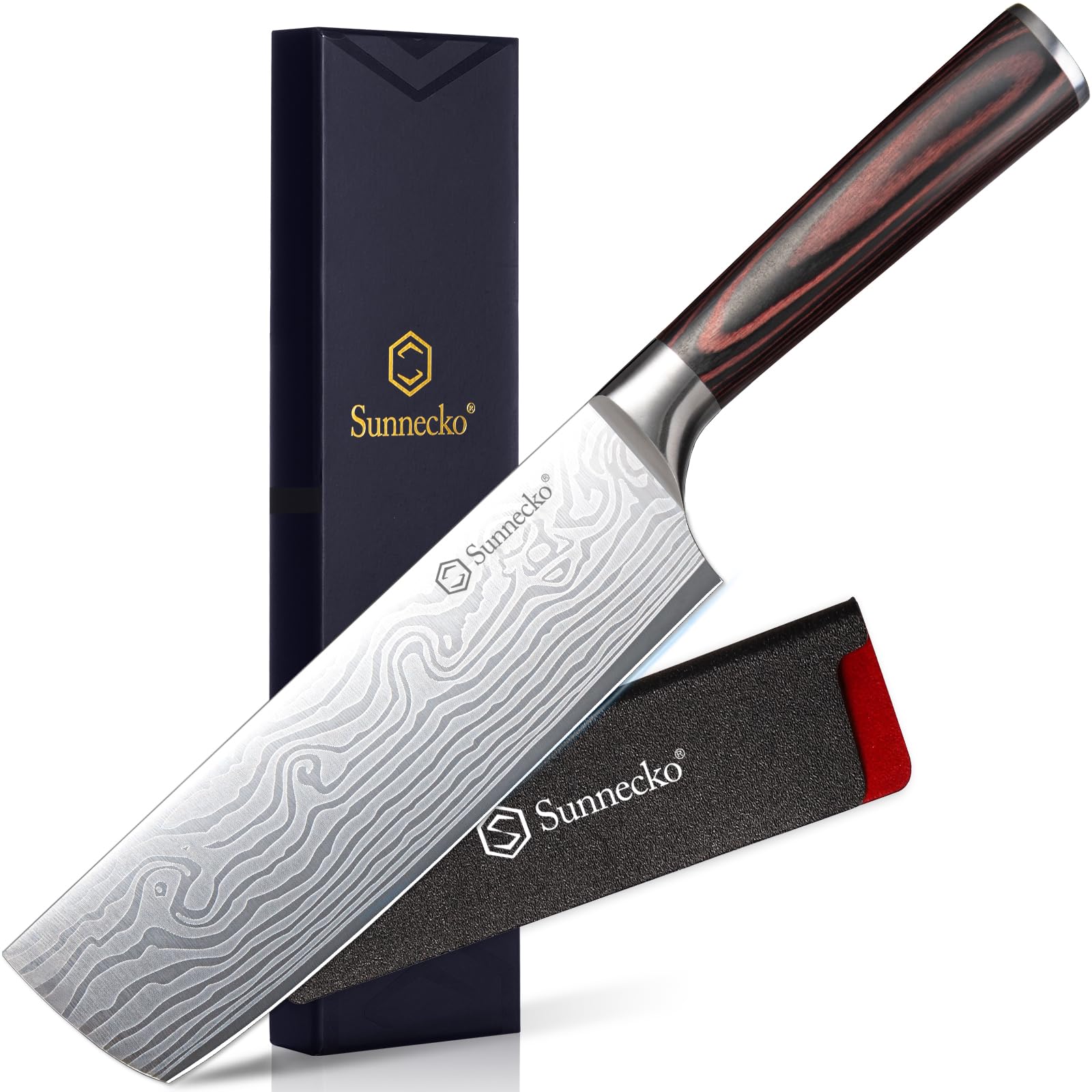
The vegetable-specialist nakiri that makes tomatoes and herbs feel like soft butter.
The Sunnecko Nakiri is built for one job — and it does that job better than any other budget option. A classic 7-inch nakiri with a straight, flat edge that makes full contact with the cutting board, it delivers clean, even slices through delicate produce like tomatoes, bell peppers, mushrooms, and fresh herbs without smashing or tearing. The double-bevel edge (12 degrees per side) is hand-forged through a 12-step process, and unlike single-bevel traditional Japanese blades that tend to pull to one side, this symmetrical design gives straight, true cuts that lefties and righties both appreciate. One customer observed they “watched some videos from Yan Can Cook about different knife styles and wanted to try a nakiri,” and found this one comfortable and well-balanced.
High-carbon stainless steel forms the ultra-thin blade, and the laser-etched wavy pattern (inspired by traditional Japanese damascus) actively reduces food sticking — onions, potatoes, and carrots slide right off the blade. The ergonomic Pakkawood handle has a non-slip textured finish that stays secure even with wet hands. A protective sheath is included for safe drawer storage, a practical feature that several competitors omit. While the label pattern is laser-etched rather than true Damascus steel — one user highlighted it “will just wear off over time” — the knife’s performance and comfortable weight (0.43 kg) make it an excellent dedicated vegetable chopper.
Vegetable Specialist
- Double-bevel 12° edge gives straight, drift-free cuts for righties and lefties alike
- Includes a protective sheath for safe storage — a feature many budget nakiris skip
- Laser-etched wavy pattern reduces food sticking on sticky produce
The Fine Print
- Laser-etched pattern is not real Damascus steel and may fade over time
- Nakiri shape is specialized for vegetables — not ideal for meat or fish work
Best for: Home cooks who chop vegetables daily and want a dedicated blade that does it better than any gyuto could.
skip it if: You need an all-rounder knife — the Huusk set or a gyuto from HOSHANHO/Kimura will serve you better as a single purchase.
Understanding the Specs
Rockwell Hardness (HRC)
This number tells you how hard the steel is. A higher HRC (57-62 range) means the blade stays sharp longer but may be more brittle. Budget Japanese knives with HRC 57-60 hit the balance: you get good edge retention for weeks of daily use without the chipping risk of ultra-hard HRC 63+ blades. Knives under HRC 57, common in cheap Western knives, will require sharpening after just a few meals.
Blade Construction: Forged vs. Stamped
Forged blades are heated and hammered into shape, aligning the metal’s grain structure for better strength and edge stability. Stamped blades are cut from a sheet of steel — cheaper to produce but not as long-lasting. Every forged Japanese knife in this guide (HOSHANHO, Kanngou, Sunnecko) uses thick steel with a harder core layer that resists dulling, while the Kimura is stamped but benefits from full-tang triple-rivet construction.
FAQ
Do I need a special sharpener for Japanese knives?
Can I put a Japanese knife in the dishwasher?
What is the difference between a Gyuto and a Nakiri?
What does full tang mean?
Is AUS-8 steel good for a knife?
Will a Japanese knife chip on hard vegetables?
How many knives do I really need as a home cook?
How do I maintain the wooden handle on a Japanese knife?
What does double-bevel mean?
Is a hammered finish for looks or function?
Final Thoughts: The Verdict
Across the board, the budget Japanese knives winner is the HOSHANHO 8 Inch Gyuto because its 9-layer 10Cr15CoMoV steel core and hand-polished 12-15 degree edge deliver premium-level sharpness and edge retention at a mid-range price. If you want genuine Japanese manufacture with a lighter feel, grab the Kimura 8 Inch Gyuto. And for vegetable-focused home cooks who want a dedicated chopping blade, the standout is the Sunnecko Nakiri 7 Inch for its straight, double-bevel 12-degree edge and included sheath.
How We Picked
We do not accept paid placement. Every pick is matched to a real buyer and a real use-case; we do not hands-on test units.
Sources & Methodology
Specifications: manufacturer listings and product documentation. Review insights: verified customer reviews, as of July 2026. Pricing: not shown on this page (it changes often); check the current price via the retailer link.
As an Amazon Associate, FitlyFast earns from qualifying purchases. This does not affect which products we feature.