
Our readers keep the lights on and the weekend projects moving. As an Amazon Associate, I earn from qualifying purchases.
Specs are compiled from manufacturer listings and verified buyer reviews and can change over time — please confirm the key details on the product page before buying.
Chances are, the knife you reach for every day has gone from slicing cleanly to smashing the tomato. You don’t need a big budget to fix that: a sharp blade is safer and faster to use, and the right sharpener can cost pocket change rather than pricey new knives.
I’m Rikta — the founder and writer behind FitlyFast. This guide is built by comparing the manufacturers’ published specifications and the patterns across verified customer reviews, so you get each pick’s real strengths and trade-offs instead of marketing spin.
if you want a simple electric unit or a traditional stone that gives you full control, these budget knife sharpener picks show you which one fits your kitchen routine and skill level.
Quick Picks
- Whetstone Knife Sharpening Stone Kit — Best Overall
- Smith’s Pull-Thru Knife Sharpener — Top Value
- Dawnstar Electric Knife Sharpener — Fastest Results
- Pegelong Electric Knife Sharpener S820 — Slim & Mighty
- YCAMMIN Double-sided Diamond Sharpening Stone — Diamond Speed
- Norton Combination Grit Oil Stone (100/280 Grit) — Oil Stone Classic
- Work Sharp Benchtop Whetstone Knife Sharpener — Precision Guide
How To Choose The Best Budget Knife Sharpener
Picking the right sharpener depends on how much time you want to spend and what kind of edge your knives need. Electric models sharpen in seconds but remove more metal; manual stones give you a finer, longer-lasting edge but need a steady hand and a few extra minutes. Here is what to weigh before you buy.
Grit Rating — the single spec that decides everything
Grit tells you how coarse the abrasive surface is. A low number like 300 or 600 aggressively grinds metal away — that’s great for fixing a chipped or very dull blade. A high number like 4000 or 6000 polishes the edge to a razor finish. Most budget-friendly setups pair a medium grit (1000) for sharpening with a fine grit (6000) for honing (the final smoothing step), giving you both jobs in one stone.
Angle guide vs freehand — your skill level decides
Keeping a consistent angle (15° to 20° is typical) is the hardest part of manual sharpening. Some kits include a plastic angle guide that clips onto the blade; others leave you to find the angle by feel. If you’re new to whetstones, an included guide or a pull-through sharpener with pre-set angles removes the guesswork and gets you a reliable edge from your first try.
Maintenance and mess — electric vs manual
Electric sharpeners create fine metal dust that needs collecting, and some have a magnetic tray that makes cleanup simple. Whetstones need to be soaked in water for 5 to 10 minutes before use, and they release a slurry of metal and stone that you wipe away afterwards. Oil stones stay lubricated longer but require a specific honing oil (or a substitute like mineral oil or WD-40). Think about how much counter space and cleanup you’re willing to handle each time.
Quick Comparison
| Model | Best For | Type | Grit Rating | Weight | Amazon |
|---|---|---|---|---|---|
| Whetstone Knife Sharpening Stone Kit | Versatile manual sharpening | Whetstone | 1000 / 6000 | 1.9 Pounds | Amazon |
| Smith’s Pull-Thru Knife Sharpener | Quick honing | Pull-through | Coarse / Fine | 0.22 Pounds | Amazon |
| Dawnstar Electric Knife Sharpener | Fast electric sharpening | Electric | Coarse / Fine | 1.41 Pounds | Amazon |
| Pegelong Electric Knife Sharpener S820 | Aggressive 12.6° edge | Electric | Fine | 2.5 Pounds | Amazon |
| YCAMMIN Diamond Sharpening Stone | Fast-cutting diamond plate | Diamond stone | 600 / 1200 | 0.75 Pounds | Amazon |
| Norton Combination Oil Stone | Durable oil-stone touch-ups | Oil stone | 100 / 280 | 1.5 Pounds | Amazon |
| Work Sharp Benchtop Whetstone | Precise angle-guided sharpening | Whetstone | 1000 / 6000 | 2.25 Pounds | Amazon |
In‑Depth Reviews
1. Whetstone Knife Sharpening Stone Kit – Double Sided 1000/6000 Grit

A beginner-friendly whetstone that gives you two grits and a stable base for under twenty dollars.
If you want to learn traditional sharpening without spending much, this kit from ZGQOOFA gives you a 1000 grit side to rebuild a dull edge and a 6000 grit side to polish it. The 8.46-inch long stone gives you plenty of room to draw the blade across, and the included non-slip bamboo base keeps it planted on the counter. An angle guide clips onto the blade — a real help if you have never matched a consistent angle (the slope between blade and stone) before.
Buyers report the “dual stone: 1K side for 5-8 minutes per side, 6K side for polishing” works well once you watch a video tutorial, because no printed instructions are in the box. The silicone holder adds stability, and you only need water — no expensive oil. A few reviewers mention you’ll eventually need a leveling stone (a flat abrasive stone used to re-flatten a whetstone surface) to keep the surface flat after repeated use, but at this price, the trade-off is honest.
What stands out
- Two useful grits (1000 and 6000) handle both sharpening and polishing
- Bamboo base and silicone holder prevent sliding while you work
- Works on knives, scissors, and even axes without needing oil
What to know
- No instructions included — you have to find an online tutorial
- Stone surface may dish over time and need flattening
Best for beginners: The 1000/6000 grit combo and the bamboo base make this an honest starter kit that teaches you the skill while staying affordable.
One drawback: The missing instructions can be frustrating if you have never used a whetstone before — plan to watch a short video first.
2. Smith’s Pull-Thru Knife Sharpener
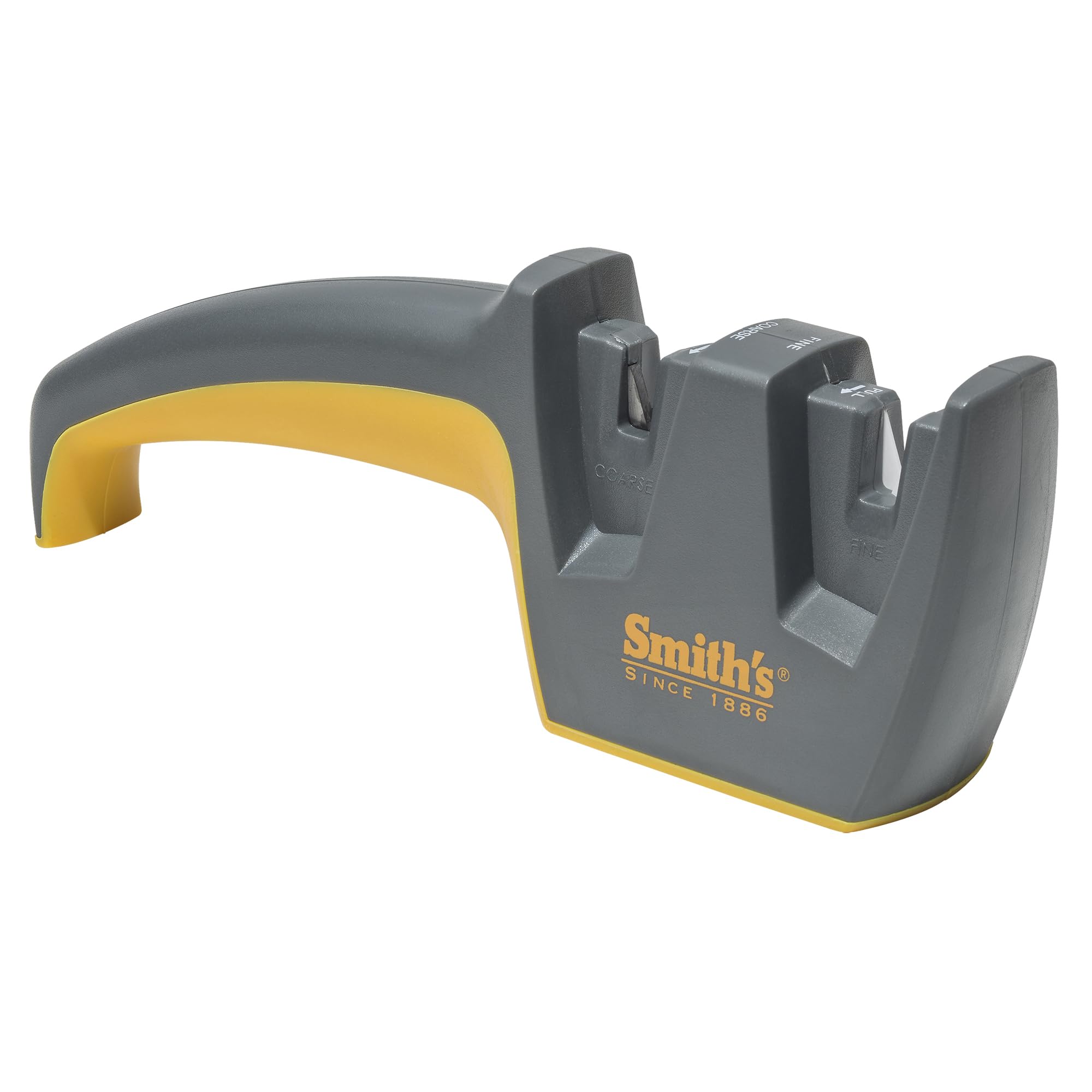
A pocket-sized pull-through that takes seconds to refresh an edge with zero learning curve.
At just 6 inches tall and 0.22 pounds, this Smith’s sharpener is barely larger than a marker, yet it packs coarse carbide blades (very hard, metal-cutting inserts) for fixing dull edges and fine ceramic rods (hard alumina rods used for final honing) for final honing. You just set the knife in the slot, pull it through a few times, and you’re done — no angle guessing, no setup. The rubber base and soft-grip handle keep it steady on the counter.
Buyers confirm “pull-thru sharpener works well for quick honing; Fine side gave great results on slicing knife with few swipes.” The trade-off is that it shaves off more metal than a whetstone and is not ideal for badly chipped or very thick blades. Serrated knives should use only the Fine side. But for keeping everyday kitchen knives in serviceable shape, this speed and simplicity are hard to argue with.
Why it works
- Two-stage sharpening (coarse carbide + fine ceramic) handles most kitchen dullness
- Rubber feet and ergonomic grip make it safe and comfortable to use
- Replaceable components extend the tool’s life
Where it falls short
- Not suitable for severely damaged or chipped knives
- Carbide side removes more metal than a stone — use sparingly
Grab it for: Quick weekly touch-ups on knives that are already reasonably sharp — you’ll have a working edge in under 30 seconds.
Pass on it if: Your blades are very dull or chipped; you need a stone or electric model that can grind away more metal first.
3. Dawnstar Electric Knife Sharpener, 2-Stage (Coarse & Fine)
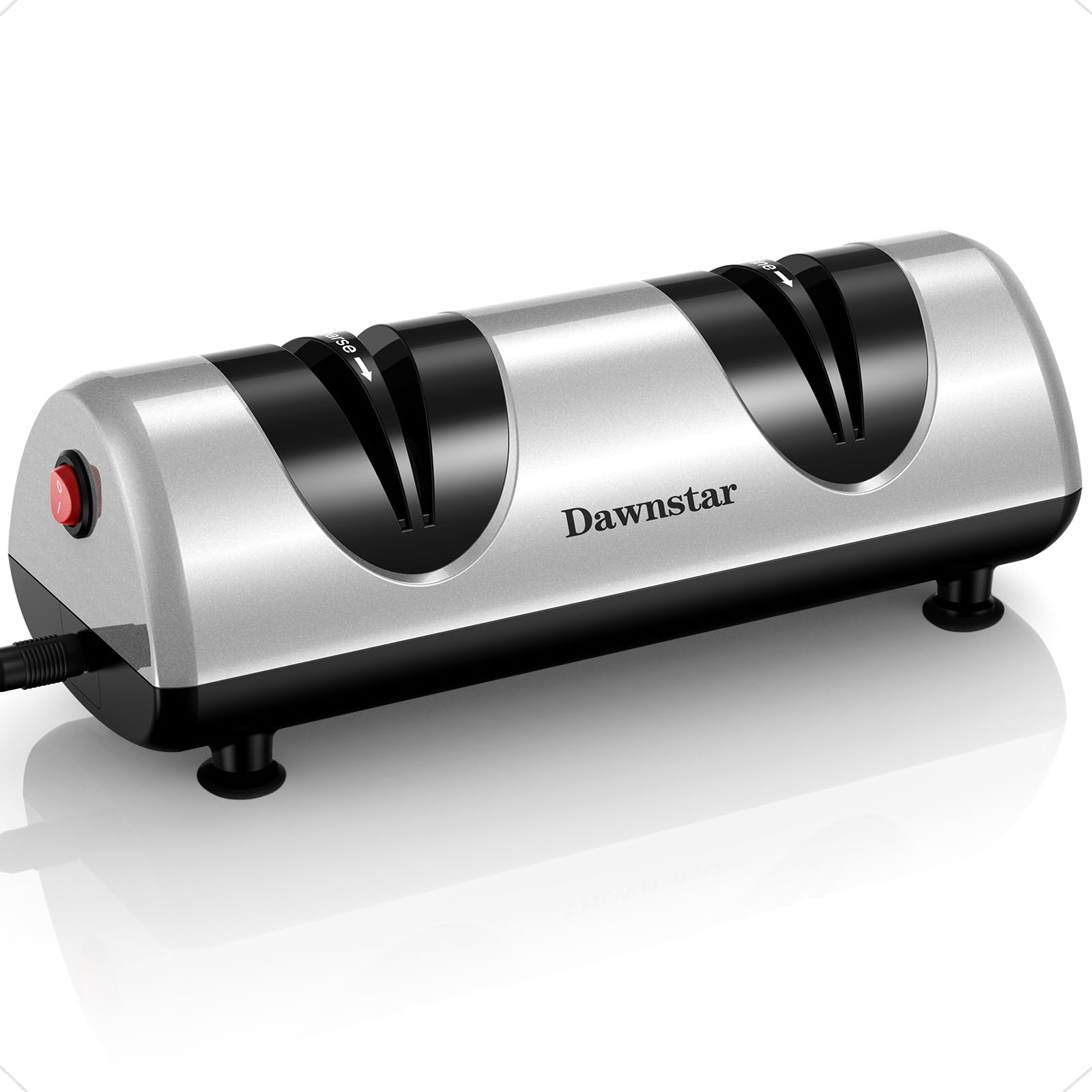
An electric sharpener that refreshes a dull blade in about 30 seconds with no skill required.
The Dawnstar runs a coarse stage to grind a new edge and a fine stage to polish off the burr (the tiny metal wire left after grinding). You slide the blade from base to tip through each slot for about 2-5 passes. The motor keeps running steadily for a whole set of knives without overheating. At just 1.41 pounds, it’s much lighter than the 2.5-pound Pegelong electric model, making it easier to pull out and put away.
Owners mention “took ~20 minutes for 5 knives, ~1 minute per blade” — a massive time saving over manual stones. A magnetic metal dust collection box underneath catches the filings, so cleanup is as simple as pulling out the tray and wiping the magnet clean. The catch is that the edge is more “working sharp” than “razor mirror” — if you need the absolute finest finish possible, a hand stone like the Work Sharp Benchtop Whetstone will still beat it. But for everyday speed and convenience, this is the clear winner among electrics at this price.
Speed advantage
- Coarse and fine stages let you sharpen and finish in one machine
- Magnetic dust tray collects metal shavings for mess-free cleaning
- Universal voltage (100-240V) works worldwide
Speed trade-off
- Guided system is less precise than manual stropping (the final polishing step) — don’t expect a shaving-sharp edge
- Only works for straight-edge knives, not serrated blades
Pick this for: Anyone who wants a sharp knife without spending ten minutes per blade — it delivers a solid kitchen edge fast.
skip it if: You enjoy the control of a hand stone or need to sharpen serrated knives.
4. Pegelong Electric Knife Sharpener S820 (12.6° Bevel)

An electric sharpener that cuts a steeper 12.6-degree bevel for a noticeably keener edge.
Most budget electric sharpeners use a 15- or 20-degree angle, but Pegelong sharpens at a sharper 12.6-degree bevel — the maker claims this makes the blade cut faster and feel sharper. The 50-watt motor drives replaceable grinding wheels, and the 8.66-inch body keeps a small footprint on the counter.
Customers note the unit works well for both kitchen knives and scissors. A few mention the plastic housing feels sturdy enough for regular use, and the compact size sits neatly above a utensil drawer. The catch is that the aggressive angle removes metal quickly, so you need to be careful not to oversharpen a blade. If you want a sharp edge fast and don’t mind the extra weight on your counter, this is a solid choice.
Defining edge
- Sharper 12.6-degree bevel cuts faster than standard 15-degree models
- Replaceable wheels extend the machine’s lifespan
- Heavy 2.5-pound build stays put during sharpening
Weight to consider
- Narrower angle removes more metal — easy to oversharpen
- Only works on straight-edge knives
Reach for this if: You want a noticeably sharper edge than most electric sharpeners deliver and don’t mind a heavier machine.
Look elsewhere if: Your knives are thin or delicate — the aggressive angle could wear them faster than standard sharpeners.
5. YCAMMIN Double-sided Diamond Sharpening Stone (600/1200 Grit)

A diamond stone that cuts faster than traditional whetstones and stays flat for years.
Instead of bonded corundum (the abrasive in standard whetstones), this YCAMMIN stone uses diamond grit bonded to a steel plate in a honeycomb pattern — that pattern helps metal dust fall away instead of clogging the surface. The 600 grit side does heavy sharpening, and the 1200 grit side refines the edge. At 7 inches long, it handles full-size chef’s knives in a few passes. Unlike water stones, a diamond plate never needs soaking and does not dish out over time.
Reviewers point out the stone “makes my knives and cleavers razor blade sharp” and slices paper easily. The included non-slip plastic base helps, though some reviewers mention the base is lightweight and can slide if you press hard. The honeycomb surface can also catch on very thin knife edges at first, requiring a brief break-in period (a few uses until the surface smooths). For fast material removal and long service life, this diamond plate outperforms the whetstone kits above at similar cost.
Performance edge
- Diamond surface cuts hard steel faster than standard whetstones
- Honeycomb pattern prevents metal clogging and keeps cutting
- Never needs soaking or flattening — just rinse and use
Learning curve
- Lightweight plastic base can slide — a damp cloth underneath helps
- Honeycomb pattern may feel grabby on very thin blades before it breaks in
Best for: Home cooks who want the speed of a diamond plate without the maintenance of a water stone — it’s ready to use in seconds.
Not ideal for: Complete beginners who need a stable base; plan to place it on a non-slip mat or wet towel.
6. Norton Combination Grit Oil Stone (100/280 Grit)

A tough oil stone made for re-shaping damaged edges and maintaining workhorse blades.
Norton’s oil stone is a different beast from the whetstones and diamond plates above. The 100 grit side aggressively grinds away chips and nicks, while the 280 grit side puts a working edge back on. It is prefilled with oil from the factory, so the lubricant is already in the stone’s pores — you just add a bit more mineral oil or WD-40 and start sharpening. At 8 inches long, it is sized for larger tools like hatchets and machetes as well as kitchen knives.
Buyers describe the coarse side as “cuts fast” and the “fine” side as closer to a medium grit — not fine enough for a polished razor edge. It’s better for re-profiling (re-shaping) a blade than for final finishing. The stone is more durable than a whetstone and never needs to be soaked or flattened, though shoppers say you must keep it very wet with oil to prevent metal from loading the pores. If you fix up heavily neglected knives or outdoor tools, this Norton stone will outlast softer stones by a wide margin.
Tough build
- 100 grit side re-shapes chipped and damaged edges quickly
- Prefilled with oil for ready-to-use lubrication
- Harder and more durable than whetstones — resists dishing (forming a concave groove from use)
Limited finish
- “Fine” 280 grit is not fine enough for a polished, hair-shaving edge
- Requires oil or WD-40 — needs a slightly messier setup than water stones
Reach for it when: Your knives are really dull or chipped — the coarse 100 grit will restore an edge faster than any other stone here.
pass on it if: You want a razor-polished finish; you will need a 1000+ grit stone to follow up.
7. Work Sharp Benchtop Whetstone Knife Sharpener (1000/6000 Grit)

A water stone system with magnetic angle guides that take the guesswork out of manual sharpening.
Work Sharp solves the biggest problem beginners face with whetstones: holding a steady angle. Included magnetic guides click onto the blade at either 15° or 17°, so every pass matches the same angle. The 1000 grit side sharpens, the 6000 grit side polishes, and the water-control base keeps the stone stable while catching excess water. The whole setup measures 9.5 inches tall by 4 inches wide — bigger than the ZGQOOFA whetstone kit, but with a more refined guidance system.
Buyers call it “easy and simple to use” even for newbies, and the 1000/6000 grit combo delivers a finish that rivals much pricier stones. The stone itself needs a 5-minute soak before use, and some buyers report the plastic base feels a bit cheap compared to other Work Sharp products. But the included angle guides, anti-skid mat, and limited lifetime warranty make this the most complete manual sharpening package in this lineup. If you want the control of a stone without the frustration of finding the angle, this is your pick.
Guided precision
- Magnetic 15° and 17° angle guides lock onto the blade for consistent edges
- Premium 1000/6000 grit aluminum oxide stone creates keen edges
- Water-control base and anti-skid mat reduce mess and movement
Minor quirks
- Stone is smaller than some stand-alone whetstones — may feel cramped for large blades
- Plastic base does not feel as premium as the stone itself
Best for: Anyone who wants the edge quality of a whetstone without the frustration of freehand angling — the magnetic guides make every pass count.
One note: The stone is on the smaller side; if you regularly sharpen 10-inch chef’s knives, you’ll need to sweep the blade fully across to use the whole surface.
Understanding the Specs
Grit Rating — what the numbers mean for your blade
The grit number tells you how coarse the abrasive is. Low numbers like 100 or 300 grind away a lot of metal very fast — you use these to fix a chipped edge or reshape a blade. Medium grit around 1000 is what most home cooks reach for: it sharpens a dull blade without taking off too much steel. High grit like 4000 and above polishes the edge to a smooth, razor-like finish. So a “1000/6000” stone gives you both in one tool: the 1000 side sharpens, the 6000 side polishes.
Sharpening angle — why 15° vs 20° matters
The angle between the blade and the stone determines how aggressive the edge will be. A sharper angle like 15° cuts through food more easily but is more fragile. A 20° angle is more durable — good for outdoor and hunting knives that take abuse. Most kitchen knives sit between 15° and 20°. Some sharpeners have pre-set guides that lock in the angle for you; others leave you to hold it steady by hand. Pull-through sharpeners and electric models use pre-set angles, which is why they are so easy to use.
FAQ
How often should I sharpen my kitchen knives?
What grit should a budget knife sharpener have?
Can I use a whetstone without oil or water?
Will a budget knife sharpener work on serrated knives?
How do I know when my knife is fully sharp?
What is the difference between a whetstone and a diamond stone?
Is an electric knife sharpener easier than a manual stone?
How do I clean a knife sharpening stone?
Can I use a budget knife sharpener on expensive Japanese knives?
Why does my knife get dull so quickly after sharpening?
Final Thoughts: The Verdict
For most people, the Whetstone Knife Sharpening Stone Kit wins because it pairs a true 1000/6000 grit stone with a stable bamboo base and an affordable price — giving you total control over the edge while staying affordable. If you want speed without learning the angle, grab the Dawnstar Electric Knife Sharpener; it’s 1.41 pounds and sharpens a whole set in about 20 minutes. And for precision-guided manual sharpening, the Work Sharp Benchtop Whetstone with its magnetic angle guides is the most complete package for those who want stone-sharp edge quality through the help of a 15° or 17° guide.
How We Picked
We do not accept paid placement. Every pick is matched to a real buyer and a real use-case; we do not hands-on test units.
Sources & Methodology
Specifications: manufacturer listings and product documentation. Review insights: verified customer reviews, as of July 2026. Pricing: not shown on this page (it changes often); check the current price via the retailer link.
As an Amazon Associate, FitlyFast earns from qualifying purchases. This does not affect which products we feature.