
Our readers keep the lights on and the weekend projects moving. As an Amazon Associate, I earn from qualifying purchases.
Specs are compiled from manufacturer listings and verified buyer reviews and can change over time — please confirm the key details on the product page before buying.
You don’t need to empty your wallet to get a microphone that makes you sound like a pro. The real challenge isn’t money—it’s knowing which specs actually matter for your voice, your room, and your setup. This guide filters out marketing hype to spotlight budget mics that deliver clear, warm recordings.
I’m Rikta — the founder and writer behind FitlyFast. This guide is built by comparing the manufacturers’ published specifications and the patterns across verified customer reviews, so you get each pick’s real strengths and trade-offs instead of marketing spin.
You’ll discover the best budget microphone options that deliver studio-quality sound without the premium price tag, so you can record with confidence.
Our Picks at a Glance


How To Choose The Best Budget Microphone
Your ideal budget mic hinges on your primary use case—podcasting, streaming, or gaming. Are you recording vocals for YouTube, chatting with teammates in Discord, or hosting a weekly podcast? Matching the mic type to your scenario prevents wasted money, even on a budget.
USB Connectivity vs. XLR
USB microphones plug directly into your computer and work instantly—no extra hardware needed. XLR microphones require an audio interface or mixer to convert their signal, which adds cost and complexity but offers more room to upgrade your sound later. For most beginners, USB offers plug-and-play simplicity without extra hardware.
The Pickup Pattern Decides Your Sound
A cardioid pickup pattern captures sound mainly from the front while rejecting noise from the sides and rear, making it ideal for solo recordings at a desk. A supercardioid pattern is even tighter, focusing harder on your voice but demanding more precise positioning. In noisy rooms, the pickup pattern is the most critical spec.
Quick Comparison
| Model | Best For | Connectivity | Pickup Pattern | Frequency Range | Amazon |
|---|---|---|---|---|---|
| ZealSound K66★ Best Overall | ASMR & desktop creators | USB-C / Lightning | Cardioid | 40Hz–18kHz | Amazon |
| sktome BM-800 BundleBest Starter Kit | Full starter podcast kits | USB / Aux | Cardioid | 20kHz | Amazon |
| FIFINE K669D XLRUpgrade-Ready Pick | Upgradable home studios | XLR | Cardioid | 16kHz | Amazon |
| Razer Seiren V3 Mini | Gamers & streamers | USB-A | Supercardioid | 20kHz | Amazon |
| HyperX SoloCast 2 | High-res studio recording | USB-C | Cardioid | 20kHz / 96kHz sample | Amazon |
| Sennheiser XS 1 | Live vocals & PA gigs | XLR | Cardioid | — | Amazon |
| 512 Audio Skylight | Studio vocal sessions | XLR | Cardioid | 20kHz | Amazon |
| FIFINE T669 Kit | Voiceover & streaming | USB-A / USB-C | Cardioid | 20Hz–20kHz | Amazon |
| Samson Q2U | Podcasters who want both | USB-C / XLR | Cardioid | 50Hz–15kHz | Amazon |
In-Depth Reviews
1. ZealSound Podcast Microphone K66
The plug-and-play desktop mic that captures every whisper for ASMR and podcasts alike.
Its 40Hz–18kHz range captures whispers and taps with natural detail, earning praise from ASMR creators. The cardioid pattern focuses on your voice and limits room noise, making sound quality the top owner praise.
Everything you need is in the box: a metal anti-vibration base, a 70.87-inch USB cable, USB-C and Lightning adapters, and a foam windscreen. The on-mic knobs for gain, headphone volume, and echo let you shape sound without opening any software, and the 3.5mm headphone jack gives you zero-latency monitoring so you catch plosives before you hit publish.
Owners praise the weighted metal base for stability and the one-button noise reduction that tames keyboard clicks. The recurring honesty note: it’s a condenser, not a miracle worker, and one person near a highway could still hear cars passing, so treat the noise-reduction as a helper, not a silencer.
What wins people over
- Driver-free setup works with Windows, Mac, PS4/PS5, and iPhones via included adapters
- Zero-latency 3.5mm headphone jack for real-time monitoring
- On-mic knobs for gain, headphone volume, and echo effects
Who should think twice
- Noise reduction helps but won’t fully silence a loud room
- Some buyers report reliability hiccups over time
Reach for this if: you’re an ASMR creator, podcaster, or streamer who wants studio-style detail straight from a USB port.
Look elsewhere if: you need a mic that completely blocks a noisy environment—a dynamic model suits you better.
2. Podcast Equipment Bundle BM-800
One box with the mic, arm, shock mount, and sound card—a full studio for beginners.
The appeal here is completeness: you get the black BM-800 condenser, a suspension scissor arm, shock mount, pop filter, anti-wind foam cap, power cable, and a V8 sound card. For newcomers, this bundle means you don’t have to piece together gear separately, and the cardioid pickup pattern captures your voice with a rich, mellow tone.
The V8 sound card adds a voice changer with multiple effects, so you can alter your voice for calls, games, or TikTok—compatible with Windows, Mac, Android, and iOS, plus PS4, Xbox, and Switch. The 48kHz maximum sample rate keeps recordings clean and detailed for a budget kit.
Owners find it “a great starter” for podcasting, but honesty requires the flip side: setup can frustrate, with weak instructions and a micro-USB port instead of USB-C. A few units arrived dead, so the budget price carries a reliability gamble—charge it fully first, as the maker advises.
Why it’s a bargain
- Includes everything: mic, arm, shock mount, pop filter, and sound card
- Voice changer adds fun effects for calls and short videos
- Works across PC, mobile, and major game consoles
The honest catches
- Setup instructions are vague and the port is micro-USB
- Reliability is a gamble—some units don’t power on
Best for: a podcaster or streamer on a tight budget who wants every accessory in one shipment.
Skip if: you value consistency—the mixed reliability reports make this a riskier pick.
3. FIFINE K669D XLR Dynamic
A sturdy metal dynamic mic that challenges mics costing far more—if you have an interface.
You get a mic that handles loud vocals without distortion, thanks to its 120dB SPL (sound pressure level) rating—so if you shout or scream on stream, your audio stays clean. The dynamic design with a cardioid (front-facing) pickup pattern blocks background noise while keeping your natural voice intact, a feature even a 28-year pro engineer praised. This is the “punches way above its price point” mic for streamers who need reliability without the studio price tag.
The metal chassis feels solid, with three-layer shockproofing to reduce vibrations, and the 3/8″ and 5/8″ threads fit most stands. But the key trade-off: this is an XLR-only mic, meaning you must pair it with an audio interface or mixer—the XLR cable isn’t even included, and recording range is a tight 1.5 to 4 inches from the capsule.
The low noise floor is what owners admire, capturing high frequencies well while rejecting side and rear bleed. The catch is its boosted low end can rumble with handling noise; a suspension shock mount and a little EQ in post fixes it, but that’s extra work for beginners.
Pros that stand out
- Metal build feels heavy and durable
- Low noise floor keeps recordings clean
- 120dB SPL handles loud vocals smoothly
Consider this first
- Requires an audio interface and an XLR cable (not included)
- Boosts low frequencies, needing EQ to tame rumbling
Choose this if: you already own or plan to buy an audio interface and want room to upgrade your sound later.
Not for: anyone who wants to plug straight into a computer with zero extra gear.
4. Razer Seiren V3 Mini

A tiny, sleek mic with a tap-to-mute that owners call a 10/10 for work calls.
The standout feature is the tap-to-mute sensor on top with an LED indicator—just tap the mic to instantly mute for meetings or streams, and the light tells you your status at a glance. It’s “really good if you are on work calls all the time,” as owners put it, and the supercardioid pattern focuses tightly on your voice while suppressing typing and mouse clicks.
Weighing just 8.32 ounces, this ultra-compact mic fits any cramped desk, and the built-in shock absorber dampens knocks and bumps. The USB-A plug-and-play design works instantly with Discord, OBS, and XSplit, no drivers needed—while the Razer Synapse software open up studio-level sample rates and separate volume mixes for playback.
Owners consistently highlight the build quality and crisp sound on Discord and Zoom, but the honest note is that background noise dampening is only so-so without software tweaks. Its compact size also means it’s better for streaming and YouTube than casual chat—some found their older headset mic sounded just as good for everyday calls.
What you get
- Tap-to-mute sensor with a clear LED status light
- Supercardioid pattern suppresses side noise well
- Ultra-compact at 8.32 ounces, easy to reposition
What to keep in mind
- Background noise dampening is modest without software
- Best for streaming, not necessarily everyday casual chat
Grab this if: you’re a gamer or streamer who wants a tiny, clean-looking mic with instant mute control.
Think twice if: you record in a very noisy room—this will need software noise suppression.
5. HyperX SoloCast 2
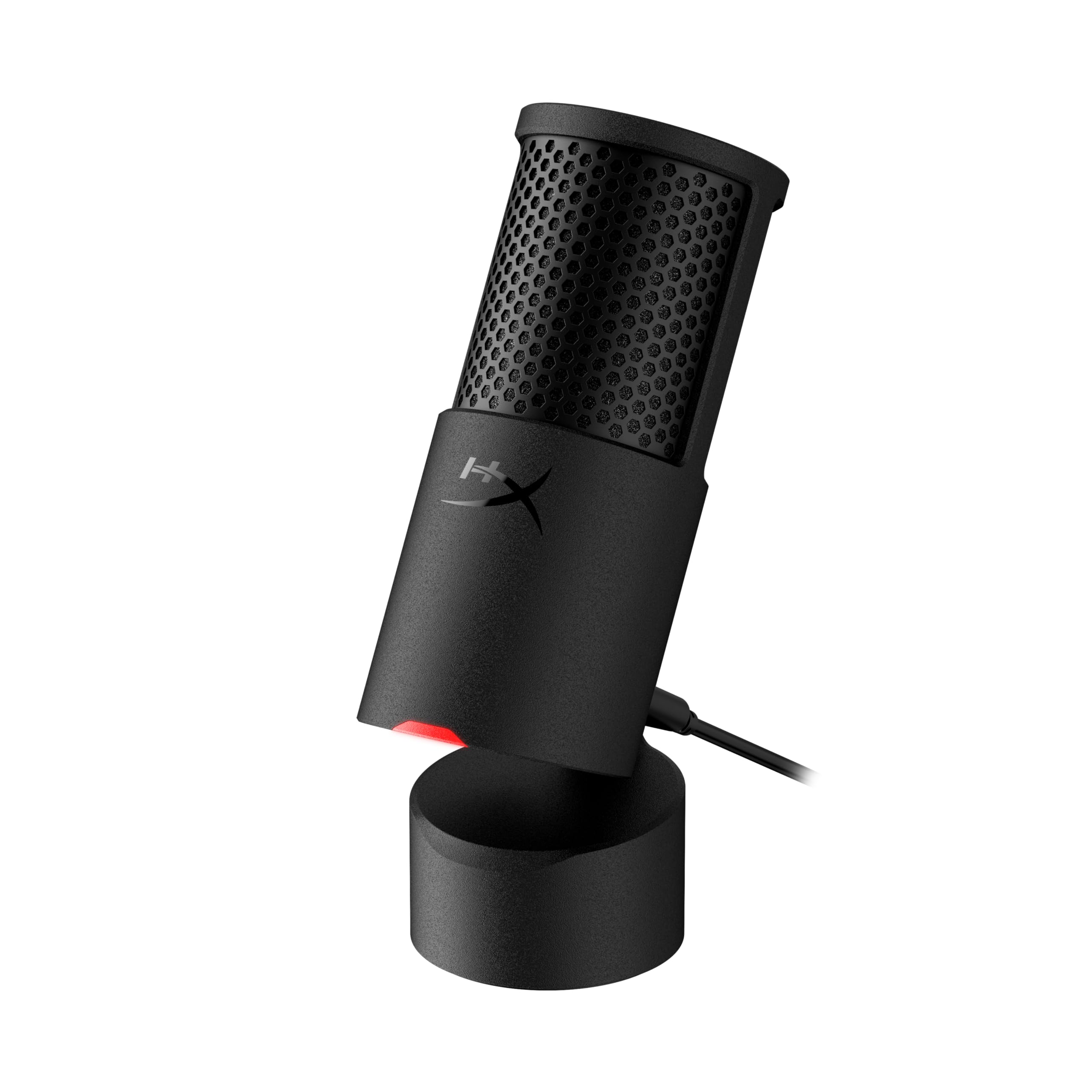
Studio-grade 24-bit/96kHz capture in a compact, no-fuss desktop package.
Here’s a mic that records at 24-bit depth with a 96kHz sampling rate, so your voice comes through with high-resolution clarity that owners say rivals pricier mics. The built-in suspension system delivers shock-mount benefits in a compact design, and the integrated foam pop filter means you don’t need to buy extras—it also handles plosives cleanly.
The cardioid pattern focuses on your voice from the front while cutting side and rear noise, and the tiltable stand with a weighted base keeps it stable. Built-in 3/8″ and 5/8″ threads let you mount it on a boom arm easily, and the plug-and-play USB-C to USB-A connection gets you recording in seconds. Optional HyperX NGENUITY software adds high-pass, low-pass, and voice-enhancement filters, saving settings directly to the mic.
Owners praise the crisp, professional recordings and tap-to-mute LED control—”crisp every time,” as they describe it. The one recurring annoyance is the USB-C port on the lower back isn’t firmly secured, so it can unplug if you move the mic; securing the cable with a zip tie solves it.
Why it impresses
- 24-bit/96kHz recording delivers clean, natural audio
- Built-in pop filter and shock mount need no extras
- Filters are customizable via HyperX NGENUITY software
Watch out for
- USB-C port isn’t super secure—cable can disconnect if moved
- Very sensitive, so it catches background noise
Best for: streamers and gamers who want a premium-sounding USB mic that’s ready from the start.
Consider a different pick if: you need heavy background noise rejection—this favors sensitivity.
6. Sennheiser XS 1

A legendary brand’s handheld dynamic with studio-grade reliability for live and podcast use.
This is a handheld dynamic microphone with an XLR-3 connector, built for live vocals and PA gigs as much as podcast studios on a budget. Owners call it “a really good sounding basic mic” that outperforms its price point, with a cardioid polar pattern that isolates your voice and a silent mute switch for quick control on stage.
The build is heavy and premium—”German engineering evident,” as one put it—with a metal enclosure that feels solid in hand. It pairs well with mixers, amplifiers, and karaoke machines, and the included carrying pouch and mic clip make it easy to transport between a home studio and a gig. The muted, reliable tone means no hiss or hum, even on lower-end equipment.
Its voice character sits close to Sennheiser’s higher-end handheld dynamics, though it lacks the vocal enhancement and proximity-effect support of an SM58-style mic. That means a shouty or thin voice might not get the extra vibe boost some singers want—but for clear, dependable speech, it’s stellar.
What stands out
- Premium Sennheiser build quality in a metal body
- Silent mute switch works cleanly for live use
- Pairs well with mixers, PA systems, and interfaces
Note this
- XLR only, so it needs an interface or mixer
- Lacks the vocal enhancement of some classic stage mics
Reach for this if: you need a reliable dynamic for live singing, PA gigs, or a budget podcast setup.
Pass if: you want a desktop USB mic—this one is built for hands-on use.
7. 512 Audio Skylight

A large-diaphragm studio condenser that brings warm, high-end vocal detail home.
This mic is built for your voice, with a vintage-inspired 34mm gold-plated capsule that delivers a rich, modern sound cutting through your mix. Owners describe it as crisp and airy without muddiness, ideal for deep vocals and voiceover work, and the cardioid pattern reduces ambient room noise while capturing your voice in front.
The custom metal mesh pop filter eliminates plosives, and the low-profile shockmount reduces vibrations for clean recordings. It’s an XLR condenser, so you’ll connect it to any USB interface or mixer—and it requires phantom power, as is standard for condensers. The 200-ohm impedance pairs well with typical interface inputs.
The all-metal build feels heavy and premium, with 59 owners singling out sound quality as the top praise. Honest notes: it’s a delicate studio-only mic, not built for travel or rough handling, and there’s no pad or low-cut filter—just a single, well-tuned cardioid voice. The included bag and shockmount soften the transition from box to desktop.
Its strengths
- 34mm gold-plated capsule delivers warm, detailed vocals
- Includes metal pop filter and low-profile shockmount
- All-metal construction feels premium
Keep in mind
- Requires phantom power and an XLR interface
- Delicate, studio-only design—not for travel
Grab this if: you want a serious studio condenser for voiceovers and vocals without a four-figure price tag.
Look elsewhere if: you need a rugged, portable mic for on-the-go recording.
8. FIFINE T669 Kit
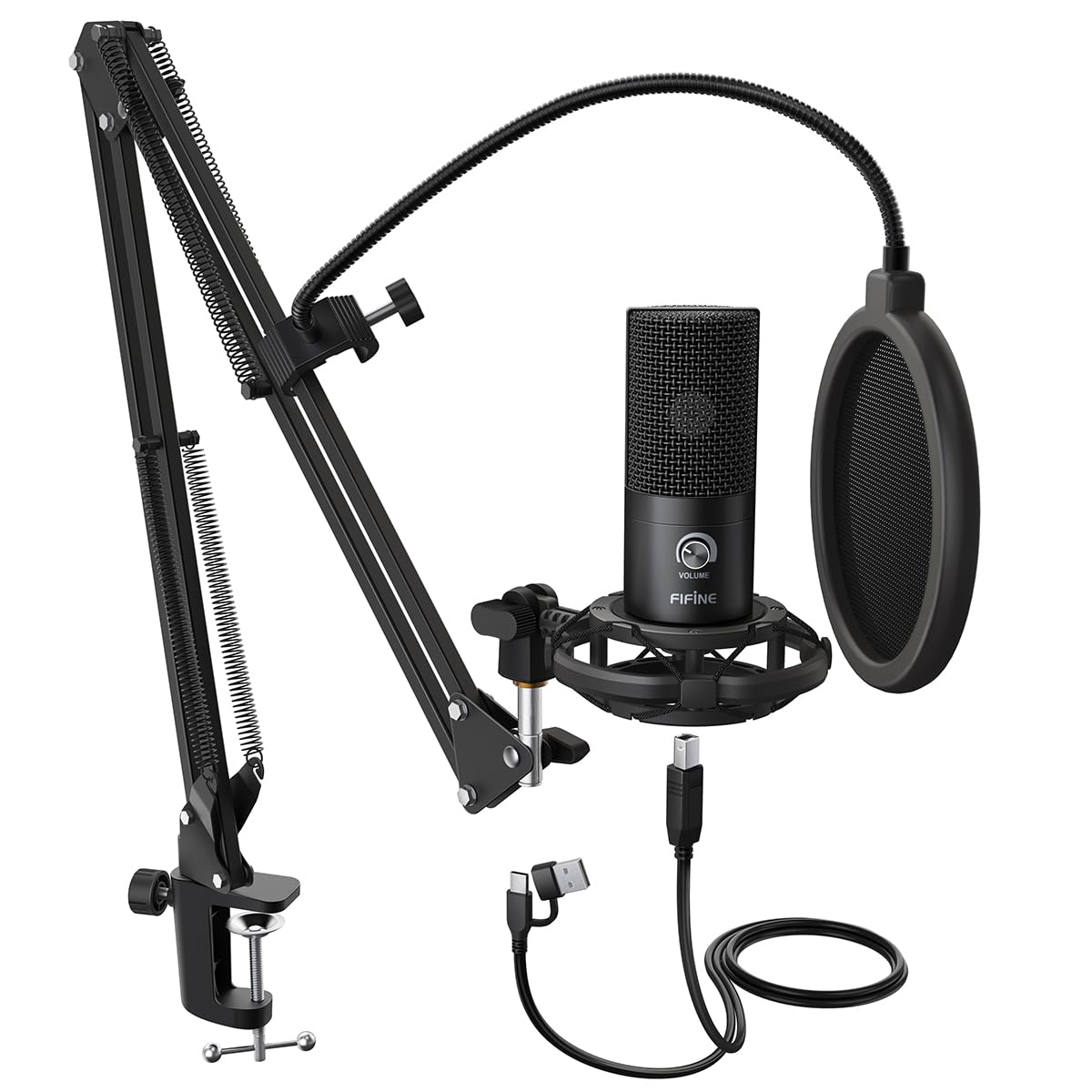
A complete USB studio kit with a scissor arm and shock mount—plug in, position, and record.
Owners call this “just about the best microphone you could get for a relatively cheap price,” and the specs back it up. The cardioid condenser capsule (a sensitive mic that picks up sound from the front) captures clear audio while avoiding ambient noise, across a 20Hz–20kHz frequency range (the full human hearing spectrum). You also get a sturdy scissor boom arm that rotates 180° up-and-down and extends 135° forward-and-backward, plus a double pop filter and shock mount—everything you need to start recording right away.
The wide 30-inch reach of the low-profile arm keeps your face clear for streaming or voiceover, and the C-clamp plus detachable desktop mount give you flexible positioning. The 8.2ft USB cable plugs into PC, laptop, or PS4/PS5, with a USB-B to USB-A/C connection—no drivers needed. It’s not compatible with Xbox, which is worth knowing before you buy.
The mic handles high SPLs (sound pressure levels) with ease, so it suits louder vocals and instruments without clipping. Honest gripes: the pop filter can hang or twist without a secure attachment, and the arm feels wobbly for some owners—a common budget trade-off that doesn’t affect sound quality, which remains the strongest praise across hundreds of owners. If you’re recording loud sources, this is a solid pick, but if you need a rock-solid arm, you might look elsewhere.
The big wins
- Complete kit: boom arm, shock mount, double pop filter, cable
- Plug-and-play USB with a long 8.2ft reach
- Cardioid capsule delivers clear, warm vocal capture
Known quirks
- Pop filter attachment isn’t always secure
- Boom arm can feel wobbly; desktop grip suits square tables
Best for: streamers and voiceover beginners who want everything in one box for a low price.
Skip if: you plan to mount on a console—this works best with a PC.
9. Samson Q2U

The hybrid dynamic that plugs into any computer now and grows into an XLR rig later.
This is the rare budget mic with both USB-C and XLR connectivity, so you can plug it straight into a computer today and later connect it to an audio interface or mixer as you upgrade. The dynamic capsule delivers clear, warm sound with low background noise, making it “a big improvement from the cheap headset,” as owners describe the jump.
The 50Hz–15kHz frequency range is tuned for speech, and the cardioid pattern focuses on your voice while rejecting room noise—great for podcasting, Zoom calls, and vocal recording. It ships with a tripod desktop stand, tripod extension, mic clip, windscreen, and both USB-C and XLR cables, so you have everything to record right away. It’s built for PC use primarily.
Owners praise it as excellent value for singers and bands on a budget, noting it handles close-proximity vocals well and survives drops without damage. The honest limits: the included tripod stand is flimsy, the mic is sensitive to desk noise (so a boom arm helps), and it picks up keyboard clicks if positioned poorly—worth knowing for quiet recordings.
What makes it special
- Dual USB-C and XLR means it grows with your setup
- Dynamic design rejects background noise well
- Includes tripod, extension, clip, windscreen, and both cables
What to expect
- Included tripod stand is flimsy—a boom arm is better
- Sensitive to desk vibrations; needs careful placement
Choose this if: you want one mic that works for both USB recording now and XLR upgrades later.
Not ideal if: you need a sturdy stand from the start—budget for a better mount.
Understanding the Specs
Pickup Pattern
This decides how much of your room ends up in the recording. Cardioid picks up sound mainly from the front and rejects the sides and rear, so it’s forgiving for solo desk work. Supercardioid is even tighter but demands you stay directly on-axis. For noisy rooms, a dynamic mic with a cardioid pattern is your best friend.
Frequency Response and Sample Rate
Frequency response (like 40Hz–18kHz) shows the range of pitch the mic can capture—wider is better for deep voices and high detail. Sample rate (like 96kHz) measures how often the audio is captured per second; higher rates mean crisper, more detailed recordings. Both matter most for studio-style vocal work.
FAQ
Will a USB microphone work with my phone?
Why does my microphone pick up so much background noise?
What is the difference between USB and XLR microphones?
How close should I sit to a dynamic microphone?
Is a condenser or dynamic microphone better for a quiet room?
How long will a budget microphone last?
Can I use these microphones with game consoles?
Do I need a pop filter if my mic has a windscreen?
Final Thoughts: The Verdict
For most people, the budget microphone winner is the ZealSound K66 because it delivers studio-style detail, onboard controls, and broad device support at a price that’s tough to top. If you want a complete kit with a boom arm from the start, grab the FIFINE T669—it includes the arm, pop filter, and shock mount. And for a hybrid that works with USB now and XLR later, the Samson Q2U is the one to reach for, giving you flexibility as your setup grows.
How We Picked
We do not accept paid placement. Every pick is matched to a real buyer and a real use-case; we do not hands-on test units.
Sources & Methodology
Specifications: manufacturer listings and product documentation. Review insights: verified customer reviews, as of August 2026. Pricing: not shown on this page (it changes often); check the current price via the retailer link.
As an Amazon Associate, FitlyFast earns from qualifying purchases. This does not affect which products we feature.