
Our readers keep the lights on and the weekend projects moving. As an Amazon Associate, I earn from qualifying purchases.
Specs are compiled from manufacturer listings and verified buyer reviews and can change over time — please confirm the key details on the product page before buying.
If you need a voltmeter for weekend wiring, car batteries, or checking a dead outlet, you don’t need to spend a hundred bucks. The trick is knowing which cheap multimeter actually delivers stable, accurate readings and which one is a toy. This guide cuts through the noise on nine budget-friendly models that real owners actually trust for daily work.
I’m Rikta — the founder and writer behind FitlyFast. This guide is built by comparing the manufacturers’ published specifications and the patterns across verified customer reviews, so you get each pick’s real strengths and trade-offs instead of marketing spin.
Every meter here costs under, but they vary widely in safety ratings, counts, and included extras. This is your straight-to-the-point breakdown of the best budget multimeter options for home and shop use, ranked by real owner feedback and core specs.
Our Picks at a Glance

How To Choose The Best Budget Multimeter
Finding a good cheap multimeter is less about the lowest price and more about getting the right balance of safety, accuracy, and features for the kind of work you actually do. Here is what to look for before you click buy.
Counts and Resolution
The “counts” number (like 2000, 4000, or 6000) tells you how many individual steps the meter can divide a voltage range into. A 6000-count meter can show you a reading like 120.0V, while a 2000-count meter maxes out at 199.9V. For modern electronics and automotive work, at least 4000 counts is a solid floor, and 6000 counts gives you noticeably better detail on low-voltage circuits.
Safety Ratings (CAT I, CAT II, CAT III)
The CAT rating tells you how well the meter is protected against sudden voltage spikes and surges. A CAT III 600V meter is safe for household mains circuits and distribution panels, while a CAT II meter is fine for small appliances but not for breaker boxes. For any work on 120V or 240V household wiring, stick with at least CAT III 600V — your safety depends on it.
True RMS vs Average Responding
A standard multimeter measures average voltage and assumes a clean sine wave. True RMS (Root Mean Square) meters measure the actual heating value of the waveform, which matters for modern electronics, variable-speed motors, and dimmer-controlled circuits where the waveform is distorted. If you plan to test anything beyond a simple light bulb or battery, True RMS is worth the small premium.
Quick Comparison
| Model | Best For | Counts | Safety Rating | Power Source | Amazon |
|---|---|---|---|---|---|
| ENJOYVO EJ8010★ Best Overall | All-round DIY value | 5999 | CAT III 600V | 2x AAA | Amazon |
| Crenova 890ZBest Value | Feature-packed starter | 6000 | CAT II 1000V | 2x AA | Amazon |
| Neoteck VC837Top Performer | Compact accuracy | 6000 | CAT III 1000V / CAT IV 600V | Battery | Amazon |
| Extech MN35 | Basic home & auto | 2000 | CAT II | 9V | Amazon |
| Mastfuyi FY157B | Rechargeable simplicity | 6000 | CAT III | USB-C rechargeable | Amazon |
| CBGYYWF FS899L | Smart auto-detection | 6000 | CAT III 1000V / CAT IV 600V | USB-C rechargeable | Amazon |
| Klein Tools MM325 | Jobsite drop resistance | 2000 | CAT III 600V | 2x AAA | Amazon |
| FKM 188D | Smart auto-sensing | 6000 | CAT III 600V | 2800mAh USB-C rechargeable | Amazon |
| Proster T28B | HVAC and hands-free work | 6000 | CE, RoHS | 3x AAA | Amazon |
In‑Depth Reviews
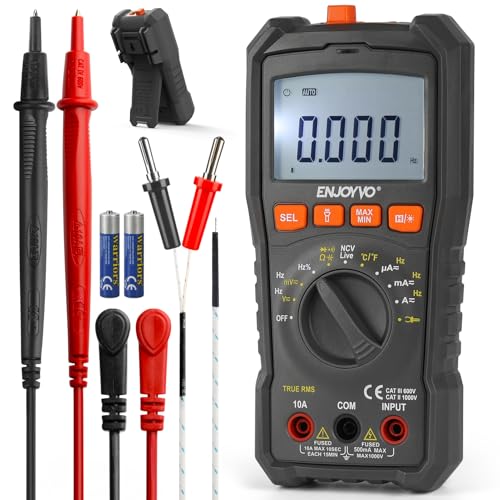
1. ENJOYVO EJ8010 Digital Multimeter
The budget champion that punches well above its weight class for DIYers and techs alike.
This is the crowd favorite for a reason. The ENJOYVO EJ8010 packs 5999-count True RMS resolution, a K-type temperature probe that reads from -40 to 1000°C, and a built-in LED flashlight and backlit LCD — all for a price that leaves you change for a coffee. Buyers report testing this meter against units costing five times more, and it performed every function identically, making it a no-brainer for mobile service work.
You can diagnose tiny signals on a circuit board or check a car battery because this meter handles AC/DC voltage up to 1000V DC and 750V AC, down to 600mV and 0.1μA. The auto-ranging True RMS (True Root Mean Square — a feature that gives accurate readings on electronics with messy, distorted waveforms) delivers stable readings on modern electronics. The protective rubber case and compact 11.04-ounce build feel solid enough to survive a knock off the workbench, and the auto power-off after 15 minutes saves your AAA batteries.
The main trade-off is the NCV (non-contact voltage) sensor, which some owners find triggers false alarms from simple hand movement near the meter. The backlight also auto-shuts after 15 seconds, which can be annoying in dim panels. But at this price point, the sheer feature density — capacitance up to 60mF, frequency up to 10MHz, continuity buzzer under 10Ω — makes it the clearest recommendation on this list.
Auto-ranging precision
- 5999-count True RMS with 1000V DC / 750V AC range — beats many meters costing double
- Included K-type thermocouple for HVAC and engine diagnostics from -40 to 1000°C
- Built-in LED flashlight and backlit LCD for dark breaker panels and tight engine bays
- Auto-ranging with fast 2-3 times/sec sampling for stable readings on fluctuating circuits
Battery hog
- NCV sensor can false-trigger from hand motion near the meter
- Backlight auto-off after just 15 seconds in low-light conditions
- No manual-ranging mode — auto-range only
- Instructions are sparse; you’ll want to watch a video for setup
Reach for it if: you want the most features per dollar — temperature probe, flashlight, high-voltage range, and True RMS all in one rugged package.
Look elsewhere if: you rely heavily on NCV detection for live-wire hunting, or you need a manual-range option for repeat specific measurements.
2. Crenova 890Z Digital Multimeter
A 6000-count TRMS workhorse that comes with a full accessory kit and a huge, easy-to-read display.
The Crenova 890Z is the meter that thousands of owners have bought as their first upgrade from an old Radio Shack unit — and it consistently impresses. It measures AC/DC voltage up to 1000V DC and 750V AC, which is a 67% higher DC voltage ceiling than the Neoteck VC837’s 600V maximum. That extra overhead matters when you’re working on solar panels, industrial gear, or high-voltage power supplies. The 6000-count LCD with backlight and built-in flashlight makes readings visible in dim crawlspaces or under a car hood.
What 36 buyers rave about most is the wide range of measurements — from transistor (hFE — a gain test for transistors) and capacitance to frequency and temperature via the included K-type thermocouple (a temperature sensor wire). The kit comes with test leads, alligator clip leads, two AA batteries, and a semi-hard carrying case. The silicone protective cover and double fuse protection (0.5A and 10A) give you safety for CAT II 1000V / CAT III 600V environments (safety ratings for household and light industrial circuits). The flip-out stand and test lead holder on the back add real workshop convenience.
The honest shortfall is that the test leads feel less durable than the meter itself. A few owners mention the probes breaking after several months of regular use, and the auto-ranging cannot be manually overridden for repeated readings on the same value. The NCV detector works but is basic. Still, for the price, this is a genuinely complete starter kit.
Grab it for: the complete accessory package — alligator clips, thermocouple, and carrying case — plus the highest DC voltage range in this budget tier at 1000V.
Think twice if: you want premium probe leads from the start, or you need manual-ranging for repetitive measurements on identical circuits.
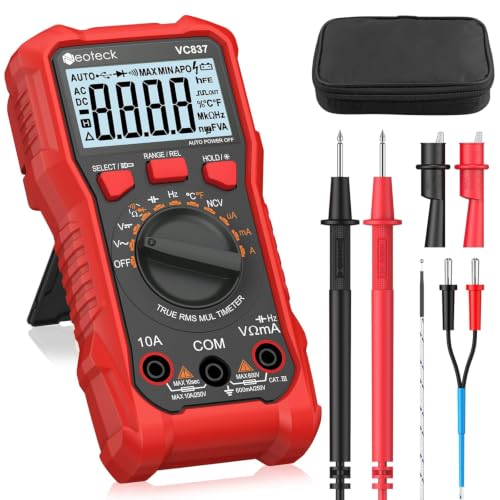
3. Neoteck 6000 Counts True RMS Digital Multimeter
A pocket-friendly 6000-count meter with a pro-grade safety rating that rivals expensive brands.
The Neoteck VC837 stands out for its safety credentials. It carries a CAT III 1000V / CAT IV 600V rating — the highest in this budget lineup — which means it’s rated to survive voltage spikes on main distribution panels and industrial circuits. That, plus dual fuses and full-range overload protection, makes it a serious tool despite its compact 5.51-inch length. The 6000-count True RMS resolution handles AC/DC voltage up to 600V, current up to 10A, and includes capacitance, frequency, duty cycle, and temperature measurement.
Owners consistently highlight the value for money, with 11 buyers specifically noting it as a top-tier bargain. The auto/manual dual-range switching gives you flexibility that the ENJOYVO and Crenova lack — you can lock in a range for repeated tests on the same type of circuit. The backlit display, built-in flashlight, and loud continuity buzzer are exactly what you need when working in noisy or dark environments. It also runs on standard batteries, so you are never stuck without power.
The catch: the Neoteck does not come with alligator clips or a carrying case, unlike the Crenova. A few buyers found the included test leads adequate for basic use but replaced them with sturdier aftermarket options. If you need a compact, highly safe meter for on-the-go work and can supply your own accessories, this is a strong contender.
Ideal for: technicians who work around high-energy circuits — the CAT III 1000V / CAT IV 600V rating is rare at this price.
Not ideal if: you prefer a complete kit with alligator clips and a case, or you need the 1000V DC range that the Crenova offers.
4. Extech MN35 Digital Mini Multimeter

A tiny, pocket-friendly meter that is easy to use and even easier to recommend for basic electrical checks.
A different breed from the TRMS meters above, the Extech MN35 is a manual-ranging 2000-count mini multimeter built for quick, simple tasks. It measures AC/DC voltage and current, resistance, diodes, and continuity — no capacitance, frequency, or temperature (though some versions include a thermocouple). The large LCD display and pop-out stand make it easy to read on a bench, and the protective rubber holster gives it enough durability for casual drops. At just 0.19 kg, it slips into a toolkit pouch easily.
Where the Extech shines is sheer simplicity. It is the most-discussed meter on this list for its functionality (136 mentions) and value (114 mentions), with owners calling it “sweet, simple and cheap” and praising its accuracy — within 0.01% of a high-end Fluke on car battery tests. The included 9V battery and temperature probe (on some units) mean it’s ready from the start. It does not have auto-ranging, auto-off, or NCV (non-contact voltage detection — sensing live wires without touching them), but for basic household outlets, batteries, and fuses, it is more than enough.
The downsides are real. The continuity buzzer is weak and non-latching, the probe leads are short and cheap (a few owners replaced them with Keysight leads after a year), and there is no integrated probe storage. The lack of auto-off means you will drain the 9V battery if you forget to turn it off. This is a meter for the “I just need to know if this wire is live” crowd, not for advanced diagnostics.
Best for: basic home and auto electrical checks where simplicity and a large readable display matter most.
skip it if: you need auto-ranging, capacitance, frequency, or a reliable continuity beeper for professional troubleshooting.
5. Mastfuyi FY157B 6000 Counts TRMS Digital Multimeter
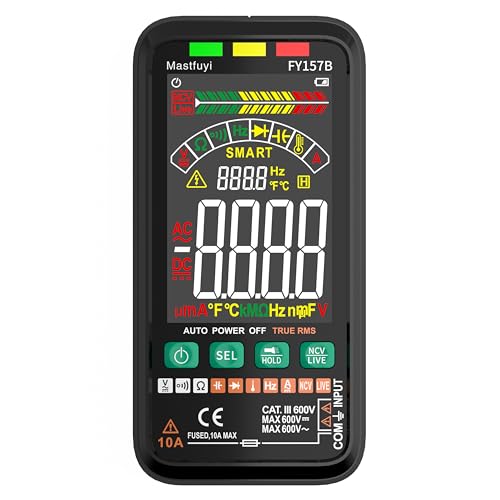
A modern rechargeable meter with a smart jack guidance system that helps beginners avoid mistakes.
The Mastfuyi FY157B brings a fresh idea to the budget segment: a USB-C rechargeable multimeter with a guided jack system. When you select a measurement function, the corresponding input jack lights up green — a simple but powerful aid for students and first-time users who often plug leads into the wrong port. It runs on a built-in rechargeable battery via USB-C, so you never buy AAA or 9V cells again. The auto-ranging 6000-count True RMS engine measures AC/DC voltage, current, resistance, capacitance, frequency, temperature, and includes NCV for non-contact voltage detection.
Owners find the functionality fine for general use, and the 250V smart burn prevention is a welcome safety net for beginners. The backlit display and built-in flashlight help in dim spaces. The meter is slim and lightweight, making it easy to toss in a tool bag. It also features a 15-minute auto shut-off to preserve the rechargeable battery.
The major quirk is that the USB-C charging port is tucked under the back plate, requiring a small Phillips screwdriver and a box cutter to access. One owner solved this by modifying the plate to allow direct cable access. This is a strange design choice that makes recharging feel like a repair job. If you are comfortable with that one-time mod or only charge it rarely, this is a solid, modern entry point.
Perfect for: beginners who appreciate the guided jack lighting and want to avoid buying disposable batteries.
Consider carefully if: the hidden USB port under a screw-on plate feels like an unnecessary hassle for frequent charging.
6. CBGYYWF FS899L USB Rechargeable Digital Multimeter
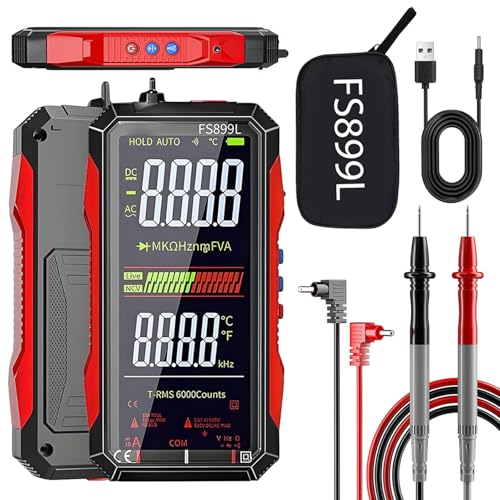
A smart auto-detecting multimeter that takes the guesswork out of setting ranges and dials.
The FS899L is designed for the person who finds traditional multimeter dials intimidating. It features smart mode that automatically identifies whether you are measuring voltage, resistance, or continuity — no manual range setting required. The large 4.8-inch illuminated color display and built-in torch make readings crisp in cramped electrical panels. Safety specs are strong: CAT III 1000V / CAT IV 600V with double fuse anti-burn and overload protection, plus CE and RoHS certifications.
The modern USB-C rechargeable battery delivers 8 hours of continuous operation on a 2-hour charge, eliminating the cost and waste of disposable batteries. Owners call it “the easiest multimeter I’ve ever used” and note the battery lasts for weeks on a single charge. Accuracy is praised, with the 6000-count True RMS engine covering AC/DC voltage from 60mV to 600V, current up to 10A, capacitance up to 60mF, and frequency plus temperature readings.
The catch is that the smart mode, while beginner-friendly, can sometimes misinterpret the signal on complex circuits — you may occasionally need to switch to manual mode for precise readings. The included test leads are functional but not premium. For someone who wants a modern, fuss-free experience and values rechargeability over raw control, this is a compelling option.
Ideal for: first-time multimeter buyers who want automatic detection and never want to buy batteries again.
pass on it if: you need full manual control for advanced troubleshooting, or you prefer the traditional dial interface.
7. Klein Tools MM325 Multimeter
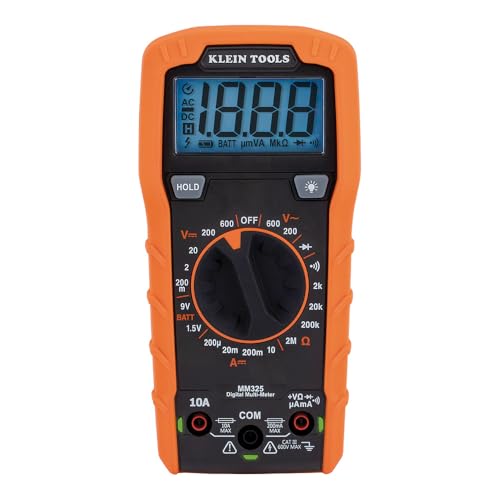
A Klein Tools brand meter built for the jobsite — tested to survive a 6.6-foot drop onto concrete.
The Klein Tools MM325 is not the most feature-rich meter on this list, but it is arguably the most rugged. It is rated to withstand a 6.6-foot (2-meter) drop, making it a favorite for electricians and contractors who work on ladders and scaffolding. The manual-ranging 2000-count meter measures AC/DC voltage up to 600V, 10A DC current, resistance up to 2MΩ, and includes continuity, diode test, and battery test modes. The Lead-Alert LEDs on the face of the meter illuminate to tell you where to insert the test leads — a simple but effective safety aid.
The backlit LCD display works well in dim conditions, and the test lead holders on the back plus a kickstand (and optional magnetic hanger) allow hands-free operation. The compact package includes test leads with CAT III / CAT IV safety caps, instructions, and 2x AAA batteries. For basic residential, commercial, and light-industrial work, it gets the job done.
The honest feedback from owners is mixed. While many appreciate the Klein brand reputation, a vocal minority reports the resistance (ohms) function failing after a few months, the annoying beep that warns of auto-shutdown every 5 minutes, and the fact that the battery door requires a screwdriver to open. The 2000-count display (shows readings up to 1999) and 2MΩ resistance limit also feel dated compared to the 6000-count options at similar prices. This is a meter for someone who values drop survival over measurement range.
Best for: electricians on active jobsites where the meter will take falls — the 6.6-foot drop rating is genuine.
Not for: automotive diagnostics or any work requiring resistance readings above 2MΩ, or anyone annoyed by frequent beeping.
8. FKM 188D Smart Digital Multimeter
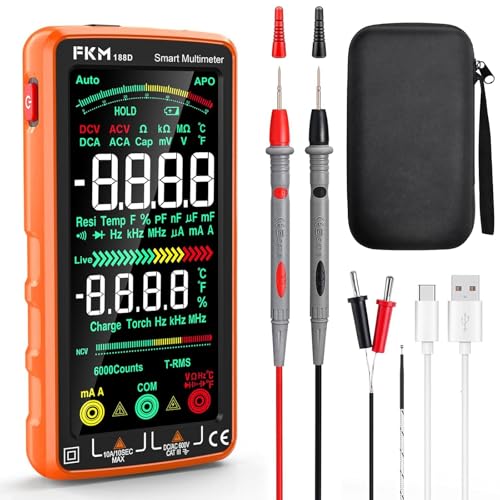
A smartphone-sized meter with a vivid 5-inch color screen and smart auto-sensing for easy everyday use.
The FKM 188D stands out immediately with its 5-inch color LCD display — the largest and most readable screen in this lineup. It boots into a smart mode that automatically identifies voltage, resistance, and continuity, so you can probe without touching a dial. The auto-ranging 6000-count True RMS engine samples 3 times per second for stable readings on AC/DC voltage, current, resistance, capacitance, frequency, duty cycle, diode, continuity, and temperature via the included thermocouple.
Power comes from a 2800mAh USB-C rechargeable battery, and the sturdy silicone cover protects against drops and wear. The NCV (non-contact voltage) detector provides both sound and light alerts for live-wire detection. Owners love the large readout, the auto-sense feature, and the convenience of recharging like a phone. The meter also includes a built-in flashlight and data hold function for tricky dark spots.
The main complaints revolve around the manual — it has poor English translation and omits charging instructions entirely, leaving you to guess what the red indicator light means. Reliability is mixed in the data, with some owners reporting units that stopped working after first use, while others call it “high end features at a low cost.” The auto-sensing works well for basic tasks but can be slow or confused on complex waveforms. If you prioritize screen size and rechargeability, this is a fun tool, but it may not be your most reliable daily driver.
Grab it for: the gorgeous 5-inch color screen and the self-sensing feature that makes it incredibly beginner-friendly.
Be cautious if: you need a tool you can rely on daily without question — the mixed durability feedback is worth noting.
9. Proster T28B Digital TRMS Multimeter
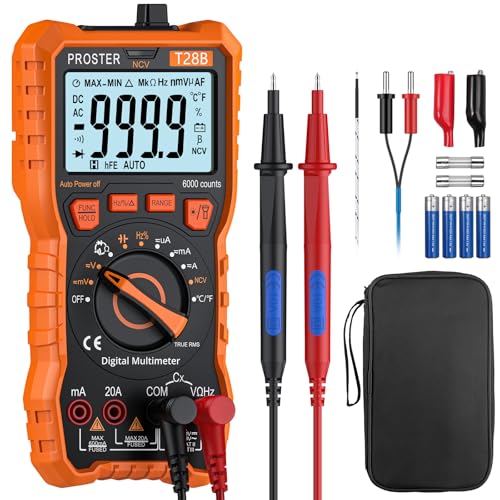
A technician-focused meter with a built-in magnet that sticks to breaker panels and car chassis for true hands-free use.
The Proster T28B is built for real-world field work, especially HVAC, automotive, and industrial settings. Its standout feature is the built-in magnetic back — stick it to any ferrous metal surface like a breaker panel, car chassis, or AC unit, and both hands are free to manipulate probes. Combined with a fold-out kickstand and probe storage slots on the back, it offers the most thoughtful ergonomics in this price bracket. The 6000-count auto-ranging True RMS display samples 3 times per second and includes NCV, temperature via a probe, capacitance, frequency, duty ratio, diode, transistor testing, and continuity.
Owners in HVAC work praise it as “a great meter for techs in the HVAC Industry,” noting its accuracy matches Fluke measurements for a fraction of the price. The silicone cover, flashlight, and backlit LCD make it usable in dark attics and basements. The kit is generous: alligator clips, two fuses, a screwdriver, and a storage bag are included alongside the test probes and temperature probe.
The weak point is the test leads and temperature probe — after about two months of daily use, a few customers note the COM contact on the meter becoming intermittent, causing roughly 40% failure on readings. The included probes are functional but not heavy-duty. The AC/DC selection uses a button rather than a dial position, which some traditionalists dislike. For a technician who needs a magnetic, hands-free meter and is comfortable replacing probes eventually, this is a fantastic value.
Perfect for: HVAC and automotive techs who need the meter to stay put on a metal surface while they work with both hands.
Think twice if: daily use means you need premium probe durability from the start — plan for an aftermarket lead upgrade.
Understanding the Specs
True RMS (True Root Mean Square)
Standard multimeters assume the voltage waveform is a perfect sine wave and average the reading. True RMS meters calculate the actual heating value of the waveform, which gives you accurate readings on modern electronics, variable-speed motors, dimmer circuits, and switching power supplies where the waveform is distorted. For anything beyond a simple incandescent bulb or a car battery, True RMS is a feature worth having.
CAT Safety Ratings
The CAT rating (I, II, III, IV) defines where a multimeter is safe to use based on the energy it might encounter during a fault. CAT I is for low-energy electronics. CAT II is for household appliances. CAT III is for distribution panels and fixed wiring in buildings. CAT IV is for utility-level outdoor service. The voltage number (e.g., 600V) is the maximum steady-state voltage the meter can handle. Always match the CAT rating to your work environment — a CAT II meter on a breaker panel can be dangerous.
Counts vs Display Resolution
The “counts” specification tells you the maximum number the display can show before it rolls over to the next range. A 2000-count meter cannot show 120.0V (it would show 120V only, losing the tenths place). A 6000-count meter can display 120.0V, giving you finer detail on low-voltage circuits like car sensors or battery testing. Higher counts directly translate to better resolution, especially below 100V.
Auto-Ranging vs Manual-Ranging
Auto-ranging meters automatically select the best measurement range for whatever you are probing — you just connect the leads and read the value. Manual-ranging meters require you to turn a dial to the correct range (e.g., 200V AC) before testing. Auto-ranging is more convenient and beginner-friendly, but manual ranging gives you faster repeat measurements on known circuits and can sometimes be more stable on noisy signals.
FAQ
Can a budget multimeter measure car battery voltage accurately?
What is the difference between CAT II and CAT III safety ratings?
Do I really need True RMS on a budget multimeter?
How do I safely test a live 120V outlet with a budget multimeter?
How long do budget multimeters typically last?
Can I measure AC current with these budget multimeters?
What does NCV (Non-Contact Voltage Detection) actually do?
Is it safe to use a budget multimeter for home electrical work?
Final Thoughts: The Verdict
For most people, the budget multimeter winner is the ENJOYVO EJ8010 because it packs 5999-count True RMS, a K-type temperature probe, a flashlight, and 1000V DC range into a rugged package at a price that leaves every competitor scrambling. If you want a complete kit with alligator clips and the highest DC voltage ceiling (1000V), grab the Crenova 890Z. And for HVAC or automotive techs who need a magnetic back for hands-free work on metal panels, the Proster T28B is the one to reach for.
How We Picked
We do not accept paid placement. Every pick is matched to a real buyer and a real use-case; we do not hands-on test units.
Sources & Methodology
Specifications: manufacturer listings and product documentation. Review insights: verified customer reviews, as of July 2026. Pricing: not shown on this page (it changes often); check the current price via the retailer link.
As an Amazon Associate, FitlyFast earns from qualifying purchases. This does not affect which products we feature.