
Our readers keep the lights on and the weekend projects moving. As an Amazon Associate, I earn from qualifying purchases.
Specs are compiled from manufacturer listings and verified buyer reviews and can change over time — please confirm the key details on the product page before buying.
Buying your first oscilloscope on a tight budget means one thing above all else: you want to see the waveform clearly without spending a month’s rent. The market is flooded with no-name black boxes, tiny unreadable screens, and frustrating interfaces that hide the one signal you actually need. This guide cuts through that noise to find the eight models that deliver clean, usable traces for the kind of real-world troubleshooting you actually do.
I’m Rikta — the founder and writer behind FitlyFast. This guide is built by comparing the manufacturers’ published specifications and the patterns across verified customer reviews, so you get each pick’s real strengths and trade-offs instead of marketing spin.
Whether you are diagnosing a car sensor, checking power supply ripple, or learning the trade, these picks cover the essentials for any budget oscilloscope purchase today.
Our Picks at a Glance


How To Choose The Best Budget Oscilloscope
A budget oscilloscope is a trade-off exercise — no box does everything a bench scope does. The trick is knowing which corners you can afford to cut and which specs are non-negotiable for your specific projects.
Bandwidth vs. Sampling Rate — Which Matters More?
Bandwidth (measured in MHz) is how high of a frequency the scope can accurately capture. A good rule of thumb is to pick a scope with a bandwidth at least five times the highest frequency you plan to measure. Sampling rate (MSa/s) is how many times per second the scope takes a snapshot of that signal. If the sampling rate is too low, you will miss fast glitches and your waveform will look jagged. For most budget buyers, the sampling rate is the more critical number — a 50MHz scope with a 250MSa/s rate will show you a cleaner trace than a 100MHz scope with a poor 100MSa/s rate.
Handheld 3-in-1 vs. Bench Scope
Handheld units pack an oscilloscope, multimeter, and often a signal generator into one battery-powered box. They are perfect for field work, automotive diagnostics, and cramped desks. Bench scopes are larger, plug into the wall, and usually offer a bigger screen with more precise controls. If you work on one bench, a bench scope gives you more screen real estate for the money. If you chase problems around the house or your car, a handheld is the smarter pick.
The Probe Quality Trap
Your scope is only as good as the probes touching your circuit. Cheap scopes often include flimsy probes that introduce noise or break after a few uses. Look for switchable 1x/10x probes and read reviews that mention probe quality specifically.
Quick Comparison
| Model | Best For | Bandwidth | Sampling Rate | Channels | Amazon |
|---|---|---|---|---|---|
| ZOYI ZT-703S★ Best Overall | Best Overall Value | 50 MHz | 280 MSa/s | Dual | Amazon |
| FNRSI Upgraded 2C53TTop Specs | Most Features for the Price | 50 MHz | 250 MSa/s | Dual | Amazon |
| FNIRSI 2C53TBest Value | Proven Reliability | 50 MHz | 250 MSa/s | Dual | Amazon |
| IMARS HO-3S | Best Data Storage | 70 MHz | 200 MSa/s | Dual | Amazon |
| HANMATEK HO52 | Premium Handheld | 50 MHz | 250 MSa/s | Dual | Amazon |
| FNIRSI 1014D | Best Entry-Level Bench | 100 MHz | 1 GSa/s | Dual | Amazon |
| HANMATEK DOS1102 | Best Bench for Beginners | 110 MHz | 500 MSa/s | Dual | Amazon |
| Hantek DSO2D15 | Highest Specs on a Budget | 150 MHz | 1 GSa/s | Dual | Amazon |
In‑Depth Reviews
1. ZOYI ZT-703S (3 in 1 Handheld)
The handheld that packs a 50MHz scope, a 25,000-count multimeter, and a signal generator into a red pocket-sized chassis.
You get a dual-channel oscilloscope that hits a 280MSa/s sampling rate in high-speed mode — a 12% gap over the 250MSa/s units in the same price bracket, meaning a finer resolution on fast edges. The AUTO recognition function handles unknown waveforms for you, which beginners will appreciate. In multimeter mode, it reads up to 25,000 counts for resistance, capacitance, continuity, diodes, and current, so you rarely reach for a second tool. The built-in signal generator outputs sine, square, and triangle waves, displayed live in a demo window for instant verification.
The thing that buyers rave about is the sheer versatility — 56 owners specifically praise the functionality, calling it “well worth the price” and a “great multi-purpose tool.” The bright, easy-to-read screen draws consistent praise. On the downside, the display auto-shuts off in under ten minutes, and only the full shutdown timer is adjustable, which is a genuine irritation when you are poking around a live circuit. The interface has a small learning curve, but most owners say it clicks within an hour of use.
It charges over a standard Type-C port and weighs just 380 grams, so it slips into the included cloth bag without adding bulk to your tool kit. The crowd favorite — 4.6 stars across nearly 300 owners — confirms this is the most balanced pick for the price.
ZOYI triple-mode handheld
- Highest sampling rate in this price tier at 280 MSa/s, giving you a 12% edge on signal detail.
- Dual-channel 50MHz scope plus a 25,000-count multimeter and signal generator in one box.
- Lightweight at 380 g, charges over Type-C, and ships with a cloth carry bag.
limited bandwidth depth
- Display shuts off in less than 10 minutes — buyers report this as the main annoyance.
- Interface has a learning curve; the manual is worth reading before your first real job.
reach for this if: you want the most capable all-in-one handheld under a tight budget and do not mind a quick shutdown-timer workaround.
a small reality check: The screen saver timeout can interrupt longer tests — plan to tap the controls every so often or adapt your workflow.
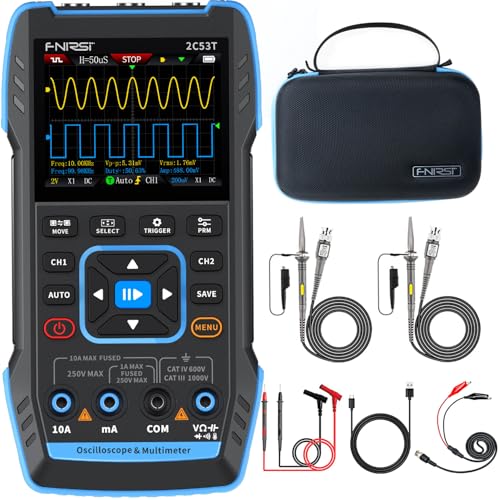
2. FNRSI Upgraded 2C53T with 2 P6100 Probe
The successor to the 2C23T that jumps from a 10MHz/50MS/s spec to 50MHz/250MS/s, making it a legitimate competitor overnight.
The FNRSI 2C53T is a 3-in-1 device that gives you a dual-channel 50MHz oscilloscope with a 250MSa/s sampling rate, a 4.5-digit 19,999-count True RMS multimeter, and a DDS signal generator capable of 13 waveform types up to 50kHz. The multimeter mode measures AC voltage up to 750V and DC voltage up to 999.9V, so it can handle most household and automotive circuits. It comes with a carrying case and switchable 1x/10x probes — a welcome upgrade over the single-mode probes that ship with many budget units.
Buyers praise the accuracy, with one owner noting it matches a Fluke down to three decimal places. The 3,000mAh battery delivers roughly six hours of operation, making it a solid field companion. The main complaints center on the non-standard multimeter probe spacing and the included leads feeling flimsy — budget for a better set of leads and you will be set. The AUTO timebase can be hit-or-miss on complex signals, and the manual is poorly translated, so plan to learn by experimenting. At 4.4 stars from 148 ratings, it is a proven upgrade path for anyone who wants the latest hardware revision.
grab this for: a modern feature set (the jump from 10MHz to 50MHz bandwidth is real) in a portable form factor with a battery that lasts a full work session.
what you should know: the manual is rough and the stock multimeter leads are cheap — plan to replace them early for the best experience.
3. FNIRSI 2C53T (Official Version)
The FNIRSI-branded version of the same 2C53T platform, backed by 789 ratings and a well-worn reputation.
This is the same FPGA+MCU+ADC hardware architecture as the WESTOBiG version above, but sold under the FNIRSI name — the brand most widely recognized in the budget scope space. You get the same 50MHz dual-channel scope with a 250MSa/s sampling rate, the same 19,999-count multimeter, and the same 13-waveform DDS signal generator. The included kit is generous: a 10X probe, crocodile clip probe, multimeter probes, Type-C cable, and a storage case.
What sets this version apart is the sheer volume of feedback. Across 789 ratings, value for money is the most praised aspect with 51 owners calling it out, followed closely by build quality at 41 mentions. Buyers describe it as “a pocket lab that actually keeps up” and note that the 2.8-inch display is bright enough for indoor use, though it washes out in direct sunlight. The UI defaults to Chinese on first boot, but switching to English is a quick menu dive — a common quirk that takes 30 seconds to fix. The main sticking point is that the 2C53T is more of a “pocket companion” than a bench replacement, but for intermittent diagnostics and embedded work, it is a solid, well-liked performer.
pick this one if: you value a large buyer consensus behind your decision — hundreds of other owners have already stress-tested this unit and given it their thumbs up.
one honest limitation: The small screen and button-based UI make it slower to operate than a full-size bench scope; expect a 30-minute learning curve.
4. IMARS HO-3S
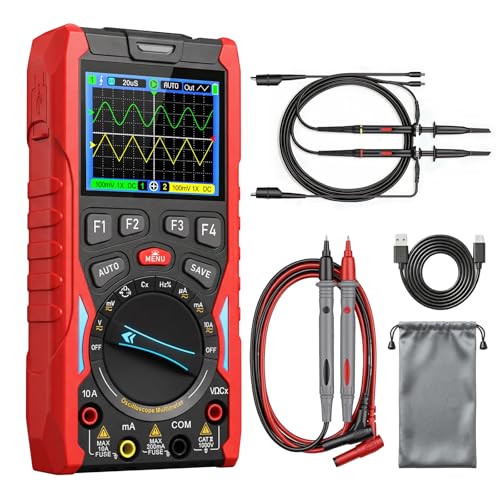
The only scope in this lineup that stores 1,000 multimeter readings and 200 waveform records internally for later analysis.
The IMARS HO-3S offers a 70MHz bandwidth — a noticeable step up from the 50MHz units — with a 200MSa/s sampling rate. The big news is the internal storage: you can save up to 1,000 sets of multimeter data and 200 oscilloscope waveform records right on the device. One-touch save and recall means you can capture a signal in the field and analyze it back at your desk without a laptop. The 20,000-count True RMS multimeter handles voltage, current, resistance, capacitance, frequency, duty cycle, diode, and continuity tests.
The unit runs on a replaceable 18650 battery that lasts about 4 hours and charges over Type-C. It includes a one-key flashlight for low-light work and a customizable auto-sleep timer that you can disable entirely — a thoughtful fix for the “display shuts off too soon” complaint owners have about other models. Accuracy is the top praised feature with 47 mentions, and owners rate the value-for-money highly as well. The 2.4-inch TFT display has 8-level adjustable backlight, and the housing is built to be drop-resistant. The main downside versus the top pick is the lower 200MSa/s sampling rate, but the storage and safety certifications (CAT II 1000V, IEC1010-1) make this a strong choice for methodical diagnostics.
choose this for: jobs where you need to capture and compare waveforms hours or days apart — the internal storage is genuinely useful for troubleshooting intermittent issues.
who should think twice: if you chase fast digital edges, the 200MSa/s rate will be the bottleneck — the top pick at 280MSa/s shows cleaner detail on high-speed signals.
5. HANMATEK HO52

The highest-rated handheld in this lineup — 4.7 stars — thanks to a fast 10,000 wfms/s refresh rate and a clear backlit screen.
The HO52 delivers a mode that refreshes the waveform 10,000 times per second, so you see signal changes almost in real time. The dual-channel 50MHz scope and built-in multimeter have separate inputs, meaning you can run a scope trace and a voltage reading simultaneously without swapping probes. The USB Type-C port supports power bank charging and data transfer for saved screenshots and CSV waveform exports, which is useful for documenting your work. It saves 4 groups of settings, 4 reference waveforms, 4 images, and 4 CSV waveform files.
You get a clear display with an illuminated grid and easy button navigation, so you can see waveforms even in dim light. The controls are not as intuitive as a knob-based scope, and the capacitor measurement mode has a known software quirk where it sometimes reads in “mF” (millifarads) instead of “uF” (microfarads). Battery life is good at around five hours, and one owner used it successfully to tune car audio by finding amplifier clipping points. At 4.7 stars and 589 ratings, this is the most consistently praised handheld in the group. skip it if you need knob-style controls for fast adjustments — the button layout takes more getting used to.
best suited for: owners who want the smoothest real-time waveform display in a handheld package and value high refresh rates for seeing live changes.
the one caveat: the button-based controls demand a brief adjustment period if you are used to analog-style knobs.
6. FNIRSI 1014D
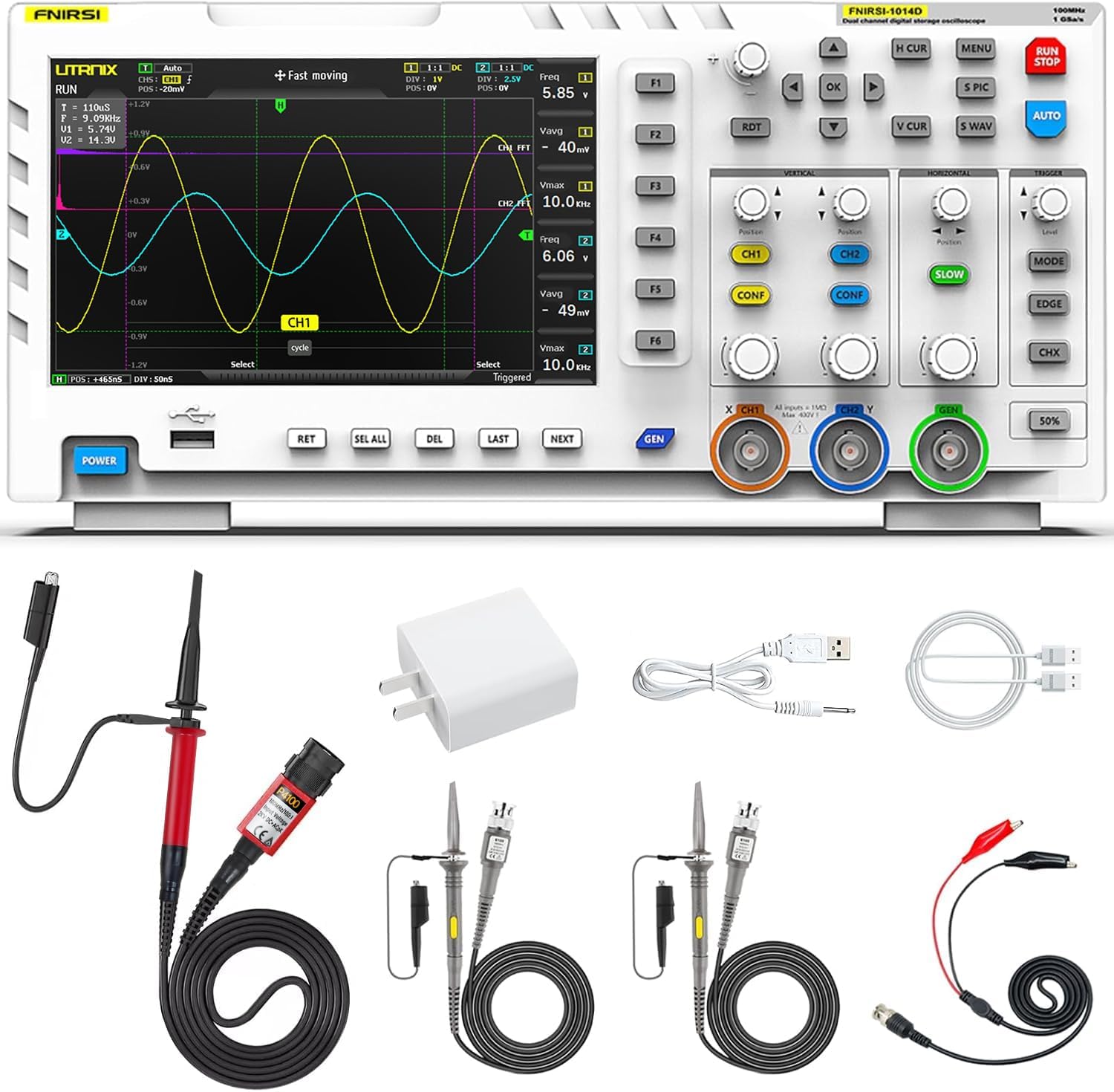
A full 7-inch 800×480 LCD bench scope at a price that undercuts any brand-name equivalent by hundreds of dollars.
The 1014D jumps to a 100MHz analog bandwidth with a 1GSa/s real-time sampling rate — four times the sample speed of the handhelds above. This is the first unit on the list that can comfortably handle the signals you will encounter in most hobby-level microcontroller and audio work. The built-in DDS signal generator outputs 14 types of function signals and can store up to 1,000 customized waveforms. The 7-inch screen shows Lissajous patterns for phase comparison and includes an FFT view for harmonic analysis.
Value for money is the #1 praised aspect with 51 mentions, and owners call it “a very good ‘scope at a bargain price.” The 100X probe and easy calibration setup make it approachable for students. The big trade-off is build quality consistency — a small number of owners received units with dead screens or jammed power buttons, which points to spotty QC. The included USB power supply can introduce noise into measurements; using a cleaner iPad power supply solved that issue for several owners. The voltage reading also tends to read 5-10% high, so this is not a precision instrument for pro lab work.
buy this if: you are a student or hobbyist moving up from a pocket scope and want a large, readable display with a built-in signal generator.
be aware of: the QC lottery — order from a seller with a solid return policy, and budget for a better USB power supply to avoid noise issues.
7. HANMATEK DOS1102
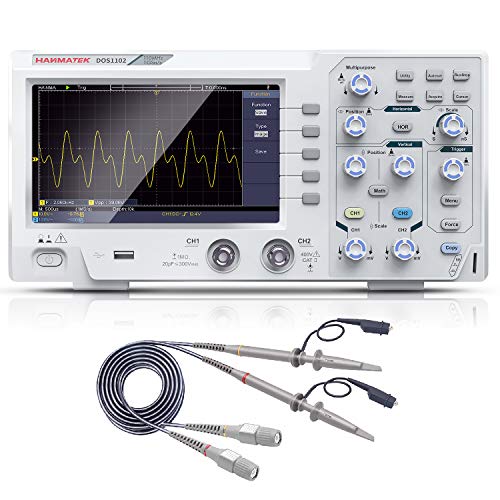
A 110MHz bench scope with a 7-inch color display and 30 automatic measurement functions that owners mention outperforms old Tektronix units in ease-of-use.
The DOS1102 gives you a 110MHz bandwidth with a 500MSa/s real-time sampling rate on each of its two channels. The 7-inch TFT LCD displays 65,535 colors at 800×480 resolution, and the time base spans from 2 ns per division all the way to 1,000 seconds per division. It has 30 automatic measurement functions, a built-in 6-digit hardware frequency meter (measuring 2Hz to 20MHz), and support for USB storage and SCPI protocol for secondary development. The probe attenuation supports 1X, 10X, 100X, and 1000X multiples.
Quality is the most praised aspect with 23 mentions, followed closely by value for money at 18. Owners describe it as “perfect for field use, also good for lab use” and praise the knob-based controls over the touchscreen competitors. The unit is lightweight for a bench scope at 2.4 pounds, making it easy to move between workstations. The display quality gets mixed notes — some call it very clear, while others report slight fuzziness. The power supply is also a frequent complaint point, with 11 owners flagging it as underpowered. The min vertical scale is 20mV/div, so very low-level signals (under 20mV) require a preamp.
reach for this if: you want a recognizable bench-style interface with knobs and a large screen, and you work primarily on signals above 20mV.
keep in mind: the included power supply is weak — plan to use a higher-rated replacement, and the 20mV/div floor limits micro-signal work.
8. Hantek DSO2D15

The most capable bench scope in this budget roundup — 150MHz bandwidth with 1GSa/s sampling and 8M memory depth per channel.
The DSO2D15 is the lab instrument of the group. It offers a 150MHz bandwidth on two channels with a 1GSa/s sampling rate and 8M points of memory depth, which is an order of magnitude more storage than the other bench scopes here. It also includes a single-channel arbitrary waveform generator with 14 trigger modes and 5 kinds of serial protocol triggers and decodes. The build quality is noticeably more substantial — owners describe it as durable and signal-stable, with one noting it outperformed expectations for Ham Radio use.
Owners confirm it is “great for digital timing measurements and comparisons,” with 22 mentions praising its functionality. The firmware is updatable, and Hantek provides the manual online (though the specific DSO2D15 manual requires using the DSO2D20 manual as a substitute). The Auto Set function is limited — you will need to set up measurements manually, which is standard for scopes at this level. A small number of owners experienced lock-ups with misconfigured settings, fixed by a quick power cycle. At 4.6 stars from 190 ratings, this is the scope to reach for when budget meets genuine lab-grade expectations. It is sharper for digital timing than the handheld pick above, but you trade portability for that precision.
best for: the buyer who knows they will grow into the specs and needs a scope that can handle university labs, Ham Radio, or serious microcontroller debugging without budget compromises.
what to plan for: there is a slight learning curve with manual operation, and you will want to update the firmware right from the start for the best stability.
Understanding the Specs
Bandwidth (MHz)
This is the highest frequency signal the scope can measure accurately. A common rule is to choose a bandwidth at least five times your signal’s frequency. A 50MHz scope is fine for most audio, automotive sensors, and low-speed digital work. A 100MHz+ scope is needed for high-speed digital protocols like SPI or I2C and RF troubleshooting.
Sampling Rate (MSa/s)
This is how many times per second the scope takes a snapshot of the voltage. A higher rate means a more accurate reconstruction of fast signals. A scope with 250MSa/s can capture a 25MHz signal with about 10 points per cycle, which is the minimum for a recognizable waveform. For clean edges on square waves, aim for 250MSa/s or more.
Channels
Most budget scopes are dual-channel, meaning you can view two different signals at once. This is useful for comparing input vs. output on a circuit, measuring phase shift, or triggering one channel off another. Single-channel scopes are cheaper but severely limit your diagnostic capability.
Memory Depth (kpts / Mpts)
This controls how long the scope can record at a given sampling rate. Deeper memory means you can capture a longer time window while maintaining high detail. 8M points (found in the Hantek DSO2D15) is significantly better than 1K samples (found in many budget handhelds) for capturing intermittent glitches over a longer period.
FAQ
What is the difference between a handheld and a bench oscilloscope?
Can a 50MHz scope measure a 50MHz signal?
What does “True RMS” mean in a multimeter mode?
Do I need a signal generator built into my oscilloscope?
Will a budget scope work for car diagnostics?
How important is the probe quality that comes with the scope?
What does the AUTO button actually do?
Can I use a budget oscilloscope for audio amplifier tuning?
Is the ZOYI ZT-703S better than the FNIRSI 2C53T?
How long does the battery last in handheld oscilloscopes?
Final Thoughts: The Verdict
Across the board, the budget oscilloscope winner is the ZOYI ZT-703S because it balances the highest sampling rate (280MSa/s) with the most versatile feature set (dual-channel scope, 25,000-count multimeter, signal generator) at an accessible price. If you need deep data storage for documenting intermittent faults, grab the IMARS HO-3S. And for the buyer who wants a true bench experience on a budget, the Hantek DSO2D15 offers the highest bandwidth and memory depth in the group.
How We Picked
We do not accept paid placement. Every pick is matched to a real buyer and a real use-case; we do not hands-on test units.
Sources & Methodology
Specifications: manufacturer listings and product documentation. Review insights: verified customer reviews, as of July 2026. Pricing: not shown on this page (it changes often); check the current price via the retailer link.
As an Amazon Associate, FitlyFast earns from qualifying purchases. This does not affect which products we feature.