
Our readers keep the lights on and the weekend projects moving. As an Amazon Associate, I earn from qualifying purchases.
Specs are compiled from manufacturer listings and verified buyer reviews and can change over time — please confirm the key details on the product page before buying.
If you are shopping for a budget pellet stove, the real question isn’t just about the sticker price — it’s about how much you will spend keeping it running all winter. The best budget pick balances a large hopper so you aren’t refilling at 2 a.m., a heat output that matches your square footage, and a cleaning routine you can actually keep up with. This guide breaks down five solid options, from a smart WiFi model for a workshop to a gravity-fed unit that runs without any electricity.
I’m Rikta — the founder and writer behind FitlyFast. This guide is built by comparing the manufacturers’ published specifications and the patterns across verified customer reviews, so you get each pick’s real strengths and trade-offs instead of marketing spin.
We focus on what matters for a budget pellet stove: real heat output, hopper size, and how much maintenance each model demands before you buy.
Our Picks at a Glance


How To Choose The Best Budget Pellet Stove
Buying a pellet stove is a multi-year home heating purchase, so matching the machine to your space and your habits matters more than shaving a few dollars off the price. The three numbers that tell you the most are the heat output in BTUs, the hopper capacity in pounds, and the stove’s own weight — because that weight usually predicts how solidly it is built.
Match the BTUs to the room you actually heat
BTUs are the unit of heat the stove produces, and each model’s rating comes with a square-footage claim from the maker. A 40,000 BTU stove rated for 2,000 square feet sounds great, but real-world reviews show a hard ceiling: one owner in Northern Maine could not push past 68°F even in a 600-square-foot room on the coldest nights. If you live in a sub-zero climate, aim for a stove rated well above your home’s size — the buffer is your safety net.
Hopper capacity controls your sleep schedule
Before you pick a pellet stove, think about how often you want to refill it. The hopper (the bin that holds the wood pellets) is measured in pounds, and a 24-pound hopper may not hold an entire 40-pound bag, so you could face refills mid-evening or a cold morning start. Larger units jump to 60, 66, or even 130 pounds, stretching burn time to roughly 30 hours or more. Decide if you want to load once a day or once every day and a half before you choose.
Electric versus non-electric operation is a lifestyle choice
Most pellet stoves use an electric auger to feed pellets and an electric blower to push heat, so they stop working during a power outage. A few designs, like the gravity-fed model here, need no electricity at all — a key advantage for off-grid cabins or storm-prone areas. Weigh your local power reliability against the convenience of thermostatic, programmable controls that only electric models offer.
Quick Comparison
| Model | Best For | Heat Output | Hopper Size | Coverage | Amazon |
|---|---|---|---|---|---|
| Mr. Heater Cleveland Iron Works★ Best Overall | Smart control in a workshop | 28,423 BTU | 24 lb | 800–1,200 sq ft | Amazon |
| US Stove WisewayOff-Grid Pick | No-electricity backup heat | 40,000 BTU | 60 lb | Up to 2,000 sq ft | Amazon |
| Castle Serenity | Programmable whole-home warmth | 32,000 BTU | 40 lb | 1,500 sq ft | Amazon |
| Cleveland Iron Works Bay Front | Large open areas with WiFi | 30,173 BTU | 66 lb | 1,800–2,500 sq ft | Amazon |
| Canyon Lodge Large | Huge hopper for whole-house heat | 29,501 BTU | 130 lb | Up to 3,000 sq ft | Amazon |
In‑Depth Reviews
1. Mr. Heater Cleveland Iron Works Small Pellet Stove
The smart-thermostat stove that keeps a workshop toasty without babysitting.
This stove earns its spot because its 28,423 BTU heat output (the amount of heat it produces per hour) actually warms real spaces. It covers 800 to 1,200 square feet, and buyers report a 400 sq ft shop pushed all the way to 80°F. A Western New York owner calls it dependable, easy to use, and very efficient for a small wood shop.
You can schedule or adjust heat from your phone thanks to the built-in WiFi and remote app (a smartphone app that controls the stove), a standout convenience at this tier. The cast-iron construction gives it a solid, well-made feel that owners repeatedly praise for build quality and value. Keep in mind the 24 lb hopper is the small point — it won’t hold a full 40 lb bag, so an all-night burn requires a refill before bed; one owner solved this by adding a custom hopper extension.
The honest trade-off is a learning curve baked into the settings. Owners mention the manual is weak, but tech support is genuinely helpful, and the EC01 mode cycles off at temperature while P1 burns pellets fast — so most owners settle on the P3 medium setting. The recurring maintenance complaint is real: pellet stoves demand regular cleaning, and skipping it leads to error codes that frustrate owners. Treat cleaning as a daily routine and this unit rewards you with steady shop heat.
What Wins People Over
- Easy to install and dependable — “a joy to use” per buyers
- WiFi app and remote work well for scheduling
- Quality cast-iron build at a value price
The Real Trade-Offs
- 24 lb hopper can’t fit a full 40 lb bag
- Weak manual — tech support picks up the slack
- Needs regular cleaning to avoid error codes
Reach for this if: you want smart-phone control over a dependable heater for a workshop, garage, or small home up to 1,200 sq ft.
Think twice if: you need an all-night burn without a refill — the small hopper forces a bedtime top-up.
2. US Stove GW1949 Wiseway Non-Electric Pellet Stove
The gravity-fed heater that keeps burning when the power goes out.
The headline feature is that this stove needs no electricity at all — a natural gravity feed system moves the pellets, which is a genuine lifesaver for off-grid cabins and storm-prone homes. Its 40,000 BTUs is the strongest heat output on this list, beating the Mr. Heater’s 28,423 BTUs, and the 60 lb hopper stretches burn time up to 30 hours. One owner with a slow-burn basket made a 40 lb bag last 38 hours.
The 131-pound build is noticeably lighter than the Castle’s 186 pounds, which makes moving and positioning it easier, though the alloy steel finish is more utilitarian than elegant. Owner experience shows a real tuning curve: the first burn produces heavy smoke, so you need to run it outside first, and the burn rate improves with practice, settling into a 400–600°F range as you learn the controls.
The honest catch is that gravity feed has a documented weakness — pellets can clump and clog the chute, requiring a rod to push them down and a flat blade to clear burned leftovers. One frustrated owner in Northern Maine found it simply could not keep a 1,200 sq ft home above 68°F in sub-zero weather, despite the 2,000 sq ft rating. This is a stove for mild-to-moderate climates and patient tinkerers, not for brutal northern winters or “low-maintenance” users.
Silent operator: No auger motor and no blower means this runs completely silent — and keeps running through a blackout.
Patience required: Owners who tune it properly get long burns, but the gravity chute needs regular clearing and a learning curve.
3. Castle 41278 Serenity Pellet Stove

The programmable workhorse that warms a whole home around your schedule.
The defining feature is the Smart Controller with four operating modes — Manual, Weekly, Thermostat, and Eco — all programmable from the included remote. That means you can schedule the heat to drop while you sleep and rise before you wake, which is exactly why one owner reported their electric bill dropping way down in winter. The 32,000 BTU output covers 1,500 sq ft, and the 40 lb hopper runs roughly 16 hours on fan setting 2 — bump to setting 3 when temperatures fall below 30°F.
At 186 pounds, this is the heaviest unit among the mid-range picks, so it’s solidly built but demands a dolly for setup and truck delivery. Owners who got past the labor say it does what it claims — one buyer with a 1,300 sq ft home notes it gets the whole house warm and runs quietly, a direct upgrade from a noisier box-store brand. The easy-clean design with no tubes, corrugations, or hidden chambers is a genuine selling point for anyone who dreads ash maintenance.
The reliability feedback is the honest caveat — it’s the most-discussed negative in the review data, with reports of the unit turning off unexpectedly. Most issues trace back to ash buildup: the toothpick-sized vacuum hose must stay clean or the unit shuts down, and the burn pot needs a wire brush every couple of days. One unit arrived non-functional from the start, which is rare but worth noting. For owners who stay on top of cleaning, this is a quiet, programmable whole-home heater with strong value.
Why It Earns The Value Label
- Four programmable modes with remote control
- Easy-clean design with no hidden chambers
- Quiet operation that warms a full 1,500 sq ft
What To Watch
- 186 lb unit needs a dolly for delivery
- Ash buildup in the vacuum hose can trigger shutdowns
- Occasional units arrive non-functional
Best for: homeowners who want a programmable schedule and don’t mind a twice-weekly ash vacuum routine.
Not for: anyone who wants to ignore maintenance — this stove demands a clean vacuum hose to run reliably.
4. No.210 Bay Front Pellet Stove

The quiet, WiFi-controlled giant built for open basements and big square footage.
This stove’s defining spec is the 66 lb hopper paired with a 30,173 BTU output covering 1,800 to 2,500 square feet — the largest coverage claim among the mid-tier models. It easily holds a full 40 lb bag, and owners confirm it heats a 1,400 sq ft basement quickly and easily with the app handling scheduling. In a cold West Virginia winter, it kept a 1,650 sq ft home comfortable, though it chewed through 40 to 60 lbs of pellets per day at that output.
The cast-iron construction and quiet operation are the traits buyers praise most, alongside solid instructions that make installation straightforward. At 224.9 pounds, this is a heavy, substantial machine that needs planning to move, but that weight translates into a well-made feel. The WiFi app gets consistent positive notes for scheduling on and off times, and the ECO2 mode helps manage pellet consumption.
The honest watch-outs are reliability and maintenance. Customers note the hopper door switch is easily bent — if it doesn’t register the door as closed, the auger stops feeding — so you must load pellets gently. There are mixed reports of error code 2 issues, and running at full output means high pellet consumption and glass that smokes up quickly. One owner dealt with a bent door from delivery damage, though manufacturer responsiveness on that was frustrating. For big spaces with a willingness to do a 5-minute daily clean, this stove delivers strong, quiet heat.
Big heat, big hopper: The 66 lb bin and 2,500 sq ft reach make it the pick for open basements and large great rooms.
Handle with care: The hopper door switch bends easily — load gently, or the auger stops feeding entirely.
5. Canyon Lodge Large Pellet Stove
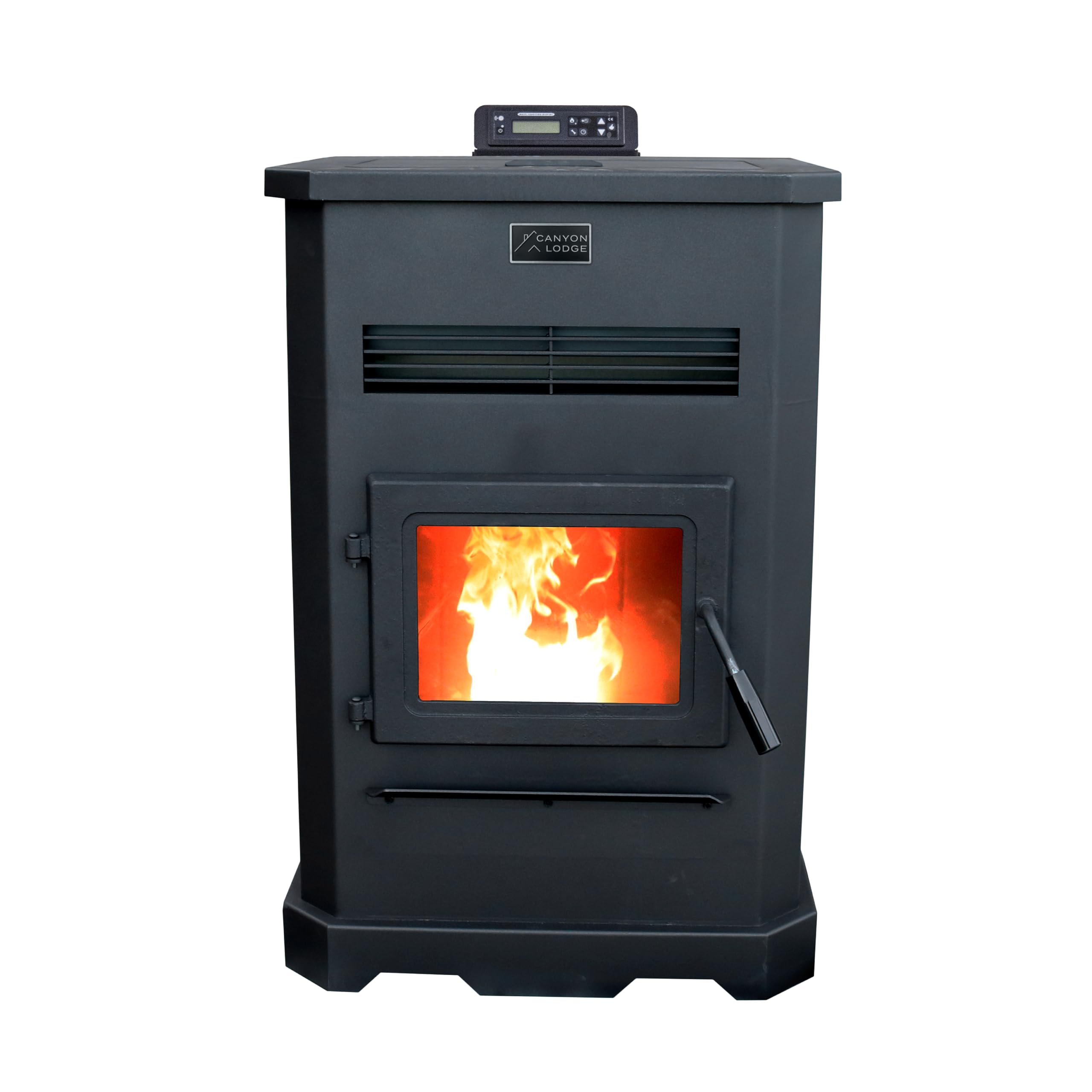
The 130-pound-hopper giant that runs up to three days between refills.
The one spec that defines this stove is the 130 lb hopper — at 130 lb versus the Mr. Heater’s 24 lb bin and the largest on this list. That translates to 2,000 to 3,000 sq ft of coverage on a single load, and one owner confirmed it holds roughly 120 lbs (three 40 lb bags) in practice. For a 4-bedroom mobile home, reviewers point out it heats the entire house, and another owner runs one from the basement to warm the whole home.
This is the feature-fattest pick here: automatic ignition, a large viewing glass with an air wash system to keep it clear, a Whisper Quiet Blower Technology, Smart Home Technology, and an EPA-Approved rating. The fresh air kit is included in the box, and it’s mobile-home approved — a rare combination of certifications at this level. At 209.4 pounds it’s a substantial appliance, but owners say installation goes easy once you get past a few newbie snags.
The hard truth is that the safety feedback sits right alongside the praise, so this pick carries the most serious caveat in the group. One buyer reports a fire hazard — thin metal that caught fire inside the stove, requiring two extinguishers and a hose. That is an alarming single data point, but the positive reviews are genuinely strong: owners call it beautiful, high quality, and functioning exceptionally well, with good customer support. This is a stove for someone with a very large space who wants maximum capacity, but you should weigh that fire report heavily before committing.
The Capacity King
- 130 lb hopper means multi-day burn times
- Automatic ignition and WiFi smart home controls
- Mobile-home approved with fresh air kit included
Serious Caveats
- A buyer reports a severe fire hazard with thin metal
- App and remote are finicky though functional
- Weigh the safety report heavily before purchase
Choose it for: massive spaces and a hopper that outlasts the weekend, with auto-ignition convenience.
Pause before buying: one alarming fire report puts this unit behind the others in confidence — check newer reviews.
Understanding the Specs
Heat Output (BTUs) vs. Square Footage
BTUs measure how much heat the stove generates, and each maker pairs that number with a coverage claim in square feet. The real-world lesson from reviews is that these ratings assume moderate insulation and average winters. If you live somewhere with sub-zero stretches, buy a stove rated well above your home’s actual size so you have a buffer. A good rule is to match the stove’s rating to your largest open area, not your whole house.
Hopper Capacity and Burn Time
The hopper is the bin that stores wood pellets, measured in pounds. Bigger means fewer refills — a 24 lb hopper may not fit a full 40 lb bag, while a 130 lb hopper can run for days. Watch how the feed system works: an electric auger pushes pellets mechanically and needs power, while a gravity-feed design drops pellets by weight alone and runs without electricity. Your power reliability should dictate which style fits.
FAQ
How many pounds of pellets does a pellet stove use per day?
Can a pellet stove run during a power outage?
How often do I need to clean a pellet stove?
Will a 24 lb hopper hold a full 40 lb bag of pellets?
What does a pellet stove do on the first burn?
Can I use a pellet stove to heat a mobile home?
How do I control a pellet stove remotely?
Is a gravity-feed pellet stove better than an electric one?
Why does my pellet stove keep turning off?
What should I check when a pellet stove arrives?
Final Thoughts: The Verdict
For most buyers, the best budget pellet stove pick is the Mr. Heater Cleveland Iron Works because it pairs a solid cast-iron build with WiFi control and dependable shop heat at a value price. If you want programmable whole-home warmth on a schedule, grab the Castle Serenity. And for a large open space that needs serious BTUs, the No.210 Bay Front is the one to reach for.
How We Picked
We do not accept paid placement. Every pick is matched to a real buyer and a real use-case; we do not hands-on test units.
Sources & Methodology
Specifications: manufacturer listings and product documentation. Review insights: verified customer reviews, as of August 2026. Pricing: not shown on this page (it changes often); check the current price via the retailer link.
As an Amazon Associate, FitlyFast earns from qualifying purchases. This does not affect which products we feature.