
Our readers keep the lights on and the weekend projects moving. As an Amazon Associate, I earn from qualifying purchases.
Specs are compiled from manufacturer listings and verified buyer reviews and can change over time — please confirm the key details on the product page before buying.
You spent good money on a turntable and speakers, but your vinyl still sounds thin and flat. That is because most modern amps and powered speakers lack a phono input (a dedicated jack for a turntable’s weak signal), so your turntable’s delicate signal never gets the boost it needs before hitting your speakers. A budget preamp fixes that by taking that tiny signal and bringing it up to line level (the standard strength your amplifier expects) without adding noise or distortion.
I’m Rikta — the founder and writer behind FitlyFast. This guide is built by comparing the manufacturers’ published specifications and the patterns across verified customer reviews, so you get each pick’s real strengths and trade-offs instead of marketing spin.
The right budget preamp changes how your records sound more than almost any other single upgrade you can make. It fixes thin sound and gives you back the bass and detail you paid for.
Quick Picks
- Fluance PA10 High Fidelity Phono Preamp — Best Overall
- PROZOR Pre Amplifier for Turntable (PRR019) — Best Value
- ART DJ Pre II Turntable Phono Preamplifier — Most Versatile
- Fosi Audio Box X4 Phono Preamp — Tube Starter
- Fosi Audio P3 Tube Preamp Headphone Amplifier — Bluetooth Hub
- U-Turn Audio Pluto 2 Phono Preamp — Clean & Compact
- AMPAPA A1 Vacuum Tube Phono Preamp — Feature-Packed Tube
How To Choose The Best Budget Preamp
Picking the right phono preamp for your vinyl setup depends on a few clear choices: what kind of cartridge your turntable uses, if you want tone controls, and how much noise you are willing to accept in the background. Here is what matters most.
Moving Magnet vs. Moving Coil Support
The vast majority of budget turntables use a Moving Magnet (MM) cartridge. Every preamp on this list works with MM cartridges, and that covers 95% of what you will find under. Moving Coil (MC) cartridges need significantly more gain and a different preamp stage, so do not pay extra for MC support you will never use.
Gain, Signal-to-Noise, and RIAA Accuracy
Gain is the amount of boost the preamp applies, measured in dB. Most phono preamps deliver between 40dB and 63dB of gain. A higher number means a louder signal, but it can also amplify noise. Signal-to-noise ratio (SNR), also measured in dB, tells you how much hiss or hum rides along with the music — a higher SNR means a cleaner background. RIAA equalization is the standard curve that restores the original frequency balance that was altered during vinyl mastering; a preamp that follows this curve accurately will sound neutral and natural, so instruments don’t sound thin or boomy.
Solid-State vs. Tube (Vacuum Tube) Preamps
Solid-state preamps use transistors and integrated circuits. They tend to be quieter, more consistent, and cheaper. Tube preamps use glass vacuum tubes to add a warm, slightly rounded character to the sound. At budget prices, tubes often introduce a bit of noise and can be less reliable, but many listeners prefer the musical texture they add. If you want a clean, accurate signal, go solid-state. If you want some vintage flavor, try tubes.
Connectivity and Extra Features
The standard connection is RCA input from the turntable and RCA output to your amp or speakers. Some preamps add a 3.5mm headphone jack, adjustable bass and treble controls, a subsonic filter to remove low-frequency rumble from warped records, and a grounding post to eliminate hum. An on-off switch is rarer than you would think at entry-level prices, and many units stay powered as long as they are plugged in.
Quick Comparison
| Model | Best For | Gain | Type | Weight | Amazon |
|---|---|---|---|---|---|
| PROZOR PRR019 | Entry-level value | 63 dB | Solid State | 180 g | Amazon |
| ART DJ Pre II | Flexibility for tweakers | — | Solid State | 1.5 lbs | Amazon |
| Fosi Audio Box X4 | Tube warmth on a budget | — | Tube / Solid Hybrid | 12.8 oz | Amazon |
| Fosi Audio P3 | Bluetooth versatility | — | Tube | 500 g | Amazon |
| Fluance PA10 | Clean, neutral performance | — | Solid State | 11.52 oz | Amazon |
| U-Turn Audio Pluto 2 | American-made accuracy | — | Solid State | 10 oz | Amazon |
| AMPAPA A1 | Full-featured tube stage | — | Tube | 13.6 oz | Amazon |
In‑Depth Reviews
1. Fluance PA10 High Fidelity Phono Preamp
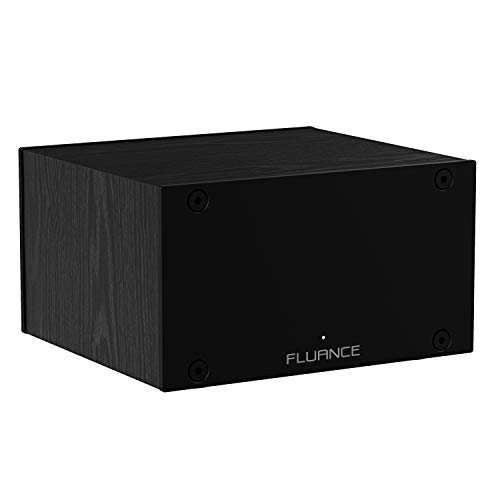
Clean, neutral, and dead simple — just what the quiet listener ordered.
You get a clear, accurate signal with no fuss from the Fluance PA10 because it uses individual left and right channel operational amplifiers (OP amps — chips that boost the signal) for strong channel separation and what the maker calls virtually no crosstalk (signal leaking between channels). The internal metal shielding blocks electromagnetic interference, so buzzing from nearby electronics stays out of your music. It also includes a selectable high pass filter that rolls off frequencies below 20Hz — helpful if your turntable picks up rumbling from a less-than-flat record.
Buyers report that it “sounds clear, just hook it up and you are done.” There are no gain switches, no capacitance adjustments, no tone controls — nothing to set beyond plugging in the RCA cables. If you prefer a preamp that stays out of the way and presents your vinyl exactly as the cartridge sends it, this is the pick. The simple design is the whole point, not a missing feature.
Straightforward Strengths
- Clean, neutral sound with no coloration
- Internal metal shielding resists interference
- Subsonic filter cleans up warped records
The Limits
- No gain adjustment or tone controls
- No power switch — stays on when plugged in
- MM-only; no Moving Coil support
Transparent choice: If you want a preamp that adds nothing and takes nothing away, the Fluance PA10 is exactly it — set it up once and forget it.
Pass if you tweak: Anyone who needs variable gain, bass/treble knobs, or tube warmth should look at the Ampapa A1 or the Fosi Audio Box X4 instead.
2. PROZOR Pre Amplifier for Turntable (PRR019)

The lowest entry fee to get your turntable singing through powered speakers.
You get a maximum gain of 63dB from the PROZOR PRR019, making it one of the highest-gain options in the budget zone — useful if your turntable’s cartridge produces a particularly weak signal, so you don’t have to crank your amp to hear quiet passages. It outputs simultaneously to both RCA and 3.5mm jacks, so you can connect speakers and headphones at the same time.
Owners mention that the “signal to noise ratio wasn’t exactly staggering, but for the price this performed beyond all expectations.” The compact size and an actual ON/OFF button (rare at this level) make it easy to tuck behind a turntable and control without reaching for a power strip. A few owners received units with issues, which is a common risk at this price point, but the majority find it works as advertised from the start.
What Stands Out
- 63 dB of gain, enough for weak cartridges
- Simultaneous RCA and 3.5mm output
- Includes a real on/off switch
The Trade-Offs
- Noise floor is higher than pricier preamps
- Some units arrive defective, per reviews
- No tone controls or adjustable gain
Lowest-cost starter: This is the go-to if your budget is tight and you just need a functioning phono stage that sounds decent right away.
Upgrade if you can: If you can stretch your budget, the Fluance PA10 or ART DJ Pre II will give you a quieter background and more flexibility.
3. ART DJ Pre II Turntable Phono Preamplifier
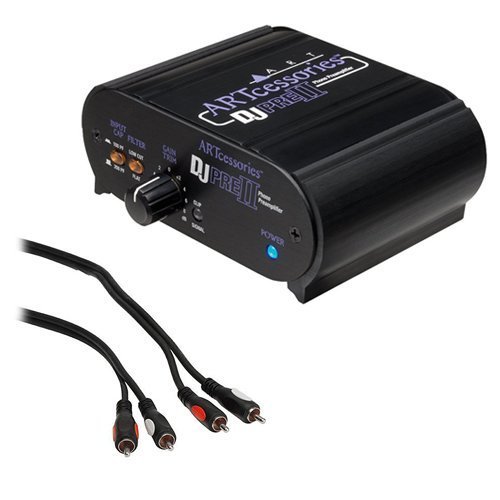
A switch-laden problem-solver for odd cartridges and noisy turntables.
The ART DJ Pre II is built for the tinkerer. It gives you a switchable input capacitance of 100pF or 200pF (capacitance is an electrical load that affects how bright or dark your cartridge sounds), which lets you match the preamp to your specific cartridge’s electrical load for a more accurate frequency response. There is also a low cut filter switch to suppress subsonic rumble from warped records, plus a gain trim knob with a signal/clip LED so you can set the perfect level without distortion. It comes with a 3-foot RCA cable, saving you a trip to the store.
One reviewer noted a “hum with 1960s Thorens belt drive fixed by adding ground wire from preamp to AV receiver,” confirming that the grounding post solves the issue even with vintage gear. The unit is built well and delivers good RIAA equalization, but the blue and yellow LEDs run continuously with no power switch — more than one owner covered them with electrical tape. The 1.5-pound weight makes it heavier than most budget preamps, which actually helps it stay put on a shelf.
Flexibility Highlights
- Switchable input capacitance for cartridge matching
- Gain trim knob with clip LED indicator
- Low cut filter cleans up rumbling bass
Annoyances
- No on/off switch; LEDs stay lit 24/7
- Bright blue and yellow LEDs can be distracting
- No Moving Coil support
For the tweaker: If you like dialing in your cartridge’s perfect capacitance and want visual feedback on gain staging, the DJ Pre II gives you control that most budget units skip entirely.
Skip for simplicity: If you just want to plug and play without fiddling with switches, the Fluance PA10 or the PROZOR are simpler choices.
4. Fosi Audio Box X4 Phono Preamp with JAN 5725W Vacuum Tubes

Tube warmth and tone shaping for the person who wants to color the sound a little.
The Fosi Audio Box X4 is a phono preamp with two JAN 5725W vacuum tubes, plus adjustable bass and treble controls — a rare combination at its price level. It accepts both MM turntable and 3.5mm AUX input, and outputs to RCA or a headphone jack. At just 4 x 2 x 1 inches, it is smaller than the Fosi Audio P3 (which measures 4.33 x 6.3 x 1.57 inches), making it among the most compact tube stages you can buy. The grounding post uses a spring-loaded mechanism that a reviewer noted works well with spade connectors.
One buyer mentioned the “phono preamp sounds excellent: detailed, punchy, warm, quiet background, useful tone controls.” The headphone output is less impressive — another reviewer called it “boxy, tinny, lacking low/high end” — so consider this primarily a phono stage with a bonus headphone jack, not a dedicated headphone amp. The fake tube lighting is cosmetic, but the actual tube sound is real enough that some owners love swapping in different tubes (6K4, 6J1, GE5654, or 6AK5) to change the character.
Tube-Friendly Features
- User-replaceable tubes for DIY tuning
- Bass and treble controls for easy tone shaping
- Compact footprint at 4 x 2 x 1 inches
The Catch
- Headphone output is noticeably lower quality
- Some units have weak output or noise issues
- Fake tube lights may feel gimmicky to purists
Tube-curious starter: This is the cheapest way to get real vacuum tubes and tone controls into your vinyl chain without spending over.
Beware inconsistency: Quality control varies — if you get a good unit it sounds excellent, but returns are not uncommon. Buy from a seller with a solid return policy.
5. Fosi Audio P3 Tube Preamp Headphone Amplifier
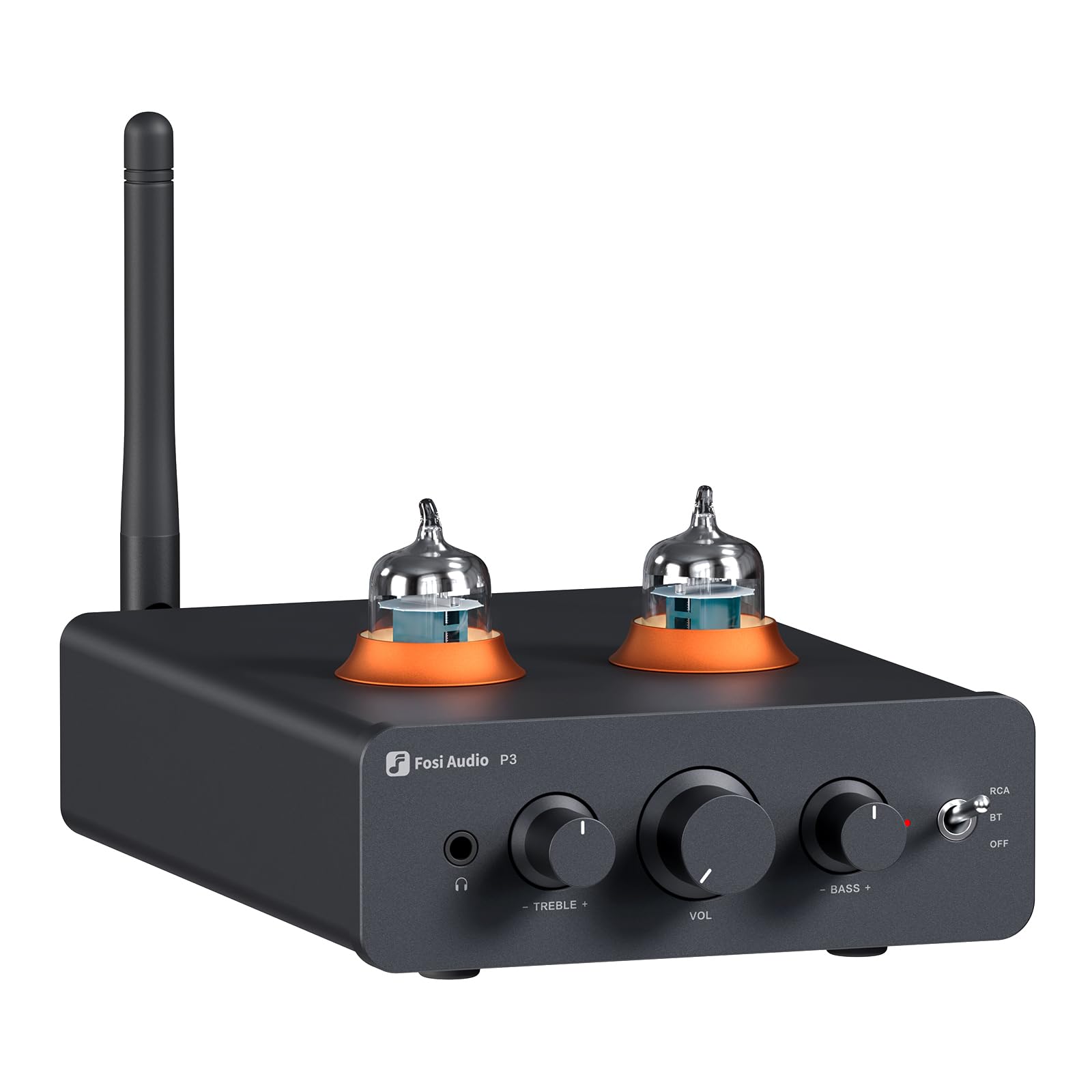
A tube preamp that streams Bluetooth and drives headphones — for the multi-source listener.
The Fosi Audio P3 is a tube preamplifier that goes beyond simple phono duty. It uses a Qualcomm QCC3031 Bluetooth 5.1 chip with aptX HD and aptX LL codecs (aptX LL is a low-latency codec that keeps audio and video in sync), so you can stream wireless audio from your phone or computer without noticeable delay. The preamp circuit improve voltage to 54V to get full performance from the 5654W vacuum tubes, and the ELNA audiophile-grade capacitors help keep the signal clean. It supports headphone impedance from 16Ω to 300Ω, meaning it works with everything from sensitive IEMs (in-ear monitors — small earbuds for monitoring audio) to demanding studio headphones like the Sony MDR-7506.
At 500 grams, the P3 is significantly heavier than the PROZOR (which is 180 grams) that reflects its larger chassis and physical controls. One owner reported “this made a huge difference in sound for me,” noting it paired well with a computer sound card and Sony headphones. Tube installation can be frustrating — one owner spent 30 minutes per tube because the pins were crooked — and the headphone jack has a known left/right channel reversal on some units. But for the price, the combo of tube warmth, Bluetooth, and a headphone amp is hard to match.
Multi-Function Perks
- True tube circuit with 54V plate voltage for full tube saturation
- Bluetooth 5.1 with aptX HD and aptX LL for wireless streaming
- Drives headphones from 16Ω to 300Ω
Where It Stumbles
- Only one RCA input — no switching between sources
- Tube installation is difficult; pins bend easily
- Some units have reversed left/right headphone channels
Desktop all-rounder: If you want a single preamp that handles your turntable, computer, and phone with tube warmth, the P3 is the most versatile option here.
Not for pure phono: If you only need a phono stage and nothing else, the Fluance PA10 or the ART DJ Pre II do the job with fewer complications.
6. U-Turn Audio Pluto 2 Phono Preamp

American-assembled accuracy with an class-leading warranty — set it and stop worrying.
The U-Turn Pluto 2 is a no-frills phono preamp for Moving Magnet cartridges, designed and assembled in Woburn, Massachusetts. It uses WIMA film capacitors and precision resistors in a dual high-performance gain stage to keep total harmonic distortion (THD — a measure of added electrical noise) low. The compact aluminum enclosure at 4.5 x 3.85 x 1.4 inches shields sensitive components from interference, and an active subsonic filter removes low-frequency noise from warped records. It comes with a 3-year warranty and lifetime support from U-Turn Audio, which is longer than almost any competitor at this level.
Customers note a “night and day difference for my vinyl setup” compared to built-in preamps, with noticeably better soundstage and instrument separation. One customer observed it “beats tube preamps for hard rock, metal, classic rock” for clarity and detail. There is no power switch, so it draws power whenever it is connected, and you need a ground wire to eliminate hum with some turntables. At 10 ounces, it is lighter than the Fluance PA10’s 11.52 ounces, but just as solidly built.
Engineered Strengths
- WIMA film capacitors and precision resistors for high accuracy
- Low THD with dual high-performance gain stages
- 3-year warranty with lifetime support
What You Give Up
- No adjustable gain, capacitance, or tone controls
- No on/off switch — always powered when plugged in
- MM-only; no Moving Coil support
For the long-haul listener: The 3-year warranty and US assembly are rare at this price — buy it once and stop thinking about your phono stage for years.
Not for tweakers: If you want bass/treble knobs or cartridge-matching capacitance switches, you will find more flexibility in the ART DJ Pre II or the Ampapa A1.
7. AMPAPA A1 Vacuum Tube Phono Preamp

Looks and sounds like it costs twice as much, with controls to match.
The AMPAPA A1 is a tube phono preamp, headphone amp, and preamplifier all in one aluminum chassis that uses a whole die-casting molding and CNC machining process (CNC stands for computer numerical control, a precision manufacturing method) for a premium feel. It runs on classic JAN GE5654 vacuum tubes and gives you independent bass, treble, and volume knobs so you can shape the sound to your liking. It accepts MM phono input plus line-level sources like a CD player, phone, or PC through the 3.5mm AUX input, and it has a proper on/off switch on top — a detail that costs more to engineer but makes a big difference in daily use.
Reviewers report it is “noticeably louder, more vibrant sound than Fluance PA10” and that the bass control is a standout for vinyl. Another buyer said it “blows away previous phono stage” when paired with a Kenwood KA-7100 amplifier, with huge bass improvement and a wide soundstage. The tubes are user-swappable, so you can try different 6K4, 6J1, 6J4, GE5654, or 6AK5 tubes to tweak the sonic character. The headphone output is decent but not as refined as dedicated headphone amps at the same price.
Full-Featured Design
- Bass, treble, and volume knobs for complete tone control
- User-replaceable JAN GE5654 vacuum tubes
- Solid aluminum CNC-machined shell with on/off switch
Minor Quirks
- Headphone output is serviceable but not audiophile-grade
- Sounded thin with certain Class D amps (e.g., Fosi V3 mono blocks)
- Made in China, not a boutique US brand
Best tube value under: The A1 gives you real tube sound, bass/treble control, and a build quality that outshines everything else in this price range.
Caveat for Class D amps: If your amp is a Class D model (like Fosi V3), test the pairing; some reviewers point out a thin sound that disappears entirely with a traditional A/B receiver.
Understanding the Specs
Gain (dB)
Gain measures how much the preamp boosts the turntable’s weak signal before sending it to your amplifier. Most phono preamps deliver between 40dB and 63dB of gain. A higher number means you can drive your amp to louder volumes without straining, but it can also amplify background noise. The PROZOR offers 63dB, which is the highest in this roundup and useful for lower-output cartridges so you don’t have to crank your amp to hear quiet passages.
Signal-to-Noise Ratio (SNR)
Signal-to-noise ratio, measured in dB, tells you how clean the signal is compared to the noise the preamp itself generates. An SNR of 80dB or higher is good for budget gear; above 100dB, like the 103dB on the Fosi Audio P3, means a very quiet background where you hear only the music and not a layer of hiss or hum. A preamp with a low SNR will sound noisy between tracks and on quiet passages.
FAQ
Do I need a phono preamp if my turntable has a built-in preamp?
What is the difference between Moving Magnet MM and Moving Coil MC cartridges?
Why does my turntable hum when I connect it to a preamp?
Can I use a phono preamp with a regular line-level input on my receiver?
What does RIAA equalization mean?
How do I know if my cartridge needs a specific input capacitance?
Will a tube preamp make my vinyl sound warmer?
Can I use a phono preamp with a powered Bluetooth speaker?
How long do vacuum tubes in a phono preamp last?
What is a subsonic filter and do I need one?
Final Thoughts: The Verdict
Across the board, the top budget preamp is the Fluance PA10 because it delivers clean, neutral sound with excellent shielding and a subsonic filter at a mid-range price you can rely on for years. If you want full tone control and a tube stage that outperforms its price tag, grab the AMPAPA A1. And for the absolute lowest cost of entry that still sounds good, the PROZOR PRR019 gets your turntable playing while staying affordable.
How We Picked
We do not accept paid placement. Every pick is matched to a real buyer and a real use-case; we do not hands-on test units.
Sources & Methodology
Specifications: manufacturer listings and product documentation. Review insights: verified customer reviews, as of July 2026. Pricing: not shown on this page (it changes often); check the current price via the retailer link.
As an Amazon Associate, FitlyFast earns from qualifying purchases. This does not affect which products we feature.