
Our readers keep the lights on and the weekend projects moving. As an Amazon Associate, I earn from qualifying purchases.
Specs are compiled from manufacturer listings and verified buyer reviews and can change over time — please confirm the key details on the product page before buying.
The problem with buying a cheap random orbital sander is that you usually trade vibration for the lower price. Your hand goes numb after the first board, the dust bag fills the room instead of the canister, and the motor stalls the moment you lean in. This guide sorts through the corded 5-inch contenders to find the ones that cut fast, stay smooth, and keep the dust where it belongs — without emptying your wallet.
I’m Rikta — the founder and writer behind FitlyFast. This guide is built by comparing the manufacturers’ published specifications and the patterns across verified customer reviews, so you get each pick’s real strengths and trade-offs instead of marketing spin.
Whether you are restoring a tabletop or smoothing drywall, you need a sander that starts fast and finishes clean. Here is our breakdown of the best budget random orbital sander picks this year.
Our Picks at a Glance

How To Choose The Best Budget Random Orbital Sander
Picking the right sander on a tight budget means knowing which specs save you time and which ones are just marketing numbers. Below are the three things to check before you click buy.
Amperage: The Real Measure of Grunt
Ignore the flashy max RPM number for a second. Amperage tells you how much torque the motor can deliver before it bogs down. A 2.0-amp motor is fine for light paint removal on softwood, but if you are flattening a piece of oak or stripping old varnish, you want 2.8 amps or more. A 3.0-amp model like the NARBELL keeps spinning even when you lean into it, so you don’t have to baby the trigger.
Variable Speed vs Single Speed
Single-speed sanders (typically around 12,000 OPM) work for one job: medium-stock removal. Variable speed gives you a dial — usually 6 settings — so you can drop to 6,000 OPM for polishing plastic or metal and crank it to 14,000 OPM for hogging off wood. If you plan to move between projects, the extra few dollars for variable speed are worth it.
Dust Collection: Bag vs Box vs Vacuum
A standard dust bag is the bare minimum, and many cheap ones leak fines straight into the air. A cyclonic dust box (like on the SKIL) spins the dust into a separate chamber so the filter stays clear longer. For serious work, look for a model that includes a vacuum adapter — hooking it to your shop vac is the only way to keep a sanding session truly dust-free.
Quick Comparison
| Model | Best For | Amps | Max OPM / RPM | Variable Speeds | Amazon |
|---|---|---|---|---|---|
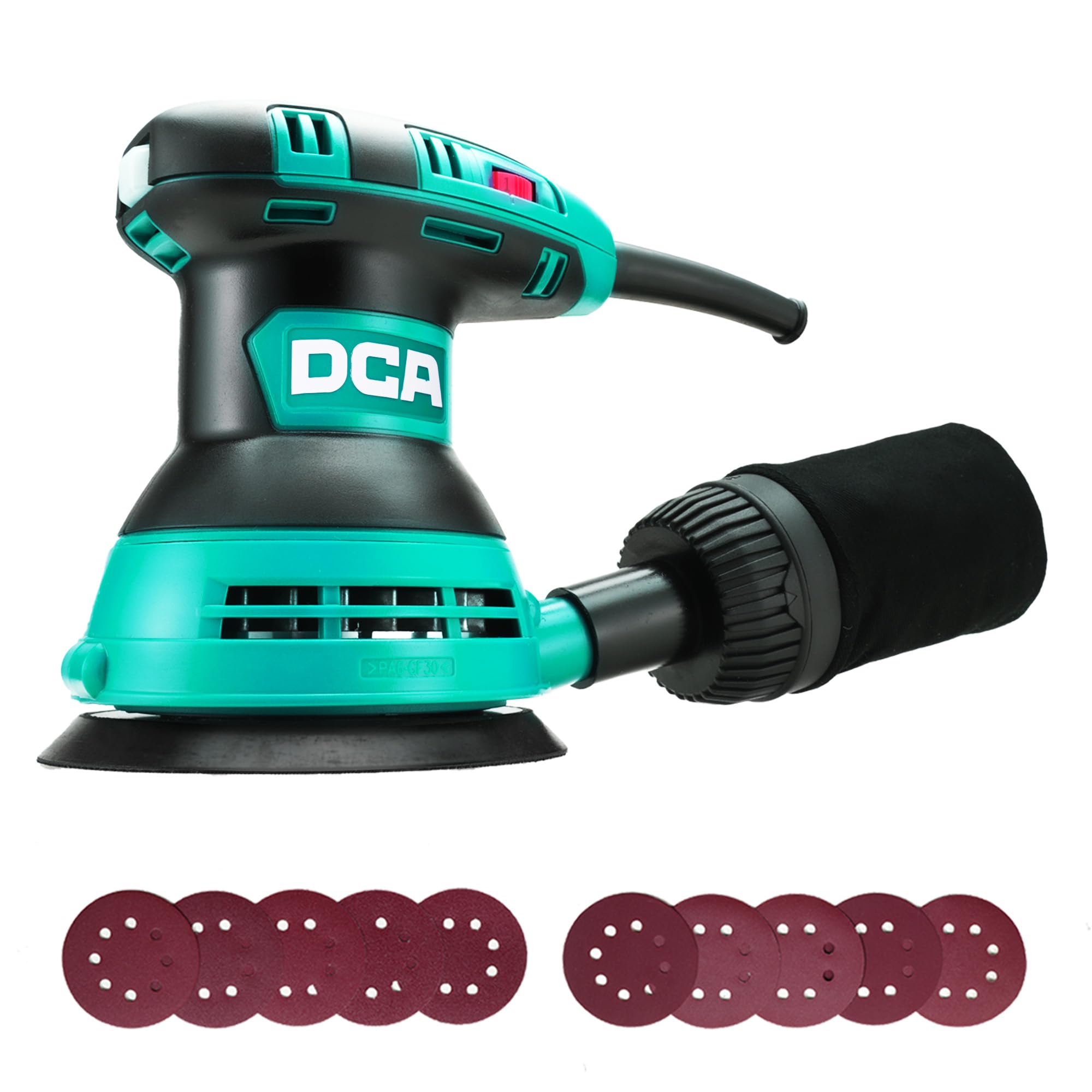
| DCA ASA125★ Best Overall | Best Overall Value | 3.0 A | 12,000 OPM | 6 | Amazon |
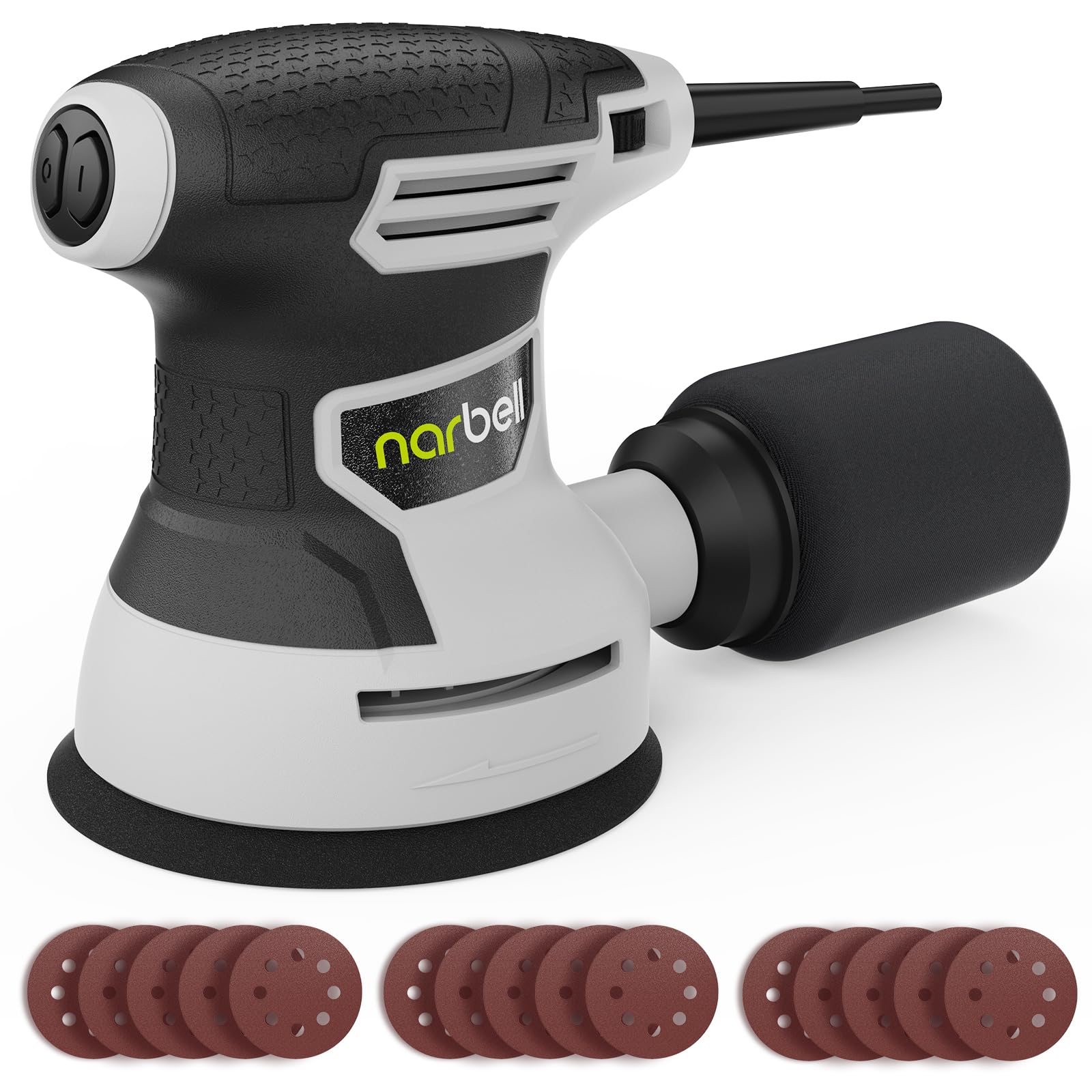
| NARBELL 3.0AMPTop Performer | Highest RPM for Speed | 3.0 A | 14,000 RPM | 6 | Amazon |
| SKIL SR211601Cleanest Dust Pick | Cleanest Dust Collection | 2.8 A | 13,000 OPM | 6 | Amazon |
| BLACK+DECKER BDERO100 | Entry-Level Simplicity | 2.0 A | 12,000 OPM | 1 | Amazon |
| Dong Cheng DSA02-125 | Best Accessory Kit | 3.2 A | 12,800 OPM | 6 | Amazon |
| TurboVolt TL-OS001 | Pad Brake for Swirl-Free Finish | 3.0 A | 13,000 RPM | 6 | Amazon |
| Metabo HPT SV13YST | Trusted Brand Reliability | 2.8 A | 13,000 RPM | Variable | Amazon |
| DEWALT DWE6421K | Low-Vibration Comfort | 3.0 A | 12,000 OPM | 1 | Amazon |
| Bosch ROS20VSK | Pro-Grade Finish | 2.5 A | 12,000 OPM | Variable | Amazon |
In‑Depth Reviews
1. DCA Random Orbital Sander
The underdog that delivers a 3.0-amp punch for the price of a takeout dinner.
This DCA sander is the crowd-pleaser that proves you do not need to spend a lot to get a clean finish. Its 3.0-amp copper motor drives through six speeds from 4,000 to 12,000 OPM, so you can dial in a slow crawl for plastic polishing or open it up for flattening a glued-up panel.
Your hand stays comfortable through a full afternoon of work thanks to the rubber grip and ergonomic body, and buyers report it does “a fantastic job on the hood of my TJ” — meaning it handles automotive body prep just as well as furniture. The dust bag uses a rubber seal on the port to improve collection, a detail you usually only see on pricier sanders.
A mild caveat: the hook-and-loop pad can let the paper drift after extended use, occasionally leaving a slight pattern on the wood. If you are sanding for a show-quality finish, check the disc alignment every few minutes.
What Wins People Over
- Strong 3.0-amp motor that does not bog down on hardwood
- Six variable speeds for switching from paint removal to fine finishing
- Effective dust collection with a sealed port and a 10 fl oz (0.3L) bag
- Lightweight at 2.87 lbs — easy to handle one-handed overhead
The Trade-Off
- Sanding disc may drift and leave swirl marks if not checked periodically
- Not recommended by the maker for walls or ceilings
Reach for this if: you need a powerful, versatile sander for weekend projects and want to keep your budget under control.
Think twice if: you demand a pro-grade pad-brake system to eliminate every last swirl mark without checking alignment.
2. NARBELL 3.0AMP Random Orbit Sander
The speed demon that hits 14,000 RPM and keeps pulling long after cheaper motors quit.
Where the DCA maxes out at 12,000 OPM, the NARBELL pushes its 360W copper motor to 14,000 RPM — a 17% speed advantage that translates to noticeably faster material removal. The six-speed dial lets you drop to 6,000 RPM for delicate work, meaning it behaves like two sanders in one: a hogger and a finisher.
The dust system pulls debris through the pad itself, which owners who have used it for 18 months on everything from concrete countertops to oak mantles call surprisingly effective. One long-time owner reports that it “works great, better than my dewalt and a lot cheaper.” The rubber cover over the power switch takes a deliberate press, which some find mildly annoying but also prevents accidental starts.
A minority of owners mention that pressing too hard stalls the pad — this works best when you let the motor’s 360 watts do the work rather than leaning your weight into it.
Pros
- Highest max speed in this roundup at 14,000 RPM for fast stock removal
- 15-piece sandpaper assortment (60/80/120 grit) included to get started
- Dual dust mounting: bag or vacuum adapter
- Ergonomic design with shock absorption for long sessions
Cons
- Motor can stall if you apply too much downward pressure
- Rubber on/off switch cover requires a firm press
Best for speed-focused work: if you want to strip paint or shape wood faster than the other budget options, this is the one.
Not ideal for: light-touch finishing where any pad stall would ruin the surface.
3. SKIL 5” Random Orbital Sander SR211601
The DIY champion that keeps dust out of the air with a clever cyclonic box.
SKIL’s X-flow dust collector is the standout feature here. Instead of letting the bag clog and spew fines, it uses cyclone force to spin dust into a transparent container that stays clear far longer than a standard bag. For a shop-vac-free workshop, this is the difference between breathing easy and choking out.
At 2.8 amps and 13,000 OPM (orbits per minute — how fast the pad spins), it is not the most powerful sander in the list, but the variable-speed dial (six settings) and the soft rubber grip make it among the most comfortable. As buyers put it: “the six-speed control offers versatile options.” The compact shape — 5.51 inches tall — lets you get into tight corners that bulkier sanders miss. It weighs 3.4 lbs, which is middle-of-the-pack but well-balanced.
The dust box works brilliantly for wood, but if you are sanding drywall joint compound (mud), buyers warn that the fine powder clogs it fast. For drywall, attach a shop vac to the dust port instead.
Strengths
- Cyclonic dust box that stays effective much longer than a basic bag
- Six speeds for matching every material from plastic to hardwood
- Low-vibration design with counterweight balance reduces hand fatigue
- Dust-sealed switch for longer switch life in the shop
Limitations
- Dust box struggles with fine drywall mud — shop vac recommended for that use
- Slightly less torque than 3.0-amp rivals under heavy load
Choose it for: woodworking projects where a clean shop matters more than absolute max power.
Pass on it if: your main work is sanding drywall compound — the dust box will frustrate you.
4. BLACK+DECKER BDERO100
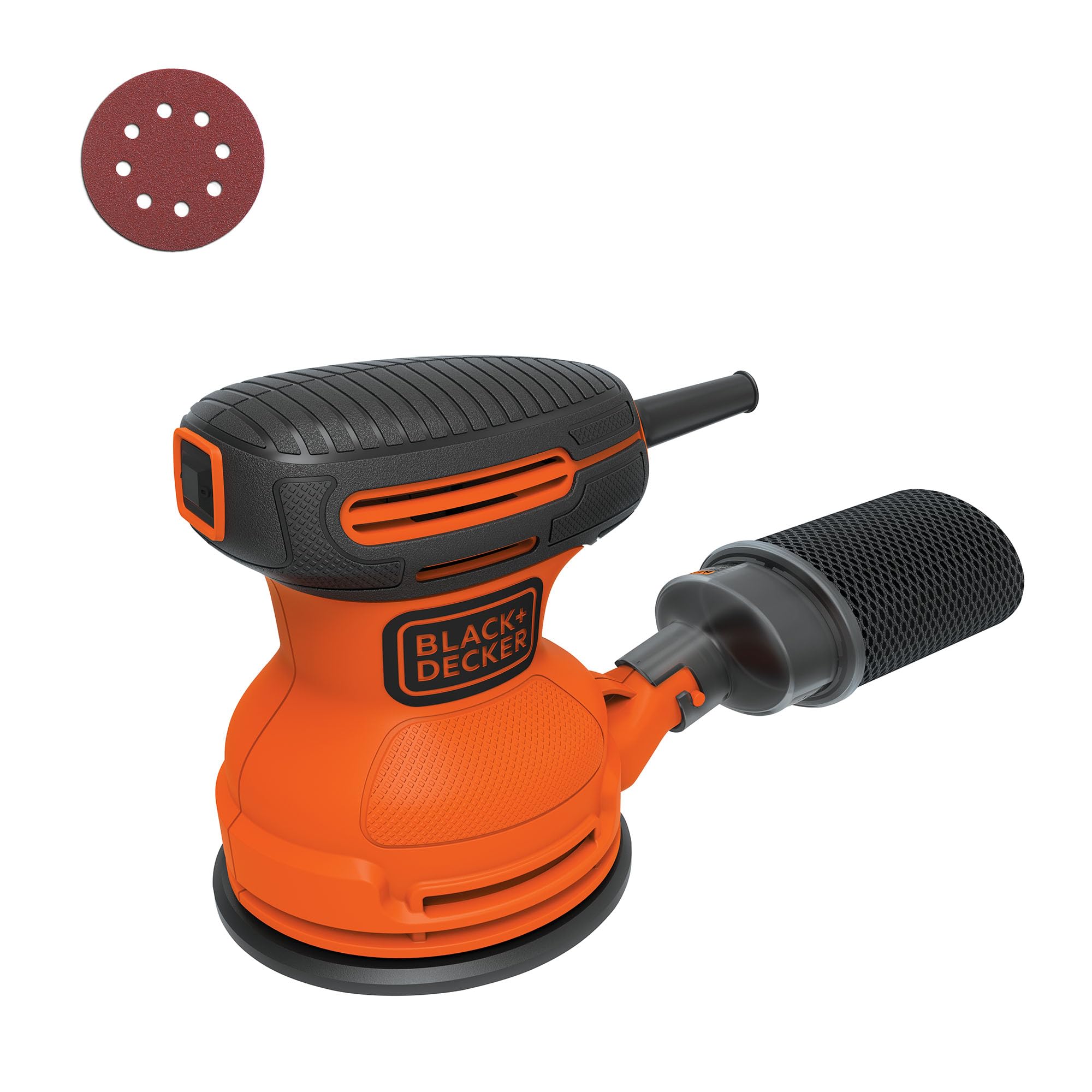
The reliable workhorse that has been on job sites for years because it just works.
This BLACK+DECKER is the simplest sander in the lineup — a single-speed 2.0-amp motor that spins at 12,000 OPM, a basic dust bag, and no variable-speed dial to fiddle with. That simplicity is exactly why it is so popular for light furniture refinishing and quick paint touch-ups.
Owners who refinish furniture frequently call it “light weight and easy to change papers.” The dust-sealed switch and hook-and-loop system keep things straightforward. At 3.2 lbs, it is light enough to use one-handed without tiring out. The short cord — typical for budget sanders — means you will likely need an extension lead.
The catch is the dust bag: it does a passable job but leaks fine particles into the air. Multiple owners recommend wearing a mask and working outside with this one. Also, at 2.0 amps, it has noticeably less torque than the 3.0-amp picks; pushing too hard on hardwood will stall it.
What It Does Well
- Lightweight and compact for overhead or tight-space sanding
- Quiet operation with minimal heat buildup for its class
- Two-year warranty provides confidence on a budget buy
Where It Falls Short
- Dust bag is ineffective — plan to use a mask or hook it to a vac
- Single speed limits versatility for polishing or fine finishing
Grab this if: you need a no-fuss sander for small projects and do not want to overthink settings.
Look elsewhere if: you will be sanding large surfaces or dense hardwoods regularly.
5. Dong Cheng 5-Inch Random Orbital Sander

The sander that arrives with more accessories than some tool kits come with.
Dong Cheng squeezes a 380W motor (3.2 amps) into a compact frame and pairs it with six speeds covering 8,000 to 12,800 OPM. That is the highest amperage draw in the entire roundup, which translates to serious torque for cutting through old finishes. The kit includes 20 sanding discs (five grits from 80 to 320), a heavy-duty nylon tool bag, a pair of carbon brushes, and a dust box.
The internal ventilation design pulls dust through the pad and into the box, and a 32-mm vacuum adapter lets you upgrade to a shop vac for extended sessions. The grip uses a rubberized surface that the maker says “improves grip in critical sanding areas.” At 3.3 lbs, it feels planted without being heavy.
The dust box latch can be finicky — a few owners mention that it won’t stay secured during use. For big jobs, the included bag fills fast and needs a larger option. But given the 3-year manufacturer warranty and the full accessory set, this is tough to top on sheer box-store value.
Kit Highlights
- 380W motor (3.2 amps) for heavy stock removal without bogging
- Comes with 20 sanding discs, tool bag, carbon brushes, and warranty card
- Three-year manufacturer warranty — best in this budget group
Worth Knowing
- Dust box latch can detach during use on some units
- Small dust bag fills quickly on large projects
Best for beginners: you get everything needed to start sanding in one box, plus a long warranty.
Skip if: you prefer a tool-only purchase and do not want extra accessories to store.
6. TurboVolt 5-Inch Random Orbital Sander with Brake
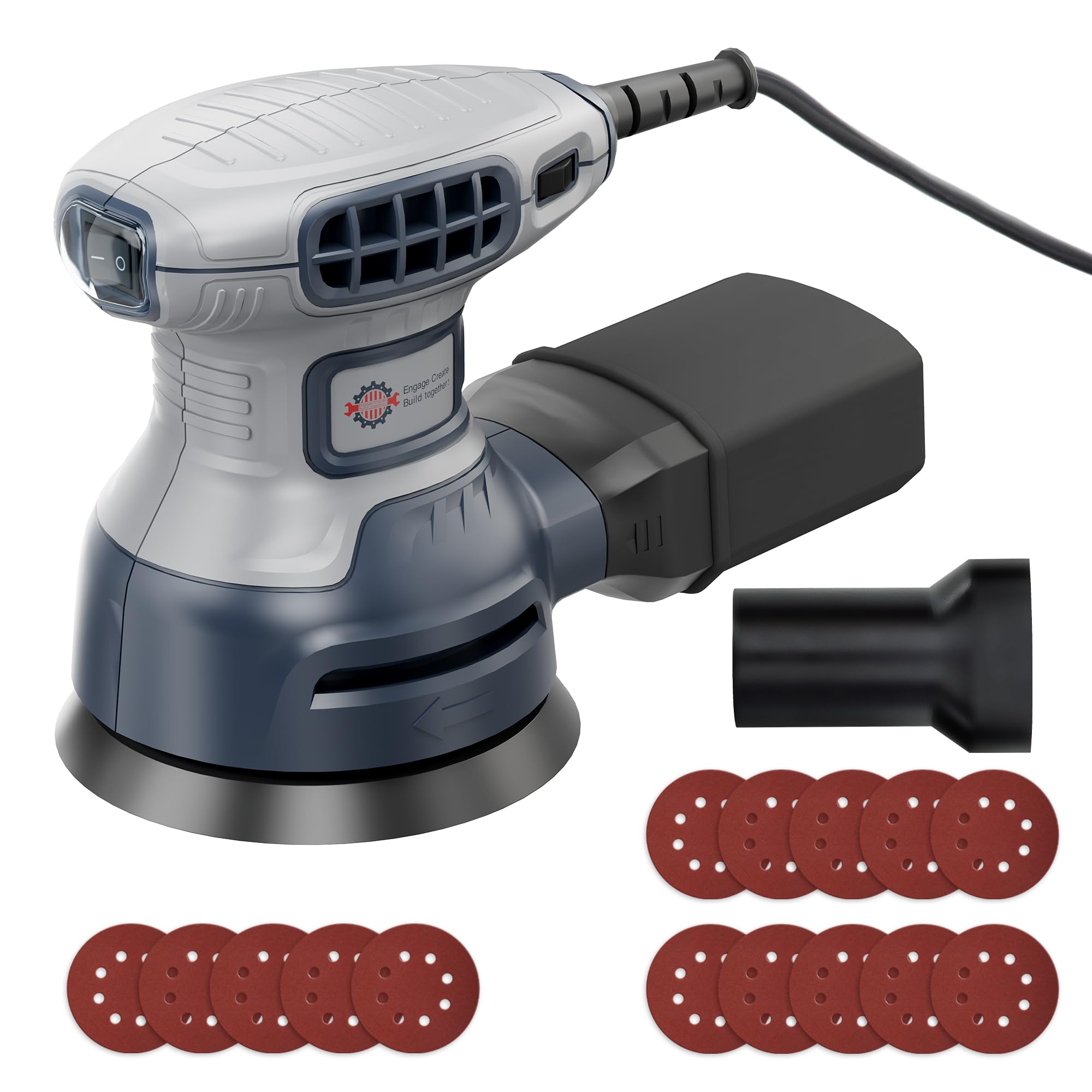
The electronic brake kills pad spin in one second so your last pass stays swirl-free.
Swirl marks happen when the pad continues to orbit after you lift the sander. TurboVolt’s patented electronic braking system stops the pad within one second — seven times faster than conventional coast-down. This is a genuine pro-level feature on a budget-priced tool.
Under the brake is a 3.0-amp pure copper motor with six speeds from 6,000 to 13,000 RPM. Speed 1-2 covers heavy stock removal, 3-4 is for medium smoothing, and 5-6 handles fine polishing. The ZeroDust system includes both a bag and a universal vacuum adapter. Owners consistently call the dust canister “surprisingly effective” and note that the noise level is lower than expected for a 3-amp sander.
The included 15 sandpapers (60/80/120 grits) are basic; you will want to upgrade to better discs for prolonged work. And with only 74 total ratings so far, there is less long-term data than on established models.
Unique Benefits
- 1-second electronic brake prevents swirl marks on every lift-off
- Six speeds from 6,000 to 13,000 RPM for full task range
- ZeroDust dual collection includes bag and vacuum adapter
- Dust-sealed switch for longer tool life
Trade-Offs
- Relatively new model with fewer owner reviews for long-term durability
- Included sandpapers are entry-level; budget for premium discs
Perfect for finishing work: if a swirl-free surface matters more than anything, this brake system delivers.
Consider another if: you want a track record of hundreds of owner reviews before buying.
7. Metabo HPT SV13YST

The Hitachi-rebadged sander that seasoned woodworkers buy as their trusted backup.
Metabo HPT (formerly Hitachi) packs a Japanese-engineered 230W 2.8-amp motor into this palm-style sander, with a variable-speed dial that sweeps from 9,000 to 13,000 RPM. Owners upgrading from entry-level sanders report it “cutting my time in half” for metal polishing and wood finishing alike.
The included accessories are generous: five A-P120 sanding discs, a dust bag, a vacuum adapter, and a rubber adapter for the dust port. The soft comfort grip and compact size make it easy to hold for long stretches, though some users note hand strain after extended overhead use. The dust-sealed rocker switch helps keep the internals clean. Hook it to a shop vac (HEPA recommended) and the dust collection rivals sanders that cost twice as much.
The included dust bag is mediocre — most customers note switching to the vacuum adapter right away. A few also note that the dust collector can occasionally pop off during work. But for the price, you are getting a 5-year professional tool warranty and a brand with decades of industrial reputation.
Standout Qualities
- Japanese-engineered motor with durable build quality
- Five-year professional tool warranty covers the long haul
- Variable speed from 9,000 to 13,000 RPM with a 3mm stroke
- Includes vacuum adapter for shop vac hookup
Considerations
- Included dust bag is poor — plan to use the vacuum adapter
- Slightly louder and heavier than premium European brands
Go for it if: brand reliability and a long warranty matter more than having the lightest tool on the shelf.
Think twice if: you need whisper-quiet operation or the absolute lowest vibration.
8. DEWALT DWE6421K
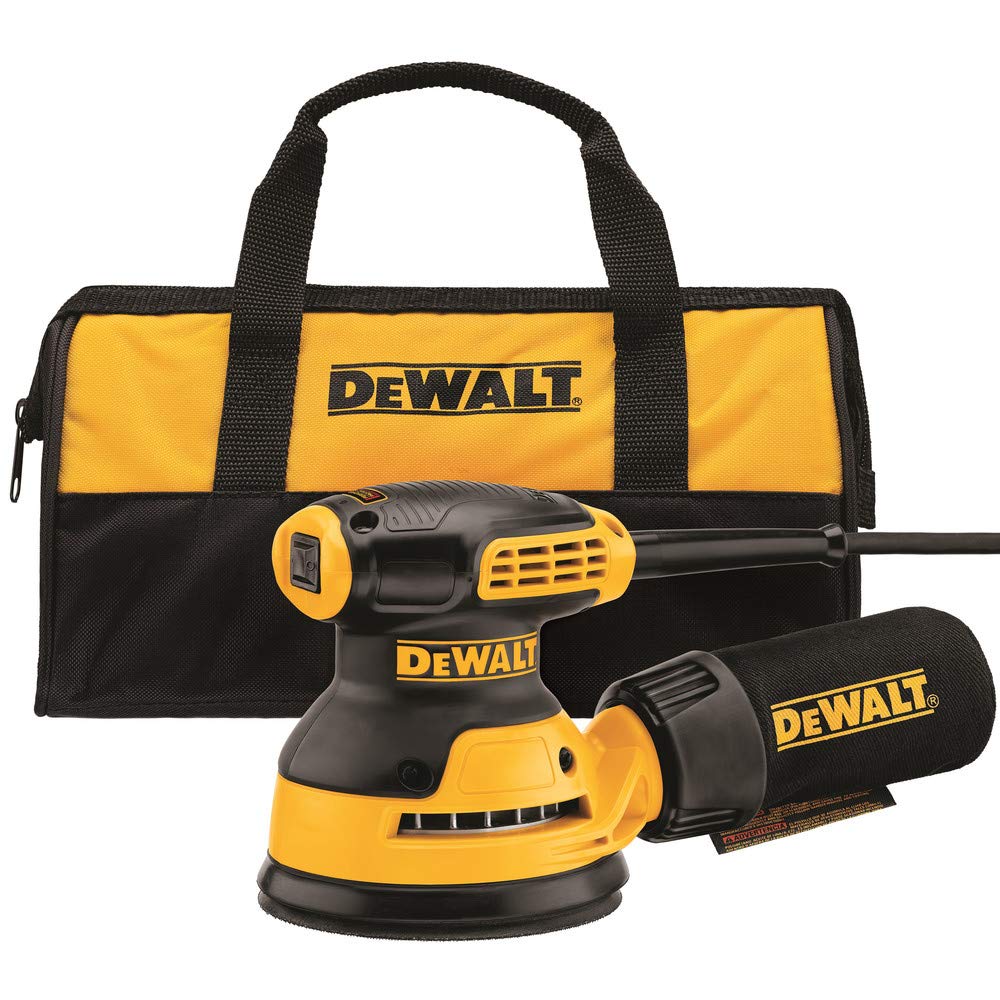
The 3.0-amp pro that thousands of woodworkers trust for its low-vibration comfort.
DEWALT’s DWE6421K uses a separate counterweight design that cancels out vibration before it reaches your hand. On a long sanding session — say, flattening a resin river table or smoothing a deck — that makes a real difference in how you feel the next morning. The 3.0-amp motor spins at a fixed 12,000 OPM, so there is no speed dial to adjust, but the motor has the torque to power through hardwood without slowing down.
The dust port is designed to fit directly into DEWALT’s DWV010 or DWV012 dust collectors, and the one-handed locking dust bag makes emptying quick. The shorter body height lets you get closer to the work surface than taller sanders. Owners praise its “excellent balance” and note that the attached dust bag “collects nearly all dust.”
Fixed single speed is the main limiting factor. At 12,000 OPM, it is fine for stock removal and medium sanding, but you cannot drop it to a slow polish speed. A small number of owners also report failures after heavy daily use, though DEWALT’s 3-year warranty covers it.
Why It Stands Out
- Separate counterweight drastically reduces hand vibration
- Shorter body height for better control on close work
- Dust-sealed switch and efficient one-handed dust bag
- Direct fit to DEWALT dust extraction systems
Its Limitations
- Single-speed operation limits versatility for polishing
- Reviewers point out occasional motor failure under heavy daily use
Reach for it: as the most comfortable single-speed sander for all-day woodworking sessions.
Look for something else: if you need variable speed for switching between heavy removal and fine polishing.
9. Bosch ROS20VSK
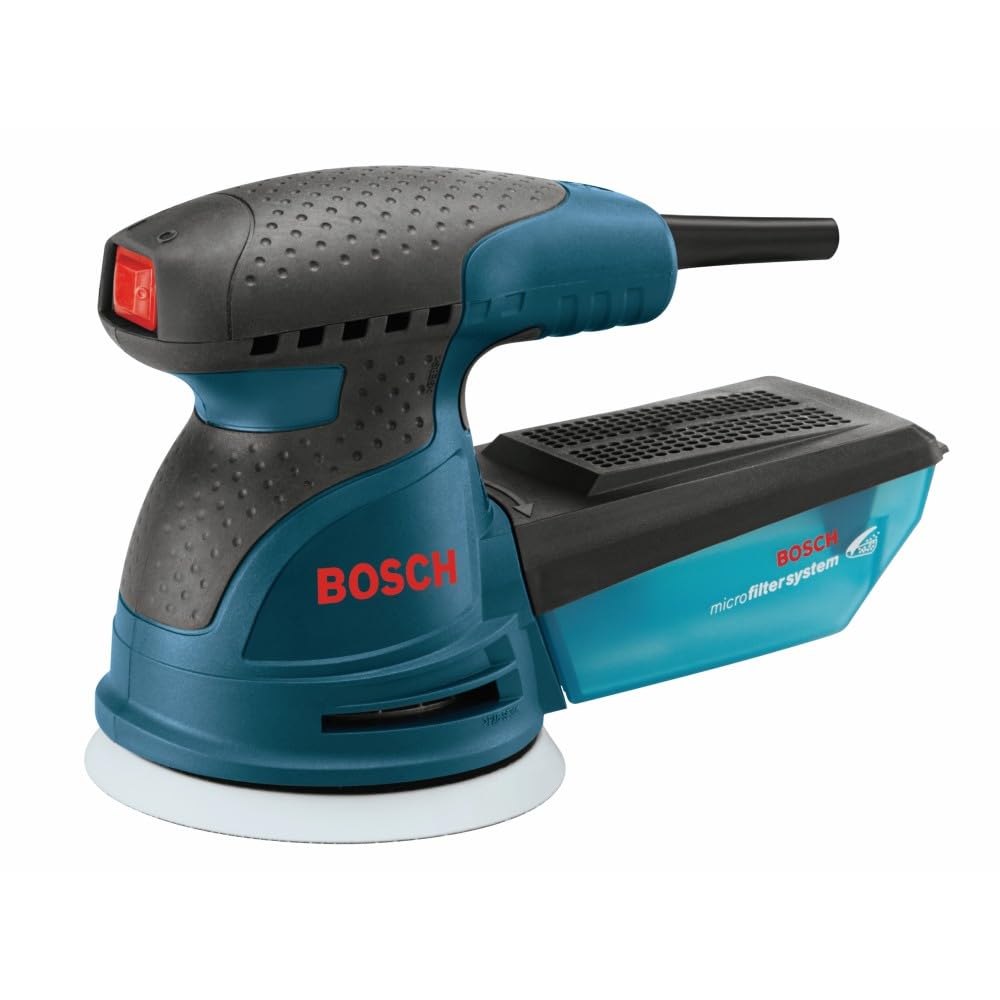
The five-year veteran that cabinet makers still reach for over newer models.
Bosch’s integral pad dampening system is a mechanical brake that slows the pad when you lift, preventing the swirl marks that plague cheaper sanders during final passes. The variable-speed control adjusts between 7,500 and 12,000 OPM, and the microcellular backing pad delivers a fine finish even with low-grit paper.
Owners who have used this sander for years call it “the best orbital sander you’ll ever buy” and praise its dust collection, which uses a filter canister that catches fine dust effectively. The soft-grip top and body absorb vibration well, and the slow-start feature prevents the pad from gouging the surface when you pull the trigger. It uses industry-standard 5-inch 8-hole hook-and-loop discs.
Two real-world downsides: replacing the filter requires buying the whole canister — which costs nearly half the sander’s price. The dust canister lid can be stubborn to remove, and the O-ring that holds it on can fail over time. At 2.5 amps, it has less raw torque than the 3.0-amp competitors, so it prefers sharp discs and light pressure.
What Experts Love
- Pad dampening brake prevents swirl marks for show-quality finishes
- Variable speed from 7,500 to 12,000 OPM for full task versatility
- Excellent fine-dust collection with effective onboard filter
- Low vibration and quiet operation for long workshop days
Realistic Drawbacks
- Dust filter is integrated into canister; replacing it costs nearly half the tool price
- At 2.5 amps, it stalls more easily on heavy stock removal than 3.0-amp rivals
Best for finish work: if you sand furniture and want a swirl-free surface every time, this is the specialist for you.
Look elsewhere if: your main job is aggressive paint stripping or flattening rough lumber.
Understanding the Specs
Orbits Per Minute (OPM) vs RPM
Both measure how fast the pad spins, but OPM (orbits per minute) is the more accurate term for random orbital sanders because the pad moves in a small circle. Higher numbers (12,000–14,000) mean faster material removal. For fine finishing, you want a sander that can drop to the 6,000–7,500 range so you don’t burn the wood.
Pad Brake
A pad brake (mechanical or electronic) stops the pad from spinning the instant you lift the sander. Without a brake, the pad keeps orbiting while it is off the surface, which digs tiny swirls into your workpiece. This feature is what separates a good final finish from a passable one.
FAQ
What is the difference between a random orbital sander and a palm sander?
What amperage do I need for sanding hardwood?
Can I connect these sanders to a shop vacuum?
What is a hook-and-loop sanding pad?
How important is a dust bag versus a cyclonic dust box?
Is a corded sander better than a cordless sander for budget buyers?
What does a variable speed dial actually do for me?
Will a 5-inch sander fit in a standard tool bag?
Final Thoughts: The Verdict
For most buyers, the budget random orbital sander winner is the DCA ASA125 because it delivers a strong 3.0-amp motor, six variable speeds, and effective dust collection at a price that leaves room for sanding discs and a shop vac. If you want the fastest stock removal, grab the NARBELL with its 14,000 RPM top speed. And for a clean shop with a cyclonic dust box that actually works, the SKIL SR211601 is the one to reach for.
How We Picked
We do not accept paid placement. Every pick is matched to a real buyer and a real use-case; we do not hands-on test units.
Sources & Methodology
Specifications: manufacturer listings and product documentation. Review insights: verified customer reviews, as of July 2026. Pricing: not shown on this page (it changes often); check the current price via the retailer link.
As an Amazon Associate, FitlyFast earns from qualifying purchases. This does not affect which products we feature.