Our readers keep the lights on and the weekend projects moving. As an Amazon Associate, I earn from qualifying purchases.
Specs are compiled from manufacturer listings and verified buyer reviews and can change over time — please confirm the key details on the product page before buying.
You want razor-sharp edges and glass-smooth surfaces on miniatures, jewelry, or tabletop figures. A resin 3D printer can give you that detail, which an FDM (plastic filament) printer simply cannot match. The catch used to be cost, but today’s budget machines pack serious resolution and reliability without the high price tag. This guide breaks down the top affordable resin printers so you know which one matches your projects and which trade-offs to expect.
I’m Rikta — the founder and writer behind FitlyFast. This guide is built by comparing the manufacturers’ published specifications and the patterns across verified customer reviews, so you get each pick’s real strengths and trade-offs instead of marketing spin.
After comparing build volumes, XY resolution (pixel size on the screen), print speeds, and hundreds of owner experiences, one machine stands out for most people looking for a budget resin 3d printer that balances detail, speed, and easy setup.
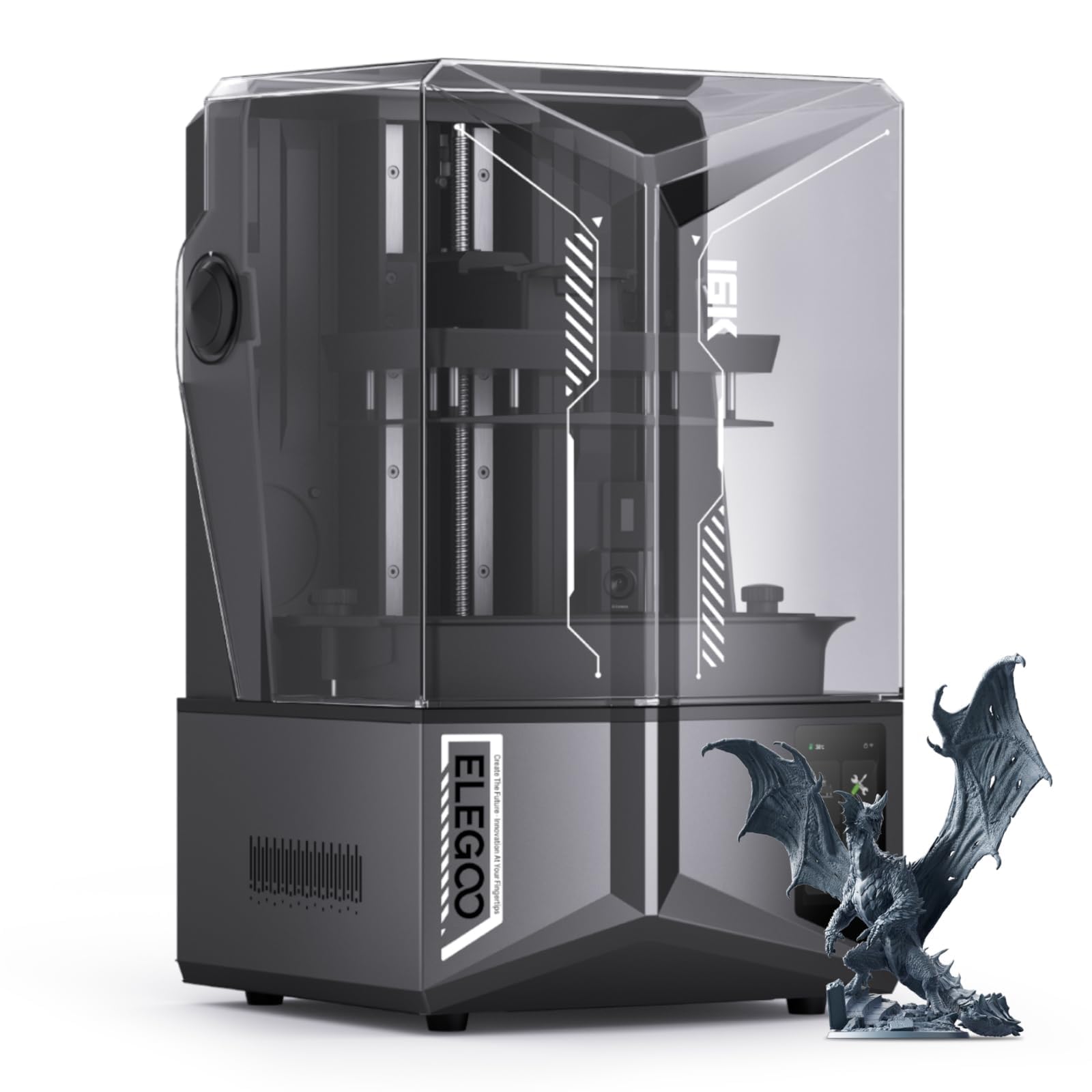
Mid-Range PowerhouseELEGOO Saturn 3 MSLA 12K 3D Printer4.2★286 ratingsYou get a 10-inch 12K screen that prints large models without losing sharp detail. This printer delivers a 19×24µm XY resolution, which is fine enough to pick out individual scales on a dragon miniature.Check Price on Amazon
How To Choose The Best Budget Resin 3D Printer
Picking a resin printer on a budget means knowing which specs you can safely cheap out on and which ones will ruin your prints if you go too low. Here are the three areas that matter most.
Resolution and XY Precision (Microns)
The single most important number for detail is the XY pixel size, measured in microns (µm). A smaller number means finer detail. For models like D&D miniatures or character figures, look for something at or under 35µm. The “K” labels (4K, 8K, 10K, 12K) are just marketing shortcuts for the total pixel count on the screen; what actually determines sharpness is the pixel size on the XY axis. For example, a 17µm pixel size is sharper than a 22µm pixel, even if the screen has fewer “K”s in its name.
Build Volume vs. Reliability
Budget printers typically have a smaller build volume, usually around 6 x 3 x 6 inches. This is fine for single miniatures, small busts, or jewelry molds. A larger vat (the resin tank) requires more resin to fill and increases the peel force on each layer, which can cause failed prints on cheaper machines without sturdy Z-axis hardware. If you mostly print small, detailed objects, a smaller build volume is actually a reliability advantage.
Light Source Uniformity
The light source is what cures each layer of resin. Older budget printers use a matrix of LEDs, which can create uneven light distribution and cause some areas of your print to be under-cured or over-cured. Modern budget printers are moving to a COB (Chip on Board) light source combined with a Fresnel lens. This setup delivers much more uniform light, producing smoother surfaces with fewer visible layer lines. If the product description mentions “COB light source” and “light uniformity over 90%,” that is a strong sign of consistent print quality.
You get the same 17-micron pixel density as the Ultra model for a lower price in a 7.7-pound frame.
The standard Photon Mono 4 shares the same 7-inch 10K screen and 17×17µm XY pixel size as the Ultra, so you get identical detail resolution for less money. Its LighTurbo matrix light source reduces layer lines and rasterization (a digital stair-step effect on curved surfaces). The laser-engraved build platform 2.0 improves adhesion so models do not lift or warp during printing, but parts still come off easily afterward. With a 4-point leveling method, you level the bed once, tighten four screws, and you are set for future prints without re-leveling.
Owners mention “great prints 90% of the time” but note minor leveling issues in the back corner. Another reviewer found the print size smaller than expected for some models, requiring scaling. At 7.7 pounds, it is the lightest printer on this list and 4.3x lighter than the 33-pound ELEGOO Saturn 3, making it ideal for a desk that doubles as a workspace. If your projects are all under about 6 inches, this is the most budget-friendly way to get 17-micron detail — a full 5µm sharper than the Phrozen Sonic Mini 8K S. But if you ever plan to print terrain pieces or larger busts, you will outgrow this build volume quickly and should look at the Saturn 3 instead.
Amazing Detail, Tiny Footprint
17×17µm XY resolution rivals printers costing twice as much for small parts.
At 7.7 pounds, it is the lightest resin printer here and easy to store or move.
4-point leveling system means you level once and rarely touch it again.
Size and Vat Concerns
Small build volume (6.04 x 3.42 x 6.49 inches) limits single-print model size.
Resin vat is reportedly prone to breaking, which can lead to LCD damage and a repair.
Some owners experienced occasional warping on large prints and a few complete part failures.
Value pick for small prints: If your projects are all under about 6 inches, this is the most budget-friendly way to get 17-micron detail.
Not for large models: If you ever plan to print terrain pieces or larger busts, you will outgrow this build volume quickly — look at the Saturn 3 instead.
You get a 10-inch 12K screen that prints large models without losing sharp detail.
This printer delivers a 19×24µm XY resolution, which is fine enough to pick out individual scales on a dragon miniature. The build volume of 8.62 x 4.84 x 9.84 inches is the largest among these budget options, so you can print a full-sized helmet plaque or a whole squad of miniatures in one batch. The COB light source (a chip-on-board LED) with a Fresnel lens keeps the 405nm (nanometer) UV light beam within a 5° angle and achieves over 90% light uniformity — that means the edges of your print cure as evenly as the center, with fewer surprises when you peel it off.
At 33 pounds, it is 4.3x heavier than the 7.7-pound ANYCUBIC Photon Mono 4, so you need a sturdy table and will not move it often. Buyers report great results with wargaming miniatures, but one owner noted a UV screen failure after 5 months. Elegoo treats the LCD as a consumable with a 2000-hour (roughly 3-month) lifespan not covered under the warranty. Think of the screen as a part you might eventually replace, like a light bulb. If you batch-print large objects and have a dedicated workspace, this is the most capable machine in this price range; if you prefer a lighter, more portable printer or want a longer screen warranty, look at the smaller ELEGOO Mars 5 Ultra instead.
Big Build, Big Detail
10-inch 12K monochrome LCD with 19×24µm XY resolution delivers exceptional detail on large models.
Fresnel collimating light source provides over 90% light uniformity for consistent curing.
At 33 pounds, it is noticeably heavier than smaller printers like the Photon Mono 4.
The included USB drive is reportedly unreliable; one reviewer noted it caused errors.
UV screen is treated as a consumable part (roughly 2000-hour lifespan) and not covered under standard warranty.
Best for volume: If you print large, detailed models like busts or terrain pieces and have a dedicated workspace, this is the most capable machine in this price range.
Consider the screen cost: Factor in that the LCD screen is a wear item; it is worth budgeting for a spare or an extended warranty.
You unbox it, fill the resin, and print without ever touching a leveling screw.
The Saturn 4 Ultra 16K is the most friction-free machine on this list. Its automatic leveling system requires zero manual adjustment — no paper trick, no screw tightening. The smart tank heating holds the resin at a steady 30°C (86°F), which stops defects like bubbles and layer separation even if your room is cool. It uses tilt release technology to peel layers at speeds up to 150mm/h, and the AI camera watches for stuck prints or low resin levels and sends an alert to your phone.
One reviewer liked the included 1kg of mint green resin but noted that resin pools on the build plate after printing, requiring a simple drip bracket to keep things clean. Another owner upgraded from an Anycubic and reported sharper detail on small features like hair textures and fabric folds. At 35.5 pounds, it is only a couple pounds heavier than the Saturn 3, but the flip-up lid makes the footprint larger. If you are a beginner or want the least friction between unboxing and your first model, this is the one to get. But if you only print single 28mm miniatures, its large build volume and price are overkill compared to the smaller ELEGOO Mars 5 Ultra.
Truly Plug-and-Print
Automatic leveling means no manual adjustment — just press a button and start.
Smart tank heating to 30°C ensures consistent layer adhesion in cooler rooms.
AI camera with chamber light enables real-time monitoring and time-lapse video recording.
Price and Some Minor Flaws
Premium price tag puts it at the high end of this list, even though the features justify the cost.
Resin pools on the build plate after a print finishes; some owners 3D print a drip tray bracket.
Firmware upgrades have reportedly corrupted settings in rare cases, so proceed with caution.
Ideal for beginners: If you want the least friction between unboxing and printing your first model, the Saturn 4 Ultra is your machine.
Overbuy for small prints: If you only print single 28mm miniatures, the build volume and price may be overkill compared to smaller, cheaper options on this list.
It prints at 150mm/h, nearly twice as fast as the standard Mars 1 according to one owner who upgraded.
The Mars 5 Ultra packs advanced tech into a compact 24.6-pound frame. Its tilt release mechanism reduces Z-axis movement time, pushing print speeds to 150mm/h — so a 5-inch tall miniature finishes in roughly 3-4 hours. A built-in smart mechanical sensor detects issues like low resin or foreign objects on the build plate. The AI camera lets you time-lapse your prints and check progress remotely over WiFi, supporting both 2.4G and 5G networks. You can even manage cluster printing across multiple machines on the same LAN.
Buyers praise the print quality for miniatures, but they warn about temperature sensitivity. One reviewer spent three days troubleshooting failed prints in a 67°F room and found a cold build plate was the culprit. Once they warmed the resin bottle and plate, the printer ran flawlessly. Another owner had an LCD crack under 90 days, but Elegoo’s customer service replaced it quickly — a pattern other owners also praised. The learning curve with Chitubox slicing software is steeper than some rivals’ default slicers. If you churn through batches of miniatures and want WiFi convenience, this is a top choice; if you prefer a printer that works immediately from the start without tweaking temperature or slicer settings, the Saturn 4 Ultra is easier.
Speed and Intelligence
Print speed up to 150mm/h, making it one of the fastest printers in this price bracket.
AI camera provides real-time monitoring, time-lapse recording, and warped-model detection.
WiFi file transfer supports 2.4G and 5G networks, eliminating the need for USB drives.
Temperature-Sensitive
Resin and build plate must be warm (around 70°F or above) to prevent failed prints — cold rooms are a problem.
One owner experienced an LCD crack under 90 days; Elegoo handled the replacement, but it is a hassle.
The learning curve with Chitubox slicing software is steeper than with some rivals’ default slicers.
For speed-hungry hobbyists: If you churn through batches of miniatures and want WiFi convenience, the Mars 5 Ultra is a top choice.
Mind the learning curve: If you prefer a printer that works immediately from the start without tweaking temperature and slicer settings, the Saturn 4 Ultra is easier.
You get a reliable, no-frills resin printer with a 22µm XY resolution for a low entry price.
The Phrozen Sonic Mini 8K S is the simplest on-ramp to resin printing. It works with open-source slicers like Lychee, Chitubox, or Tango — no proprietary software lock-in. Its 7.1-inch monochrome LCD gives a 22µm XY resolution, slightly less dense than the 17µm on the ANYCUBIC models but still sharp enough for detailed miniatures and action figures. The build volume is 6.5 x 2.8 x 6.7 inches, so you can fit a few 28mm miniatures in one go. The Z-axis calibration is precise for even, accurate layers.
Buyers call it a workhorse. One owner described it as “very reliable,” and another using it for dental impressions was impressed by the quality jump. The main catch: you must use a USB drive for file transfers — no WiFi or Ethernet option. A minor but notable issue: one owner found the included scraper was bent, damaging the build plate during first print removal; Phrozen’s customer service responded quickly. If you want a straightforward, reliable machine without smart features that add complexity, this is a strong starter. But the 22µm XY is less sharp than the 17µm you get on the ANYCUBIC Photon Mono 4 Ultra, and the lack of WiFi could be a dealbreaker if you hate juggling USB drives — in that case, look at the ELEGOO Mars 5 Ultra.
Reliable Simplicity
Open-source slicer compatibility means you are not stuck with one software ecosystem.
Precise Z-axis calibration ensures consistent layer accuracy across prints.
Good value for money, with a 4.5/5 average rating from 152 reviews.
Missing Modern Conveniences
USB-only file transfer; no WiFi or network printing available on this model.
Build volume is narrower than the ANYCUBIC and ELEGOO options, limiting larger models.
One reviewer’s included scraper was damaged, requiring a customer service replacement — not a systemic problem but worth inspecting on arrival.
For first-timers: If you want a straightforward, reliable machine without smart features that add complexity, the Mini 8K S is a strong starter.
Look elsewhere for connectivity: If you hate dealing with USB drives and want WiFi file transfers, any of the ELEGOO Ultra models are a better fit.
Budget Runner-Up
6. ANYCUBIC 10K Resin 3D Printer, Photon Mono 4 LCD 3D Printer
You get the same 17-micron core as the standard Mono 4 but with a stated 6-month LCD warranty.
Visually this is the same machine as the standard Photon Mono 4, but its packaging dimensions are 20 x 10 x 15 inches — double the 10 x 10 x 15 inches of the standard version, suggesting a different retail bundle. The core specs are identical: a 7-inch 10K monochrome screen with 9024×5120 resolution and 17×17µm pixel size, a LighTurbo matrix light source with 1.5-second layer exposure times, and a build volume of 6.04 x 3.42 x 6.49 inches. This version explicitly states a one-year warranty with the LCD screen warranty extended to six months (films and tool kit excluded), which is a clearer safety net than the standard model’s vague terms.
Reviews are mixed. One buyer mentioned the first unit worked great for months, but a second unit’s LCD burned out after just 3 weeks — they noted the replacement screen costs less than a whole new printer. Another reviewer had constant print failures and an error message after the second print, blaming a proprietary part. On the positive side, multiple owners call it a “great budget resin printer” with clean, crisp details and an easy setup, though it only supports USB file transfer (no WiFi). The stated 6-month LCD warranty gives more confidence than the standard Mono 4’s implicit terms, but the QC anecdotes of early LCD failures mean you should test the screen frequently during the first month and use that warranty if needed. If you want the best warranty safety net among these budget picks, this version is your best bet; if you need WiFi or a larger build volume, look at the ELEGOO Mars 5 Ultra or Saturn 3 instead.
Proven Print Quality
Same 17×17µm XY resolution as the standard Mono 4 for excellent detail on small prints.
6-month LCD warranty is better than the implicit “consumable” treatment on some competitors.
One owner reports high-quality prints after months of use at a budget-friendly investment.
QC Concerns
A handful of reports of LCD burnouts within weeks, though replacement screens are available.
One reviewer experienced constant print failures requiring a proprietary part, though this seems rare.
USB-only file transfer; no network printing, which some buyer’s workflows require.
If you want the warranty safety net: The stated 6-month LCD warranty gives more confidence than the standard Mono 4’s implicit terms.
Consider the risk: The QC anecdotes of early LCD failures suggest you may want to test the screen frequently during the first month and make use of that warranty if needed.
Understanding the Specs
XY Resolution (Microns)
This is the distance between the center of one pixel (the tiny light square on the screen) and the next. A smaller number means finer detail. For a budget resin printer, anything under 35µm (micrometers) is good; under 25µm is excellent. For example, a 17µm pixel produces sharper edges on a miniature’s sword blade than a 22µm pixel. The “4K/8K/12K” labels on the box tell you the total number of pixels on the screen, but XY resolution is the real spec that determines whether a model’s tiny face details come out clearly or look blurry.
Light Source and Uniformity
The light source cures the resin layer by layer. Older matrix LED sources can cast uneven light, making some areas of your print overcure (sticky, overexposed) and others undercure (soft, fragile). Better budget printers now use a COB (Chip on Board) light source combined with a Fresnel lens. This combination keeps the light rays parallel and within a narrow angle (like 3° to 5°). A “light uniformity rate over 90%” means the edges of your print cure as evenly as the center, which produces smoother walls and fewer layer lines.
FAQ
How long does a resin 3D printer LCD screen last?
Most monochrome LCD screens are rated for roughly 2000 hours of use, which is about 3 months if you run the printer constantly. Many manufacturers treat the screen as a consumable part not covered under the standard warranty, though some like ANYCUBIC offer a 6-month LCD warranty on certain models. Replacement screens typically cost between and depending on the model.
Does a budget resin printer need ventilation or an enclosure?
Yes. All UV-curing resins release volatile organic compounds (VOCs) that create a strong chemical smell and can be irritating in a closed room. Budget printers rarely include a carbon filter or enclosure, so you should place the printer in a well-ventilated area or build a simple enclosure with a vent hose. Some buyers add a small inline fan to pull fumes outside.
Can I use any brand of resin with these printers?
Most budget resin printers use a 405nm (nanometer) wavelength UV light source, which is the industry standard for consumer resins. As long as the resin bottle says “405nm,” it will cure in any of these machines. However, you may need to adjust exposure times when switching between resin brands or colors — translucent and clear resins usually need slightly longer exposure than opaque gray.
What is the difference between a matrix light source and a COB light source?
A matrix light source uses an array of individual LED bulbs spread across a board, which can create uneven brightness (hot spots in the center, dimmer edges). A COB (Chip on Board) light source mounts a single large LED chip directly onto the board, and when paired with a Fresnel lens, it focuses the light into a more parallel and uniform beam. COB sources generally produce more consistent layer curing across the entire build plate.
Why do my prints keep failing on a cold build plate?
Resin is a liquid that becomes more viscous (thicker) as the temperature drops below roughly 20°C (68°F). Thicker resin does not flow easily under the build plate after each layer lift, causing delamination and failed prints. If your room is cold, warm the resin bottle in a bowl of warm water for 10 minutes before pouring, and consider using a small space heater to keep the printer area around 22-25°C (72-77°F).
What is the typical print speed for a budget resin printer?
Most budget resin printers advertise speeds around 70mm/h to 150mm/h (millimeters per hour of Z-axis height). In reality, the limiting factor is the layer exposure time (typically 1.5 to 3 seconds per layer) plus the time the build plate takes to lift, peel, and reposition. A 70mm/h printer can usually print a 5-inch tall miniature in about 3-4 hours. Faster printers (150mm/h) use tilt-release technology to reduce the lift and peel time.
Should I buy a larger build volume or a higher resolution printer?
It depends on what you print. If you make small miniatures, jewelry, or dental models, resolution (smaller XY microns) is much more important because you need fine detail on a small scale. If you print terrain pieces, cosplay props, or large busts, build volume matters more because you can fit bigger parts in one go. A large printer like the Saturn 3 can also print many small miniatures at once, but it uses more resin to fill the vat.
Is auto-leveling worth paying extra for?
Auto-leveling saves you a lot of frustration on the first day. Manual leveling requires you to loosen screws, place a piece of paper on the screen, press the build plate down, and tighten screws evenly — it is easy to get wrong, causing the first layer to squish too much or not enough. If you are a beginner or plan to swap build plates frequently, the extra investment in a printer with genuine auto-leveling (like the Saturn 4 Ultra) is worth it.
What is a monochrome LCD and why does it matter?
Monochrome LCD screens (also called mono LCDs) transmit UV light more efficiently than older color LCDs, which means they can cure a layer in 1.5-3 seconds instead of 8-12 seconds. This makes prints 3-4x faster. Monochrome screens also last longer because the UV light (which degrades LCD panels over time) passes through more easily, generating less heat. Every printer on this list uses a monochrome LCD for that reason.
Can a budget resin printer produce quality jewelry casts?
Yes, but with a caveat. A printer with 17-22µm XY resolution (like the Photon Mono 4 Ultra or the standard Mono 4) can produce wax-like resin patterns that are smooth enough for lost-wax casting. However, budget printers usually lack a heated chamber, so you may need to pre-warm the resin and castable resin types often require longer exposure times. Some reviewers on this list reported excellent results for jewelry patterns on the Mono 4 Ultra.