
Our readers keep the lights on and the weekend projects moving. As an Amazon Associate, I earn from qualifying purchases.
Specs are compiled from manufacturer listings and verified buyer reviews and can change over time — please confirm the key details on the product page before buying.
You need a running watch that tracks your pace, distance, and heart rate without hassle—and for well under a couple hundred dollars. The catch is that many cheap watches sacrifice GPS accuracy or die mid-week. That leaves you guessing your splits and scrambling for a charger before your long run. The good news: several genuinely capable options now exist that don’t demand a Garmin Forerunner budget. You just need to know which trade-offs you can live with.
I’m Rikta — the founder and writer behind FitlyFast. This guide is built by comparing the manufacturers’ published specifications and the patterns across verified customer reviews, so you get each pick’s real strengths and trade-offs instead of marketing spin.
This roundup of the best budget running watch helps you find a model that nails the essentials while staying affordable.
Our Picks at a Glance



How To Choose The Best Budget Running Watch
Not every affordable watch is built for the road. Here are the critical specs that separate a good running companion from a smartwatch that just happens to have a step counter.
GPS Accuracy Is Non-Negotiable
A watch that can’t lock onto satellites or constantly drifts off your path ruins your pace data. Look for models with multi-system support (GPS + GLONASS + Galileo) or dual-frequency chipsets (which use two radio bands to cancel out signal reflections from buildings). They maintain a lock even under heavy tree cover or between tall buildings, so your mile splits are real.
Battery Life That Matches Your Week
Daily charging is a deal-breaker for most runners. A watch that lasts at least 7 days in smartwatch mode and 10+ hours in continuous GPS mode means you never have to baby the battery before a long run. Some models here push that to 25 days or more.
Screen Usability in Motion
An always-on AMOLED (Active Matrix Organic Light Emitting Diode) display is a major upgrade—you can glance at your pace without an exaggerated wrist flick. Transflective screens (like COROS uses) are another runner favorite because they stay crisp in direct sunlight without much battery drain. Avoid basic LCD (Liquid Crystal Display) panels that wash out under the sun.
Heart Rate Monitoring That Keeps Up
Optical heart rate sensors on budget watches can lag during intervals. Look for models that sample frequently and have a reputation for matching a chest strap during steady-state runs. A sensor that reacts quickly to effort changes is worth the slight premium.
Quick Comparison
| Model | Best For | Battery Life (Smartwatch) | GPS Modes | Display | Amazon |
|---|---|---|---|---|---|
| Amazfit Active 2★ Best Overall | Overall Value & Clarity | Up to 10 days | 5 Satellite Systems | 1.32″ AMOLED | Amazon |
| Fitbit Charge 6Ecosystem Value | Ecosystem & Basic Fitness | Up to 7 days | Built-in GPS | Small AMOLED | Amazon |
| Amazfit Active MaxBattery Beast | Max Battery & Bright Screen | Up to 25 days | 5 Satellite Systems | 1.5″ AMOLED, 3000 nits | Amazon |
| SUUNTO Run | Dedicated Run Tracking | Up to 12 days | Dual-Band GNSS | 1.32″ AMOLED | Amazon |
| Garmin vívoactive 5 | All-Day Health & Style | Up to 11 days | Built-in GPS | Bright AMOLED | Amazon |
| COROS PACE 3 | Lightweight Training | Up to 24 days | Dual-Frequency GNSS | 1.2″ Transflective Touch | Amazon |
| Garmin Forerunner 165 | Serious Running Metrics | Up to 11 days | Built-in GPS | Colorful AMOLED | Amazon |
In‑Depth Reviews
1. Amazfit Active 2 Smart Watch
A premium-looking watch that doubles as a serious running tool.
This watch nails the balance between a premium feel and a no-nonsense training tool. The 1.32-inch AMOLED screen is bright enough to read mid-stride, and the stainless steel build holds up to daily abuse—owners wearing it for nursing and farm work report no scratches on the sapphire glass. What wins people over is the build quality, with over 500 owners highlighting it as the top strength. The battery life is a close second: 364 owners praise a 10-day charge that often stretches to 11 or 12 days in real-world use.
GPS accuracy is a standout for a watch at this level. One reviewer noted it was “GPS accurate within 0.5mi on 15mi ride,” so your long-run data is trustworthy. It uses 5 satellite positioning systems (GPS, GLONASS, Galileo, BeiDou, and QZSS), so lock times are fast even in tricky spots. The Zepp app also keeps everything in one place with zero subscription fees—a rare perk in this price range. The catch is that the 21 cm band is about 5% shorter than some competitors, so larger wrists should check the fit first.
For runners who also want a sharp everyday watch, this is the one. It tracks over 160 sport modes, including running and cycling, and offers downloadable offline maps with turn-by-turn directions. The 50-meter water resistance also gives you confidence if you get caught in a downpour or want to hit the pool.
Runner’s Highlights
- Bright, always-readable AMOLED display
- 10-day battery with fast 1-hour charging
- Accurate 5-system GPS with dedicated running modes
- Premium stainless steel and sapphire glass build
Minor Trade-Offs
- Band is on the shorter side for larger wrists (21 cm)
- Step tracking counts actual steps (some find it lower than expected)
Grab It If: You want a high-quality running watch that doubles as a sharp daily smartwatch without subscriptions.
Think Twice If: You have a larger wrist circumference or need advanced training metrics like training load and recovery suggestions.
2. Fitbit Charge 6 Fitness Tracker
A fitness band that wraps Google’s smarts around your wrist.
The Charge 6 is less a traditional running watch and more a sophisticated health band with GPS. It excels at 24/7 heart rate tracking and integrates with Google Maps for turn-by-turn navigation and Google Wallet for tap-to-pay—features runners appreciate during post-run coffee stops. The 40-plus exercise modes include dedicated running profiles, and the 22 cm band is a touch longer than the Amazfit Active 2’s, making it a better fit for larger wrists.
Battery life clocks in at a claimed 7 days, but the real-world feedback is mixed. Some owners get a solid 6 to 7 days between charges, but others report that heavy GPS use drains it daily—a 3.6x gap compared to the Amazfit Active Max’s 25 days. The GPS itself has a finicky startup; a buyer noted it “requires 2 min stillness to connect, failed during run,” so you may need to plan your warm-up around it. Accuracy complaints also surface, with some owners finding distance off by 70% on an elliptical.
Where this watch shines is the Fitbit ecosystem. The premium trial gives you personalized coaching, and the companion app is among the most polished in the budget space. Small-wristed users love the fit, and the community features are a strong motivator for daily movement. But for pure running data, the trade-off is real.
Perfect For: Runners who also want a sleek health band with Google’s ecosystem and contactless payments. The 22 cm band is a plus for larger wrists.
Best Avoided If: You need reliable, instantaneous GPS lock or long battery life on multi-hour trail runs.
3. Amazfit Active Max Smart Watch
A 25-day battery that eliminates charging anxiety.
With a 25-day battery life, the Active Max is in a league of its own for endurance. That is a 3.6x gap compared to the Fitbit Charge 6’s 7 days, which means you can train for weeks without thinking about a charger. The 1.5-inch AMOLED panel hits 3000 nits of brightness (a measure of luminance—roughly three times brighter than a typical smartphone screen), so you can read your pace even under direct desert sun. The 4GB of onboard storage also lets you download offline maps and music, freeing you from carrying a phone on shorter runs.
Build quality is a consistent praise point—99 owners single it out as excellent—and the BioCharge energy monitoring gives you a smart readiness score to know if you should push or rest. With 170-plus sport modes and Zepp Coach for personalized running plans (including 5K to marathon distances), it is genuinely capable for structured training. The catch is the limited app ecosystem; it is not as deep as Garmin’s, and advanced health metrics can lag during intense interval work.
For runners who prioritize autonomy, this is the pick. You charge it once a month and get a massive, vibrant display that makes every run feel like you are looking at a premium dashboard. It also has a built-in speaker and mic for Bluetooth calls, so you can stay connected without stopping.
Standout Spec: The 25-day battery and 3000-nit AMOLED display make it the most screen-forward, low-maintenance running watch in this list.
Who Might Pass: Runners who want deep Garmin- or COROS-level training metrics and a richer third-party app store.
4. SUUNTO Run GPS Sport Running Watch
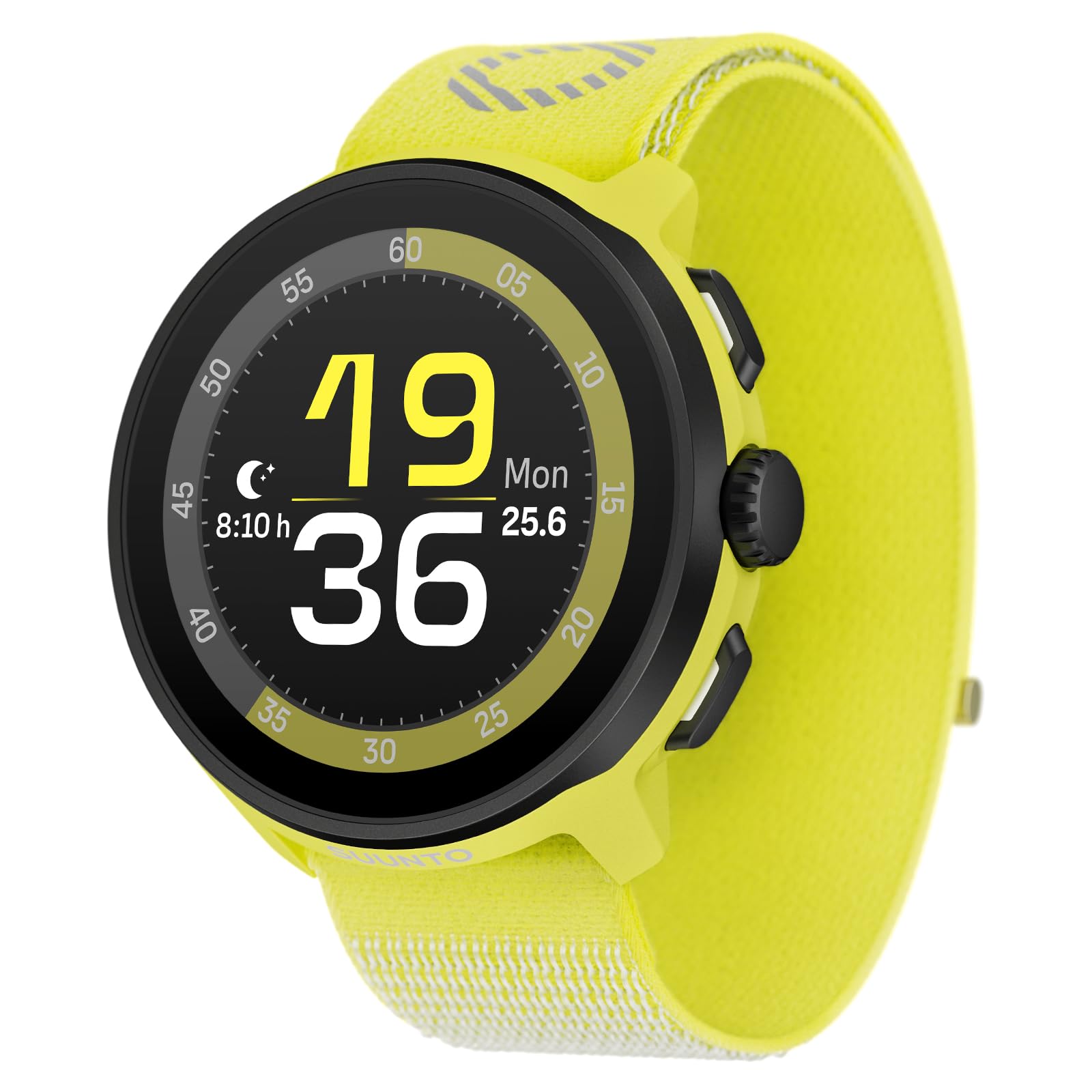
A 36g watch that delivers dual-band GPS accuracy.
At just 36 grams with the textile velcro strap, the SUUNTO Run is the lightest running-focused watch here. You barely notice it during a hard effort. The 1.32-inch AMOLED screen is crisp, and the crown button makes quick menu navigation a breeze even with sweaty gloves. Dual-band GNSS (Global Navigation Satellite System—using two radio frequencies to cancel out building reflections) gives you accurate route tracking whether you are in a city canyon or a tree-covered trail.
Battery life is a solid 12 days for daily use and a respectable 21 hours in high-precision GPS mode—enough for a marathon or a long training weekend without recharging. The dedicated running features are thoughtful: Training Stress Score (TSS, a number that rates how hard a workout was on your body) and post-exercise HR (heart rate) monitoring give you actionable fatigue data without drowning you in charts. Buyers consistently mention the comfortable fabric band and the informative SUUNTO app interface. The downside is that the app lacks advanced weekly training targets and custom plan scheduling, so structured athletes may find the data presentation basic.
The 4GB of offline music storage is a welcome addition for phone-free runs. With 34-plus sport modes covering hiking, cycling, yoga, and boxing, it is not a one-trick pony—it just does running better than anything else at this weight class.
Made for the Road
- Ultralight 36g weight with comfortable textile band
- Dual-band GNSS for precise urban and trail tracking
- 21 hours GPS battery with 1-hour full recharge
- Runs-focused TSS and recovery insights
Needs Better Planning
- App lacks weekly training targets and custom schedule creation
- Some health metrics (sleep, stress) reported as less accurate
Ideal For: Runners who want the lightest possible GPS watch with professional training metrics and long GPS battery life.
Skip If You Need: A deep wellness ecosystem with sleep coaching, stress analytics, and contactless payments.
5. Garmin vívoactive 5

A fashionable smartwatch with solid running and health tracking.
The vívoactive 5 is Garmin’s bridge between a fashionable smartwatch and a capable running tracker. The bright, colorful AMOLED display looks sharp on the wrist, and the silicone band is comfortable for all-day wear—even on small wrists, as owners note it doesn’t roll or slide. It offers up to 11 days of battery in smartwatch mode (5 days with always-on display) and more than 30 built-in GPS sports apps, including detailed running and cycling profiles.
What sets this model apart is its health-first approach. The Body Battery energy monitoring, stress tracking, and sleep coaching give you a comprehensive picture of readiness. The morning report is a nice ritual—HRV (Heart Rate Variability, the variation in time between heartbeats) status, recovery outlook, and weather in one glance. For runners, the data is solid but not as deep as the Forerunner line; you get recovery time and workout benefit labels but lack training load and status. Buyers appreciate the swim-proof build and the comfort for sensitive skin.
The key trade-off: at 11 days of battery (with the Amazfit Active Max offering 25 days), you will charge it more often. And the GPS is reliable but not dual-frequency, so urban canyon tracking is adequate rather than exceptional. Still, for an all-around health and running watch that you never want to take off, this is a strong mid-range value.
Best For: Runners who want Garmin’s health ecosystem (Body Battery, sleep score, HRV) with a stylish, slim smartwatch form factor.
Consider Alternatives If: Your primary focus is pure running analytics or you want GPS battery life beyond a marathon distance.
6. COROS PACE 3 GPS Sport Watch

A minimalist running watch with 38-hour GPS battery life.
The COROS PACE 3 is almost fanatical about being a running watch first. At 30 grams with the nylon band, it is even lighter than the SUUNTO Run (36g), and the 11.7mm ultra-slim profile hugs your wrist without snagging on sleeves. The always-on 1.2-inch transflective touchscreen (a display that reflects ambient light, so it gets brighter in sunlight without using extra battery) is a runner’s dream—it stays readable in direct sunlight without a backlight, and it sips battery so slowly that you get 38 hours of continuous GPS tracking or 24 days of daily use per charge. That is the longest continuous GPS runtime on this list.
Dual-frequency satellite chips keep tracks accurate even in high-rise cities, and the route planner in the COROS app lets you build custom courses and sync them directly to the watch. The breadcrumb navigation means you never lose your way on a new trail. Owners consistently call it the best running watch for any budget, praising the battery life that goes weeks between charges and the no-nonsense interface. The watch turns off under 10% charge—a quirk to watch for on long efforts.
It lacks smartwatch features like music streaming and contactless payments, and the app interface is simpler than Garmin’s. But for a pure running and triathlon companion that can go on back-to-back long runs without a recharge, the PACE 3 is class-leading at this price point.
Built to Run
- Industry-leading 38 hours GPS battery
- Ultra-light 30g weight for zero-distraction wear
- Dual-frequency GNSS for accurate urban tracking
- Transflective screen readable in any light
Spartan Experience
- No music storage, no NFC payments
- App is less polished than Garmin Connect
- Charging connection can be finicky
You Will Love This If: You are a dedicated runner, triathlete, or ultra-runner who values battery life, weight, and GPS accuracy above all else.
Pass If: You want a smartwatch that also makes contactless payments or streams music from your wrist.
7. Garmin Forerunner 165

An affordable Garmin with adaptive training and AMOLED display.
If you want genuine Garmin running analytics without the Forerunner 265 price tag, the 165 is the balance. The colorful AMOLED touchscreen is crisp, and the 43mm case fits most wrists comfortably—owners praise the lightweight feel and the fact it doesn’t interfere during sleep. With up to 11 days of smartwatch battery and 19 hours of GPS mode, it handles a marathon training block without needing a mid-week charge.
The training features are lifted straight from higher-end models: daily suggested workouts that adapt to your recovery, training effect labels (to understand each session’s impact on your aerobic and anaerobic fitness), and recovery time guidance. The morning report gives you HRV (Heart Rate Variability) status, sleep score, and training outlook all at once. GPS connects in seconds—a stark contrast to the Fitbit Charge 6—and the accuracy is well-regarded by owners. Quality is the top praise point with 217 mentions, and 112 owners highlight the battery life which, with settings tune, can stretch to 13 days.
The downside? No training load or training status metrics—the deeper fatigue analysis is reserved for the Forerunner 265. But you still get incident detection and assistance (which can alert emergency contacts if it detects an accident), Garmin Pay for contactless payments, and smart notifications. It also lacks a barometric altimeter for elevation data on trail runs. For road runners and fitness-focused athletes, it is the best-value Garmin for structured training.
Serious Training Tools
- Daily adaptive workout suggestions with recovery insights
- Bright AMOLED display with 19hr GPS battery
- Fast GPS connection and reliable tracking
- Garmin Pay, smart notifications, incident detection
Missing Some Edge
- No training load/status metrics (higher-end models have them)
- No barometric altimeter for elevation gain on trails
Reach For This If: You want Garmin’s best entry-level running watch with adaptive training plans and a gorgeous AMOLED screen.
Look Elsewhere If: You need ultra-running battery life (38hr GPS) or trail-specific features like a barometric altimeter and compass.
Understanding the Specs
GPS Systems and Frequency
A watch that tracks your run uses satellites to pinpoint your location. Multi-system support (GPS + GLONASS + Galileo or BeiDou) means it can lock onto more satellites at once, which helps in dense urban areas or under tree cover. Dual-frequency GNSS (Global Navigation Satellite System) goes a step further—it uses two radio bands to cancel out signal reflections from buildings, giving you precise tracking even in skyscraper canyons. If you run mostly in open parks, single-frequency GPS is fine. For city or trail runners, dual-frequency is a real step up.
Heart Rate Optical Sensors
Most budget watches use an optical sensor that shines a light into your skin to measure blood flow. This is plenty accurate for steady-state runs and daily heart rate. For high-intensity intervals or strength training, the sensor can lag behind a chest strap. Look for a watch that samples HR (heart rate) frequently (every second during activities) to get more responsive data. The sensor itself is fine for most runners—just don’t expect lab-grade precision during a 400-meter repeat.
AMOLED vs Transflective Displays
AMOLED (Active Matrix Organic Light Emitting Diode) screens are vibrant, colorful, and look like a mini smartphone. They are great for maps and watch faces, and they are visible in direct sunlight at high brightness. The trade-off is battery drain—even with always-on mode, you lose a few days of runtime. Transflective displays (like COROS and Garmin Instinct use) are always-on by nature—they reflect ambient light and get more readable in the sun. They use almost no power for the display layer itself, preserving battery for GPS and HR monitoring. For runners who want the brightest readout, AMOLED is the choice. For maximum battery endurance, go transflective.
Training Metrics and Recovery
Advanced running watches give you more than just pace and distance. Training effect (how a workout impacts your aerobic and anaerobic fitness), recovery time (hours needed before your next hard effort), and training load (the cumulative stress of recent workouts) help you avoid overtraining. The Garmin Forerunner 165 and COROS PACE 3 offer a deeper set of these metrics, while the Amazfit Active 2 focuses on basic pace and heart rate tracking. If you are following a structured plan, look for a watch that offers daily suggested workouts and HRV (Heart Rate Variability) status—these are the tools that actually help you improve without getting injured.
FAQ
What battery life do I need for marathon training?
Will a budget running watch work with my iPhone or Android?
Can I use a budget running watch for swimming and showering?
How accurate is the heart rate monitor on budget watches?
Do I need music storage on a running watch?
What is the difference between a fitness tracker and a running watch?
How do I know if the watch will fit my wrist?
Is a budget running watch good enough for race-day tracking?
Final Thoughts: The Verdict
If you want one dependable pick, the top choice among the budget running watch options is the Amazfit Active 2 because it wraps a premium stainless steel design, a bright AMOLED display, and a reliable 10-day battery into a package that costs half of what you’d pay for comparable Garmin models. If you want the longest possible battery life and a massive screen, grab the Amazfit Active Max. And for pure running performance with industry-leading GPS battery life and a featherlight build, the COROS PACE 3 is the one to reach for. The best pick depends on which trade-off—screen quality, battery endurance, or training depth—matters most to your running style.
How We Picked
We do not accept paid placement. Every pick is matched to a real buyer and a real use-case; we do not hands-on test units.
Sources & Methodology
Specifications: manufacturer listings and product documentation. Review insights: verified customer reviews, as of July 2026. Pricing: not shown on this page (it changes often); check the current price via the retailer link.
As an Amazon Associate, FitlyFast earns from qualifying purchases. This does not affect which products we feature.