
Our readers keep the lights on and the weekend projects moving. As an Amazon Associate, I earn from qualifying purchases.
Specs are compiled from manufacturer listings and verified buyer reviews and can change over time — please confirm the key details on the product page before buying.
A check engine light is a gut-punch — you need answers right now, not a hundred-dollar dealer fee just to learn the code. The right cheap scan tool turns that anxiety into a ten-second handshake with your car’s computer, telling you exactly what hurts before you spend a dime on repairs. This guide cuts through the noise to find the actual budget-friendly OBD2 scanners that owners trust, not just the ones that look the part on a shelf.
I’m Rikta — the founder and writer behind FitlyFast. This guide is built by comparing the manufacturers’ published specifications and the patterns across verified customer reviews, so you get each pick’s real strengths and trade-offs instead of marketing spin.
Every tool listed here can pay for itself on the first code it reads, which is why we dug through thousands of owner experiences to find the budget scan tool that actually holds up in a driveway at 8 p.m. on a Sunday.
Our Picks at a Glance


How To Choose The Best Budget Scan Tool
A dirt-cheap code reader that only gives you a five-digit number is less useful than Google. The tools that actually save you money do more: they tell you what that number means, whether your car is ready for an emissions test, and sometimes even if your 12V battery is about to give up. Here are the features that separate the helpers from the duds.
Live Data vs. Bare Codes
The cheapest readers simply spit out a code — a P0301 tells you cylinder 1 misfired, but a tool with live data shows you the misfire count happening in real time. That graphing ability, where you watch sensor voltage wiggle on screen, is the difference between guessing and knowing. For a budget tool, live data is the feature that punches above its price tag.
I/M Readiness — The Smog Test Saver
Before you roll into an emissions station, you need to know if your car’s monitors have run their self-tests since the last code clear. A one-button I/M readiness check is not a luxury; it is the single feature that stops you from failing a smog inspection and paying for a retest. If your pick includes it, you are ready.
Code Definitions on Screen
A tool that shows a plain-English description of a diagnostic trouble code (P0171 becomes “System Too Lean Bank 1”) saves you from grabbing your phone mid-diagnosis. The best budget readers pack a built-in DTC library (an internal database of thousands of trouble codes with their meanings) so you are not stuck squinting at a five-digit number with no context.
Vehicle System Coverage
Standard OBD2 covers only the engine and emissions systems. If you own a car with a flashing airbag light or a wonky ABS (anti-lock braking system) module, you need a tool that reads those deeper systems. Budget scanners typically stop at engine codes, but a few mid-range picks stretch into transmission, SRS (supplemental restraint system — airbags), and ABS diagnostics — worth the step-up if your dashboard has more than one light on.
Quick Comparison
| Model | Best For | Live Data | Screen | System Coverage | Amazon |
|---|---|---|---|---|---|
| Veepeak OBDCheck BLE★ Best Overall | App-Based Power Users | Via app | Phone (BLE) | OBD2 generic | Amazon |
| Autel AL329Handheld Champion | Reliable Handheld Simplicity | Graph + playback | 2.8″ color | OBD2 generic | Amazon |
| Professional V519Code Library King | Built-In Code Library | Graph + playback | Backlit LCD | OBD2 generic | Amazon |
| FIXD | Beginner-First App Experience | Via app | Phone (BLE) | OBD2 generic | Amazon |
| A-Premium AD200 | 50-Point Data Deep Dive | Visual curve | 1.77″ color | OBD2 generic | Amazon |
| VDIAGTOOL VD31 | Battery + Key Fob Tester | 4-in-1 graphing | 2.8″ color | OBD2 generic | Amazon |
| OBDMATE OM901 | Multi-System Diagnostics (ABS/SRS) | Graphing | 3.5″ TFT | ABS, SRS, Engine, TCM | Amazon |
| ANCEL AD310 Pro | 2-in-1 Diagnostics + Battery Test | Via app | 2.4″ + app | OBD2 generic + 12V battery | Amazon |
In‑Depth Reviews
1. Veepeak OBDCheck BLE
The wireless dongle that talks to everything from a Prius to a Bimmer without breaking a sweat.
If you already live inside phone apps — Torque, Car Scanner, BimmerCode, Dr. Prius — this is the adapter that bridges your phone and your engine bay for around the cost of a tank of gas. It uses Bluetooth Low Energy (a power-efficient wireless standard) so the pairing is near-instant, and the crowd favorite; feedback across thousands of owners points to a rock-solid connection once you follow the golden rule: never pair it from the phone’s Bluetooth menu, do that from inside the app itself. Buyers report it works flawlessly with BimmerCode on BMWs before the 2008 model year, and the same hardware handles Fiat diagnostics through AlfaOBD without a hitch.
The honest downside: it is a parasitic device. Leave it plugged into the OBD2 port for three days straight, and it will drain a weak battery dead. That is a real-world caution echoed by several owners, so treat it like a test lead — plug it in, scan, and pull it out. Also, advanced systems like ABS, SRS, and airbag modules are entirely off the table, and manufacturer-specific functions like oil-light resets or injector coding are not supported. This is a pure OBD2 window into the engine brain, and it is excellent at exactly that.
For the buyer who wants maximum flexibility — using one dongle across a BMW, a Mini Cooper, a Toyota, and an EV — the Veepeak is the hands-down winner. It beats the FIXD on app flexibility (you are not locked into a single ecosystem) and beats the Autel AL329 on sheer connectivity breadth, though the Autel is the faster pick if you just want a handheld screen and no phone involved.
BLE reliability
- Pairs instantly with Car Scanner, Torque, OBD Fusion, and brand-specific apps
- Works on most 1996+ US cars, plus hybrids and EVs (app-dependent)
- Mini carrying case included — slides into the glovebox unnoticed
limited code data
- Drains a weak 12V battery if left plugged in for multiple days
- No ABS/SRS/transmission diagnostics at all
- Not compatible with Carly, MHD, or bootmod3 tuning apps
grab it for: A single wireless adapter that talks to every OBD2-compliant car in your driveway and the full universe of third-party apps.
think twice if: You want a standalone screen with no phone — or you regularly leave a scanner plugged in for the whole work week.
2. Autel Autolink AL329
The handheld that reads codes, shows you their exact meaning, and handles smog readiness — all without a phone.
What wins people over here is the sheer day-one utility: the AL329 has a 2.8-inch TFT color screen (220×176 dpi — crisp enough to read live data graphs without squinting), a one-click I/M readiness key that instantly tells you if your car will pass emissions, and it displays the definition of the code right there on the screen. Owners praise its speed — it plugs in, auto-VIN grabs the vehicle info, and you have a fault code plus its plain-English meaning in under 30 seconds. For a DIYer facing a P305F code on an Infiniti, that speed means you can Google the fix before the engine cools down.
It is also grease- and water-resistant, which counts when you are leaning over a grimy engine bay in a drizzle. The 12-month warranty from Autel is a solid confidence signal, and the build feels substantial enough for a small garage to use daily. The main gap: it covers only OBD2 systems — engine and emissions — so an ABS or airbag light stays unread. If that is all you need, this is the fastest path from “what is that light?” to “here is the code and what it means.”
fast diagnosis: The thing that gets the most praise — 45 owners call out its functionality — is that it delivers on the core promise without fluff. No app, no pairing dance, no subscription. Plug it in, read the code, fix the car.
ideal for: Drivers who want a no-phone, plug-and-play experience that shows a code and its meaning in under a minute. The Autel AL329 is the fastest OBD2 reader at its price point.
pass on it if: You need to diagnose ABS, SRS, or transmission faults — this tool stays strictly inside the engine computer.
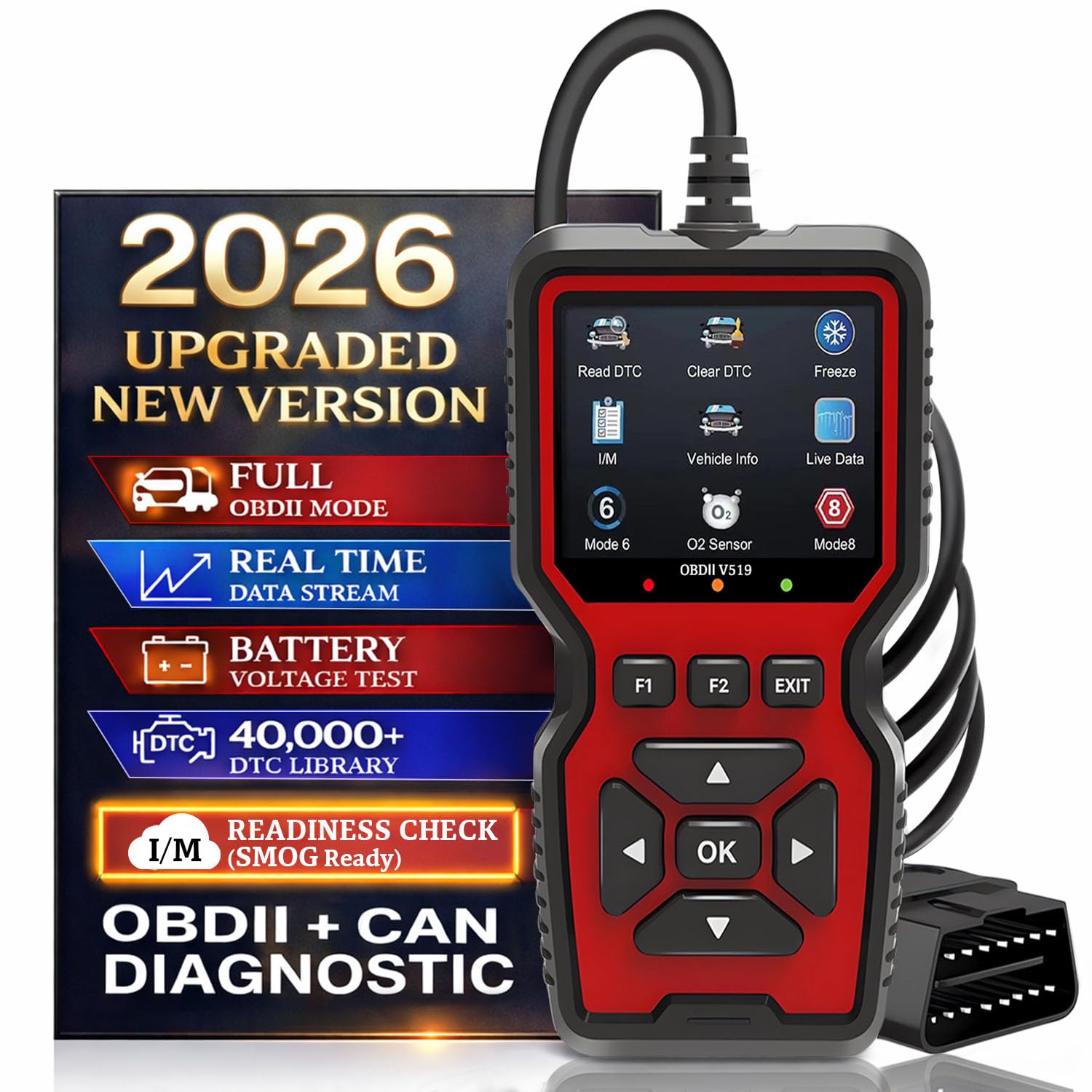
3. Professional OBD2 V519 Scanner
A backlit handheld with a 40,000-code library so you never need internet to know what P0171 means.
This one is for the buyer who wants everything on the tool, not on a phone. The V519 stores over 40,000 diagnostic trouble codes (including all the common P0 and P2 series) in its internal DTC library — an on-board database of trouble codes with plain-English definitions that works even when you are deep in a garage with no cell signal. Live data streaming shows O2 sensor voltages and fuel trims in graph form, and you can capture a freeze frame (a snapshot of what the engine was doing when the fault triggered) to track down intermittent issues like a random misfire.
Owners describe it as “a huge step up” from entry-level readers, with the live data being the standout feature. It also includes battery voltage monitoring that tells you the pre-crank health (detects a weak battery) and the post-start alternator output — a quick check that can catch a dying charging system before you are stranded. The body feels light, but the trade-off is a plug-and-play convenience with lifetime free updates delivered via USB Type-C, a detail that keeps the tool relevant as car protocols evolve. It automatically shuts off the check engine light after you have addressed the code.
reach for it if: You want a standalone handheld with a huge code library, live data graphing, and battery voltage checks — and you do not want to depend on a phone app to interpret codes.
consider another if: You need ABS/SRS diagnostics or feel the lightweight plastic body needs a rugged case for daily shop use.
4. FIXD Bluetooth OBD2 Scanner
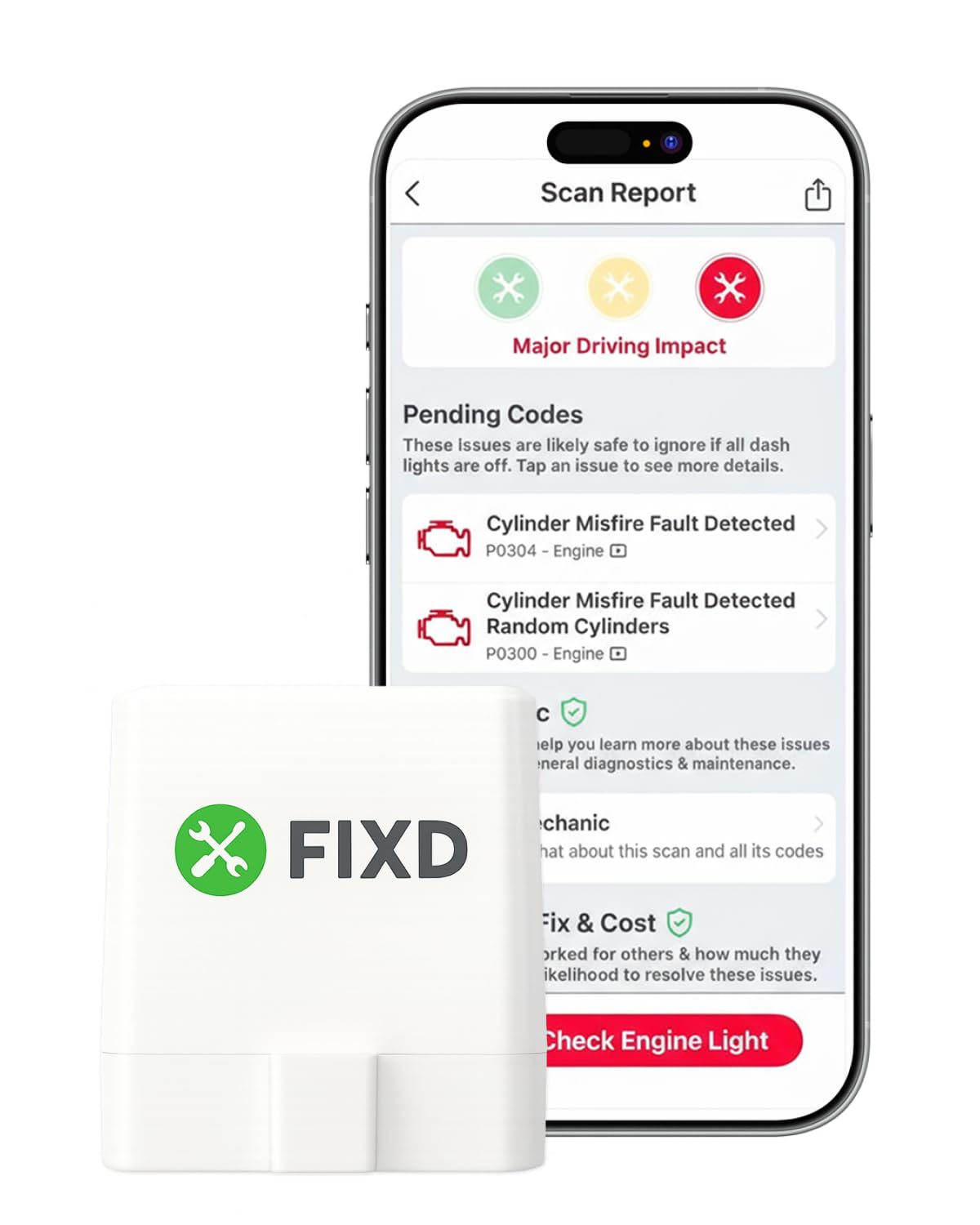
The dongle that turns your phone into a car doctor with plain-English explanations, not cryptic numbers.
FIXD is built for the owner whose eyes glaze over at “P0420” and just wants to know “is this serious and how much will it cost to fix.” The free app identifies up to 39,000 issues across thousands of vehicles and gives you simple descriptions instead of raw codes. It also tracks mileage-based maintenance reminders and keeps a history of every scan across all the cars you register — useful if you manage a family fleet. The hardware itself is tiny: 1.5 x 0.5 x 1.75 inches, weighing about an ounce, so it hides under the dash and stays plugged in.
The catch here is the subscription model. The free app is genuinely useful, but full repair estimates, cost breakdowns, and live mechanic support live behind a /year Premium subscription. Owners note that pending codes sometimes show as “Unknown Issue” and that clearing the dash light does not always work on the basic plan. If you just need a code reader and you mind a monthly bill, look at the Autel AL329 instead — it tells you the code and its meaning with zero subscription. But if you want a polished UI that walks you through the repair, FIXD’s free 14-day trial lets you decide without risk.
best for: First-time car owners who want a hand-held translation service between the check engine light and a repair shop estimate — no mechanical knowledge required.
skip it if: You hate monthly subscriptions or want live data graphing that FIXD does not offer on the free tier.
5. A-Premium AD200 Professional OBD2 Scanner
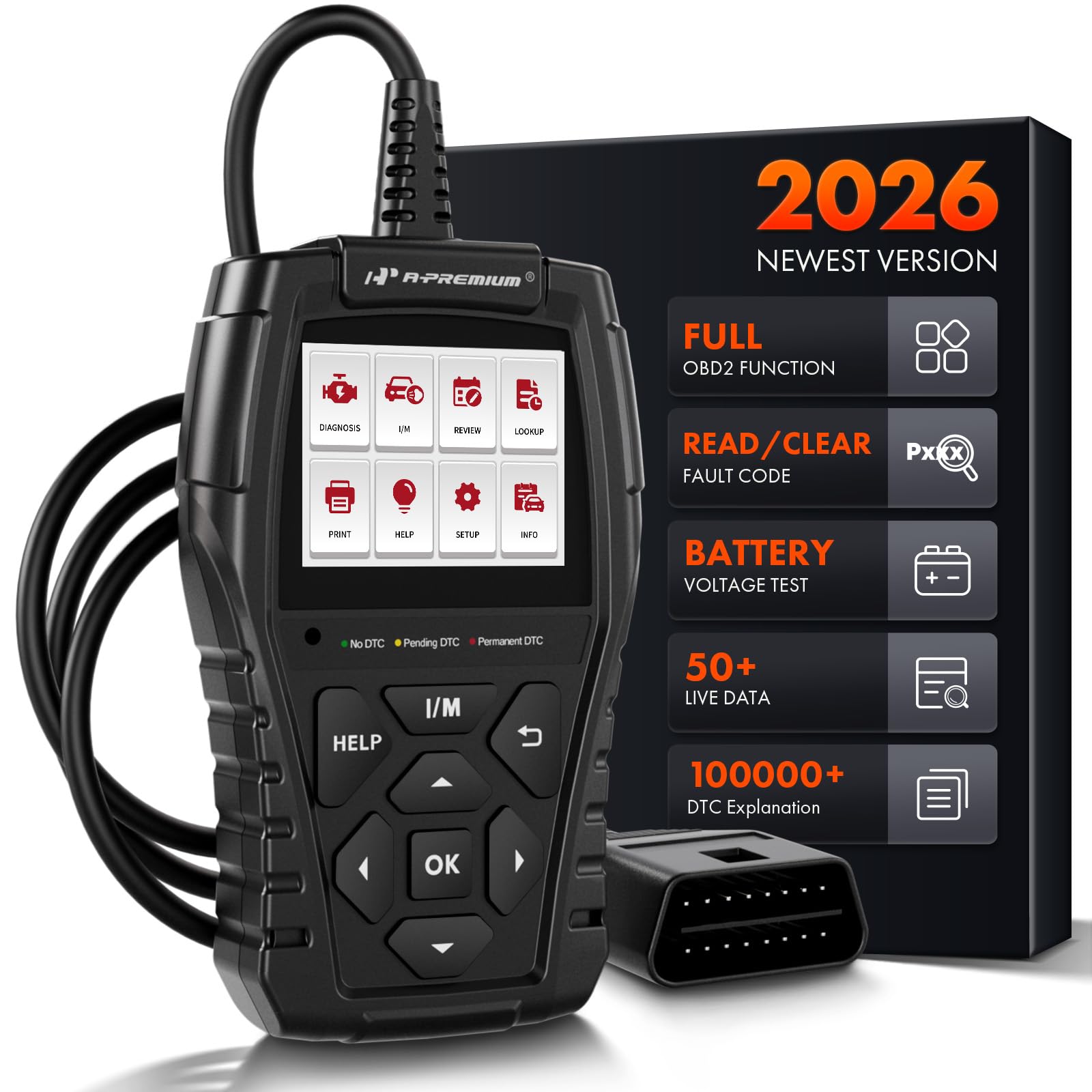
A 50-point data stream reader that turns your engine’s sensor chatter into a visual curve you can actually use.
Where most budget scanners stop at reading and clearing codes, the AD200 pushes further by pulling up to 50 different live data parameters — battery voltage, coolant temp, engine RPM, fuel rail pressure, transmission gear status, air flow rate, oil temp — and presenting them as real-time visual curves. Watching a sensor value jump on the graph is the quickest way to spot an intermittent glitch that a static code read would miss. It also has three warning lights (green for healthy, yellow for minor, red for serious) that summarize the vehicle’s condition at a glance, which new DIYers find reassuring.
Functionality is the thing owners name most — 73 of them call it out — and the feedback consistently lands on how much value it packs for the price. The ARM processor is claimed to be three times as fast as entry-level scanners, which translates to snappy menu navigation. The body is made of strong plastic that survives drops, and the 3.9-foot cable gives you room to read the screen while sitting in the driver’s seat. The downsides: connectivity gets mixed reviews (not every first plug is successful for all vehicles), and a few owners mention the instruction manual could be clearer. It also stays inside OBD2 systems only — no ABS or airbag coverage here.
choose it for: Deep data analysis — if you want 50 live parameters in graph form and a clear health-color readout, the AD200 punches well above its price bracket.
look elsewhere if: You need multi-system coverage (ABS/SRS) or flawless first-time connectivity on every car you plug it into.
6. VDIAGTOOL VD31
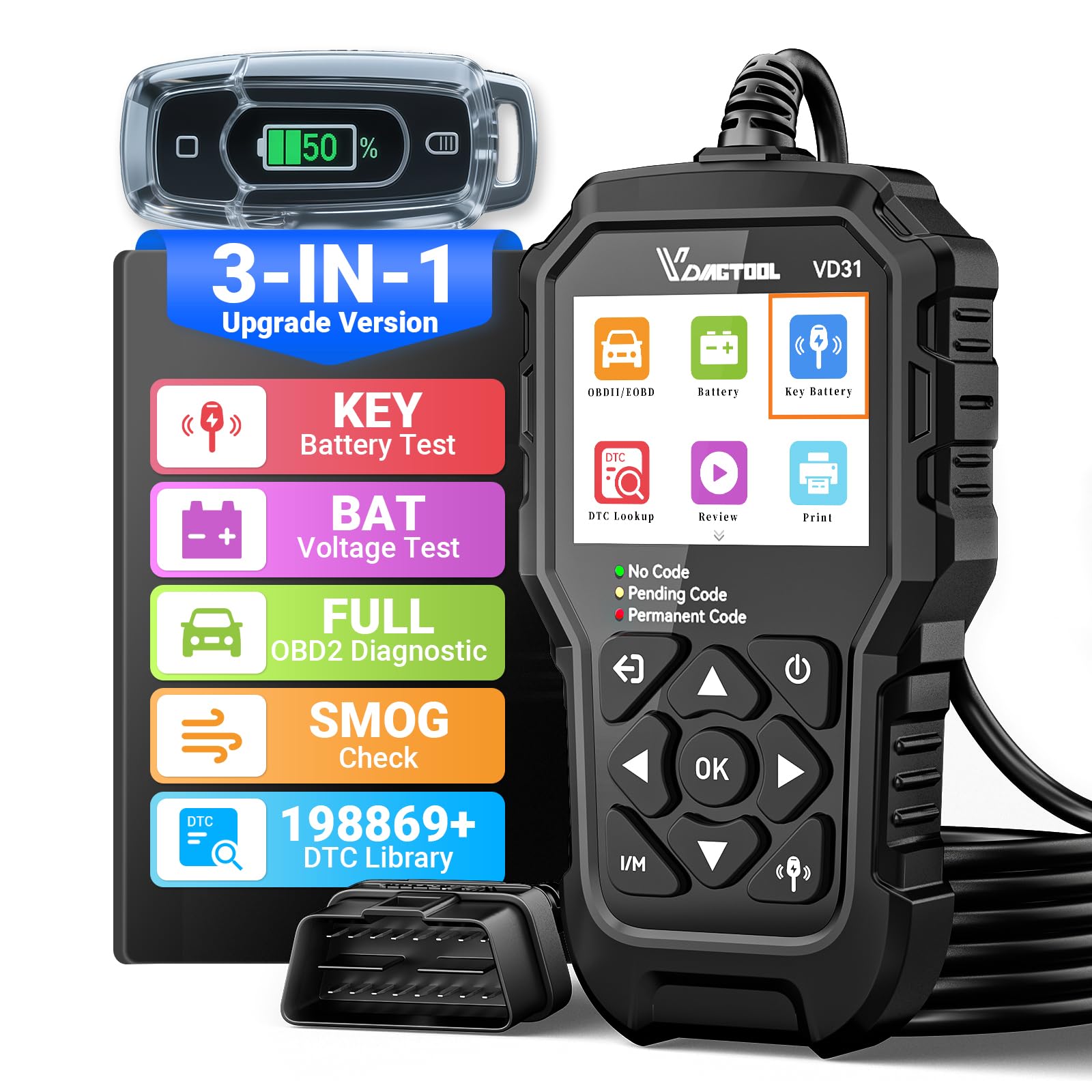
A scanner that also tests your car battery and your key fob battery — three tools in one compact handheld.
The VD31 is the only scanner at this price point that doubles as a dedicated key fob battery tester. You plug a 9V battery (included) into the unit, enter your key’s frequency from the fob casing, and it gives you an instant voltage reading — no more guessing whether the fob is dead or the car’s receiver is broken. Beyond that a neat extra, it performs all ten OBD2 tests, including one-click I/M readiness for smog checks, 4-in-1 live data graphing, and a built-in DTC lookup covering over 198,869 codes. The 2.8-inch display is bright and easy to read, even in direct sunlight.
Functionality and quality are the two most-praised aspects — 33 and 25 owners respectively highlight how well it works for the price. The car battery test checks voltage, cranking power, and charging system output, giving you a full picture of your 12V system’s health. Free lifetime updates come via USB cable to a Windows PC, and the 2-year warranty is longer than most rivals. The catch: it does not support TPMS (tire pressure monitoring system) reset, nor does it diagnose ABS or SRS systems — it is purely an engine, battery, and emissions tool, plus the key fob bonus.
grab it for: The novelty that saves real money — testing your own key fob batteries instead of tossing them. The VD31 is the only budget scanner that does this, plus it is a full OBD2 reader and battery tester.
pass if: You need ABS, SRS, or TPMS diagnostics, or you want an app-based experience instead of a standalone handheld.
7. OBDMATE OM901
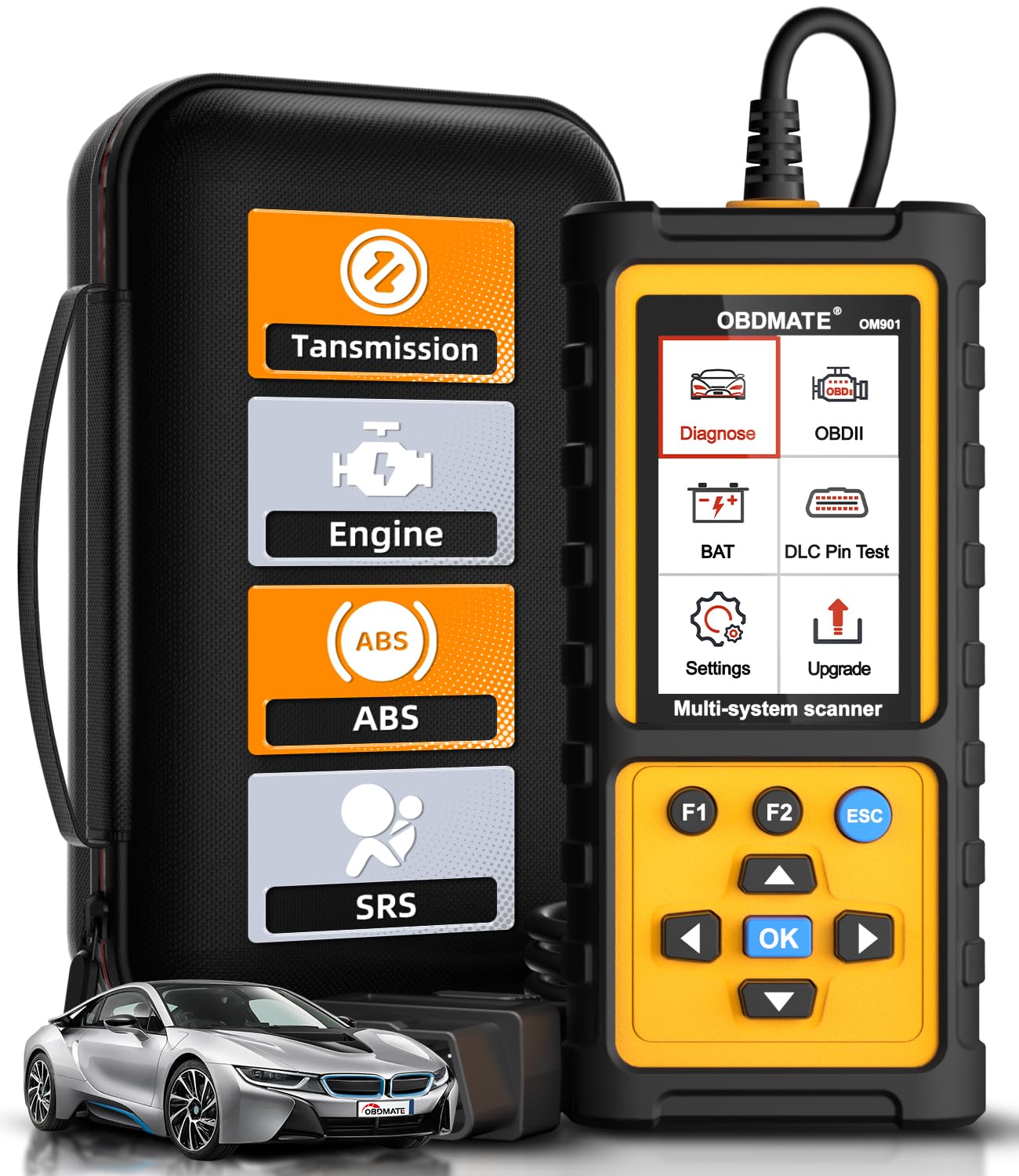
The first budget-friendly scanner that steps outside the engine bay to read ABS, airbags, and transmission codes.
Most budget scanners are window-lickers — they only see the engine computer. The OM901 is the first pick on this list that crosses into ABS (anti-lock brake system), SRS (airbag system), and TCM (transmission control module) diagnostics. If a flashing airbag light or a wonky ABS sensor is your problem, this is the tool that reads those codes and clears them. It also supports the usual OBD2 functions — read/clear codes, live data with graphing, freeze frame, EVAP leak test, and O2 sensor test — plus a DLC pin test that checks the voltage on all 16 pins of the OBD2 connector.
Owners consistently call out its build quality; the 3.5-inch TFT screen (480×320 resolution) is the largest on this list, and the silicone protective case plus hard-shell carrying case make it feel like a professional-grade tool. The one-click I/M readiness key is color-coded so you know at a glance if your car is smog-legal. The user manual gets mixed feedback — some find it sparse — but the device itself is plug-and-play, requiring no batteries or setup beyond plugging it in. Free updates are available for Windows and Macs, with a 3-year warranty backing the purchase.
reach for it if: You are fighting an ABS or airbag light that a standard OBD2 reader cannot touch. The OM901 is the cheapest way into multi-system diagnostics that actually works.
consider another if: You only need engine code reading — the OM901’s extra systems are wasted on a car with no dashboard warnings beyond the check engine light.
8. ANCEL AD310 Pro
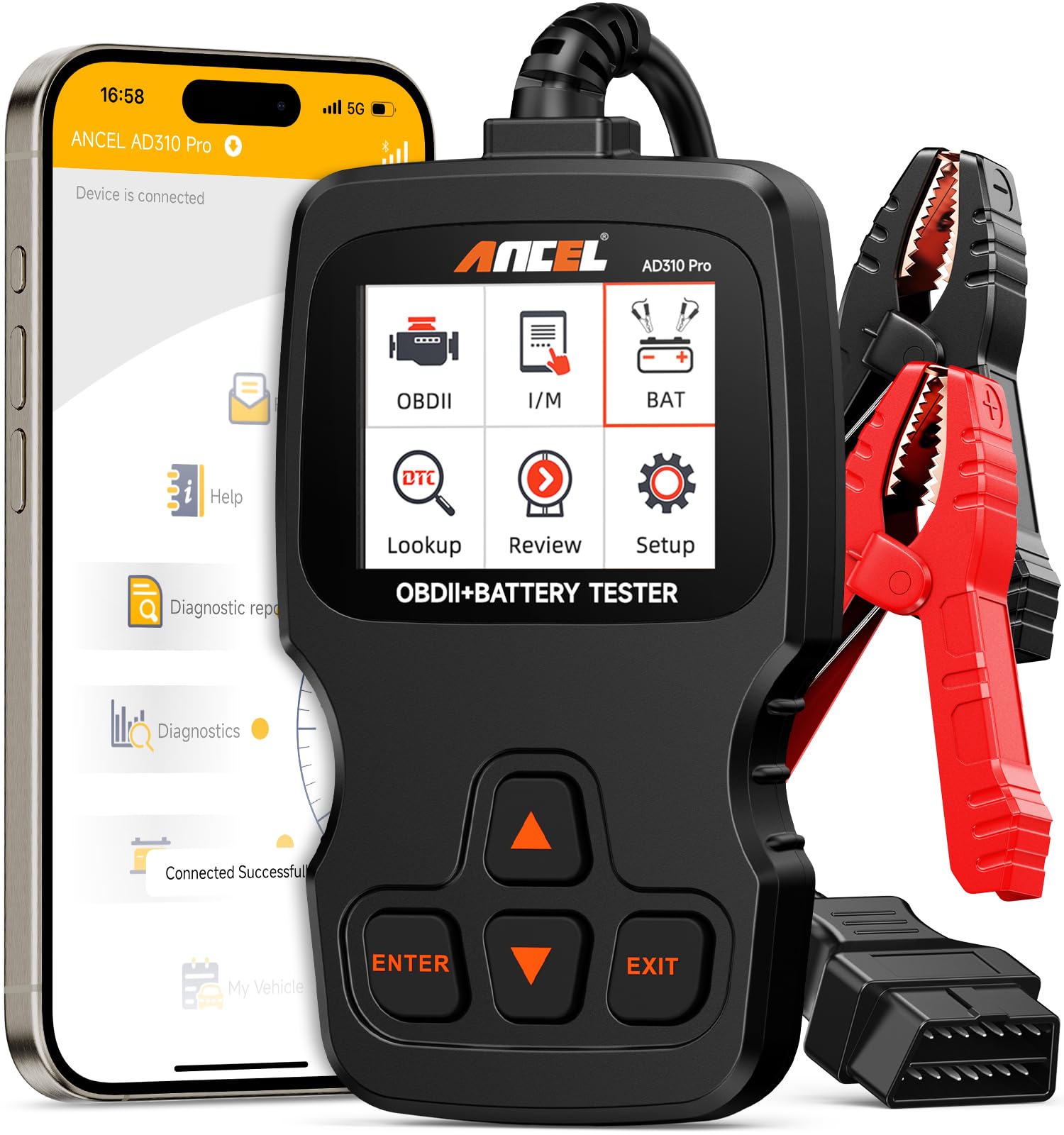
A handheld OBD2 reader plus a full 12V battery load tester in one package, with a Bluetooth app for deeper analysis.
The AD310 Pro splits the difference between a standalone handheld and an app-based dongle. It includes battery clamps for a proper battery health, cranking, and charging system test — so you can diagnose a no-start as either a dead battery or a dying alternator before you buy any parts. On the OBD2 side, it reads and clears engine codes, shows live data and freeze frames, checks I/M readiness, retrieves VIN info, and runs O2 sensor and EVAP tests. The built-in Bluetooth lets you connect wirelessly to a phone app for a real-time dashboard, battery monitoring, and vehicle health insights that go beyond what the 2.4-inch screen alone shows.
The consensus among early owners is that this is an essential tool for the multi-vehicle household: five different cars means five different personalities, and the AD310 Pro handles all of them. The battery testing adds a dimension that most budget scanners skip entirely — knowing whether a cold crank voltage drop is the battery failing or the starter dragging changes the whole repair strategy. The app interface is still maturing, and it only supports 12V systems (no 24V trucks or commercial vehicles), but for a passenger car or light SUV, it is a rare combination of diagnostics and battery analysis at a friendly price.
ideal for: DIYers managing multiple cars who want one tool that diagnoses both the check engine light and the battery health — the AD310 Pro merges two tools into one handheld plus an app.
pass on it if: You never mess with batteries or you absolutely need a standalone tool with no phone dependency — the app is part of the value here.
Understanding the Specs
I/M Readiness — The Smog Gatekeeper
I/M stands for Inspection and Maintenance — it is the emissions monitor status your car reports to a smog station. A tool with a one-click I/M readiness key checks whether all the vehicle’s self-tests have run since you last cleared a code. If they have not, you will fail an emissions test. It is the feature that pays for itself the first time you use it before a smog appointment.
Live Data Streaming
This is the sensor-level view of what is happening inside your engine in real time. Instead of just getting a code that says “fuel mixture too lean,” you watch the oxygen sensor voltage swing from 0.1V to 0.9V on a graph. That moving line lets you spot a lazy sensor or an intermittent misfire that a static code would never catch. Budget tools with live data graphing are genuinely more useful than cheap ones that only flash codes.
DLC Pin Test
The DLC (Data Link Connector) is the 16-pin port under your dashboard. A pin test checks what voltage each pin is carrying — a quick way to rule out a blown fuse, a broken wire, or a dead module before you blame the scanner itself. This shows up on the OM901 and is a pro-level diagnostic habit.
Code Definitions On-Screen
A diagnostic trouble code (DTC) is a five-character alphanumeric string (like P0420). Tools with a built-in DTC library store thousands of these codes with their meanings in the device itself. You do not need internet or a phone to know what “P0420 Catalyst System Efficiency Below Threshold” means — the scanner tells you on its own screen.
FAQ
Will a budget scan tool work on my 2020 car?
Can a cheap code reader clear airbag lights?
What is the difference between a code reader and a scan tool?
How long does it take to read a code with these budget tools?
Can I leave the scanner plugged in all the time?
Do I need an internet connection to use these scanners?
Will a budget scan tool damage my car’s computer?
What does I/M readiness mean for a smog test?
Final Thoughts: The Verdict
For most buyers, the budget scan tool that fits every driveway is the Veepeak OBDCheck BLE because it works across nearly every car and every major third-party app while costing less than a single dealer diagnostic. If you want a standalone handheld with fast code reading and I/M readiness, grab the Autel AL329. And for scanning ABS and airbag lights on top of engine codes, the OBDMATE OM901 is the one to reach for — a rare multi-system tool at a price that still fits the budget bracket.
How We Picked
We do not accept paid placement. Every pick is matched to a real buyer and a real use-case; we do not hands-on test units.
Sources & Methodology
Specifications: manufacturer listings and product documentation. Review insights: verified customer reviews, as of July 2026. Pricing: not shown on this page (it changes often); check the current price via the retailer link.
As an Amazon Associate, FitlyFast earns from qualifying purchases. This does not affect which products we feature.