
Our readers keep the lights on and the weekend projects moving. As an Amazon Associate, I earn from qualifying purchases.
Specs are compiled from manufacturer listings and verified buyer reviews and can change over time — please confirm the key details on the product page before buying.
Budget solar panels no longer require guesswork. Will it actually deliver the wattage it promises, or will you be stuck with a glorified paperweight that barely trickle-charges a phone? Affordable panels now deliver N-Type cells, IP67 waterproofing, and verified 100W output. The key is identifying which budget panels prioritize real-world charging specs over marketing fluff.
I’m Rikta — the founder and writer behind FitlyFast. This guide is built by comparing the manufacturers’ published specifications and the patterns across verified customer reviews, so you get each pick’s real strengths and trade-offs instead of marketing spin.
if you need a rigid panel for a shed roof or a foldable one for a camping trip, the right budget solar panels can still deliver high efficiency, solid build quality, and enough juice to keep your power stations topped off while staying affordable.
Our Picks at a Glance


How To Choose The Best Budget Solar Panels
Choosing a budget solar panel hinges on three critical trade-offs.
Cell Technology: N-Type vs PERC vs Poly
N-Type cell technology is the biggest performance leap in this price range. A panel with 25% efficiency generates noticeably more power on a cloudy day or in hot weather than an older poly or PERC panel of the same wattage. Look for “N-Type” and a high efficiency number (ideally 25%) as the first filter.
Form Factor: Rigid vs Portable Foldable
Your setup dictates the form. Rigid panels with an aluminum frame and tempered glass (like the 100W TÜV Certified panel) are best for permanent installation on a van roof, shed, or cabin. They handle high wind and snow loads but weigh around 12 lbs. Portable foldable panels (like the ZOUPW and HQST) are lighter at 5-9.5 lbs, include kickstands, and are ideal for camping trips or emergency backup where you need to set up and pack down in seconds.
Key Specs Beyond the Wattage Label
The “100W” label can be misleading. Check the amperage capacity in amps (A) — a higher amperage means faster charging for your battery bank. The 5.31A figure on the Renogy N-Type is a strong target. Also check the temperature coefficient; a lower percentage per degree Celsius (e.g., -0.35%/°C) means the panel loses less power on a scorching summer day. Finally, the IP rating (IP67 is excellent for waterproofing) and the included adapter cables matter if you plan to use it with a specific power station like a Jackery or EcoFlow.
Quick Comparison
| Model | Best For | Efficiency | Amperage (A) | Weight | Amazon |
|---|---|---|---|---|---|
| ECOBOSS 100W TÜV★ Best Overall | Best Overall Rigid | 25.8% | 4.79 A | 12 lbs | Amazon |
| ZOUPW 100W PortableBest Portable | Best Portable | 23.5% | 4.96 A | 9.5 lbs | Amazon |
| Renogy 100W N-TypeHigh Amperage | High Amperage | 25% | 5.31 A | 13 lbs | Amazon |
| JJN 200W (2x100W) | Best Value 2-Pack | 23% | 6.42 A | — | Amazon |
| HQST 100W Portable | Ultra-light Portable | up to 25% | — | 5 lbs | Amazon |
| ECO-WORTHY 200W (2x100W) | Budget 2-Pack | High Efficiency | — | 11.5 lbs each | Amazon |
| Callsun 200W (2x100W) | Compact 2-Pack | 25% | — | 23.8 lbs total | Amazon |
| Renogy 200W N-Type | Premium Single Panel | 25% | 6.85 A | 23.4 lbs | Amazon |
In‑Depth Reviews
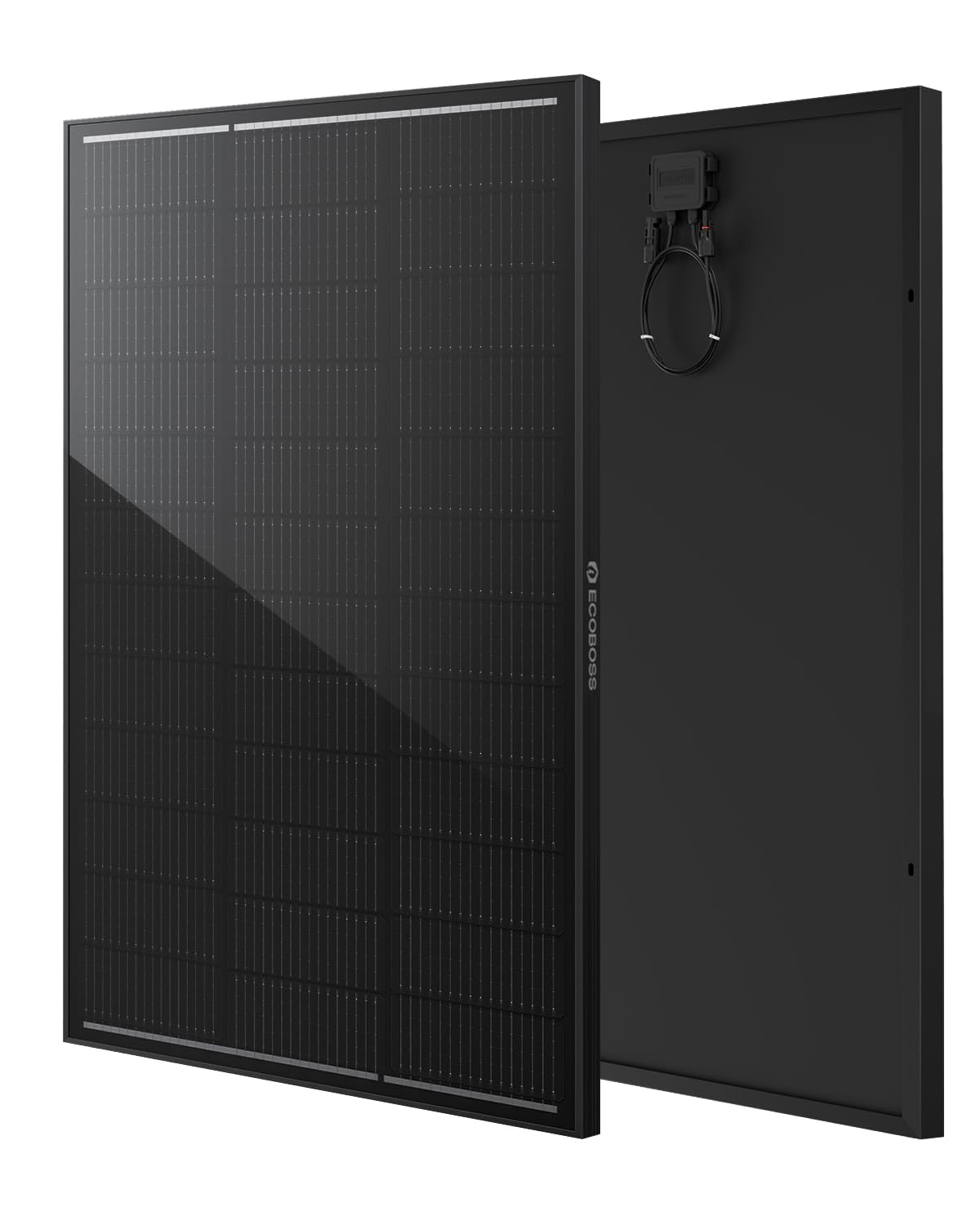
1. ECOBOSS 100W TÜV Certification Solar Panel
The rigid panel that proves its performance specs with independent TÜV safety and durability certifications.
Those certifications cover electrical safety, mechanical strength, and long-term weather durability — the things that matter most when you bolt a panel to your RV roof or cabin. You get a 25.8% efficiency rating from N-Type monocrystalline cells with 16 busbars (thin metal wires that carry current across the cell), which helps the panel hold its power even during mornings and overcast conditions. That extra busbar density captures more sunlight from low-angle winter sun.
Buyers confirm the real-world output matches the sticker. One owner reported pulling “94W early morning, ~100W at solar noon (March 6th, 119°F panel temp)” — a serious sign of life for a rigid panel at this price point. The 12-pound weight is noticeable compared to the portable panels below, but that heft comes from the 3.2mm tempered glass and aluminum frame that can handle 2400Pa wind and 5400Pa snow loads — so the panel survives a heavy storm. The trade-off is weight during installation, but the pre-drilled holes make mounting straightforward.
TÜV Verified Strength
- Highest efficiency on this list at 25.8% from N-Type cells — extracts maximum power from limited roof space.
- Rated for harsh weather with 2400Pa wind and 5400Pa snow loads.
- 1-year manufacturer warranty and IP68 junction box (dust-tight and submersible) for outdoor moisture protection.
Weight & Cable Note
- 12-pound weight is the heaviest 100W panel reviewed here.
- Included cables are on the shorter side, which may require an extension for some roof layouts.
The certified choice: Grab this ECOBOSS if you are installing a permanent 12V system on a camper, shed, or cabin and you want verified quality without a premium price tag. skip it if you need a portable panel for camping trips — this rigid frame is not designed for folding and carrying daily.
2. ZOUPW 100W Portable Solar Panel
The portable panel that packs a 5-in-1 adapter cable, so it plugs straight into Jackery or EcoFlow stations without a separate adapter.
Where the ECOBOSS panel excels on a roof, the ZOUPW shines at a campsite. It folds down to 24.13 x 21.06 x 1.77 inches, weighs 9.5 pounds, and includes a magnetic carry handle that makes setup a matter of seconds — just unfold, pop the kickstands to 45°, and plug in. The 23.5% efficiency from grade A+ monocrystalline cells (a top-quality silicon type) is solid for a portable panel, and the IP67 waterproof ETFE coating (a durable, transparent film) means rain during a trip will not ruin the panel.
What really sets this panel apart is the connectivity. The upgraded 5-in-1 solar cable includes connectors for DC8020, XT60, Anderson, DC7909, and DC5521, covering the Jackery, EcoFlow, Bluetti, and Anker power stations you likely own. One reviewer noted it “works great with Jackery Explorer 300; charged 84% to 100% in ~20 minutes on cloudy day.” That is a real-world assurance that the 4.96A amperage output translates to fast charging. The built-in 3-in-1 charging hub (USB-C at PD 15V/3A and two USB-A with QC3.0) also lets you charge phones or tablets directly without hauling out a generator.
Portability & Connectivity
- Lightest portable reviewed here at 9.5 lbs with a magnetic handle for easy carrying.
- 5-in-1 adapter cable works with 99% of popular power stations — no extra adapters needed.
- Built-in USB-C and USB-A ports for direct device charging without a solar generator.
Minor Adjustability Limits
- The kickstands are fixed at a 45° angle, lacking the fine tilt adjustability of some competitors like the HQST panel which adjusts 40° to 70°.
- USB-C PD port is limited to 45W output despite the 60W label printed on the panel, according to buyer reports.
Reach for this if: You need a foldable panel for camping, overlanding, or emergency backup and you want guaranteed compatibility with your Jackery or EcoFlow station. Look elsewhere if you are installing a fixed rooftop system — a rigid panel will always be lighter per watt in that permanent setup.
3. Renogy 100W Solar Panel N-Type
The rigid panel with the highest amperage (5.31A) in the 100W class, so it charges your 12V battery faster than any other 100W panel reviewed here.
If charging speed is your priority, the Renogy N-Type panel delivers. Its 5.31A amperage rating beats the ECOBOSS (4.79A) by over 10%, which translates directly to more current flowing into your 12V battery bank during each hour of good sunlight. The N-Type cells with 16 busbars hit 25% efficiency, and Renogy backs the panel with a 10-year material warranty and a 25-year performance guarantee at 80% output — the strongest warranty on this list, meaning the panel should still produce at least 80% of its original power after 25 years.
Performance is the most praised aspect among owners, and the build quality gets consistent mention as well. The 13-pound weight is the heaviest of the 100W rigid panels here, but the temperature coefficient of -0.35%/°C (a measure of power loss in heat) is low, so you lose less power on a 95°F summer day than with standard P-Type panels. One owner summed it up: “puts out full wattage. I have several and they all have been working great for a long time.” The 2400Pa wind and 5400Pa snow load ratings match the ECOBOSS panel, so it is equally ready for a van roof or cabin installation.
Charging & Warranty
- Highest amp output (5.31A) on this list — charges 12V batteries faster than any other 100W panel reviewed.
- Industry-leading warranty: 10-year material and workmanship, plus 25-year 80% output guarantee.
- Low degradation rate of ≤1% in the first year and ≤0.4% annually thereafter, so it holds its power over time.
Weight & Price
- At 13 pounds, it is the heaviest rigid 100W panel reviewed here — a pound heavier than the ECOBOSS.
- Power output from a small number of owners was rated mixed, with some expecting slightly higher watts in partial shade.
Grab this if: You want the fastest-possible 12V battery charging from a rigid 100W panel and the long-term warranty coverage that Renogy is known for. pass on it if weight is a concern for your installation — the ECOBOSS panel is a pound lighter and still offers strong efficiency.
4. JJN 200 Watt Solar Panel (2x100W)
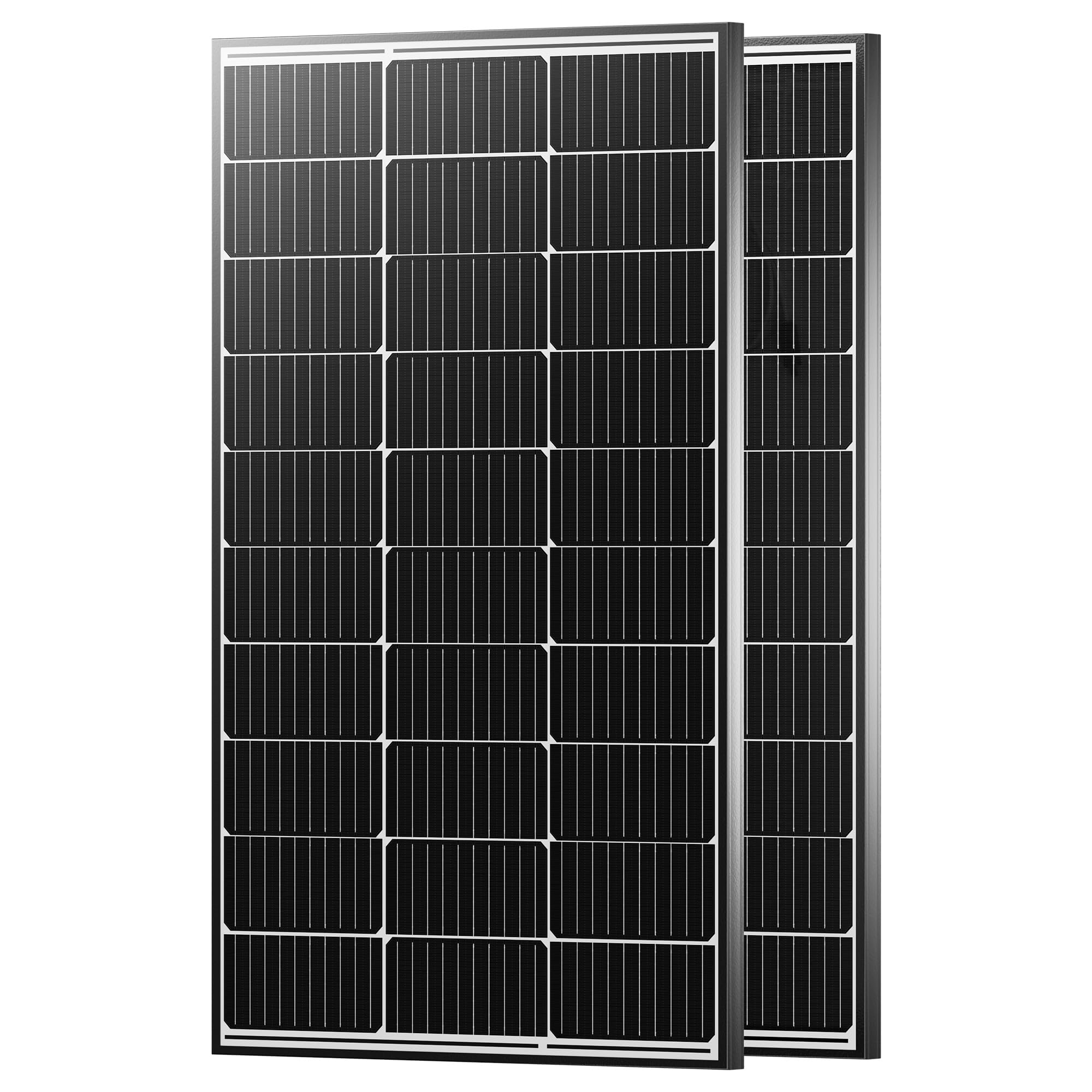
The 2-pack that delivers a combined 200W with a 30-year transferable warranty — the longest coverage on this list.
When you need to cover more roof area, the JJN 2-pack is an outstanding value. The two 100W panels use 10BB monocrystalline cells (10 busbars instead of 16) reaching 23% efficiency. While that is behind the N-Type panels above, the 6.42A combined amperage means this pair will push serious current into your battery bank. Buyers report impressive numbers: four panels on an RV roof output over 848W on good days, and one owner noted the 100W panels deliver “up to 102W on sunny days.”
The 30-year transferable power output warranty is a standout — few budget panels offer this kind of long-term coverage. The panels are CE, ETL, and ISO9001 certified, so the safety and performance claims are backed by recognized testing labs. The trade-off is the 23% efficiency, which is slightly lower than the 25%+ N-Type panels like the ECOBOSS. The rigid 10BB design also means less tolerance for shading compared to the 16BB panels. But for a permanent installation where space is not the tightest constraint, the JJN 2-pack is a reliable workhorse.
Value & Longevity
- Extra-long 30-year transferable power output warranty, easily the best on this list.
- Real-world output matches or exceeds the 100W rating (buyers measured up to 102W).
- CE, ETL, and ISO9001 certifications for safety and performance.
Efficiency & Durability
- 23% efficiency is solid but lags behind the 25%+ N-Type panels like the ECOBOSS.
- 10BB technology is less effective at managing partial shade compared to 16BB panels.
Pick this if: You are outfitting a larger setup (RV roof, cabin, or farm) and want the lowest cost per watt with a 30-year warranty. Consider something else if your installation space is very tight — a 25% efficient N-Type panel will give you more watts per square foot.
5. HQST 100W Portable Solar Panel
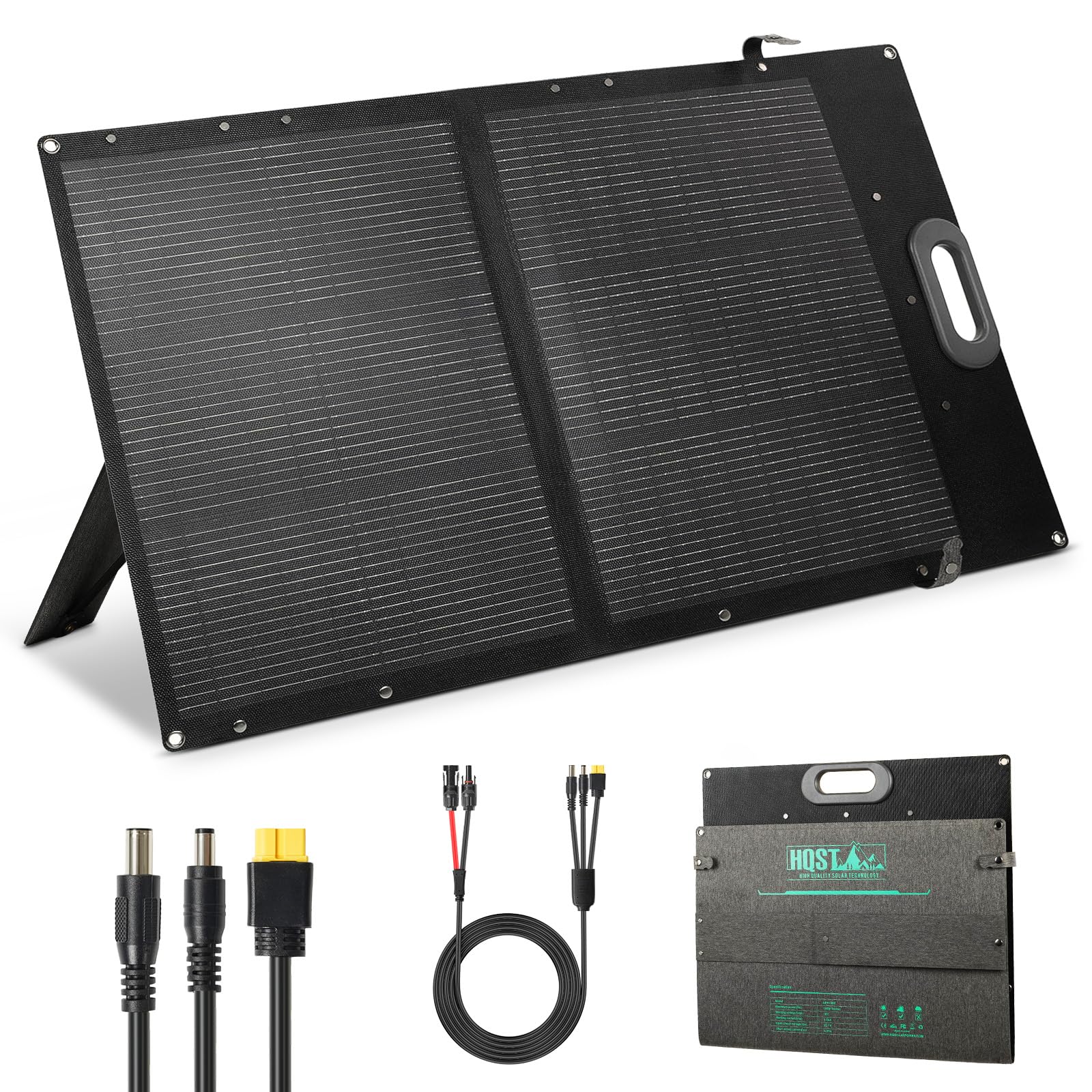
The featherweight panel that weighs only 5.91 pounds — nearly 40% lighter than most portable 100W panels — and folds to just 1.38 inches thick.
The HQST panel solves the biggest pain point of portable solar: weight. At 5.91 pounds, it is nearly 40% lighter than most portable 100W panels and over half the weight of the ECOBOSS rigid panel. The secret is the N-Type cells that hit up to 25% efficiency combined with a PET and PVDF-coated laminated construction (a lightweight, scratch-resistant coating) instead of a heavy glass frame. It folds to just 1.38 inches thick, making it the easiest panel to stash in a trunk or backpack.
Functionality and build quality are the two most praised aspects by far. The adjustable kickstands (40° to 70°) let you angle the panel toward the sun on uneven ground — more adjustability than the ZOUPW’s fixed 45° kickstands. The 3-in-1 adapter cable (XT60, DC7909, DC5521) covers the essentials for Jackery, EcoFlow, and Bluetti power stations. Buyers praise the “super lightweight” design and the “premium” feel of the fabric backing. The trade-off is that it does not include the direct USB hub that the ZOUPW panel offers, and the laminated construction, while lighter, may not be as physically tough against sharp rocks as the glass-fronted rigid panels.
Ultra-light & Packable
- Weighs only 5.91 pounds — lighter than most camping chairs.
- N-Type cells deliver up to 25% efficiency, matching premium rigid panels.
- IP67 waterproof with PVDF coating for scratch resistance.
Cable & Durability
- Does not include a built-in USB hub for direct phone charging — you need a power station in the chain.
- Laminated construction is less resistant to puncture than rigid glass panels.
Best for: Backpackers, hikers, or anyone who carries solar gear on foot and needs the absolute lightest 100W panel that still uses high-efficiency N-Type cells. it’s not for you if you plan to leave the panel on a roof full-time — a rigid, glass-covered panel is more durable for permanent outdoor exposure.
6. ECO-WORTHY 2pcs 100 Watt Solar Panels
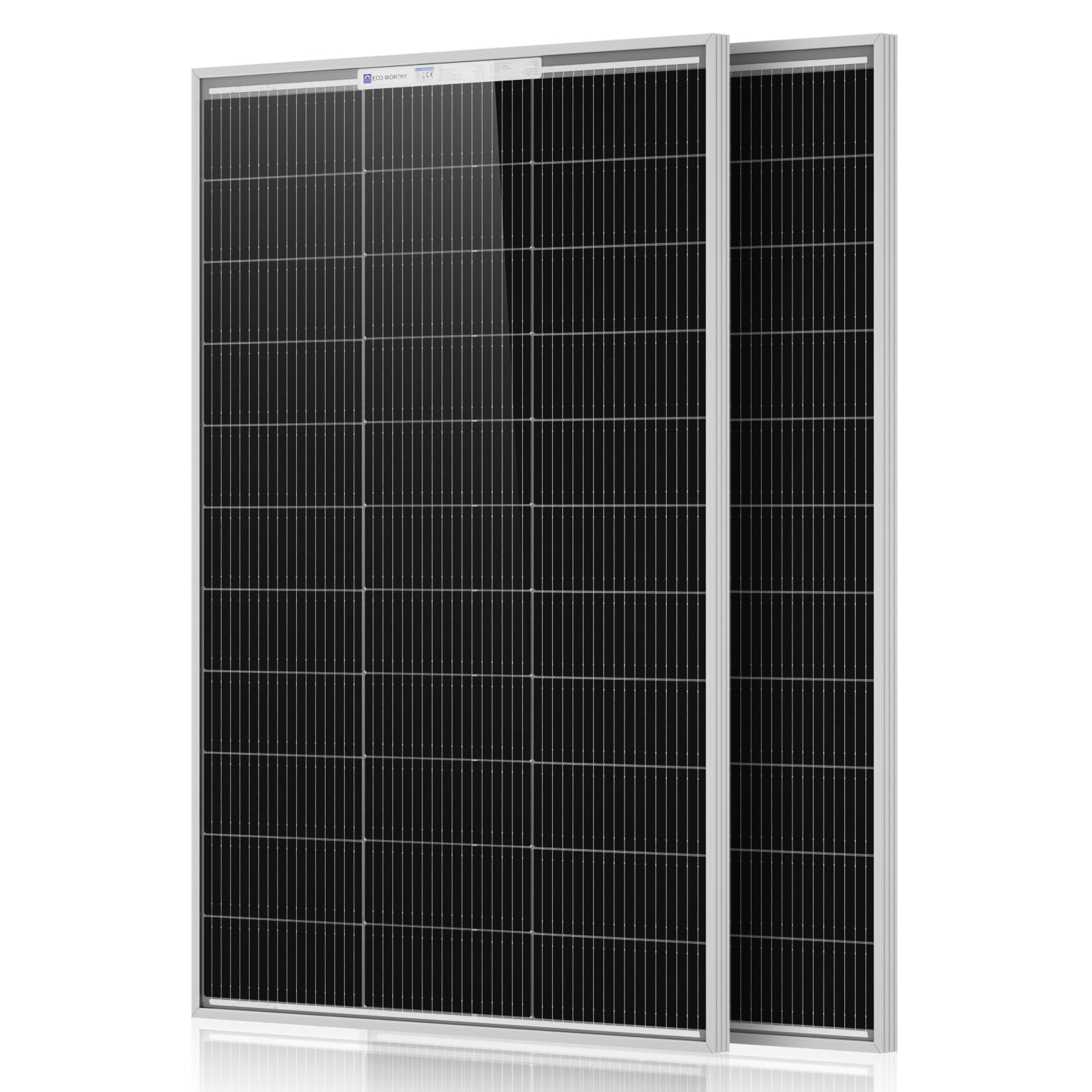
A reliable 2-pack that has proven itself over years of use by a community of budget-minded off-gridders.
The ECO-WORTHY 2-pack is the budget-conscious entry for anyone jumping into a 12V or 24V system. The panels use PERC technology (a light-trapping layer that boosts efficiency) to push efficiency high, though the manufacturer does not publish an exact percentage. The real proof is in the owner consensus: these panels are called “decent cheap panels” where “paying more is unjustified.” Several owners mention using them for 4+ years without failure. The 1.18-inch thick edge aids heat dissipation, and the IP68-rated junction box (the sealed connector box on the back) with bypass diodes helps maintain output when a corner of the panel is shaded.
Each panel weighs 11.5 pounds — competitive for rigid panels — and comes with 35-inch cables and pre-drilled holes for quick mounting. Customers note real-world output of around 95W in winter, which is normal for any 100W panel in low-angle sun. The main caveat is packaging: one owner received a box “full of glass pieces” due to shipper damage, though Amazon handled the replacement quickly. If you are on a budget and need a trusted, simple 2-panel setup, this is the one — it costs less per watt than the JJN 2-pack, but the JJN offers a better warranty.
Proven Value
- Consistent real-world output near 100W per panel, per multiple long-term owner reports.
- IP68 junction box with bypass diodes for good partial-shade performance.
- Lightweight at 11.5 lbs per panel with easy plug-and-play MC4 connectors.
Packaging Risk
- Packaging has been criticized as insufficient; some units arrive with damaged glass.
- Manufacturer does not publish a precise efficiency percentage, making comparisons harder.
Reach for this if: You need a straightforward 2-panel kit for a shed, garden, or small off-grid setup and you want the lowest total cost. Watch for possible shipping damage — inspect the panels as soon as they arrive and contact ECO-WORTHY or Amazon immediately if the glass is cracked.
7. Callsun N-Type 16BB 200 Watt Solar Panel (2x100W)
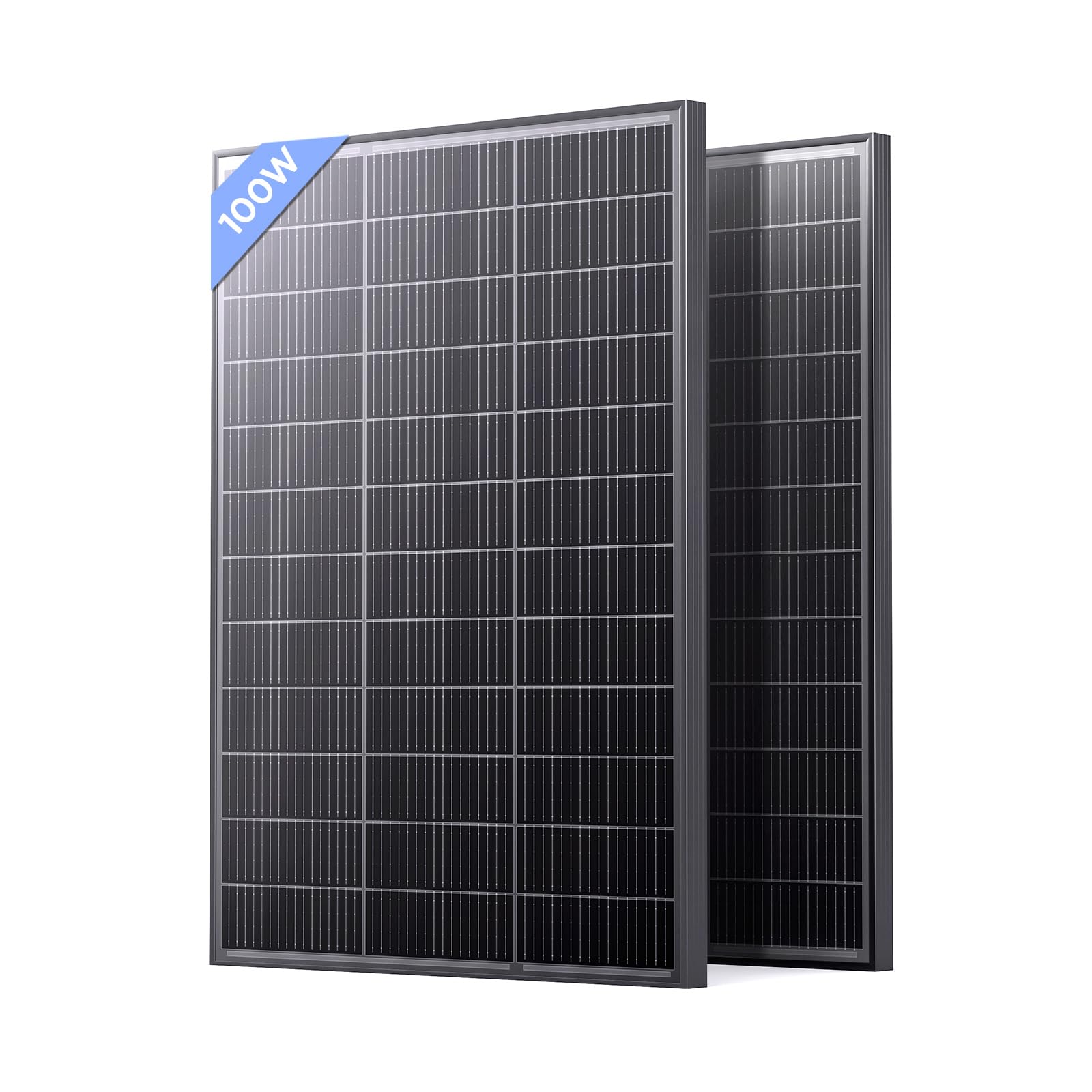
The compact 100W panels that are 15% smaller than traditional ones — built to fit tight van, cargo trailer, and balcony spots.
For anyone building a system in a class B van, cargo trailer, or apartment balcony, the Callsun 2-pack is a perfect size match. Each panel measures 31.1 x 22.7 x 1.1 inches — noticeably shorter than the 35-inch-plus panels — and weighs 11.4 lbs. The N-Type cells with 16 busbars hit 25% efficiency, and the temperature coefficient of -0.3%/°C (the lowest on this list) means it loses less power on a hot roof than the ECOBOSS (-0.35%/°C) or standard panels.
Build quality is the top praised aspect among owners. One buyer called these N-Type panels “the highest quality,” noting they exceed specs by delivering 125% output in full sun and 92-95% in shade. Another reported achieving 227W briefly on a single panel before settling to 208W in mid-July at elevation. The 25-year performance guarantee at 84.5% output and a 10-year materials warranty give it long-term backing. The compact size does mean fewer solar cells per panel, but the 16BB design compensates with better light absorption.
Small Footprint, Big Output
- 15% smaller than traditional 100W panels — essential for tight van or balcony spaces.
- N-Type 16BB cells deliver up to 25% efficiency with excellent low-light performance.
- Strong warranty package: 10-year materials plus 25-year 84.5% output guarantee.
Warehouse Concerns
- Some buyers have reported minor cosmetic damage (dented trim) likely from warehouse handling.
- At 23.8 lbs total for the pair, the 2-pack is still a meaningful weight for a roof install.
Grab these if: Your mounting space is limited and you need the highest possible efficiency per square inch from a budget-friendly 2-pack. Consider other options if you prioritize absolute lowest cost over size — larger panels with 23% efficiency will be cheaper per watt.
8. Renogy Solar Panels 200 Watt N-Type

The single 200W panel that is 7.5% smaller and 11.7% lighter than previous Renogy 200W models — built specifically for class B vans.
The 200W Renogy N-Type panel delivers the highest amperage on this list at 6.85A, making it a powerful single-panel solution for anyone who wants a simple buy-and-install experience without wiring multiple smaller panels in parallel. The 25% efficiency from 16BB N-Type cells is excellent, and the 24V design minimizes current loss over longer cable runs. The 37.44V maximum voltage means it pairs naturally with an MPPT charge controller (a device that tune power from the panel to the battery) — more efficient than a basic PWM controller.
Quality is the most praised aspect, with owners regularly noting that the panel “performs well in shade/clouds” and delivers “near-advertised specs in sun.” One buyer installed it on a shed to power tools and charge an Anker Solix C1000 station, calling it “lighter than some other panels I looked at.” The 23.4-pound weight is a significant lift for one person, but it is lighter than older 200W poly panels. Renogy backs it with a 10-year output and material commitment plus a 25-year 80% output guarantee — the same strong warranty as the Renogy 100W. The only minor head-scratcher is the mixed feedback on solar performance from a very small group of owners, though the vast majority report solid power delivery.
Power & Design
- Highest amperage (6.85A) and total wattage (200W) on this list — perfect for single-panel charging.
- 7.5% smaller and 11.7% lighter than previous Renogy 200W models for better fit on small vans.
- Renogy’s proven long-term warranty and low degradation (.4% per year after year one).
Weight & Value
- At 23.4 pounds, it is still a heavy panel to maneuver during installation without a second person.
- Price is higher per watt than buying a 2-pack of 100W panels from the same brand, like the JJN 2-pack.
Choose this if: You want a single-panel install for a class B van or small cabin and you prefer the simpler wiring of one 200W panel vs. two 100W panels. Think twice if you could fit two separate 100W panels — the 2-pack options above offer similar total wattage for a lower cost.
Understanding the Specs
N-Type Cells & 16BB Busbars
N-Type monocrystalline cells are the current balance for solar panel efficiency. They use a different silicon wafer that degrades slower than P-Type cells and performs much better in high temperatures. The “16BB” refers to the number of thin metal busbars (wires) across the cell surface. More busbars (16 vs 9 or 10) means electricity travels a shorter distance inside the cell, which reduces resistance and micro-cracks. The result is a panel that produces more power in low-light conditions and lasts longer.
Temperature Coefficient
This number tells you how much power the panel loses as the temperature rises above 25°C (77°F). A standard panel might have a coefficient of -0.45%/°C, meaning for every degree above 77°F, you lose nearly half a percent of power. The best budget panels here (Callsun’s -0.3%/°C) lose significantly less power on a 95°F summer day. That difference adds up to real wattage during the hours you need it most.