
Our readers keep the lights on and the weekend projects moving. As an Amazon Associate, I earn from qualifying purchases.
Specs are compiled from manufacturer listings and verified buyer reviews and can change over time — please confirm the key details on the product page before buying.
A budget receiver’s real-world power and input flexibility determine whether your speakers deliver clean audio or frustrating noise. This guide ranks budget amps by sustained RMS power, practical inputs, and reported durability, not marketing specs. You will find picks that drive multi-room speaker setups, connect to your TV via optical cable, and let you plug in a turntable without extra gear.
I’m Rikta — the founder and writer behind FitlyFast. This guide is built by comparing the manufacturers’ published specifications and the patterns across verified customer reviews, so you get each pick’s real strengths and trade-offs instead of marketing spin.
Read on to find the budget stereo receiver that balances real power, useful inputs, and dependability for your home audio setup.
Our Picks at a Glance

How To Choose The Best Budget Stereo Receiver
To pick a budget receiver, you need to match its real power and inputs to the speakers you already own and the devices you want to connect. A receiver that claims massive peak power but lacks the right connections for your TV or turntable will not solve your problem.
Read the Fine Print on Power
Manufacturers often advertise “peak” or “max” wattage, which is a brief burst of power rather than a sustained output. The number that matters for everyday listening is the RMS (Root Mean Square) rating, which reflects continuous power. A unit rated at 600W peak might only deliver 60W per channel continuously, which is still plenty for most bookshelf speakers but good to know before you buy.
Check the Inputs You Actually Need
Look for the specific jacks that match your gear. If you have a modern smart TV, you will want an optical or coaxial input to get digital audio out. If you own a turntable, a dedicated phono input with a built-in preamp is essential, or you will need a separate box. A headphone jack and USB port for MP3 playback are convenient extras that expand how you can use the receiver.
Quick Comparison
| Model | Best For | Power | Channels | Key Inputs | Amazon |
|---|---|---|---|---|---|
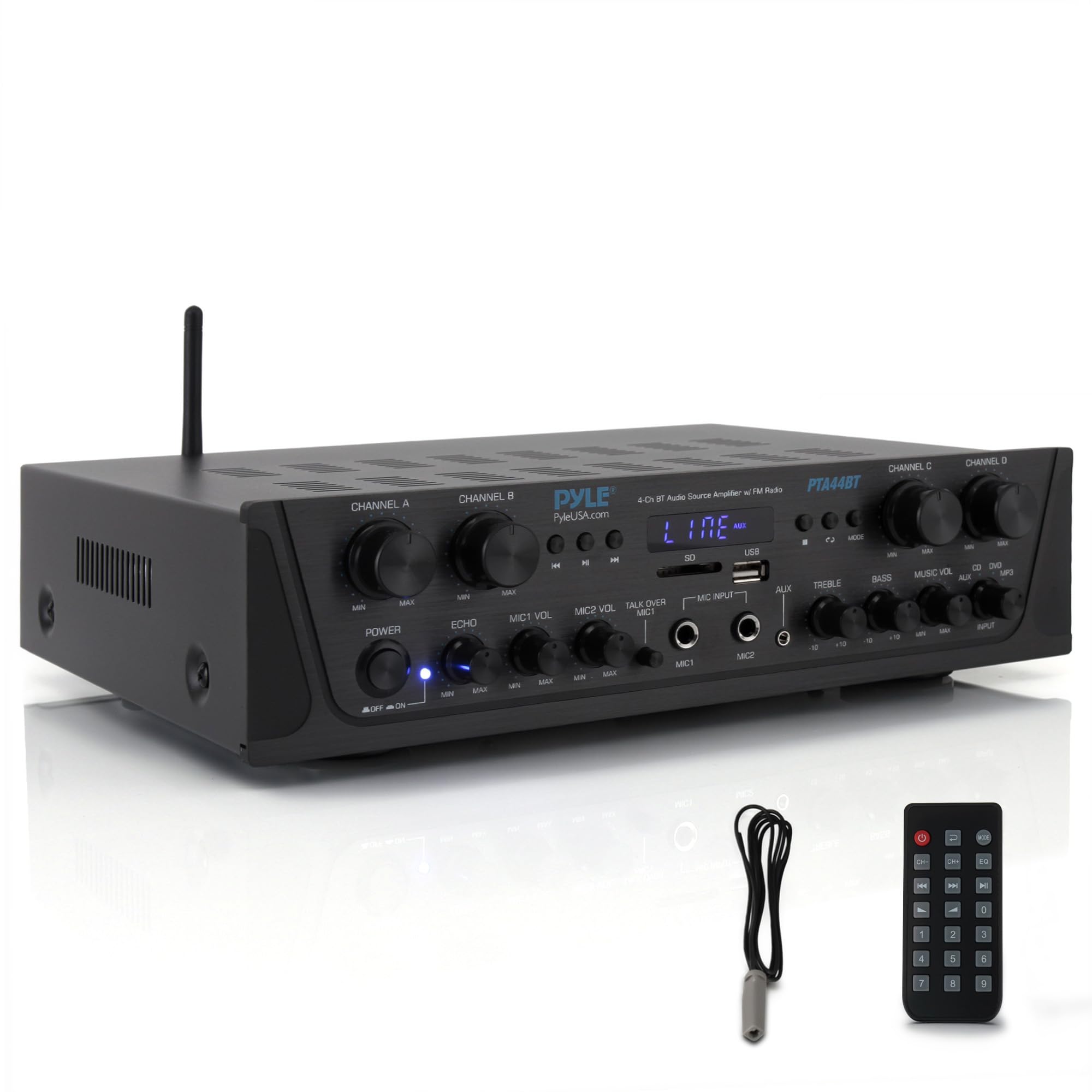
| Pyle 500W 4-Channel★ Best Overall | Karaoke & paging | 500W Peak | 4 | 2 Mic, USB, FM, Sub Out | Amazon |
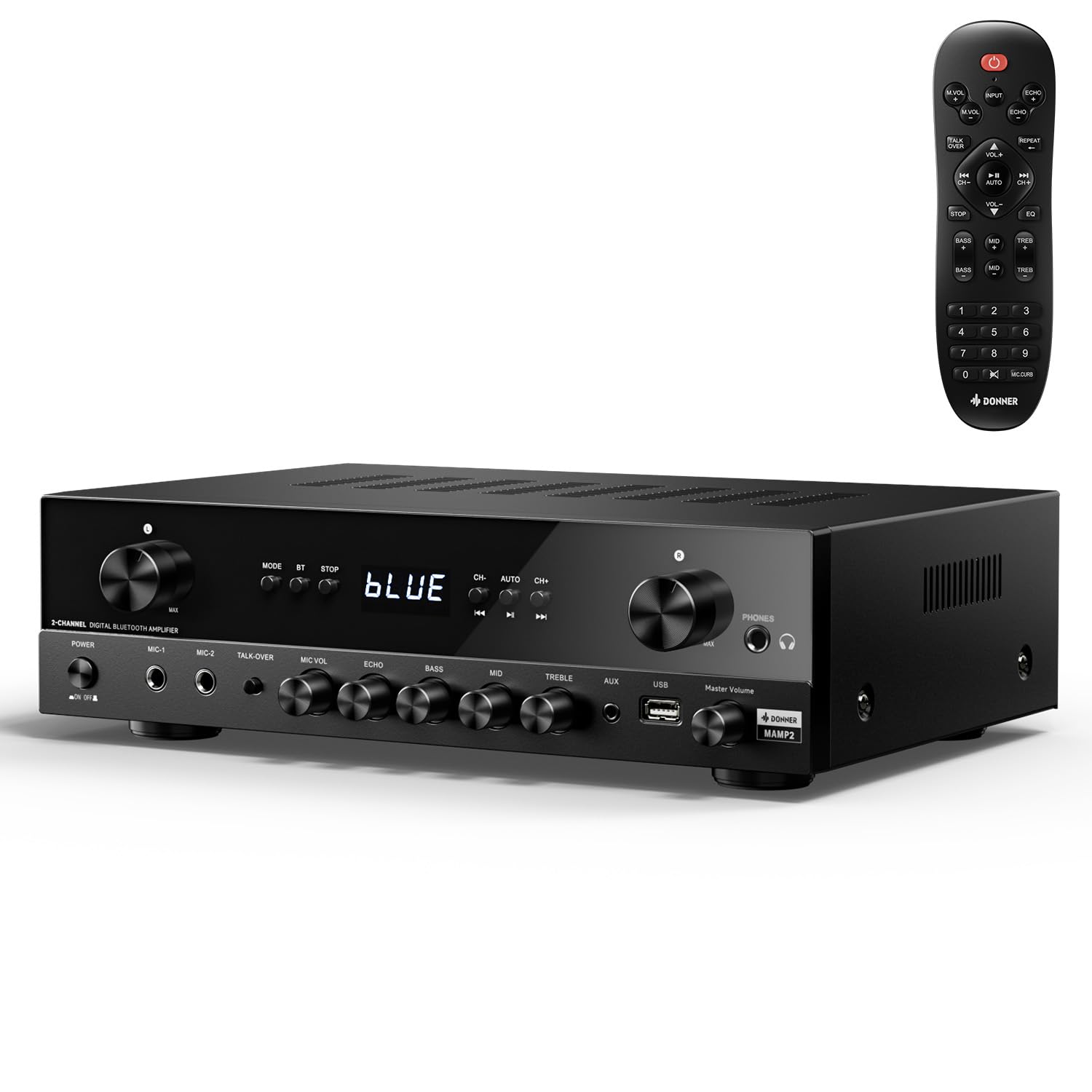
| Donner MAMP2Most Versatile | Vinyl + TV setup | 600W Peak (60W×2 RMS) | 2 | Phono, Optical, Coaxial | Amazon |
| Pyle 600W 6-ChannelZone Control | Whole-home zones | 600W Peak | 6 | USB, SD, AUX, FM, Headphone | Amazon |
| Donner 1000W Premium | TV & karaoke | 1000W Peak | 4 | Optical, Coaxial, Bluetooth 5.3 | Amazon |
| Yamaha R-S202 (Renewed) | Reliable two-speaker stereo | 100W per Channel (8 ohms) | 2 | 4x RCA-in, 1x RCA-out | Amazon |
| Yamaha R-S202BL | Streaming + FM/AM purist | 100W per Channel (8 ohms) | 2 | Bluetooth, 40-station presets | Amazon |
| Sony STRDH190 (Renewed) | Turntable & multi-speaker | 100W x 2 (8 ohms) | 2 | Phono, 4x RCA, 3.5mm, Bluetooth | Amazon |
In‑Depth Reviews
1. Pyle 4-Channel Bluetooth Amplifier
This 500W peak 4-channel amp drives multi-room offices and backyards with seven inputs and dual mic jacks.
This Pyle earns its top spot because it balances a practical 500W peak power with a set of inputs that cover nearly every scenario. You get seven inputs total — including USB, micro SD, AUX, and 2 quarter-inch microphone jacks with echo — so it pulls double duty as a stereo receiver and a small PA system for karaoke or office paging. An included remote lets you adjust bass, treble, mic, and master volume from across the room.
Buyers report that the sound is crisp for the price and that the 4-channel design matches pre-wired whole-home setups perfectly. The real strength owners rave about is the value: it is a genuinely capable unit for a modest outlay. It pairs easily with an iPhone over Bluetooth, and the FM radio is sensitive enough to pull in stations clearly. Be aware that it is not a true stereo separation unit in all modes — some report the outputs blend to mono — so audiophiles chasing a precise soundstage should look elsewhere.
There is a durability caveat worth knowing: a small number of units have failed after about a year of heavy use, with one owner reporting hissing and a blown channel after 1.5 years. The cooling fan stopping was cited as the likely culprit. This is a budget amp, so treat it with respect — keep it ventilated and it should serve well for basic home and commercial use.
Why it wins
- 500W peak power drives multiple 4-8 ohm speakers for a full-room sound.
- Seven different inputs, including a subwoofer output for added bass depth.
- Dual mic inputs with echo make it an instant karaoke machine.
Know the limits
- Not a true stereo separation unit in every mode — outputs can blend to mono.
- Occasional reports of units failing after a year; keep it well ventilated.
The right fit: Homeowners running a multi-room speaker setup with Bluetooth streaming who want an all-in-one unit with mic inputs.
The trade-off: If precise channel separation and long-term durability top your list, a pricier Yamaha or Sony will serve better.
2. Donner Stereo Audio Amplifier
This 600W peak 2-channel amp adds a phono input and optical/coaxial jacks, beating pricier Sony and Yamaha models for value.
The Donner MAMP2 brings a 600W peak output (60W × 2 RMS) and a connection panel that outshines many expensive receivers. It is one of the few budget units with a dedicated phono input for a turntable, plus digital optical and coaxial connections to pull audio straight from a smart TV. Bluetooth 5.3 keeps streaming stable, and dual microphone jacks with Talk Over make it a karaoke-ready living room hub.
Owners mention it drives demanding speakers — including Klipsch KLF-10S towers with a powered subwoofer and two pairs of Jamo S803 speakers — with solid, clean power. The separate left and right volume knobs and individual bass, midrange, and treble controls let you fine-tune the sound without menus. The verdict from owners is that it beats the sound and value of Sony, Denon, Yamaha, and Onkyo models at a higher price, especially for a starter 2-channel system. A toroidal power supply inside is a sign of quality rarely seen at this level.
The main complaint is noise: the internal cooling fan is audible, making this a poor choice for a closed cabinet or a silent listening room. Owners also advise replacing the bundled optical cable, which they describe as cheap. The maker rates the unit for 4-8 ohm speakers, but when running two pairs, stick with 8-ohm speakers because the combined load is lower impedance.
The standout: The phono input plus optical and coaxial connections make this the single most flexible budget receiver for a modern TV and turntable setup.
The honest caveat: The cooling fan noise is the recurring gripe — open shelf placement is a must, and skip it for a dead-quiet listening room.
3. Pyle 6-Channel Stereo Receiver
This 600W peak 6-channel amp offers six independent zones and a headphone jack for whole-home control.
If your home has multiple rooms wired for sound, the 600W peak power of this 6-channel Pyle is what you want to split across zones. Reviewers point out running five pairs of ceiling speakers effectively and setting up 6 independent audio zones plus a master volume. The front panel puts 6 volume knobs plus echo, mic tone, and master control at your fingertips, and a headphone jack lets you monitor quietly.
The Bluetooth range is a highlight — owners confirm roughly 40 feet of wireless reach through walls, which covers most homes and backyards. The unit also reads USB flash drives and SD cards for MP3 and WMA playback, plus RCA and AUX inputs. For a whole-home system on a budget, this delivers what the pricier multi-zone amps do.
The honest trade-offs: the included remote is unreliable, with some buttons working only about half the time, and FM auto-scan can be random. This is a workhorse for commercial and outdoor duty rather than a hi-fi piece — owners describe the sound as adequate and powerful, not refined. If you need flawless remote control or critical listening quality, plan around those gaps.
The big win: Six independent channels with a 40-foot Bluetooth range let you feed a whole home with one affordable box.
The catch: The remote is hit-or-miss and the FM tuner is quirky — budget on using the front panel instead.
4. Donner 1000W Premium Amplifier

This 1000W peak 4-channel amp adds optical/coaxial TV inputs and dual mic jacks for karaoke.
The most powerful Donner here claims a 1000W peak across 4 channels, and it brings the modern connections that Pyle models skip. Digital optical fiber and coaxial inputs let you plug a smart TV straight in for clear digital audio — no HDMI, but the two digital jacks cover most TVs. Bluetooth 5.3 handles wireless streaming, and the dual quarter-inch mic jacks with Talk Over keep the karaoke party going.
Owners praise the easy setup and the ability to adjust treble, midrange, and bass independently from either the unit or the upgraded remote in any input mode. One buyer runs it with an Amazon Dot, a Sony CD player, and FM radio using the dedicated antenna, calling it a fair price with great sound. At 13.7″D x 9.8″W x 3.9″H and 4.12 kg, it stays compact for the power it claims.
There are two real caveats. Some shoppers say the fan noise grows audible at higher volumes, which could distract in a quiet room. And one buyer found it could not drive large floor-standing towers and a subwoofer with satisfying bass, so match it to reasonably efficient bookshelf speakers. The manual also asks you to power down via the on/off button rather than the remote to avoid a humming noise.
Best suited to: TV-centric living rooms with bookshelf speakers where optical connectivity and a karaoke mic both matter.
Not the pick for: Driving power-hungry tower speakers or a silent listening room where the cooling fan will be noticed.
5. Yamaha R-S202 Stereo Receiver (Renewed)

The name-brand entry point with 100W per channel and a speaker selector for two systems.
This is the budget receiver for buyers who want a trusted Japanese brand name and do not need karaoke mics or a million inputs. The renewed Yamaha R-S202 delivers up to 100W per channel into 8 ohms, which powers bookshelf speakers and even restored vintage floor-standers with confident headroom. A speaker selector on the front lets you toggle between two pairs of speakers or play both at once.
Owners describe this as the perfect entry-level receiver with excellent sound and smooth Bluetooth for streaming from a phone. The 40-station FM and AM preset tuner is a genuine pleasure for radio lovers, and the 4 RCA inputs — plus one RCA output — give you plenty of room for a record player, CD player, and a second source. A front-panel quarter-inch headphone jack covers private listening.
Keep the match in mind: it has no subwoofer output, so it is designed for passive speakers only, and it is bulky for a desk at 20″D x 15″W x 8″H. The volume knob requires more turns than you might like, and being a renewed unit, individual quality can vary. For a straightforward stereo with a brand-name badge, this is a strong contender.
The draw: 100W per channel with a speaker selector and excellent FM/AM reception at a price that undercuts new models.
The limit: No subwoofer output and a large footprint mean it pairs best with passive speakers on a cabinet, not a desk.
6. Yamaha R-S202BL Stereo Receiver

The new-in-box Yamaha with a brushed aluminum face that sounds far bigger than its 100W rating.
This is the brand-new version of the R-S202 that owners say sounds like 2,000 watts, not 200. The 100W per channel into 8 ohms drives speakers with authority, and the frequency response stretches from 10Hz to 100kHz for a wide, open sound. The brushed aluminum finish and simple layout give it a premium look that fits both a living room and a garage shelf.
Buyers rave about the FM sensitivity, calling it superb and comparable to high-end receivers, and the Bluetooth streams music easily from any phone. It pairs beautifully with outdoor speakers — one owner runs Polk Atrium 6 speakers poolside with bright treble, decent bass, and no distortion at high volume. The speaker selector for two systems and auto power standby are practical touches, and the remote is intuitive.
There is no subwoofer output here, so plan for passive speakers only, and the treble rolls off above a certain frequency (some note highs start around 6kHz), so cymbal-heavy music may need tone adjustments. It also lacks any digital inputs — no optical or coaxial — so a TV would need a separate converter. For a pure two-channel stereo with FM/AM and Bluetooth, this is tough to top among new units.
The verdict: A clean, powerful 100W-per-channel stereo with superb FM reception and a premium look for the price.
The honest gap: No subwoofer output or digital inputs keeps it firmly in the two-channel analog world.
7. Sony STRDH190 Stereo Receiver (Renewed)

The low-profile Sony with a phono input and 100W per channel made for vinyl and Bluetooth together.
For turntable owners, the Sony STRDH190 is the renewed-value standout. Its dedicated phono input accepts a record player’s signal directly, no extra preamp box needed, and the 100W × 2 output (8 ohms, 1 kHz) drives bookshelf speakers with full, clear sound. Owners pair it with Klipsch RP-6000 towers and report excellent results, and one owner runs it with Koss headphones through the full-size quarter-inch jack.
The design is genuinely thoughtful for a budget unit. Four stereo RCA audio inputs plus a 3.5mm input cover every analog source, and A/B switching lets you connect up to 4 speakers to play all at once or in separate zones. The low-profile cabinet stands just 5.25 inches tall, sliding into a conventional AV cabinet easily, and Bluetooth streams from phones or an Alexa Dot without issue.
Two quirks to know: the auto-wake feature powers the receiver on whenever a paired Bluetooth device like a laptop turns on, which some find annoying, and owners note the bass could be a touch stronger. FM radio includes 30-station presets, and the remote runs on 2AA batteries that are included. As a renewed unit, it arrives looking close to new, with durability still to be proven over time.
The right buyer: Vinyl fans who want a phono input, A/B speaker switching, and Bluetooth in one low-profile, affordable box from a trusted brand.
The compromise: The auto-wake Bluetooth behavior takes getting used to, and bass-heavy listeners may want the tone controls turned up.
Understanding the Specs
Peak vs. RMS Power
Peak wattage is the maximum the amp can deliver in a split-second burst, often shown in big marketing numbers like “800W” or “1000W.” RMS (Root Mean Square) is the continuous power the amp can sustain while playing music, and that is the number that actually drives your speakers. A 600W peak unit might only deliver 60W per channel RMS — plenty for bookshelf speakers, but worth checking if you run large floor-standing towers.
Impedance and Speaker Matching
Impedance, measured in ohms, is the electrical resistance your speakers present to the amplifier. Most budget receivers handle 4-8 ohm speakers, and the lowest number matters — a 4-ohm speaker draws more current than an 8-ohm speaker. Running two pairs of speakers drops the effective impedance, so stick with 8-ohm speakers for two-pair setups unless the maker specifies otherwise, to keep the amp from overheating.
Phono Input vs. Line Input
A phono input has a built-in preamp that boosts a turntable’s weak, equalized signal up to line level. Without one, you need a separate phono preamp box between the record player and the receiver. If your receiver only has AUX or RCA line inputs and no phono jack, factor the cost of that adapter into your budget.
Digital Inputs (Optical and Coaxial)
Optical and coaxial inputs carry digital audio from a TV, game console, or streaming box into the receiver’s built-in digital-to-analog converter. This keeps the signal clean and avoids the hum or noise that analog connections can pick up. Budget receivers without these jacks require a separate converter box to connect a modern TV.
FAQ
How many watts do I need for a stereo receiver?
What is the difference between peak and RMS wattage?
Will this receiver work with my turntable?
Can I connect my smart TV to a budget stereo receiver?
What impedance speakers can I use with these receivers?
Do budget receivers have a subwoofer output?
Can these receivers power outdoor or patio speakers?
What is a Talk Over function on a karaoke receiver?
How long do budget stereo receivers last?
Is a 2-channel receiver enough for a home theater?
Final Thoughts: The Verdict
For most people, the budget stereo receiver winner is the Donner MAMP2 because it packs a phono input, optical and coaxial connections, and Bluetooth 5.3 into one affordable box that owners mention beats pricier big-name amps. If you want a whole-home multi-room setup, grab the Pyle 800W for its stable 30-foot Bluetooth range and 800W peak power. And for turntable fans who prefer a trusted brand, the Sony STRDH190 brings a phono input and A/B speaker switching that is hard to match elsewhere.
How We Picked
We do not accept paid placement. Every pick is matched to a real buyer and a real use-case; we do not hands-on test units.
Sources & Methodology
Specifications: manufacturer listings and product documentation. Review insights: verified customer reviews, as of August 2026. Pricing: not shown on this page (it changes often); check the current price via the retailer link.
As an Amazon Associate, FitlyFast earns from qualifying purchases. This does not affect which products we feature.