
Our readers keep the lights on and the weekend projects moving. As an Amazon Associate, I earn from qualifying purchases.
Specs are compiled from manufacturer listings and verified buyer reviews and can change over time — please confirm the key details on the product page before buying.
You want clear voice sound for streaming, without draining your wallet. The challenge is finding a budget streaming mic that cuts through keyboard clatter, PC fan hum, and background noise — all for a low price. This guide breaks down the real trade-offs: condenser vs dynamic (a microphone’s internal design that affects sensitivity), USB-only vs dual XLR (a professional audio connection that needs a separate mixer), and which extras like RGB lights or shock mounts actually matter for your stream.
I’m Rikta — the founder and writer behind FitlyFast. This guide is built by comparing the manufacturers’ published specifications and the patterns across verified customer reviews, so you get each pick’s real strengths and trade-offs instead of marketing spin.
The trick in this price range is knowing which specs solve your specific problem. After looking at seven popular models, these are the best budget streaming mic options that deliver clear audio without the high price.
Quick Picks
- FIFINE AmpliGame AM8PROT Kit — Best Overall
- FIFINE AmpliTank Tank3 — Studio Feel
- Elgato Wave Neo — Best Value
- Razer Seiren V3 Chroma — Ecosystem Pick
- Razer Seiren V2 X — Mac Friendly
- HyperX SoloCast 2 — Budget Champion
- MAONO PD100X — Entry Level
How To Choose The Best Budget Streaming Mic
Most first-time streamers grab the cheapest condenser mic they see, then fight with background noise for months. Here is what you should actually check before buying.
Condenser vs Dynamic: The Room Matters Most
Condenser microphones (like the HyperX SoloCast 2 or Razer Seiren V2 X) are very sensitive — they pick up your voice clearly from a distance but will also capture keyboard clicks, mouse taps, and your roommate’s TV. Dynamic microphones (like the FIFINE AM8PROT or the Tank3) are less sensitive and naturally reject ambient sound, making them better for untreated rooms or shared spaces. If your room is quiet and treated, a condenser offers more detail. If you stream from a typical bedroom with a mechanical keyboard, a dynamic mic will save you hours of post-processing.
USB vs Dual XLR/USB: Upgrade Path vs Simplicity
USB-only mics (the Elgato Wave Neo, Razer Seiren V3 Chroma) are truly plug-and-play — you plug it in, select it in OBS, and you are live. Dual XLR/USB options (the MAONO PD100X and both FIFINE models) let you start with USB and later upgrade to an XLR audio interface or mixer for higher-quality sound and gain staging. If you plan to stay with a simple setup long-term, save money with USB. If you see yourself buying a mixer or audio interface within a year, pay a little more now for dual connectivity.
The Features That Actually Help a Streamer
Tap-to-mute is practically essential — nobody wants a hot mic during a bathroom break. A headphone jack with zero-delay monitoring lets you hear yourself in real time, so you do not shout over game audio. RGB lighting is cosmetic but helps your setup look professional on camera. A built-in shock mount or pop filter saves desk space and reduces plosive sounds (the “p” and “b” pops) without needing extra gear. Skip features you won’t use: if you never use synced RGB lighting, don’t pay extra for it.
Quick Comparison
| Model | Best For | Connectivity | Polar Pattern | Sample Rate | Amazon |
|---|---|---|---|---|---|
| Razer Seiren V3 Chroma | Razer ecosystem streamers | USB | Supercardioid | — | Amazon |
| FIFINE AM8PROT Kit | All-in-one kit with boom arm | USB, XLR | Cardioid | 48kHz/24bit | Amazon |
| FIFINE Tank3 | Broadcast sound on a budget | USB, XLR | Cardioid | 48kHz/24bit | Amazon |
| Elgato Wave Neo | Mac/iPad simplicity | USB | Cardioid | Up to 96kHz | Amazon |
| Razer Seiren V2 X | Mac dictation & quiet rooms | USB | Supercardioid | — | Amazon |
| HyperX SoloCast 2 | Long-range pickup needs | USB | Cardioid | 24-bit / 96kHz | Amazon |
| MAONO PD100X | Entry-level dual connectivity | USB, XLR | Cardioid | 24-bit/48kHz | Amazon |
In‑Depth Reviews
1. FIFINE AmpliGame AM8PROT Kit
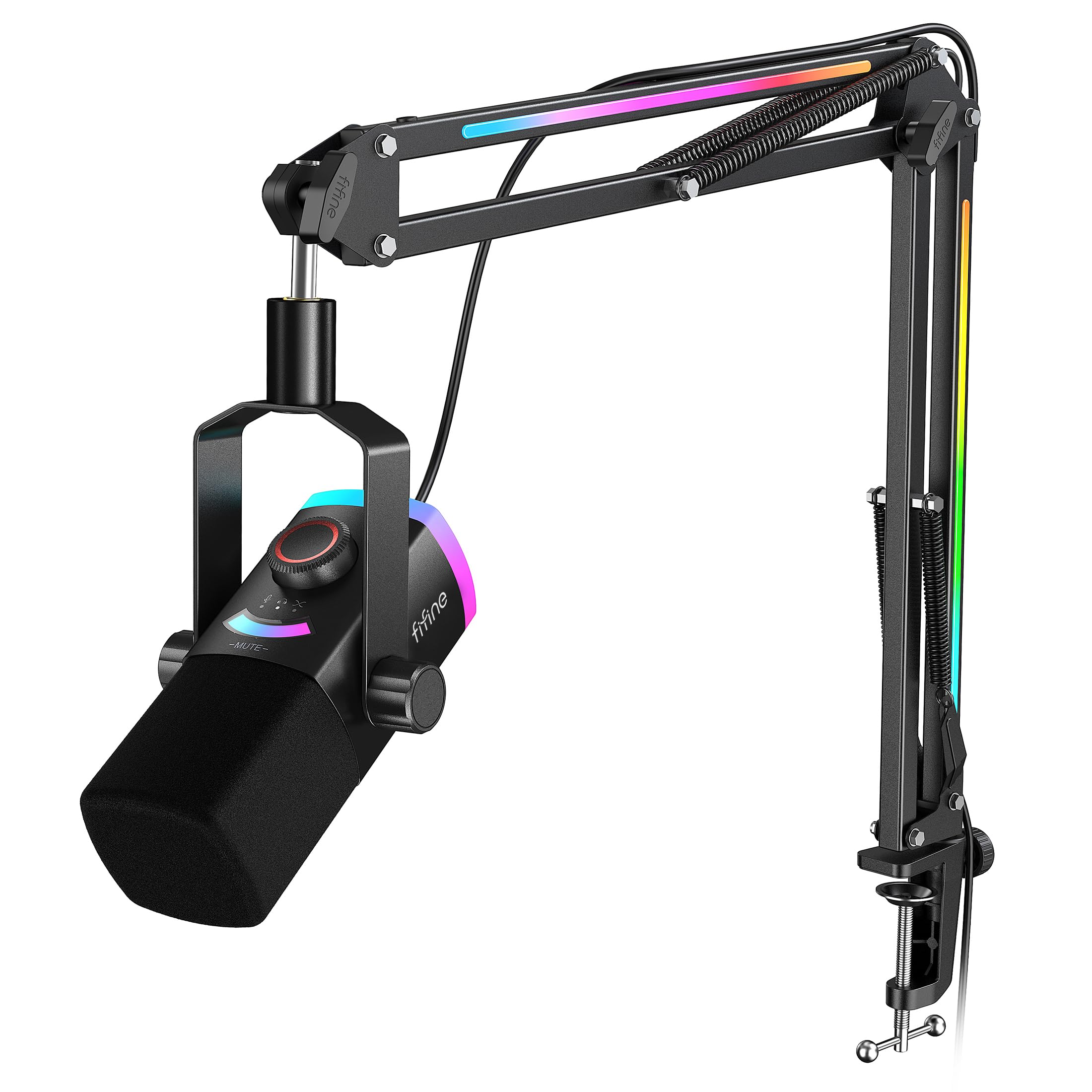
The complete streaming kit that skips the expensive audio interface.
This FIFINE kit includes the dynamic microphone, a thickened boom arm, a foam windscreen, and an 8.2ft USB cable — everything you need to go live. The dynamic mic core with a cardioid pattern and 75dB SNR (signal-to-noise ratio, which measures how much cleaner the audio is compared to background hiss) naturally rejects room noise and interference from multiple devices, so your voice stays clean even with a loud keyboard nearby. You get both USB and XLR connectivity, meaning you can plug straight into a PC today and upgrade to an audio interface or mixer later without buying a new mic.
The RGB system offers over 240 lighting combos that pulse to game soundtracks, and the 3-in-1 knob lets you adjust gain (how loud the mic picks up sound) and headphone volume silently. Unlike the Elgato Wave Neo, this mic includes a full boom arm in the box, saving you a separate purchase. Buyers report the clarity is “top tier” and that the foam cover helps make your voice sound professional right away. The catch is that the RGB and knob functions only work over USB, not XLR — so if you move to an XLR-only setup, you lose the lighting and onboard controls. Buyers who want everything in one box and plan to use USB now with an XLR upgrade later will get the most from this kit. If you need a tiny desktop-only mic with no boom arm or want to go XLR-only immediately with full control, look elsewhere.
What comes in the box
- Dynamic mic with cardioid pattern and 75dB SNR for clean voice capture
- XLR/USB dual connectivity for future upgrade path
- Thickened boom arm and foam windscreen included
- Over 240 RGB lighting combos with beat-syncing modes
The fine print
- RGB and controls only work via USB, not XLR
- Dynamic design requires you to speak close to the mic (2-6 inches)
Grab this kit if: you want everything in one box — mic, boom arm, cables — and you plan to use USB now with the option to switch to XLR later.
Look elsewhere if: you need a tiny desktop-only mic with no boom arm or you plan to go XLR-only immediately and want full control.
2. FIFINE AmpliTank Tank3

A broadcast-sound tank in a metal shell that shrugs off background noise.
This all-metal dynamic microphone weighs 500 grams (about 1.1 pounds) and feels built to last. It uses a cardioid dynamic capsule with a frequency range of 50Hz—16KHz (the range of sound pitches it can pick up), giving your voice a warm, rounded tone that reviewers describe as a “warm broadcast sound.” The internal pop filter handles plosive sounds (the “p” and “b” pops) well, and the shock-absorbing design reduces thumps from desk bumps. Dual XLR/USB connectivity gives you the same upgrade flexibility as the AM8PROT, but the Tank3 focuses purely on audio — no RGB lighting, no gimmicks, just a serious mic for vocal recording, voiceovers, and streaming.
Owners mention that the audio sounds “crisp and rich for streaming” and that the “solid metal build” significantly outperforms cheaper plastic USB mics. Unlike the Razer Seiren V2 X, which integrates best with Mac dictation, the Tank3 works best when you speak 2 to 6 inches from the top — it is designed for a close-mic technique. One honest trade-off is that the headphone preamp is a bit quiet; you may need to boost the volume in Windows or OBS to hear yourself clearly. Also, the arm stand and base stand are not included, so you will need to buy a separate mic stand or boom arm. A buyer who already owns a boom arm and wants a no-frills all-metal mic for voiceovers or podcasts gets the best value here. skip it if you need RGB lighting or a built-in stand in the box.
Broadcast-worthy build: All-metal construction at 500g with dual USB/XLR and a 50Hz—16KHz range that delivers warm, broadcast-style audio that beats plastic USB mics — just plan to add your own stand.
Choose this if: you want a no-frills, all-metal dynamic mic for voiceovers, podcasts, or streaming and you already own a boom arm or stand.
pass on it if: you need RGB lighting, a built-in stand in the box, or you prefer a louder headphone output without extra software tweaks.
3. Elgato Wave Neo

The clean, white minimalist that sounds as good as it looks and works everywhere.
The Wave Neo is a USB condenser mic with a cardioid pattern and a frequency range of 20 Hz – 20 kHz. Where it stands out is the high-rise stand design — a riser extension that lifts the mic 3.9 inches above your desk, bringing it closer to your mouth and naturally reducing keyboard and mouse noise. Customers note that audio quality is “on par with Blue Yeti” and that the capacitive touch mute (with a white/red LED indicator) is silent, so there is no loud click in your stream when you mute. It is fully plug-and-play with laptops, iPads, PS5, and iPhones, and it comes packaged with zero plastic.
Unlike the HyperX SoloCast 2, which picks up sound from up to 30 feet away (and all the background noise with it), the Wave Neo’s design focuses on close-range vocal clarity with better room echo rejection. One buyer found that the audio at 96,000 Hz is excellent but significantly worse at 48,000 Hz, and it required some software tweaking to get the higher sample rate working. The cardioid pattern is the only option — there is no omnidirectional or figure-8 mode, so it works best for single-person streaming rather than interviews or duets. This is the mic for someone who wants a sleek, minimalist condenser that works across desktop and mobile devices with silent mute controls. Consider another option if you need a multi-pattern mic for interviews or a dynamic mic for heavy noise rejection.
Why it stands out
- High-rise stand (3.9 inch riser) reduces desk noise pickup
- Capacitive touch mute with silent operation and LED feedback
- True plug-and-play with Mac, iPad, PS5, and iPhone
- Zero-plastic packaging if you prefer sustainable products
One catch
- Cardioid pattern only — not suitable for multi-person recording
- Best 96kHz audio requires specific software setup
Reach for this mic if: you want a sleek, minimalist condenser that works smoothly across your desktop and mobile devices and you appreciate silent mute controls.
Consider another option if: you need a multi-pattern mic for interviews or you want a dynamic mic for heavy background noise rejection.
4. Razer Seiren V3 Chroma

The stream-and-game reactive lighting mic that doubles down on Razer’s ecosystem magic.
This USB condenser mic uses a supercardioid pickup pattern, which is tighter than standard cardioid — it captures your voice from the front while suppressing typing and mouse clicks from the sides and rear more aggressively. The defining feature here is the Chroma RGB lighting that reacts to in-game events (compatible with Chroma-integrated games) and stream events like emotes and alerts. The tap-to-mute sensor on top also accepts double and triple tap commands, letting you adjust lighting or toggle the digital gain limiter without reaching for software.
Compared to the Razer Seiren V2 X (which has a supercardioid pattern too but no RGB), the V3 Chroma adds the lighting and a more responsive mute sensor. Reviewers praise the “excellent vocal clarity” and note that the all-metal build feels more durable than the plastic-bodied HyperX SoloCast 2. One buyer found that the mic performs best when paired with Nvidia Broadcast AI noise cancellation or OBS filters for the warmest sound. The USB Type-A connection means it works instantly with Discord, OBS Studio, and XSplit — no drivers needed — though full RGB customization requires the Razer Synapse software. Buy this one if you already use Razer products and want synced RGB lighting that reacts to your game audio and stream alerts. Stick with the V2 X if you do not care about RGB and just want the supercardioid pattern for less money.
Ecosystem-forward design: Supercardioid pattern, game-reactive Chroma lighting, and an all-metal build make this the best pick for Razer fans who want their stream setup to match their keyboard and mouse — just be ready to tweak the EQ in software for that warm podcast tone.
Buy this one if: you already use Razer products and want synced RGB lighting that reacts to your game audio and stream alerts.
Stick with the V2 X if: you do not care about RGB and just want the supercardioid pattern with a lower price tag.
5. Razer Seiren V2 X

A supercardioid condenser that picks up whispers from across the desk but ignores the room.
The Seiren V2 X features a 25mm condenser capsule paired with a supercardioid pickup pattern — essentially a more focused version of a cardioid mic that suppresses noise from the back and sides better. The audible noise rating (the hiss the mic’s own electronics make) is 78 decibels, which is slightly quieter than the HyperX SoloCast 2 at 79 decibels. A built-in shock absorber dampens accidental knocks, and the integrated digital limiter prevents clipping and peaking during loud moments. The front-facing gain control and mute button give you quick access without hunting around the mic body.
Reviewers point out that this mic “integrates perfectly with Mac dictation” and “picks up whispers from 18 inches,” making it a strong choice for voice typing or podcasting at a distance. Unlike the FIFINE AM8PROT, which naturally suppresses noise through its dynamic design, the Seiren V2 X is a condenser — it is more sensitive, so in a quiet, treated room it delivers more vocal detail. One reviewer noted the USB-C connection and longer, thicker cable over the previous version. The free-spinning gain knob was mentioned as a minor frustration, and the plastic enclosure feels less premium compared to the all-metal Razer Seiren V3 Chroma. This mic works well if you stream from a quiet room and want a plug-and-play USB-C condenser that captures vocal detail without picking up mouse clicks from the sides. Look at a dynamic mic if your room has significant background noise that a supercardioid pattern cannot fully block.
Excellent for quiet-room detail: The 25mm supercardioid condenser + digital limiter combo captures voice detail at higher frequencies while suppressing side noise — ideal for Mac dictation and quiet streaming setups, but less forgiving in noisy rooms than a dynamic mic.
Perfect if: you stream from a quiet room and want a plug-and-play USB-C condenser that captures vocal detail without picking up mouse clicks from the sides.
Look at a dynamic mic if: your room has significant background noise (fans, traffic, kids) that a supercardioid pattern cannot fully block.
6. HyperX SoloCast 2
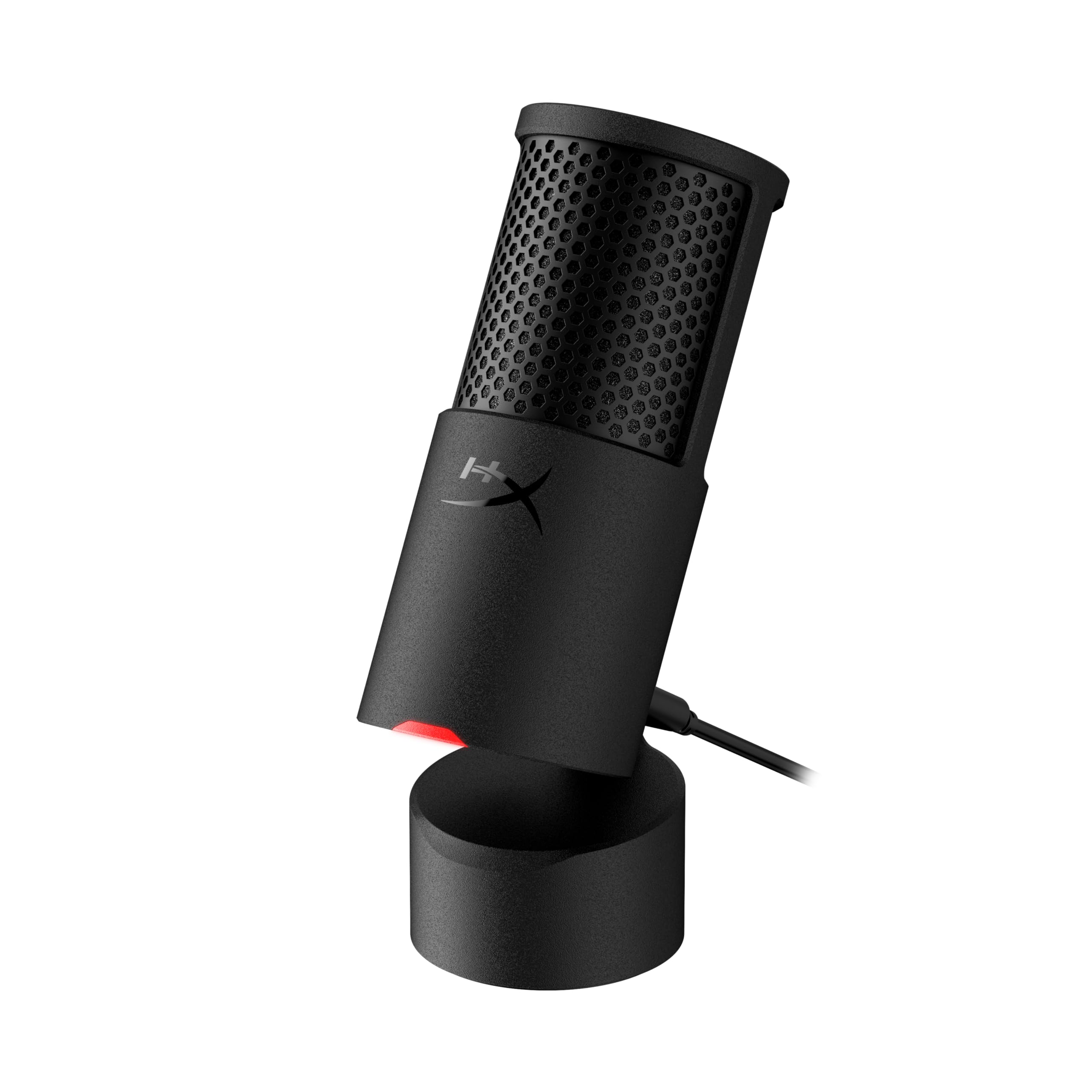
Studio-quality 24-bit/96kHz audio in a compact package that picks up everything within 30 feet.
The SoloCast 2 is a USB condenser microphone with a cardioid polar pattern and a 24-bit bit depth with a 96kHz sampling rate — one of the highest sample rates at this price point. It features a built-in pop filter and an internal shock mount, so you do not need to buy accessories. The tap-to-mute function has a red LED indicator (red when live, off when muted), and the compact, tiltable stand has both 3/8″ and 5/8″ threads for mounting to a boom arm. Shoppers say “excellent sound at distance (up to 30 ft)” but also note it is “very sensitive to all background noise.”
Compared to the Razer Seiren V2 X (78 decibels audible noise), the SoloCast 2’s audible noise is 79 decibels — a 1% difference that most listeners would not notice. Where this mic shines is the raw audio resolution: the 24-bit/96kHz capture is higher than the MAONO PD100X’s 24-bit/48kHz. However, the sensitivity that gives it great range also means it picks up every keyboard click and fan hum — reviewers specifically warn that it “needs noise suppression for shared spaces.” The USB-C port on the lower back was noted as not being very secure, with one reviewer mentioning it may disconnect with movement. Choose the SoloCast 2 if you want the highest audio resolution in this price range and you stream from a quiet, treated room where background noise is not an issue. it’s not for you if you stream from a noisy room or share a space.
Why the high resolution matters
- 24-bit/96kHz sampling rate for clean, high-resolution audio capture
- Built-in pop filter and shock mount save you accessory costs
- Impressive 30-foot pickup range for flexible positioning
- Tap-to-mute with clear red LED indicator
The sensitivity trade-off
- Picks up all background noise — not ideal for shared spaces without noise suppression software
- USB-C port may feel loose and can disconnect with movement
- No onboard gain knob for quick volume adjustments
Choose the SoloCast 2 if: you want the highest audio resolution in this price range and you stream from a quiet, treated room where background noise is not an issue.
look elsewhere if: you stream from a noisy room or share a space — the condenser sensitivity will capture everything you do not want in your stream.
7. MAONO PD100X

The cheapest way to get both USB and XLR in one box with customizable RGB.
The MAONO PD100X is a dynamic microphone with dual USB/XLR connectivity, a cardioid capsule, and a 24-bit/48kHz sampling rate with a frequency response of 40Hz-16KHz. The maker claims a 50% improvement in sound detail over 16-bit/48kHz mics, but this is a marketing figure, not a verified spec. It features custom double noise cancellation through a dynamic mic core and MaonoLink software, and the RGB lighting offers 3 modes and 9 colors. The 2-in-1 smart knob controls both gain (how loud the mic picks up sound) and monitoring volume, and the tap-to-mute function includes a mute light (red in person, though it appears orange on camera).
Buyers report “clear 24-bit/48kHz audio” and “effective double noise cancellation” that needs no compressor. The key trade-off — and this is important — is that XLR connectivity disables the mute button, RGB lighting, and headphone jack. So if you eventually move to an XLR-only setup with a mixer, you lose the features that make this mic easy to use. The USB-C connection lowers audio quality slightly compared to XLR, according to reviewers. Unlike the FIFINE Tank3, which focuses on XLR-ready broadcast sound, the PD100X is best as a starter USB mic with an optional XLR upgrade path you may never take. A beginner who wants to try USB streaming today with the option to experiment with XLR later, without spending much upfront, is the ideal buyer. It is not for anyone who plans to go XLR-only immediately — you will lose too many features to make it worthwhile.
A dual-connectivity starter with limits: 24-bit/48kHz dynamic capsule with noise cancellation and customizable RGB — but going XLR-only disables the mute, headphone jack, and lights, making this best kept as a USB mic with an upgrade option you may not need.
Best for: a beginner who wants to try USB streaming today with the option to experiment with XLR later, without spending much upfront.
Not for: anyone who plans to go XLR-only immediately — you will lose too many features to make it worthwhile.
Understanding the Specs
Polar Pattern
This describes which direction the microphone hears sound from. Cardioid (heart-shaped) picks up sound mainly from the front and rejects sound from the sides and rear — perfect for a single streamer at a desk. Supercardioid is even tighter, rejecting more side noise but also catching a bit from the back. Most budget streaming mics use cardioid, which is the safest choice for a typical home setup.
Sample Rate and Bit Depth
Sample rate (measured in kHz) is how many times per second the mic captures your audio. 48kHz is standard for video and streaming, while 96kHz captures more detail but produces larger files. Bit depth (like 24-bit) determines the dynamic range — the quiet-to-loud range the mic can capture. 24-bit/48kHz is the minimum you want for streaming. 24-bit/96kHz gives you more headroom for post-production but most streaming platforms compress audio down to 48kHz anyway.
Condenser vs Dynamic
A condenser mic uses a thin diaphragm that is very sensitive — it captures subtle vocal detail but also picks up more room and background noise. A dynamic mic uses a moving coil design that is less sensitive, so it naturally rejects background noise and works best when you speak close to it (2-6 inches). For a typical untreated streaming room with a mechanical keyboard, a dynamic mic usually delivers a cleaner final sound with less noise removal work in post-production.
Built-in Accessories
A pop filter stops plosive sounds (the “p” and “b” pops) from hitting the mic capsule. A shock mount decouples the mic from the stand so desk vibrations do not make it into your audio. Some budget mics include these internally (like the HyperX SoloCast 2), saving you from buying them separately. A headphone jack with zero-delay monitoring lets you hear your own voice in real time through headphones, so you can adjust your speaking level and check for audio issues without a separate audio interface.
FAQ
Do I need an XLR microphone for streaming, or is USB fine?
Will a dynamic mic kill background noise completely?
What is the best polar pattern for a single streamer?
How close should I sit to my streaming microphone?
Can I use a streaming mic for Zoom calls and meetings?
Does RGB lighting affect audio quality?
What sample rate do I need for streaming?
Do I need a boom arm for a desk mic?
What is the difference between audible noise and background noise pickup?
Can I use a streaming mic with a PS4 or PS5?
Final Thoughts: The Verdict
For most streamers, the budget streaming mic winner is the FIFINE AmpliGame AM8PROT Kit because it bundles a dynamic mic, boom arm, and all cables in one box with dual XLR/USB for future upgrades. If you want the cleanest, most minimalist USB condenser that works with your Mac and iPad, grab the Elgato Wave Neo. And for the best pure broadcast sound in an all-metal body that grows with you through XLR, the FIFINE AmpliTank Tank3 delivers with its 500-gram build and warm 50Hz—16KHz range.
How We Picked
We do not accept paid placement. Every pick is matched to a real buyer and a real use-case; we do not hands-on test units.
Sources & Methodology
Specifications: manufacturer listings and product documentation. Review insights: verified customer reviews, as of July 2026. Pricing: not shown on this page (it changes often); check the current price via the retailer link.
As an Amazon Associate, FitlyFast earns from qualifying purchases. This does not affect which products we feature.