
Our readers keep the lights on and the weekend projects moving. As an Amazon Associate, I earn from qualifying purchases.
Specs are compiled from manufacturer listings and verified buyer reviews and can change over time — please confirm the key details on the product page before buying.
If you are stepping into digital art for the first time or rebuilding a kit without emptying your wallet, the biggest question isn’t which brand to buy — it is if you need a screen on your tablet or if a pen tablet (a pad you draw on while looking at your computer monitor) will do the job. The best budget tablet for drawing keeps your total cost low without forcing you into a frustrating, laggy, or limited creative experience, and this guide cuts through the marketing to show you exactly which ones deliver.
I’m Rikta — the founder and writer behind FitlyFast. This guide is built by comparing the manufacturers’ published specifications and the patterns across verified customer reviews, so you get each pick’s real strengths and trade-offs instead of marketing spin.
The right budget tablet for drawing depends on three things: pressure sensitivity (how finely the pen reads your touch), connectivity (Bluetooth versus wired), and surface feel — and these five options cover every angle.
Our Picks at a Glance


How To Choose The Best Budget Tablet For Drawing
Picking a drawing tablet on a budget means you have to make smart trade-offs. The biggest fork in the road is simple: do you want a pen tablet (a flat pad you draw on while looking at your computer screen) or a display tablet (a screen you draw directly on)? Pen tablets are far cheaper for the same pressure sensitivity (how many levels of force the pen detects), while display tablets let you see your strokes appear under your hand. The second decision is if you need the tablet to work away from a computer — that is a “standalone” tablet, and it costs more. Here is what to weigh.
Pen Tablet vs Display Tablet
A pen tablet (also called a graphics tablet or drawing pad) has no screen of its own. You draw on its surface while looking at your monitor, and your strokes appear on your computer. This takes a few hours to get used to — your hand moves while your eyes watch the monitor — but the price is much lower for the same pressure-sensitivity specs. A display tablet, on the other hand, has an LCD panel you draw directly on. It feels more natural because your pen tip touches where the line appears, but the screen adds cost and weight. On a strict budget, a pen tablet gives you far more drawing performance per dollar.
Pressure Sensitivity Levels
Pressure sensitivity is the number of different force levels the pen can detect. A higher number (8,192 levels is common; some reach 16,384) means the tablet can tell the difference between a whisper-light stroke and a heavy press, which translates into finer control over line thickness and opacity. For a beginner or hobbyist, 4,096 levels is plenty. Professionals pushing into subtle shading will appreciate 8,192 or higher. Any tablet below 4,096 will feel coarse — your thin-to-thick transitions will be jumpy rather than smooth.
Connectivity and Latency
How the tablet connects to your computer affects both convenience and drawing feel. A wired USB connection gives you zero lag and never runs out of battery — it is the most reliable option for serious work. Bluetooth 5.0 is wonderfully convenient (no cable clutter), but it can introduce a tiny delay, and you have to charge the tablet. Some artists feel even a 2-millisecond lag in their stroke; for others, wireless freedom is worth the trade-off. If you buy a Bluetooth tablet, make sure you can also use it wired as a fallback.
Quick Comparison
| Model | Best For | Active Area | Pressure Levels | Connectivity | Amazon |
|---|---|---|---|---|---|
| HUION Inspiroy Dial 2★ Best Overall | Speed & Workflow | 10.5 x 6.56 in | — (PenTech 3.0) | Bluetooth, USB-C | Amazon |
| XPPen Deco Pro LW 2ndTop Performer | Large Drawing Area | 9 x 6 in | 16K | Bluetooth, USB, Dongle | Amazon |
| UGEE UE16 | Direct-on-Screen Drawing | 15.4 in | 16K | HDMI, USB | Amazon |
| RubensTab T11 Pro | Standalone & Portability | 10.1 in | 1024 | Wi-Fi, USB-C | Amazon |
| HUION Kamvas Slate 10 | Versatile Android Tablet | 10.1 in | 4096 | Wi-Fi | Amazon |
In‑Depth Reviews
1. HUION Inspiroy Dial 2
The pen tablet that puts speed under your thumb with dual physical dials.
The first thing you notice on the HUION Inspiroy Dial 2 is the pair of physical dials sitting at the top edge. These let you zoom, scroll, and change brush size or opacity without taking your pen off the surface — a workflow upgrade that typically costs double. The active area is a generous 10.5 x 6.56 inches, which is large enough to span a 27-inch monitor without feeling cramped. Under your hand, the textured surface has a high-friction feel, which owners say makes the pen-on-paper sensation convincing enough to draw on for hours.
Wireless freedom comes from Bluetooth 5.0. The battery delivers up to 18 hours of drawing, and in real use people report it drains slowly — one owner noted it only dropped to 60% after days of 3-4 hour sessions. If the battery runs out, you can plug in via USB-C and keep working. The pen is battery-free (PenTech 3.0) and offers 60 degrees of tilt support, so shading with the side of the nib works naturally. Six programmable press keys sit beside the dials, and you can assign up to 12 different functions per software, which means switching between Photoshop shortcuts and Clip Studio Paint shortcuts takes one click.
The crowd favorite here is quality — over 50 owners single it out as excellent. Compatibility runs wide: Mac OS 10.12 and above, Windows 7 and above, Android 6.0 and above, and even Linux (Ubuntu) and ChromeOS 88. It also works with ibisPaint on iOS 13.0. The only recurring note is that the box design can let the tablet turn on during shipping, potentially draining the battery, but the device works fine wired if you hit that situation.
What the Dial Does for You
- Dual physical dials for zoom, brush size, and scroll — speeds up real workflow
- 18-hour battery on Bluetooth 5.0; 60% remains after days of 3-4 hr sessions
- Battery-free pen with 60° tilt and high-friction surface like real paper
- Symmetrical design works for left- and right-handed artists
A Few Fit Cautions
- Occasional Bluetooth disconnects reported by some owners
- Packaging can press the side button and drain battery before first use
- No screen — requires hand-eye coordination practice for beginners
Best for speed-focused artists: If you work in Photoshop or Clip Studio Paint and want physical controls under your fingers without paying for a screen, the HUION Inspiroy Dial 2 gives you dial-driven workflow that rivals tablets costing three times as much.
Think twice if: You need to draw directly on a screen — this is a pen tablet (pad only), and some new artists find the eye-hand separation frustrating at first.
2. XPPen Deco Pro LW 2nd
A massive drawing surface paired with a pen that reads 16,384 levels of pressure.
The XPPen Deco Pro LW 2nd gives you a large 11-inch form factor with a 9 x 6 inch active area. That is big enough to map 1:1 to a 32-inch 4K monitor, and owners upgrading from smaller Intuos tablets call the size the single biggest improvement to their comfort. The pen is the X3 Pro Smart Chip Stylus, which delivers 16K (16,384) levels of pressure sensitivity — that is double the resolution of many competitors, meaning it can detect incredibly subtle changes in your finger pressure for ultra-fine line variation and shading.
The tablet connects three ways: Bluetooth 5.0, a USB wireless receiver (dongle), or a wired USB-C connection. The large 1000mAh battery gives over 10 hours of wireless use. A Mini Keydial remote attaches to the side with 10 customizable keys, and you can set up to four different shortcut profiles. This is particularly useful for hopping between drawing, animation, and video editing without remapping. One senior 3D artist with 25+ years of experience calls the Deco Pro LW excellent value, noting it handles ZBrush and Maya well when connected by USB-C. On Bluetooth, however, that same artist reports noticeable lag in heavy 3D apps — so plan to use the cable for demanding work.
Build quality is solid, and the surface is replaceable, which extends the tablet’s life when the texture wears down. The Mini Keydial integrates smoothly with Photoshop. A few owners on Mac report that the Bluetooth connection is not usable for real-time annotation or classroom work, and the driver needs an accessibility permission that can interfere with mouse commands until you quit the app. If you are a Windows or Linux user, these complaints are almost nonexistent. The tablet ships with 4 standard nibs, 4 felt nibs, a drawing glove, and a cleaning cloth.
Where It Excels
- 16K pressure sensitivity catches the lightest pen strokes — class-leading resolution
- Large 9 x 6 inch active area maps naturally to big monitors
- Mini Keydial remote with 10 keys and 4 custom shortcut profiles
- Triple connectivity: Bluetooth 5.0, USB dongle, or wired
Where It Stumbles
- Bluetooth lag in Maya and ZBrush — wire it for professional 3D work
- Mac users report driver permission issues and mouse command conflicts
- No screen, so hand-eye separation remains a learning curve
Reach for this if: You want the highest pressure sensitivity on a budget and work primarily on a Windows PC or Linux machine — the 16K levels and large surface make it feel like a pro tool.
Look elsewhere if: You rely on Bluetooth for a Mac workflow, as the wireless lag and driver quirks frustrate many owners in that setup.
3. UGEE UE16

A display tablet that puts a 15.4-inch screen under your pen for under.
The UGEE UE16 is a drawing monitor — you draw directly on its 15.4-inch full-laminated LED screen, which means no hand-eye separation at all. Your pen tip touches exactly where the line appears. The screen covers 143% of the sRGB color gamut (the range of colors it can show) and displays 16.7 million colors with 8-bit depth, making it viable for color-critical illustration and photo work. You can switch between four color spaces: sRGB, Adobe RGB, DCI-P3, and a black-and-white mode for sketching without color distraction. For a budget display tablet, that color flexibility is rare.
The pen delivers 16K (16,384) levels of pressure sensitivity and supports 60 degrees of tilt. It is battery-free, slim, and has two customizable hotkeys plus a pressure-sensitive eraser on the back. Eight physical shortcut keys sit on the side of the tablet, joined by a scroll wheel that cycles through four preset functions (zoom, brush size, canvas rotate, and scroll). The tablet connects via a 3-in-1 cable (HDMI, USB, and power adapter), so it works with Windows 7 and above, Mac OS 10.12 and up, ChromeOS 88, Android 9.0, and Linux. Buyers report it doubles well as a second monitor for general computing when you are not drawing.
The most-mentioned praise is quality and value for money — 17 owners call the build impressive, and 15 highlight the price-to-feature ratio. One caveat: the protective plastic film that ships on the screen is blue, and if you do not peel it off, every white surface will look cold. Remove it before judging color accuracy. A few owners mention the screen nibs wear down faster than expected, so budget for replacements within a year if you draw with a heavy hand. There is also a reported faint electrical buzz from the power port, though owners say it is inaudible with headphones or normal room noise.
Why a Screen Changes Everything
- Draw directly on the 15.4-inch screen — no eye-hand separation to learn
- 143% sRGB coverage and 4 color spaces (sRGB, Adobe RGB, DCI-P3, B&W)
- 16K pressure sensitivity with 60° tilt and battery-free pen
- 8 shortcut keys plus a 4-function scroll wheel
Trade-Offs to Know
- Pen nibs wear quickly with heavy pressing; plan for early replacements
- Blue protective film shipped on screen — must be removed for accurate color
- Faint power-port buzz reported; silent to most in normal use
Grab it for: The lowest price for a drawing monitor with color-accurate specs. If you are tired of the pen-tablet learning curve and want to see your strokes appear where you draw, the UE16 is the most affordable entry point.
skip it if: You need a standalone tablet (no computer required) — the UE16 is a display monitor that must be plugged into a computer via HDMI.
4. RubensTab T11 Pro
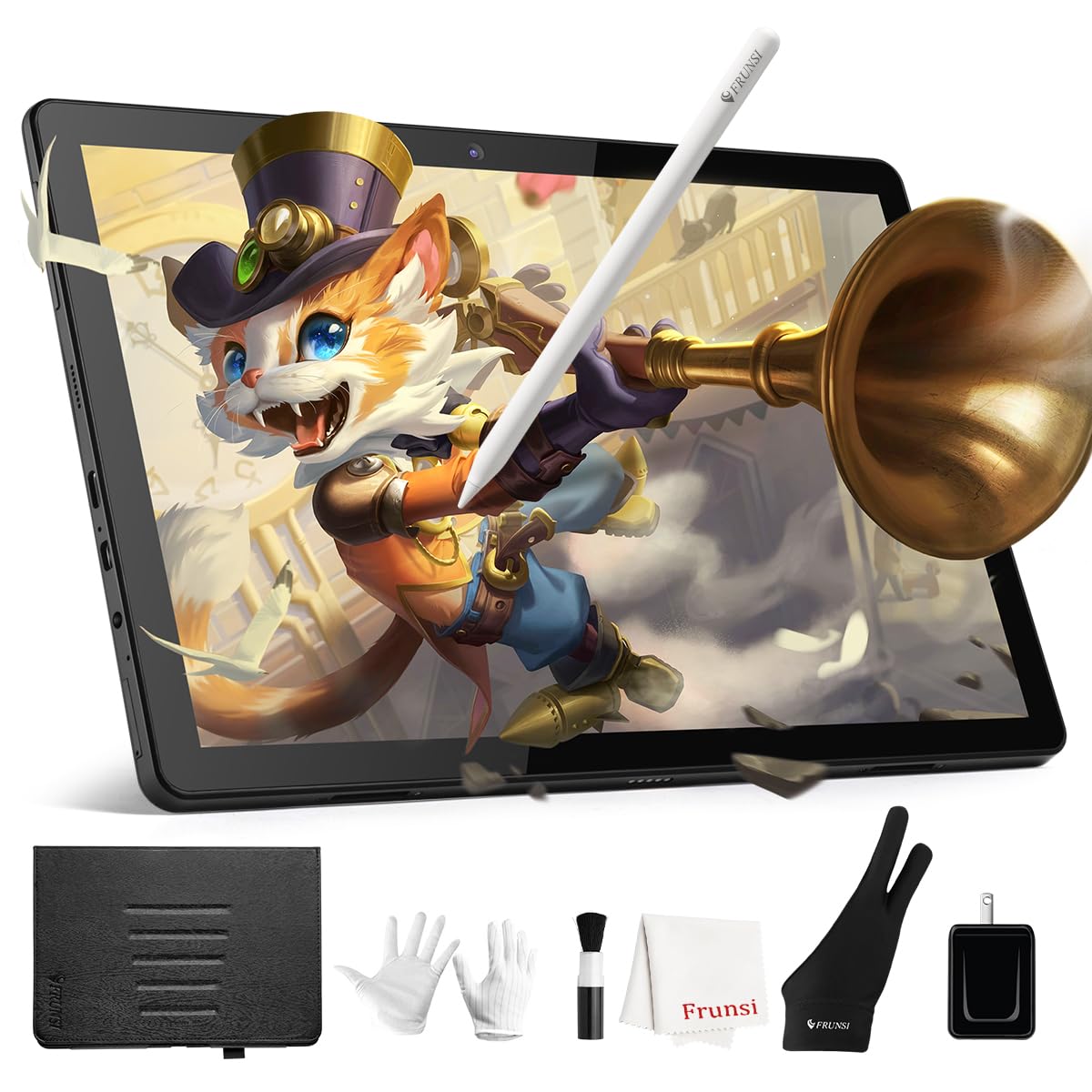
A standalone drawing tablet that works entirely without a computer — screen, battery, and apps all built in.
The RubensTab T11 Pro is different from the first three picks because it operates completely independently. No computer needed. It has a 10.1-inch Full HD IPS display (1920 x 1200 resolution), a built-in 5800mAh battery that lasts up to 5 hours of continuous drawing, and a battery-free pressure-sensitive stylus. Power it on and you are inside pre-installed drawing apps like Krita and Sketchbook, with no driver installation or cable required. The screen is bright enough to see in sunlight, according to owners.
The stylus offers 1024 levels of pressure sensitivity. That is lower than the 8K or 16K you see on pen tablets, but for a standalone device at this price, it is functional — sketch lines and basic shading work fine, and the adjustable pressure sensitivity helps if you have a heavier or lighter hand. A slight lag between drawing and the line appearing on screen is mentioned by owners, but they describe it as “not distracting for the price.” The tablet comes with an adjustable stand case, a drawing glove, and a cleaning cloth. The Octa-Core CPU handles the pre-installed apps smoothly, and Wi-Fi lets you access online tutorials and cloud storage.
Owners consistently call this an “amazing starter tablet.” It is beginner-friendly — a child as young as eight can pick it up. The included stand, protective case, and responsive customer service (one owner had an out-of-warranty issue resolved quickly) add confidence. The T11 Pro is also certified to GMS, FCC, and CE standards, backed by a 12-month warranty. The main knock: storage space is limited, and you cannot run heavyweight PC-grade creative apps (no Photoshop here). But as a portable sketchbook for travel, classrooms, or note-taking, it stands alone.
What Standalone Brings
- No computer needed — draw anywhere with a built-in screen and battery
- 5-hour battery life and Wi-Fi for cloud access and tutorials
- Pre-installed Krita and Sketchbook; beginner-friendly from the start
- Includes stand case, glove, cleaning cloth, and spare nibs
Honest Limitations
- Low pressure sensitivity (1024 levels) — shading is coarse vs pro tablets
- Minor line lag between pen and screen; serviceable but not pro-grade
- Limited internal storage; cannot run Photoshop or Clip Studio Paint
Perfect for: A child or beginner who wants to sketch without a computer.
Not for: Anyone who needs pro-level pressure sensitivity or wants to run industry-standard desktop drawing software.
5. HUION Kamvas Slate 10

A full Android tablet merged with a 4096-level drawing screen — runs apps, not just draw.
The HUION Kamvas Slate 10 blends a standalone Android 12 tablet with a dedicated drawing surface. It has a 10.1-inch Full HD IPS display covered by an anti-glare, anti-fingerprint film — the same matte finish that makes drawing on glass feel more like paper. The rechargeable HS200 stylus reads 4096 levels of pressure (the number of different force levels the pen detects) and supports tilt, and it stores magnetically on the side of the tablet so you do not lose it. The full-laminated screen means the gap between the glass and the LCD is minimal, so your pen tip appears to touch the pixels directly rather than hover above them.
Under the hood, you get an 8-core CPU, 8GB of RAM, and 128GB of internal storage, expandable up to 512GB via microSD. That is enough to run HiPaint and HUION Note (both pre-installed) plus any drawing app from the Google Play Store — including Clip Studio Paint Mobile, ibisPaint X, and MediBang Paint. The 6000mAh battery lasts through long sessions, and dual-band Wi-Fi (2.4G and 5GHz) handles online cloud syncing and social sharing. The tablet also sports a 5MP front camera and a 13MP rear camera with flash, which is useful for scanning reference images or video calls — a bonus most dedicated drawing tablets skip.
Durability gets a strong nod from owners, with one reporting the tablet survived a drop without damage after years of use. The matte, glare-free screen reduces reflections in bright rooms, though a few note the screen could be brighter for outdoor use. Customer service from Huion is frequently mentioned as responsive — when one owner received a faulty pen, the company replaced it quickly. Cases of random clicks or flickering after nearly a year of use appear in a small number of reviews, so an extended warranty is a reasonable consideration. Overall, the Kamvas Slate 10 is the most versatile standalone option, doubling as an everyday Android tablet when you are not drawing.
Why It Stands Out
- Full Android 12 tablet — runs Google Play apps, not just drawing software
- 4096 pressure levels with tilt and magnetic pen storage
- 8GB RAM + 128GB storage (expandable to 512GB) handles multitasking
- Anti-glare, anti-fingerprint screen reduces reflections in bright light
What To Consider
- Rechargeable pen — you have to charge it separately vs battery-free models
- Screen brightness is adequate but not dazzling for bright outdoor use
- A small number of units develop random touch issues after extended use
Pick this one if: You want a single device for both everyday Android use and digital drawing. The 8GB RAM and 128GB storage let it handle browsing, notes, and streaming when you are not illustrating.
Pass on it if: You need the lowest possible price — the standalone Android operating system adds cost that pushes it higher than simpler pen tablets.
Understanding the Specs
Pressure Sensitivity Levels
These numbers (4K, 8K, 16K) tell you how many different force levels the pen can tell apart. Think of it like volume steps on a knob: 4,096 steps is like having 4,096 volume levels between silent and max. 16,384 gives you four times as many steps in the same range. More steps means finer control when you are trying to do a barely-there shading stroke versus a heavy line. For sketching and beginner use, 4,096 is enough. For professional shading with subtle transitions, 16K makes a difference.
Pen Tablet vs Display Tablet
A pen tablet (also called a graphics tablet) is a flat pad you draw on while looking at your computer monitor. Your hand moves on the pad, and the line shows up on your screen. It costs less and lasts longer because there is no screen to break. A display tablet has an LCD built into the drawing surface, so you see your strokes appear directly under the pen tip. It feels more intuitive but adds weight and price. On a tight budget, a pen tablet gives you far more drawing quality for the money.
FAQ
Can I use a drawing tablet with my phone?
Do I need a computer for a standalone drawing tablet?
What is the difference between 4096 and 8192 pressure levels?
Can I replace the pen nibs on these tablets?
Does a drawing tablet work with Photoshop?
How long does a drawing tablet battery last?
Is the pen battery-free or does it need charging?
What is the difference between a drawing tablet and an iPad for drawing?
Can I use a drawing tablet for note-taking?
Do these tablets come with a screen protector?
Final Thoughts: The Verdict
For most people, the budget tablet for drawing winner is the HUION Inspiroy Dial 2 because its dual physical dials and Bluetooth 5.0 wireless freedom deliver a genuinely improved workflow at a price that undercuts alternatives with similar build quality by a wide margin. If you want to draw directly on a screen without breaking, the UGEE UE16 gives you a color-accurate display and 16K pressure sensitivity for less than a mid-range pen tablet used to cost. And for a fully self-contained Android drawing tablet that doubles as an everyday device, the HUION Kamvas Slate 10 is the most versatile standalone pick on this list.
How We Picked
We do not accept paid placement. Every pick is matched to a real buyer and a real use-case; we do not hands-on test units.
Sources & Methodology
Specifications: manufacturer listings and product documentation. Review insights: verified customer reviews, as of July 2026. Pricing: not shown on this page (it changes often); check the current price via the retailer link.
As an Amazon Associate, FitlyFast earns from qualifying purchases. This does not affect which products we feature.