
Our readers keep the lights on and the weekend projects moving. As an Amazon Associate, I earn from qualifying purchases.
Specs are compiled from manufacturer listings and verified buyer reviews and can change over time — please confirm the key details on the product page before buying.
If you want to see Saturn’s rings or Jupiter’s moons without spending a fortune, the difference between a great budget telescope and a frustrating one depends on aperture—the size of the main lens that gathers light. A 70mm lens can show you the Moon’s craters, but a 90mm or 102mm lens pulls in enough extra light to reveal cloud bands on Jupiter and the gap in Saturn’s rings. This guide covers the best picks for planet and galaxy viewing that actually deliver at the price.
I’m Rikta — the founder and writer behind FitlyFast. This guide is built by comparing the manufacturers’ published specifications and the patterns across verified customer reviews, so you get each pick’s real strengths and trade-offs instead of marketing spin.
Whether you are buying a first scope for a curious child or upgrading your own backyard setup, this roundup of the best budget telescope for viewing planets and galaxies focuses on the optics and real owner experiences that separate a keeper from a dust-gatherer.
Our Picks at a Glance


How To Choose The Best Budget Telescope For Viewing Planets And Galaxies
Picking the right scope on a budget means focusing on four specs that actually determine what you’ll see. Ignore flashy accessories and focus on the lens, the tripod, and the mount.
Aperture is King
The aperture (the diameter of the main lens or mirror) determines how much light the telescope gathers. More light means brighter, clearer images of faint objects like galaxies and nebulas. For a budget telescope, an aperture of 70mm is the bare minimum for decent planetary views; 80mm to 90mm is where you start seeing details like cloud bands on Jupiter; 102mm and above lets you tackle brighter deep-sky objects like the Orion Nebula.
Focal Length and What It Means for You
The focal length (measured in millimeters) determines the telescope’s magnification potential. A longer focal length (like 900mm) gives you higher magnification, which is great for zooming in on planets and lunar craters. A shorter focal length (like 400mm) offers a wider field of view, making it easier to scan star fields and find large objects like the Andromeda Galaxy. For a budget all-rounder that does both planets and bright galaxies, a focal length between 700mm and 900mm is a solid middle ground.
The Mount Makes or Breaks the Night
A wobbly tripod can ruin even the sharpest optics. For a budget scope, an Altazimuth (AZ) mount is the simplest to use—it moves up and down and side to side like a camera tripod. An Equatorial (EQ) mount is more complex to align but can track objects as the Earth rotates, which is a huge help if you want to share the view with others or try astrophotography. For a true beginner, a sturdy AZ mount is usually the better choice to avoid frustration.
Quick Comparison
| Model | Best For | Aperture | Focal Length | Mount Type | Amazon |
|---|---|---|---|---|---|
| SOLOMARK 80900★ Best Overall | Best Overall | 80mm | 900mm | AZ (Altazimuth) | Amazon |
| Celestron Travel Scope 70Ultra-Portable | Ultra-Portable | 70mm | 400mm | AZ (Altazimuth) | Amazon |
| CELTICBIRD 80900Premium Kit | Premium Kit | 80mm | 900mm | AZ (Altazimuth) | Amazon |
| MEEZAA 90800 | Large Aperture Value | 90mm | 800mm | AZ (Altazimuth) | Amazon |
| Hawkko 90900 | High Magnification | 90mm | 900mm | AZ (Altazimuth) | Amazon |
| Celestron StarSense Explorer LT 80AZ | Smartphone Guided | 80mm | 400mm | AZ (Altazimuth) | Amazon |
| SVBONY SV48P | Wide-Field Deep Sky | 102mm | 663mm | OTA (Optical Tube Assembly) | Amazon |
| Sky-Watcher Skymax 102 | Planetary Detail | 102mm | 1300mm | OTA (Optical Tube Assembly) | Amazon |
| Dianfan 150EQ | Maximum Light Gathering | 150mm | 650mm | EQ (Equatorial) | Amazon |
In‑Depth Reviews
1. SOLOMARK 80900 Telescopes for Adults Astronomy
The crowd favorite that lets an 8-year-old spot Saturn’s rings on the first try.
The SOLOMARK 80900 hits the balance of the category: an 80mm aperture paired with a 900mm focal length. In plain terms, the 80mm lens is big enough to pull in enough light to see Saturn’s rings without a blurry mess, and the 900mm focal length gives you enough magnification (45X with the included 20mm eyepiece, and 90X with the 10mm) to make out details. The fully multi-coated green optics glass cuts down on glare, so your view is brighter and more contrasty than what cheap, uncoated lenses deliver.
What wins people over is the image quality—buyers are emphatic that the clarity is “unreal” for the price. It ships with a phone adapter, so capturing that first look at the Moon’s craters is straightforward. The tripod has an altazimuth mount with altitude and azimuth scales that let you dial in a target without guesswork, and the whole kit packs into a carrying bag that makes carting it to a dark-sky spot easy.
Great for the price, but mind the view: This is a solid refractor, but several owners point out that city light pollution will limit what you see. It excels on the Moon and bright planets, but faint galaxies will be tough if you are not in a dark location. The finderscope is a basic reflex type, and a few owners noted the phone adapter instructions could be better.
Reach for this if… you want a near-guaranteed “wow” moment showing the Moon, Saturn, and Jupiter to a beginner or a child, all for an entry-level price.
Look elsewhere if… you live in a heavy light-pollution zone and your main goal is faint deep-sky objects—you will need a larger aperture to cut through the glow.
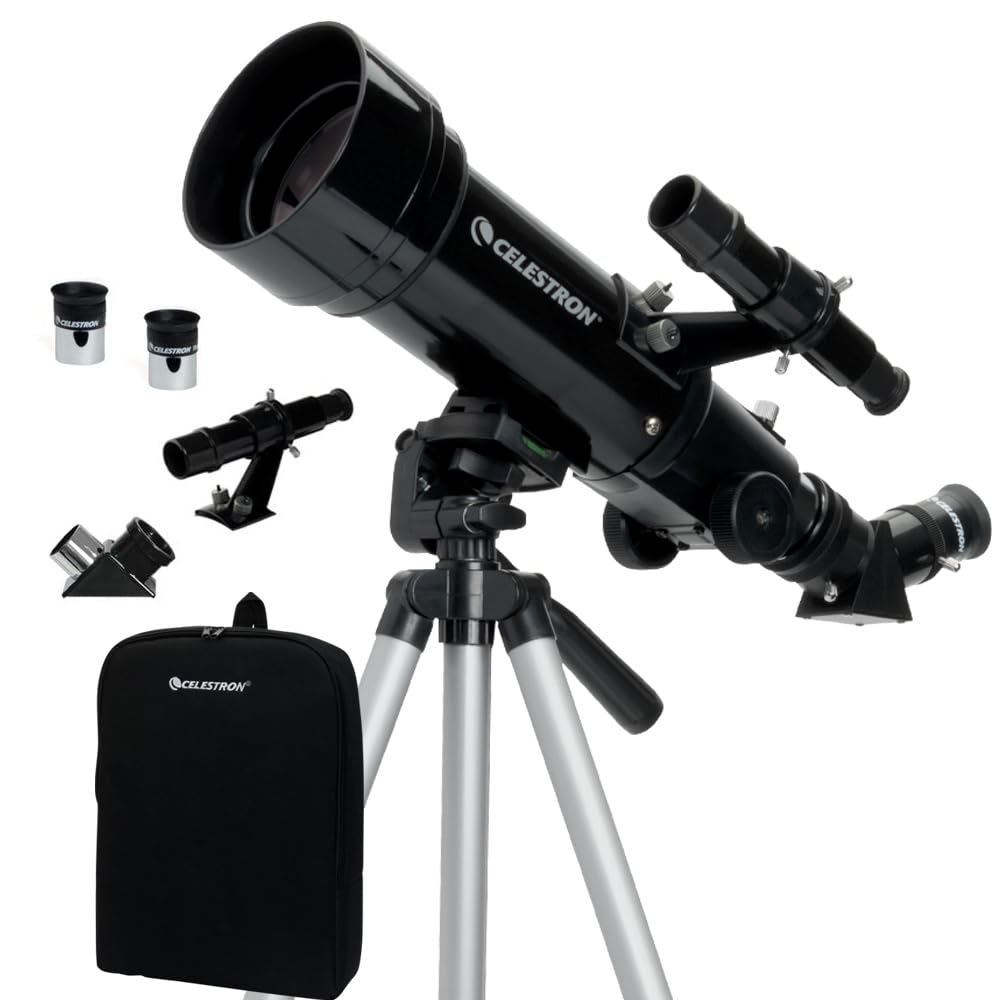
2. Celestron Travel Scope 70mm
The go-anywhere scope that fits in a backpack and sets up in seconds.
The Celestron Travel Scope 70 is built for portability above all else. Its 70mm aperture and 400mm focal length is the smallest combo in this guide—meaning it gathers less light than the 80mm and 90mm scopes—but what it loses in raw power, it makes up for in convenience. The whole kit packs into a padded backpack, and the tripod and tube assemble without any tools. Owners say the lunar detail is surprisingly sharp for such a compact design, and you can make out Jupiter’s moons and Saturn’s ring-like halo.
The trade-off is visible in the numbers: at 400mm focal length, the field of view is 1.43 degrees—wider than the SOLOMARK’s 1.35 degrees, which helps you find things faster in the sky. But the 70mm aperture is 14% smaller than an 80mm scope, so faint galaxies will appear dimmer. The 20mm and 10mm eyepieces are decent to start, but several experienced buyers upgrade to a better Plossl eyepiece to sharpen views. The tripod is the weakest link—some owners describe it as wobbly when fully extended, especially in a breeze.
What owners love
- Extremely portable, packs into included backpack
- Very quick no-tool setup in minutes
- Crisp views of the Moon and bright planets
- Good value as a first telescope for kids and adults
The honest trade-offs
- Small aperture limits views of faint deep-sky objects
- Tripod can be unstable when extended fully
- Included eyepieces benefit from an upgrade
- Struggles in areas with significant light pollution
Grab this if… you need a telescope you can easily toss into a car or carry on a hike. It is a fantastic first scope for kids who want to see the Moon’s craters and spot Jupiter’s moons without a complicated setup.
Think twice if… your main goal is detailed planetary views or hunting for deep-sky objects—the larger scopes below will give you more light and more magnification.
3. CELTICBIRD 80900 Telescope for Adults High Powered
A crowd-pleaser that delivers Jupiter’s moons and sharp lunar views at a killer price.
The CELTICBIRD 80900 matches the SOLOMARK’s core specs—80mm aperture and 900mm focal length—but edges ahead on accessory quality. The tripod adjusts from 20 to 45 inches, making it usable for both a seated adult and a kid. The two included Wide Angle eyepieces (20mm and 10mm) are better-than-average for this price range, and a phone adapter is included for quick snapshots. what separates it in practice is the build refinement: a metal tube instead of plastic, and a 5×24 finder scope that makes locating objects simpler.
Owners consistently say the clarity is “breathtaking” for a scope at this level, with one noting they saw Jupiter’s cloud bands on the first clear night. The carry case is praised for holding everything securely. The one catch is the tripod’s altazimuth mount—it is stable enough for casual use but not particularly smooth for fine tracking at high magnification. Most owners consider this a minor issue for the price, especially since the overall quality and 3-year satisfaction service provide confidence.
Best for beginners: The combination of easy assembly (roughly 5 minutes), a well-designed carry case, and a 3-year support period makes this a low-risk entry point. It outperforms the cheaper 800mm models in clarity, according to owners who compared both.
Get this if… you want a complete, ready-to-go kit that shows the Moon, Saturn, and Jupiter clearly, with enough stability for a family to share the view.
Consider elsewhere if… you need precise tracking for astrophotography—the mount is not smooth enough for that.
4. MEEZAA 90800 Telescope for Adults High Powered

The 90mm aperture that captures enough light for Jupiter’s bands and Saturn’s ring.
The MEEZAA 90800 steps up to a 90mm aperture—a 12.5% increase over the 80mm scopes—which translates to noticeably brighter images when you are looking at faint objects. The 800mm focal length (f/8.88) strikes a balance between planetary zoom and a decent field of view. It comes with two Kellner eyepieces (10mm and 25mm) plus a 3X Barlow lens, letting you reach magnifications from 32X up to 240X. The stainless steel tripod is a meaningful upgrade over cheaper aluminum legs, and owners note it remains stable in a light breeze.
The thing everyone raves about is the ease of assembly—most buyers are set up in under 20 minutes. The carrying case is well-padded and fits all accessories. The finder scope can be finicky to align, and the phone adapter may cause some wobble at high zoom, but the overall image quality gets high marks. One owner summed it up as “excellent for the price, delivering clear views of the Moon and Jupiter that make the hobby stick.”
Why owners recommend it
- 90mm aperture provides noticeably brighter views of planets
- Stainless steel tripod is more stable than budget aluminum options
- 3X Barlow lens offers versatile magnification options
- Assembly is straightforward, about 20 minutes
A few things to know
- Phone adapter can introduce wobble at higher magnifications
- Finder scope may arrive slightly misaligned
- Best suited for planets and Moon; deep-sky objects will still require dark skies
Reach for this if… you want a step up in brightness without jumping to a premium price. It is a solid choice for a beginner who is serious about seeing planetary detail.
Look elsewhere if… you are strictly focused on deep-sky astrophotography—the mount is not designed for long-exposure tracking.
5. Hawkko 90900 Telescope for Adults High Powered

A 90mm refractor that reaches 270X magnification for detailed planetary observations.
The Hawkko 90900 pairs a 90mm aperture with a 900mm focal length, giving it a focal ratio of f/10. That longer focal length makes it very effective at high-power planetary viewing. The included 25mm and 10mm eyepieces plus a 3X Barlow let you push magnification from 36X up to 270X. The fully multi-coated (FMC) optics claim to improve light transmittance, which translates to brighter, sharper images. A stainless steel AZ mount tripod supports smooth 360-degree rotation and adjusts from 28 to 46 inches.
Owners who have used it report sharp views of the Moon and were able to identify Jupiter’s cloud bands and the Orion Nebula. The carry case is large enough to hold everything, and assembly is described as doable in under 15 minutes. The phone adapter works well for casual shots, though some users mention the included finder scope could be more precisely aligned from the factory. The build quality of the metal tube and focuser is praised as feeling more sturdy than the price suggests.
Great on planets, good on deep-sky: The 90mm aperture and 900mm focal length make this a strong performer for the Moon, Jupiter, and Saturn. The 3X Barlow is functional and offers good versatility. Light pollution will still be a limiting factor for faint galaxies, but for bright deep-sky objects like the Orion Nebula, it performs well.
Best for… a budding astronomer who wants a dedicated planetary scope with the flexibility to try a bit of deep-sky observing.
Consider alternatives if… you are on the tightest budget—the SOLOMARK or CELTICBIRD offer similar views at a lower entry point.
6. Celestron StarSense Explorer LT 80AZ

Your phone becomes a star map that points the telescope for you.
The Celestron StarSense Explorer LT 80AZ is the most beginner-friendly scope here, and it justifies its higher price with a patented technology. You dock your phone into the included mount, launch the StarSense Explorer app, and the phone analyzes star patterns overhead to determine exactly where the telescope is pointed. The app then shows on-screen arrows to guide you to planets, stars, nebulae, and galaxies—when the bullseye turns green, you are on target. It is an 80mm refractor with a 400mm focal length, meaning the same 2.2x shorter focal length than the SOLOMARK, but the app makes finding objects a breeze.
The optical performance is solid for an 80mm scope. Buyers report excellent views of the Moon, Jupiter’s moons, Saturn’s ring, and star clusters like the Pleiades. The app generates a curated list of the best targets visible from your exact time and location. The trade-off is that the telescope itself has a smaller aperture and shorter focal length than other options in this price bracket, so the raw light-gathering is lower. The mount has a manual altazimuth design with a sliding rod for slow-motion adjustment; it works, but some owners find it a bit wobbly at high magnification.
What makes it special
- Patented StarSense app guides you to objects automatically
- Excellent Moon and bright planet views
- Lightweight and easy to carry
- Great for families and total beginners
The honest downsides
- 80mm aperture is smaller than some equally-priced options
- App navigation depends on a phone with a working camera
- Some owners mention the mount is not the steadiest
- Not ideal for faint deep-sky objects due to shorter focal length
Perfect for… someone who has never used a telescope and wants to find things in the sky without learning star charts first. It is the least intimidating way to start.
skip it if… you already know how to navigate the night sky and want to boost aperture per dollar—you will get more raw power from the CELTICBIRD or MEEZAA.
7. SVBONY SV48P Telescope for Adults High Powered

A 102mm achromatic refractor that favors wide, bright views of nebulae and star fields.
The SVBONY SV48P is a different beast. It is a 102mm f/6.5 achromatic refractor with a 663mm focal length—meaning it has a short focal ratio that collects a lot of light and delivers a wide field of view (1.86 degrees). That makes it excellent for sweeping views of the Milky Way, capturing the Orion Nebula, and framing large star clusters. The dual-speed focuser is a rare find at this price; the coarse knob gets you close, and the fine knob dials in perfect sharpness. It weighs just 7 lbs, making it easy to mount on a photo tripod.
The catch with any achromatic refractor is chromatic aberration (CA)—a purple fringe around bright objects like the Moon and planets. Owners note it is present but manageable, and the SV231 filter can reduce it significantly. Image quality is praised as sharp, with one owner splitting close double stars above 250X. Because it is an optical tube assembly (OTA) without a tripod or mount included, you will need to supply your own. This makes it a better fit for someone who already has a sturdy tripod or wants to build a system gradually.
Best for astrophotography beginners: The short focal ratio and wide field make it a great starter for capturing nebula and star fields with a camera. It shows the Moon crisply and can handle planetary views, but the CA is noticeable on Jupiter and Saturn without a filter.
Get this if… you are more interested in deep-sky observation and wide-field astrophotography than planetary detail, and you already have a tripod.
Stick with a full kit if… you want a complete, out-of-the-box setup with a tripod and mount included.
8. Sky-Watcher Skymax 102mm Maksutov-Cassegrain

A compact Mak that punches far above its weight on planetary detail.
The Sky-Watcher Skymax 102 is a Maksutov-Cassegrain design—a closed-tube scope that uses a corrector plate and a mirror to fold a 1300mm focal length into a body that is just 12.25 inches long. That long focal length (f/12.7) is ideal for planetary observation because it delivers crisp, high-contrast views with no chromatic aberration. The 94% reflectivity mirror coatings ensure you are losing very little light on the way to your eye. It is an OTA, so you need a tripod, but its small size and 4.6-pound weight make it an easy “grab-and-go” scope.
Owners are emphatic about the image quality: “razor-sharp” views of Saturn’s rings, the Cassini Division, and Jupiter’s Great Red Spot are common reports. One owner noted they saw cloud band detail on Jupiter and the prominent Cassini Division on Saturn on the first night. The scope holds collimation well (the alignment of its mirrors) and handles high magnifications easily. The trade-off is a 30-minute cooldown time—the sealed tube needs to reach ambient temperature for peak performance. The included 10mm and 25mm eyepieces and red-dot finder are functional, but many owners upgrade the eyepieces for even sharper views.
Why owners are impressed
- Exceptional planetary contrast and sharpness
- Very compact and portable for a 102mm scope
- No chromatic aberration (false color) on bright objects
- Excellent for viewing the Moon, Jupiter, and Saturn
Things to consider
- Requires approximately 30 minutes to cool down for best views
- Narrow field of view makes finding objects tricky
- Included accessories (eyepieces, finder) are average
- Does not include a tripod or mount
Best for… a serious beginner or intermediate who wants the sharpest possible planetary views without spending a fortune. It is the best planetary performer on this list.
Look elsewhere if… you want a wide field for deep-sky objects or need a complete setup with a tripod included—this is a tube-only purchase.
9. Dianfan 150EQ Professional Astronomy Telescope
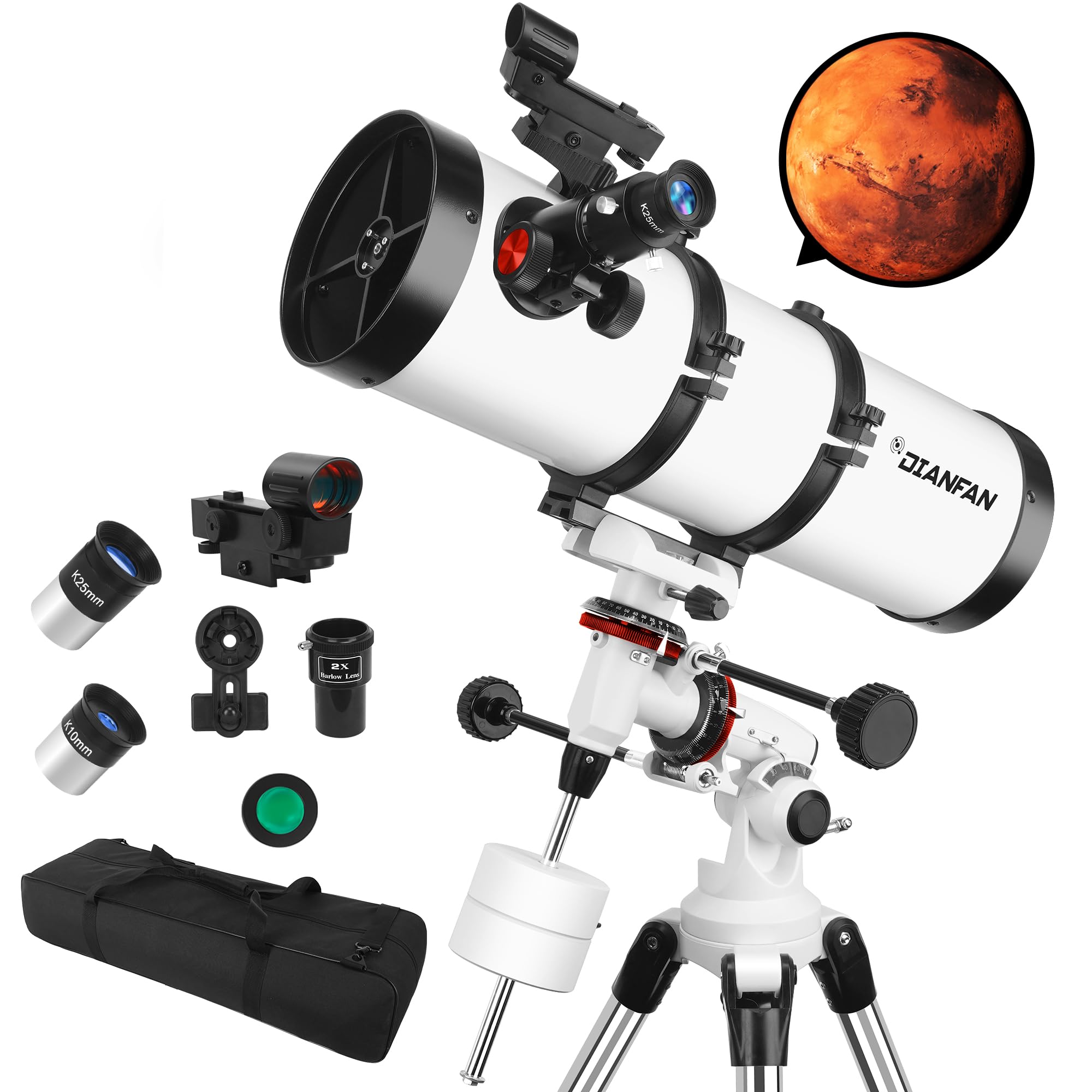
The 150mm reflector that pulls in enough light to reveal detail on faint deep-sky objects.
The Dianfan 150EQ is a reflector telescope with a 150mm aperture—by far the largest lens or mirror on this list. That means it can gather significantly more light than any of the 80-102mm refractors, making it the best choice for faint galaxies, nebulas, and star clusters. The 650mm focal length (f/5) gives a fast focal ratio that provides a wide field of view (1.9 degrees), ideal for sweeping the Milky Way. The equatorial mount (EQ) includes slow-motion control cables for tracking objects as the Earth rotates.
The extra light-gathering power comes with a trade-off: the 150EQ requires assembly and setup time. Customers note roughly 20 minutes to assemble, and the equatorial mount has a steeper learning curve than a simple altazimuth mount because you must align it with the North Star to use the tracking cables effectively. The included 2X Barlow lens and eyepieces deliver magnifications from 26X to 130X, and owners say it shows Saturn’s rings, Jupiter’s moons, and the Moon’s craters with excellent clarity. The stainless steel tripod is sturdy and well-reviewed. A few owners note the red dot finder often needs re-alignment.
Best for the serious beginner: If you are willing to learn the equatorial mount, the 150mm aperture open up views of deep-sky objects that the smaller refractors cannot match. It is larger, heavier, and more complex, but the payoff in image brightness is substantial.
Reach for this if… seeing galaxies and nebulas is your primary goal, and you are ready to spend a session learning the equatorial mount.
Choose a simpler scope if… you want a quick, grab-and-go setup or are buying for a young child who may get frustrated with the EQ mount.
Understanding the Specs
Aperture (mm)
The diameter of the main lens or mirror is the single most important spec. It determines how much light the telescope collects. A larger aperture means brighter, sharper images, especially of faint objects like galaxies and nebulae. For a budget telescope, 70mm is the minimum for decent planetary views; 80-90mm is good; 102mm and above is where you start to see a real difference on deep-sky objects. Always look for the aperture expressed in millimeters, such as “80mm.”
Focal Length (mm)
The distance it takes for the lens to focus the light. This determines your magnification potential and field of view. A longer focal length (900mm-1300mm) gives you higher magnification, which is great for zooming in on planets and lunar craters, but it narrows your field of view. A shorter focal length (400mm-700mm) gives you a wider field of view, making it easier to star-hop and see large objects like the Andromeda Galaxy. The focal ratio (aperture divided into focal length) tells you how “fast” the scope is—f/5 is fast and wide, f/12 is slow and narrow.
Mount Type
The mount is what holds the telescope and allows you to point it. An Altazimuth (AZ) mount moves up/down and left/right, like a camera tripod. It is the simplest and most intuitive for beginners. An Equatorial (EQ) mount is tilted and rotates to follow the Earth’s spin. It takes more time to learn but allows you to track objects smoothly without constantly adjusting the knobs, which is a big plus for sharing the view or trying basic astrophotography. For a first scope, a sturdy AZ mount is often the better choice.
Fully Multi-Coated Optics
A coating on the glass lenses or mirrors reduces light reflection and increases the amount of light that reaches your eye. “Multi-coated” means multiple thin layers are applied. “Fully multi-coated” means every air-to-glass surface has been treated. This results in brighter, higher-contrast images with less glare. For a budget scope, this is a sign of quality—it shows the manufacturer invested in the optics rather than just the packaging.
FAQ
What is the best aperture for seeing planets and galaxies on a budget?
Can a budget telescope really show me a galaxy?
What is the difference between a refractor and a reflector telescope?
How important is the tripod for a beginner telescope?
Will a telescope with a longer focal length be better for planets?
Is an equatorial mount worth the extra complexity for a beginner?
What do the eyepiece numbers (10mm, 20mm, 25mm) mean?
How can I tell if a telescope is good quality for the price?
Can I use a budget telescope for daytime viewing?
Do I need to buy any extra accessories right away?
Final Thoughts: The Verdict
If you want one dependable pick, the budget telescope for viewing planets and galaxies winner is the SOLOMARK 80900 because it combines an 80mm aperture and a 900mm focal length with a price tag that leaves room for accessories. If you want the portability to take the scope anywhere, grab the Celestron Travel Scope 70. And for a step up in brightness that reveals more planetary detail, the MEEZAA 90800 with its 90mm aperture is the one to reach for. Any of these picks will reward you with a first look at Saturn’s rings that makes the setup time vanish.
How We Picked
We do not accept paid placement. Every pick is matched to a real buyer and a real use-case; we do not hands-on test units.
Sources & Methodology
Specifications: manufacturer listings and product documentation. Review insights: verified customer reviews, as of July 2026. Pricing: not shown on this page (it changes often); check the current price via the retailer link.
As an Amazon Associate, FitlyFast earns from qualifying purchases. This does not affect which products we feature.